
A complete issue · 16 pages · 1887
Judge — October 22, 1887
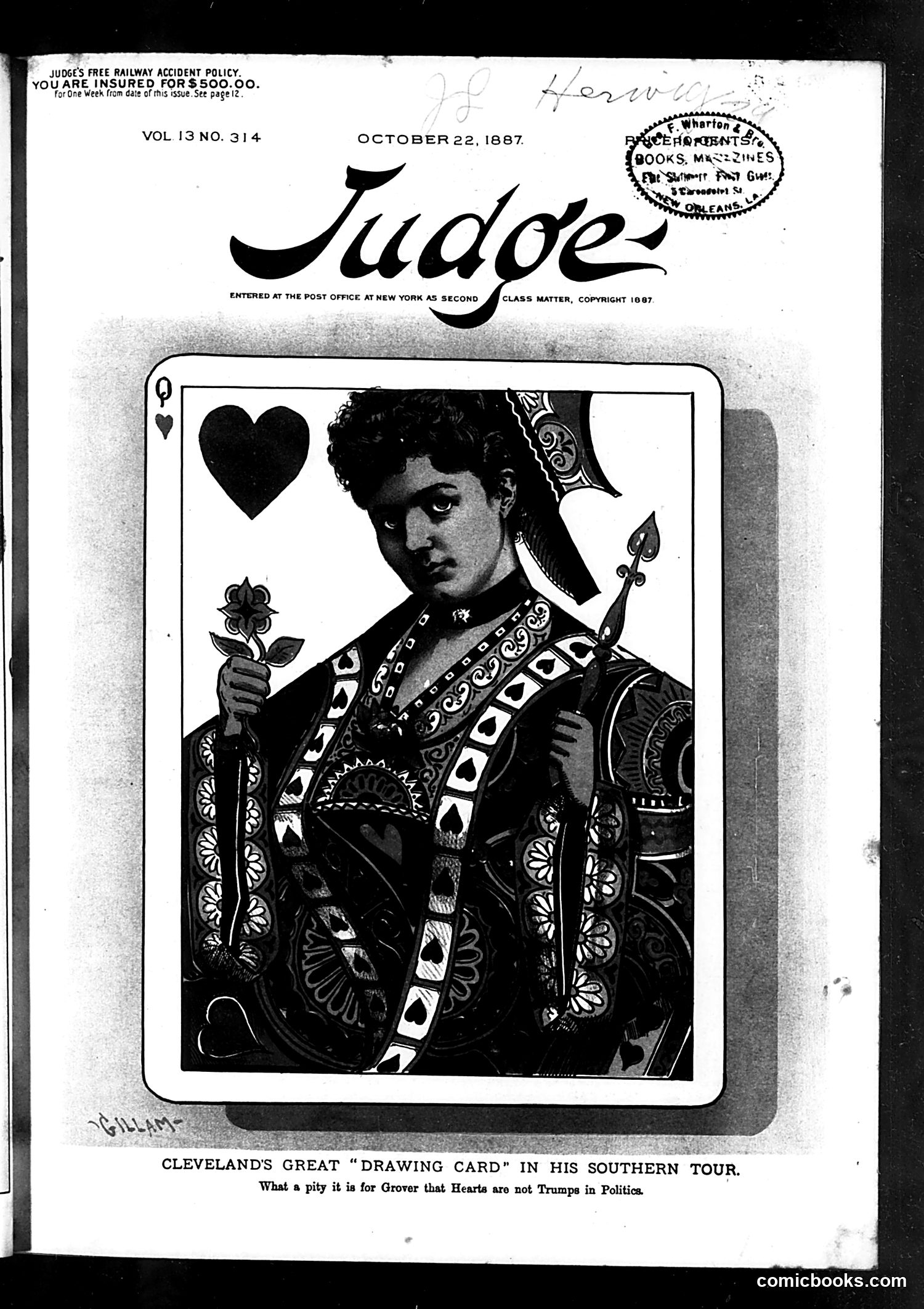
This page features a playing card design depicting a figure in ornate royal costume labeled "Cleveland's Great 'Drawing Card' in His Southern Tour." The caption reads: "What a pity it is for Grover that Hearts are not Trumps in Politics." The cartoon satirizes President Grover Cleveland's political standing during a Southern tour. The playing card imagery suggests Cleveland is being used as a political asset ("drawing card"). The joke hinges on the suit being hearts rather than trumps—implying that sentiment and popularity (hearts) won't translate into political power or electoral victories (trumps). This critiques Cleveland's limited political effectiveness despite his public appeal, particularly regarding his Southern strategy.
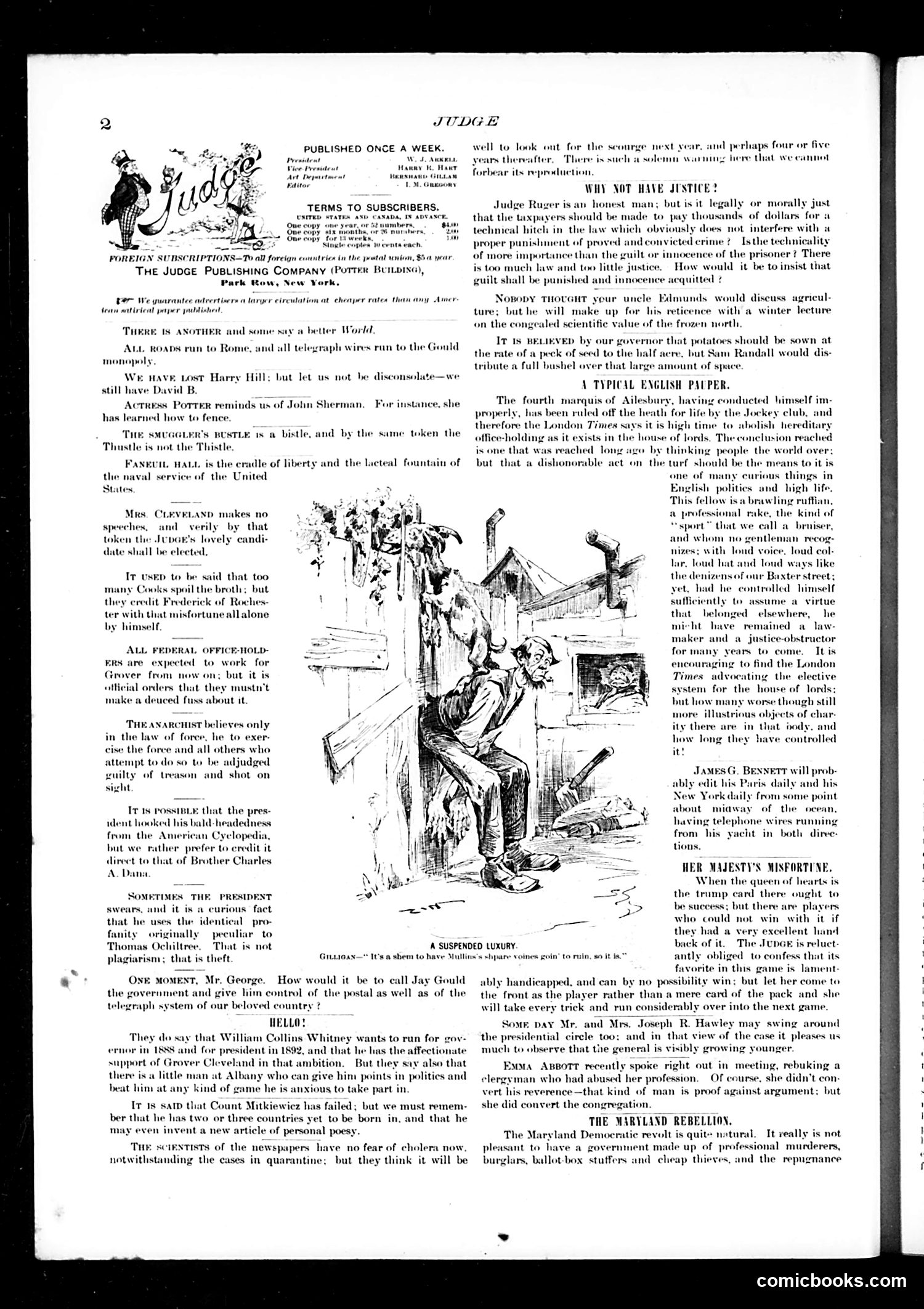
The main cartoon titled "A SUSPENDED LUXURY" depicts a disheveled man in tattered clothes sitting amid ruins, with the caption: "It's a shame to have Mullins's square pianos go to ruin, so it is." This appears to be satirizing wealth disparity during economic hardship—likely referencing the Panic of 1893 or similar period. The joke contrasts luxurious pianos deteriorating while the man is destitute, mocking the absurdity of preserving wealthy people's possessions while poor citizens suffer. The surrounding editorial text discusses various political matters: Judge Roger's legal authority, potato cultivation policy, hereditary office-holding, and other contemporary concerns. The overall tone criticizes government inefficiency and social injustice. Without specific dating or clearer identification of "Mullins," precise historical context remains uncertain.
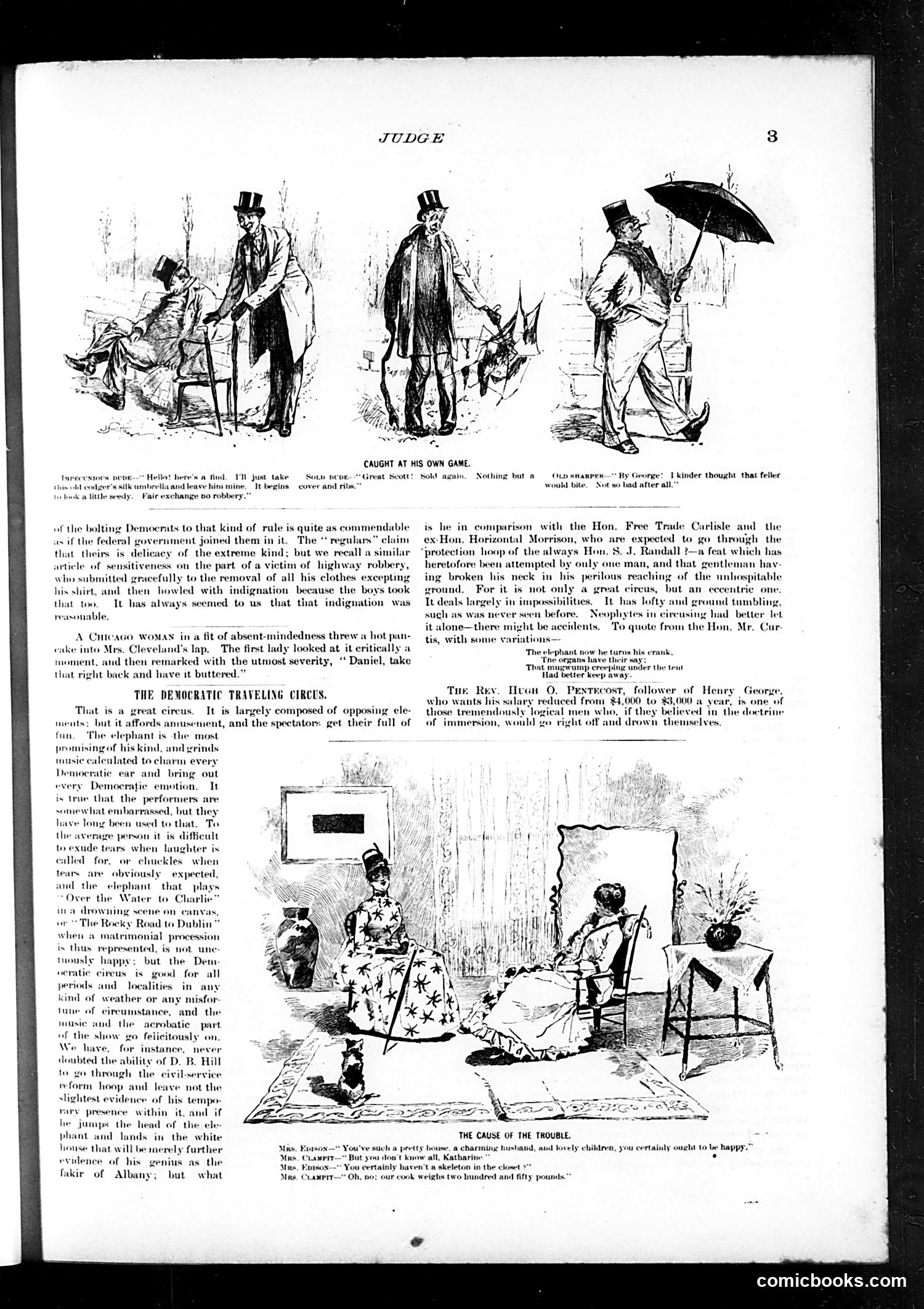
This page contains multiple satirical pieces from the 1880s-90s era: **Top cartoons ("Caught at His Own Game"):** Three vignettes mocking Democratic hypocrisy. The umbrella exchange illustrates the point: Democrats criticize Republicans for political maneuvering while engaging in identical tactics themselves—"fair exchange is no robbery" becomes absurd when applied to their own conduct. **"The Democratic Traveling Circus":** Extended editorial mockery of the Democratic Party as a chaotic traveling show mixing "opposing elements" that nonetheless entertains. It references D.B. Hill (New York political figure) as a manipulative "fakir" jumping through reform hoops while maintaining power. **Rev. Hugh O. Pentecost reference:** A brief jab at a Gilded Age religious figure wanting salary reduction—the joke being ultra-logical reformers who'd take principles to absurd extremes (drowning themselves over baptism doctrine). **"The Cause of the Trouble":** A domestic scene blaming women's dissatisfaction on material concerns despite comfortable circumstances—reflecting period sexism about female discontent. The page exemplifies *Judge's* partisan Republican satire of the era.
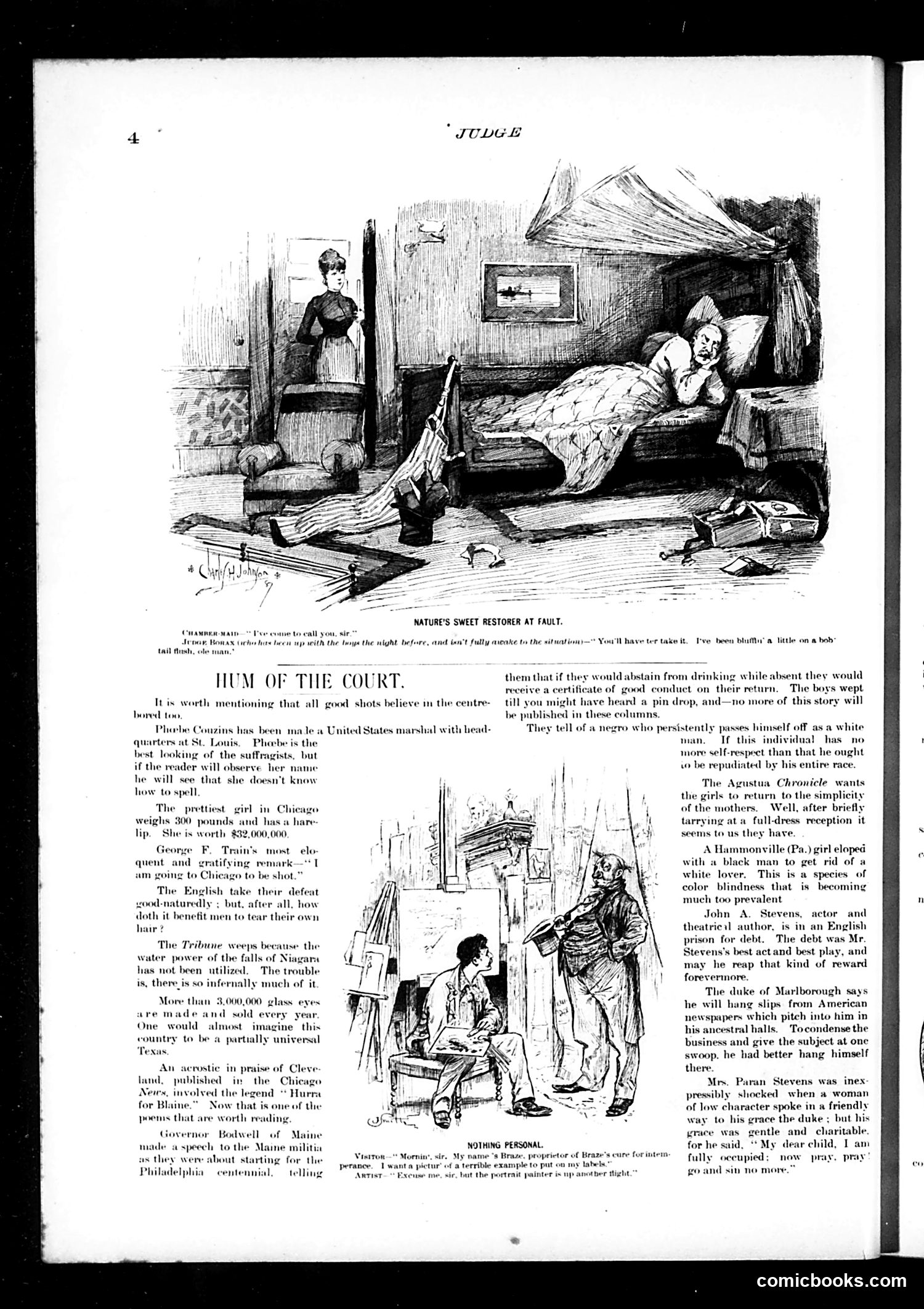
This page contains multiple brief satirical items mocking contemporary figures and social issues of the era (appears to be late 1800s). **Key targets include:** - **Phoebe Couzins**, a women's suffrage advocate made a U.S. marshal, ridiculed for poor spelling despite her prominence - **George F. Train**, quoted making a dramatic (likely fabricated) statement about going to Chicago "to be shot" - **Social commentary** on racial passing—sarcastically noting a Black man passing as white shows "no self-respect" - **The English** losing some unspecified conflict, mocked for their response - **Various moral tales**: a wealthy but unattractive Chicago woman, a Pennsylvania girl eloping with a Black man to escape a white suitor (presented as absurd), and Mrs. Paran Stevens shocked by a lower-class woman's familiarity The humor relies on ridicule of women's rights advocates, ethnic/racial stereotyping, and schadenfreude toward the English. The satirical illustrations accompany these brief, gossipy items typical of Judge's editorial approach.
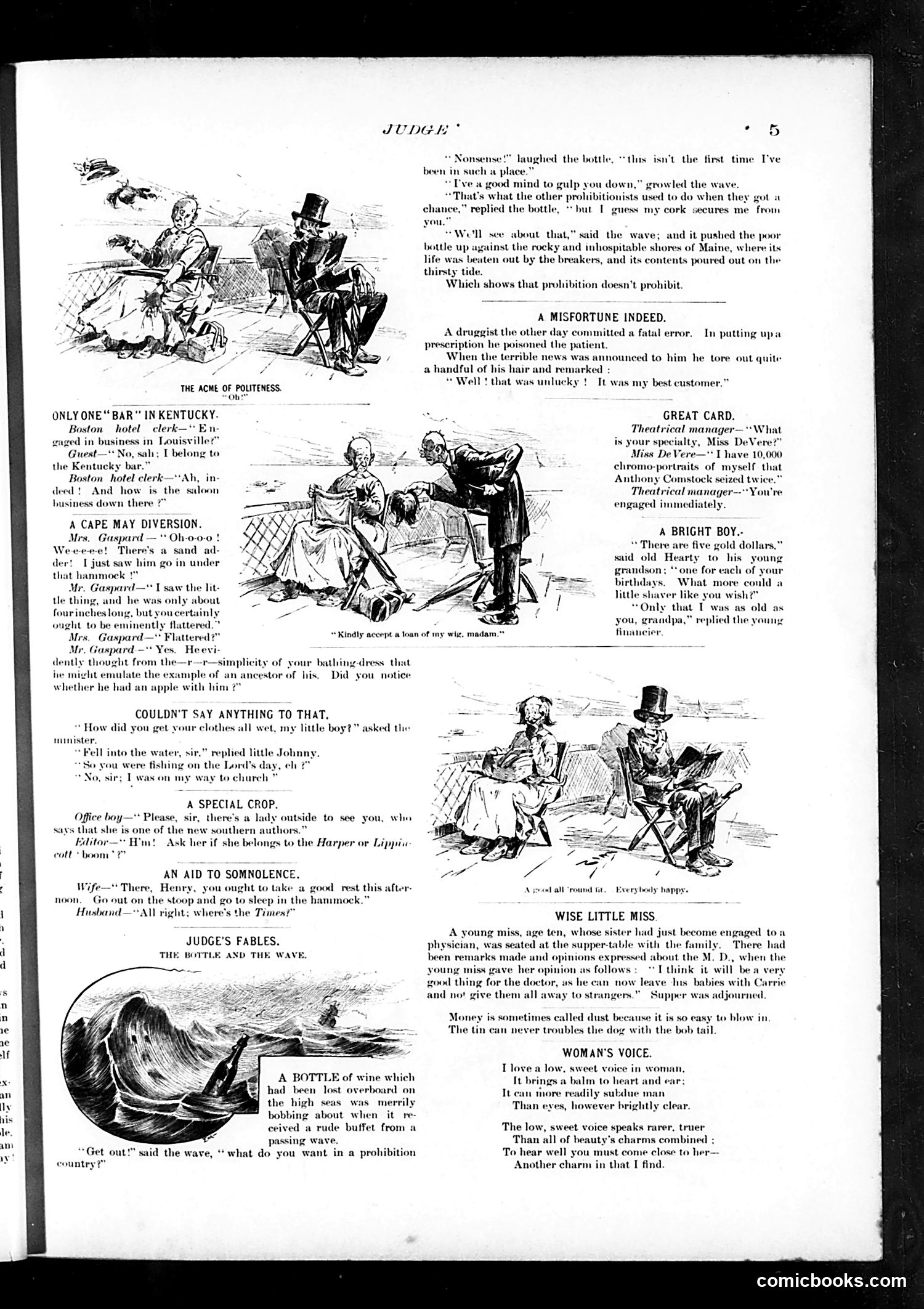
This page satirizes **Prohibition and related social issues** through multiple cartoons: **"The Bottle and the Wave"** (main fable): A wine bottle debates a wave about prohibition. The wave destroys the bottle, which Judge uses to mock prohibitionists—the moral being that "prohibition doesn't prohibit" (alcohol still exists, just illegally). This reflects the era's widespread skepticism about alcohol bans' effectiveness. **"Only One 'Bar' in Kentucky"**: A play on words—a guest claims to belong to the "Kentucky bar" (lawyers), not a drinking establishment, since Kentucky had banned saloons. **Minor jokes** target: - A druggist who poisons a patient, then regrets losing a "best customer" - Anthony Comstock (the famous censor/moralist), depicted as an inappropriate "ancestor" - Southern female authors (satirizing a literary trend) The page uses humor to critique Prohibition's failure, moral reformers' hypocrisy, and contemporary literary/social pretensions. The verse "Woman's Voice" is sentimental filler.
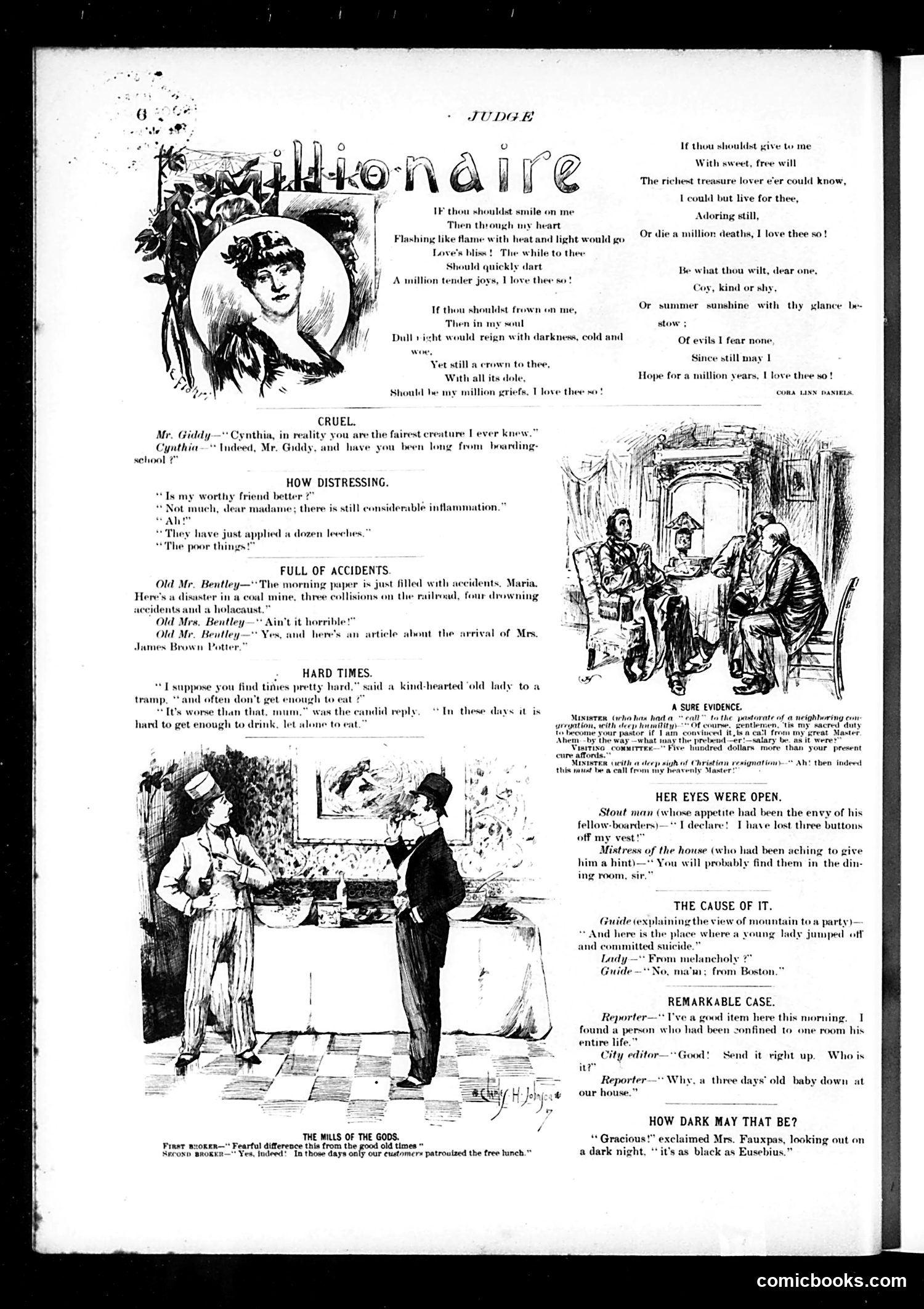
This page presents multiple short humorous sketches typical of Judge's satirical format. The content addresses social concerns of the era: **"Millionaire"** (top left): A romantic poem mocking overwrought Victorian sentimentality about wealth and love—the irony being that the speaker claims to love equally whether rich or poor, yet the title emphasizes millionaire status. **Social commentary sketches** include: - "How Distressing": Medical humor about leeches as treatment - "Full of Accidents": References to contemporary railroad disasters (a major 19th-century concern) - "Hard Times": Economic hardship—the poor woman can't afford food *or* drink - "Her Eyes Were Open": Domestic humor about a gluttonous boarder **"How Dark May That Be?"**: The final sketch satirizes pretentious malapropisms—Mrs. Fauxpas (her name suggests social climbing) compares darkness to "Eusebius" (likely a confused reference to a classical figure), revealing her ignorant affectation. Overall, the page mixes sentimental parody with social observation and gentle mockery of class pretension and contemporary anxieties.
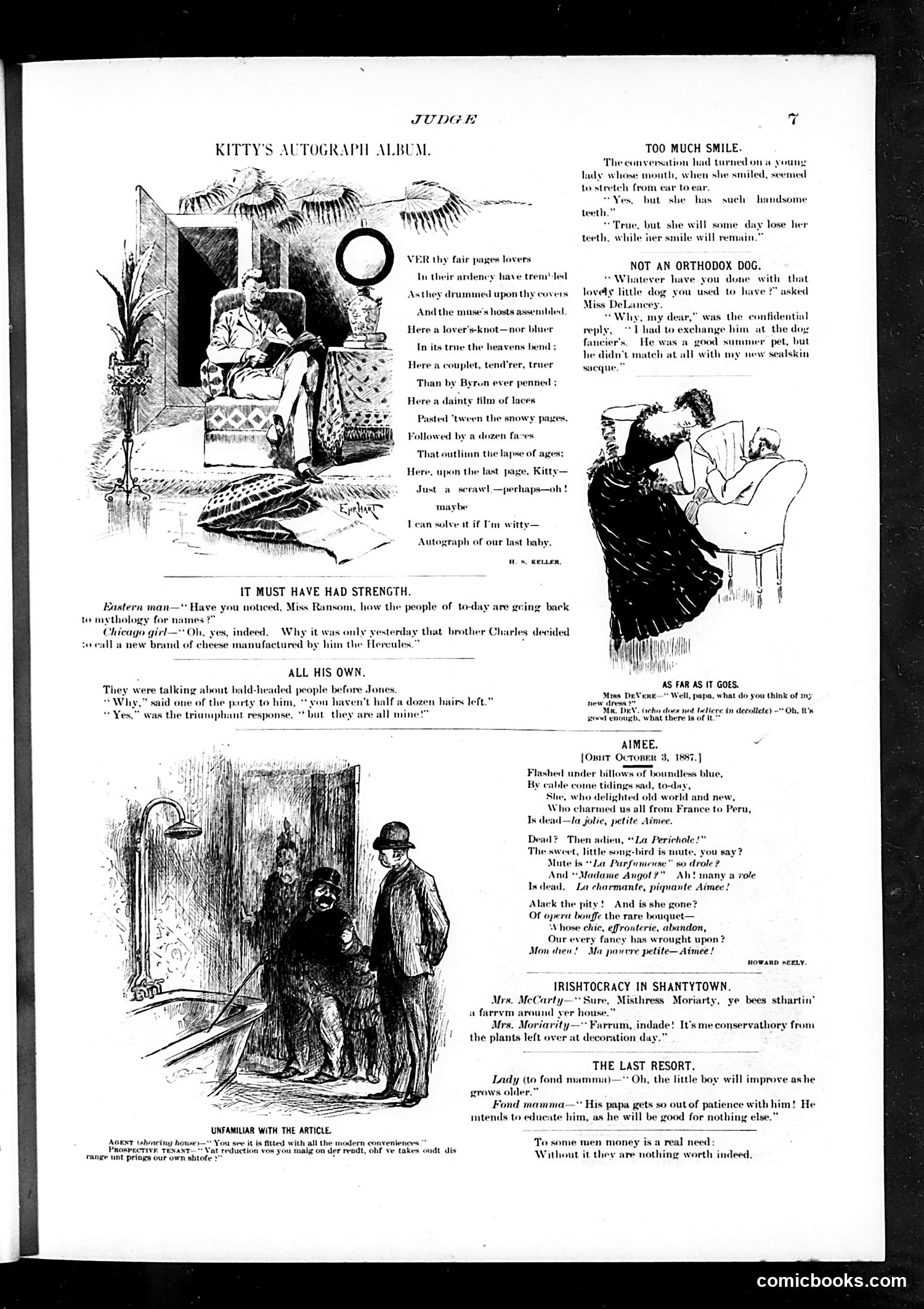
This page contains multiple brief satirical pieces typical of Judge's humor: **"Kitty's Autograph Album"** is a sentimental poem about a young woman's autograph book, ending with a joke about the last entry being an illegible scrawl from a baby. **The short jokes** mock contemporary trends and social pretensions: - A Chicago woman references her brother naming cheese "Hercules" (mocking the mythology-naming trend) - A joke about a bald man's remaining hairs - Commentary on a woman with an excessively wide smile - A woman forced to exchange her dog because it clashed with her new sealskin coat (satirizing superficial materialism) - A debutante whose low neckline leaves "nothing to see" **"Aimee"** mourns the death of a French opera performer (Aimée, likely 1834-1887), listing her famous roles in operetta. **"Irishocracy in Shantytown"** uses dialect humor, mocking working-class Irish immigrants' pretensions about having a "conservatory" of plants. **"The Last Resort"** jokes that poorly-behaved children are "good for nothing" but education. The overall tone reflects 1880s upper-class American attitudes toward wealth, appearance, ethnicity, and propriety.
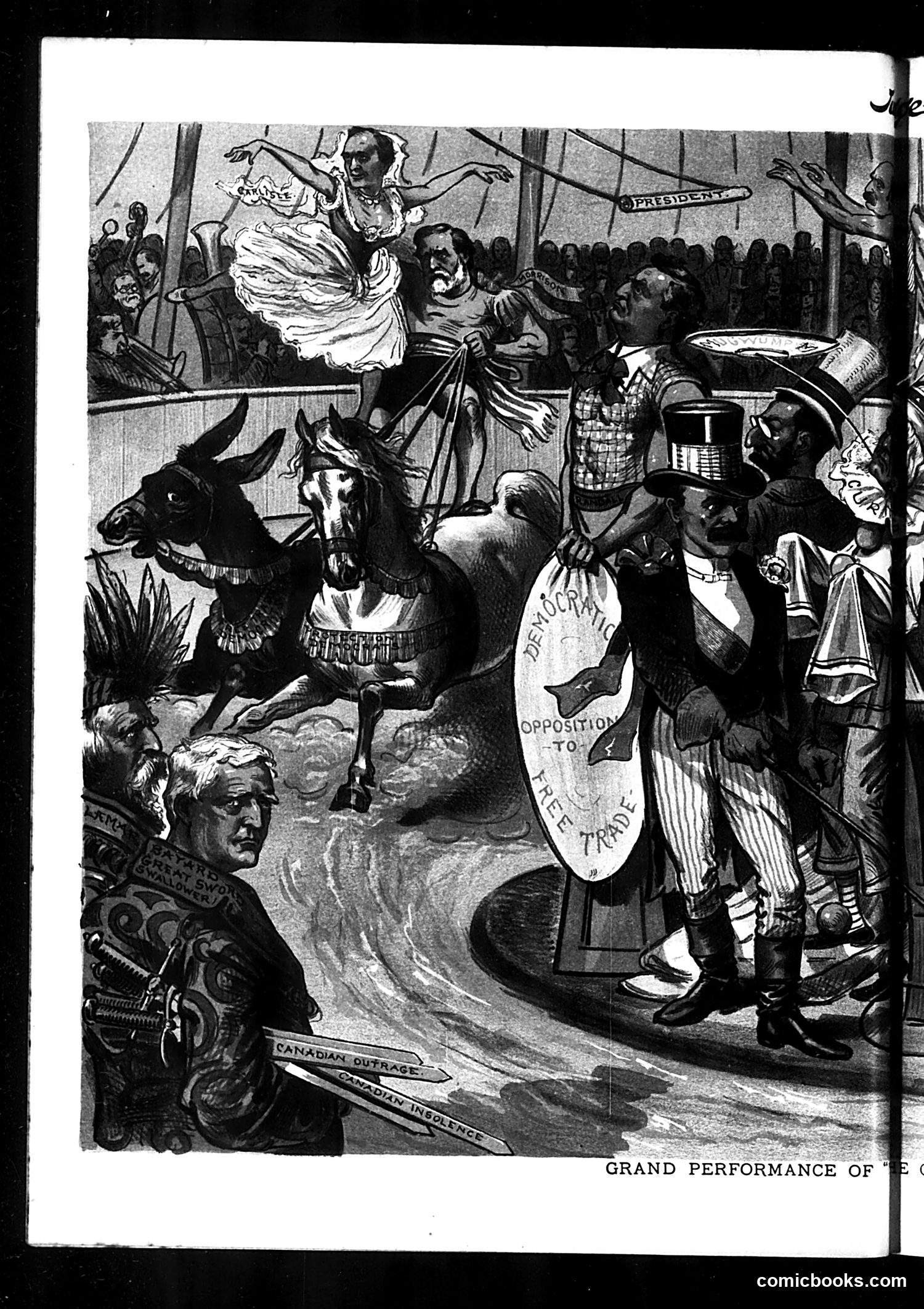
This appears to be a satirical circus scene titled "Grand Performance of..." (text cut off). The image depicts what looks like a political spectacle set in a circus tent, with acrobats or performers on a platform above and an audience below. Visible text includes "CANADIAN OUTRAGE," "OPPOSITION TO FREE TRADE," and references to a "PRESIDENT." The cartoon likely satirizes Canadian political opposition to free trade, presenting political debate as theatrical entertainment or circus performance. The elevated performers suggest political figures are being portrayed as acrobats or clowns, mocking their dramatic posturing. Without the complete caption and date, the specific individuals and exact political moment remain unclear, though this appears critical of either pro- or anti-free-trade positions in late 19th/early 20th-century Canadian-American politics.
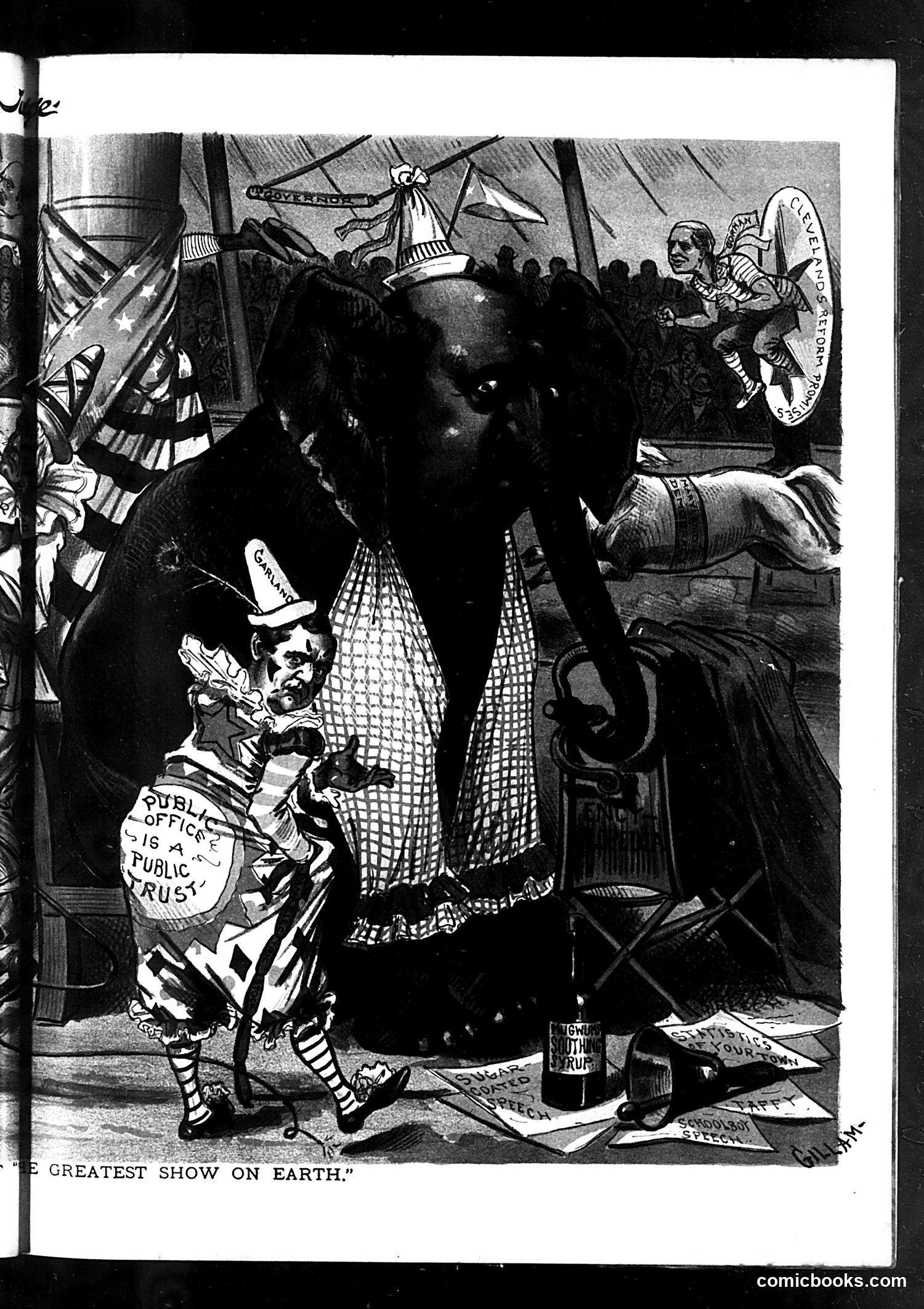
This political cartoon satirizes **public trust in government institutions**. The large figure represents government or a political authority figure, depicted as a circus ringmaster or showman. The tiny figure labeled "PUBLIC OFFICE IS A PUBLIC TRUST" appears trapped or controlled beneath this towering presence. The carnival/circus setting suggests government is treated as entertainment or spectacle rather than serious governance. The scattered debris around the base implies corruption, mismanagement, or broken promises. The contrast between the massive authority figure and the diminished "public trust" emphasizes how public interest is subordinated to governmental power and manipulation. This reflects **Progressive Era skepticism** (early 1900s Judge magazine) about whether public officials genuinely served citizens or merely exploited their trust for power and profit.
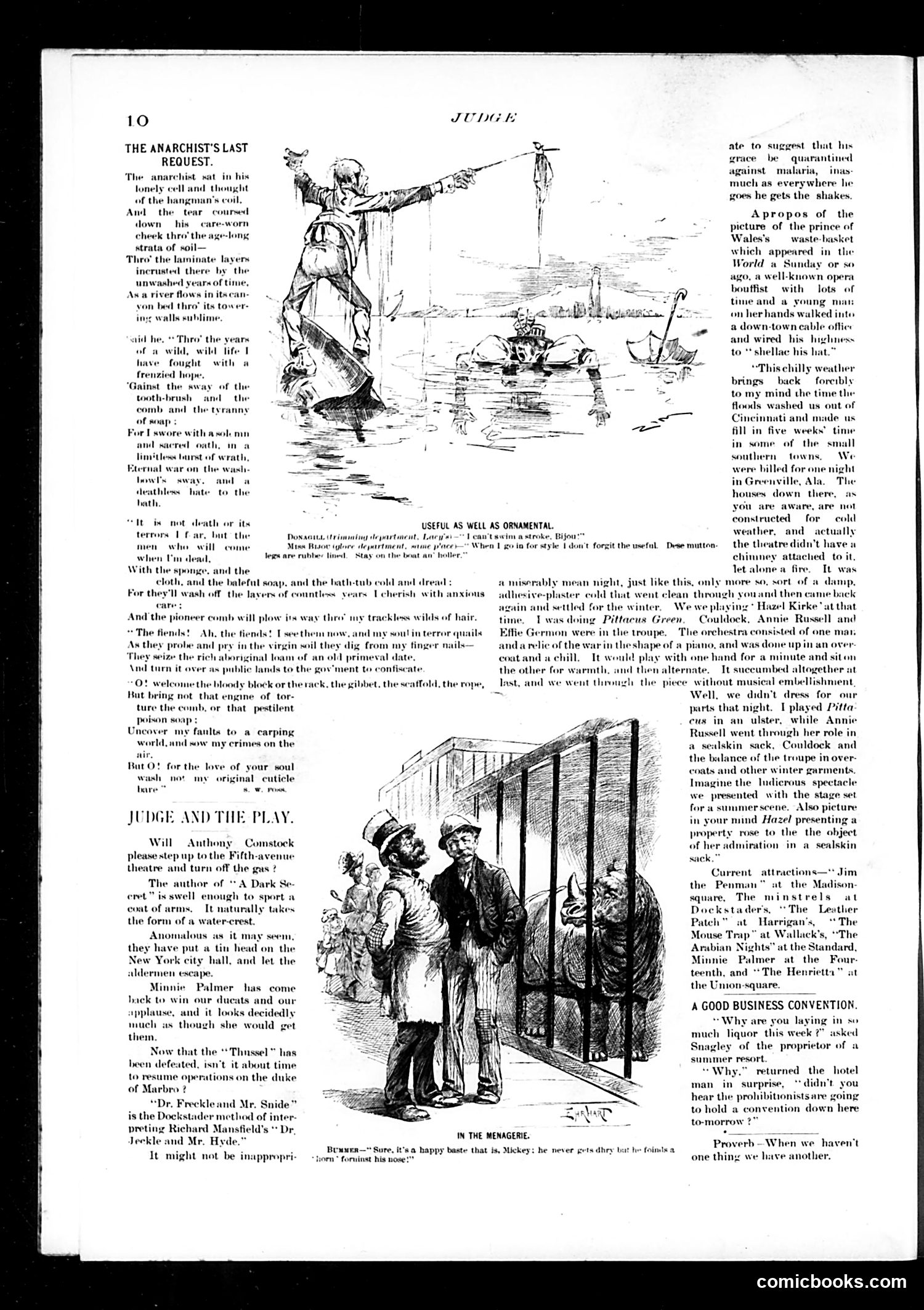
This page contains two distinct satirical pieces: ## "The Anarchist's Last Request" A poem mocking an anarchist awaiting execution, who pleads that the authorities spare him from washing—portrayed as his greatest terror. The satire ridicules anarchists as hypocritical: they rage against society's institutions yet fear basic hygiene. The extended metaphor equates soap and combs with tyranny, suggesting anarchists are absurdly unreasonable. ## "Judge and the Play" Theater criticism targeting **Anthony Comstock**, the famous anti-obscenity crusader (referenced by name). The author jokes that Comstock should "turn off the gas" at the Fifth Avenue Theatre during a production of "A Dark Secret"—implying the play is so morally objectionable that Comstock would want to shut it down. The piece sardonically lists Comstock's likely targets among current theatrical productions, mocking his aggressive censorship campaigns. Both pieces reflect Judge's editorial stance: skepticism toward radical reformers (anarchists, moral crusaders) whom the magazine portrayed as extremist busybodies threatening ordinary life.
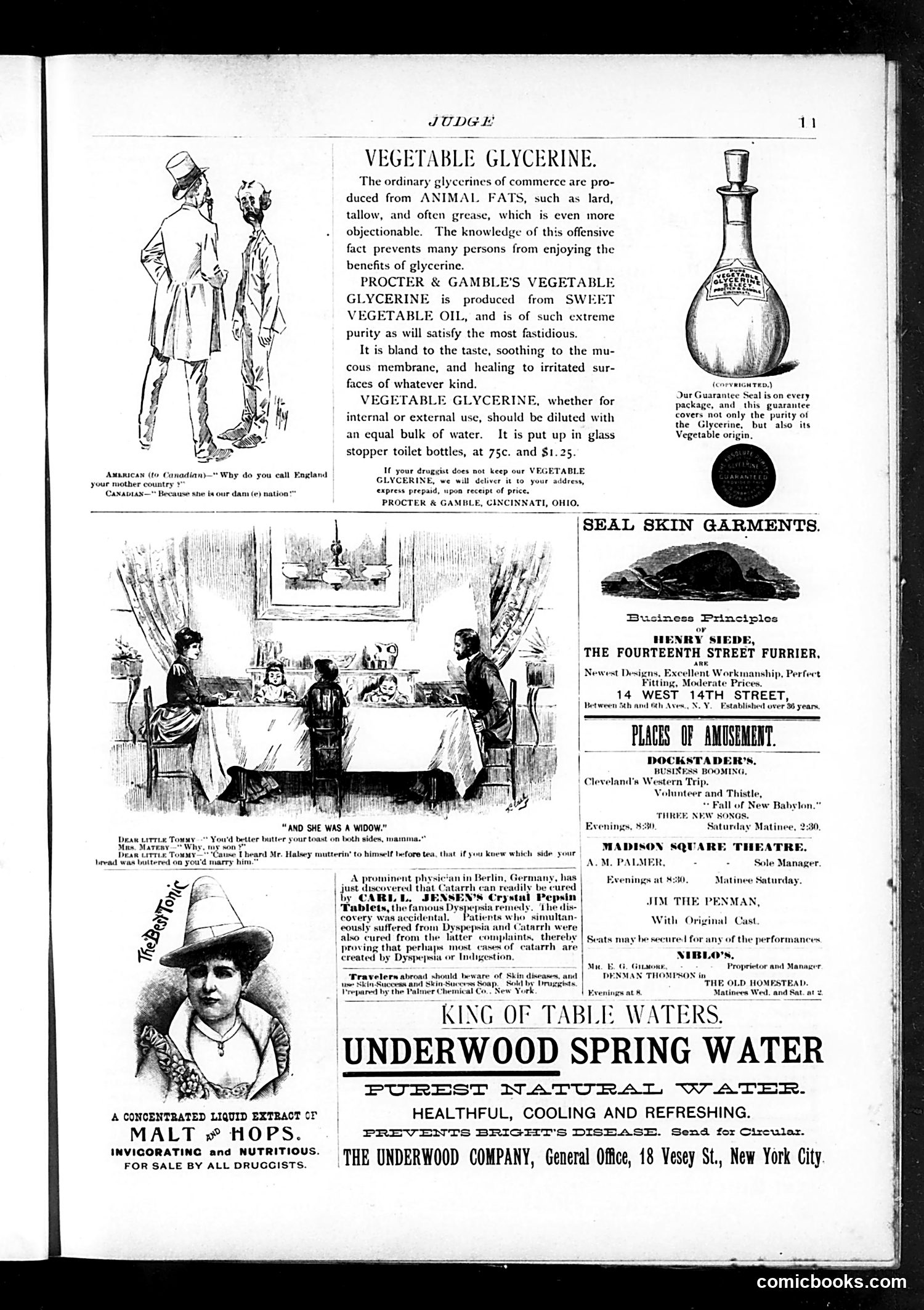
This page is primarily **advertisements and entertainment listings** rather than political satire. The content includes: **Main advertisements:** - Procter & Gamble's vegetable glycerine (emphasizing it comes from plant oil, not animal fat—appealing to fastidious consumers) - Seal skin garments from a furrier - Theater listings for venues like Madison Square Theatre and Dockstader's - Underwood Spring Water (marketed as preventing Bright's disease) - Malt and hops extract **The sole cartoon** shows a brief exchange between an American and Canadian about calling England the "mother country"—a pun on "dam(e) nation" rather than "damnation." This is mild wordplay about colonial relationships. The page reflects **late 19th-century consumer culture**: products marketed to the "fastidious" middle class, theaters advertising plays, and medical claims (Bright's disease prevention) typical of patent medicine advertising. Little political content is present.
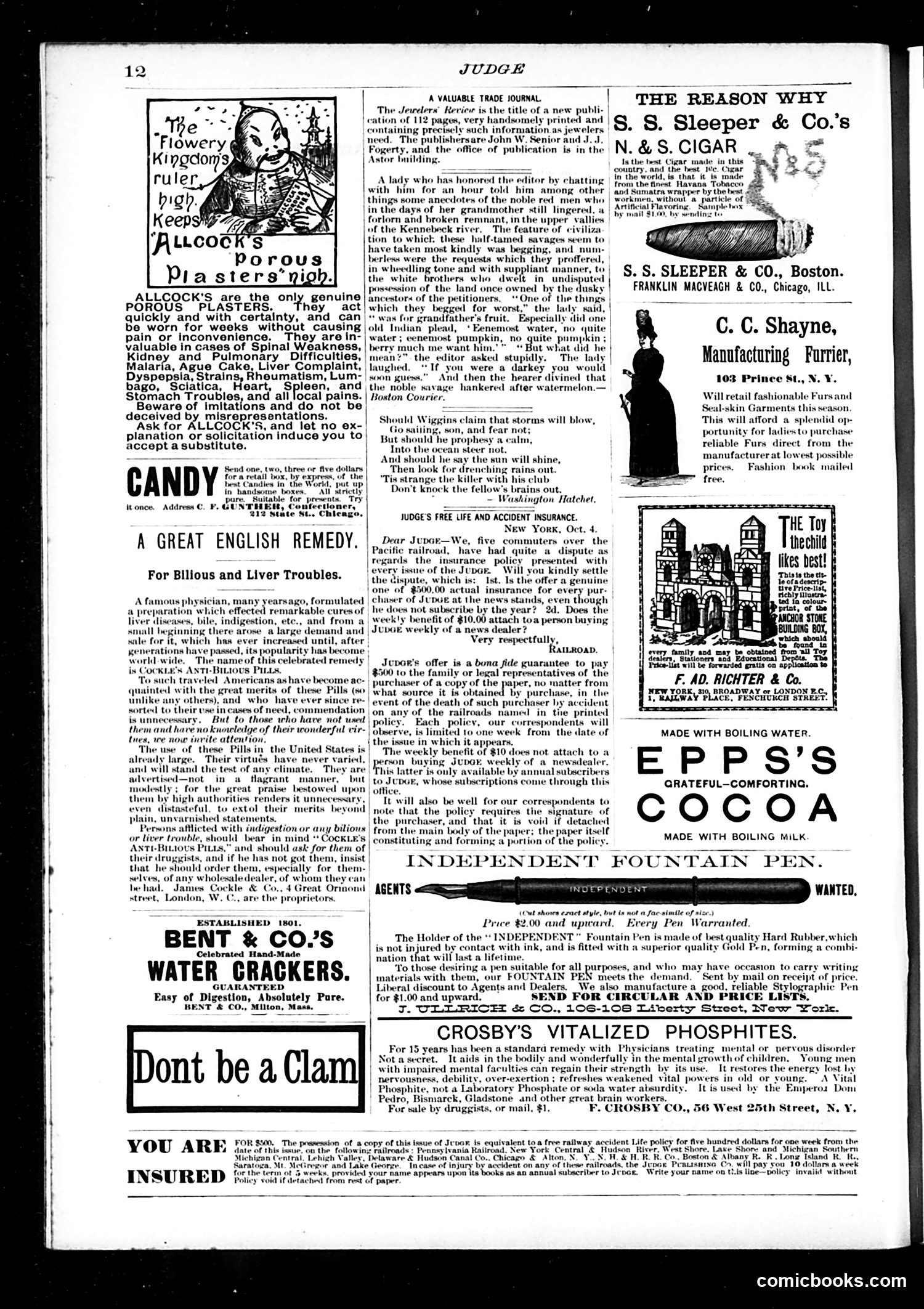
This page is primarily **advertising**, with one brief editorial anecdote about Native Americans. The small illustrated cartoon titled "The Flowery Kingdom's ruler high keeps Pillows' porous" appears to be a visual pun promoting Allcock's Porous Plasters, though the connection is unclear. The editorial note describes a lady recounting stories of Native Americans ("noble red men") from Maine's Kennebeck River valley in her grandmother's time. The anecdote emphasizes how these Indigenous peoples had adopted begging from white settlers—depicting them as dependent and reduced to requesting charity. This reflects the 19th-century perspective that Native Americans were culturally inferior and had degenerated. The overwhelming majority of the page consists of patent medicine and consumer goods advertisements (cigars, plasters, candy, pills, cocoa, water crackers), typical of Judge magazine's revenue model. These ads make exaggerated health claims common to the period.
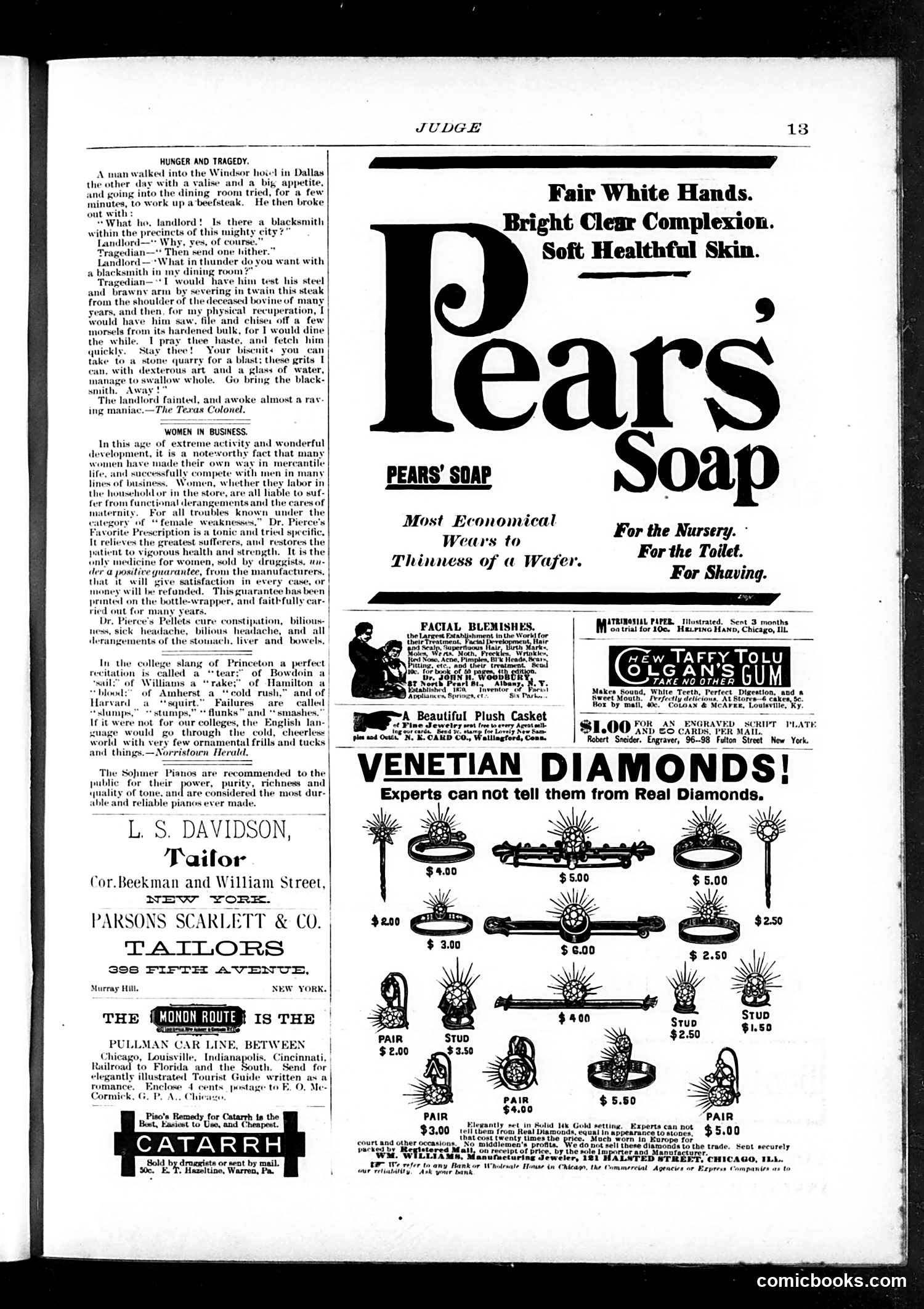
This is primarily an **advertising page** rather than a satirical cartoon page. The dominant content is commercial advertisements typical of early 20th-century Judge magazine. The small text passages at the top appear to be brief humorous sketches: one describes a theatrical character attempting to order an edible beefsteak from an uncooperative landlord—satire on either theatrical pretension or poor dining establishments. Another discusses "Women in Business," noting how women compete successfully in commerce and praising Dr. Pierce's medical products for women's health. The bulk of the page features period advertisements: Pears' Soap emphasizing beauty and complexion, Taffy Tolu gum, Venetian Diamonds marketed as indistinguishable from real diamonds, and various tailoring services. These ads reflect consumer culture and marketing strategies of the era, including the now-problematic focus on "fair white hands" and "bright clear complexion" in beauty products. There is **no prominent political cartoon visible** on this page—it's a standard magazine advertising spread.
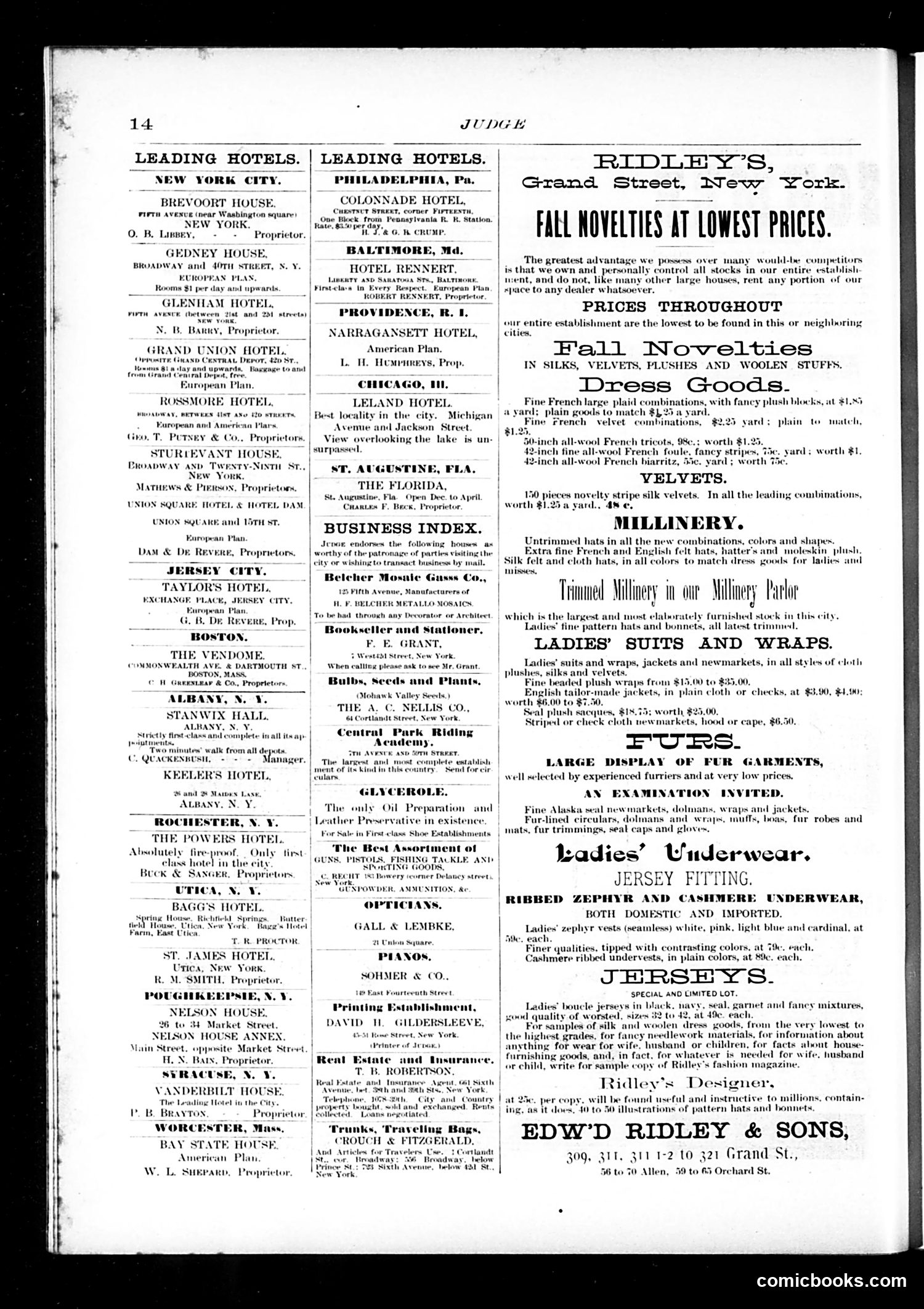
This is page 14 of *Judge* magazine and consists almost entirely of commercial advertisements—no political cartoons or satirical content visible. The page features: **Leading Hotels** listings for major cities (New York, Philadelphia, Baltimore, Chicago, St. Augustine) and other establishments. **Ridley's Department Store** (Grand Street, New York) dominates the right side, advertising fall novelties including dress goods, velvets, millinery, ladies' suits, furs, and underwear with prices and product descriptions. **Other advertisements** include hotels, pianos, sporting goods, printing services, and miscellaneous businesses. This is a typical late-19th-century magazine page where editorial content subsidized publication through dense paid advertising. There is no discernible satire, political commentary, or cartoon humor present—just commercial listings typical of the era's trade publication model.
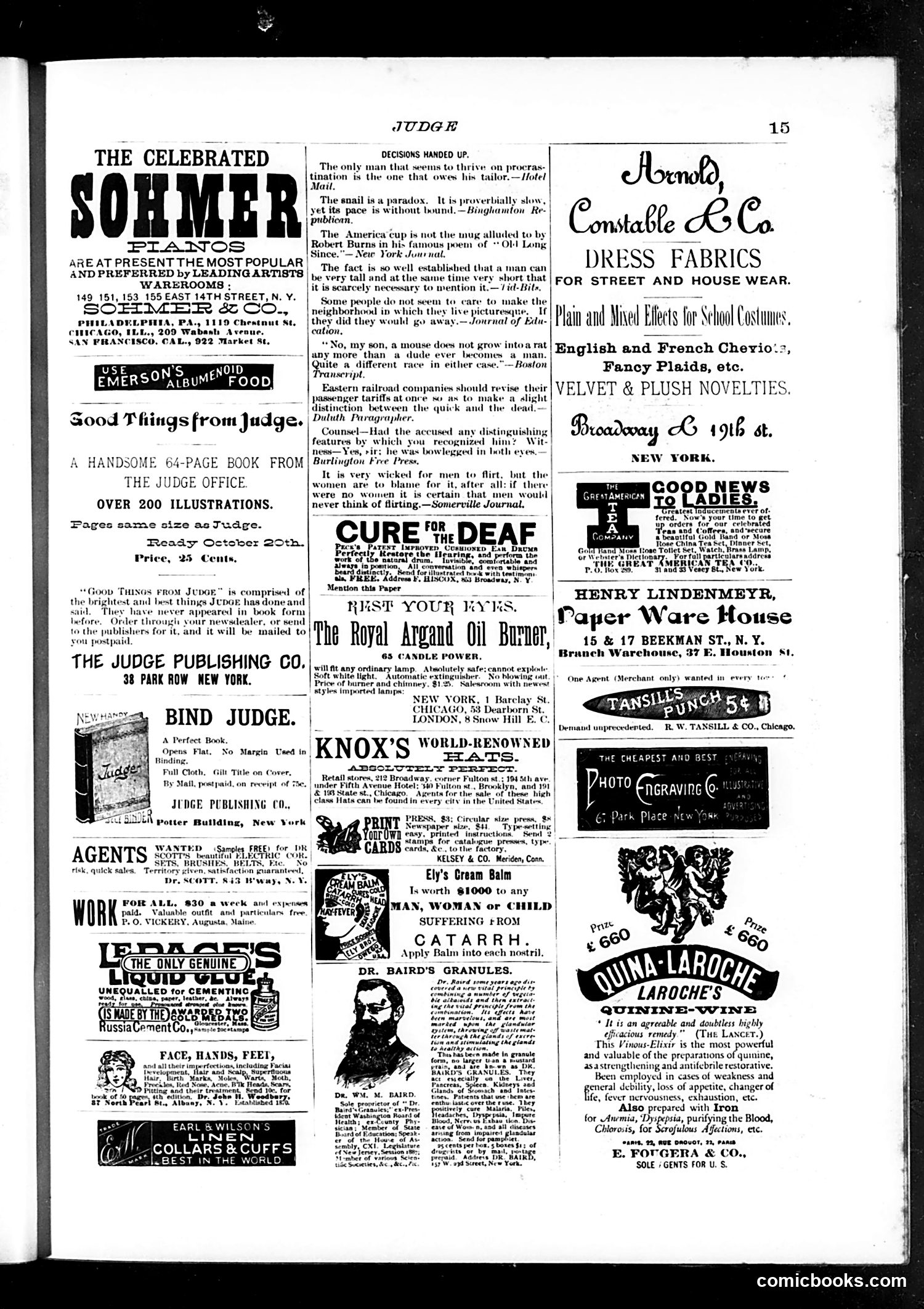
This is primarily an **advertising page** with minimal editorial content. The "Decisions Handed Up" section at the top contains brief, disconnected quips and observations typical of Judge's satirical style—short jokes about human nature, business practices, and social foibles. Examples include commentary on procrastination, railroad companies' passenger tariffs, and the relationship between men and women. The bulk of the page consists of late-19th/early-20th-century advertisements: pianos, self-help books, patent medicines (Ely's Cream Balm for catarrh, Dr. Baird's Granules), household goods, and clothing. There are no identifiable political cartoons or caricatures of specific public figures visible. The editorial content is apolitical—offering mild social humor rather than political satire. The page reflects Judge's general approach: combining lighthearted commentary on everyday life with commercial advertising to sustain the publication.
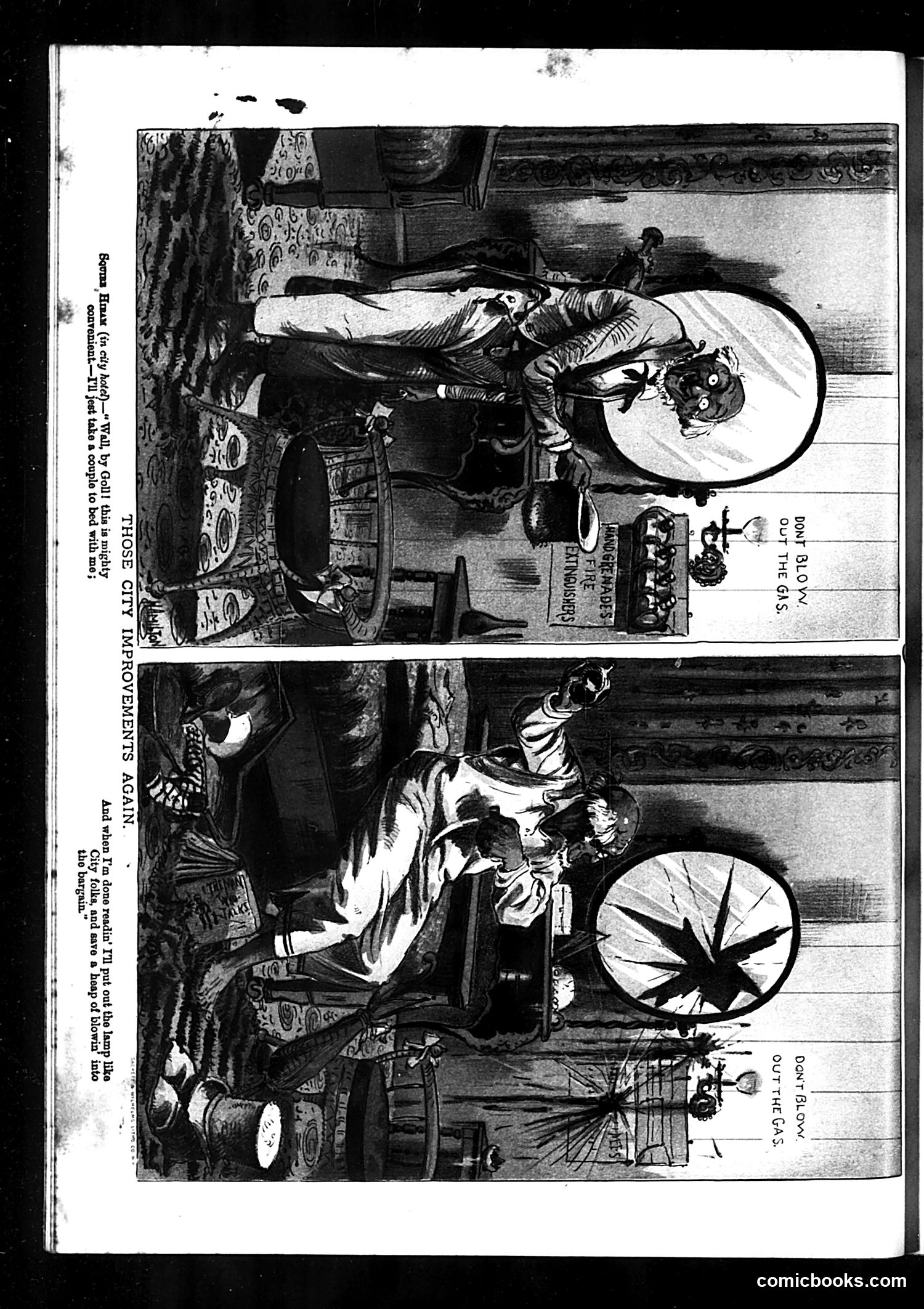
This page contains two related satirical cartoons mocking rural visitors to the city who are unfamiliar with modern gas lighting. **The Setup:** A country person (depicted with rural dialect: "Wall, by Goll!") arrives at a city hotel and encounters gas lamps instead of candles. The satire plays on the contrast between rural and urban life in the late 19th/early 20th century. **The Joke:** The rural visitor plans to take the gas lamp to bed, mistaking it for a portable light source like a candle. He jokes he'll "put out the lamp" (meaning extinguish it by blowing) to save effort—not understanding that gas lamps operate on a fixed supply and cannot simply be blown out like candles. **The Point:** The cartoons mock rural ignorance of modern city conveniences and technology. The repeated captions ("Don't Blow Out the Gas") emphasize the dangerous absurdity—blowing out gas lamps could be hazardous. This reflects Judge magazine's urban readership laughing at perceived backwardness of country folk encountering metropolitan modernity.