
A complete issue · 16 pages · 1887
Judge — April 16, 1887
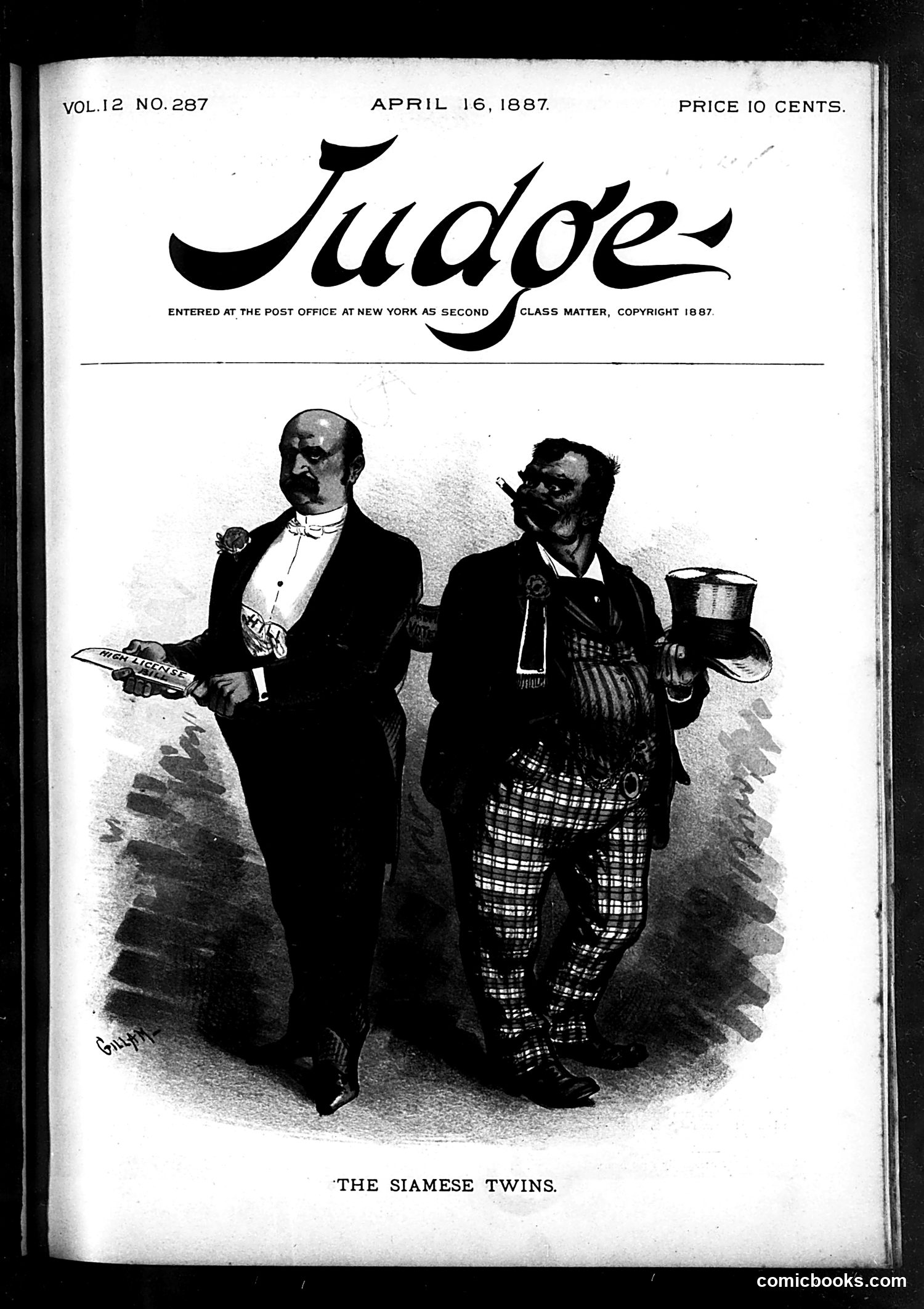
This political cartoon depicts two men in formal dress labeled "The Siamese Twins." The figure on the left wears a monocle and military decorations; the figure on the right sports a Scottish kilt and similar military insignia. The "Siamese Twins" reference appears to be satirizing a political or diplomatic relationship between two nations or leaders—likely Britain (suggested by the formal attire and monocle) and Scotland (indicated by the kilt). The cartoon likely comments on their inseparable political connection or forced union during this period. Without additional context or captions visible in the image, the specific political crisis or controversy being mocked remains unclear, though the visual metaphor of conjoined twins suggests commentary on an uncomfortable or problematic pairing.
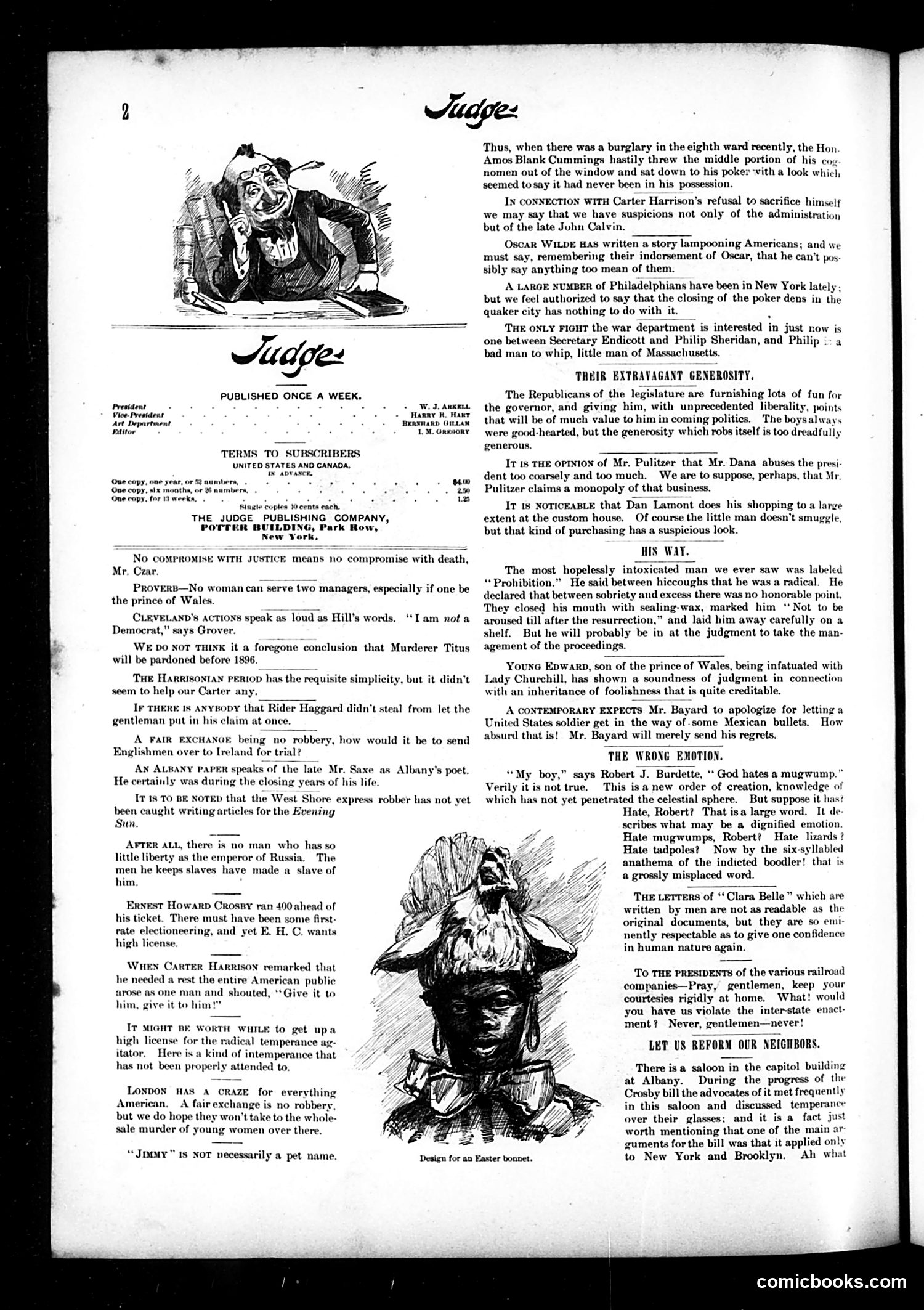
This page from *Judge* contains editorial commentary and sketches rather than narrative cartoons. The text addresses contemporary 1880s-90s political figures and scandals: **Key References:** - Carter Harrison's refusal to sacrifice himself (likely regarding the Haymarket affair) - Oscar Wilde's reputation among Americans as "mean" - Secretary Endicott vs. Philip Sheridan conflict - Dana's abuse of the president; Pulitzer's monopoly accusations - Dan Lamont's suspicious shopping habits - Young Edward, Prince of Wales, and Lady Churchill - Bayard's apology regarding U.S. soldiers and Mexican bullets **The sketches** appear to be generic illustrations rather than specific caricatures. The content satirizes political hypocrisy, corruption, and the vanities of public figures through short, biting commentary typical of *Judge's* editorial voice—mocking both politicians and society figures.
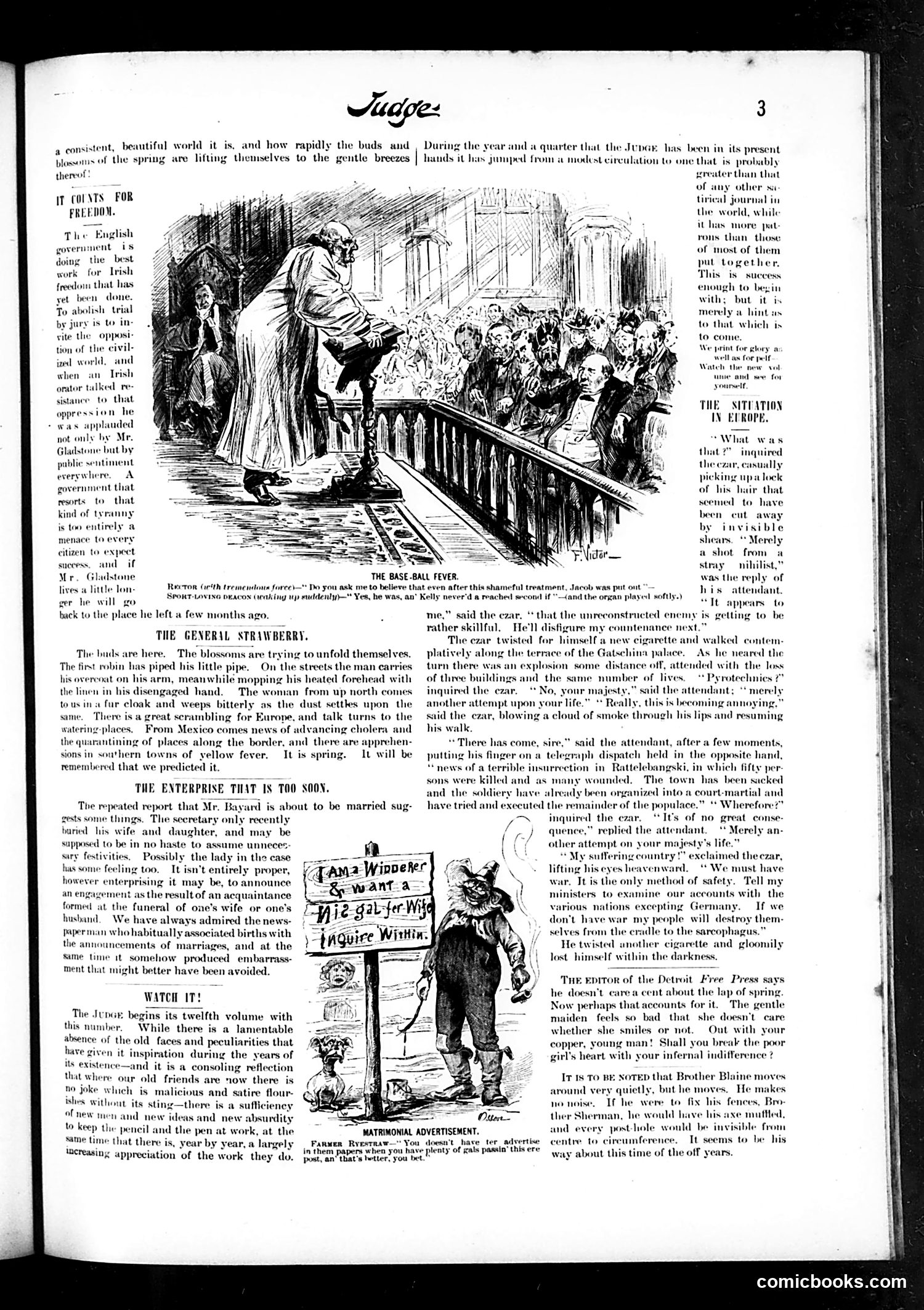
This Judge magazine page contains several satirical pieces. The main cartoon depicts "The Base-Ball Fever"—a speaker addressing a crowd, likely referencing Irish political agitation for freedom and jury trials. The satire criticizes both Irish resistance movements and English suppression. A secondary item mocks Secretary of State Bayard's reported plans to remarry shortly after burying his wife and daughter, calling the timing improper and the newspaper's quick announcement of the engagement tactless. The "Situation in Europe" section presents dialogue between a czar and an attendant about a nihilist's assassination attempt—reflecting 19th-century anxieties about Russian anarchism and political violence. The overall tone is characteristic of Judge's mix of domestic gossip, political commentary, and European affairs commentary typical of American satirical magazines during the Gilded Age.
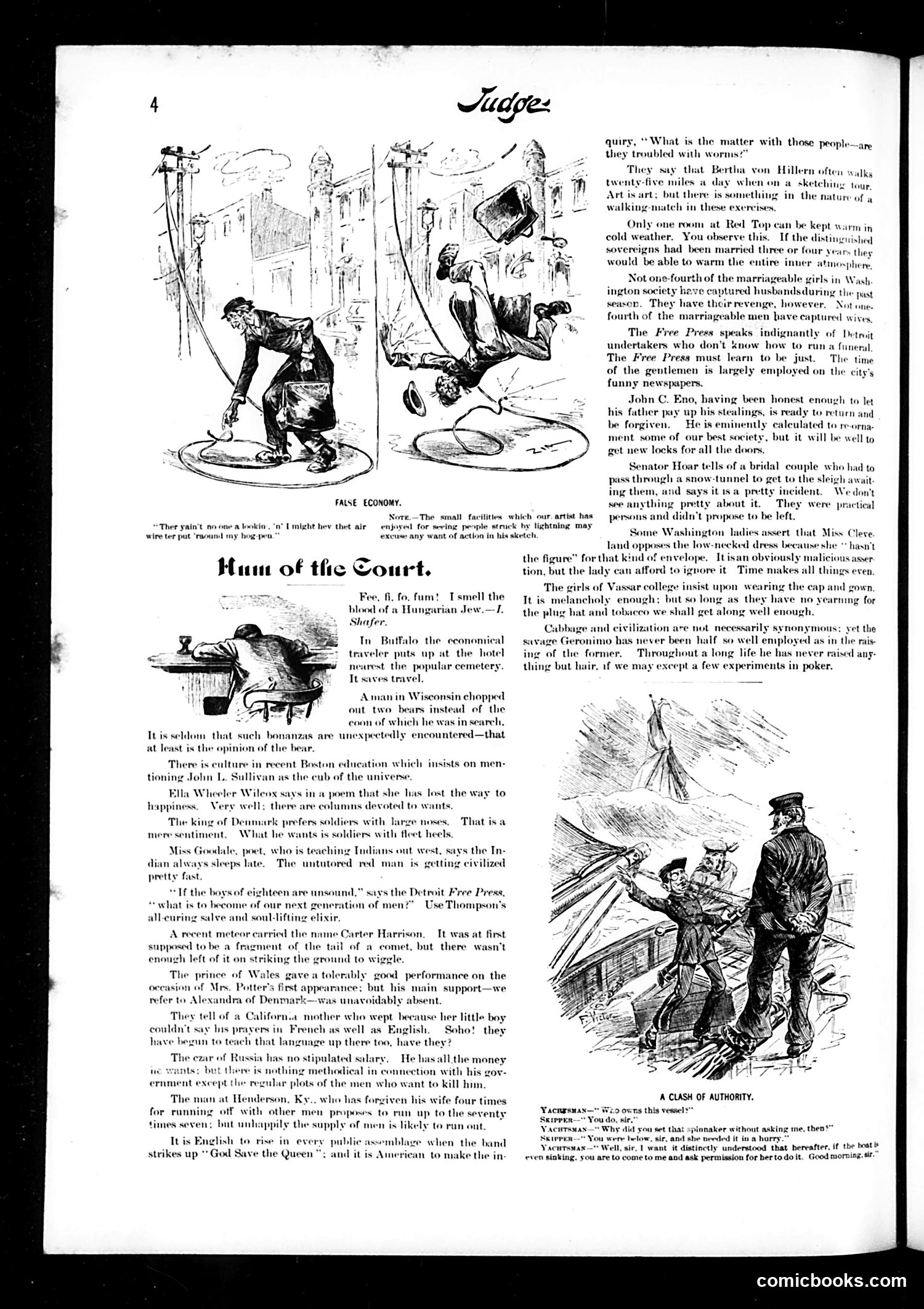
This page contains brief satirical commentaries on contemporary social issues rather than a single unified cartoon. The "False Economy" section mocks practical absurdities—a Buffalo hotel near a cemetery to "save travel," a Wisconsin man's accidental bear hunting. "Hum of the Court" collects quick jabs at cultural figures and news: John L. Sullivan (boxer) being treated as educational authority; Ella Wheeler Wilcox's poem about lost happiness; comparisons between Danish and other soldiers; observations about Native Americans being "civilized"; criticism of young men's health; and references to local scandals (John C. Eno's financial dishonesty, an undertaker's incompetence). The lower cartoon, "A Clash of Authority," depicts a confrontation between a yachtsman and a sailor over proper vessel procedures—satirizing class conflict between social superiors and working-class authority figures. Overall, these are society-page mockeries targeting hypocrisy, pretension, and incompetence among the educated and wealthy classes.
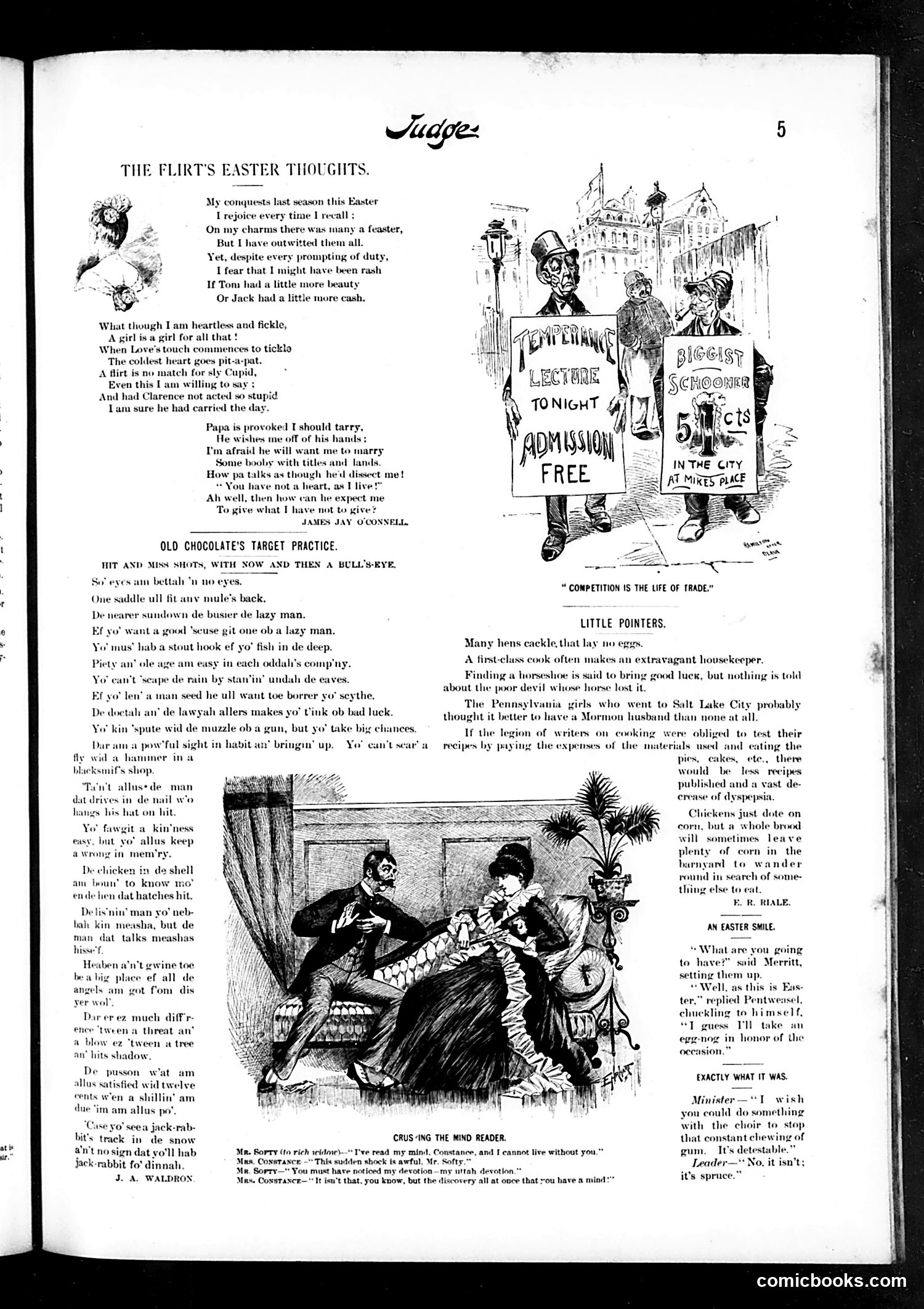
**"The Flirt's Easter Thoughts"** satirizes a young woman's shallow romanticism. She boasts of conquests while admitting she'd have married wealthier or more handsome suitors—revealing her mercenary nature beneath claims of romantic sentiment. The joke targets female flirtatiousness and the contradiction between professed feeling and actual self-interest. **"Old Chocolate's Target Practice"** and **"Little Pointers"** are collections of folk wisdom and humorous observations, likely written in dialect to represent African American speech patterns—typical of period humor that used ethnic caricature for comedic effect. **"Cruising the Mind Reader"** jokes about a wealthy widow who accepts a suitor's marriage proposal only to later regret discovering he actually *has* a mind (implying she preferred him mindless/easily controlled). The page reflects late 19th/early 20th-century American attitudes: satirizing women's perceived mercenary nature in romance, employing racial stereotypes for humor, and mocking spiritualism's popularity.
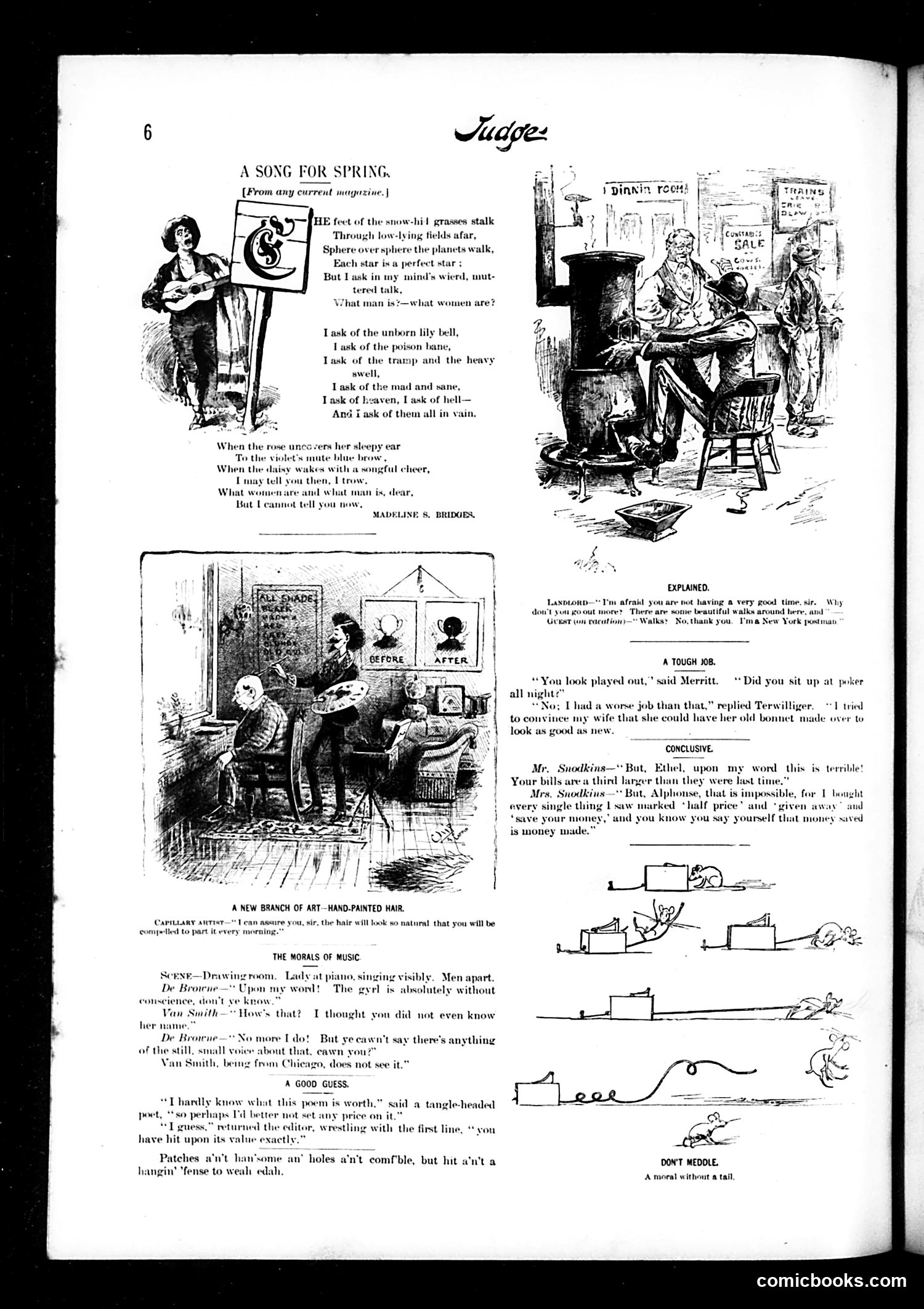
This page contains several satirical humor pieces typical of late 19th/early 20th-century Judge magazine: **"A Song for Spring"** parodies overly philosophical poetry from contemporary magazines, mocking flowery verse that asks profound questions about human nature while answering nothing—a jab at pretentious literary magazines. **"Explained"** jokes about a New York postal worker refusing walks because his job delivering mail exhausts him—gentle satire on urban working conditions. **"A Tough Job"** humorously presents convincing a wife that old clothing can look new as harder than poker all-nighters—typical domestic satire about marital persuasion. **"Conclusive"** satirizes wives' shopping habits: a woman claims she saved money through "half price" and "given away" purchases, creating circular logic about savings—commentary on consumer spending rationalization. **"A New Branch of Art"** jokes about hand-painted hair treatments looking so natural customers must part it regularly—satire on beauty industry fraud. The remaining pieces offer light domestic and social humor common to the era, without specific political references.
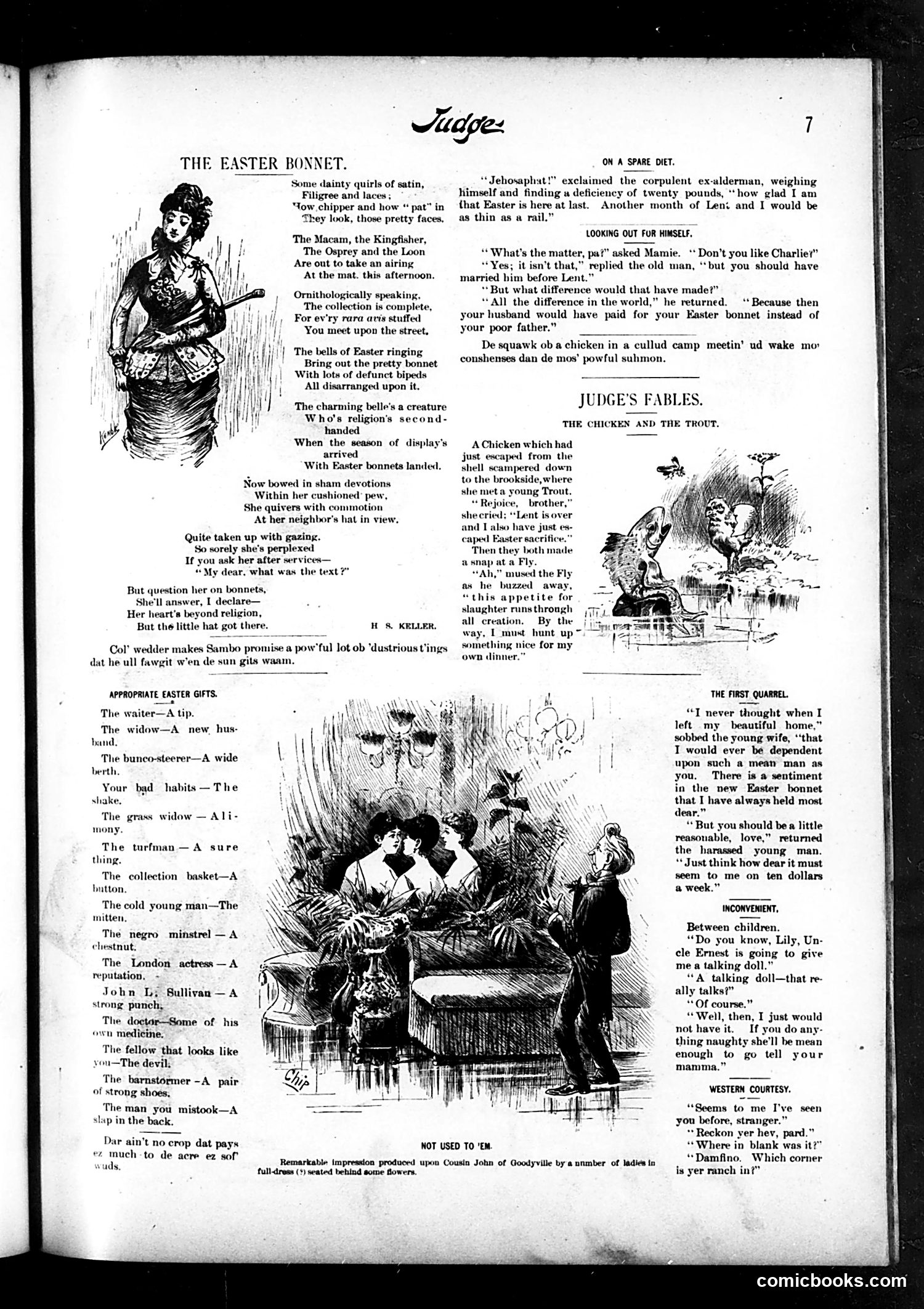
This page lampoons Easter traditions and gender stereotypes of the Gilded Age. **"The Easter Bonnet"** mocks women's vanity during Easter, when elaborate feathered hats (stuffed with "defunct bipeds"—dead birds) became fashion statements. The poem satirizes that women care more about displaying fashionable bonnets than religious devotion, neglecting the sermon to admire rivals' headwear. **"Appropriate Easter Gifts"** is a humor list offering cynical "gifts" to various social types—the widow gets "alimony," the doctor "his own medicine," etc. It reflects period class tensions and stereotypes. **"Judge's Fables"** presents short comedic dialogues. "The First Quarrel" depicts newlywed conflict: the wife treasures her Easter bonnet emotionally, while the husband resents its expense on his modest ten-dollar weekly wage—satirizing both female materialism and marital financial strain. Other pieces use racist dialect humor ("Jehosaphat," "Cousin John of Goodyville") typical of 1880s-90s publications, which modern readers should recognize as offensive period stereotyping rather than humor. The overall theme: Easter commercialism and female consumer culture.
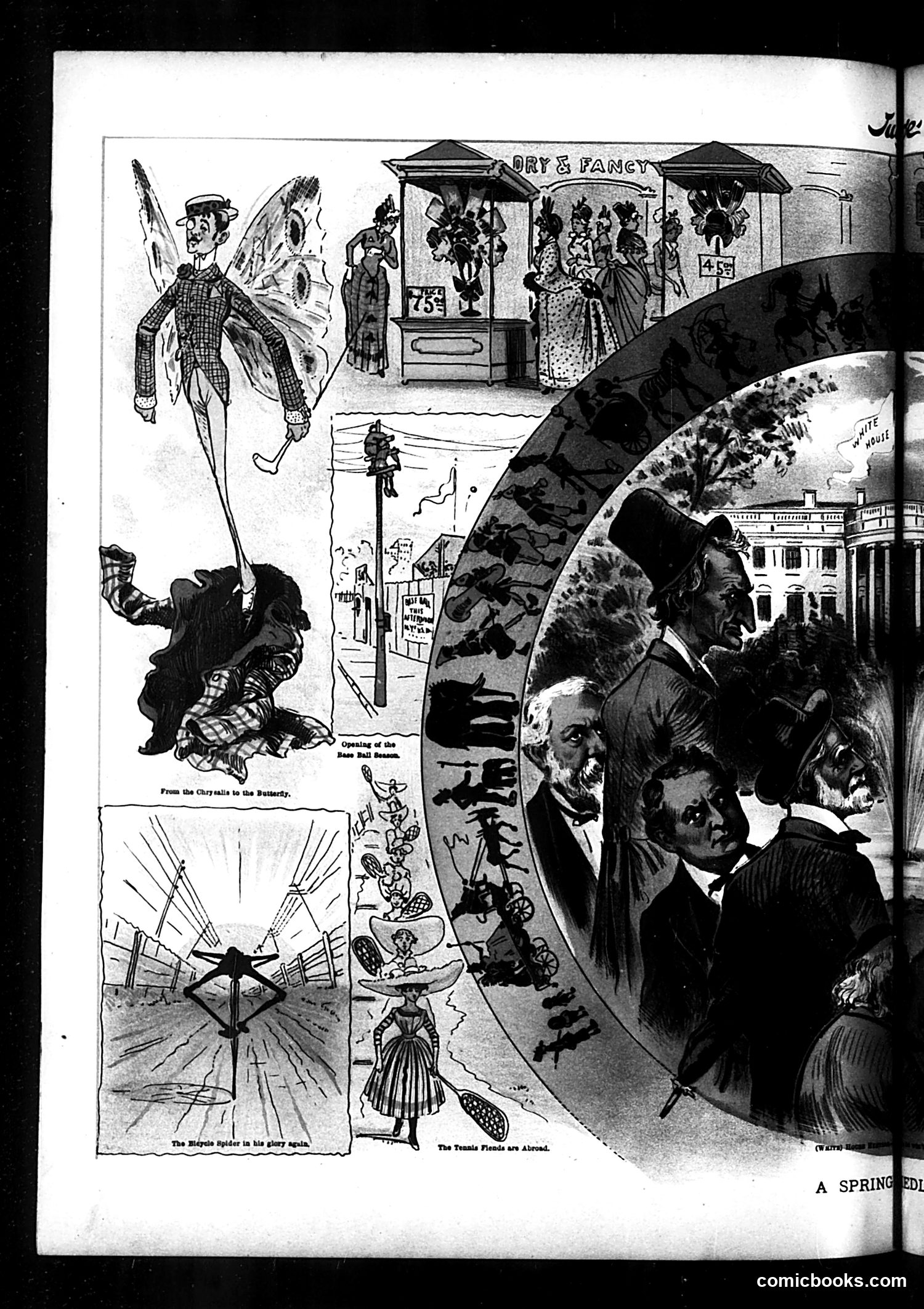
This page from *Judge* magazine contains satirical illustrations about bicycle culture and urban life, likely from the 1890s when bicycles were a major social phenomenon. The top panel shows a "Dry & Fancy" shop with fashionably dressed cyclists, satirizing how bicycling had become a trendy consumer activity for the wealthy. The lower sections appear to mock bicycle enthusiasts—particularly the "Bicycle Spider" character shown in exaggerated poses. The caricatures likely ridicule both the physical awkwardness of cyclists and the obsessive nature of cycling culture during this era. The cartoons poke fun at how bicycles had transformed from practical transportation into a status symbol and leisure pursuit for the upper classes, drawing crowds of admirers at shops and public venues.
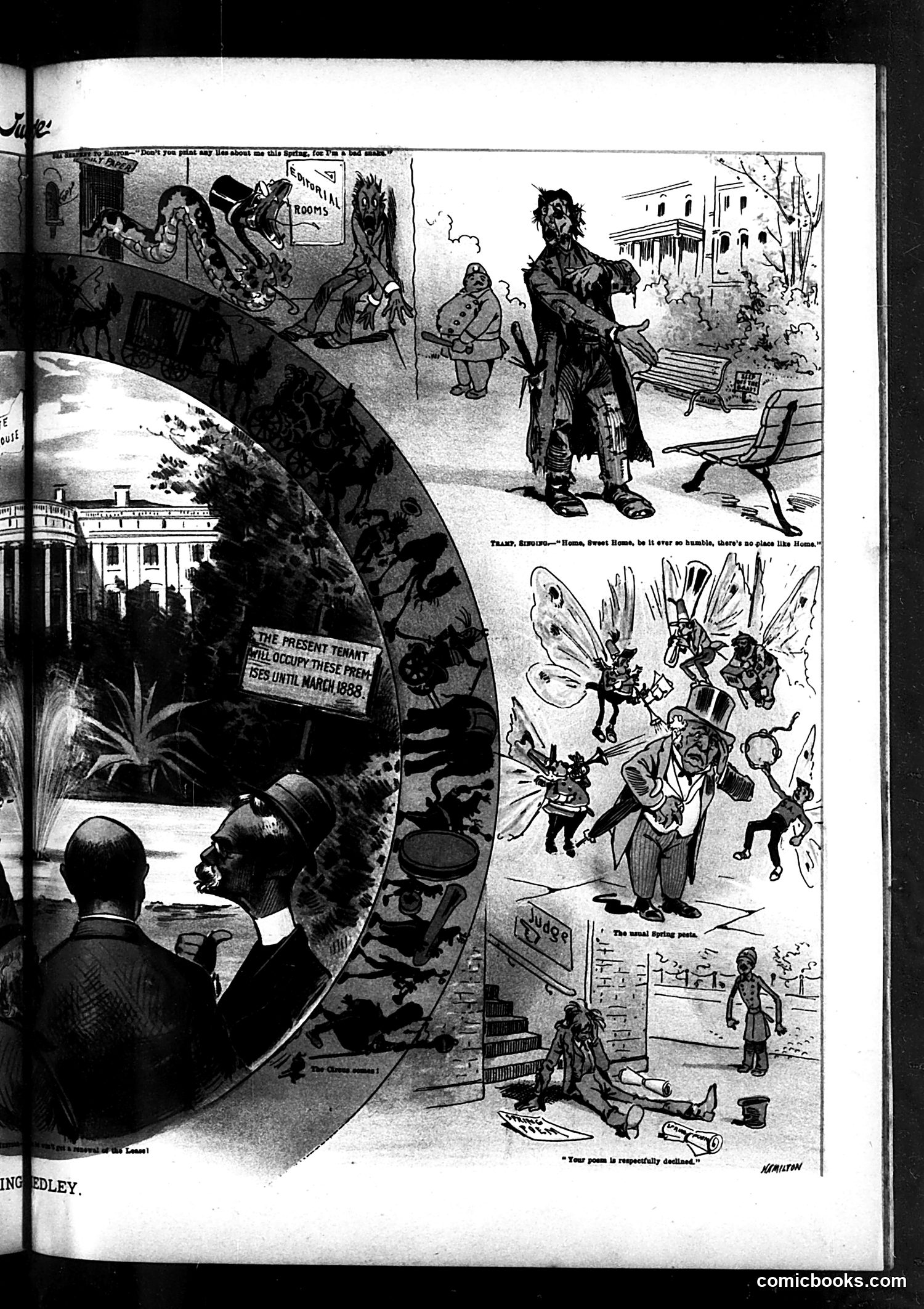
This page from *Judge* magazine contains satirical cartoons about homelessness and housing insecurity. The upper cartoon depicts a ragged, unkempt figure standing outside elegant buildings, with the caption "Home, Sweet Home, be it ever so humble, there's no place like home"—ironically contrasting the homelessness of poor Americans with the famous sentimental song. The lower panel shows what appears to be street children or impoverished youth in various states of distress, with one caption reading "Your poem is respectfully dedicated." The cartoons mock the gap between American ideals of home and prosperity versus the reality of urban poverty, likely from the early 20th century based on the artistic style and *Judge*'s satirical focus on social issues.
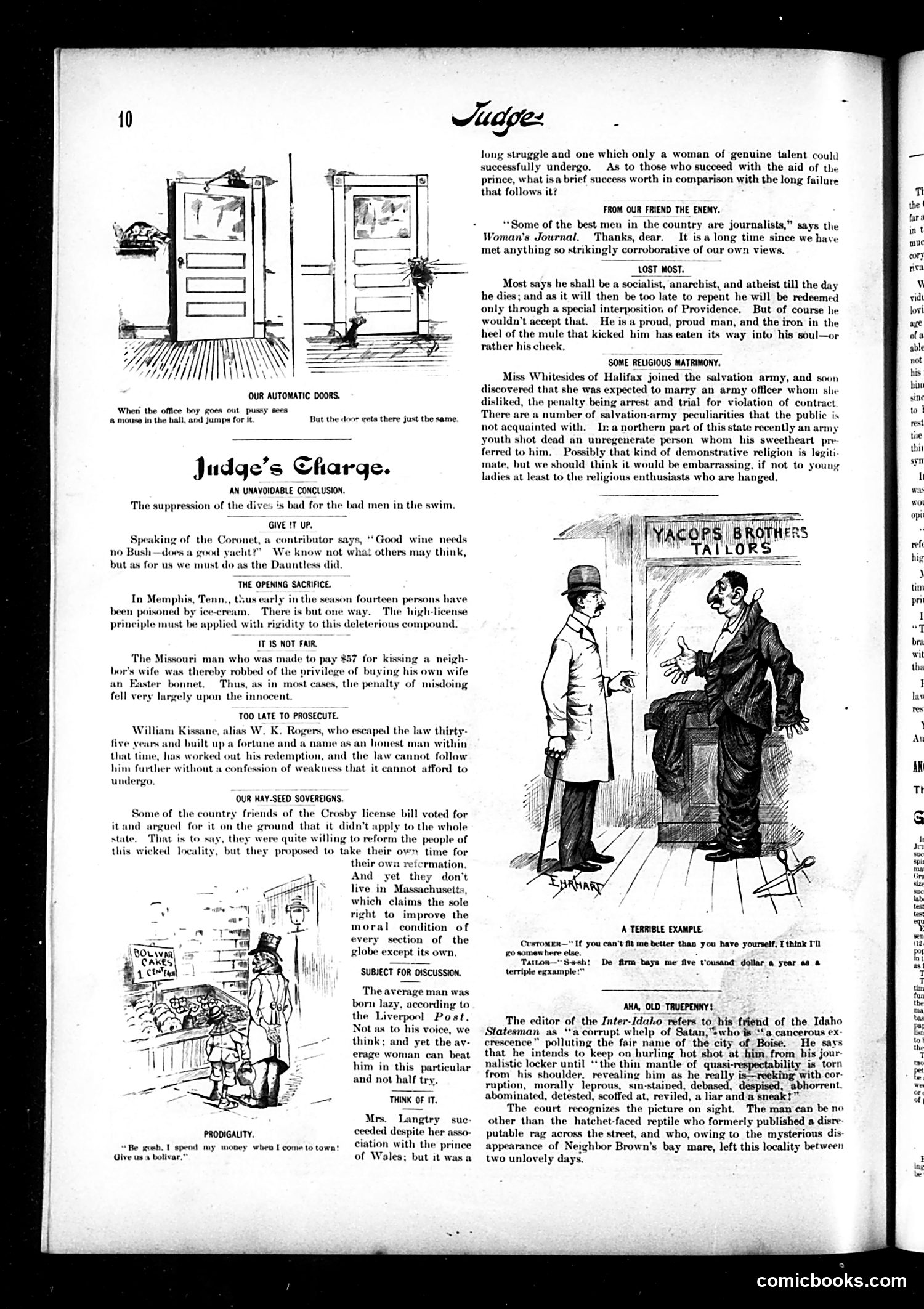
This page contains multiple brief satirical pieces typical of Judge's editorial commentary: **"Judge's Charge"** collects short quips on contemporary issues: suppressing saloons harms criminals ("bad men in the swim"), ice cream poisoning in Memphis, and a Missouri man's unfair legal penalty affecting his innocent wife. **"Our Hay-Seed Sovereigns"** mocks rural Massachusetts voters who supported licensing laws for other towns but refused reform in their own—hypocritical moralizing. The jab at Massachusetts claims it seeks to "improve the moral condition of every section of the globe except its own." **"Some Religious Matrimony"** criticizes the Salvation Army's coercive marriage practices, noting a woman was arrested for contract violation when she refused to marry a prescribed officer. The piece darkly references a similar case involving violence. **The cartoon "A Terrible Example"** (bottom right) shows a tailor poorly fitting a customer's suit, then the customer sarcastically saying if the tailor can't fit himself properly, he'll shop elsewhere—mocking incompetent tradesmen. These pieces reflect Judge's skeptical, irreverent stance toward religious institutions, rural morality, and incompetence.
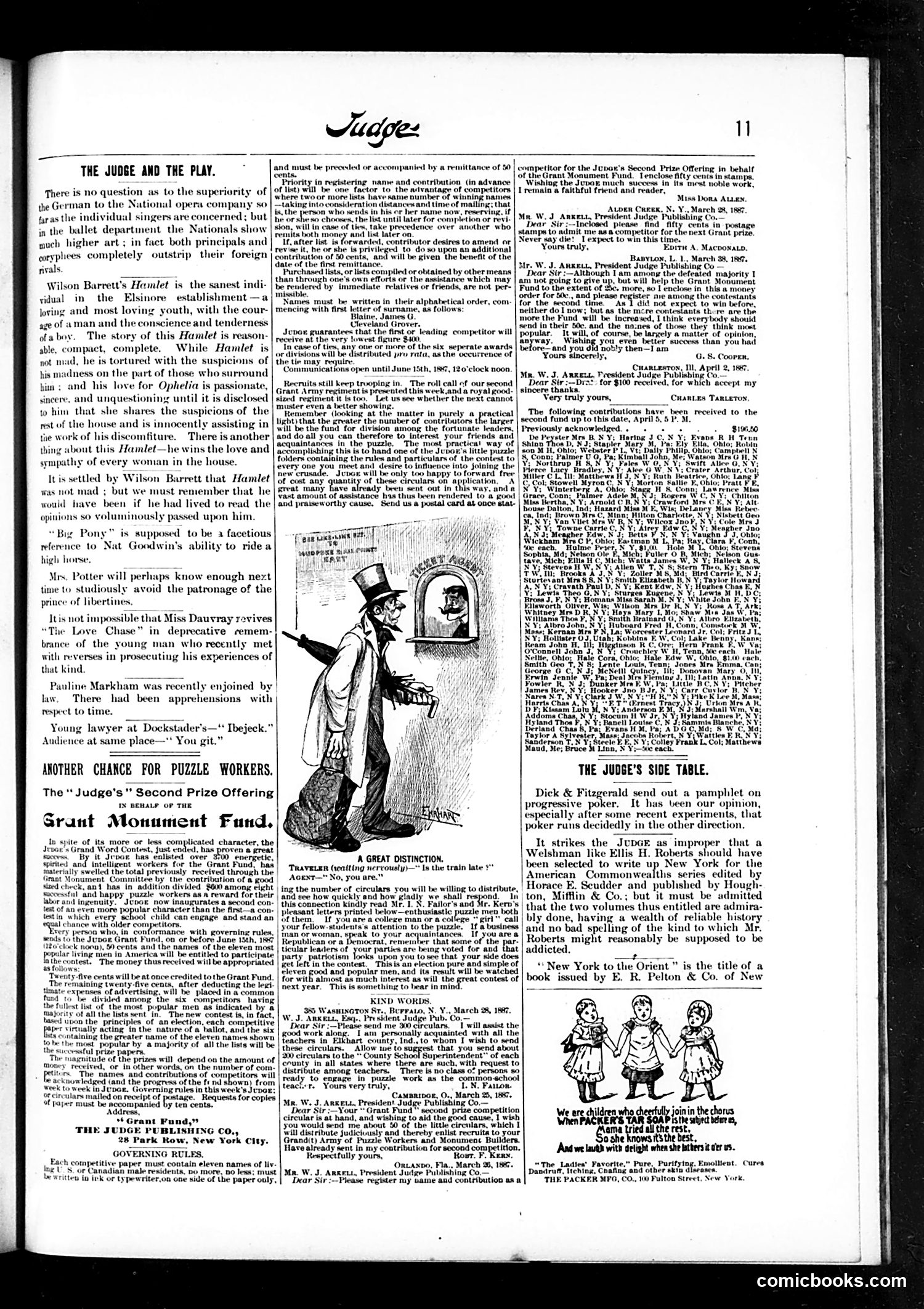
This page contains theater criticism and a puzzle-contest advertisement rather than political cartoons. **Theater Reviews:** The main text critiques stage productions: Wilson Barrett's *Hamlet* is praised as psychologically sound—the prince is portrayed as sane but *suspected* of madness by others, making the tragedy more poignant. References to other plays and performers (Nat Goodwin in "Big Pony," Pauline Markham) use theatrical gossip as humor. **The Illustration:** The sketch depicts a well-dressed man in a top hat peering into a mirror or window. The caption "A Great Distinction" suggests ironic social commentary about appearance versus reality—likely mocking vanity or pretense among the theater crowd. **Advertisement:** The bulk of the page promotes the "Judge's" second prize contest supporting the Grant Monument Fund, inviting readers to submit lists of "eleven most popular living men in America" for 25 cents. Winners share prize money. This was a fundraising mechanism disguised as a participatory game. The page reflects Judge's dual nature: cultural criticism mixed with commercial engagement.
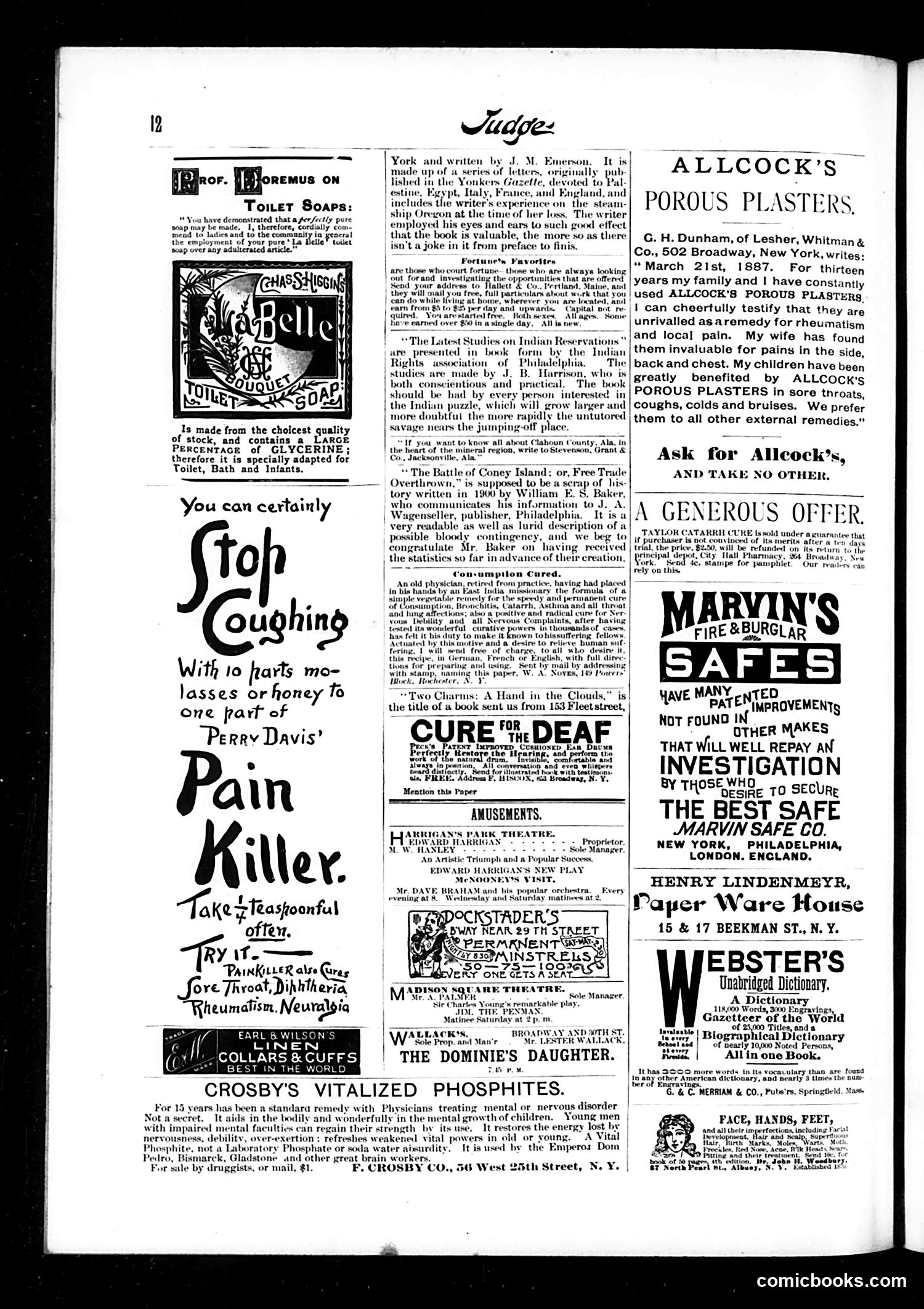
This page is primarily **advertising** with minimal editorial content. The visible cartoon/illustration shows a soap product ("La Belle") with decorative branding typical of late-19th-century patent medicine ads. The substantive text includes brief book reviews and notices: - A notice about letters on Palestine/Egypt by J.M. Emerson - A mention of studies on Indian Reservations by J.B. Harrison - Reference to "The Battle of Coney Island; or, Free Trade Overthrown," supposedly a humorous 1900 alternate-history work by William E. Baker The rest consists entirely of **advertisements**: patent medicines (Perry Davis's Pain Killer, Crosby's Vitalized Phosphites), theatrical announcements, safes, dictionaries, and toiletries. There is **no political satire or social commentary visible** on this particular page. Judge's satirical function appears absent here; this is a commercial advertising vehicle with minimal editorial matter typical of late-1880s magazine content.
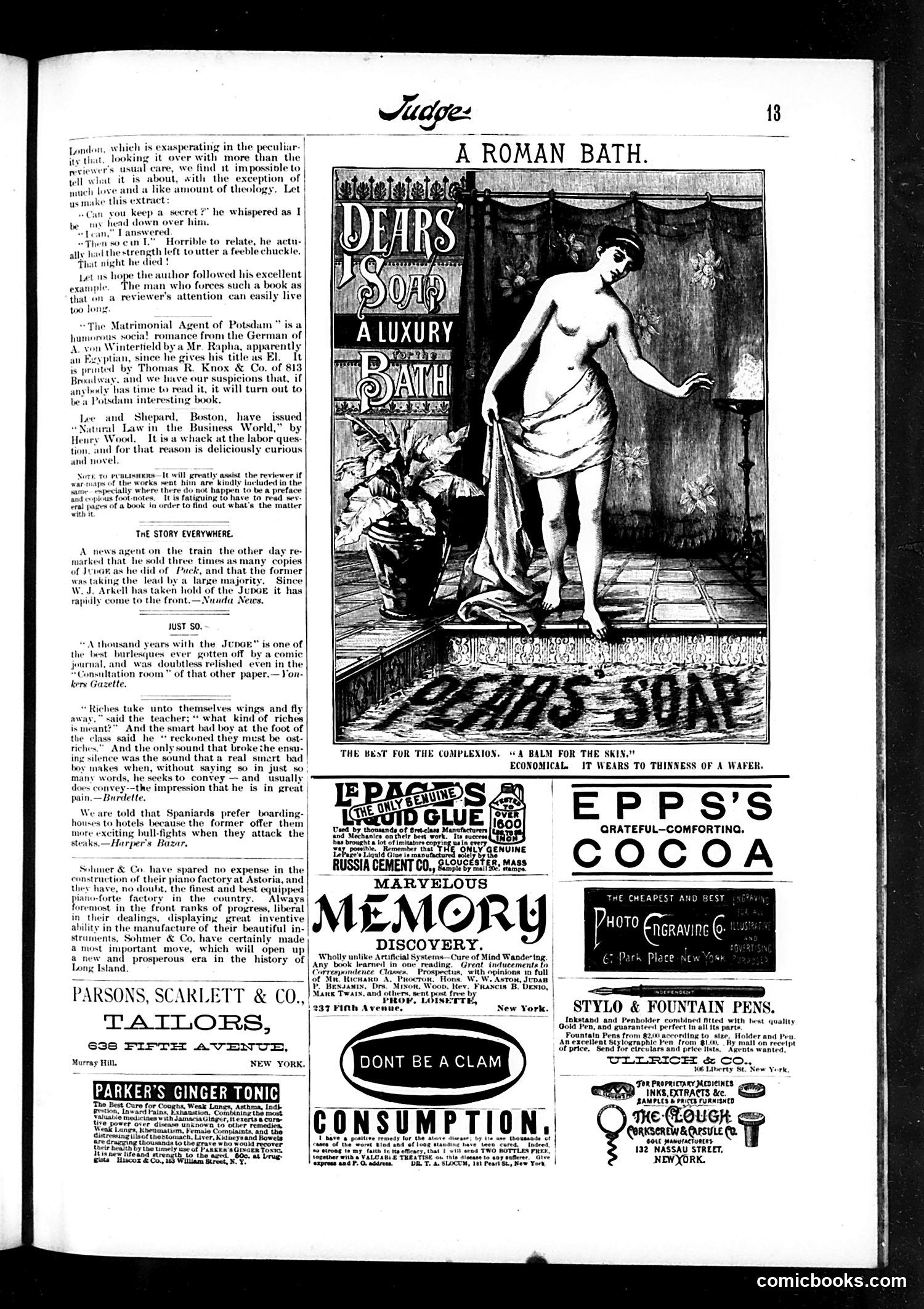
This page is primarily **advertising**, with a large illustrated advertisement for Pears' Soap dominating the upper right. The image shows a classical female figure in a Roman bath setting, promoting soap as a luxury cosmetic product—typical of late 19th/early 20th century marketing that associated consumer goods with refinement and classical ideals. The left column contains **book reviews** mocking obscure or poorly-written publications, including complaints about incomprehensible German works and tedious theological texts. The tone is satirical, suggesting Judge's editorial stance against pretentious, unreadable literature. The remaining space contains numerous **product advertisements** (Parker's Ginger Tonic, Memory Discovery courses, Stylo Fountain Pens, etc.)—standard commercial content for magazines of this era. **No political cartoons appear on this page.** The satirical content is limited to literary criticism rather than social or political commentary. The page reflects Judge's dual nature as both humor magazine and advertising vehicle.
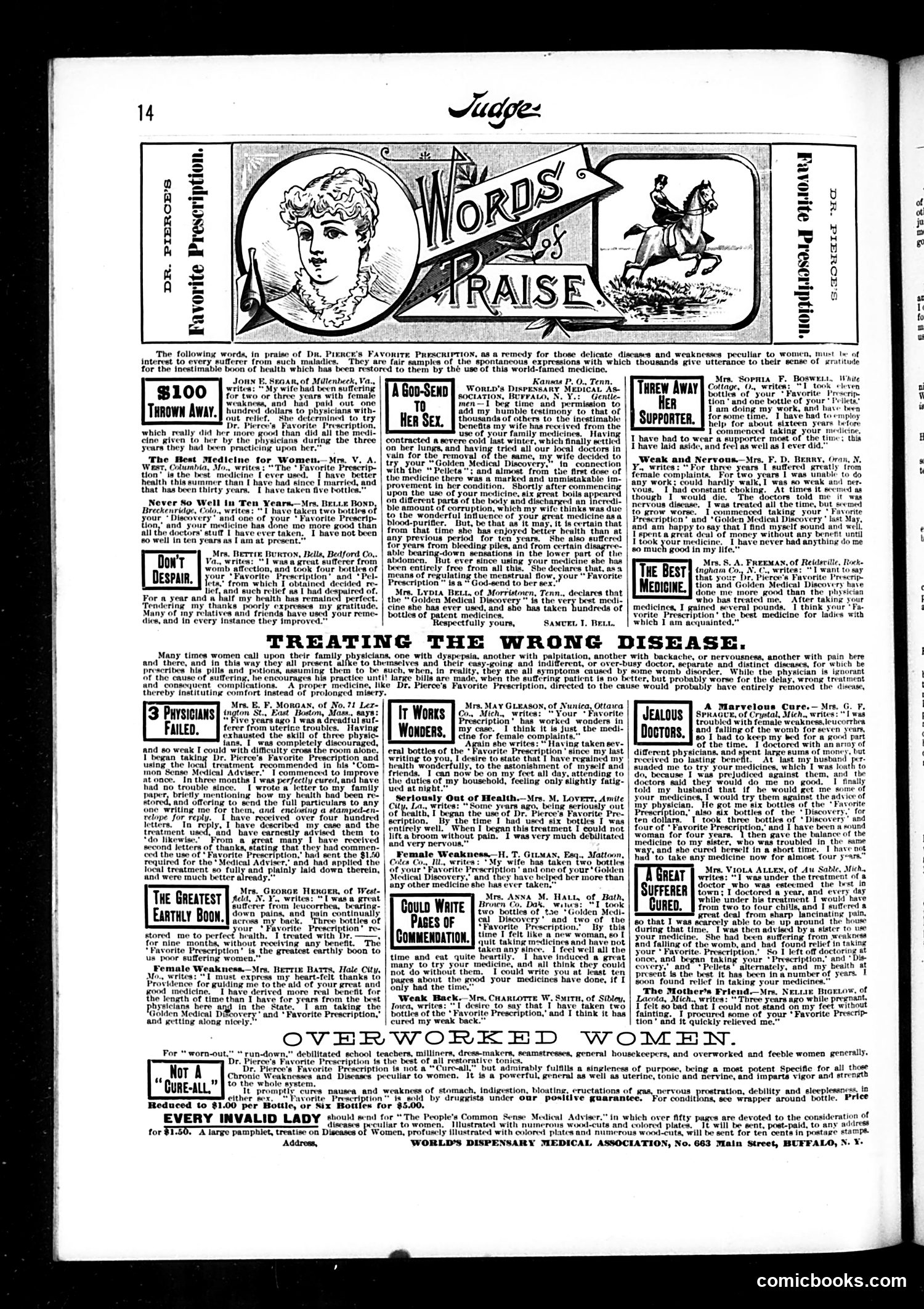
This page is **primarily advertising**, not political satire. It features testimonials for "Dr. Pierce's Favorite Prescription," a patent medicine marketed to women for "female weakness" and related gynecological complaints. The decorative header shows a woman's face with "Words of Praise" and a horseman, framing the advertisements below. **Historical Context**: In the late 19th/early 20th century, patent medicines were largely unregulated. Manufacturers published unsolicited testimonials (often fabricated) claiming miraculous cures. This particular product exploited common anxieties about women's health while offering no proven medical benefit. **The Satire Element**: Judge magazine likely included this to mock the absurd claims and gullibility of consumers who bought such products. The testimonials' emotional language and exaggerated health improvements would have seemed ridiculous to contemporary readers familiar with actual medical practice. The page illustrates how advertising exploited vulnerable populations—here, women without access to effective healthcare—through pseudoscientific claims.
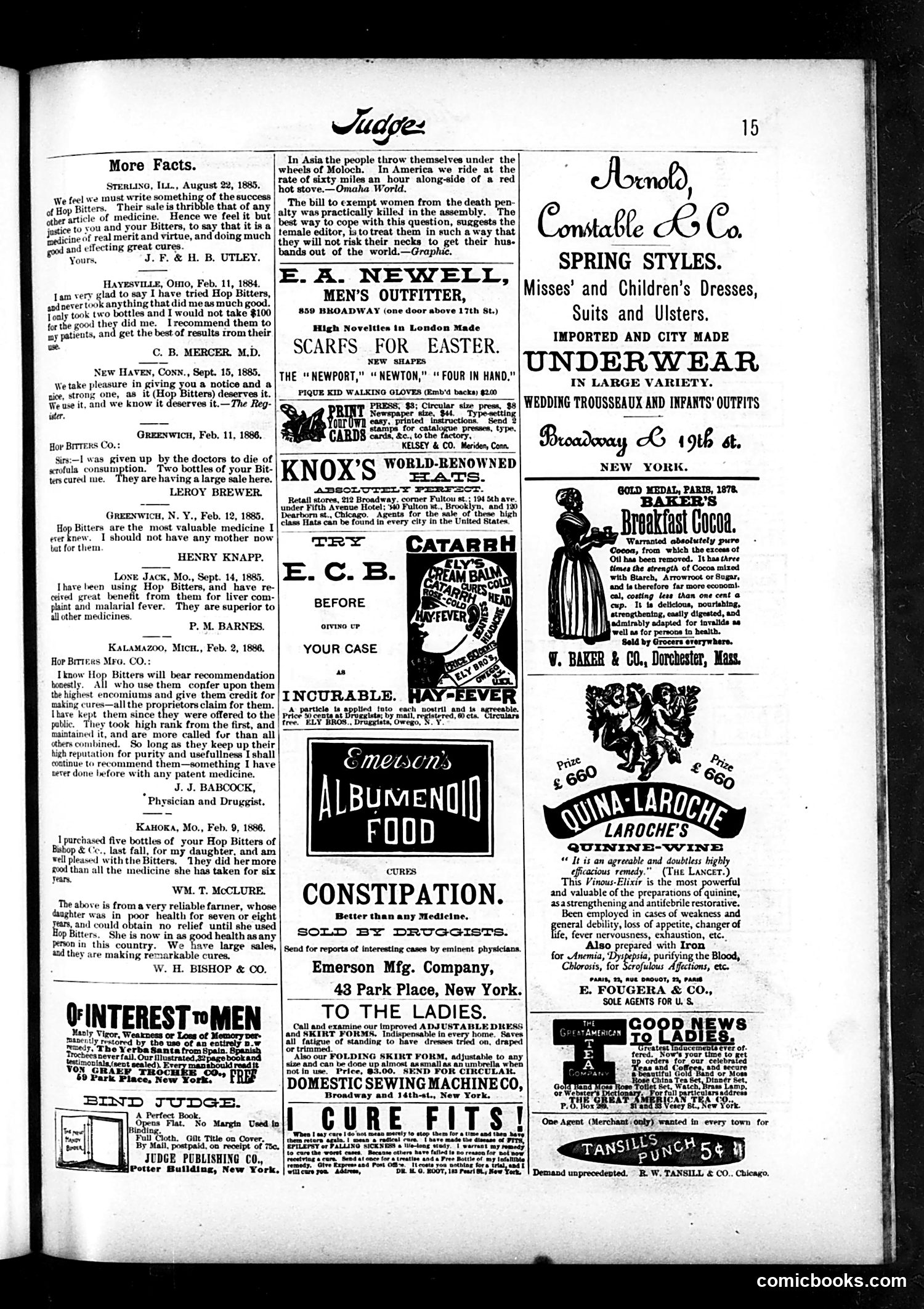
This page is primarily **advertising and testimonials**, not political satire. The dominant content features endorsements for "Hop Bitters"—a patent medicine marketed as a cure-all for ailments including consumption, scrofula, liver complaint, and malaria. The testimonials are presented as letters from doctors, druggists, and satisfied customers across the U.S., each claiming remarkable results from the product. This reflects the **late-19th-century patent medicine industry**, when unregulated commercial products made expansive health claims without scientific evidence. The few satirical cartoons visible are brief social commentaries: one contrasts Asian religious self-sacrifice with American recklessness (sixty mph travel), and another jokes darkly about exempting women from capital punishment by suggesting they won't risk their necks to free husbands. The rest of the page contains conventional advertisements for men's clothing (scarves, gloves), sewing machines, and other goods typical of 1880s magazines.
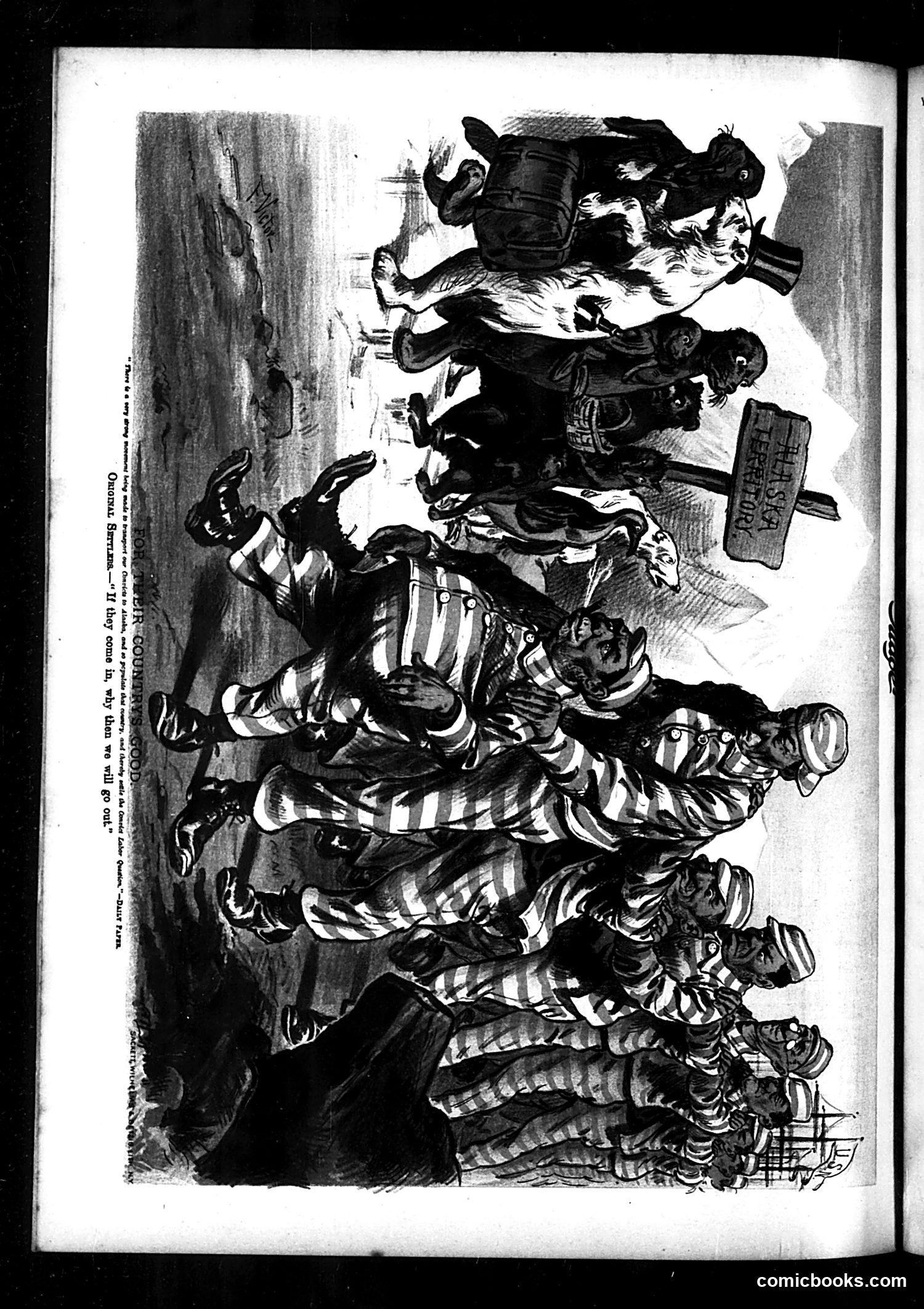
This Judge magazine cartoon satirizes a proposal to transport convicts to Alaska for labor and colonization—likely referencing early 20th-century debates about using prisoners for development projects in newly-acquired U.S. territory. The image shows prisoners in striped uniforms, depicted as dangerous criminals. The caption's "Ontonox Services" quip—"If they come in, why then we will go out"—is a darkly humorous warning that sending convicts to Alaska would drive out honest citizens and settlers. The satire targets the impracticality and moral problems of the scheme: importing criminals rather than building legitimate settlements. The cartoon mocks both the government proposal and expresses public anxiety about criminals being relocated rather than properly contained in established prisons.