
A complete issue · 18 pages · 1886
Judge — October 16, 1886
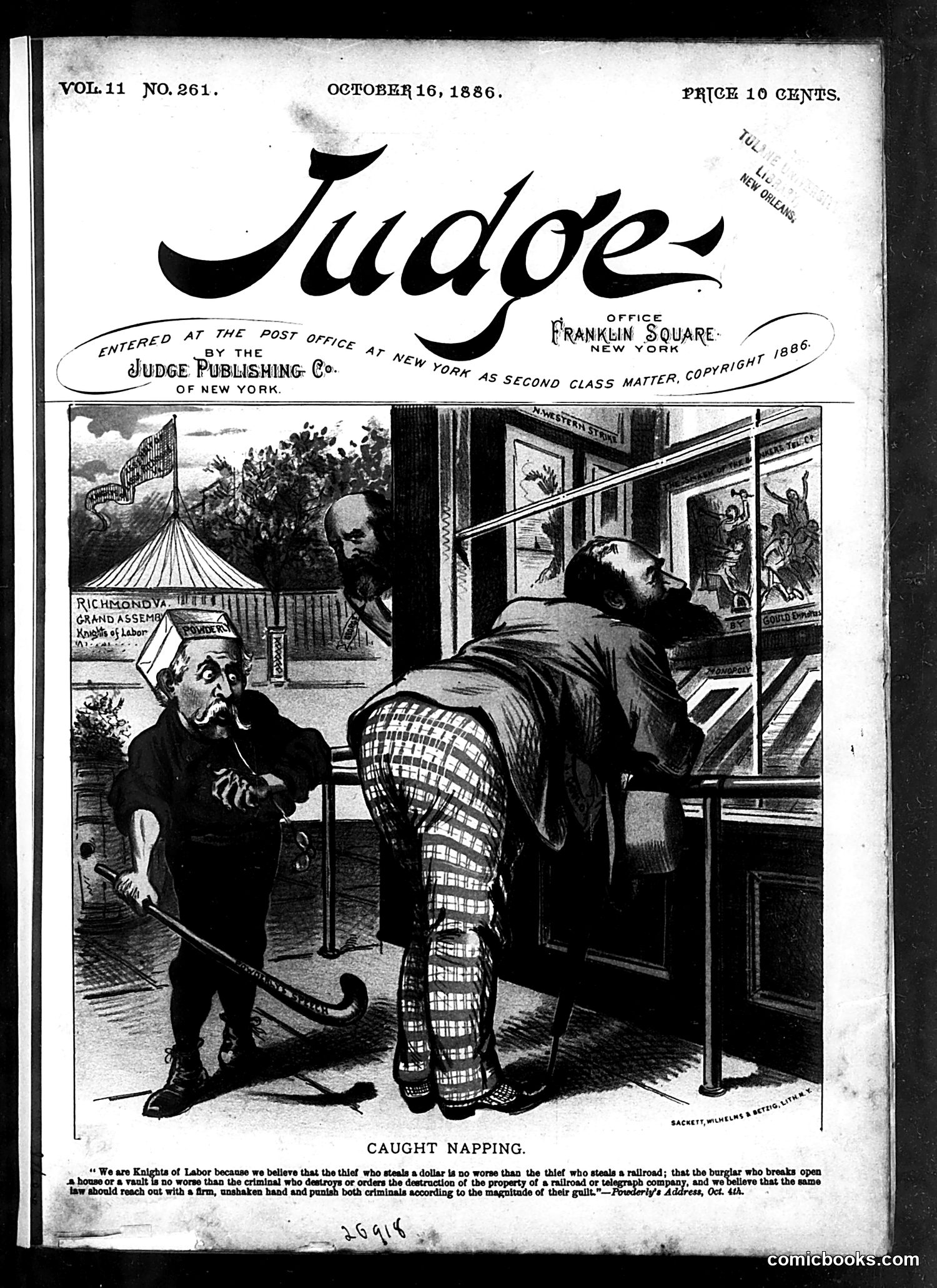
This cartoon satirizes labor radicalism and property crime during the Gilded Age. The illustration shows a man being caught breaking into a storefront at night while a policeman apprehends him. In the background, a Richmond Grand Assembly tent is visible, suggesting a labor gathering. The caption's quote defends harsh punishment for criminals who destroy railroad or telegraph property, equating labor radicals with common burglars. The satire targets "Knights of Labor" ideology—a major labor organization of the era—by suggesting that labor activists who sabotage infrastructure are no better than ordinary thieves, and deserve severe legal consequences. The "napping" likely refers to authorities being caught unaware of labor radicalism's criminal activities.
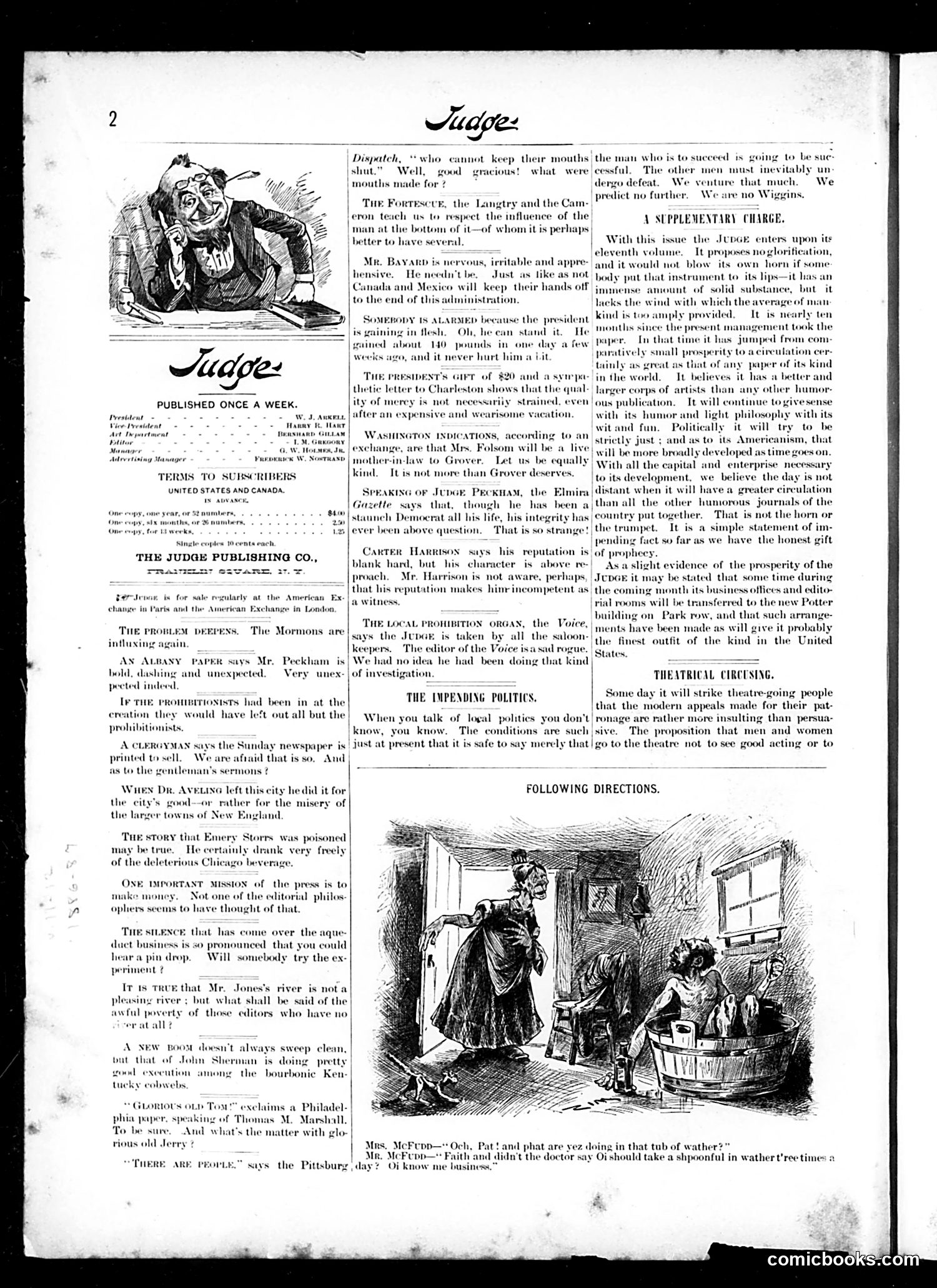
This page contains several editorial commentaries on contemporary political figures and issues. The left column features caricatured sketches of politicians being critiqued—though specific identities aren't clearly labeled in the visible text. The main commentary discusses figures like Mr. Bayard (described as "nervous, irritable and apprehensive"), the President's monetary gifts, and Washington indications about Mrs. Folsom becoming First Lady. References to "local prohibition" and mentions of the Mormons and their "problem" suggest 1880s-era debates. The bottom illustration titled "Following Directions" appears to be a domestic humor sketch unrelated to the political commentary above. Without clearer labels or dates, precise identification of the political figures being satirized remains uncertain, though the content suggests contemporary 1880s American political concerns.
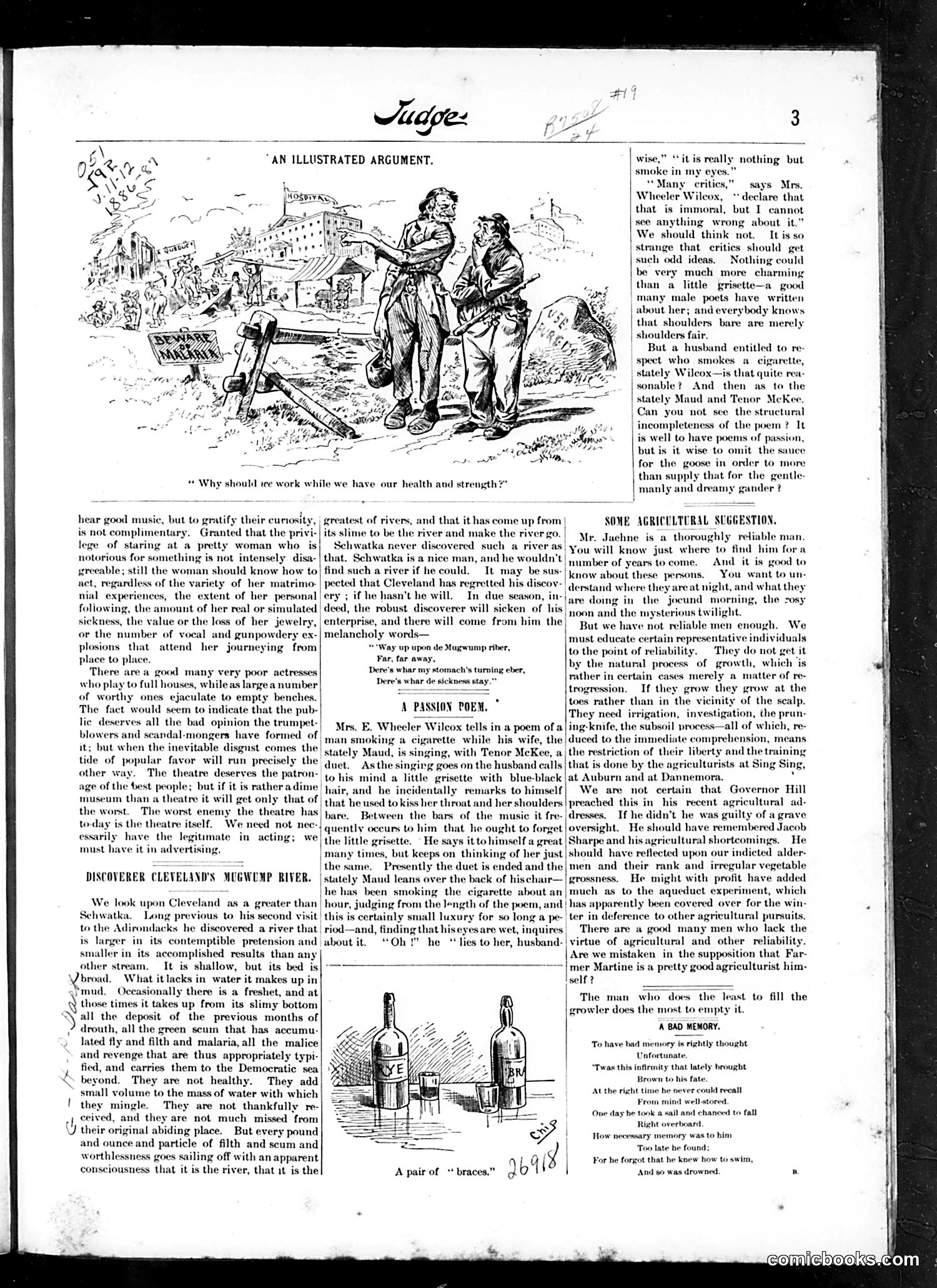
This page contains satirical commentary on several topics: **"An Illustrated Argument"** (main cartoon): The image shows two men observing industrial/urban development with the caption "Why should we work while we have our health and strength?" This appears to mock labor attitudes—likely critiquing either workers' reluctance to work or, conversely, the absurdity of working when one is healthy (suggesting idleness as a virtue). **"A Passion Poem"**: Satirizes poet E. Wheeler Wilcox's morality. The piece mocks her poem about a husband smoking while his wife sings with Tenor McKee, treating her defense of "immoral" behavior as naively prudish. The satire suggests her moral outrage is overblown. **"Discovery Cleveland's Mugwump River"**: Parodies President Cleveland's supposed discovery of a river, mocking both his accomplishment and his likely future regret—a tongue-in-cheek political jab. **"Some Agricultural Suggestion"**: Uses farming metaphors to discuss moral education and "reliability" of men, sarcastically comparing character-building to agricultural pruning. The overall tone is irreverent mockery of literary figures, politicians, and social pretension.
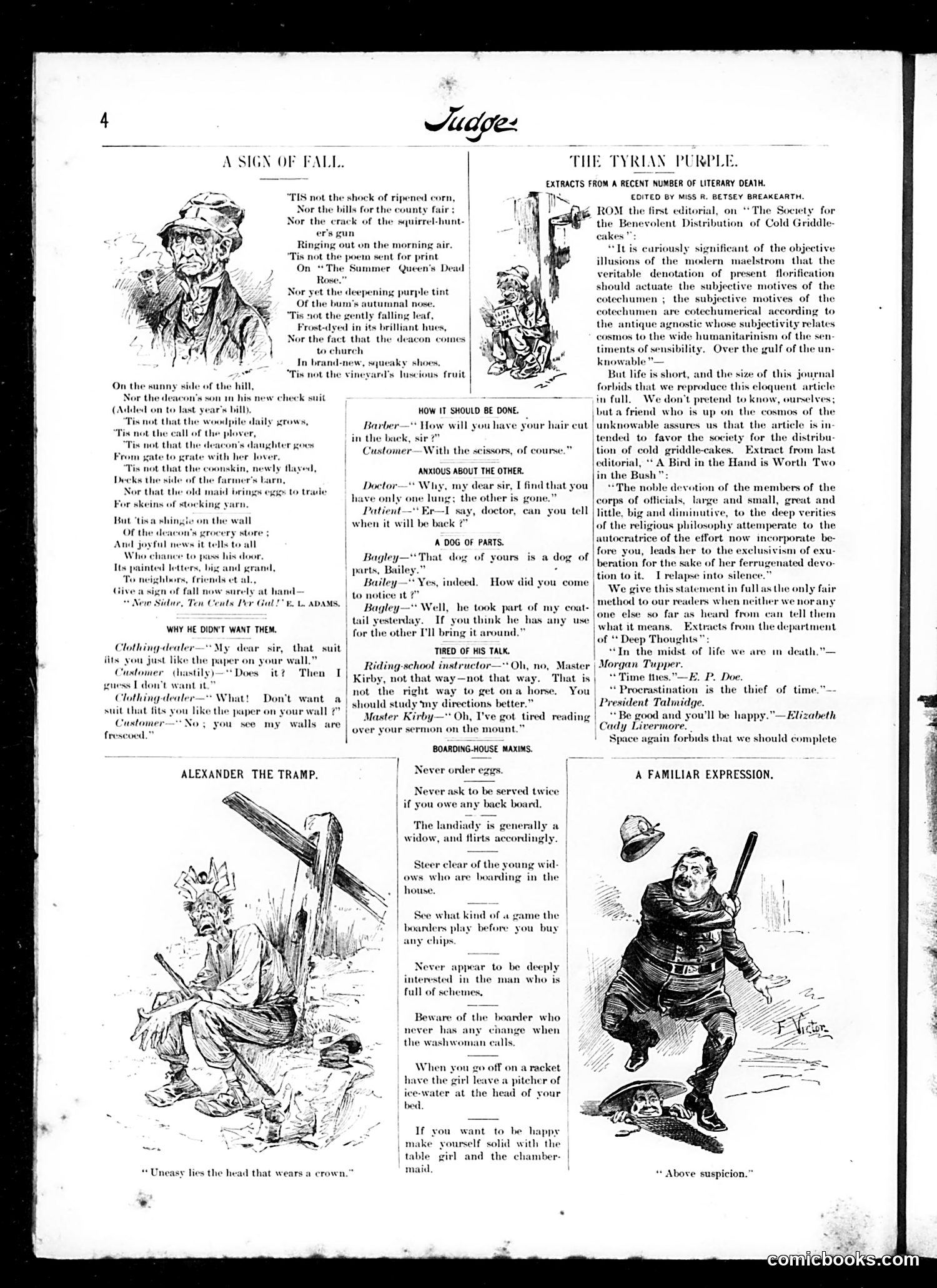
This page satirizes several targets typical of Victorian-era humor: **"A Sign of Fall"** mocks pretentious poetry submissions. The poem laboriously lists autumn imagery (ripened corn, falling leaves, deacon) before revealing the real "sign of fall": a farmer's unpaid yearly bill. It ridicules overwrought literary submissions to magazines. **"The Tyrian Purple"** parodies literary magazines' editorial pretension. The mock editorial claims to publish incomprehensible philosophical writing ("A Bird in the Hand is Worth Two in the Bush"), then admits the contributors themselves don't understand their own work. It's satire of obscurantist literary journals passing off gibberish as profundity. The scattered humorous anecdotes below mock everyday absurdities: a suit fitting "like paper on walls," a barber's obvious scissors comment, and boarding-house etiquette rules. Overall, the page ridicules Victorian literary pretension and the gap between claimed intellectual substance and actual meaning—a common Judge target.
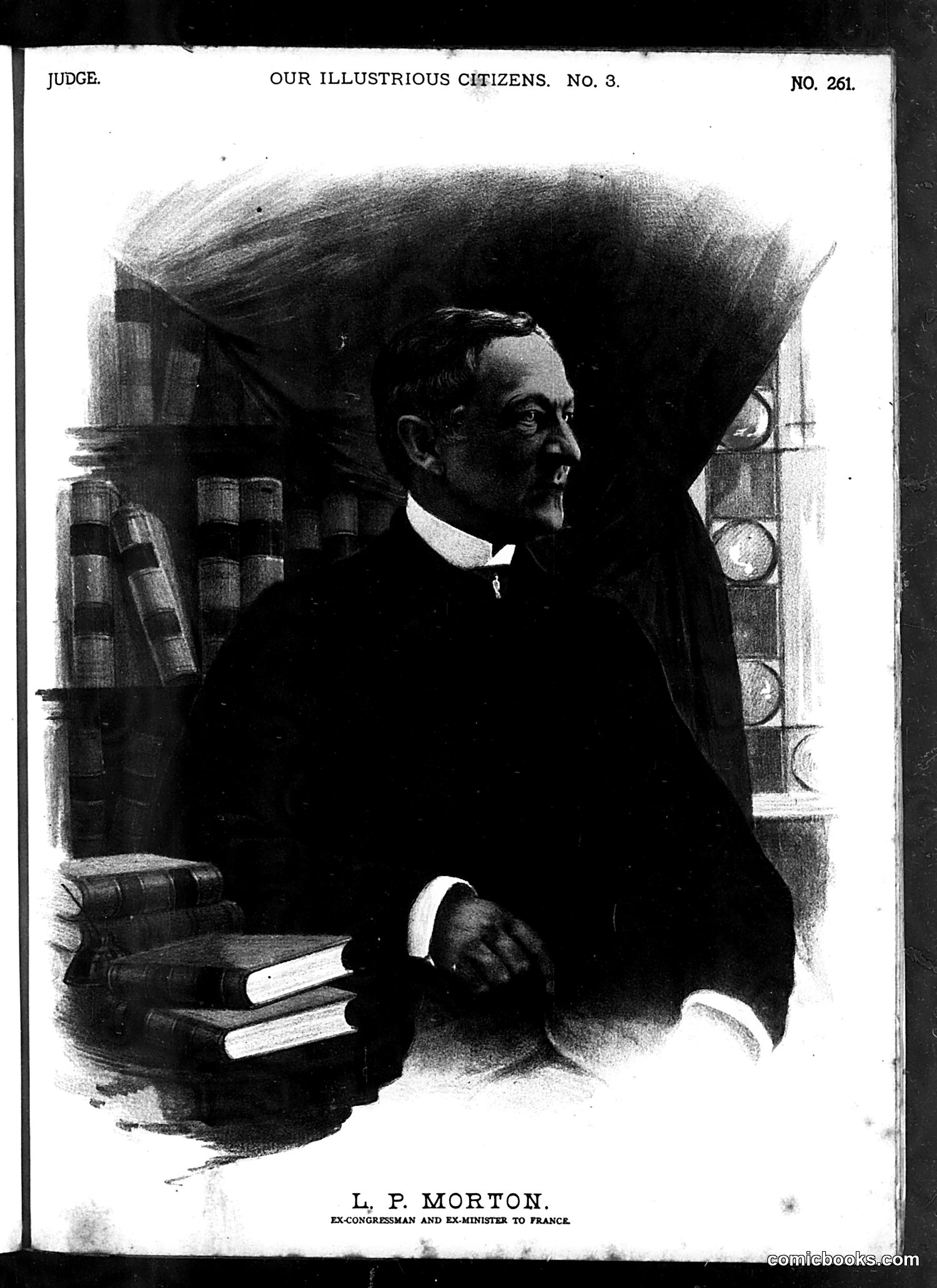
This is a portrait of L. P. Morton, identified as a former U.S. Congressman and former Minister to France. The illustration shows him in formal black attire with a white collar, positioned in what appears to be a study or library, surrounded by law books on shelves behind him. The sketch-style rendering is typical of Judge magazine's portraiture. The page appears to be part of a series called "Our Illustrious Citizens," profiling notable American public figures. Without additional context or accompanying text, the specific satirical intent—if any—is unclear. The portrait seems straightforward rather than obviously caricatured, suggesting this may be a relatively respectful profile entry rather than pointed political satire, though Judge was known for satirical commentary.
I can see this is a page from *Judge* magazine, but the image quality is too poor to read any text clearly or identify specific cartoon content with confidence. The page appears mostly blank or very faded, with only scattered marks and deterioration visible. There may be illustrations present, but they're not legible enough for me to identify figures, political references, or satirical intent. To properly analyze this as a political cartoon from *Judge*, I would need either a higher-resolution image or clearer source material that shows the actual artwork and text legibly. I cannot responsibly guess at the cartoon's meaning without being able to see it.
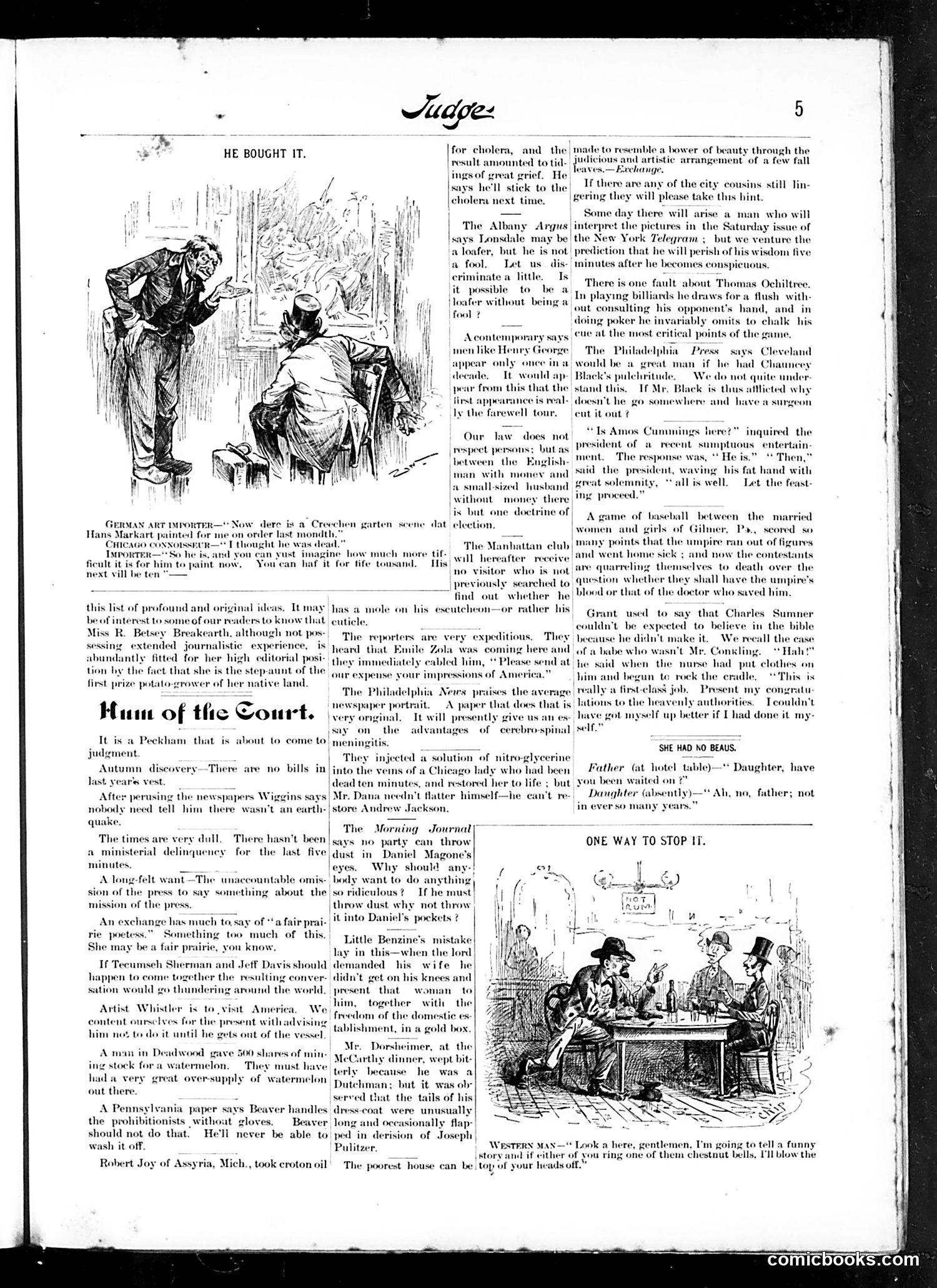
This page contains several satirical pieces mocking public figures and social absurdities of the period. **"He Bought It"** (top cartoon): Depicts a man persuading another to purchase something, likely ridiculing gullible consumers or financial schemes. **"Hum of the Court"** section critiques newspaper journalism and society figures. References include: - **Thomas Ochiltree**: A character (appears to be a recurring figure in Judge) who cheats at billiards and poker - **Henry George**: The economist/reformer who "appears only once in a decade" - **Emile Zola**: The French author, with editors jokingly requesting his "impressions of America" - Mockery of newspapers' sensationalism and the press's obsession with trivial gossip **"One Way to Stop It"** (cartoon): Depicts what appears to be a solution to a social problem, though specifics are unclear. **Lower section**: A domestic comedy about a daughter with no suitors at a hotel. The overall tone satirizes journalism's triviality, social climbing, and public figures' pretensions.
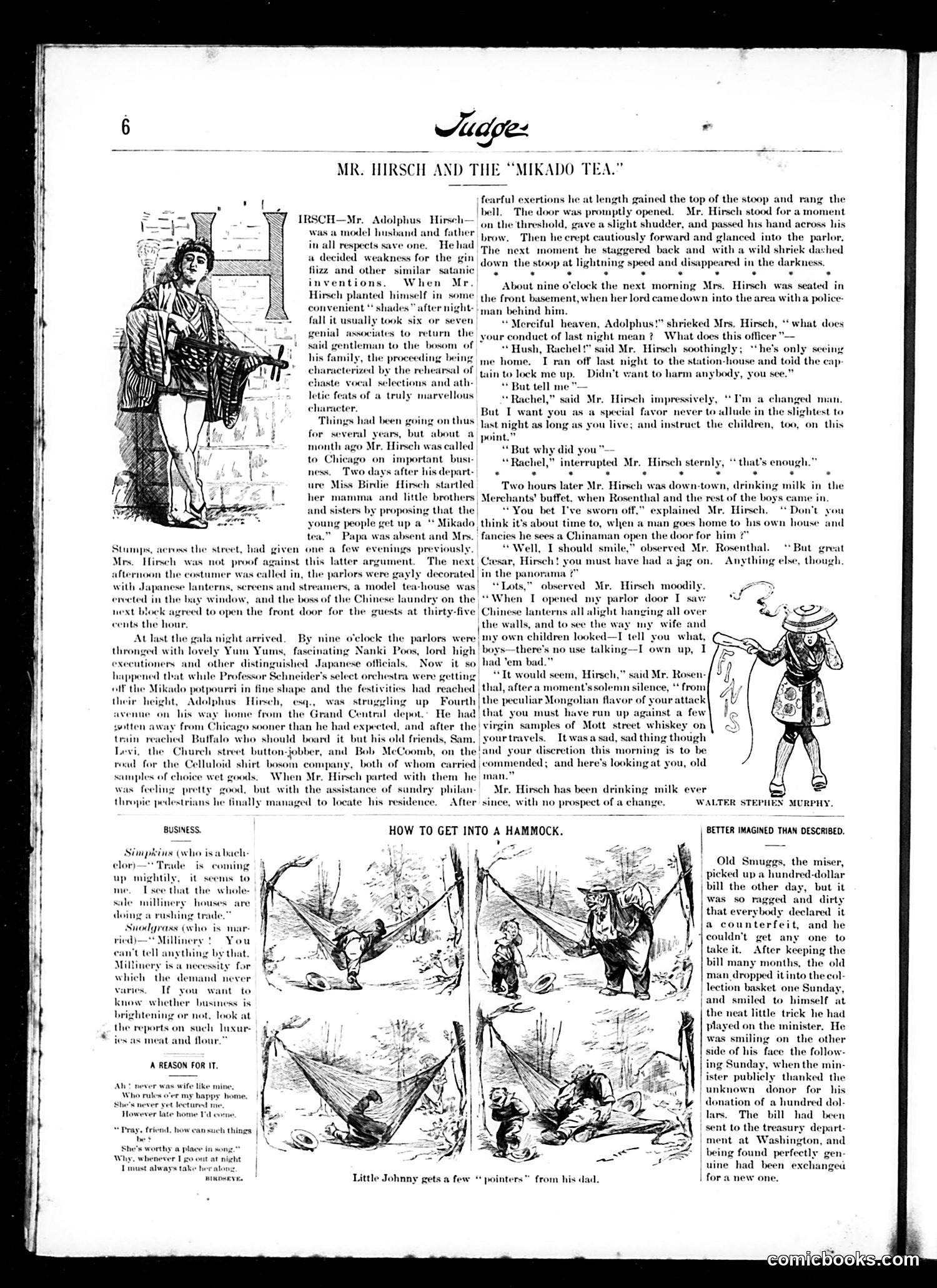
This is a satirical story about Mr. Adolphus Hirsch, a respectable married man whose weakness is frequenting Chinese establishments. The narrative ridicules both his infidelity and the era's stereotypical depiction of Chinese culture as exotic and morally corrupting. The plot centers on Hirsch sneaking out to enjoy "Mikado tea" (likely code for opium or similar vice), decorating his home with Chinese lanterns and Japanese officials for a party. When confronted by his wife and friends, he claims reformation and blames a "Chinaman" for leading him astray. The humor relies on ethnic caricature and the period's association of Chinese immigrants with moral degeneracy and hidden vices. The accompanying cartoons satirize the popularity of Japanese/Chinese aesthetic trends ("Japonisme") among Americans, treating fascination with Asian culture as foolish faddishness rather than genuine appreciation.
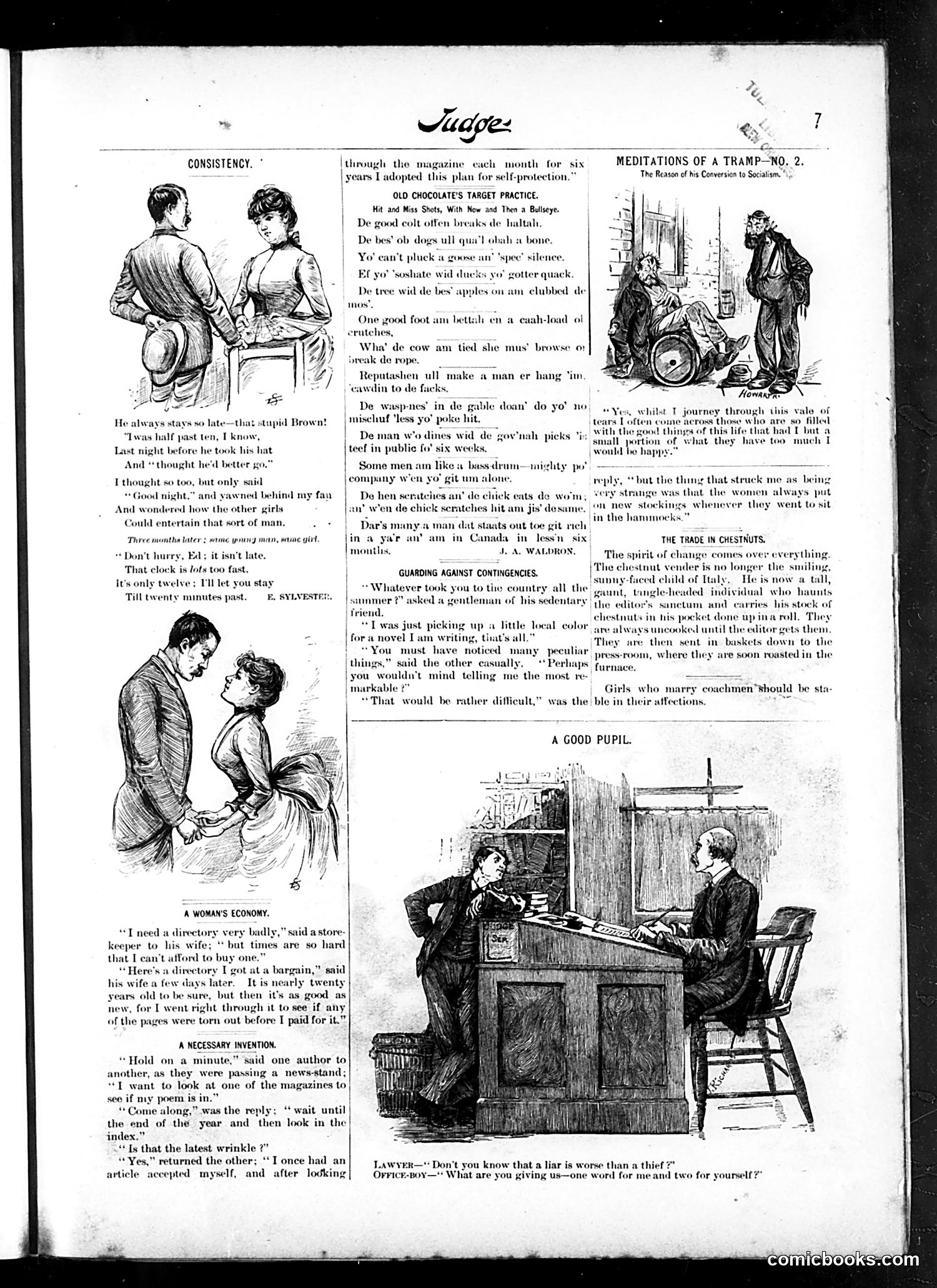
This page contains several satirical pieces typical of late 19th-century American humor: **"Meditations of a Tramp—No. 2"** depicts a vagrant's conversion to socialism after observing wealth inequality. The tramp observes wealthy people with excessive possessions and reflects that even a small share would satisfy him—social commentary on economic disparity. **"Old Chocolate's Target Practice"** appears to be dialect humor using African American vernacular (common but now-offensive in period publications), offering folk wisdom through proverbs. **"A Good Pupil"** satirizes an editor who teaches a young writer that poems are only indexed at year's end, mocking editorial gatekeeping. **"The Trade in Chestnuts"** criticizes how editors recycle stale material. **The final cartoon** shows a lawyer and office boy debating honesty—the boy's quip that lawyers demand "one word for me and two for yourself" satirizes perceived attorney dishonesty. The page reflects Gilded Age concerns: class inequality, editorial practices, and professional ethics, presented through period-typical caricature and dialect.
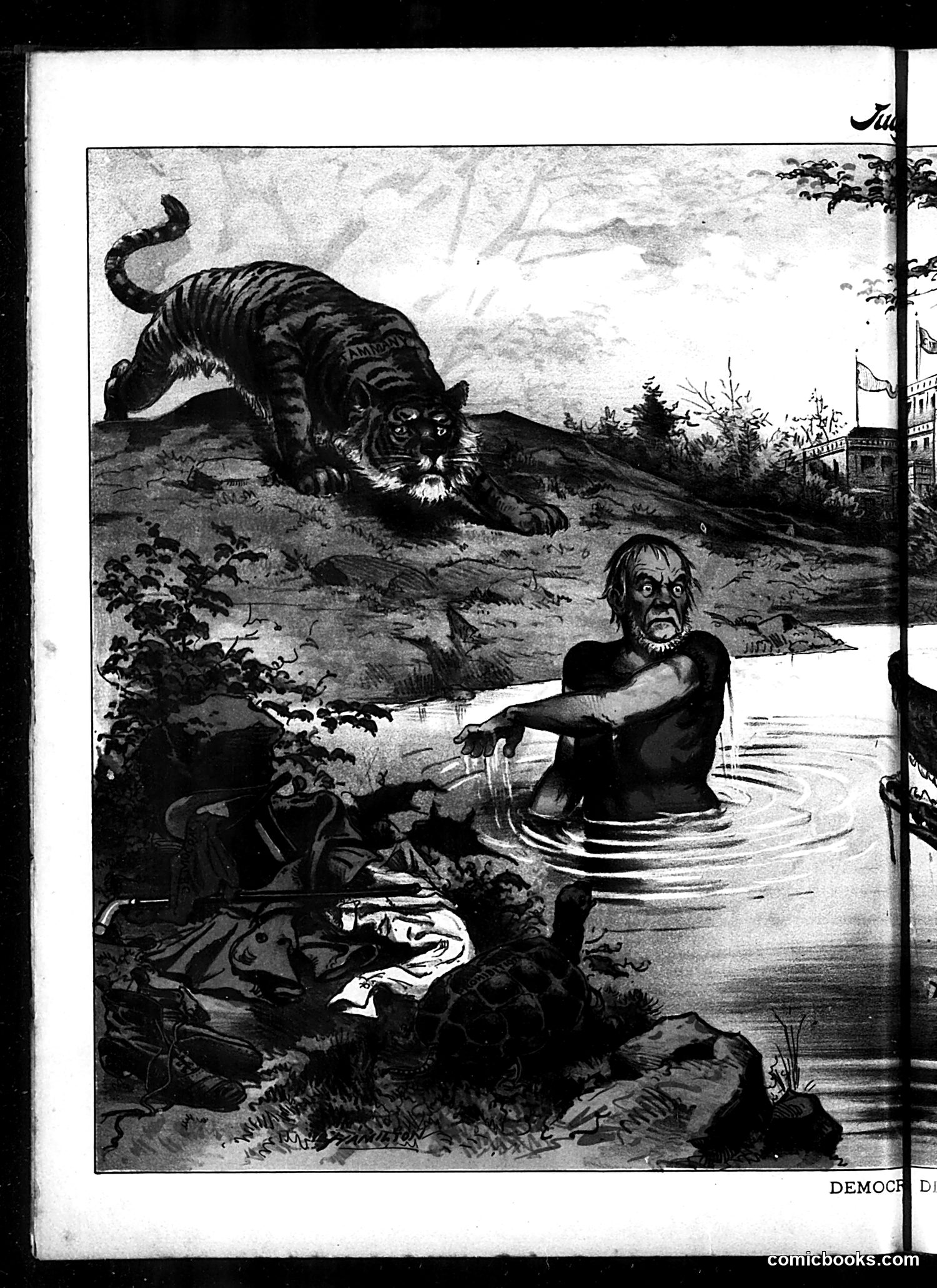
This appears to be a satirical illustration from *Judge* magazine depicting a confrontation between a man in water and a large tiger on shore. The man's expression conveys fear or distress as he gestures toward the animal. The visible text fragment "DEMOCR" (likely "DEMOCRAT") at the bottom suggests this is political satire, probably contrasting a Democratic figure or the Democratic Party with a threatening force symbolized by the tiger. Without additional context or visible text, I cannot definitively identify which specific politician or historical event this references. The imagery suggests danger or threat, but the exact political commentary—whether about party policy, a particular leader, or a contemporary crisis—**remains unclear from this page alone**.
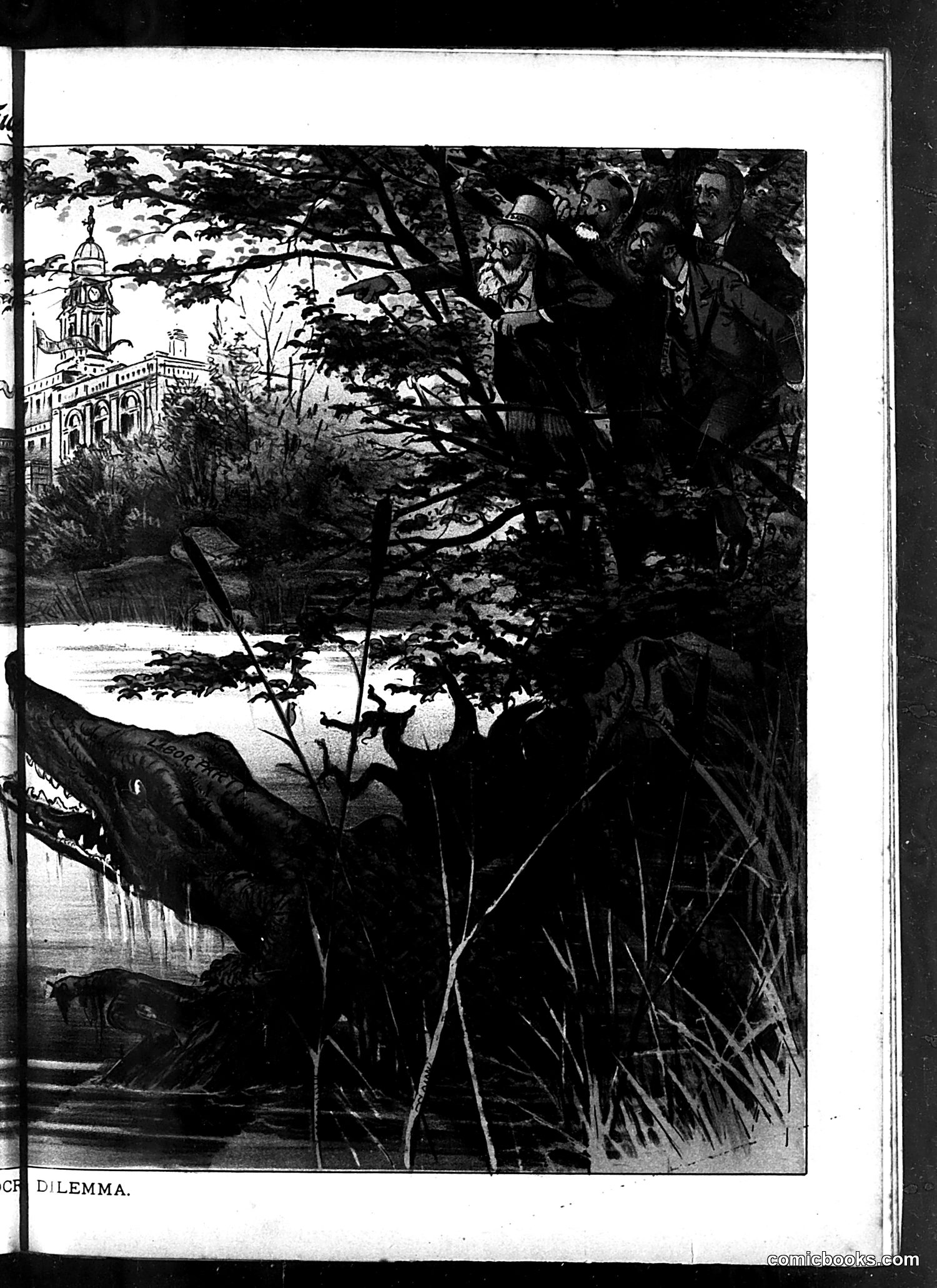
This political cartoon depicts several well-dressed gentlemen observing a crocodile in murky water near a classical building (likely representing government institutions). The caption "A DILEMMA" suggests a difficult choice or predicament. The imagery appears to satirize political leaders facing a dangerous situation—the crocodile presumably representing some threat or crisis they must confront. The men's formal attire and positioning suggest they are politicians or officials deliberating over how to handle the danger before them. Without additional context about the specific publication date, I cannot identify which particular political crisis or figures this references. However, the cartoon's structure—powerful men confronting a lurking threat while sheltered by institutional architecture—suggests commentary on political indecision or the difficulty of addressing a known danger.
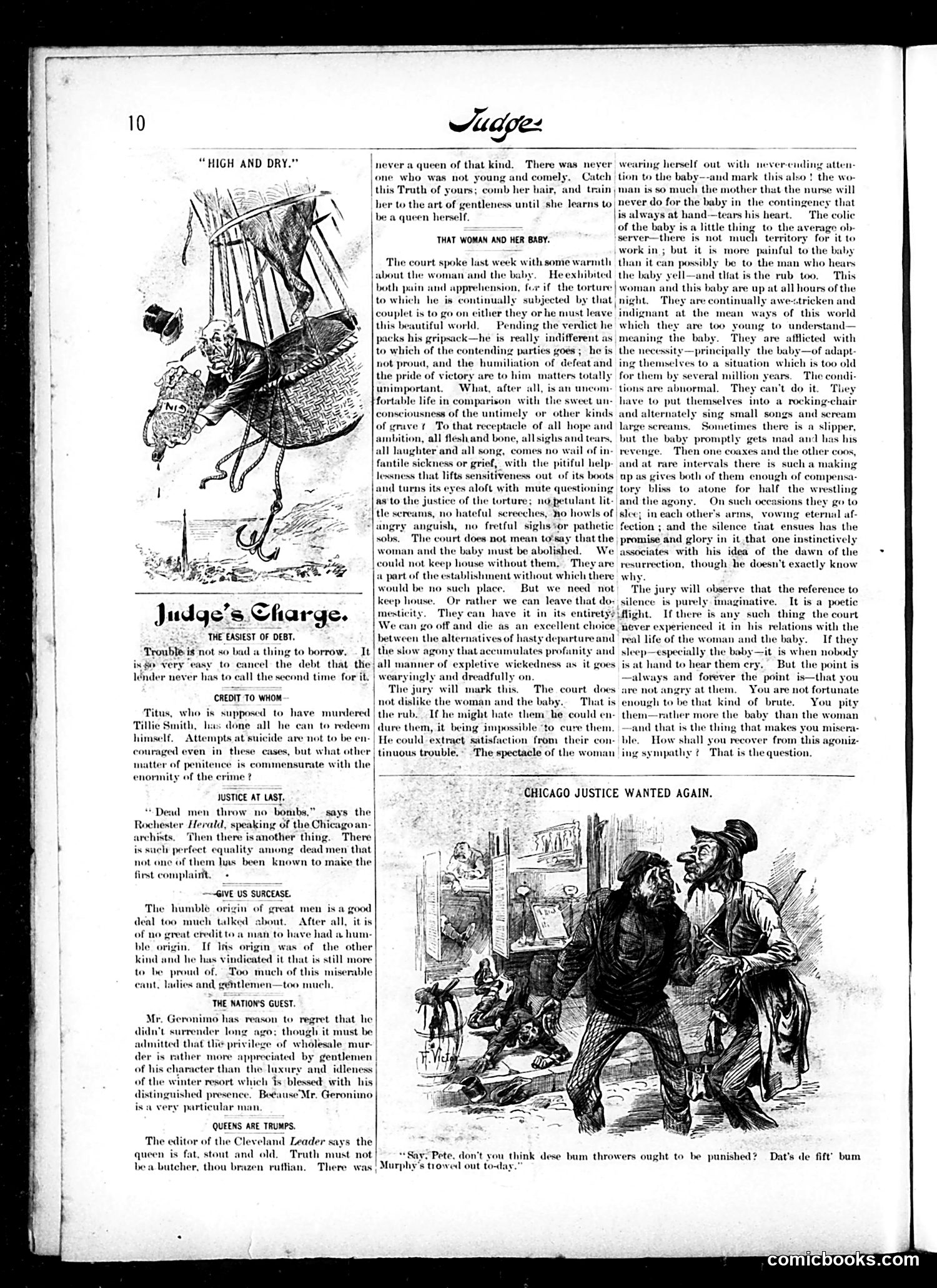
This page contains satirical commentary typical of Judge magazine's editorial voice. The main pieces critique social attitudes and legal matters: **"Judge's Charge"** sections offer moral pronouncements on various topics: debt, suicide, social mobility, and notably, Geronimo (the Apache leader, likely recently captured or in custody), sarcastically called "The Nation's Guest." **"That Woman and Her Baby"** is the longest piece—a lengthy, somewhat bitter meditation on a court case involving a woman, her baby, and apparently a man in their life. The court speaker expresses indifference toward the disputants while philosophizing about life's suffering, particularly a baby's colic and crying. The satire appears directed at legal proceedings over domestic arrangements, mocking the man's detachment while acknowledging the woman's genuine maternal suffering. **"Chicago Justice Wanted Again"** (lower right) shows a street scene with the caption about "bum throwers" needing punishment, referencing Chicago's violent crime or labor unrest. The tone throughout is cynical, upper-class moralizing typical of Judge's editorial stance.
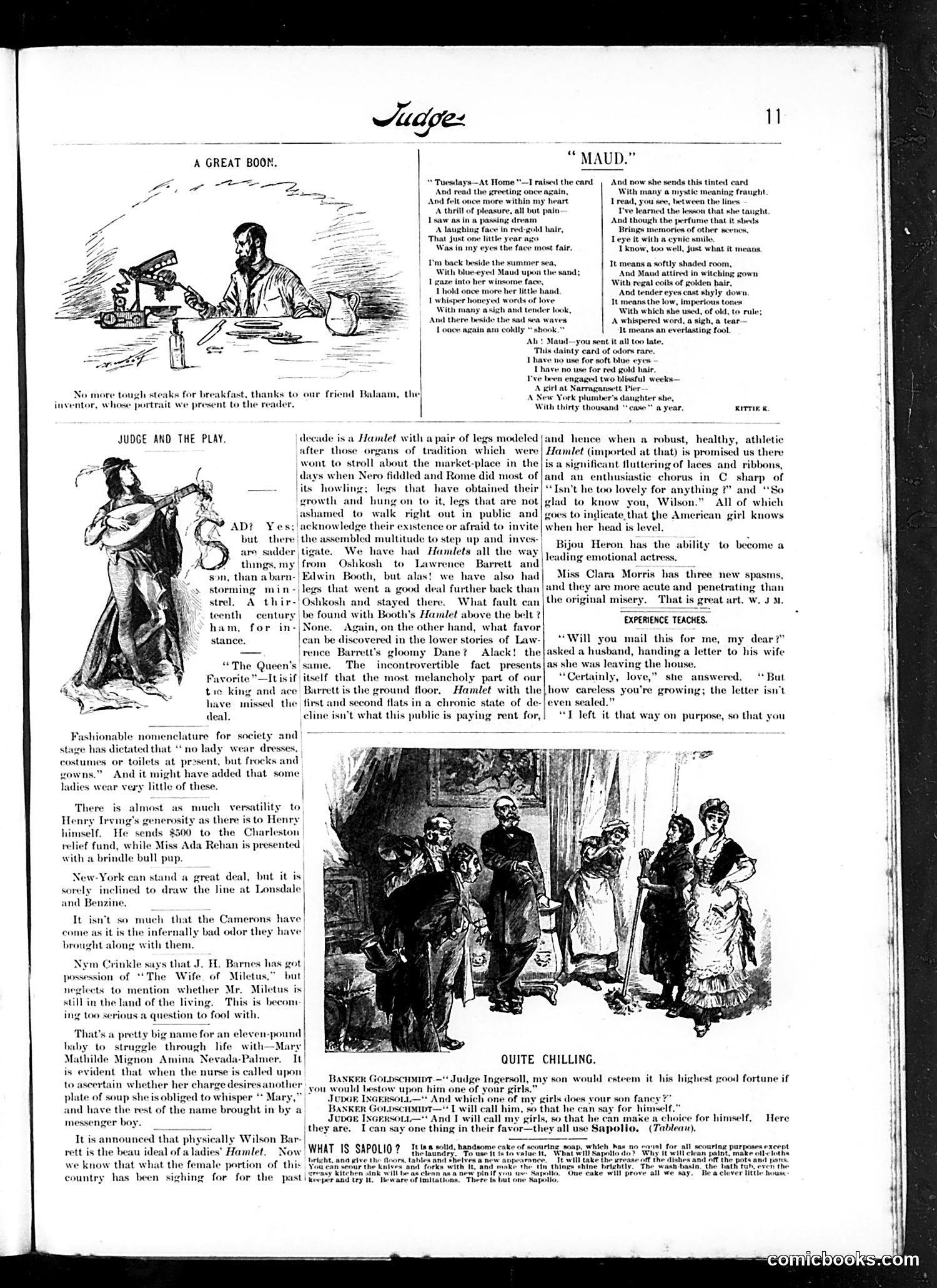
This page contains theatrical criticism and romantic poetry rather than political cartoons. The main content includes: **"A Great Boon"** (left): A sketch showing a man reading by lamplight, accompanying text about appreciating a letter from "Balaam," crediting an unnamed inventor. **"Maud"** (right): A sentimental poem about a man receiving a tinted card from a woman named Maud, whom he loved but lost. He recognizes the card as manipulative—"it means a softly shaded room" and her "imperious tones"—yet admits she's made him "an everlasting fool." **"Judge and the Play"** (center): Theatre criticism discussing recent productions of *Hamlet*. The author humorously complains that while various famous actors (Wilson Barrett, Edwin Booth, Bijou Heron, Ada Rehan) have played the role, American audiences are distracted by actresses' legs and costumes rather than focusing on the actual performance. The satire targets both shallow theatrical production values and audience superficiality. **Minor content** includes brief social commentary on fashion and gossip.
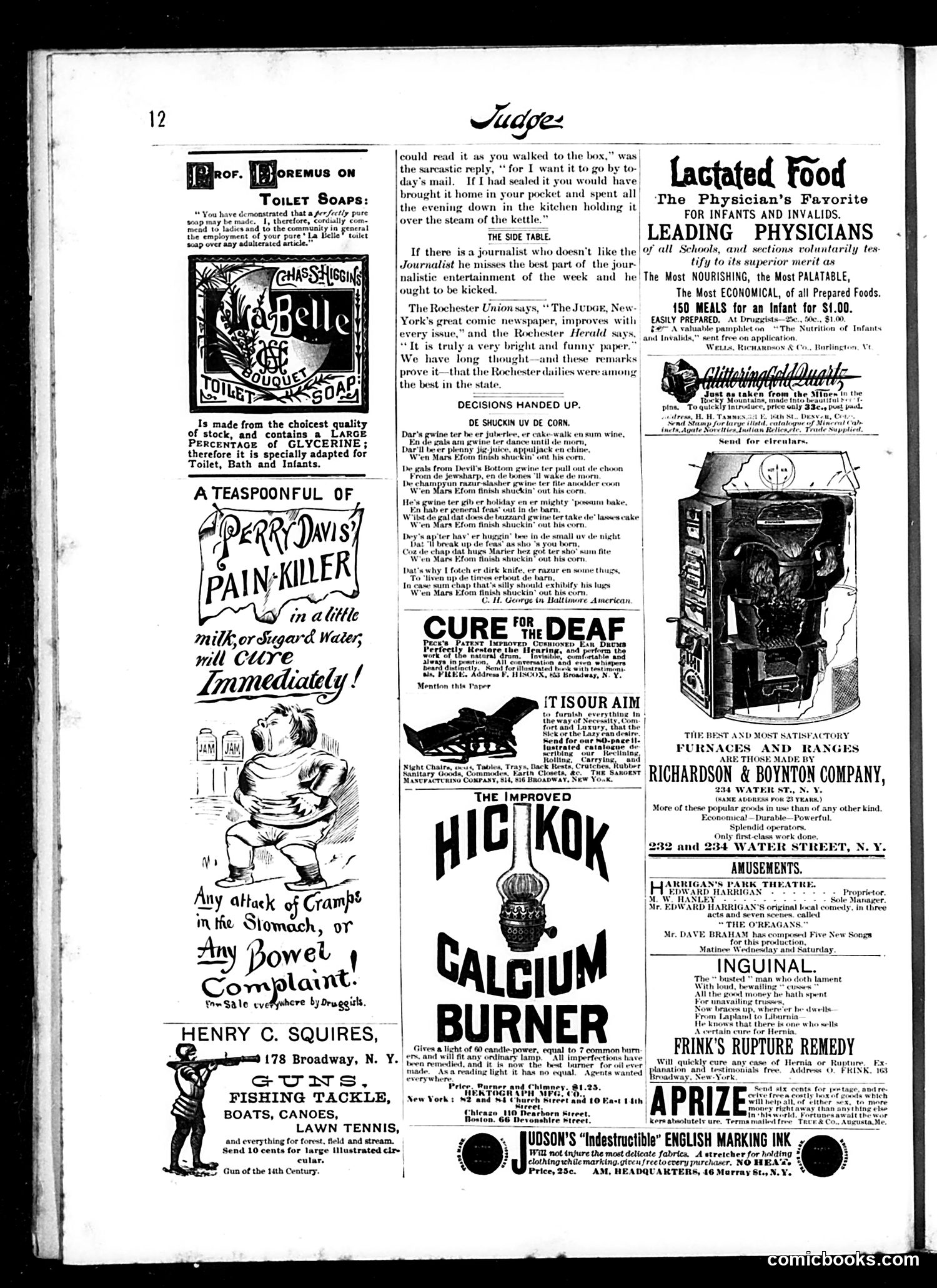
This is primarily an **advertising page** with minimal editorial cartoon content. The page showcases various patent medicines and commercial products typical of late 19th-century American publications. The notable editorial content appears to be "De Shuckin Uv De Cork" — a dialect piece written in exaggerated African American vernacular (a common if offensive convention of the era). It appears to be humorous commentary about corn-shucking, playing on phonetic spelling and rural dialect for comic effect. The bulk of the page consists of advertisements for products reflecting period concerns: Perry Davis's Pain-Killer, Hickok Calcium Burner (a heating device), Lactated Food (infant nutrition), and various remedies for deafness and rupture. These ads reveal contemporary anxieties about health, infant mortality, and medical solutions. The page also advertises Henry C. Squires's sporting goods and entertainment listings for Harrigan's Park Theatre, reflecting urban leisure activities of the period.
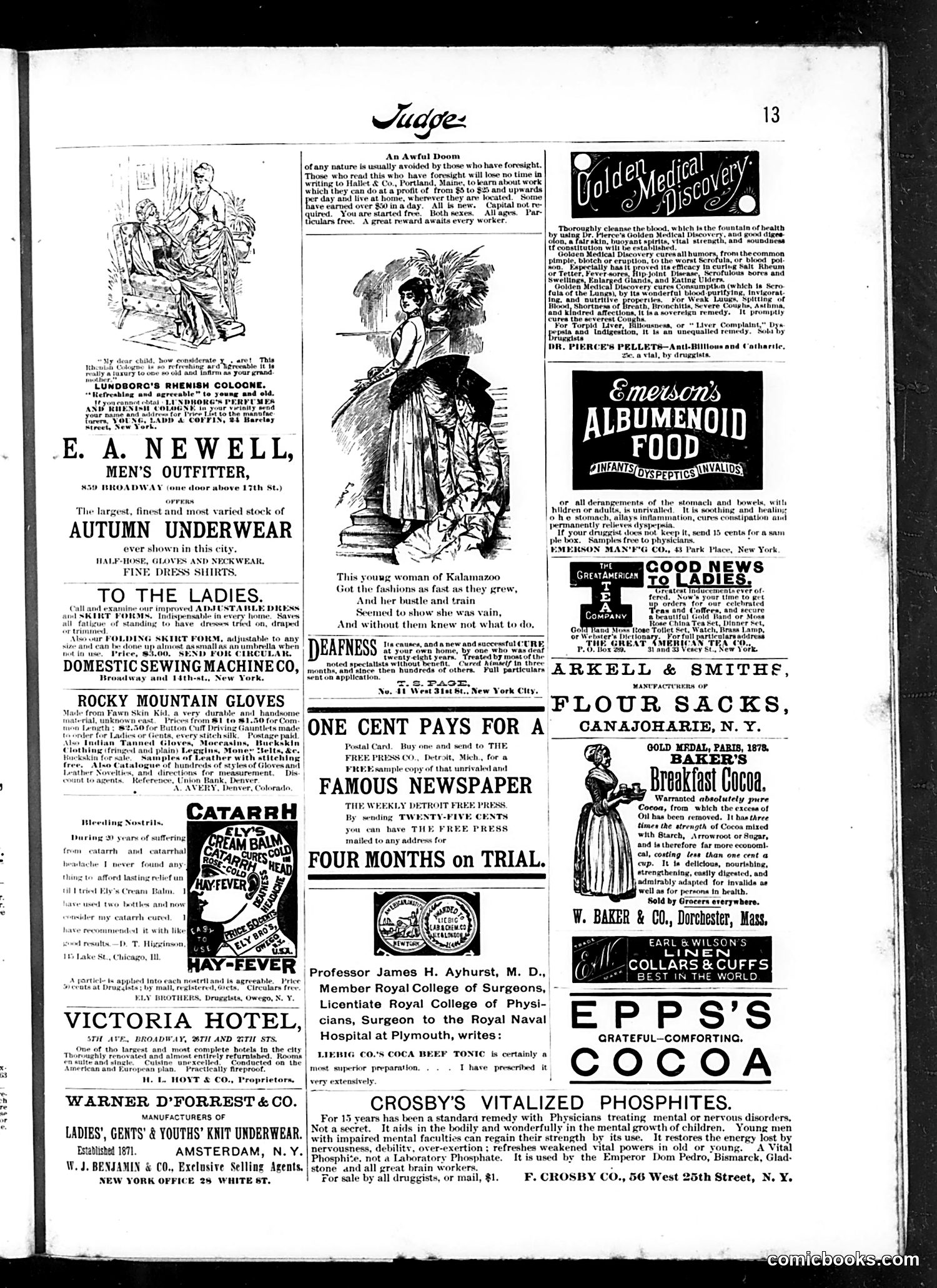
This page is primarily **advertisements** with one satirical cartoon at top-left. The cartoon, titled "An Awful Doom," depicts a young woman of Kalamazoo obsessed with fashion—constantly acquiring new bustles and trains, shown racing to keep up with rapid style changes. The satire mocks women's perceived vanity and enslavement to fashion trends; the "awful doom" is her inability to exist without fashionable garments. The remainder is typical period advertising: mail-order work schemes, underwear and clothing retailers, patent medicines (Dr. Pierce's Medical Discovery), home sewing machines, and various tonics and foods claiming health benefits. These ads reflect late-Victorian consumer culture and the prevalence of dubious medical "cures." The page number indicates this is from Judge, a satirical weekly magazine popular in the 1880s-1890s, targeting middle-class American readers with gentle social commentary alongside commercial content.
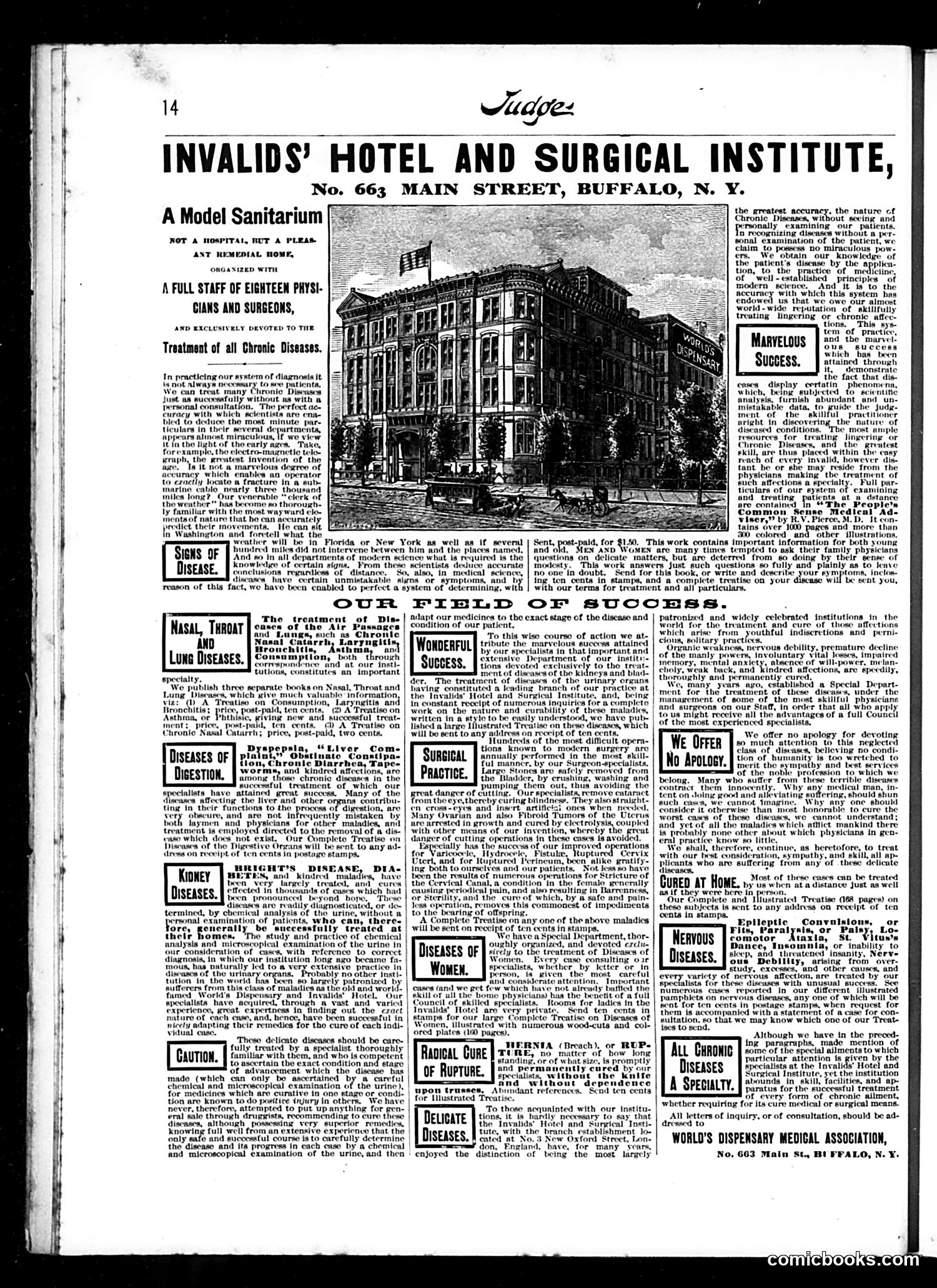
This is primarily an **advertisement, not a cartoon**, for the Invalid's Hotel and Surgical Institute in Buffalo, New York—a facility claiming to treat chronic diseases. The "satire" lies in the page's claims: the institute asserts it can diagnose and treat patients **without seeing them in person**, comparing this ability to telegraph operators locating breaks in submarine cables or meteorologists predicting distant weather. This absurd logic—that diseases can be remotely diagnosed through scientific "phenomena"—is presented earnestly but appears ridiculous to modern readers. The advertisement promotes mail-order medical consultation and mail-order treatment books ("Common Sense Medical Adviser"), positioning distance as no obstacle to accurate diagnosis. This reflects late-19th-century medical pseudoscience and mail-order medicine culture that *Judge* likely mocked as typical health-industry hucksterism of the era. The numerous sidebars advertising treatments for specific conditions (kidney disease, nervous diseases, hernia, etc.) reinforce the sense of aggressive, opportunistic medical marketing.
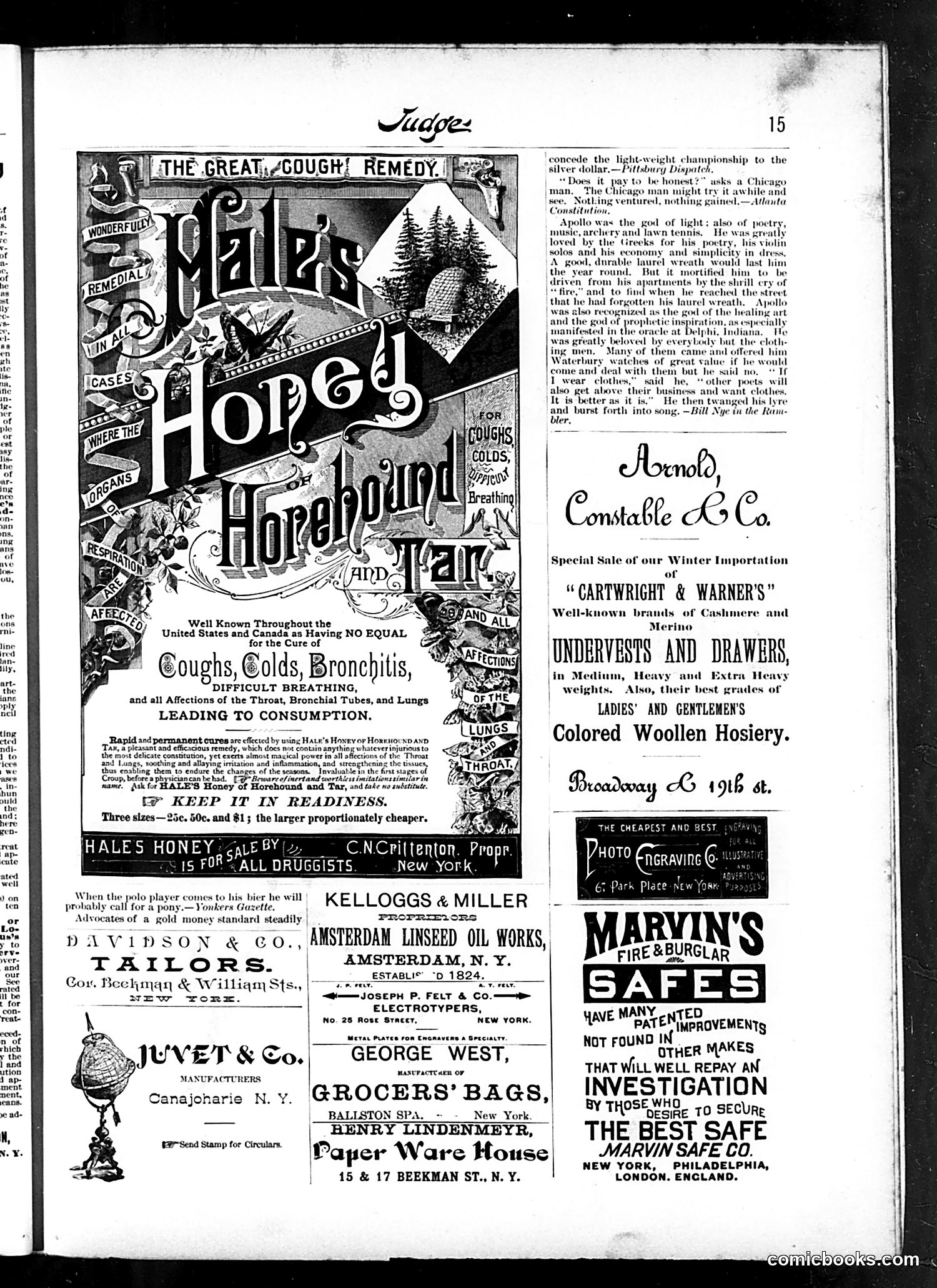
This page is primarily **advertising**, not political satire. The dominant feature is a large patent medicine ad for "Hale's Honey of Horehound and Tar"—a cough remedy marketed as a cure-all for respiratory ailments, consumption, and bronchitis. The ornate Victorian advertisement uses typical period medical marketing tactics, claiming the remedy is "Well Known Throughout the United States and Canada as Having NO EQUAL." The page also includes a brief text snippet (apparently from Bill Nye) about a violin player, followed by numerous commercial advertisements for clothing (Arnold, Constable & Co.), safes (Marvin), hosiery, paper goods, and industrial products. There is **no political cartoon or satirical content visible** on this page. It represents Judge functioning as a vehicle for commercial advertising alongside its editorial content—standard practice for 19th-century magazines.
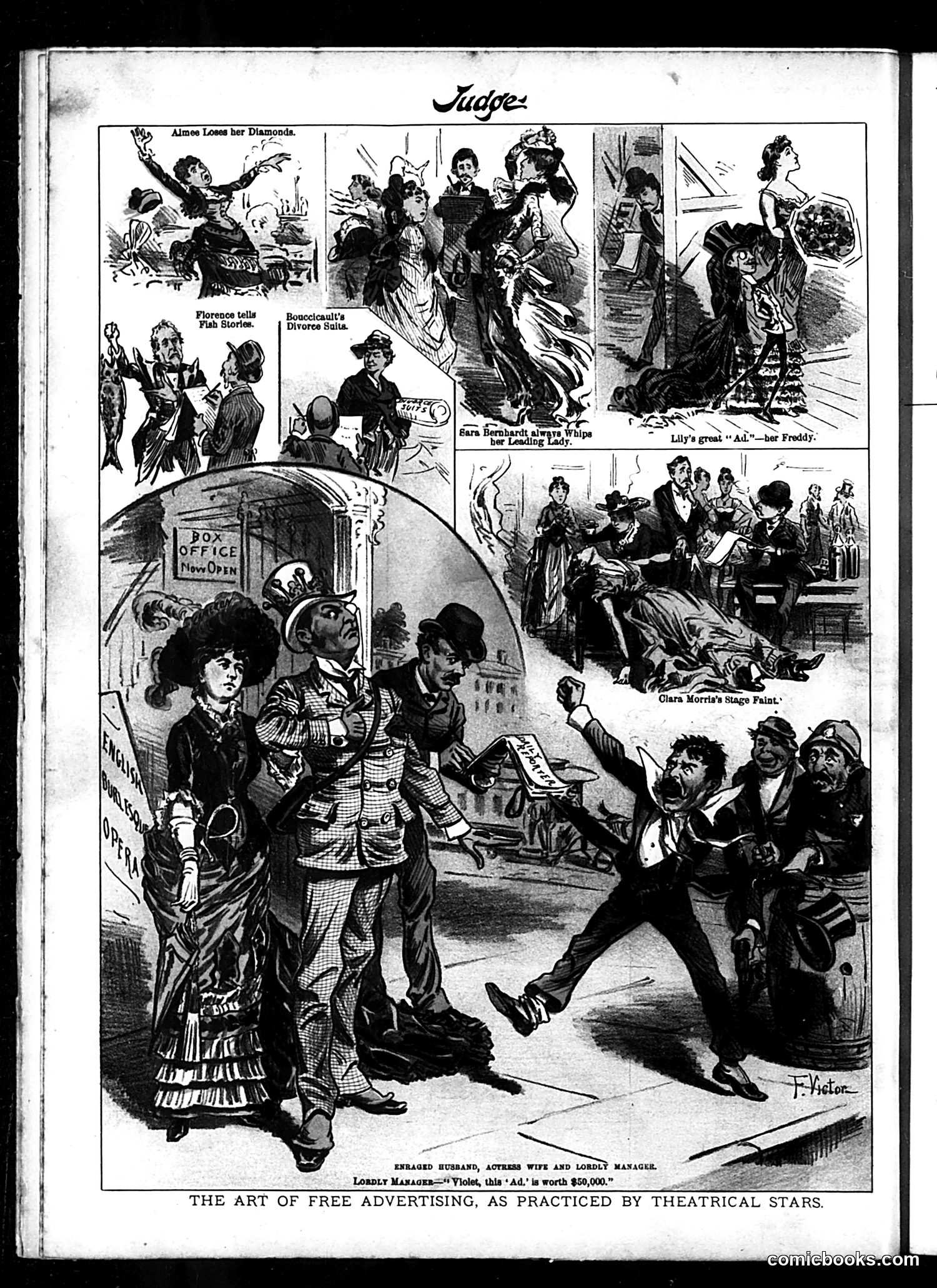
This page satirizes theatrical self-promotion and advertising practices among stage performers. The title references "The Art of Free Advertising, as Practiced by Theatrical Stars." The vignettes mock various actresses creating public spectacles for publicity: "Aimee Loses her Diamonds," "Florence tells Fish Stories," and "Sara Bernhardt always Whips her Maid in Public" depict performers manufacturing scandalous incidents to generate press coverage. The main cartoon shows an "Enraged Husband, Actress Wife and Lordly Manager," where the manager tells the actress that her manufactured "Ad" (advertisement/scandal) is worth $50,000. This directly critiques how theatrical stars of the period deliberately created controversies—domestic disputes, lost jewels, public confrontations—to gain free newspaper coverage and public attention, treating scandal as a calculated publicity tool rather than genuine misfortune.