
A complete issue · 16 pages · 1886
Judge — January 16, 1886
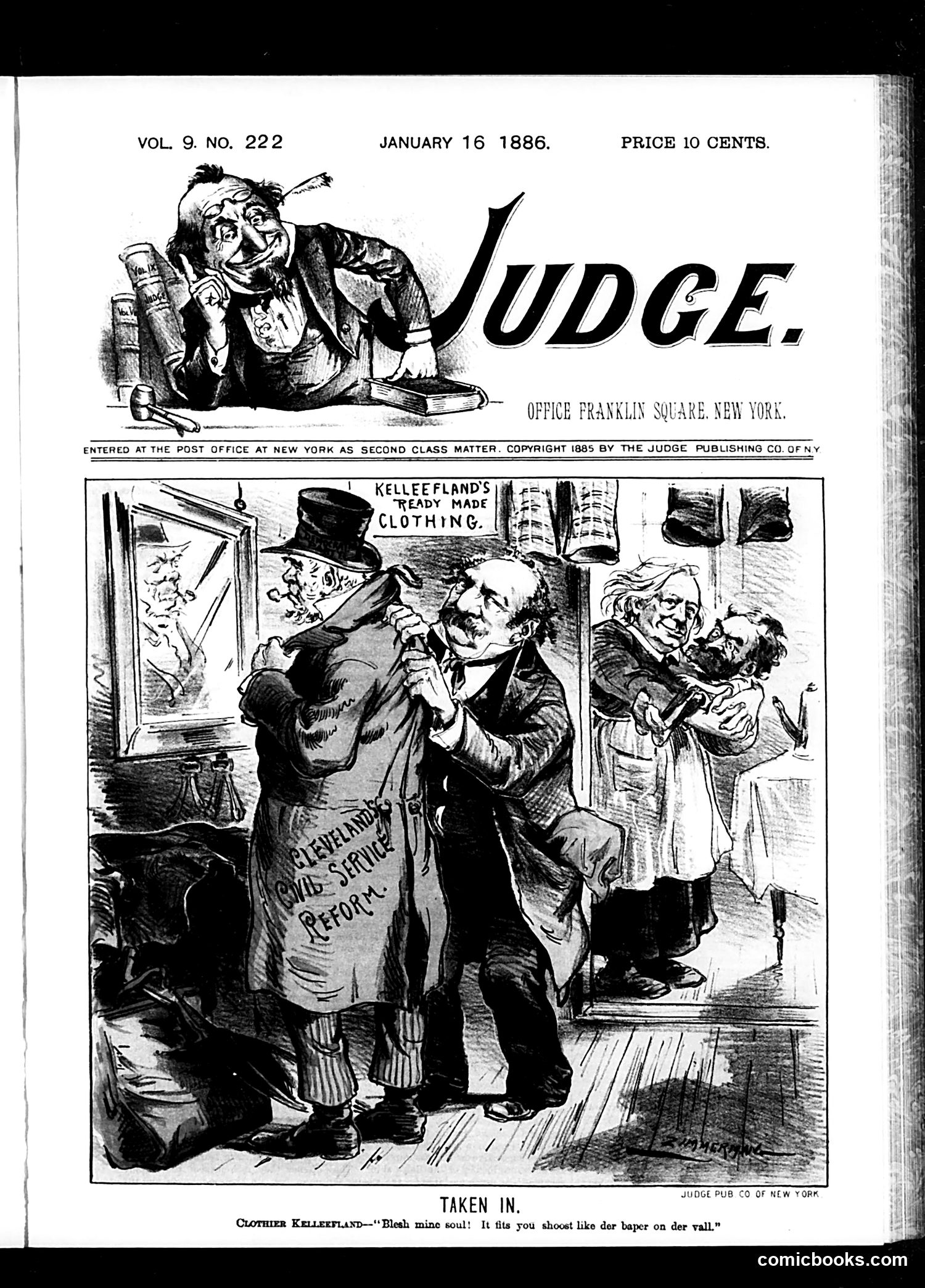
This political cartoon titled "Taken In" satirizes **Clothier Kelleland** (a clothing merchant), depicted as a con artist being swindled. The main figure wears a sash labeled "Cleveland Civil Service Reform," referring to President Grover Cleveland's reform policies. The joke appears to be that Cleveland's civil service reforms—intended to remove corruption and patronage from government—are themselves a deception or scam. The cartoonist suggests the reform movement is dishonest theater rather than genuine change. The figures in the background (possibly political figures or reformers) witness the scene, reinforcing the satirical message that prominent reform advocates are either duped or complicit in the charade. The cartoon represents skepticism about Cleveland's reform agenda and broader late-19th-century anxieties about political authenticity.
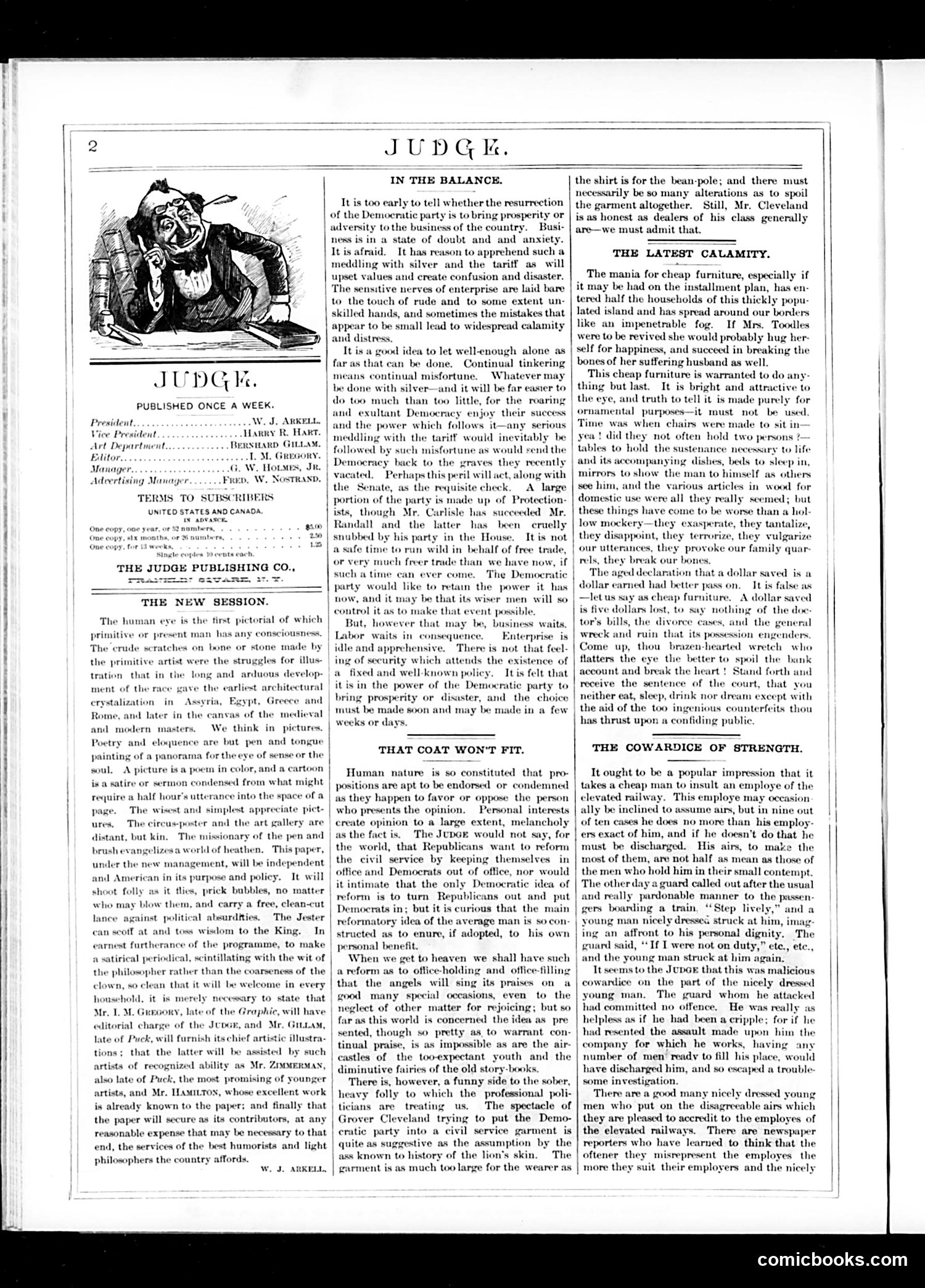
The main cartoon titled "JUDGE" shows a disheveled figure in apparent distress or collapse, representing the personification of the publication itself or perhaps the Democratic Party during economic hardship. The accompanying articles discuss business uncertainty, tariff debates, and Democratic Party struggles. References to "the Senate" and office-holding suggest late 19th-century political tensions. One article mentions "Republicans want to reform the civil service" and criticizes Democratic governance. The satirical commentary focuses on economic anxiety ("silver and the tariff"), enterprise difficulties, and Democratic mismanagement. Without specific dates or named figures visible, the exact historical moment remains unclear, but the content reflects Gilded Age political and economic controversies between Democrats and Republicans over tariff policy and civil service reform.
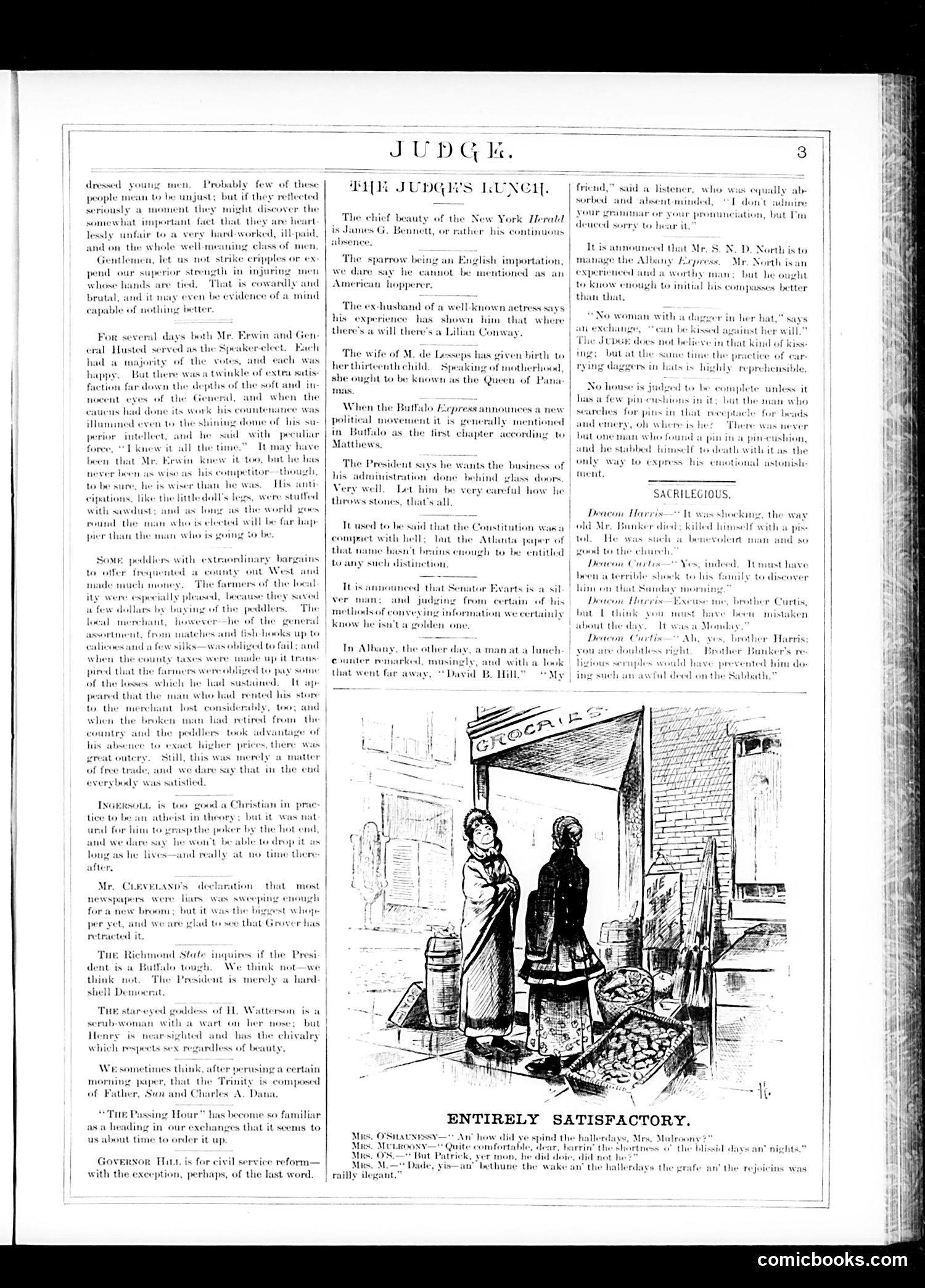
This page contains several brief political commentaries and a cartoon titled "Entirely Satisfactory," which depicts two working-class women at a grocery store. **The Cartoon:** The women appear to be having a conversation about their husbands' behavior, with dialogue suggesting domestic complaints—likely a humorous critique of lower-class life or marital dynamics of the era. **Political References:** The text mentions: - **James G. Bennett** of the *New York Herald* newspaper - **M. de Lesseps** (the French engineer of the Suez Canal), whose wife is noted for having thirteen children - **Cleveland** and references to civil service reform - Vague allusions to Buffalo and Albany politics **Overall Point:** Rather than focused satire, this appears to be a miscellaneous humor column mixing domestic comedy, press criticism, and local political jabs—typical of Judge's lighter content alongside serious political cartoons.
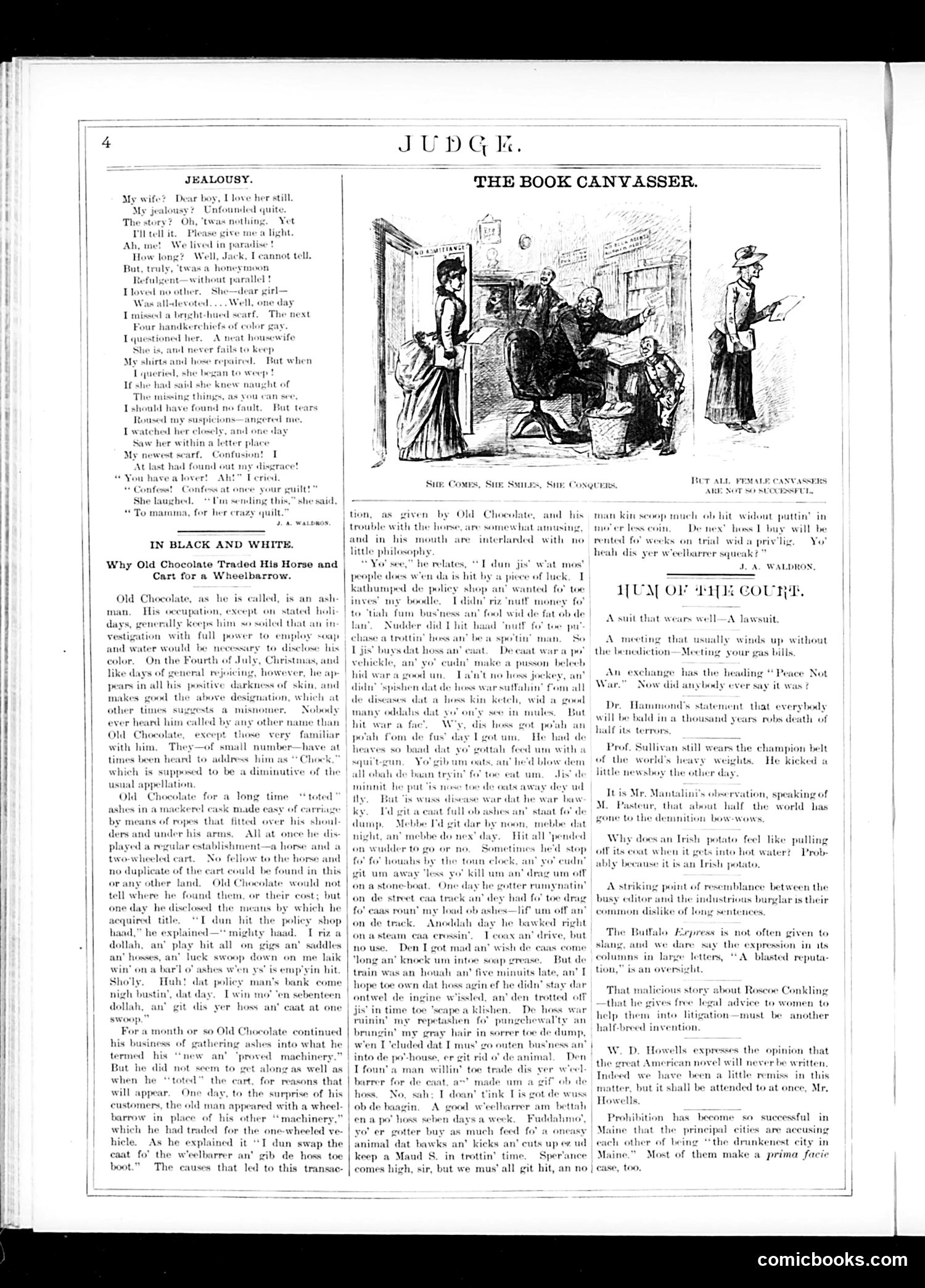
This Judge magazine page contains three distinct pieces of satirical content: **"Jealousy"** (left column): A poem about a man's unfounded suspicion that his wife is unfaithful—he notices missing scarves and interprets innocent circumstances as infidelity. The satire mocks male jealousy and paranoia in relationships. **"The Book Canvasser"** (illustration, center-right): Shows door-to-door book salesmen at work. The caption notes female book canvassers are "not so successful," likely satirizing both the emerging presence of women in sales and period assumptions about their ineffectiveness. **"Why Old Chocolate Traded His Horse and Cart for a Wheelbarrow"** (main text): A dialect-heavy story mocking an African American ash-collector's poor financial decisions. After winning at an illegal lottery ("policy shop"), he buys a horse and cart but foolishly trades them for a wheelbarrow—satirizing stereotypes about Black Americans and money management. The racist dialect spelling and patronizing tone reflect the period's deeply offensive racial attitudes.
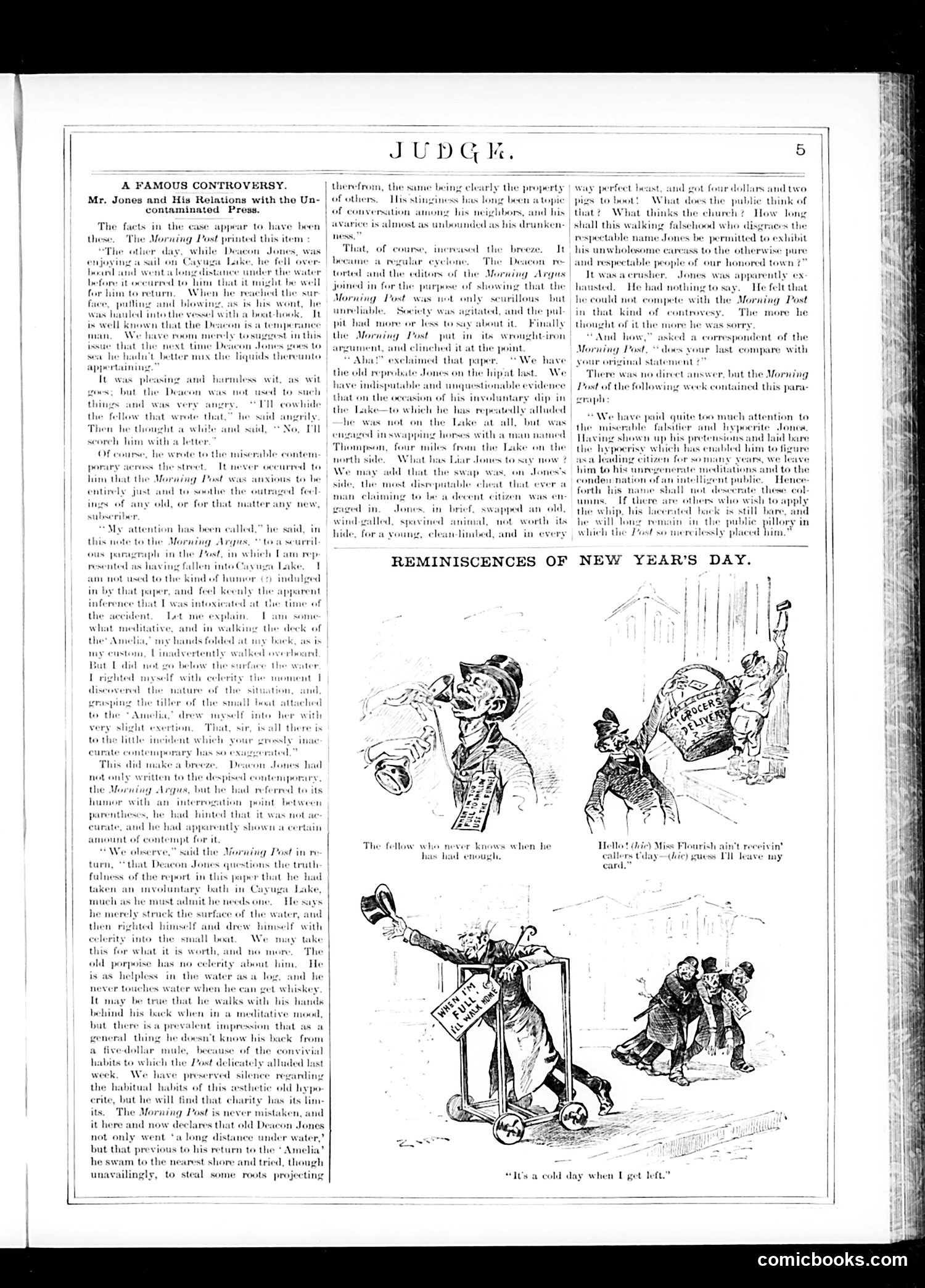
This satirical article mocks a dispute between Mr. "Deacon" Jones and the *Morning Post* newspaper. Jones claims he was walking on a ship deck near Cayuga Lake when he accidentally fell overboard, but quickly recovered himself with minimal incident. The *Morning Post* published a sensationalized account of this mishap. Jones demands a retraction, asserting he was actually on land—four miles away—swapping horses with someone (and making a disreputable deal in the process). The satire's point: Judge ridicules Jones for being a hypocrite who objects to one embarrassing falsehood while apparently telling his own lies about his whereabouts. The article emphasizes Jones's reputation for excessive drinking and moral duplicity, suggesting his complaint about the newspaper's "inaccuracy" rings hollow given his own dishonesty. The piece mocks both the man's character and the broader newspaper practice of sensationalizing trivial incidents.
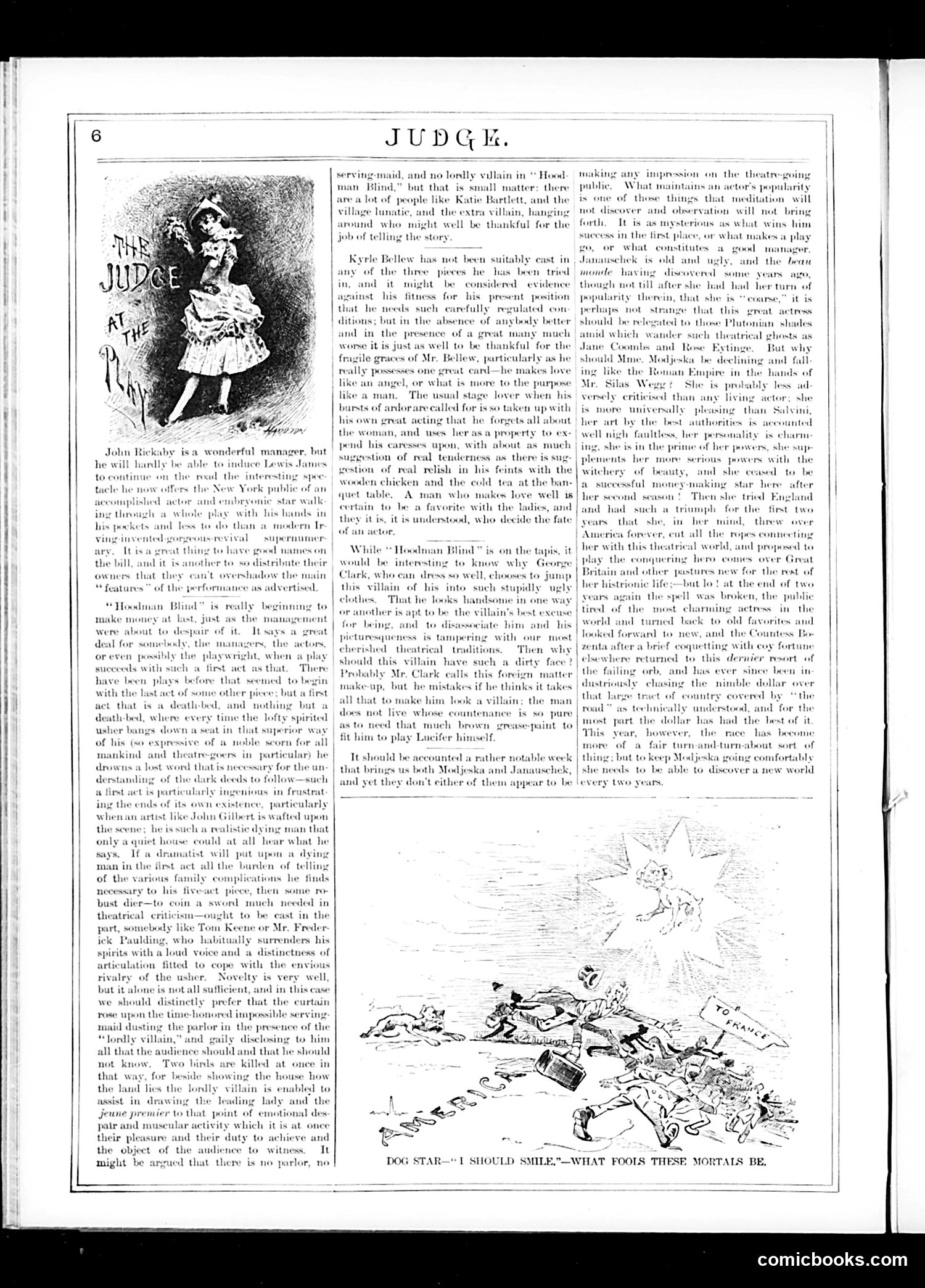
This page critiques theatrical casting and performance in late 19th-century American drama. The text discusses several actors and productions, particularly focusing on "Hoodman Blind," a contemporary play. **Key targets:** - **Kyrle Bellew** and **John Gilbert** are criticized for unsuitable casting choices and theatrical affectations (Gilbert's inaudible dying speeches, Bellew's overwrought "lordly villain" mannerism). - **Modjeska** (Helena Modjeska, a celebrated Polish actress) is discussed as aging out of roles despite remaining artistically superior to living competitors, relegated to "Plutonian shades" (theatrical obscurity). - The satire mocks how theatrical success depends on inexplicable factors—star power rather than talent—and how inferior actors maintain popularity through audience whim. The cartoon below (showing chaos with "Dog Star—'I should smile'—What fools these mortals be") reinforces the absurdity of theatrical fortune.
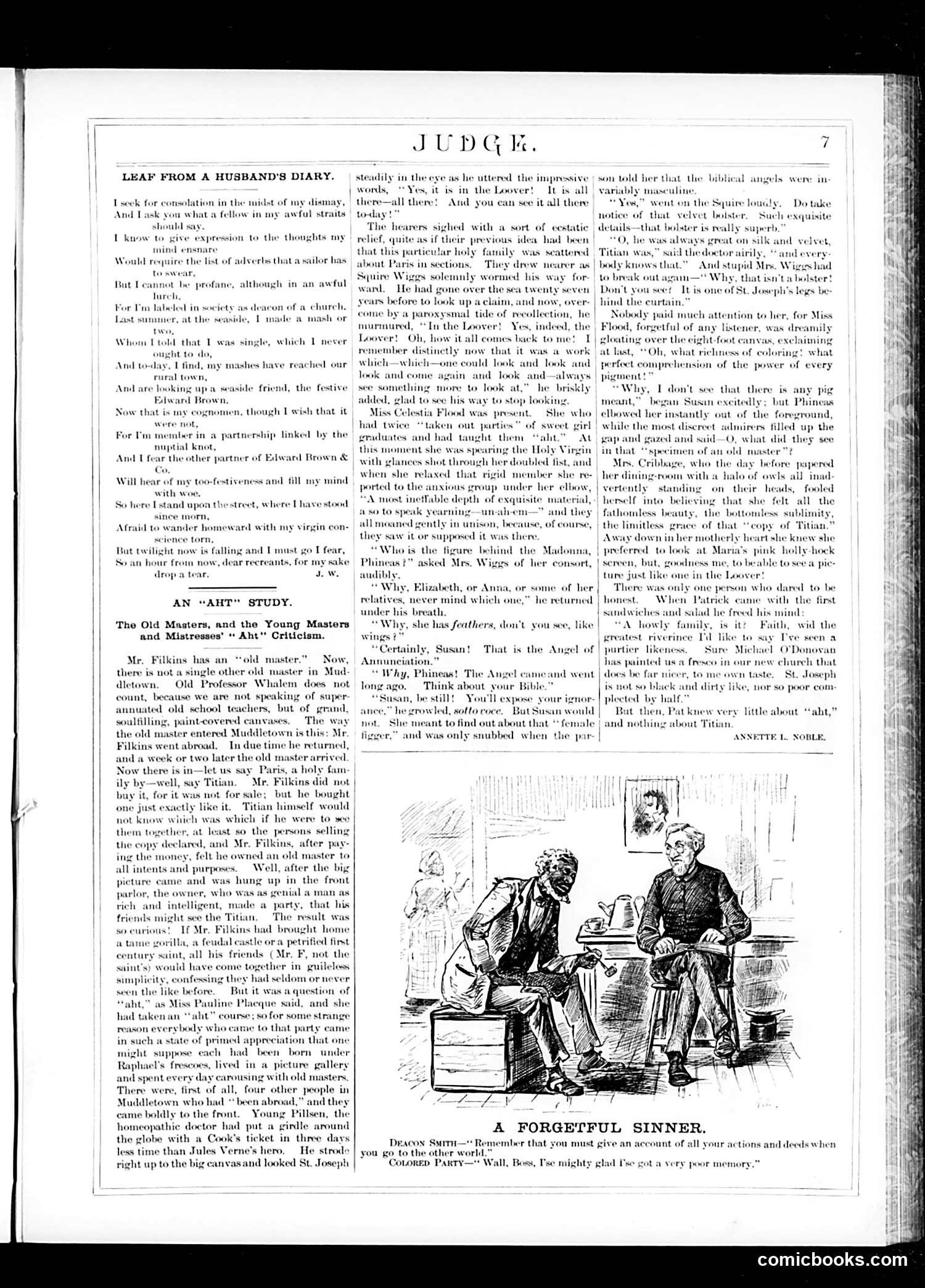
This page contains two distinct pieces: **"Leaf from a Husband's Diary"** (left column): A satirical domestic story mocking pretentious art appreciation. A husband, identified as a church deacon, recounts visiting the Louvre with various women, describing their affected gushing over paintings (particularly a Madonna). The satire targets superficial "art appreciation"—people who profess admiration for famous works without genuine understanding, simply repeating fashionable praise. The humor lies in the husband's observation that these admirers claim to see profound beauty they likely don't actually perceive. **"A Forgetful Sinner"** (bottom): An illustration with caption showing what appears to be a deacon or religious figure speaking with another man. The dialogue suggests ironic commentary on religious hypocrisy or selective morality—the deacon reminds someone to account for their actions "when you go to the other world," while the other character hopes to have "a very poor memory" (implying he wants to forget his sins). Both pieces satirize hypocrisy: pretentious cultural consumption and religious performance without substance.
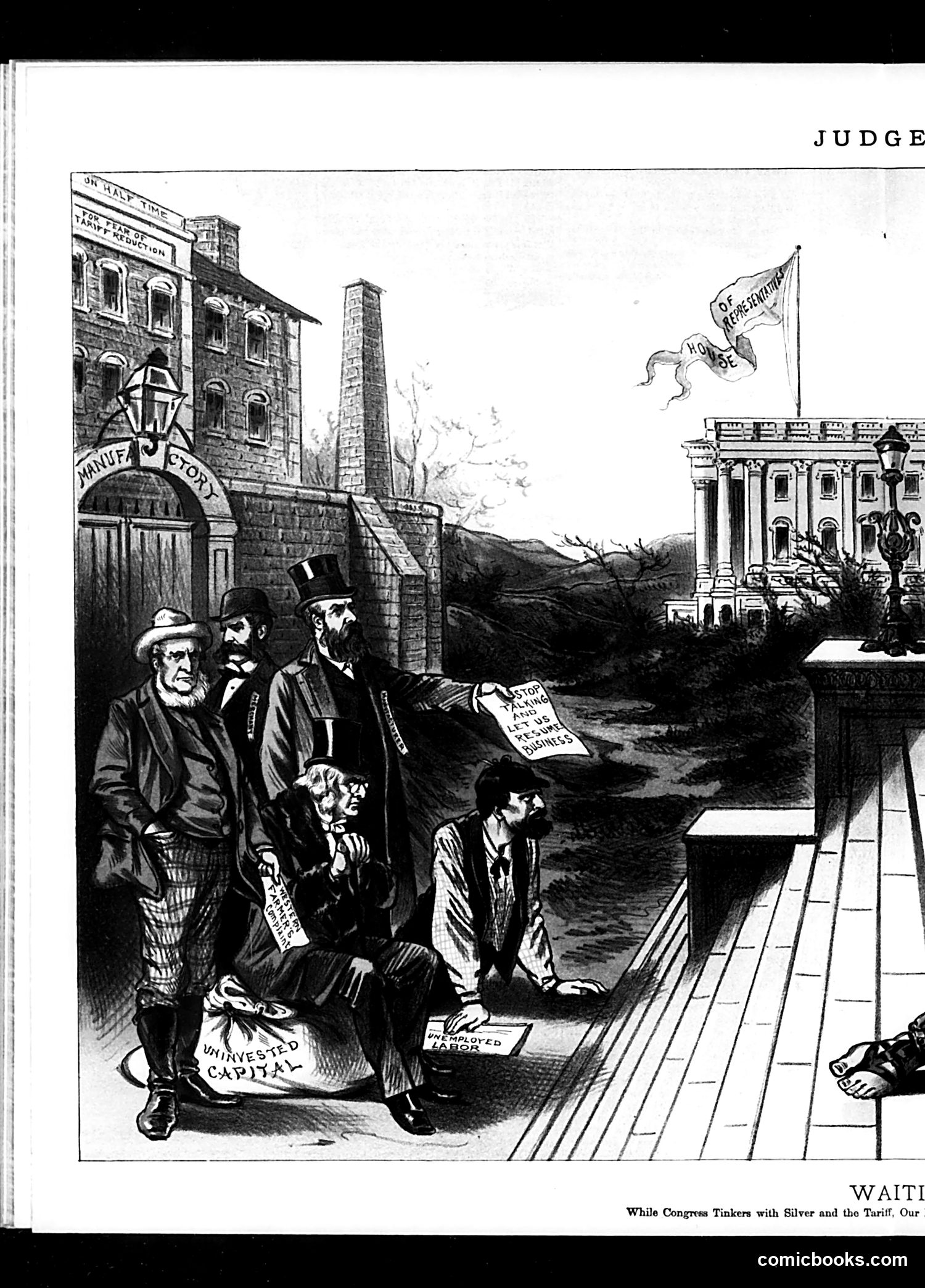
This Judge magazine cartoon satirizes Congressional inaction during economic hardship. The image depicts unemployed and impoverished workers (labeled "Unemployed Labor" and "Employed Poor") approaching the White House as supplicants, while Congress debates monetary policy ("Silver and the Tariff"). The contrast is stark: ordinary citizens suffering poverty stand outside the ornate building seeking help, while legislators inside remain focused on abstract economic theories. The factory and destitute figures on the left represent real economic suffering, while the government building on the right symbolizes disconnected leadership. The satire critiques how Congress prioritizes specialized economic debates over addressing actual human need and unemployment. This likely reflects the economic turbulence of the 1890s era, when silver and tariff policies dominated Congressional discourse amid widespread joblessness.
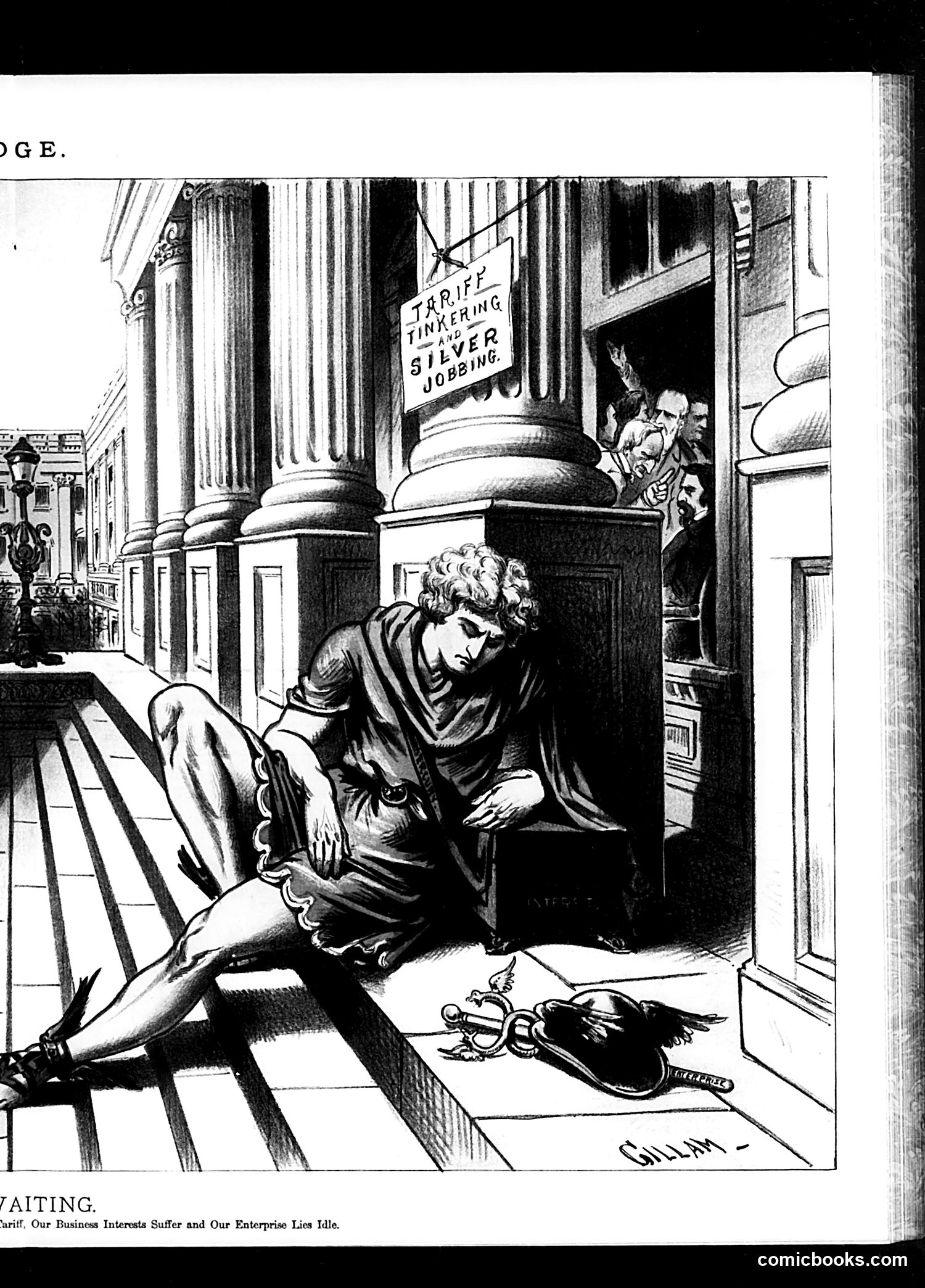
This political cartoon satirizes the economic impact of tariffs on American business. A woman sits idle outside a columned building (suggesting a government or financial institution), with her tools scattered on the ground. A sign reading "TARIFF TINKERING AND SILVER JOBBING" hangs above, indicating the cartoon blames governmental tariff and monetary policies for economic stagnation. The caption states the message directly: tariffs harm business interests and leave American enterprise idle. The woman's inactivity personifies Commerce or Industry rendered jobless by poor policy decisions. This appears to be from the late 19th century, when tariff debates dominated American politics—protectionist tariffs were controversial, with critics arguing they damaged rather than helped the economy.
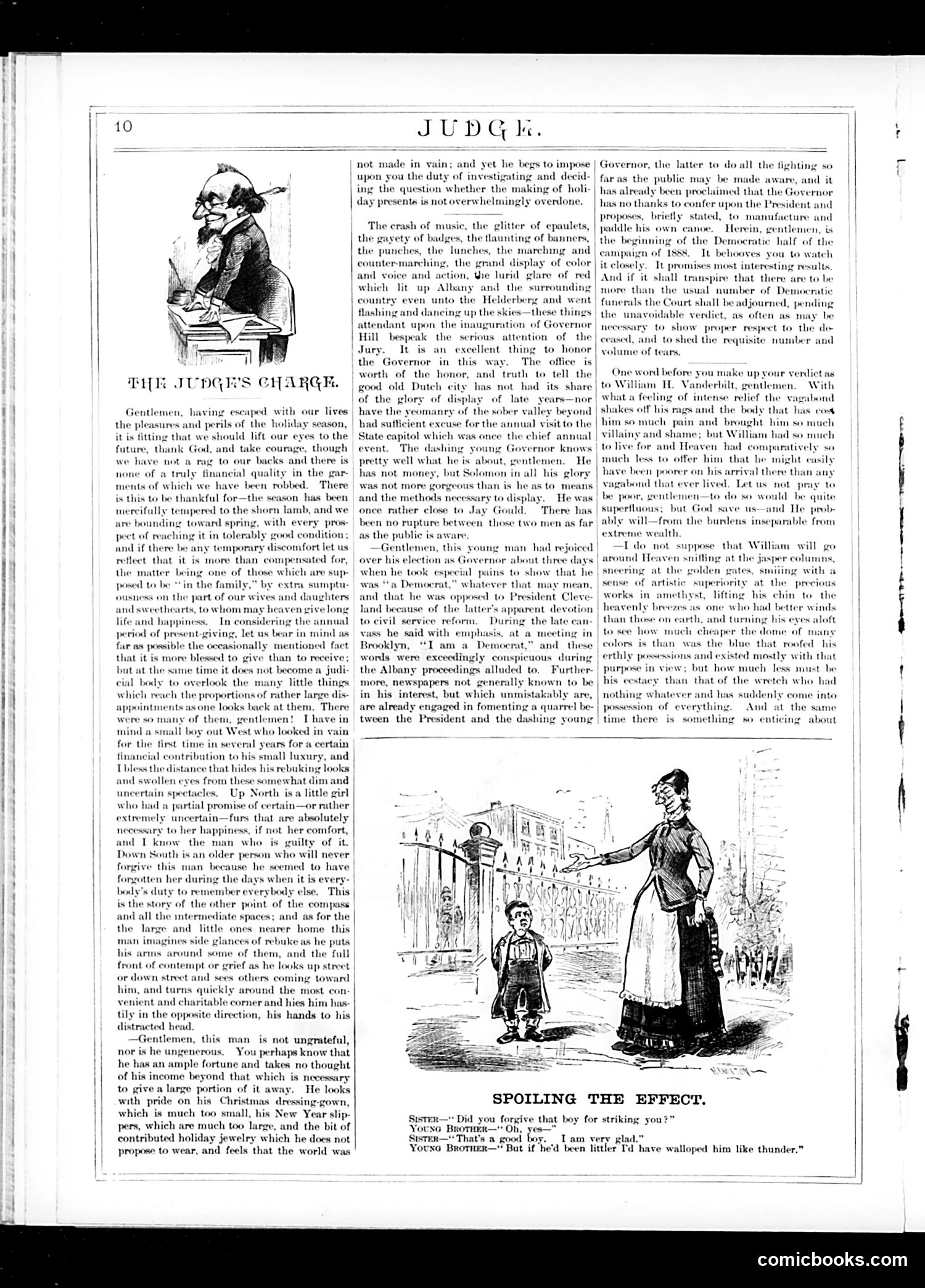
This page contains **"The Judge's Charge,"** a lengthy editorial complaint about the burdens of gift-giving during the holiday season, accompanied by a cartoon titled **"Spoiling the Effect."** The cartoon depicts a well-dressed man being confronted by a woman and child in a street scene, with the caption suggesting the man promised to strike the boy but failed to deliver. The joke satirizes parental discipline—the woman complains the man "spoiled the effect" of her threatened punishment by not following through with violence. The editorial mocks wealthy men who give inadequate or ill-fitting Christmas gifts (a dressing-gown "much too small," slippers "much too large") while congratulating themselves. The author criticizes this stingy hypocrisy, noting such men have "ample fortune" yet disappoint children across the country—"Up North," "Down South," and everywhere else—earning looks of "rebuke" and "contempt." The satire targets both wealthy negligence and the era's casual acceptance of corporal punishment as normal parenting.
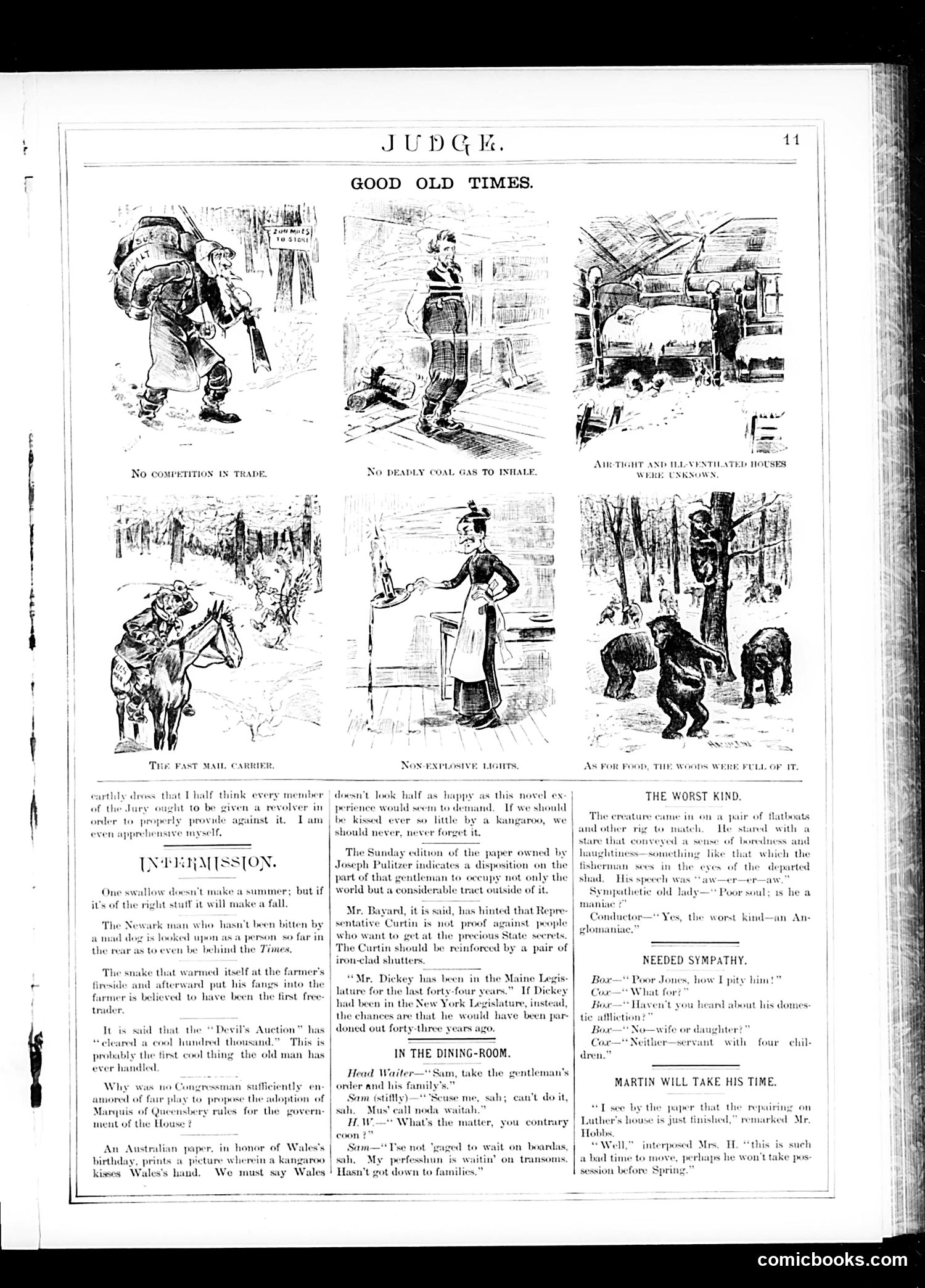
This page presents nostalgic humor contrasting "good old times" with modern complaints. The six cartoons mock Victorian-era conditions while satirizing contemporary grievances: **Key Cartoons:** - "No Competition in Trade" and "No Deadly Coal Gas to Inhale" ironically praise past hardships (dangerous work, poor air quality) - "Air-tight and Ill-ventilated Houses Were Unknown" mocks primitive housing - "The Fast Mail Carrier," "Non-Explosive Lights," and "As for Food, the Woods Were Full of It" continue this ironic praise of past deprivations **The Point:** The satire targets people who romanticize "the good old days" while ignoring actual hardships—dangerous jobs, explosions from faulty lamps, starvation risks. Judge ridicules this selective nostalgia by presenting objectively terrible conditions as supposed advantages. The prose sections include political gossip (Joseph Pulitzer, Representative Curtis) and social humor about class relations, particularly a dining-room scene satirizing racial attitudes through dialect humor—reflecting period prejudices typical of 1880s-90s publications.
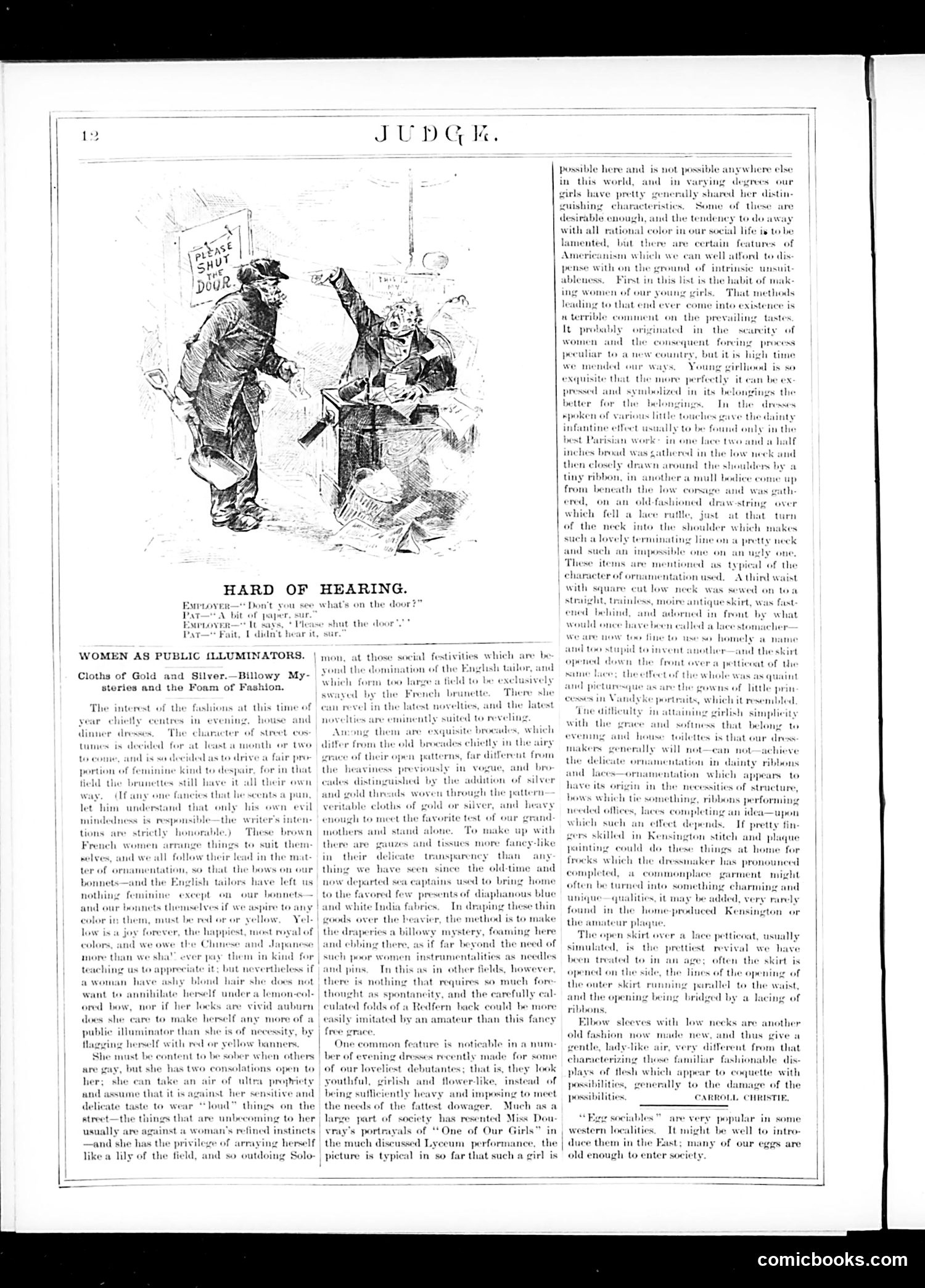
## The Main Cartoon: "Hard of Hearing" The cartoon depicts two figures at a door marked "SHUT THE DOOR." The joke is a simple pun: the employer says "Don't you see a sign on the door?" and the employee responds with a paper saying "It says, 'Please shut the door'." The humor relies on the employee pretending not to understand verbal instruction and instead reading the literal sign—a play on the phrase "hard of hearing." ## The Article: "Women as Public Illuminators" The accompanying essay satirizes contemporary women's fashion and social behavior. It critiques American women—particularly young women—for adopting excessive ornamentation: low necklines, ribbons, lace, and elaborate trim work. The author suggests these affectations are un-American, borrowed from French fashion, and represent a departure from practical taste. The satire targets the perceived vanity and "Americanism" (in a derogatory sense) of women pursuing appearance over substance, while also mocking the elaborate dress construction itself as impractical and overwrought.
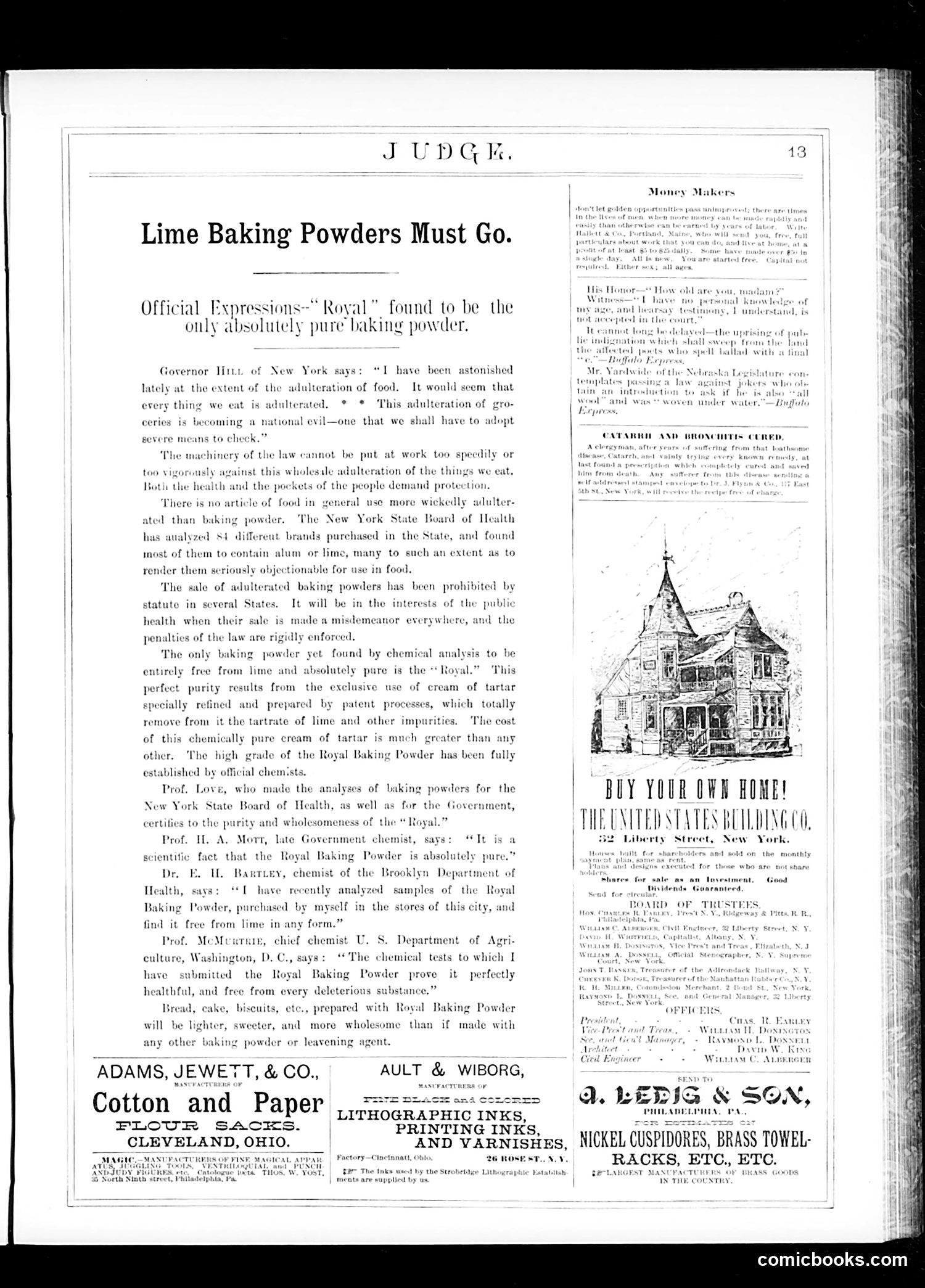
This page is primarily **advertorial content**—a lengthy advertisement for Royal Baking Powder disguised as news editorial. There is no cartoon per se. The piece addresses a genuine late-19th-century public health scandal: baking powder manufacturers commonly adulterating their products with alum and lime, harmful additives that cut costs. New York Governor Hill and the State Board of Health are quoted (legitimately) expressing outrage at food adulteration. The text argues that Royal Baking Powder alone is chemically pure, supported by testimonials from government chemists and professors. It calls for legal penalties against adulterated powders. **The satire/point**: This is Judge magazine's critique of *food industry dishonesty*. By framing Royal's purity as exceptional—rather than standard—the piece implicitly mocks the widespread corruption of American groceries and the slow regulatory response. The extensive expert testimonials underscore how contaminated competitors were. The surrounding advertisements (flour sacks, printing inks) are standard period trade ads.
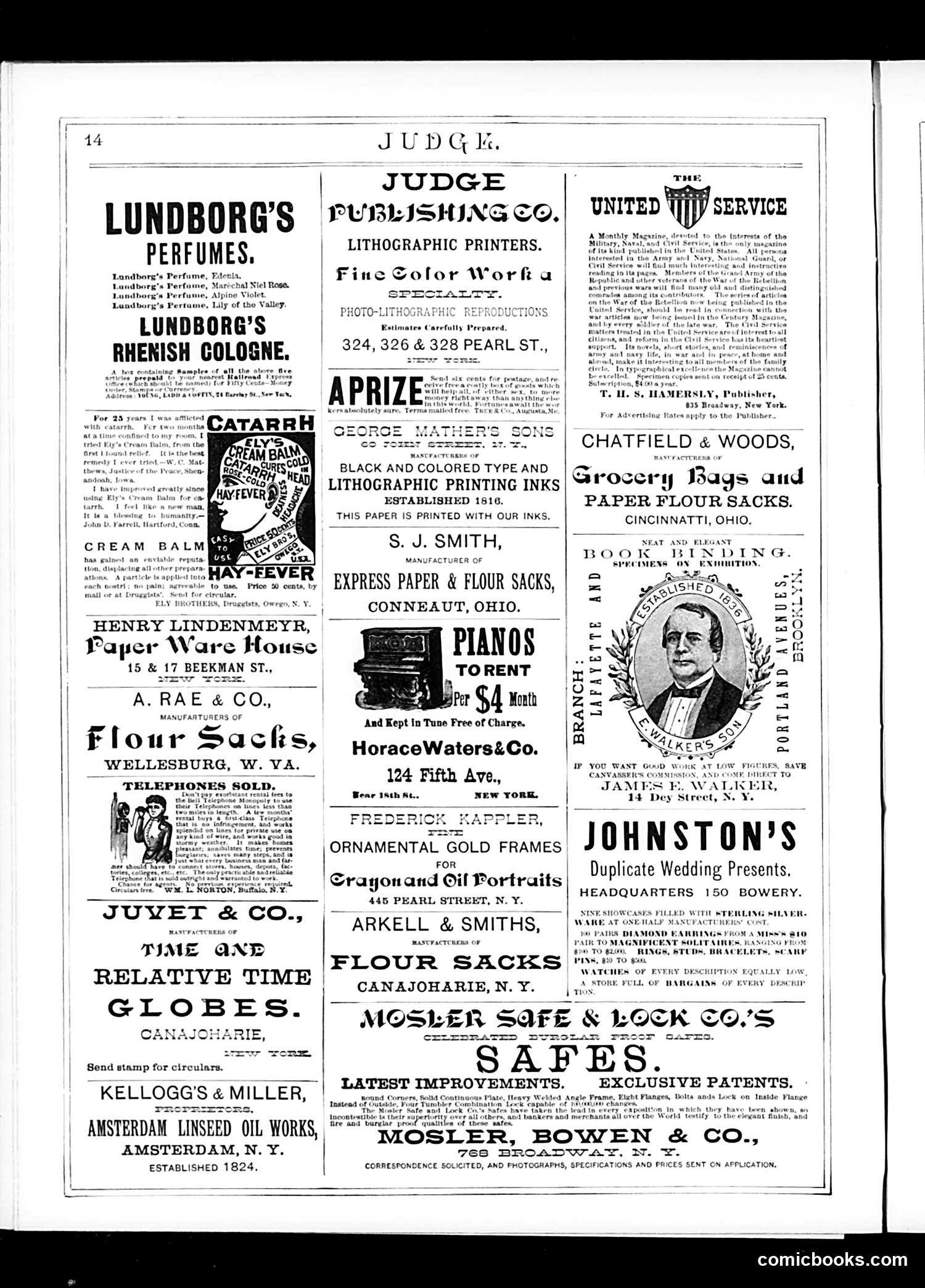
This is primarily an **advertising page** from Judge magazine, not a satirical cartoon page. It features dozens of commercial advertisements from late 19th-century American businesses, including perfume makers (Lundborg's), paper companies, printing firms, safes manufacturers (Mosler), pianos for rent, wedding gift retailers (Johnston's), and industrial suppliers. The only visual element beyond text is a **Catarrh Cream Balm advertisement** with a small illustrated figure—a common patent medicine ad typical of the era. **Context for modern readers:** This demonstrates how Judge, despite being a humor magazine, relied heavily on advertising revenue. The ads reflect the era's commercial priorities: manufacturing, industrial supplies, and dubious health products (like catarrh remedies). The page shows no political satire or social commentary—it's pure commercial content supporting the magazine's publication.
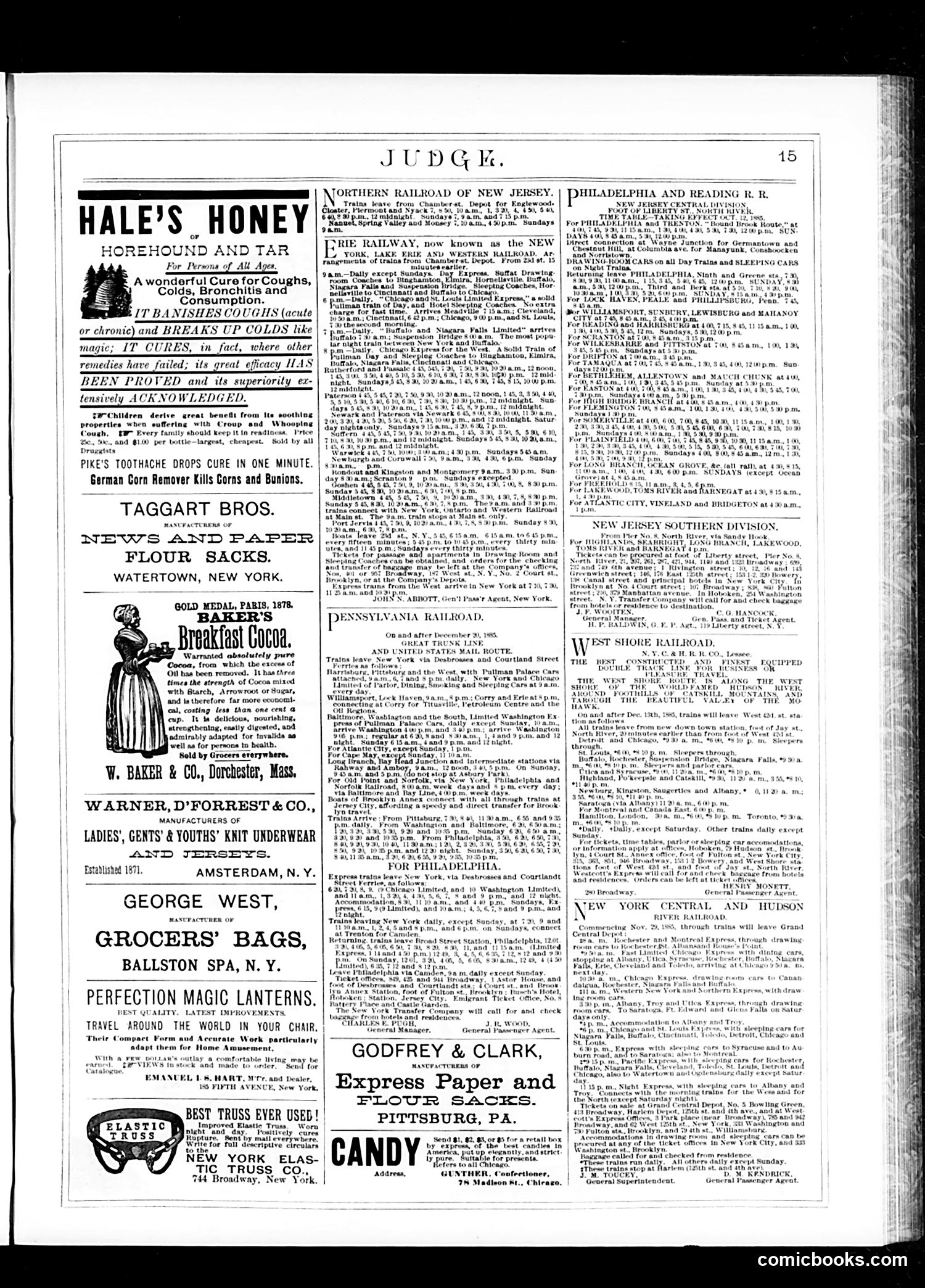
This page is primarily **advertising and railroad schedules**, not satirical content. The dominant visual element is Hale's Honey advertisement (top left), featuring a large illustration of a woman promoting a cough remedy. The text claims it "BANISHES COUGHS" and "CURES" various respiratory ailments where other remedies failed. The page contains numerous product advertisements typical of 1880s magazines—cocoa, corset truss devices, magic lanterns, grocers' bags—and extensive railroad timetables for Northern New Jersey, Erie Railway, Pennsylvania Railroad, and New York Central lines. **No political satire or cartoon is clearly visible** on this page. It represents the commercial, rather than editorial, content that filled Judge magazine. The rhetoric of the medicinal advertisements reflects 19th-century patent medicine marketing, making often exaggerated health claims common before FDA regulation.
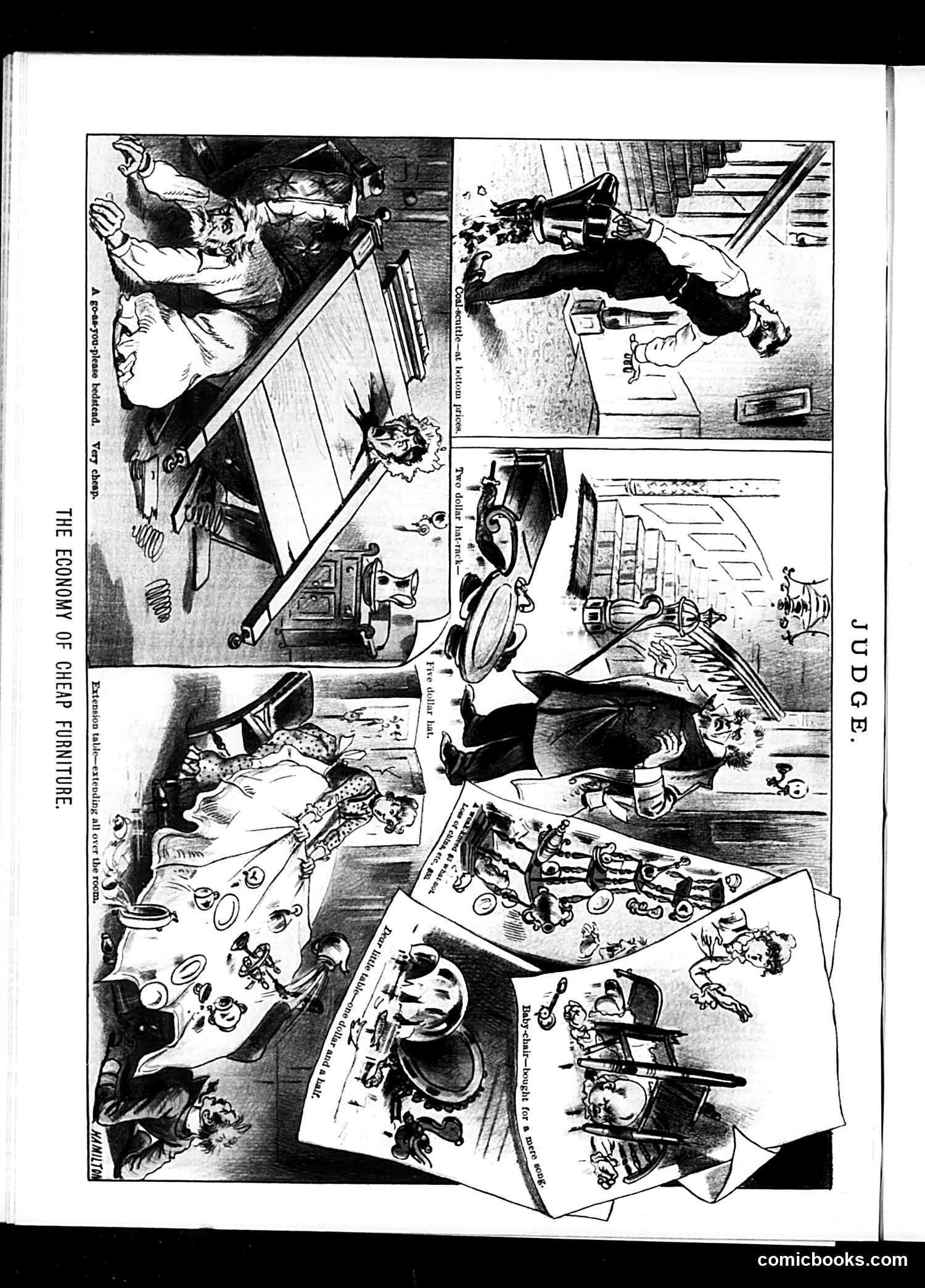
I can see this is a page from *Judge* magazine featuring what appears to be a multi-panel comic or satirical illustration, but the OCR text provided is essentially unreadable—it contains only scattered characters and numbers with no coherent words. Without legible text to accompany the image, I cannot reliably identify the specific figures, political references, or satirical point being made. While the artwork shows various scenes with people in early 20th-century dress and what appear to be domestic or social situations, I cannot determine what event, public figure, or political issue is being satirized. To provide accurate historical context, I would need either clearer OCR text or additional publication information (date, title, author).