
Judge, 1886-01-16 · page 2 of 16
Judge — January 16, 1886 — page 2: what you’re looking at
What you’re looking at
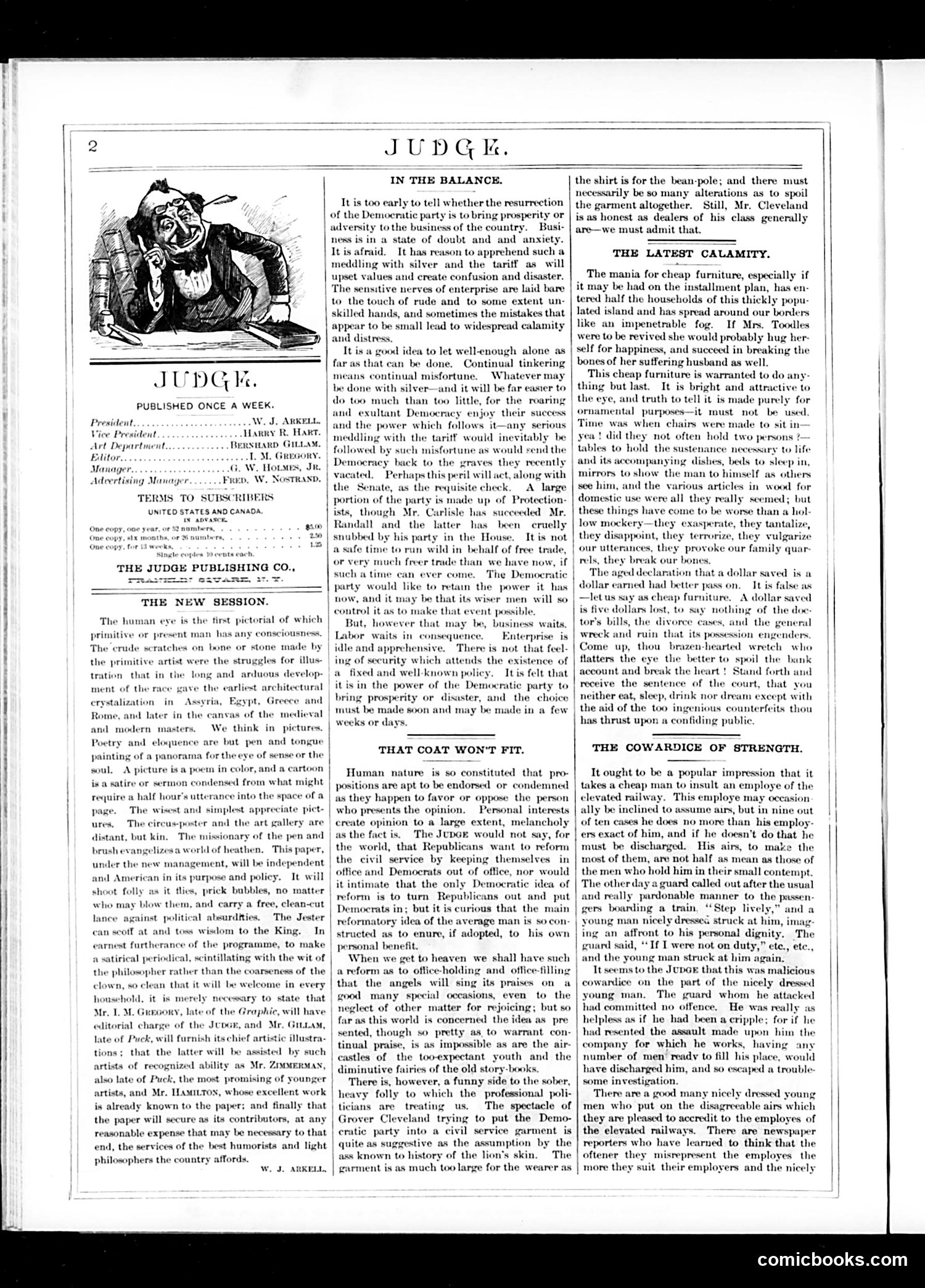
The main cartoon titled "JUDGE" shows a disheveled figure in apparent distress or collapse, representing the personification of the publication itself or perhaps the Democratic Party during economic hardship. The accompanying articles discuss business uncertainty, tariff debates, and Democratic Party struggles. References to "the Senate" and office-holding suggest late 19th-century political tensions. One article mentions "Republicans want to reform the civil service" and criticizes Democratic governance. The satirical commentary focuses on economic anxiety ("silver and the tariff"), enterprise difficulties, and Democratic mismanagement. Without specific dates or named figures visible, the exact historical moment remains unclear, but the content reflects Gilded Age political and economic controversies between Democrats and Republicans over tariff policy and civil service reform.
📄 Transcribed text from this page (OCR, searchable)
Machine-transcribed from the original scan — historical spelling and the odd misread are preserved.
JUDGK. PUBLISHED ONCE A WEEK. President. Ww. J. Vice President Art Department Eilitor. Manager. Advertising Manager Bersiaro ood. BE TERMS TO SUBSCRIBERS UNITED STATES AND CANADA. One copy, sx mnonth for is ARKELL, Harry R. Hart. GILLAM. REGORY. "THE SESSION. The human eye is the first pictorial ¢ NEW primitiv The crude the primitiv tration that in t ment of the race ratches on bone or st » the stru; long artist we ‘duous st arch crystalization in’ Assy Egypt, Gre Rome, and later in the and modern masters, We anvas of the 1 think in are but pen panorama for the A picture is a poem in color, and 4 myuienc a satire or sermon condensed from w a half hour's utterance into tl The wisest and sin The circus-poster and the art g distant, but kin. The missionary of the of heathen. Thi require spa page. ures, »prec brush evangelizes under the new and American in its purpose and policy. at folly who may blow them. s it flies, nd a free, lance a T at earnest further: a satirical period! the philosopher rat clown, so clean that it will Le welc household, it is merely necessary to st Mr, 1. M. Gr editorial el f the Jupar, a late of Puck, will furnish its chi that the latter will be assisted recognized ability as Mr. Zit of Puck, the most promising of nd Mr. HAMILTON, whose exce ean se and toss wisdom to t nce of the progi , scintillating with th ame, A Mr. artistic tions ; artists ¢ also la artists, is already known to the nd fina papers the paper will secure as its contributors, asonable expense that may be necessar; anagement, will be inde} than the coarseness of th RY, late of the Graphic, will hs of which present man has any consciousness, made by jes for illus develop- itectural pece and nedieval pictures. cartoon ofa pi lery ar nd pen is paper, pendent It will prick bubbles, no matter pan-cut inst political absurdities, The Jester e King. In ton he wit ¢ in every fe that Grits, iNustra- by such MERMAN, younger it work ly that y to that end, the services of the best humorista and light rds, philosophers the country w. J. ARKE! | and tongue | of sense or the | at might | posi | adversity JUDG Ik. IN THE BALANCE. It is too early to tell whether the resurrection of the Democratic party is to bring prosperity or tothe business of the country. Busi- ness is in a state of doubt and and anxiety. It is afraid. It has pprehend such a meddling with sil > tariff as will upset values and create confusion and disaster. The sensitive nerves of enterprise are laid bare to the touch of rude and to some extent un- skilled hands, and sometimes the mistakes that appear to be small lead to widespread calamity and distress, It is a good idea to let well-enough alone as far as that can be done. Continual tinkering means continual misfortune. Whate be done with silver—and it will be far e do too much than too little, for the roaring and r y thei and the power which follows it y serious meddling with the tariff would inevital followed by such misfortune as would send the back to the graves they recently vi the port rated, Perhaps this peril will act, along with te, as the requisite check. A large n of the party is made up of Protection- ists, though Mr. Carlisle has succeeded Mr. Randall and the latter has been cruelly snubbed by his party in the House, It is not a safe time to run wild in behalf of free trade, or very much freer trade than such a time party v now control it as to make th nt possible. But, however that 1 be, business waits. Labor waits in consequenc rprise is idle and apprehensive. re is not that feel- ing of security which attends the existence of a fixed and well-known policy. Itis felt that it isin the power of the Democratic part bring prosperity or disaster, and the choice be made in a few e have now, if me. The Deme fain the at its w tev Atie power it has must be made soon and mi weeks or day: THAT COAT, SON. FIT. Human nature is so constituted that pro- nS are apt to be endorsed or condemned happen to favor or oppose t who presents the opinion. Personal create opinion to a large extent, melancholy as the fact is. The JupGe would not say, for the world, that Republicans want to reform as the person nterests, | the civil service by keeping themselves in office and Democrats out of office, nor would it intimate that the only Democratic idea of reform is to turn Republicans out and put in; but it is curious that the of the average man is s¢ structed as to enure, if adopted, to his own personal benefit. When we get to heaven we shall ha a reform as to office-holding and offi that the angels will sing its praises on od mi: i en to the neglect of other 1 ng; but so far as this world is concerned the idea as pre sented, though so pretty as,to warrant con- tinual praise, is as impossible as are the aii castles of the too-expectant youth and the diminutive fairies of the old story-books. There is, howe a funny heavy folly to which the’ professional poli- ticians are treating us. The spectacle of er Cleveland trying to put the Demo- cratic party into a civil service garment is quite as suggestive as the assumption by the ass known to history of the lion's skin. The garment is as much too large for the wearer as such e-fillin “aster to | be | er men will so | the shirt is for the bean-pole; and there must necessarily be so many alterations as to spoil the garment altogether. Still, Mr. Cleveland is as honest as dealers of his class generally are—we must admit that. THE LATEST CALAMIT Y. The mania for cheap furniture, especially if | it may be had on the installment plan, has en- tered half the households of this thickly popu- lated island and has spread around our borders like an impenetrable fog. If Mrs. Toodles were to be revived she would probably hug her | self for happiness, and succeed in breaking the | bones of her suffering husband as well. This cheap furniture is warranted to do any. but last. It is bright e, and truth to tell it is m 1 purposes—it must not be used. was when chairs were made to sit in did they not often hold two persons ¢ | tables to hold the sustenance necessiry to life and its accompanying dishes, beds to sleep in, yea mirrors to show tl see him, and the domestic use were all they these things have come t low mockery—they | they disappoint, they terrorize, they vulgarize | our utterances, they provoke our family quar rels, they break our bones. | The aged declaration that a dollar saved is a dollar earned had better pass It is false ptus say as cheap furniture. A dollar saved dollars lost, to say nothing of the doe. 's bills, the nd the general | wreck and ruin that its possession engenders. | Come up, thou brazen-hearted wretch wl flatters the eye the better to spoil the bank account and break the heart ! Stand forth and receive the sentence of the court, that you neither eat, sleep, drink nor dream except with the aid of the tious counterfeits thou | has thrust upon a confiding public. man to himself us arti as others: les in wood for ly seemed; but be worse than a hol sperate, they tantalize, divore too THE COWARDICE OF STRENGTH. It ought to be a popular impression that it akes a cheap man to insult an employe of the vated railway. This emple Iy be inclined to assume airs, but in nine out of ten cases he does no more than his employ. ers exact of him, and if he doesn’t do that he must be discharged. His airs, to make the most of them, are not half as mean as those of the men who hold him in their small contempt. The other rd called out after the usual and really pardonable manner to t | gers boarding a train, “ young man nicely dressed struck at him, in ing an affront to his personal dignity, passen: The guard said, “If I were not on duty,” ete., ete., and the young man struck at him again. Tt seems to the JUDGE that this was malicious cowantice on the part of the nicely dressed young man, The guard whom he attacked ul committed no offence, He was really as Ipless as if he had been a cripple: for if he resented the assault made upon him the | company for which he works, having any number of men ¥ to fill his place, would have discharged him, and so escaped a trouble: some investigation. There are a good ma dressed young men who put on the disagreeable airs which they are pleased to accredit to the employes of the elevated railways. There are newspaper reporters who have learned to think that the | oftener they misrepresent the employes the | more they suit their employers and the nicely comicbooks.com