
A complete issue · 16 pages · 1883
Judge — July 28, 1883
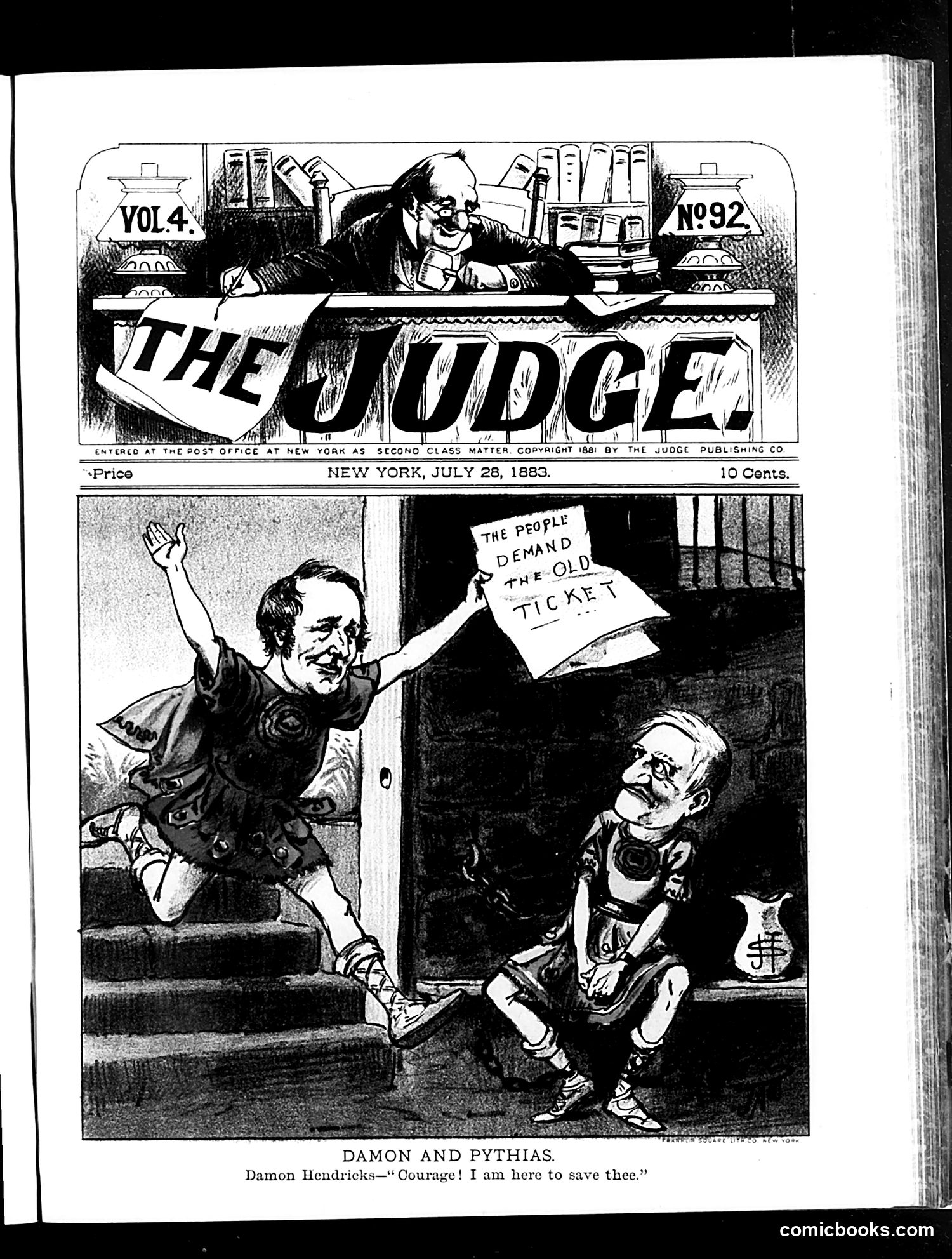
This cartoon titled "Damon and Pythias" depicts a political allegory. One figure leaps joyfully holding a sign reading "THE PEOPLE DEMAND AN OLD TICKET," while another figure sits dejected below. The caption attributes the quote to "Damon Hendricks": "Courage! I am here to save thee." The reference to the classical "Damon and Pythias" legend—about friendship and loyalty unto death—suggests this concerns a political campaign or party loyalty issue from 1883. The "old ticket" likely refers to renominating previous candidates, apparently against someone's wishes. Without identifying the specific figures or election, the cartoon appears to satirize political factionalism and the tension between party demands and individual political actors.
This Judge magazine page contains three satirical pieces attacking Democratic politics and social pretension: **"Damon and Pythias"** mocks the Democratic ticket (appears to reference Tilden-Hendricks, circa 1876), sarcastically comparing their "ancient myth" of party loyalty to the classical legend, while suggesting their unity is false political theater masking corrupt reality. **"The Dueling Mania"** criticizes inflammatory newspaper editors (likely Bennett and Dana of major New York papers) for irresponsible rhetoric that could provoke actual violence, while lamenting insufficient laws to prevent dueling. **"Town and Country"** humorously contrasts city comforts with rural discomforts when New Yorkers vacation. **"Political Pleasantries"** uses heavy sarcasm to expose Democratic hypocrisy: claiming to champion "unity, brotherly love and perfect harmony" while systematically excluding Irish-Catholic members from public offices, reserving positions for native American Protestants. The satire targets the party's stated ideals versus actual discriminatory practices.
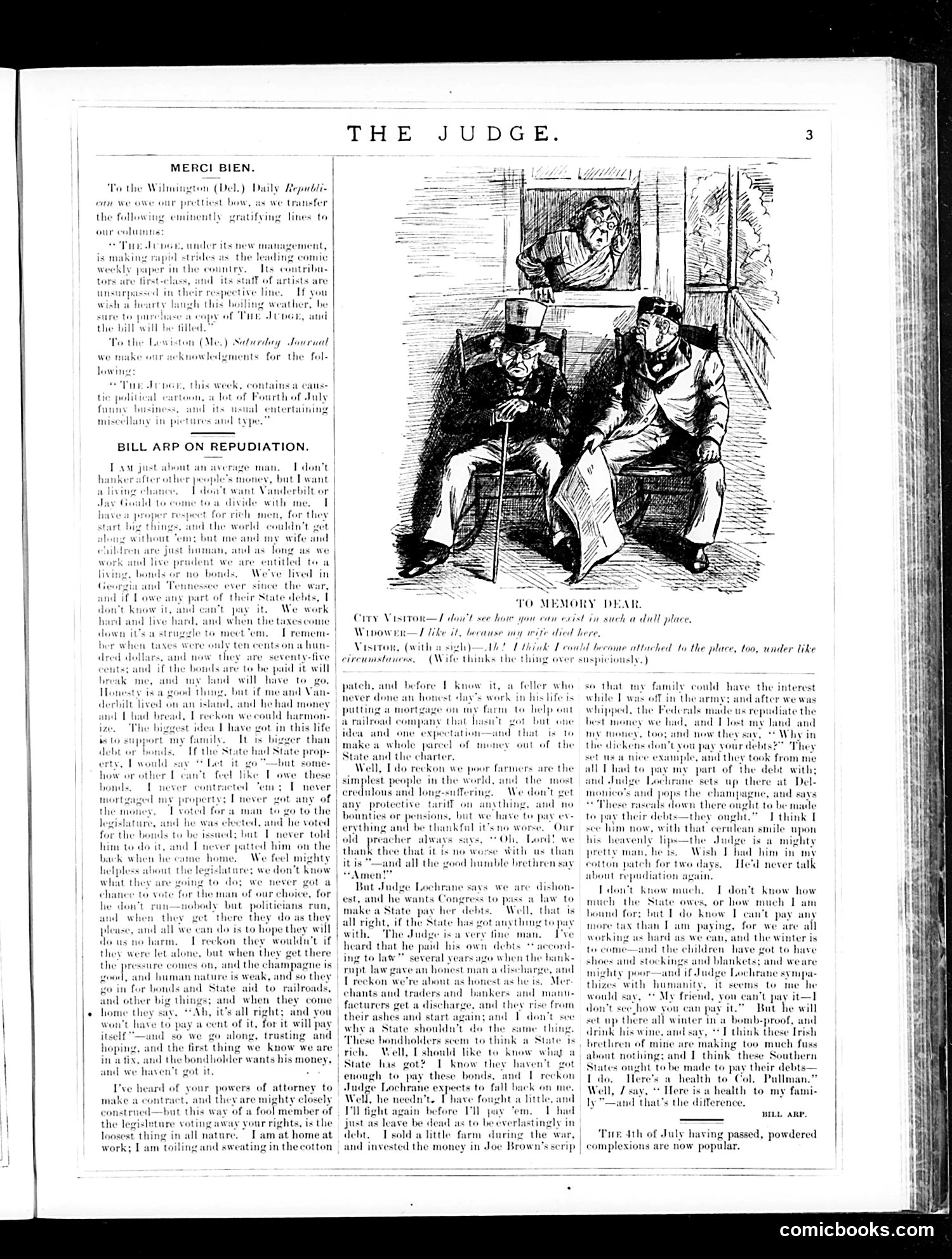
This page contains two distinct pieces of satire. The main cartoon depicts a **City Visitor** and **Widow** in conversation at what appears to be a modest dwelling. The visitor expresses surprise she'd remain in "such a dull place," but she explains emotional attachment—her late husband died there. The visitor's suspicious reaction (noted in parentheses) suggests satirical commentary on **widow's sentimentality versus practicality**. The accompanying text, "Bill Arp on Repudiation," attacks **Southern state debt repudiation**—likely referencing post-Civil War Southern states' refusal to honor their financial obligations. The narrator (Bill Arp) argues ordinary citizens like himself and his wife are honest and hardworking, yet suffer when their state refuses to pay debts while wealthy elites (judges, bankers) live luxuriously. The satire criticizes the hypocrisy: states demand citizens pay taxes but refuse their own obligations, claiming poverty while their leaders enjoy champagne.
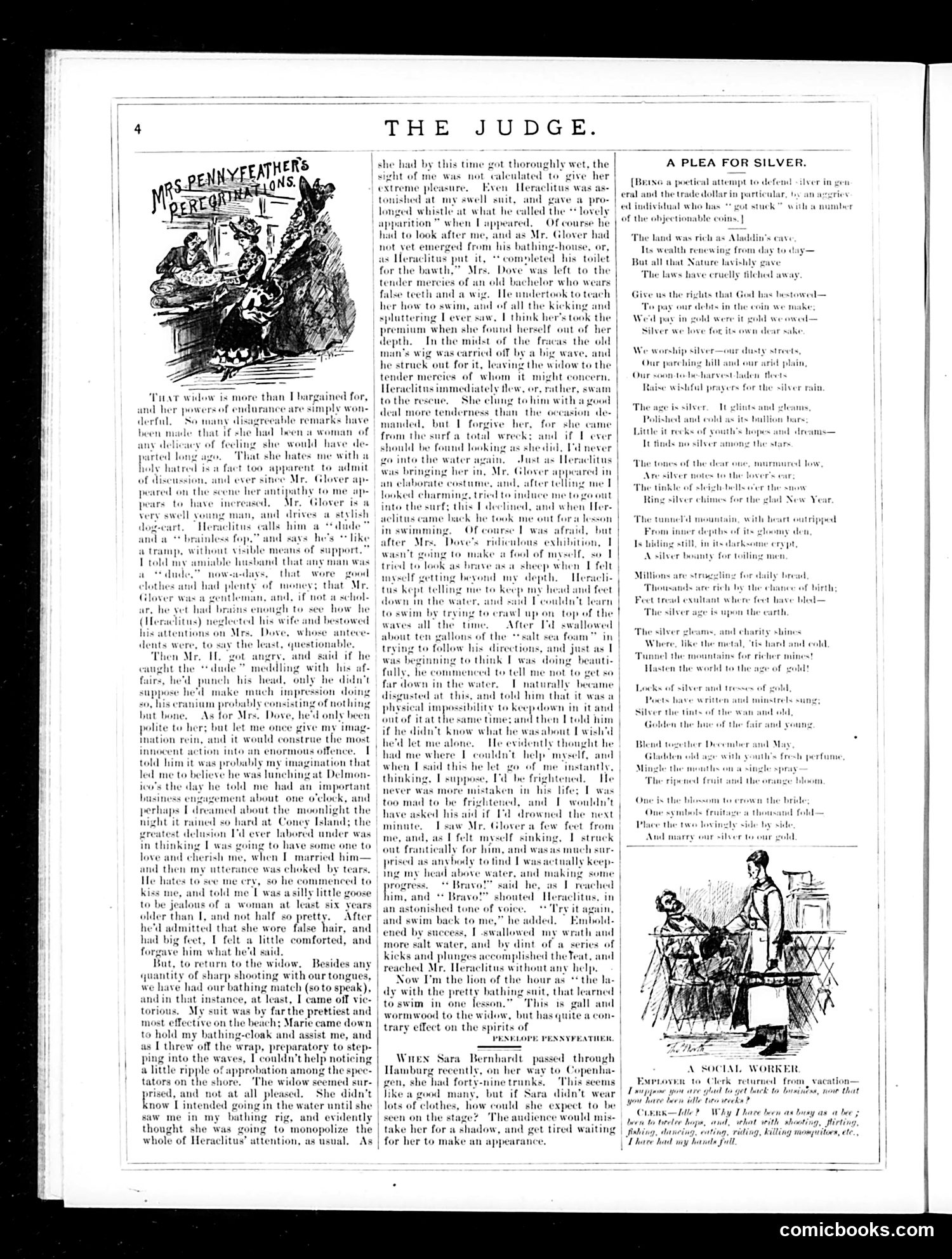
This page from *Judge* contains a lengthy humorous narrative about a widow's misadventures at the seaside. The story mocks Victorian social conventions, particularly around women's swimming and romantic entanglements. The narrator's wife recounts how an elderly bachelor with false teeth attempted to teach her swimming, losing his wig in the process. A vain "swell" young man named Mr. Glover (likely a caricature of dandyish pretension—*Judge* frequently lampooned such types) then "rescues" her, manipulating the situation for romantic advantage. When she asserts independence in the water, he deliberately releases her, nearly causing her to drown. The satire targets male condescension disguised as gallantry, female dependence on men for basic competencies, and the social posturing around seaside leisure. The adjacent illustrations reinforce the comedy of physical mishap and class pretension typical of *Judge's* social criticism.
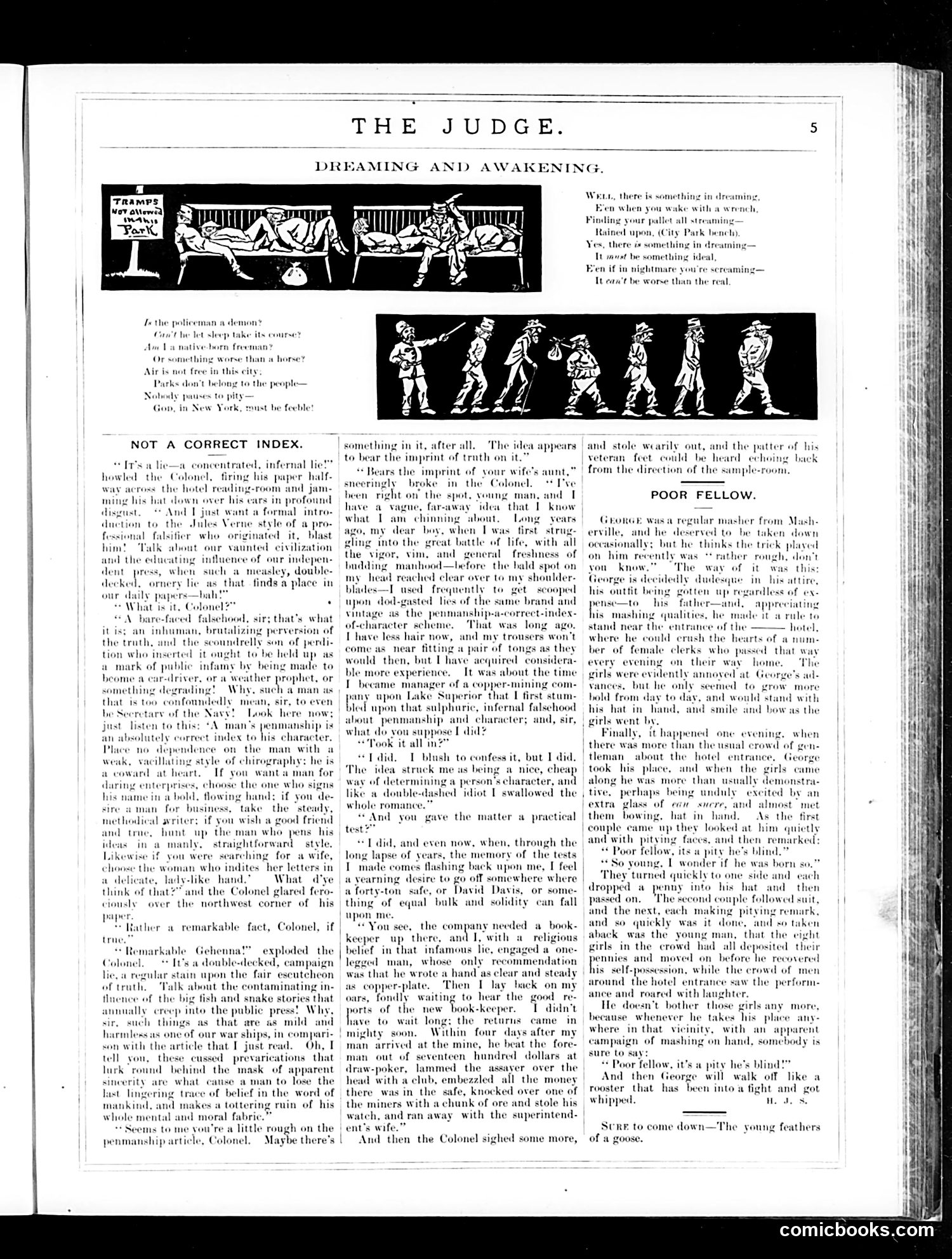
This page satirizes the popular pseudoscientific belief that handwriting analysis reveals character. A Colonel argues that penmanship is an "absolutely correct index to his character"—claiming flowing signatures indicate integrity while weak handwriting signals cowardice. The Colonel then recounts hiring a "clear and steady" penman as a bookkeeper at a copper mine, only to have the man embezzle funds and flee. The punchline: appearance of virtue on paper meant nothing; the man was a thief regardless. Judge mocks this era's obsession with physiognomy and graphology—pseudo-scientific methods claiming to divine character from external features. The satire targets both the Colonel's gullible faith in these theories and broader public credulity about judging people by superficial signs rather than actions. It's a commentary on how people were duped by fraudulent "scientific" character assessment schemes.
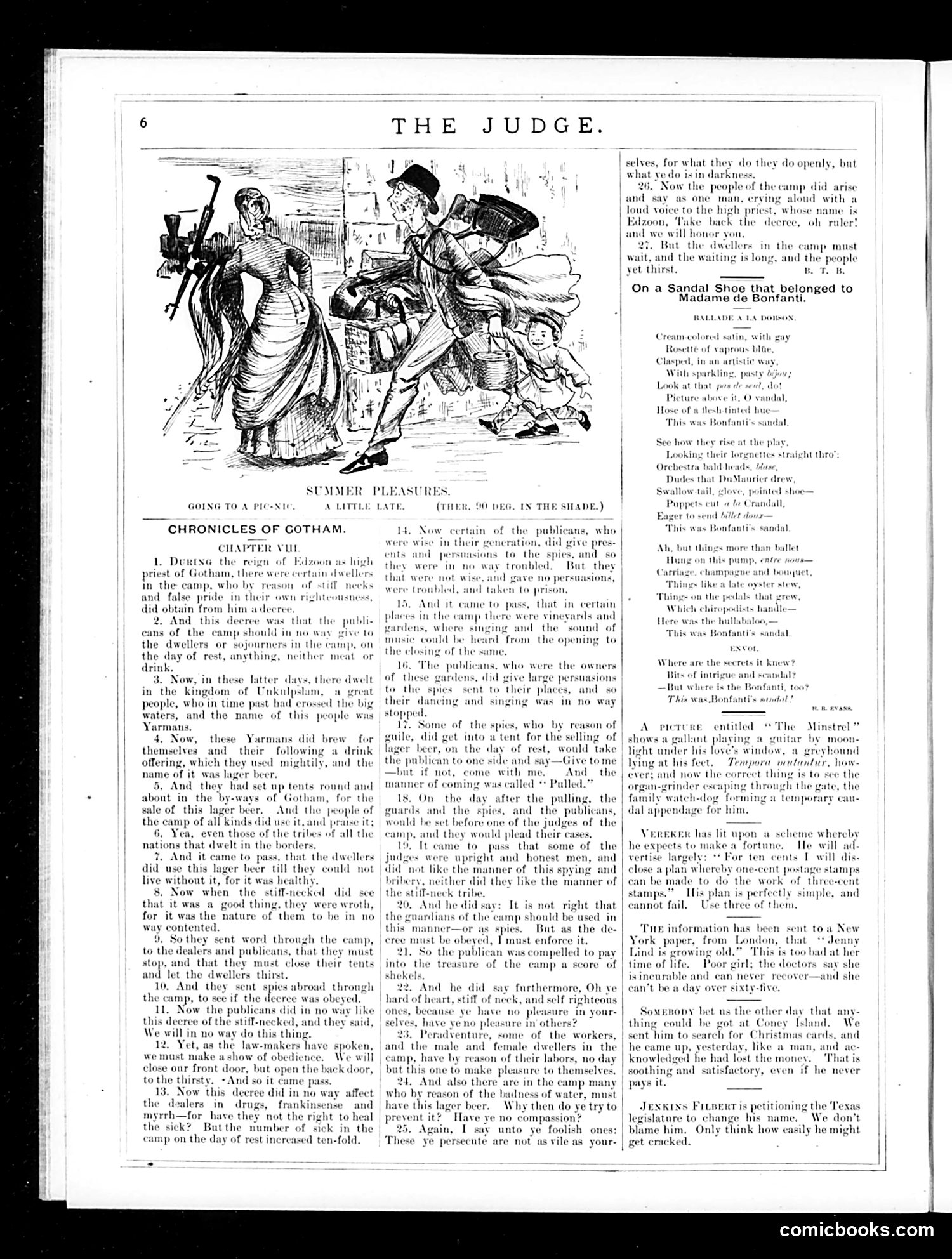
This page contains two main elements: ## "Summer Pleasures" Cartoon The top illustration shows a Victorian-era family at a picnic, with a woman and man in period dress. The caption indicates they're "going to a pic-nic" — likely satirizing upper-class leisure activities of the era. ## "Chronicles of Gotham" This is a mock-biblical narrative (using archaic language like "thee" and "thou") about a conflict in a camp between "publicans" (tavern keepers) and civic authorities. The allegory describes: - A judge issuing a decree closing taverns - Publicans defying the order by serving drinks through back doors - Workers suffering from the closure - Public outcry forcing the ruler to rescind the decree **The Satire:** This appears to reference **temperance/prohibition debates** of the late 19th century — mocking both temperance reformers' unrealistic expectations and the publicans' circumvention tactics. The mock-serious biblical tone lampoons both sides' moral posturing. The page also includes poetry about a famous dancer's sandal, appearing to be arts/theater gossip.
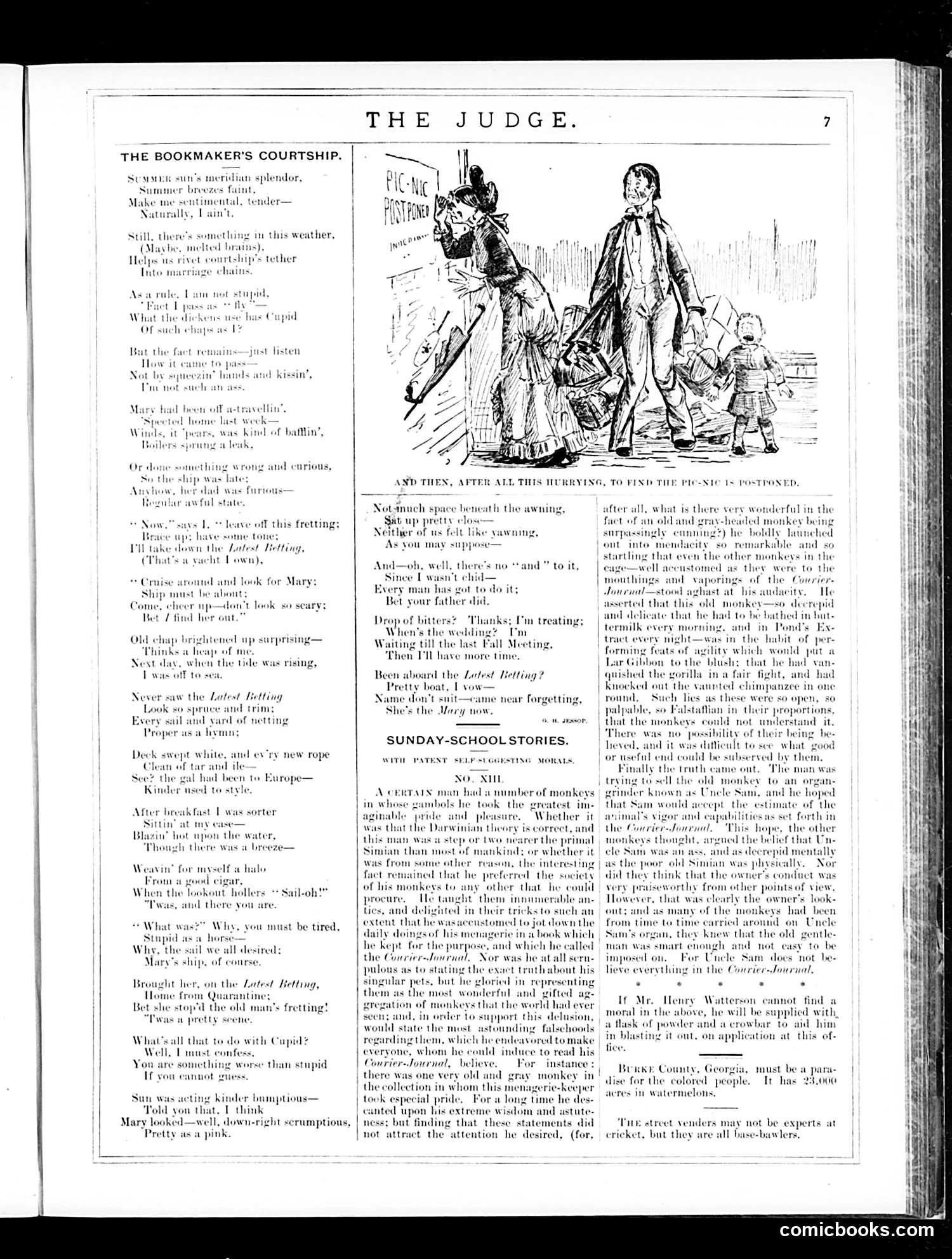
This page contains two distinct pieces: a romantic poem about a bookmaker's failed courtship, and a Sunday school moral tale about monkeys. **"The Bookmaker's Courtship"** (top): The illustration shows a couple and children at a seaside outing. The satire mocks working-class sentimentality—a rough "bookmaker" (betting operator) attempts romance but fails when the picnic is postponed. The humor lies in contrasting his tough profession with sentimental pretensions, and the relatable domestic disappointment. **"Sunday-School Stories, No. XII"** (bottom): This moral tale uses monkeys to satirize human nature. A man prefers his monkey collection's company to society and meticulously records their behaviors. The story ironically presents the monkeys as possessed of greater dignity and reliability than humans—a common 19th-century satirical device. The monkey-as-mirror critique suggests people often behave worse than animals despite claims of civilization. Both pieces employ Judge's typical approach: gentle mockery of ordinary life and human pretension through relatable domestic or animal scenarios.
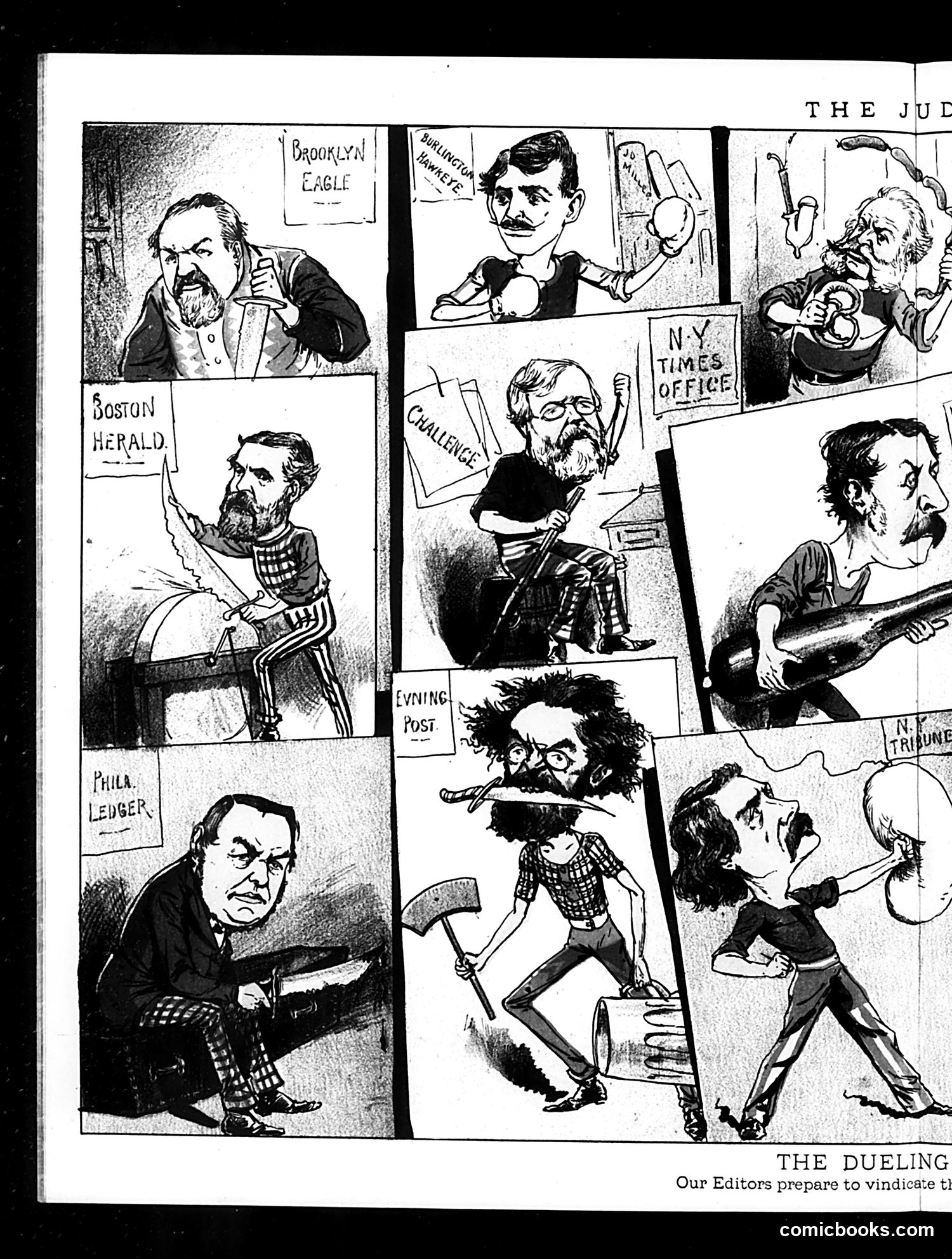
This political cartoon satirizes newspaper editors preparing for a "duel" to defend their publications' honor. The panels show caricatured editors from major newspapers—identified by mastheads including the Brooklyn Eagle, Boston Herald, Philadelphia Ledger, N.Y. Times, and Evening Post—arming themselves with various weapons (axes, clubs, newspapers). The bottom caption reads "The Dueling: Our Editors prepare to vindicate t[heir]..." The satire mocks the fierce, combative rivalry between competing newspapers of the era, depicting their editorial wars as literal duels. Each editor is shown as aggressive and ready for battle, reflecting the intense competition and heated debates characteristic of early 20th-century American journalism. The "dueling" metaphor suggests editors were willing to fight viciously to defend their publications' reputations and circulation.
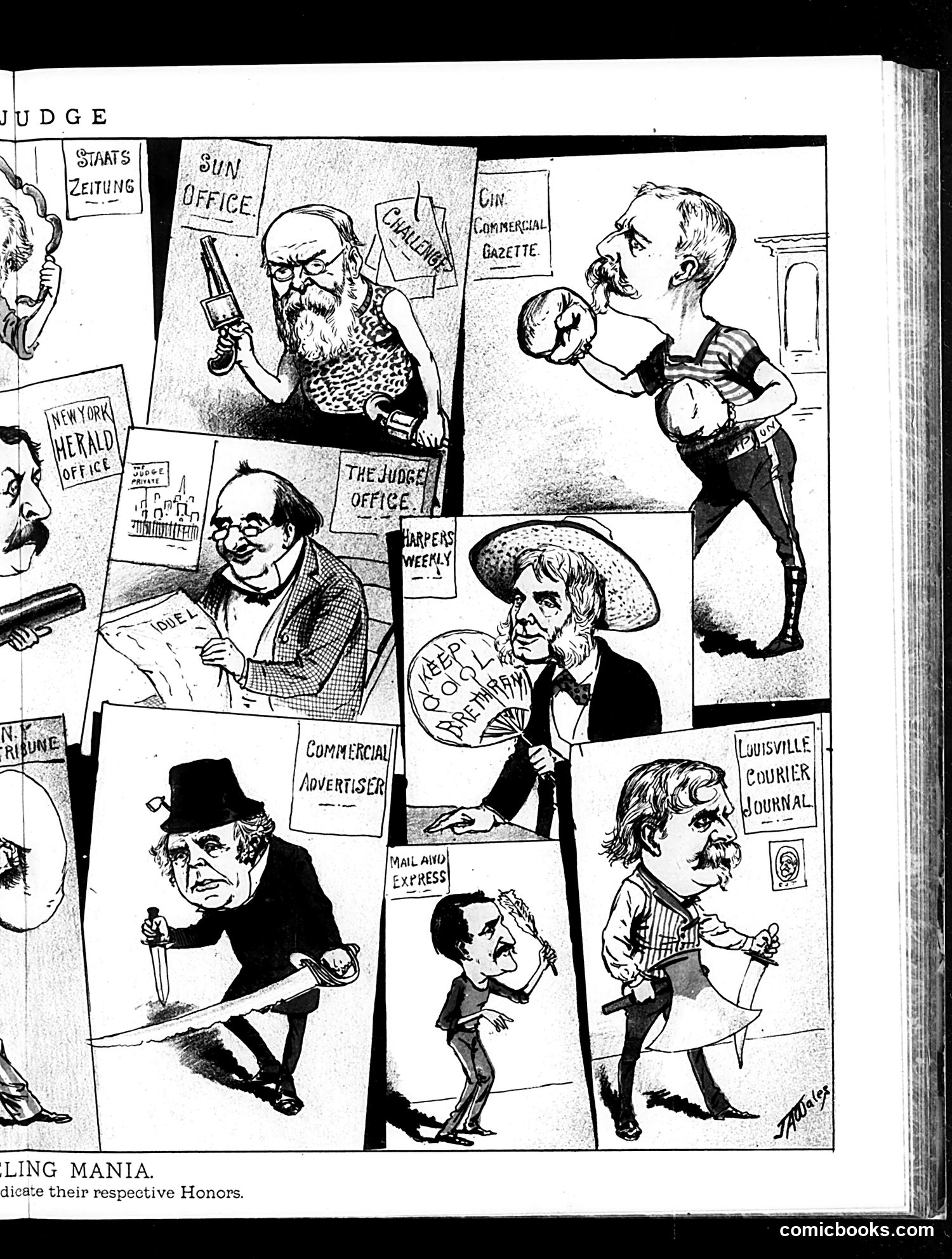
This Judge magazine page satirizes "Judging Mania"—apparently a widespread obsession with newspapers and media outlets serving as arbiters of public opinion. The cartoon depicts various newspaper offices (Sun Office, New York Herald, Commercial Advertiser, Harpers Weekly, Mail and Express, Louisville Courier Journal) personified as competing judges or authority figures, each holding symbols of power (gavels, scales, weapons). The satire suggests that in the late 19th century, newspapers had become so influential in shaping public judgment that they functioned like judges themselves. The varied caricatured figures likely represent different newspaper editors or proprietors competing for authority and credibility. The German text "Staats Zeitung" indicates even immigrant/foreign-language press participated in this phenomenon. The overall message: newspapers wielded excessive judicial-like power over American public opinion.
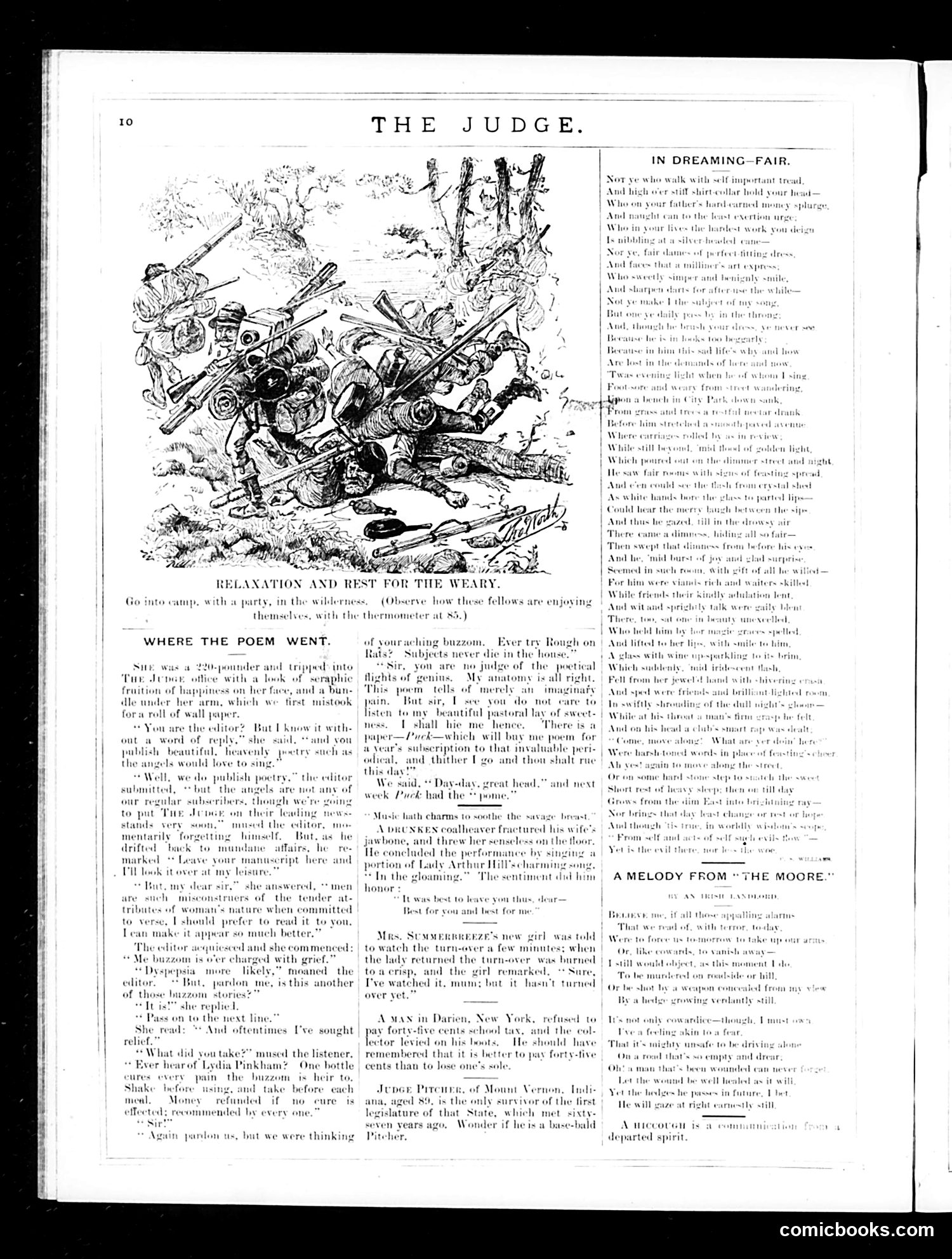
This page contains two main satirical pieces about poetry and literary pretension in the late 19th century. **"Where the Poem Went"** mocks the editorial gatekeeping of poetry magazines. A large woman submits romantic verse to a magazine editor, who initially rejects it as unsuitable for publication. She then reads it aloud dramatically, and the editor—swayed by her theatrical delivery rather than the poem's actual merit—agrees to publish it. The satire targets both the absurdity of editorial judgment based on performance rather than quality, and the presumed vanity of amateur female poets of the era. **"Relaxation and Rest for the Weary"** (top left) appears to show people lounging in a park or camp setting, likely satirizing urban leisure culture or the pretense of "roughing it." The page also includes a poem excerpt titled "A Melody from 'The Moore'" and various society anecdotes, reflecting Judge's typical mix of literary mockery and social commentary. The overall tone ridicules both poetry publishing standards and the pretentiousness of amateur literary culture.
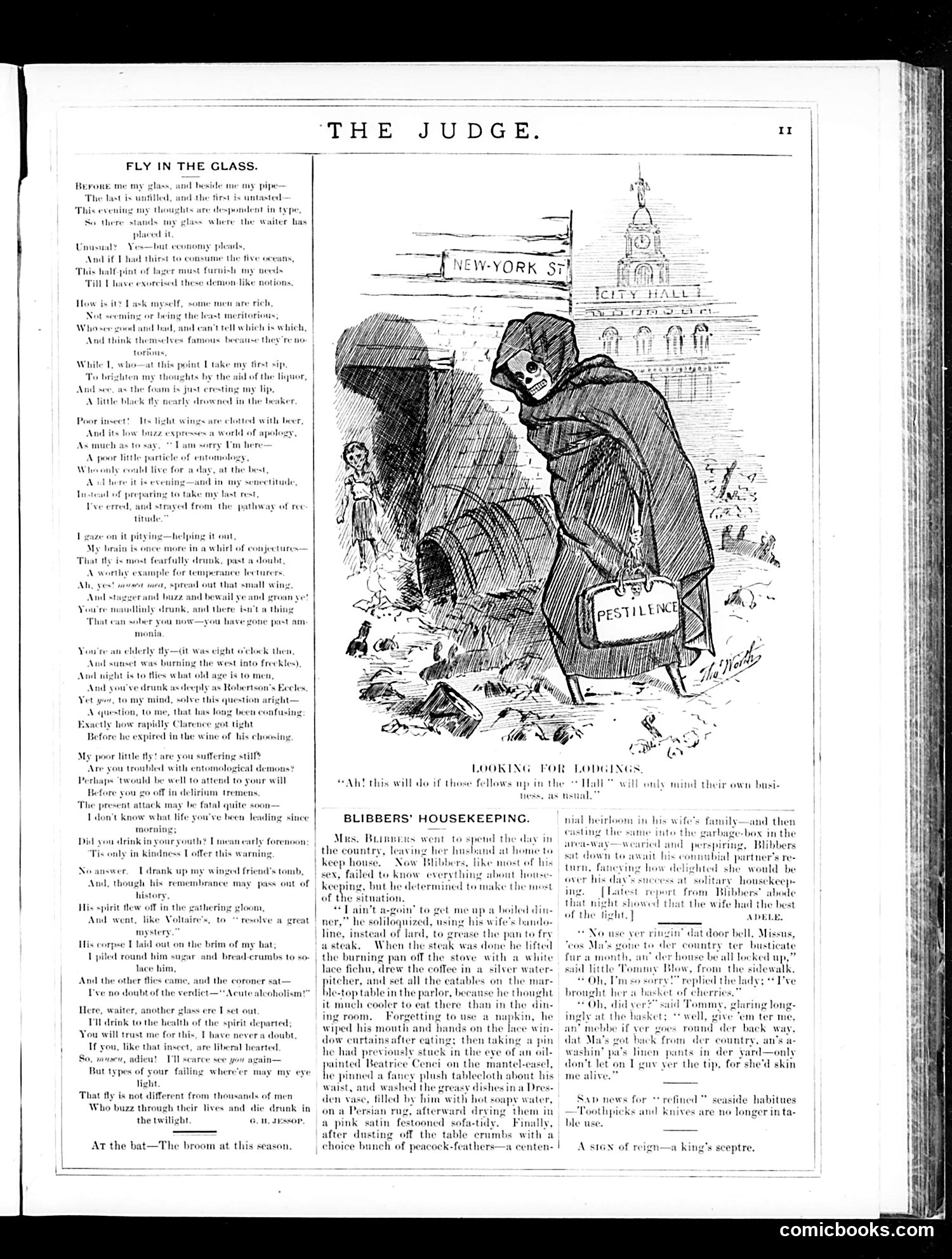
This page contains two satirical pieces from the American humor magazine *Judge*: **"Fly in the Glass"**: A poem-cartoon mocking drunkenness. The narrator philosophizes about a fly drowning in his drink, drawing parallels between the insect's plight and human alcoholism. The satire targets Victorian-era drinking culture and the hypocrisy of supposedly "refined" society—the narrator gets drunk while moralizing about temperance. The fly represents ordinary working-class men, while the speaker embodies self-deluded middle-class drinkers. **"Blibbers' Housekeeping"**: A domestic satire about Mrs. Blibbers, left alone while her husband works. The piece mocks her incompetence at managing a household—she uses valuable family heirlooms carelessly, fails at basic cooking, and generally mismanages the home. The humor targets both women's domestic failures and the pretensions of middle-class housekeeping standards of the era. "Refined" seaside ladies apparently abandoned such standards. Both pieces ridicule Victorian hypocrisy, excess, and social pretension through exaggerated character sketches typical of *Judge's* satirical approach.
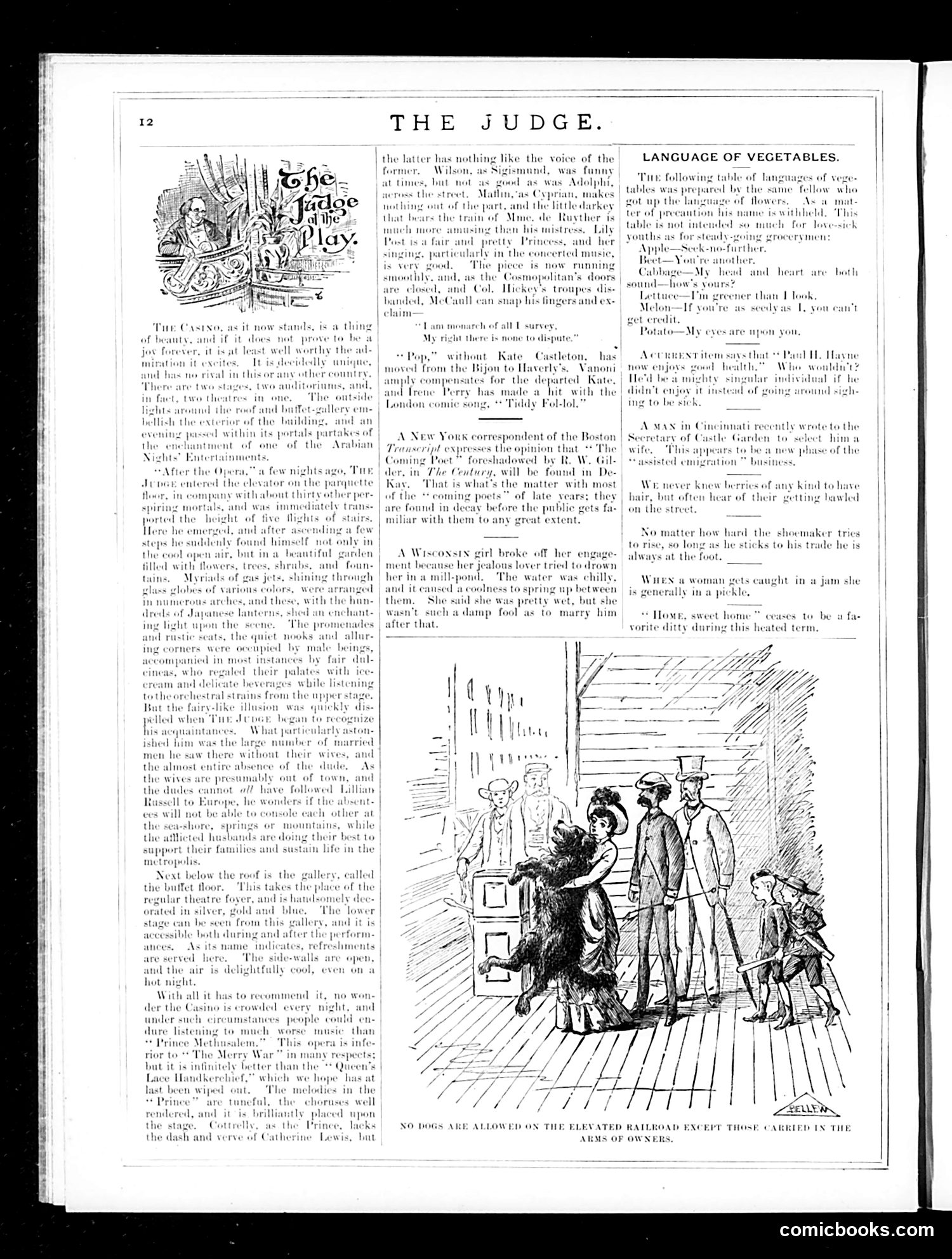
This page from *Judge* contains theater reviews, social commentary, and humor pieces typical of the satirical magazine. The main cartoon at bottom depicts a scene on an elevated railroad platform with the caption "No dogs are allowed on the elevated railroad except those carried in the arms of owners." The satire appears to mock a specific New York regulation about dogs on the newly-built elevated trains—a then-novel transit system. The joke likely plays on the absurdity of the rule itself or perhaps satirizes wealthy owners who carried small dogs while other passengers stood cramped. The surrounding text includes theater criticism (discussing performances at various venues), a "Language of Vegetables" humor section offering flirtatious double-meanings of vegetable names, and miscellaneous social observations. These represent typical *Judge* content: light satire on urban life, entertainment, and social customs of the era. Without clearer OCR or context about the specific date, precise political targets remain unclear, though the material reflects late-19th-century urban American concerns.
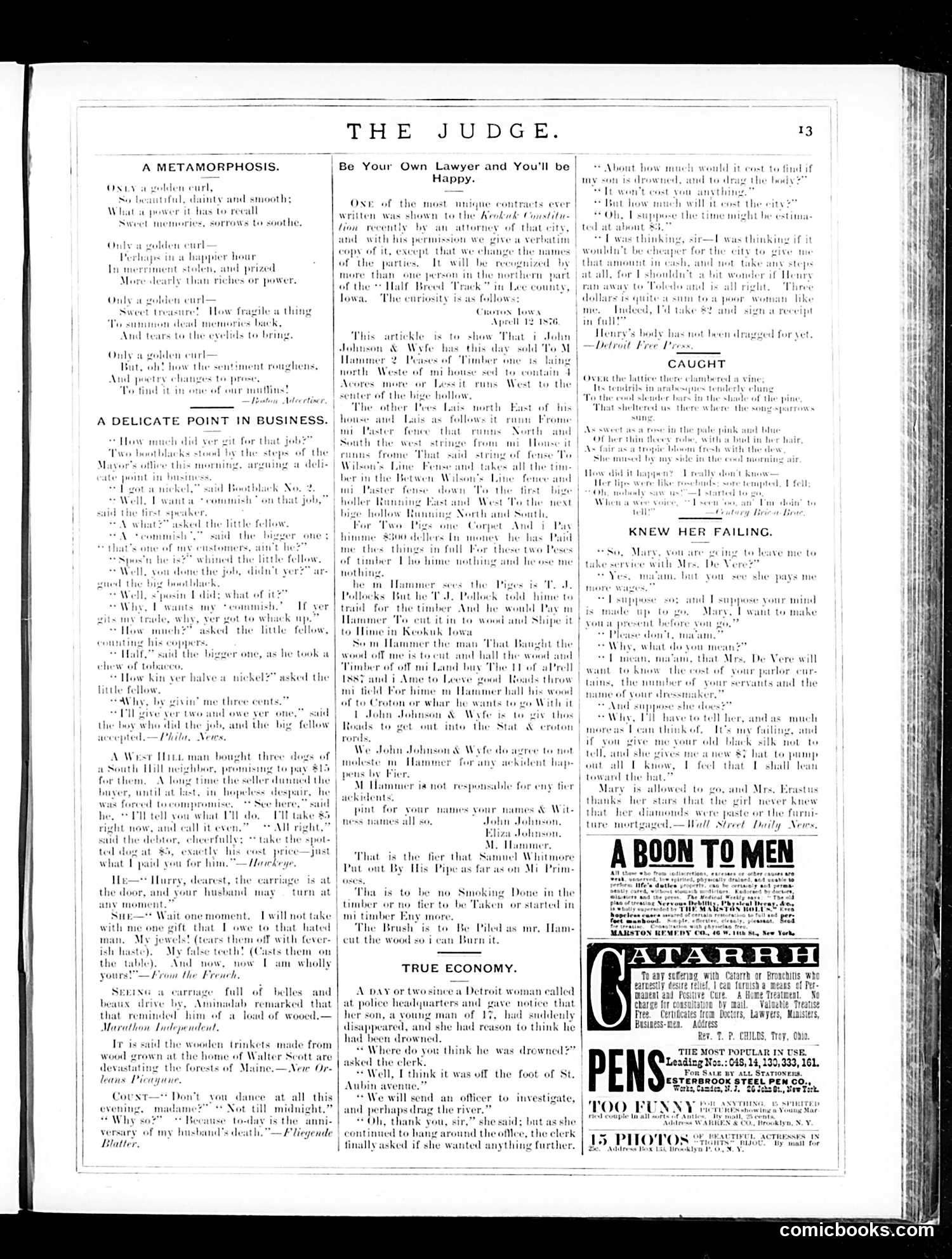
This page from Judge magazine contains primarily **humor columns and short stories** rather than political cartoons. The main pieces include: **"A Delicate Point in Business"** — A dialect-heavy anecdote about a man selling a dog, illustrating working-class speech patterns and penny-pinching negotiations—typical Judge fare satirizing ordinary commerce. **"True Economy"** — A brief joke about a Detroit widow reporting her husband missing to police, only to ask at the end if she needs to do anything "further"—the humor lies in her apparent indifference to his drowning. **"Knew Her Failing"** and **"Caught"** — Appear to be sentimental or romantic verse pieces. The page also includes period **advertisements** (Catarrh pens, "A Boon to Men" patent medicine, etc.). No identifiable political figures or specific contemporary events appear here. The satire is **social rather than political**—mocking working-class dialect, stinginess, and marital apathy—reflecting Judge's typical late-19th-century approach to American humor.
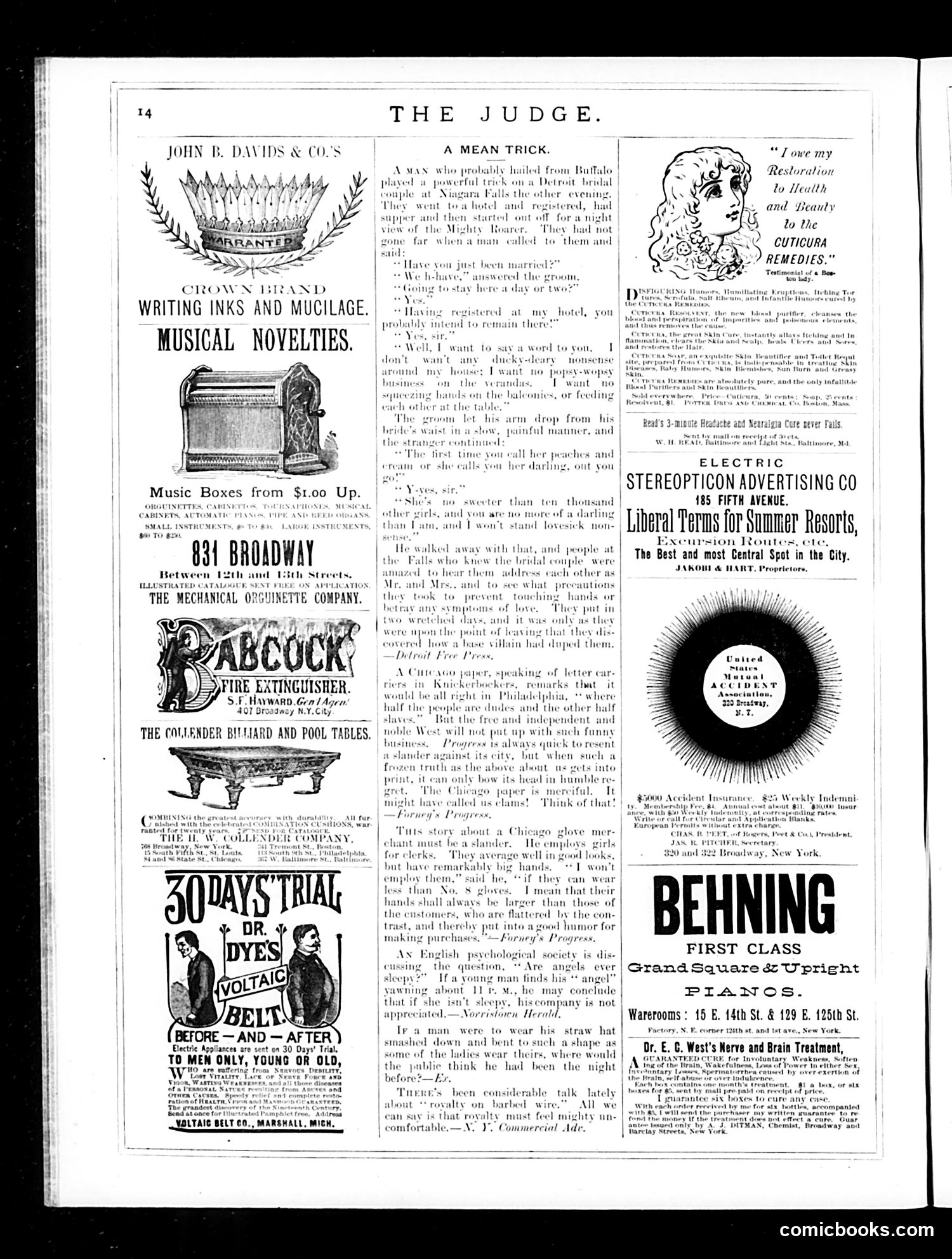
This page is primarily **advertisements** with one satirical story, "A Mean Trick," in the center column. ## The Satire The story mocks a newlywed couple's cruelty toward hotel staff. A man and woman, likely from Buffalo, register at a hotel and deliberately torment the servants—refusing to call them properly, making excessive demands, deliberately dropping things to watch servants scramble. The satire targets the **newly wealthy or socially ambitious** who use their temporary power over working-class hotel employees to feel superior and demonstrate status through rudeness. The joke's point: such behavior reveals the perpetrators as vulgar and small-minded. The punchline involves the man wearing a straw hat "smashed down and bent to such a shape" that guests assume he'd suffered an accident the previous night—suggesting his comeuppance or public embarrassment. ## Context for Modern Readers This reflects Gilded Age anxieties about **new money and class performance**. Hotels were theaters of social climbing, and mistreatment of servants was apparently common enough to warrant satirical commentary. Judge assumes readers will recognize and condemn such rudeness as marking one as genuinely lower-class despite wealth.
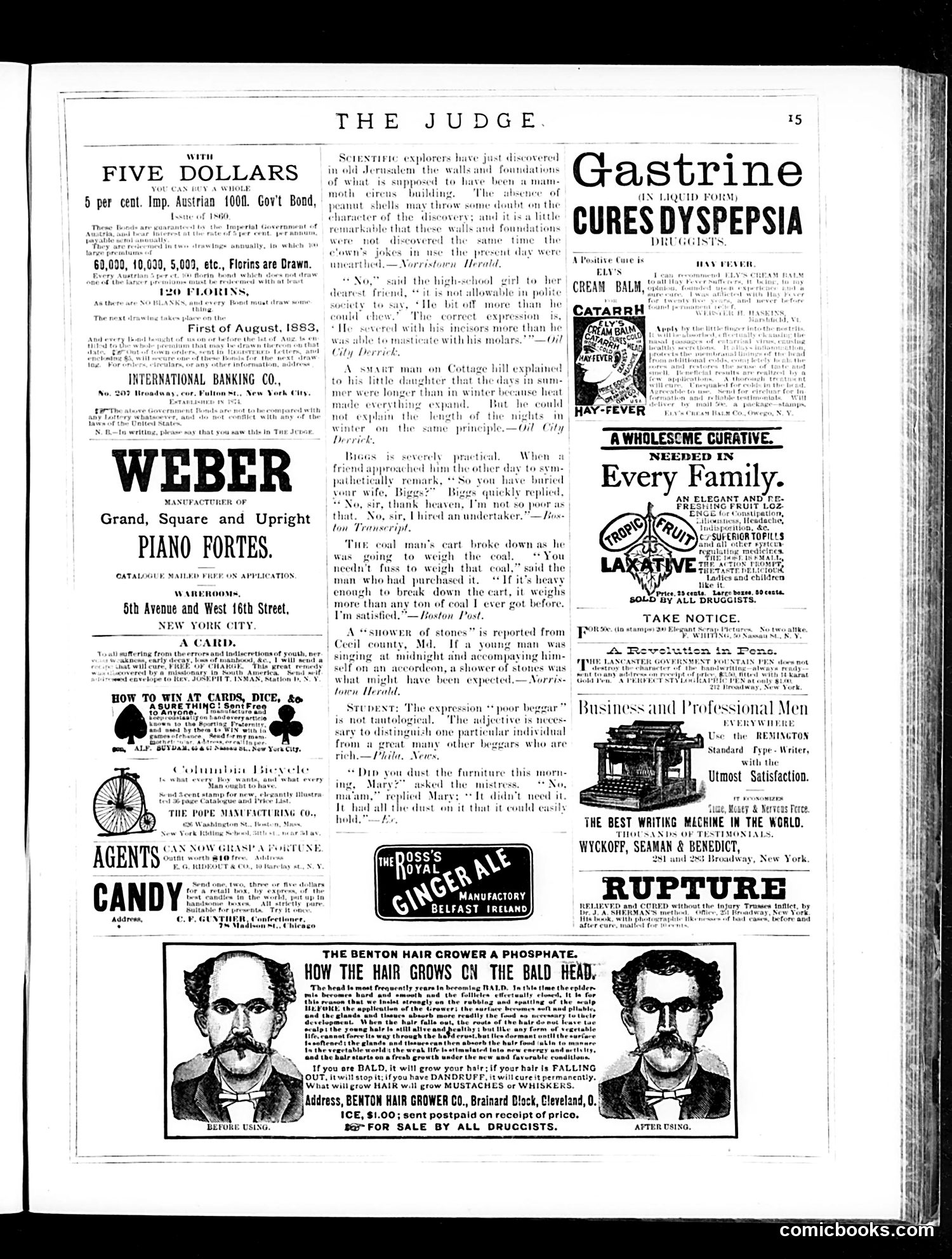
This page consists primarily of **advertisements and short humorous anecdotes** rather than political cartoons. The jokes target everyday absurdities: - A man buries his wife but hires an undertaker rather than doing it himself (practicality humor) - A coal merchant uses a broken cart as a scale—if it breaks under the load, it must weigh a ton - A schoolgirl questions her father's claim that summer days are longer because "heat makes everything expand" - A housemaid dusts furniture so thoroughly the dust settles back on it The advertisements promote period remedies (Gastrine for dyspepsia, hair-growth phosphate), pianos, and typewriters—typical 1880s commercial products. **The Benton Hair Grower ad** uses before-and-after portraits of a mustachioed man, a common advertising format of the era. The page lacks coherent political satire; it's a typical **mixed-content magazine page** blending light social humor with commercial announcements.
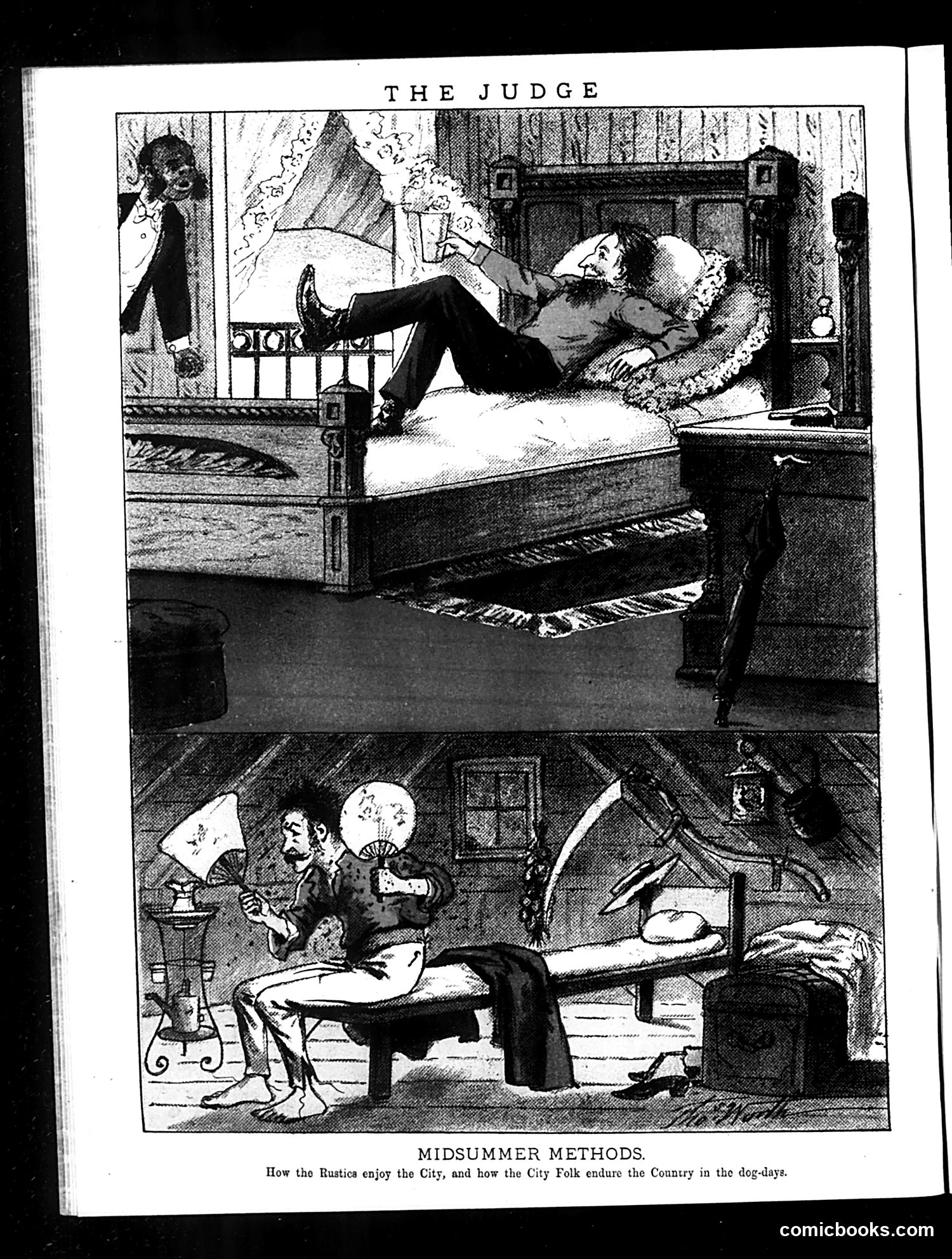
This two-panel cartoon contrasts summer behavior between rural and urban populations during hot weather ("dog-days"). **Top panel:** A country person ("Rustica") lounges indolently on a bed in the city, feet up, appearing lazy and unaccustomed to urban life—suggesting rural folk are idle or unsuited to city ways. **Bottom panel:** City dwellers in the country are shown fanning themselves frantically and appearing flustered among pastoral furnishings, suggesting urbanites are uncomfortable and out of place in rural settings. The satire mocks mutual incomprehension between social groups: country people behaving indolently in cities, city people unable to relax in the countryside. The title emphasizes this seasonal behavioral contrast—each group handling summer in their "natural" environment versus the other's domain. The humor relies on class and regional stereotypes typical of Gilded Age American satire.