
A complete issue · 16 pages · 1883
Judge — July 21, 1883
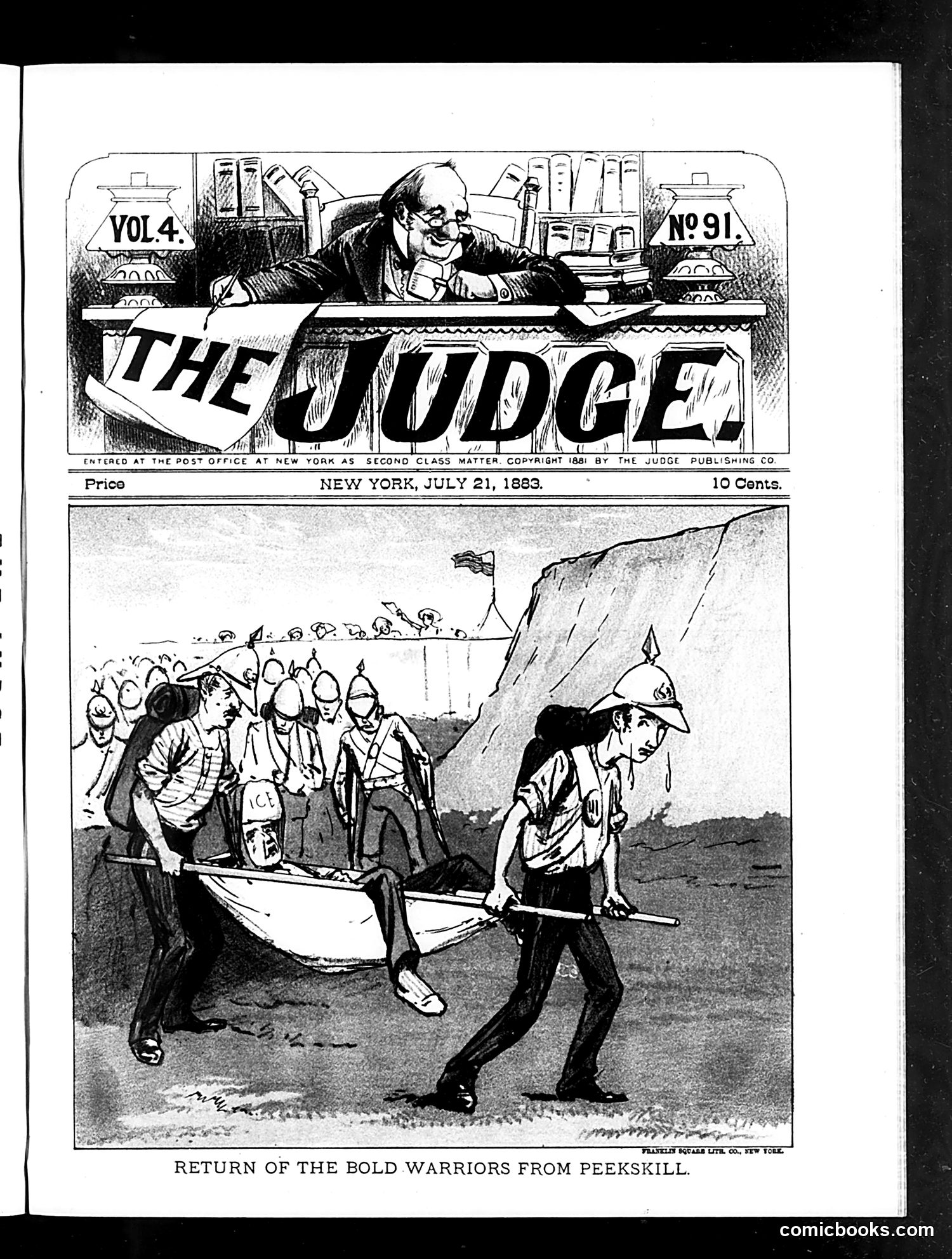
This 1883 *Judge* cartoon satirizes what appears to be a military or paramilitary excursion to Peekskill, New York. The illustration shows armed figures in military dress (possibly spiked Prussian-style helmets) returning from a expedition, carrying an empty boat or stretcher, suggesting a failed or absurd mission. The cartoon likely mocks either: - A militia group's unsuccessful venture - German-American military pretensions or exercises - A political or social movement presented as comically inept The "bold warriors" language is clearly ironic—the disheveled return and empty vessel suggest incompetence or futility. Without additional historical context about specific 1883 Peekskill events, the precise target remains unclear, but the satire ridicules some group's military ambitions as laughably unsuccessful.
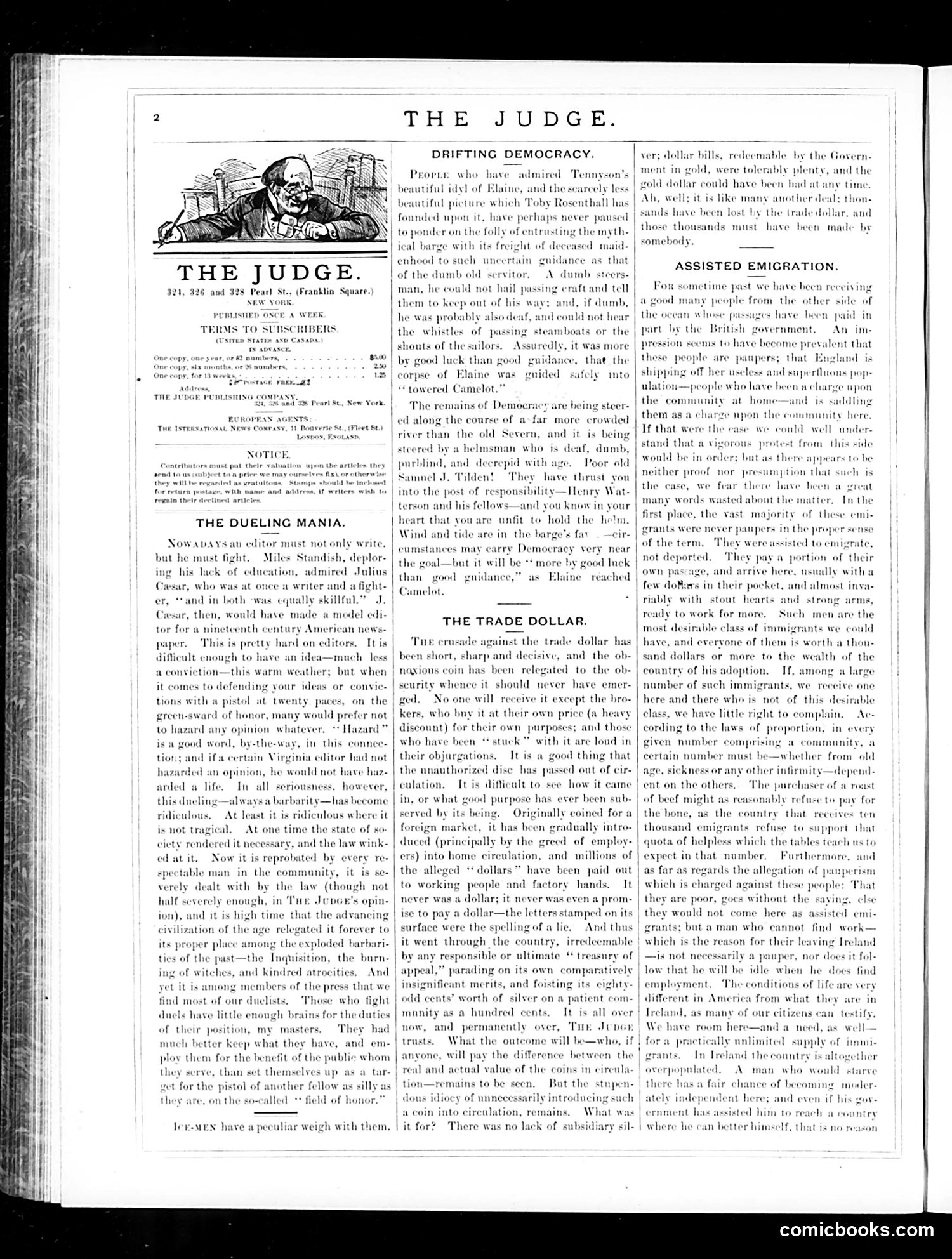
**"The Dueling Mania"** attacks the practice of editors settling disputes through pistol duels. The piece ridicules Virginia editors specifically for fighting over opinions, arguing that while dueling was once necessary, it's now barbaric absurdity in civilized society. The satire suggests editors should use their intellect, not firearms. **"Drifting Democracy"** compares the Democratic Party to Elaine's barge from Arthurian legend—a corpse floating dangerously downstream. It sarcastically portrays Samuel J. Tilden as an incompetent helmsman, "deaf, dumb, blind, and decrepit," steering the party toward disaster. The criticism suggests Democratic leadership has lost direction. **"The Trade Dollar"** attacks the trade dollar coin circulation. Originally minted for foreign markets, it entered domestic circulation through employer greed, paid to workers who couldn't easily spend it. The piece condemns this fraudulent practice as economically damaging. All three pieces exemplify Judge's role as sharp political and social criticism.
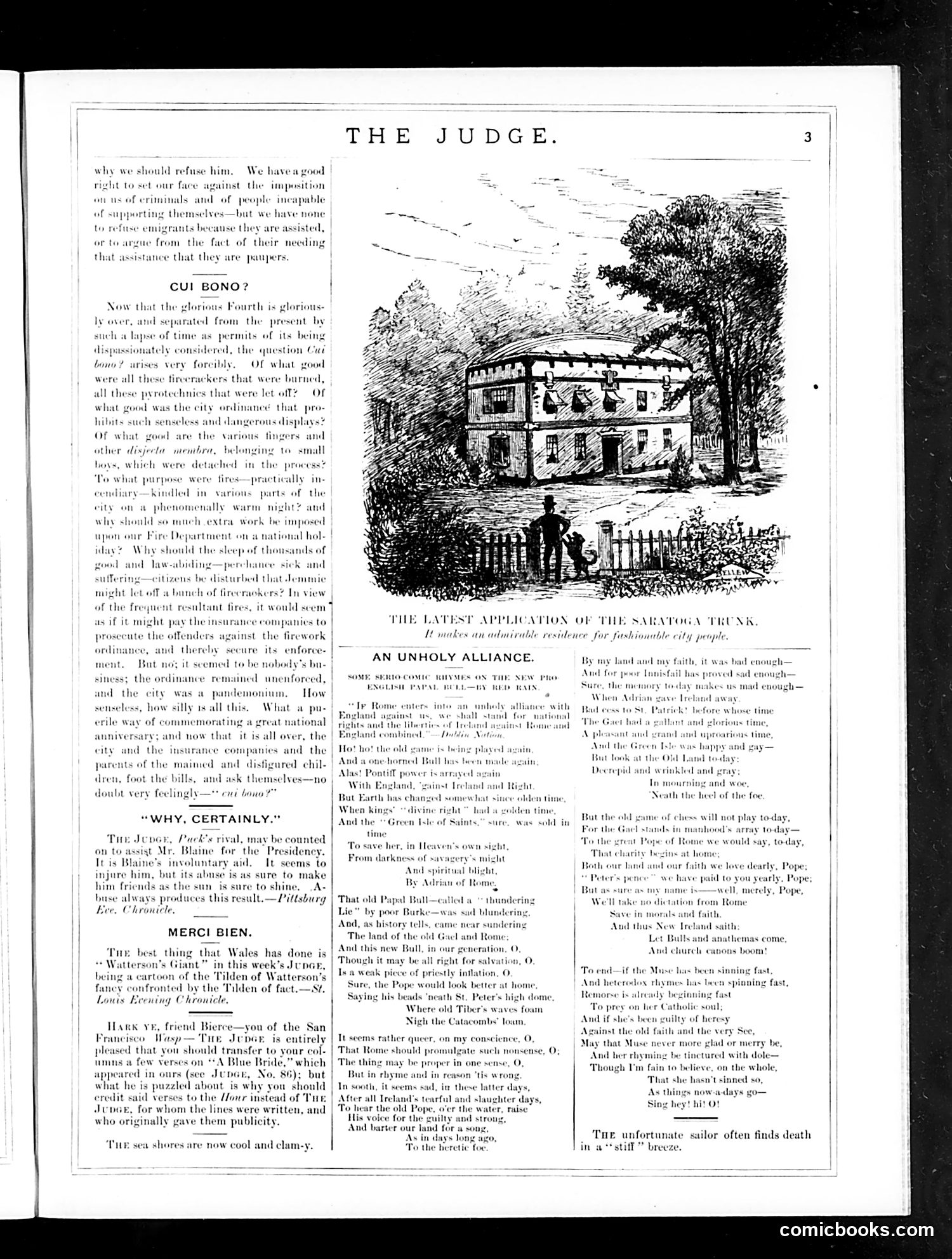
This page contains several satirical pieces from *Judge* magazine addressing late-19th-century American politics and social issues. **Main Cartoon**: "The Latest Application of the Saratoga Trunk" depicts a figure at a house, likely satirizing wealthy tourists or travelers using expensive luggage—a commentary on conspicuous consumption during the Gilded Age. **"Cui Bono?"** questions the purpose of Fourth of July fireworks celebrations, sarcastically asking what good they serve when they endanger the city, strain fire departments, and disturb citizens. It's social satire critiquing wasteful holiday practices. **"An Unholy Alliance"** is a poem attacking a supposed alliance between Rome (the Catholic Church) and Ireland against England. It references a papal "Bull" (church edict) and criticizes Irish-Catholic political alignment with Rome, reflecting anti-Catholic sentiment common in late-19th-century American publications. **Sidebar notes** discuss James G. Blaine's presidential candidacy and literary credits, typical of contemporary magazine gossip. The page reflects *Judge*'s conservative Protestant perspective on immigration, religion, and national politics.
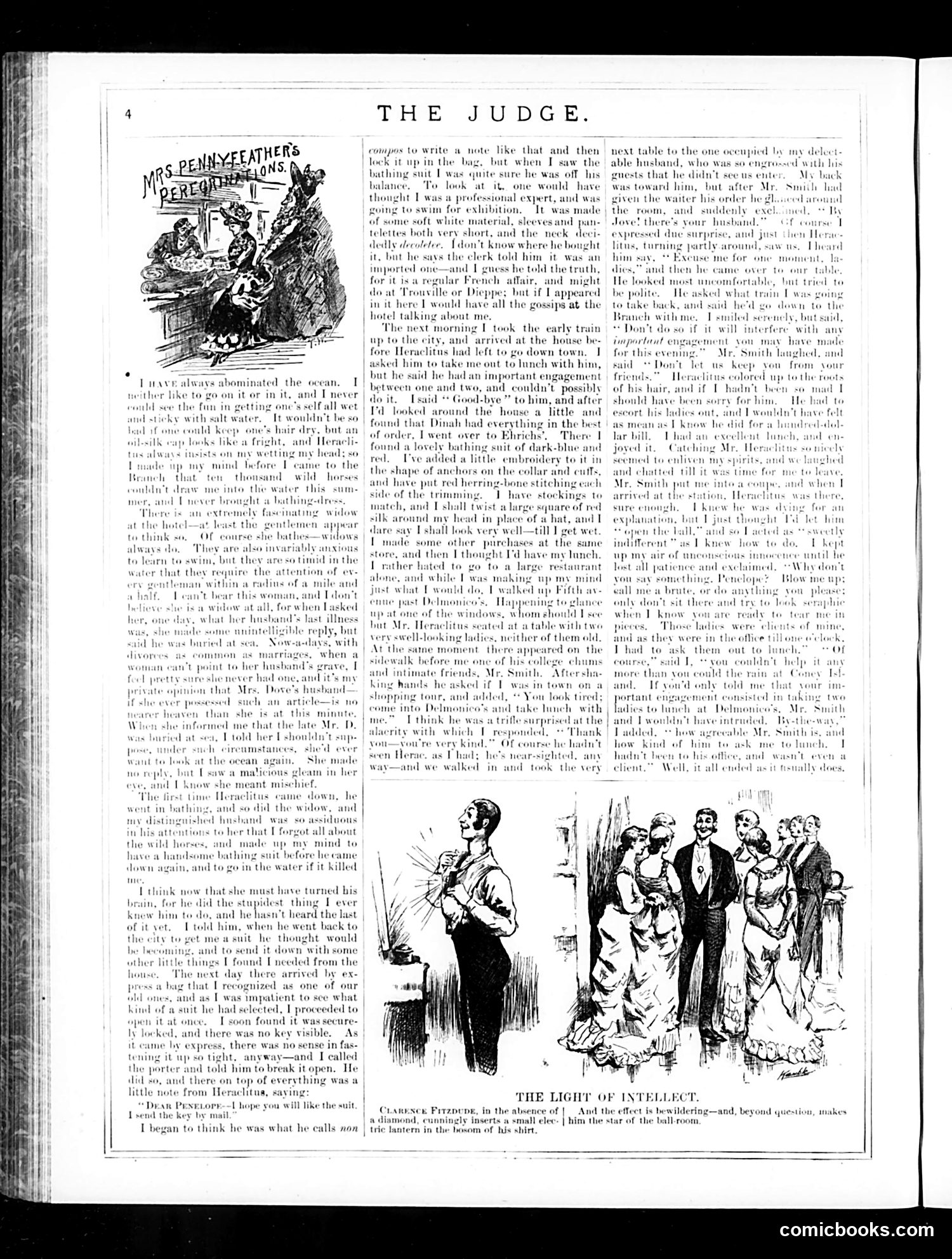
This page presents a serialized story illustrated with two cartoon vignettes. The main narrative concerns a widow's bathing suit scandal—a woman describes her husband's absurd overreaction to her wanting to swim publicly. When she requests a bathing suit, he sends one so excessively modest and old-fashioned that she's mortified. The story satirizes Victorian anxieties about female propriety and public appearance. The bottom illustration, captioned "The Light of Intellect," depicts Clarence Fitzpatrick inserting an electric lantern into his shirt bosom to make himself appear intellectually brilliant at social gatherings—a visual joke mocking pretentious masculinity and the superficial nature of social status. The satire targets rigid gender conventions, male vanity, and the absurdity of Victorian propriety standards. The humor relies on readers understanding period anxieties about women's bodies, public decorum, and the performative aspects of "respectability."
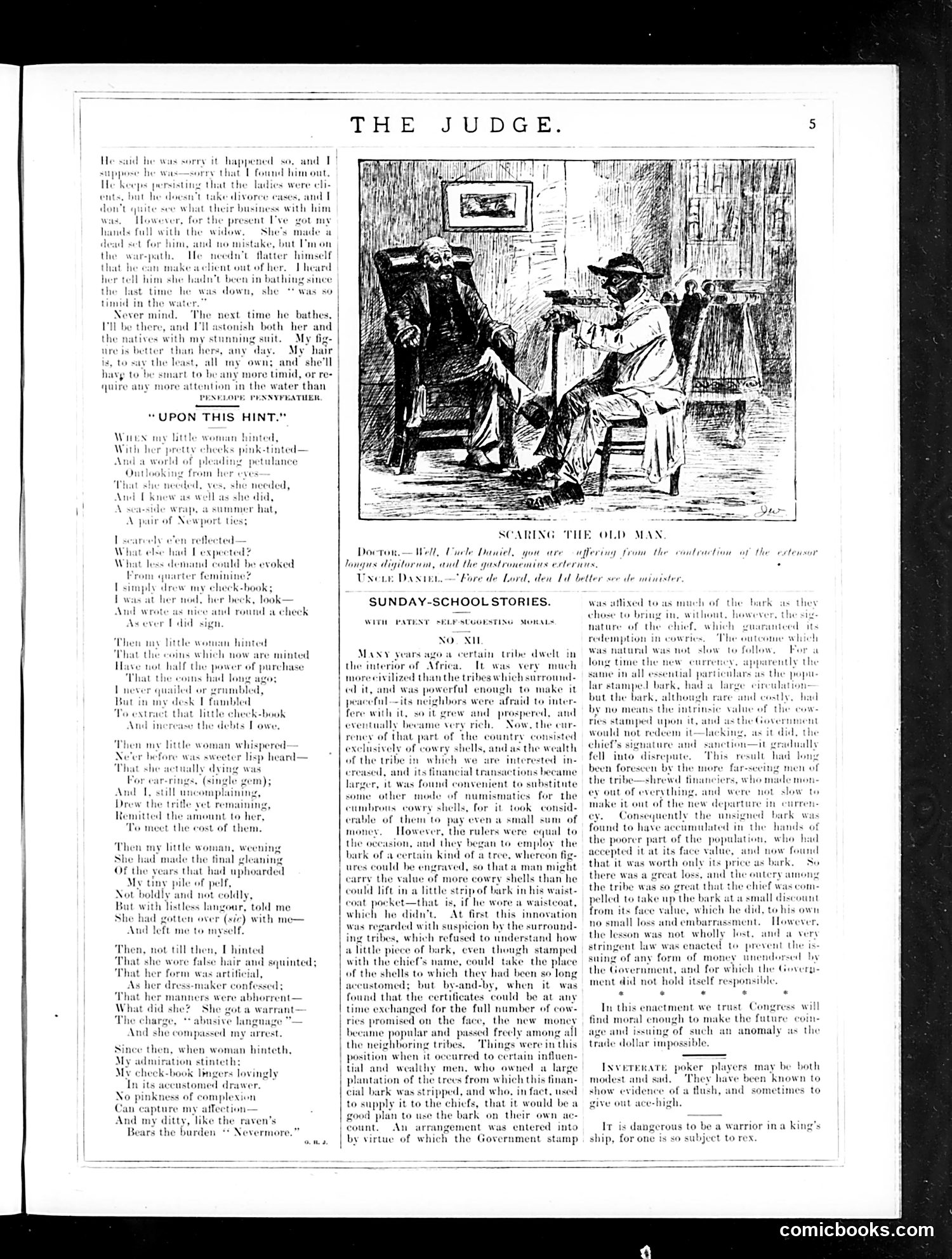
This page contains two distinct satirical pieces: **"Scaring the Old Man"** (top right): A doctor addresses an elderly patient suffering from digitorum (finger spasms) and gastromnemius (calf muscle) issues. The humor appears to rest on the doctor's thick accent ("den Ud better sev") and the implied exaggeration of medical terminology to intimidate or confuse the patient—a common satire on pretentious physicians of the era. **"Sunday-School Stories: No. XI"** (bottom): A moral fable set in Africa describing a tribe that initially used cowry shells as currency. When they replaced shells with bark certificates, shrewd merchants hoarded the bark, causing its value to collapse. Poorer citizens lost everything. The chief was forced to redeem the bark at a loss. The satire targets financial speculation, currency manipulation, and the disconnect between intrinsic and face value—likely commenting on contemporary banking practices or inflation concerns in Judge's era. The "patent self-suggesting morals" subtitle suggests these stories carry deliberately obvious lessons about deception and financial risk.
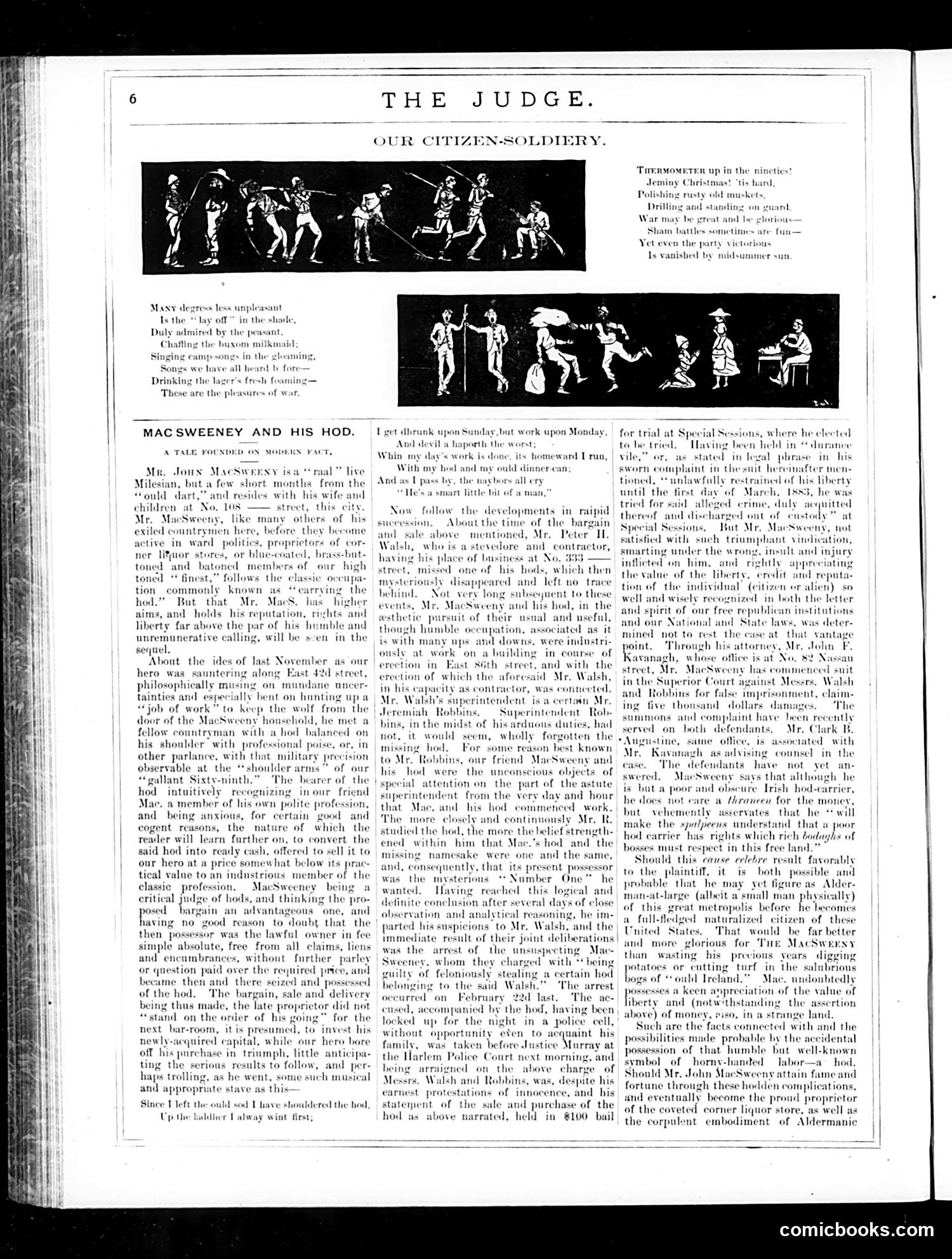
This page contains two satirical pieces about Irish-American working-class life in New York. The top cartoons ("Our Citizen-Soldiery") mock citizen-soldiers and militia culture, showing figures in military poses. The accompanying verse humorously romanticizes military life while depicting soldiers as somewhat foolish. The main story, "Mac Sweeney and His Hod," satirizes bureaucratic overreach. Mac Sweeney, an Irish hod-carrier (construction worker), and a colleague work on a building project. A superintendent becomes suspicious and has them arrested on theft charges related to a missing hod. Despite being innocent, Mac Sweeney is held on bail, sued for damages, and subjected to legal harassment. The satire criticizes how working-class immigrants could face unjust legal persecution, and how a superintendent's arbitrary suspicion could devastate humble workers through the legal system. The piece highlights class tensions and the vulnerability of immigrant laborers to authority abuse.
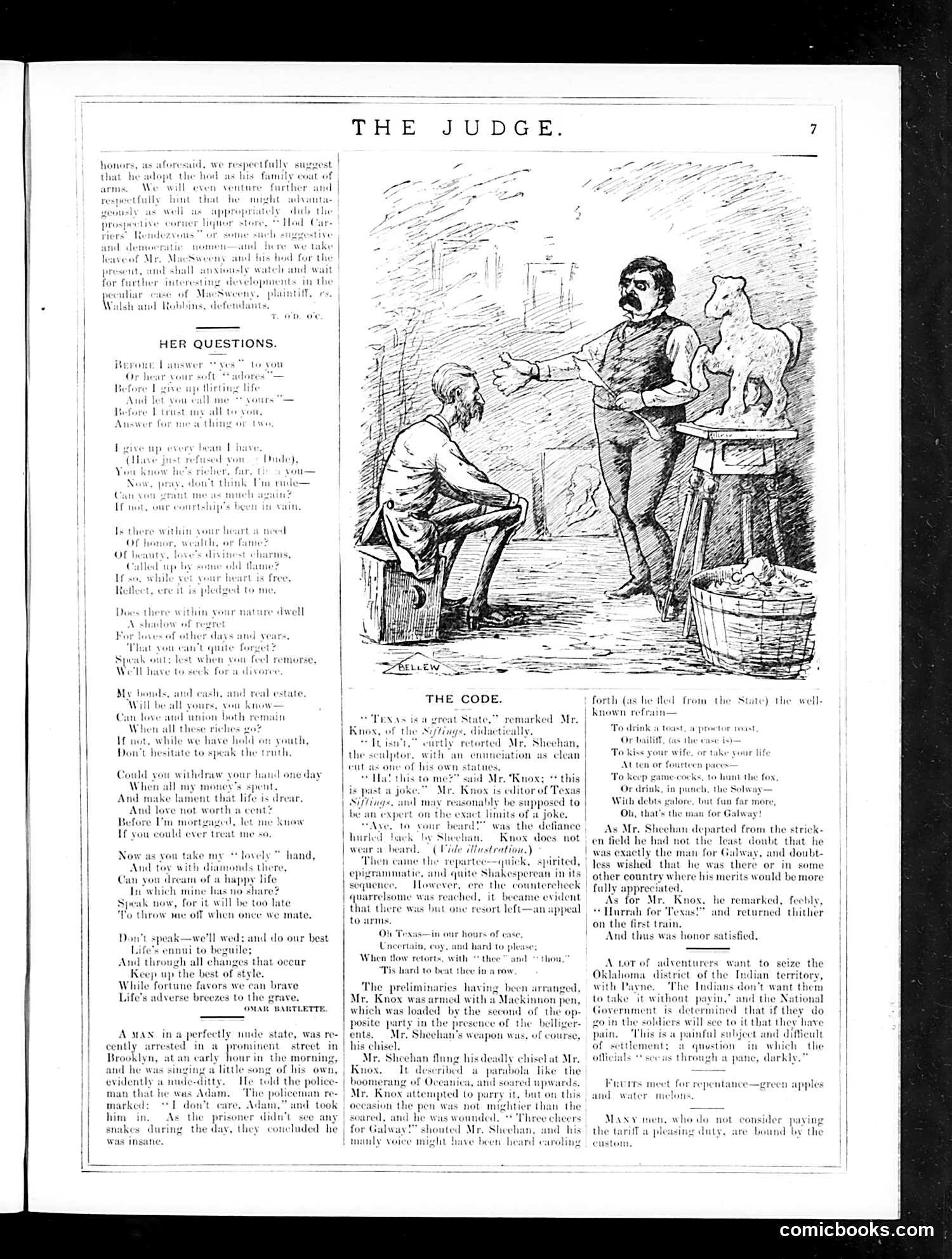
This cartoon mocks a absurd confrontation between Mr. Knox (editor of *Siftings* magazine) and Mr. Sheehan over a dispute about what constitutes a "joke." The satire escalates their petty argument into a formal duel—a melodramatic overreaction to disagreement. Knox is armed with a boomerang (labeled as from Oceanica), which he throws at Sheehan. The joke relies on the ridiculous disproportion: two men fighting with exotic weapons over editorial semantics. The accompanying verse parodies romantic/martial poetry, with absurd references to "Texas," "Galway," and "Oklahoma" that undercut any dignity. The broader satirical point appears to be criticism of magazine editors and journalists who take themselves too seriously, turning minor disagreements into theatrical "battles." The boomerang—an unusual weapon—adds to the absurdist humor, suggesting the whole conflict is equally strange and pointless. The cartoon exemplifies *Judge* magazine's style: mocking pretension through exaggeration and parody.
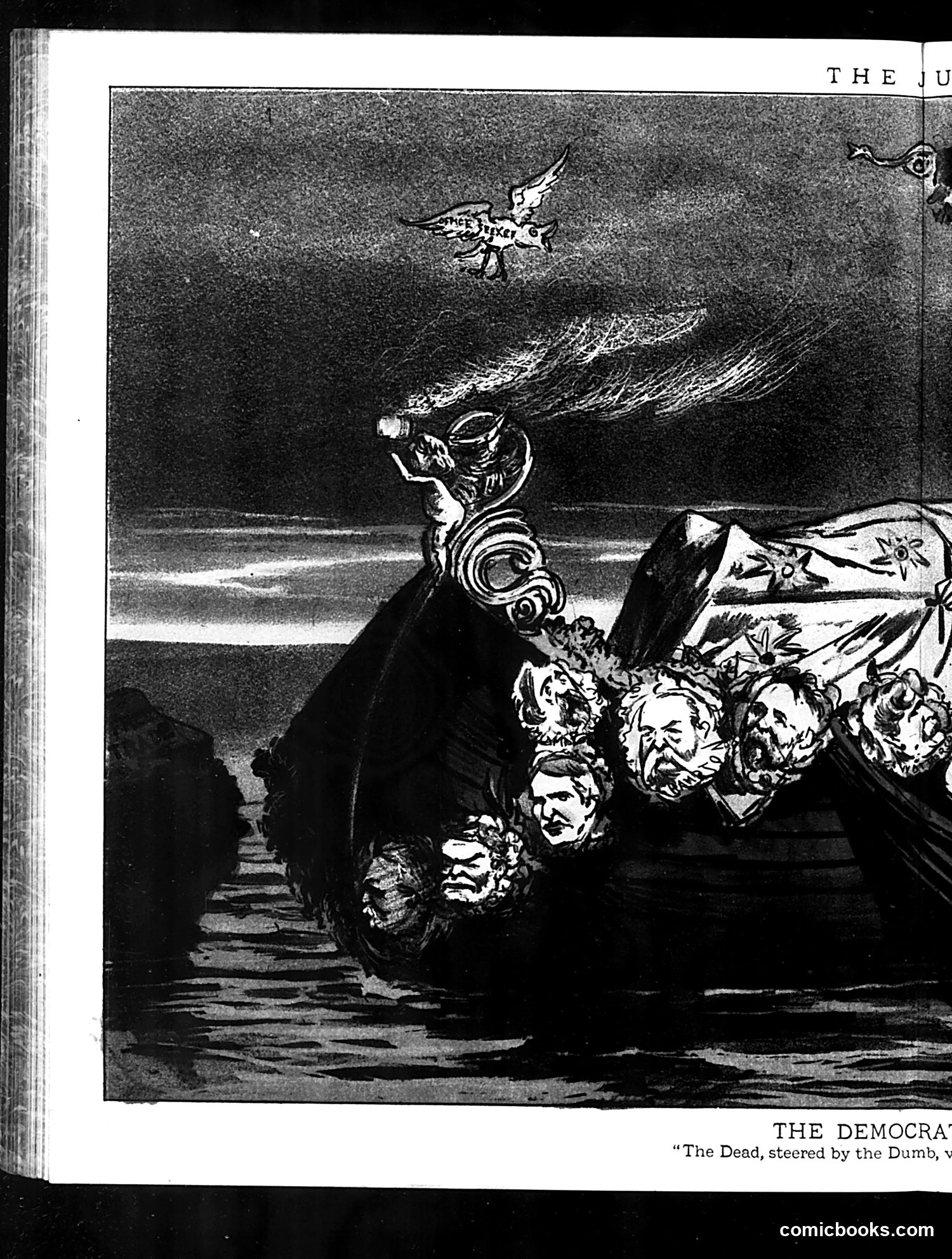
This appears to be a satirical cartoon titled "The Democrats Steered by the Dumb." The image depicts a boat or vessel being piloted by a figure holding a large helm wheel, with multiple grotesque heads visible below—likely representing Democratic party members or voters. A bird flies overhead, possibly symbolizing fate or providence. The satire criticizes Democratic Party leadership as incompetent or foolish ("steered by the Dumb"), suggesting the party is being guided by unintelligent or unfit individuals. The caricatured faces emphasize this mockery through exaggerated features typical of late 19th/early 20th-century political cartooning. Without a date visible, the specific historical context—which election or event prompted this—remains unclear, though Judge magazine regularly published partisan criticism of both major parties.
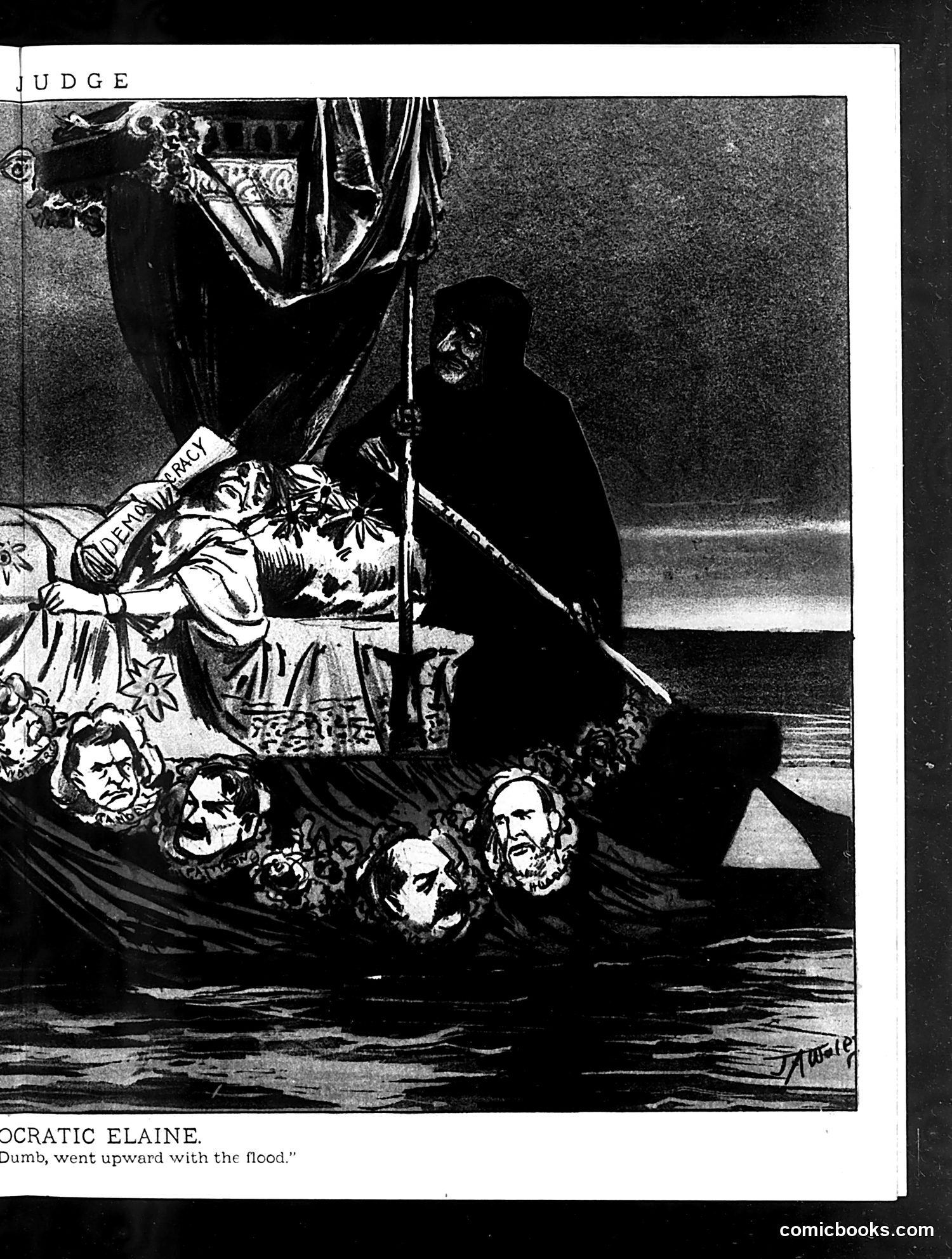
This satirical illustration depicts Death (the Grim Reaper) as a ferryman collecting corpses labeled with names, rowing them across water. The title references "Democratic Elaine" (likely a play on words involving Democratic politics), and the caption "Dumb, went upward with the flood" suggests criticism of Democratic leadership during a crisis—possibly a flood disaster. The severed heads in the water represent prominent Democratic figures being satirized as foolish or incompetent. The cartoon appears to mock Democratic politicians for mishandling a natural disaster or public emergency, using Death's harvest as a metaphor for the political casualties resulting from their incompetence. The imagery is characteristically dark for *Judge* magazine's style. Without specific dates or clearer name identification, the exact historical event remains unclear, but this represents typical late 19th or early 20th-century American political attack journalism.
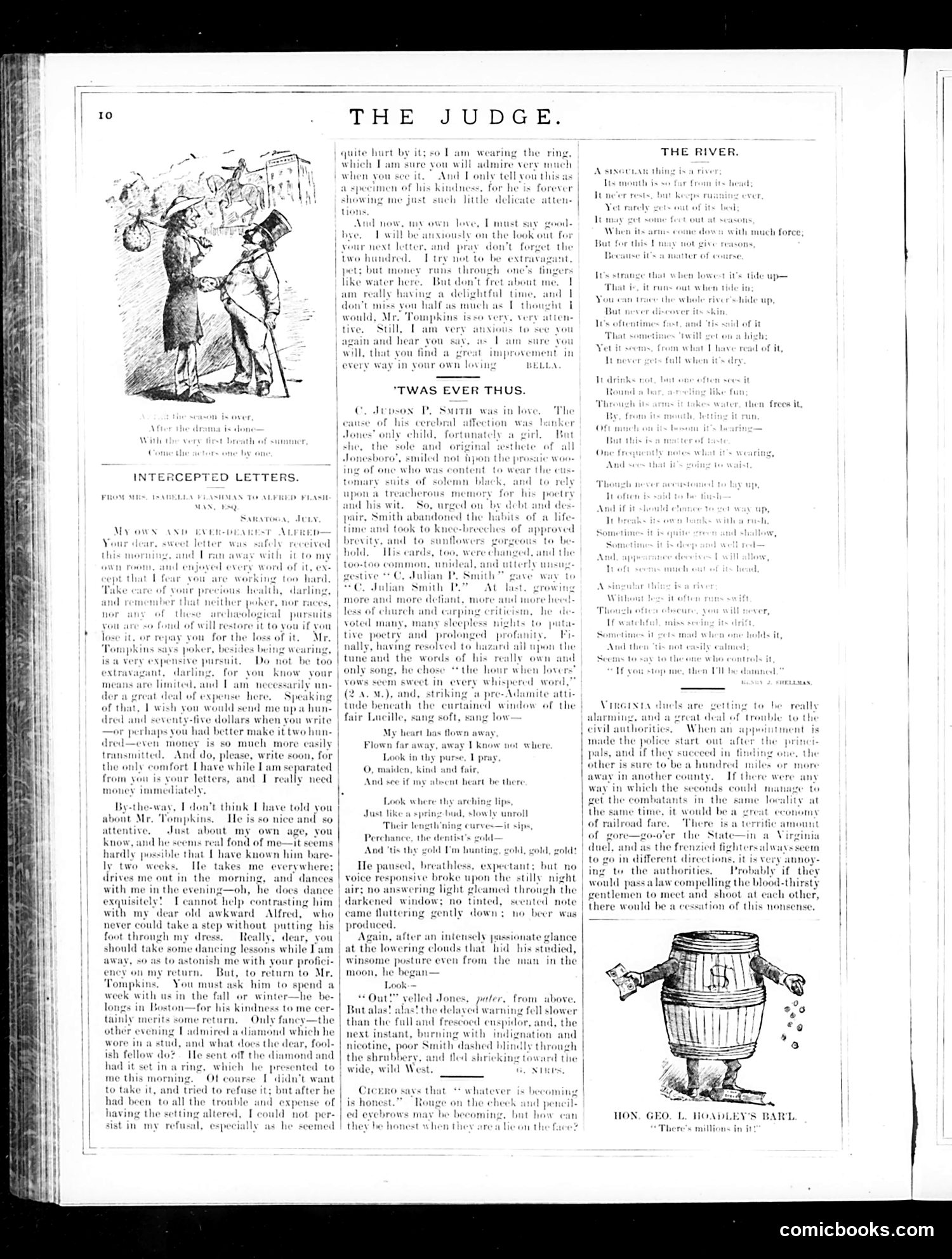
This page contains three distinct pieces of satirical content: **"Intercepted Letters"** (left column): A humorous letter from a woman named Bella to her mother describing a new suitor, Mr. Tompkins. The satire targets women's materialism and fickleness—Bella quickly abandons her "dear old awkward Alfred" for the attentive, gift-giving Mr. Tompkins, who showers her with diamonds and attention after merely two weeks of acquaintance. The joke critiques both female social-climbing and male gullibility in courtship. **"'Twas Ever Thus"** (center): A brief romantic poem about C. Julian P. Smith abandoning poetry and love for a practical life—satirizing the common narrative of idealistic youth surrendering to mundane reality. **"The River"** (right column): A sentimental poem about rivers and nature's indifference to human emotion—likely mocking overwrought Romantic-era poetry. The cartoons (a couple in period dress, a barrel labeled "Hon. Geo. L. Boadley's Barrel") appear to illustrate these satirical pieces, though specific references are unclear without additional context.
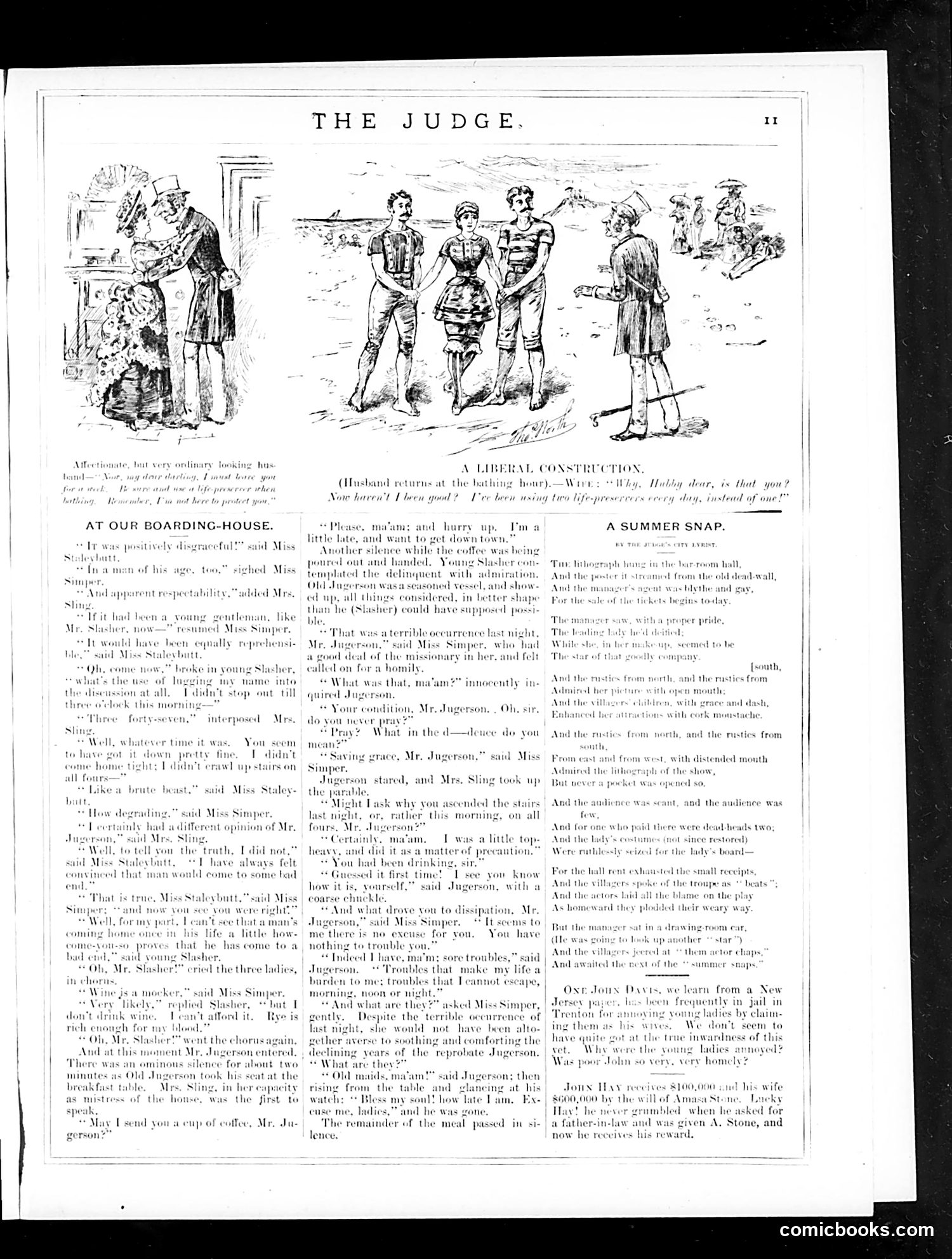
This page contains three satirical pieces from the American humor magazine *Judge*: **"At Our Boarding-House"** depicts a morality lecture where landlady Miss Simper and others scold Mr. Jugerson for returning late, drinking, and general dissipation. The satire targets Victorian hypocrisy: the ladies deliver stern sermons about virtue while Jugerson deflects with charm, and young Slasher admires his rakish behavior—suggesting the reprimand rings hollow. **"A Liberal Construction"** (center illustration) shows a husband returning to find his wife at the beach with two young women, inventing an excuse about needing to go downtown. The joke plays on marital deception and the husband's credulous acceptance. **"A Summer Snap"** describes a lithograph in a barroom depicting scenery with an empty audience—satirizing either failed entertainment or artistic pretension. The page also includes a brief item about "Ox John Davis," jailed repeatedly for harassing young women by claiming to marry them, and mentions someone receiving $100,000 from Amasa Stone's will. The overall tone mocks Victorian morality, marital discord, and social pretense.
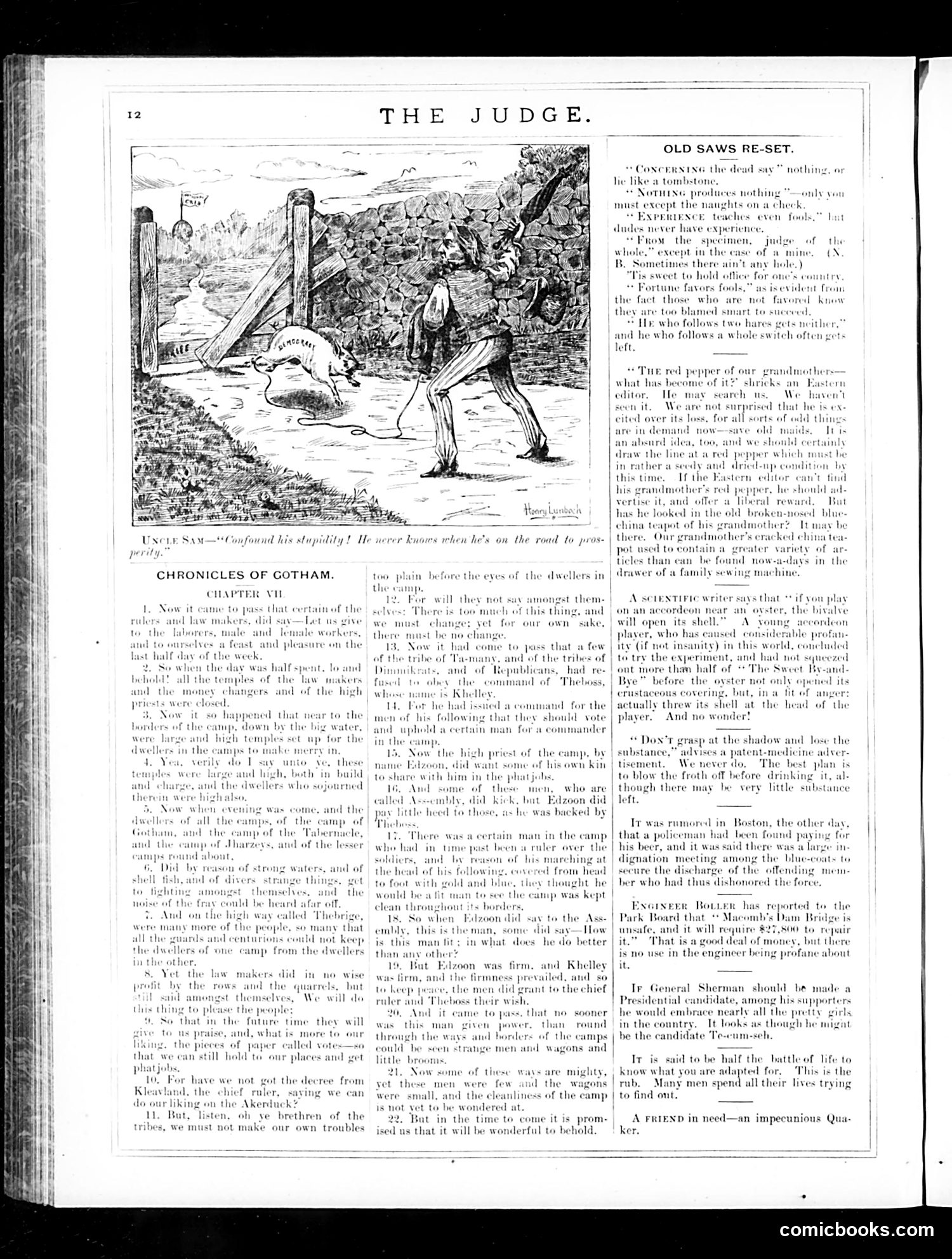
This page from *Judge* contains two distinct sections: ## "Chronicles of Gotham" (Main Cartoon) The illustrated narrative—rendered in biblical/archaic language—appears to be a political allegory about internal camp disputes over leadership selection. The story describes a camp where leaders debate whether to maintain an established commander (Edzoon) or elect someone new. The satire likely comments on contemporary American political factionalism, possibly referencing labor disputes, military command structures, or municipal governance conflicts in "Gotham" (New York City). ## "Old Saws Re-Set" (Sidebar) A collection of witty aphorisms and commentary mocking contemporary absurdities: exaggerated patent medicine claims, the loss of heirloom items, a Boston policeman's drunkenness, and infrastructure deterioration (Macomb's Dam Bridge repair costs). **Overall meaning**: The page satirizes political incompetence, nostalgia for lost quality, public corruption, and neglected civic infrastructure—recurring *Judge* themes critiquing Gilded Age American society.
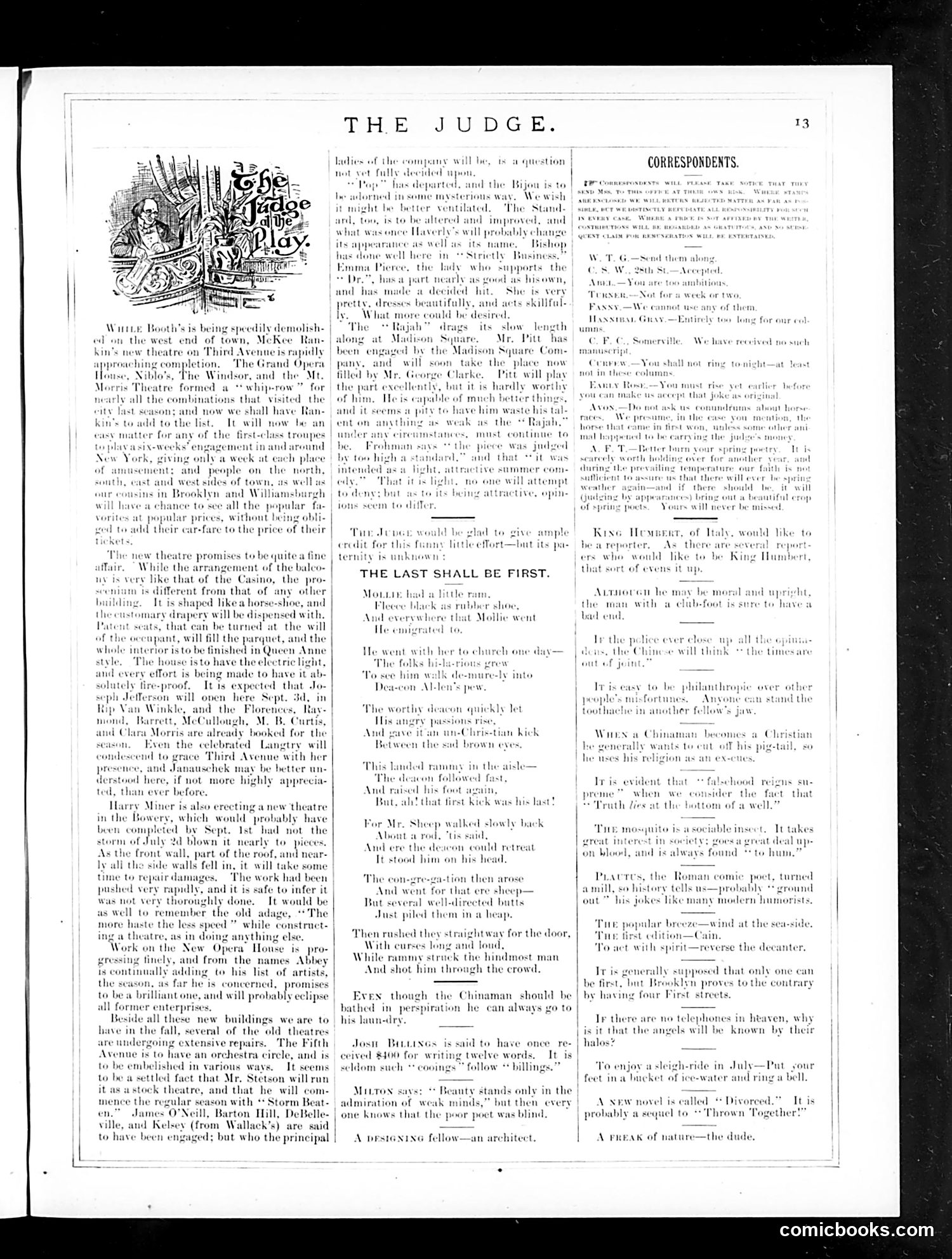
This page primarily contains **theater gossip and construction updates** rather than political satire. The main illustrated cartoon (upper left) shows "The Judge at Play"—a decorative header, not a political cartoon. The content discusses **New York theater construction and management**: multiple new theaters being built (the Grand Opera House, Windsor, Mt. Morris), upcoming seasons, and personnel changes. It mentions specific figures like **McKee Rankin** (theater manager) and **Lester Wallack** (actor). The page also includes several **light verse poems** and brief humor items typical of Judge magazine's format—puns and jokes about daily life ("The Last Shall Be First" satirizes a deacon's hypocrisy), mosquitoes, and architectural absurdities. This appears to be a **general-interest entertainment and gossip page** rather than pointed political commentary. Without clearer images of specific caricatures or more context about which theater personalities were controversial, the satirical targets remain local rather than nationally significant.
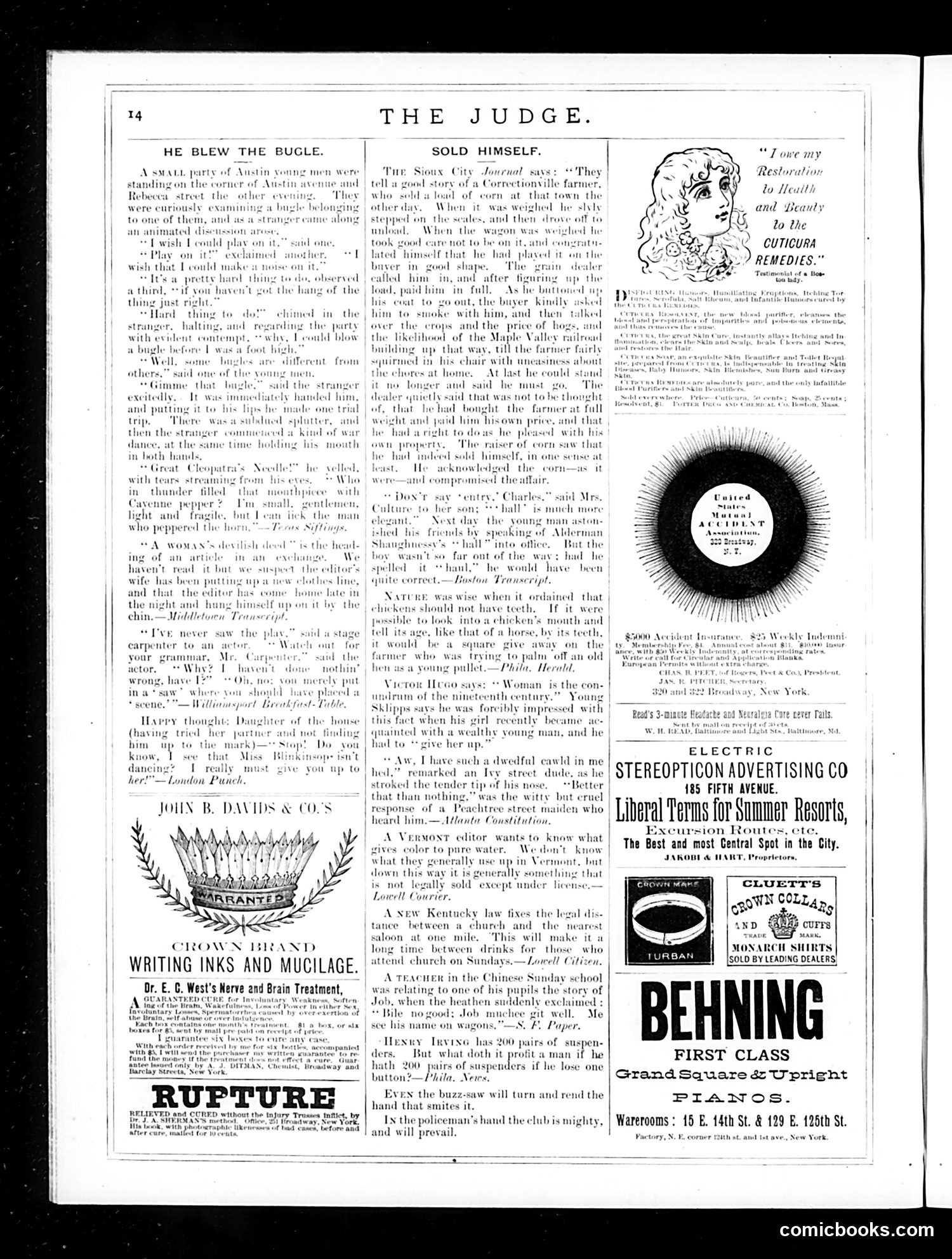
This page features a humorous anecdote about a farmer who unwittingly undermines his own negotiating position. The story, reprinted from the Sioux City Journal, describes a Correctionville farmer selling a load of corn. The buyer deliberately weighs the wagon before and after unloading to determine the corn's actual weight. The farmer, realizing he's been outmaneuvered by the buyer's clever scheme, acknowledges he has "sold himself"—meaning he's been bested in the deal through his own lack of shrewdness. The piece satirizes rural farmers' business naiveté against urban or more cunning merchants. The accompanying anecdotes below mock similar lapses in judgment across different social situations, suggesting a broader American theme about being fooled by one's own carelessness or ignorance. The page is primarily filled with period advertisements for writing inks, patent medicines, and pianos—typical Judge magazine content from the late 19th century.
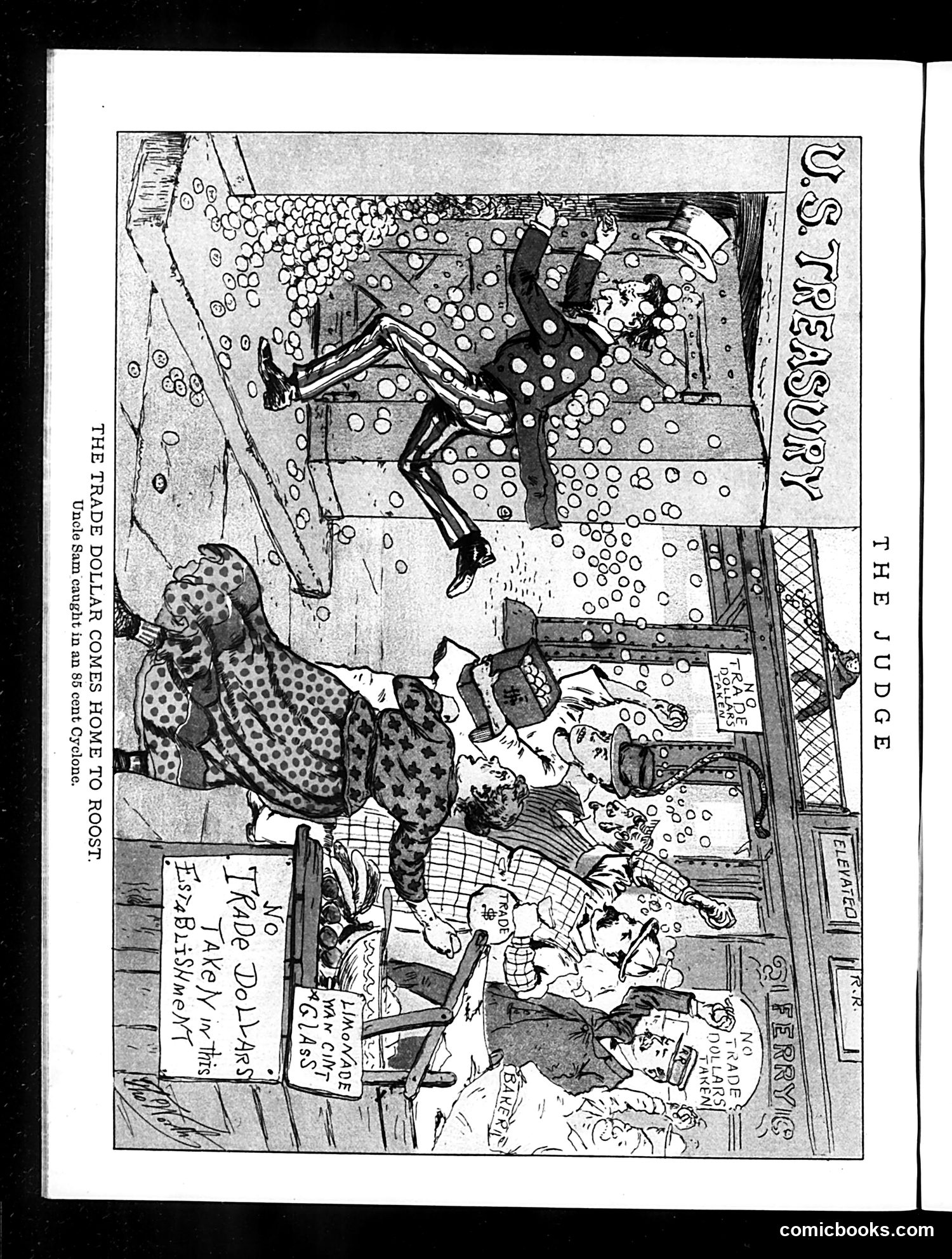
This Judge cartoon satirizes economic turbulence affecting America. Uncle Sam, the personified United States, is depicted being violently tossed about by a cyclone of coins—specifically labeled as an "85 cent" phenomenon, likely referencing a currency or price crisis of the era. The chaos below shows everyday Americans (children, families) caught in the same financial maelstrom, suggesting widespread economic hardship trickling through society. A vendor's cart and scattered goods indicate commerce disrupted. The cartoon critiques how national economic instability—whether currency devaluation, inflation, or market crash—devastates ordinary citizens. The parallel treatment of Uncle Sam and common people emphasizes that leadership and populace suffer together from poor economic management or external financial shocks.