
A complete issue · 16 pages · 1883
Judge — July 14, 1883
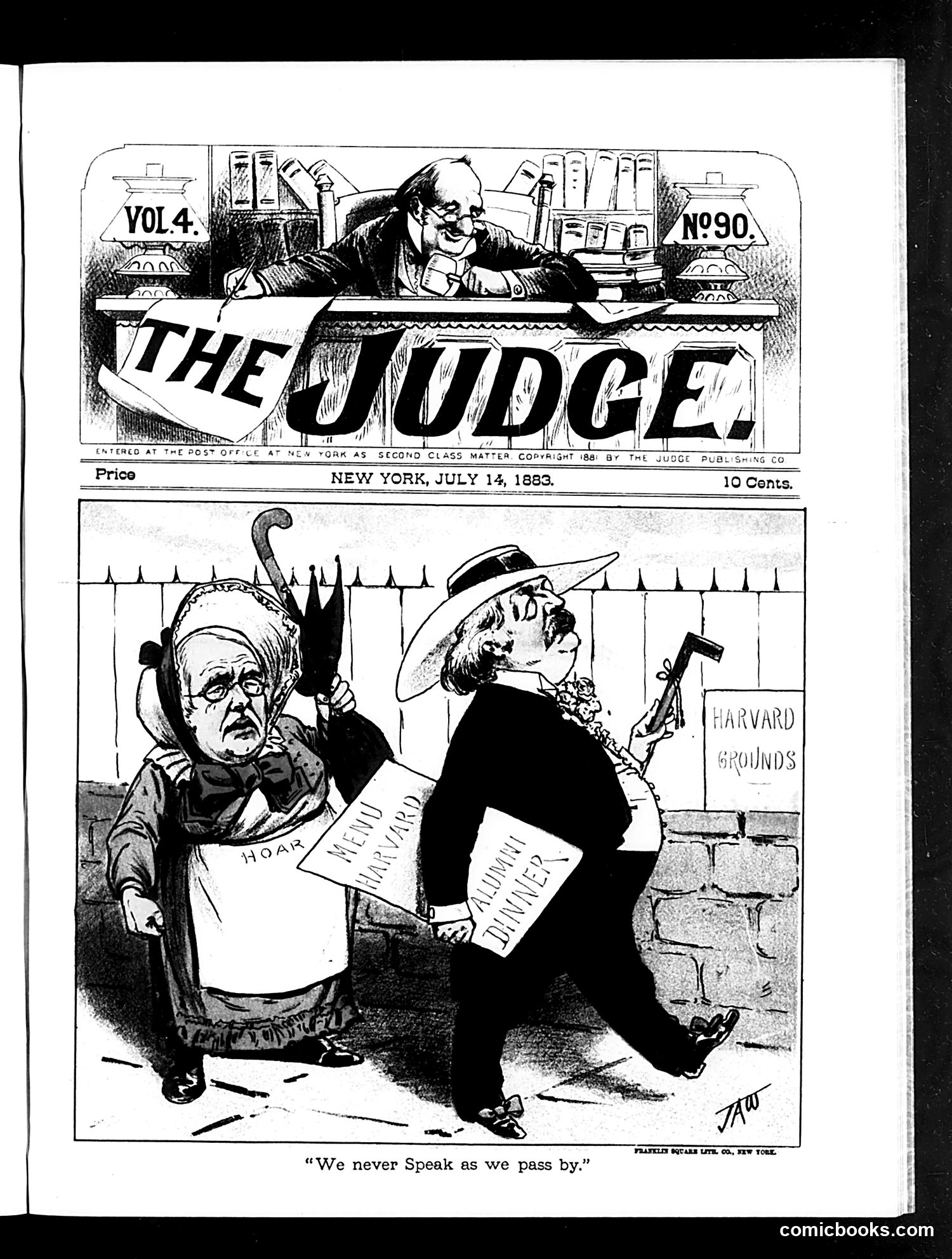
This *Judge* cartoon from July 14, 1883, depicts two figures at Harvard Grounds who pointedly ignore each other despite passing nearby. One wears a head wrap labeled "HOAR" (likely Senator George Frisbie Hoar), carrying an umbrella. The other, dressed fashionably with a hat, holds papers labeled "ALUMNI DINNER" and "HARVARD FACULTY." The caption suggests a bitter personal or political estrangement between these Harvard-connected figures. The cartoon satirizes how prominent individuals maintain public silence about their conflicts, possibly referencing a specific Harvard-related dispute or scandal from that period. Without additional context, the exact nature of their quarrel remains unclear, though the imagery emphasizes deliberate avoidance and cold relations.
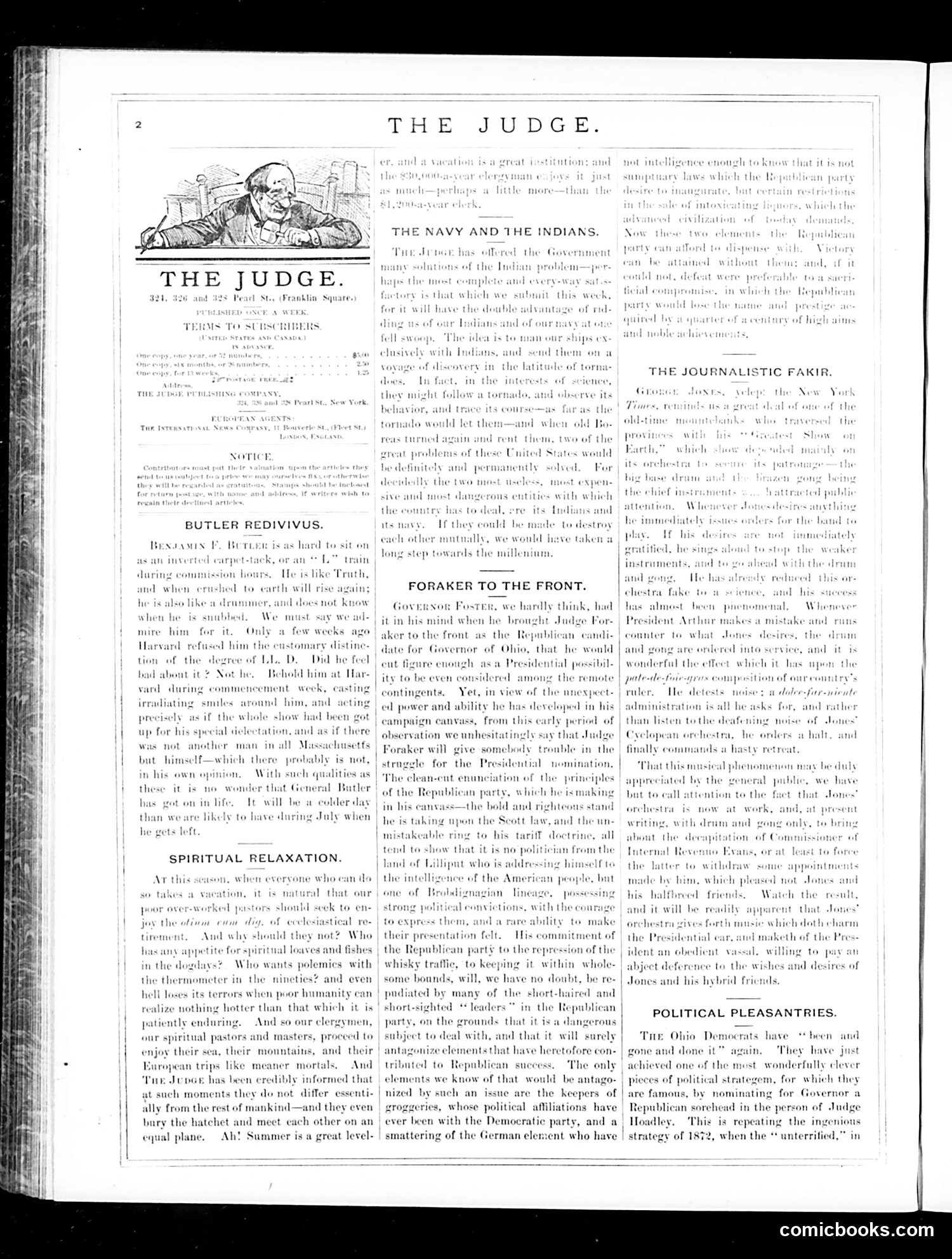
This page from the satirical magazine *Judge* contains several political commentaries: **"Butler Redivivus"** mocks General Benjamin Butler, ridiculing his shameless self-promotion and social climbing despite Harvard's public rejection of him (denying an honorary degree). The satire suggests Butler's thick-skinned opportunism allows him to advance regardless of humiliation. **"Foraker to the Front"** discusses Judge Foraker's emergence as a potential Republican presidential candidate from Ohio, apparently surprising observers given his earlier obscurity. The piece analyzes his campaign effectiveness and notes Republican party divisions over issues like tariffs and the "whisky traffic." **"Political Pleasantries"** briefly notes Ohio Democrats' clever political maneuvering in nominating someone for Governor, suggesting they've achieved a strategic advantage by nominating Judge Hoadley, repeating a successful 1872 strategy. The cartoons target Republican Party vulnerabilities and internal conflicts, while highlighting individual politicians' ambitions and contradictions—typical *Judge* fare attacking the political establishment of the 1880s.
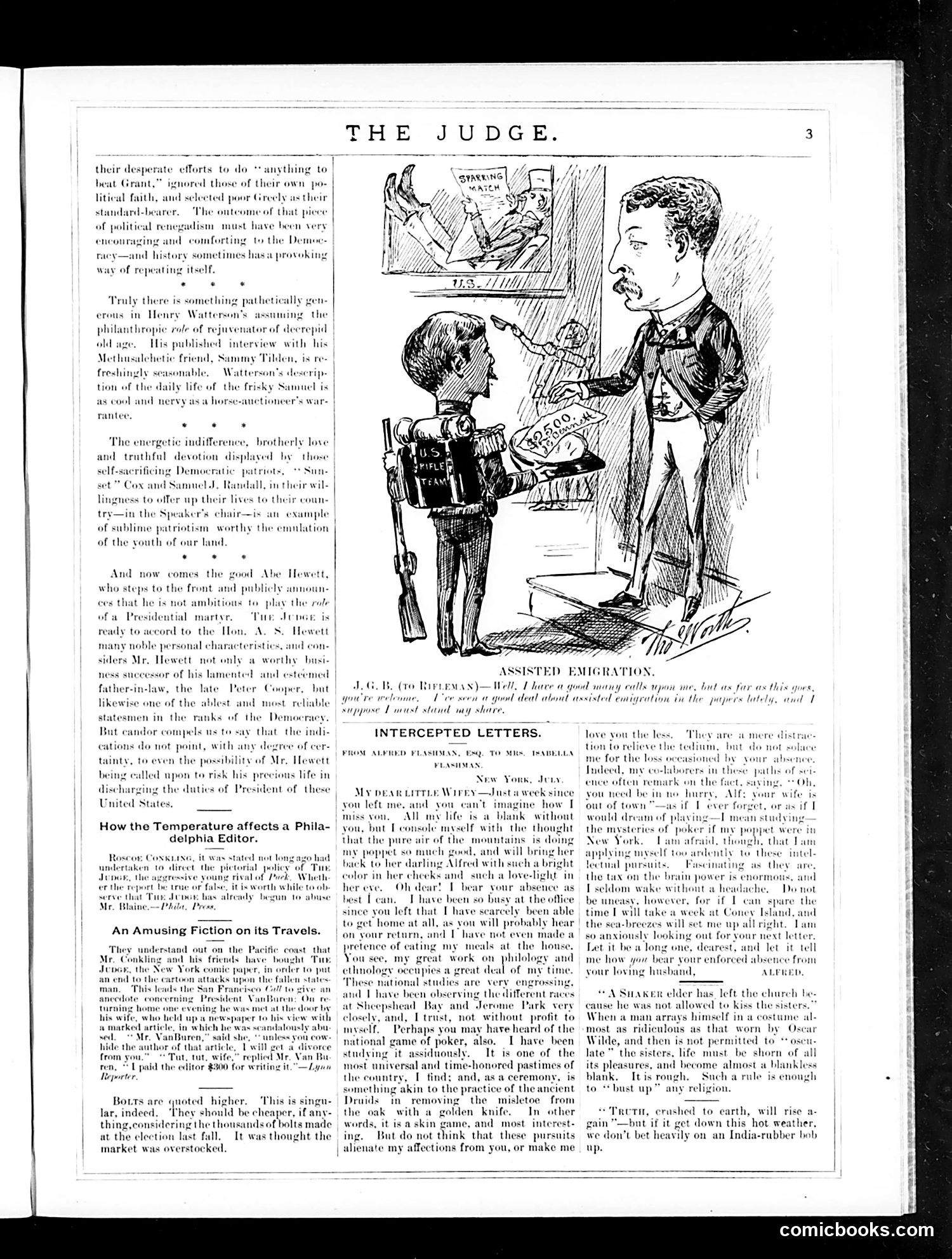
This page contains political satire from the Gilded Age, likely from the 1870s-80s based on references. The main cartoon, "Assisted Emigration," depicts a military officer (appearing to represent U.S. government authority) handing money to a young soldier, satirizing American support for emigration policies or potentially mocking corrupt patronage systems where government positions were traded for loyalty. The text discusses Democratic Party figures, mentioning Henry Watterson, Abe Hewett, and Peter Cooper—likely debating presidential succession or party leadership. The piece mocks reformist pretensions while questioning whether certain figures should hold high office. The "Intercepted Letters" section parodies romantic correspondence, using humor about absent spouses and poker-playing to satirize contemporary social vices—a common Judge device for social criticism wrapped in comedy. The scattered items about editors, bolts being "overstocked," and other fragments represent typical magazine filler mocking current events, prices, and public figures through wordplay.
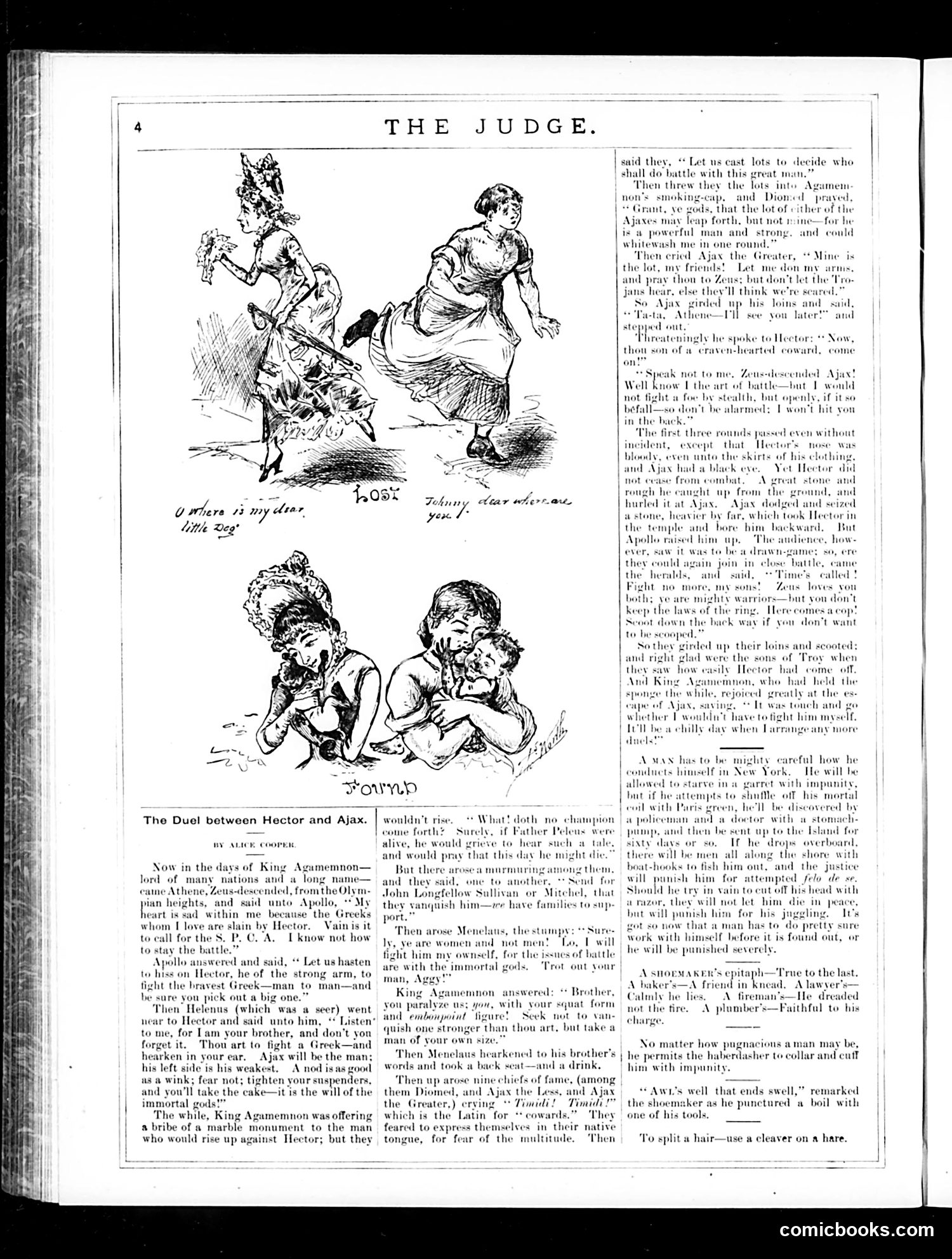
This is a humorous retelling of the Homeric duel from the Trojan War, rendered in mock-heroic style with contemporary American references. The cartoon illustrates scenes from the battle while the text parodies classical epic language. The satire works by treating ancient Greek warriors as if they were modern American figures—comparing them to contemporary boxers like John L. Sullivan and Mitchell. The final section shifts to modern New York, satirizing how a man must be careful conducting himself there, referencing attempted suicide laws and urban policing. The concluding epitaphs (baker, lawyer, fireman, plumber) are jokes about professional stereotypes. The point appears to be contrasting the glory and freedom of ancient heroic combat with modern urban constraints and legal restrictions—suggesting American society has become overly regulated and restrictive compared to simpler, more straightforward eras.
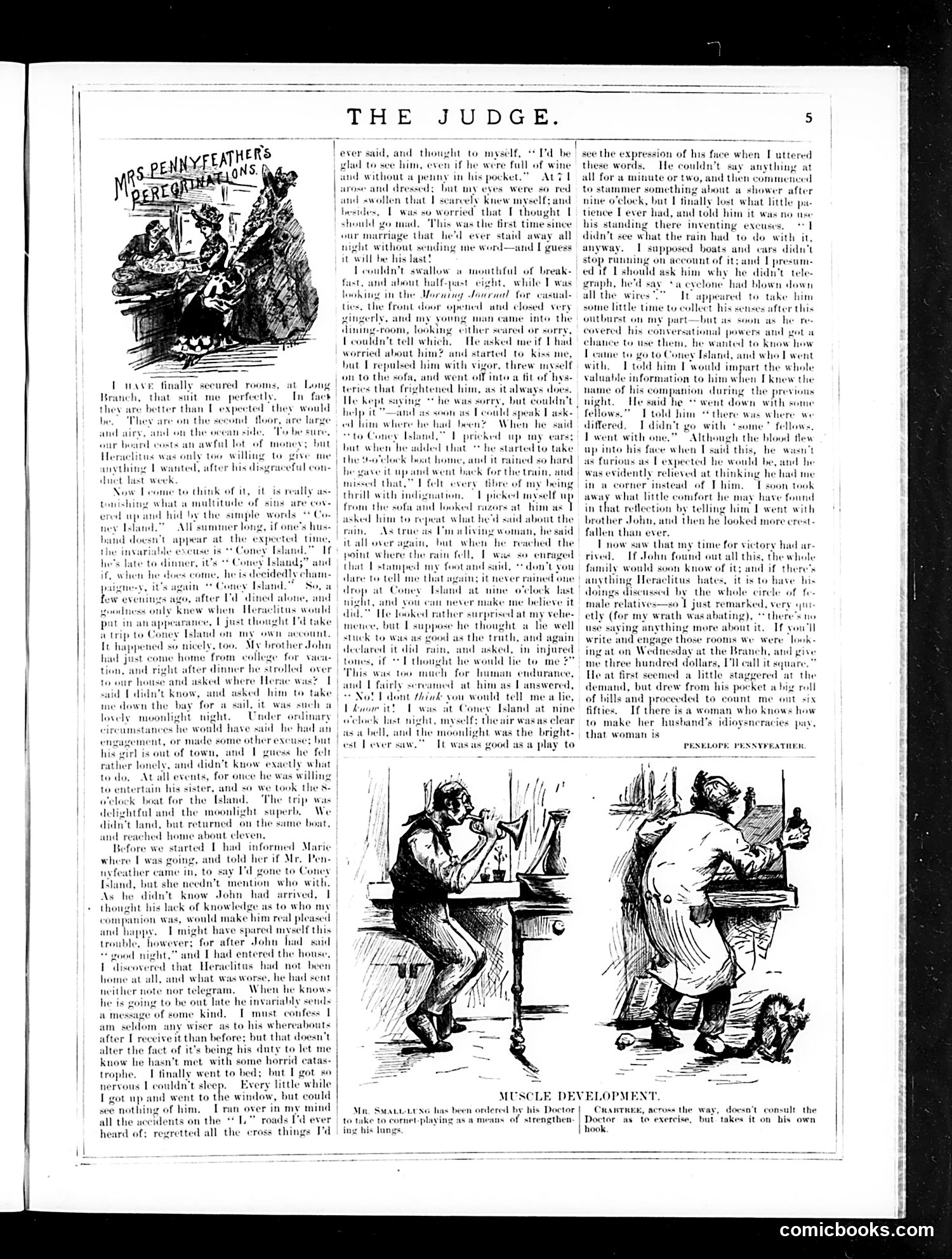
This page contains a serialized story titled "The Judge" rather than a standalone political cartoon. The narrative describes a mother's anxiety over her son Heraclitus's unexplained absence from home, followed by his mysterious late-night return. The two illustrations labeled "Muscle Development" depict a humorous scene: a small, weak man consulting a doctor about exercise, contrasted with the same man now heavily muscled. The caption jokes that the doctor didn't recommend exercise itself, but rather "takes it on his own looking his lungs"—suggesting the man's muscle development came from some other source (possibly manual labor or hard work rather than proper training). The page exemplifies Judge magazine's approach: mixing domestic fiction with satirical commentary on contemporary life. The story's emphasis on proper notification and social propriety reflects Victorian-era concerns about family communication and respectability—themes Judge would have used to both entertain and gently mock its middle-class readership.
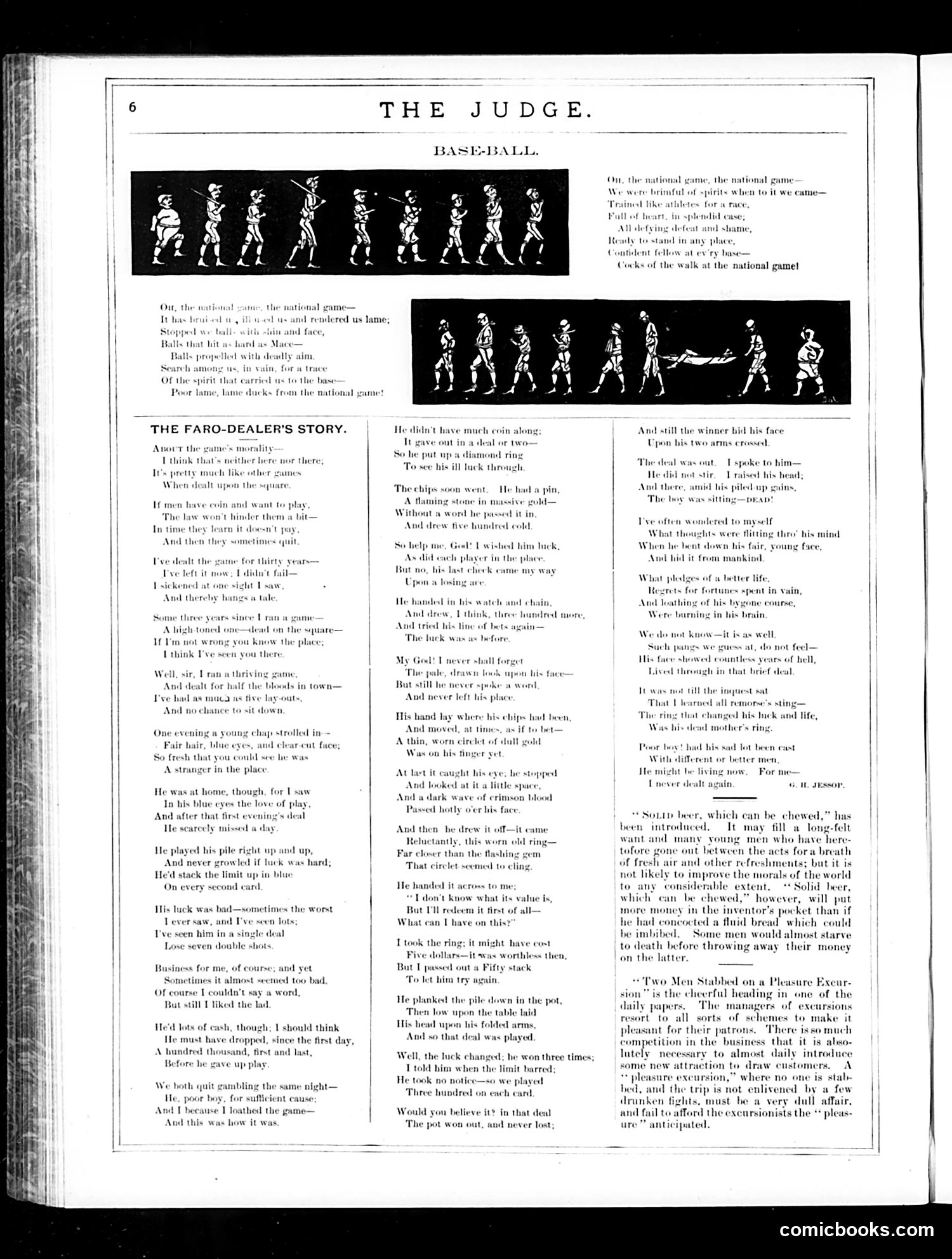
This page presents a narrative poem about gambling's moral corruption, illustrated with silhouettes of baseball players at top (establishing "the national game" as a metaphor for American life). The story concerns a young man who frequents a faro game (illegal card gambling). He gambles away his fortune, then stakes his watch, chain, and finally a diamond ring—apparently his mother's. After losing that final bet, he places his head on the table and later dies (implied suicide by "inquest"). The satire targets **faro dealers and gambling establishments** as predatory institutions that destroy youth and families. The faro-dealer narrator, while claiming reluctant sympathy, profits from ruining the "fair-haired" boy. The poem criticizes both the vice itself and those who enable it. The baseball framing suggests gambling represents a broader American moral danger—a perversion of competitive spirit into destructive vice. Judge's message: gambling destroys lives while enriching cynical operators.
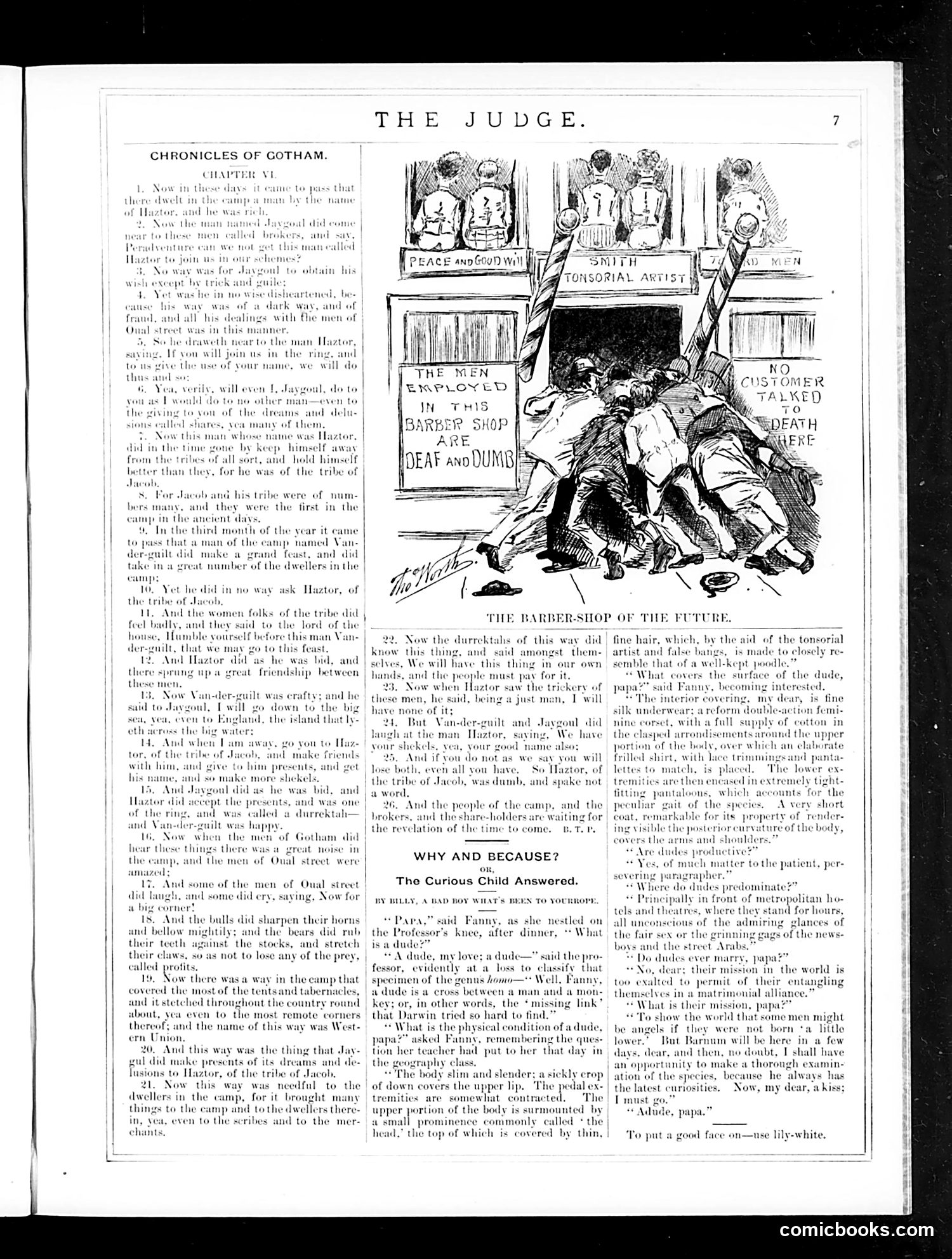
This Judge magazine cartoon satirizes corrupt **monopolistic practices** in late 19th-century America, likely referencing the **Western Union telegraph monopoly** and ruthless business consolidation. The image depicts a barbershop where workers are rendered "deaf and dumb"—a metaphor for silenced laborers exploited by monopolistic power. The signs reading "Peace and Good Will," "Sonsorial Artist," and "No Customer Talked to Death Here" drip with irony, mocking the contradiction between proclaimed virtues and brutal business tactics. The accompanying text, framed as biblical allegory ("Chronicles of Gotham"), tells how the character **Haztor** (representing workers or small competitors) is forced into submission through economic coercion by **Jaygoul** and **Van-der-guilt** (likely stand-ins for monopoly magnates). When resistance organizes—"the men of Qual street were amazed"—the narrative suggests monopolies control communication channels to suppress dissent. The humor targets how gilded-age corporate titans hid exploitation behind respectable facades while crushing competition and worker autonomy.
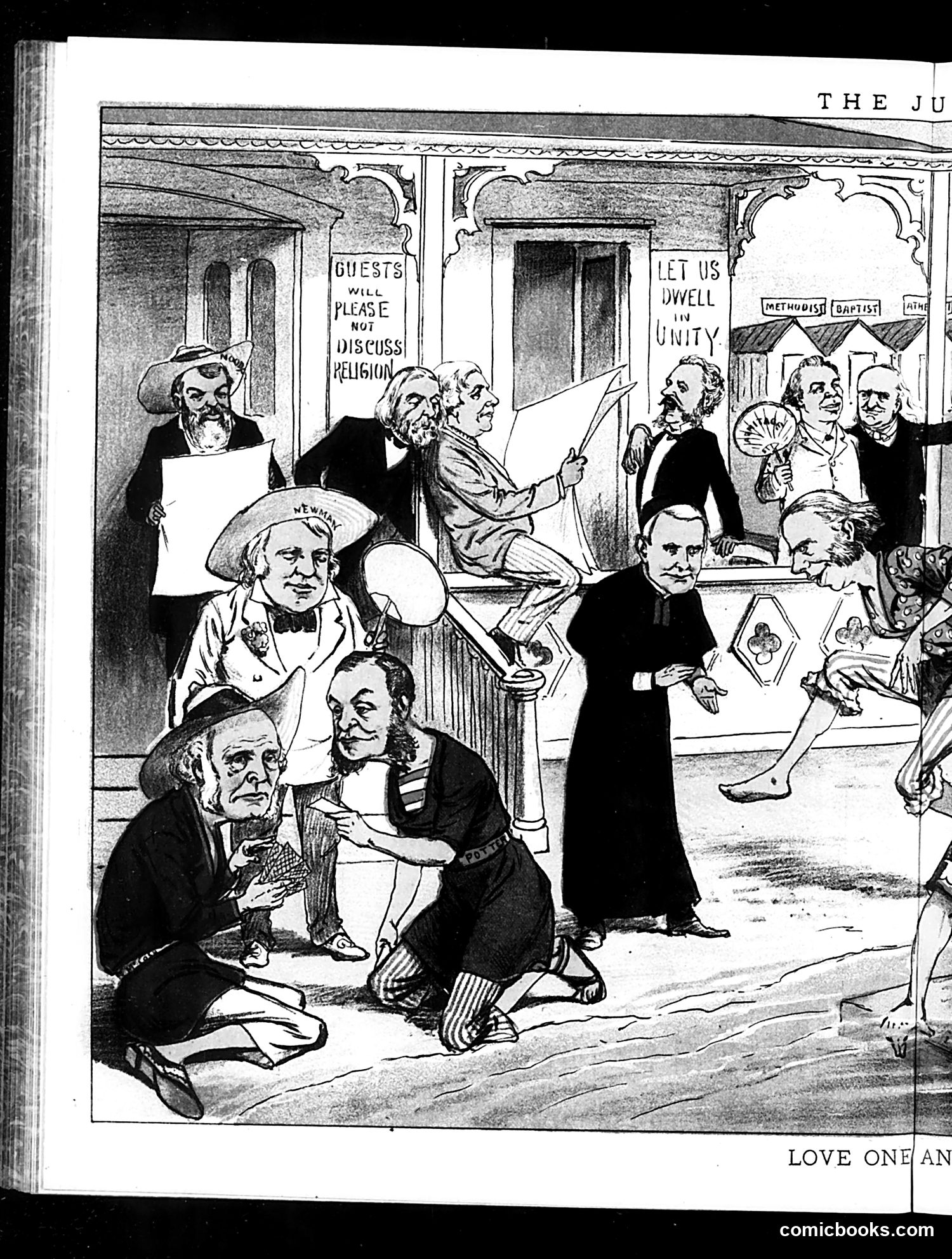
This Judge magazine cartoon satirizes religious discord among American Protestant denominations. The scene shows various clergy (identifiable by their dress and the denominational labels visible—Methodist, Baptist, and others) engaged in heated debate inside what appears to be a gathering space. The irony is sharp: signs reading "GUESTS WILL PLEASE NOT DISCUSS RELIGION" and "LET US DWELL IN UNITY" contrast sharply with the actual arguing, fighting figures below. Clergy members are literally fighting and gesticulating wildly while supposed to maintain civility. The satire targets the hypocrisy of religious leaders who publicly preach unity and forbid controversial discussion, yet privately engage in bitter sectarian conflicts. This reflects late-19th/early-20th-century tensions between American Protestant churches competing for congregants and influence.
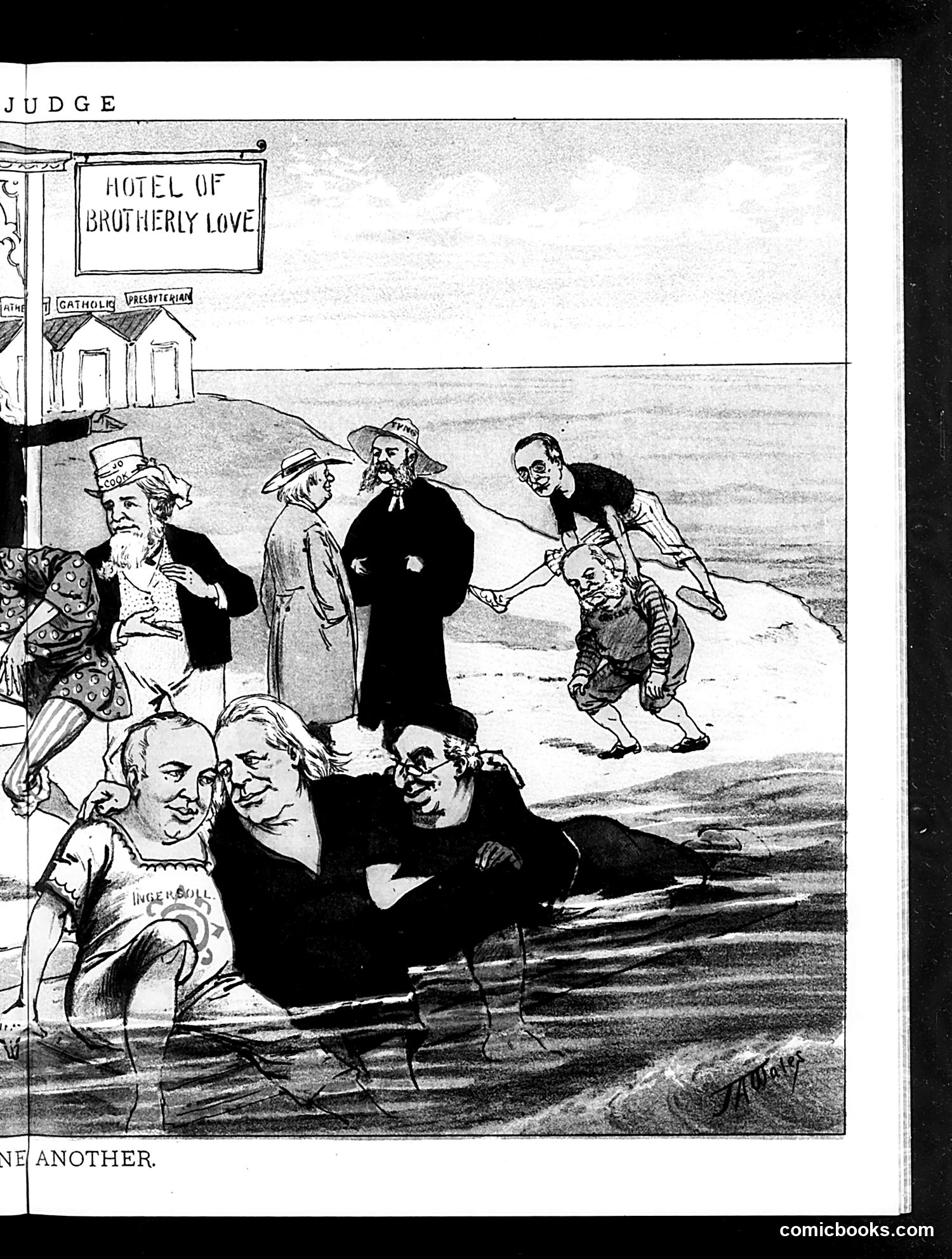
This Judge magazine cartoon satirizes the "Hotel of Brotherly Love"—likely referencing Philadelphia or American fraternity/brotherhood ideals. The scene depicts men in suits and hats engaged in what appears to be deceptive or underhanded dealings on a beach or boardwalk, with some figures crouching conspiratorially in the foreground. The satire contrasts the sign's promise of "brotherly love" with the actual behavior shown: collusion, backroom deals, and mutual deception. The caricatured figures suggest specific political or social personalities of Judge's era, though without additional context, their precise identities remain unclear. The cartoon criticizes hypocrisy—the gap between professed values of fraternity and actual self-interested behavior among men in power.
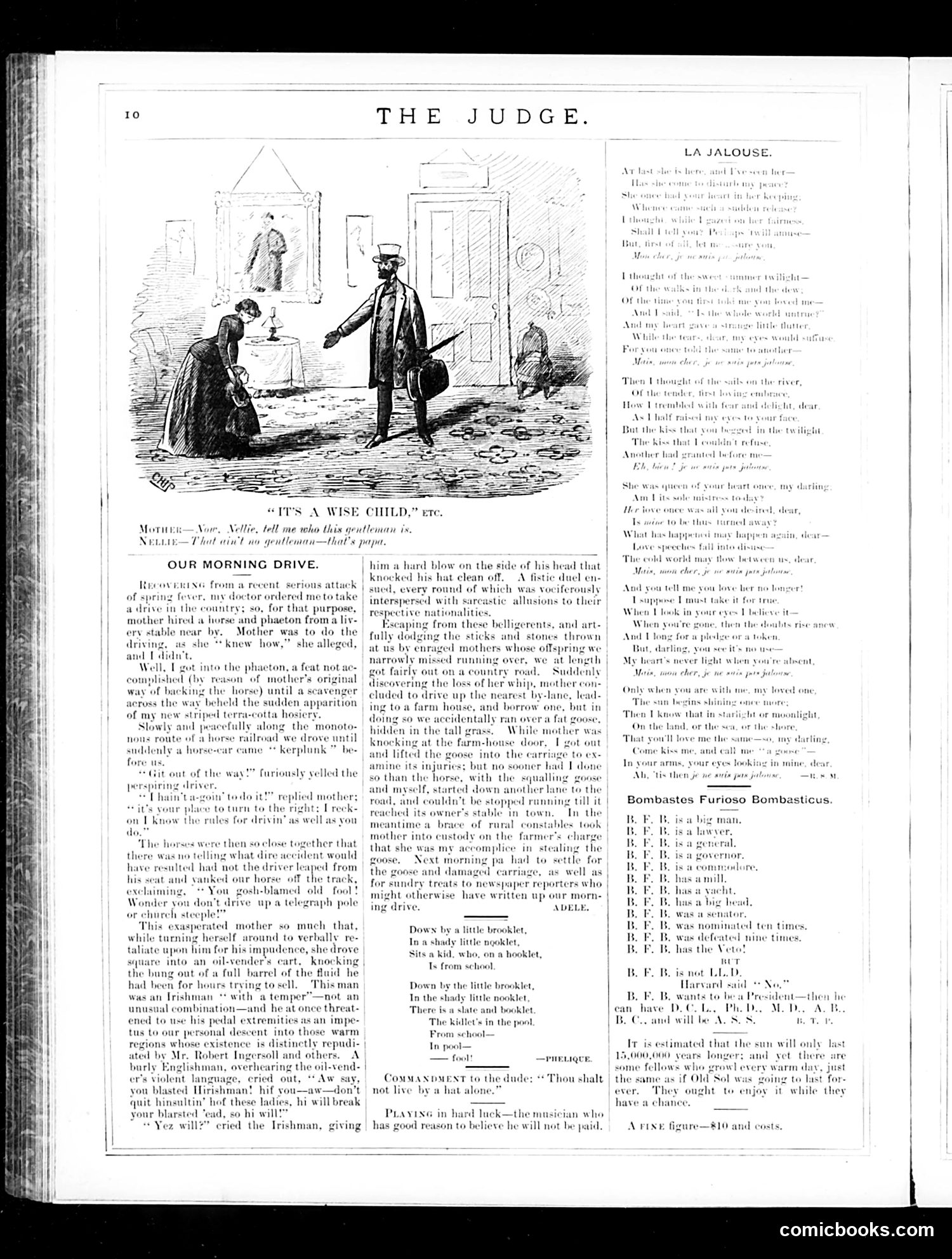
This page contains two main satirical pieces from Judge magazine: **"Our Morning Drive"** is a humorous narrative about a mother and child's carriage ride disrupted by an Irish immigrant driving a cart. When the vehicles collide, the two drivers engage in a heated, sarcastic insult-filled argument. The satire targets anti-Irish prejudice common in the era—the "blasted Irishman" stereotype is mocked through exaggerated dialogue. The joke ultimately ridicules both the drivers' volatility and class tensions between immigrant working-class laborers and middle-class Americans. **"La Jalouse"** (The Jealousy) is a sentimental poem about romantic jealousy, separate from the main cartoon. **"Bombastes Furioso Bombasticus"** appears to be a humorous reference list, possibly mocking a pompous or inflated public figure through absurdist descriptions of their attributes and accomplishments. The page reflects late-19th-century American attitudes toward Irish immigrants while using humor to critique broader social pretensions and conflicts.
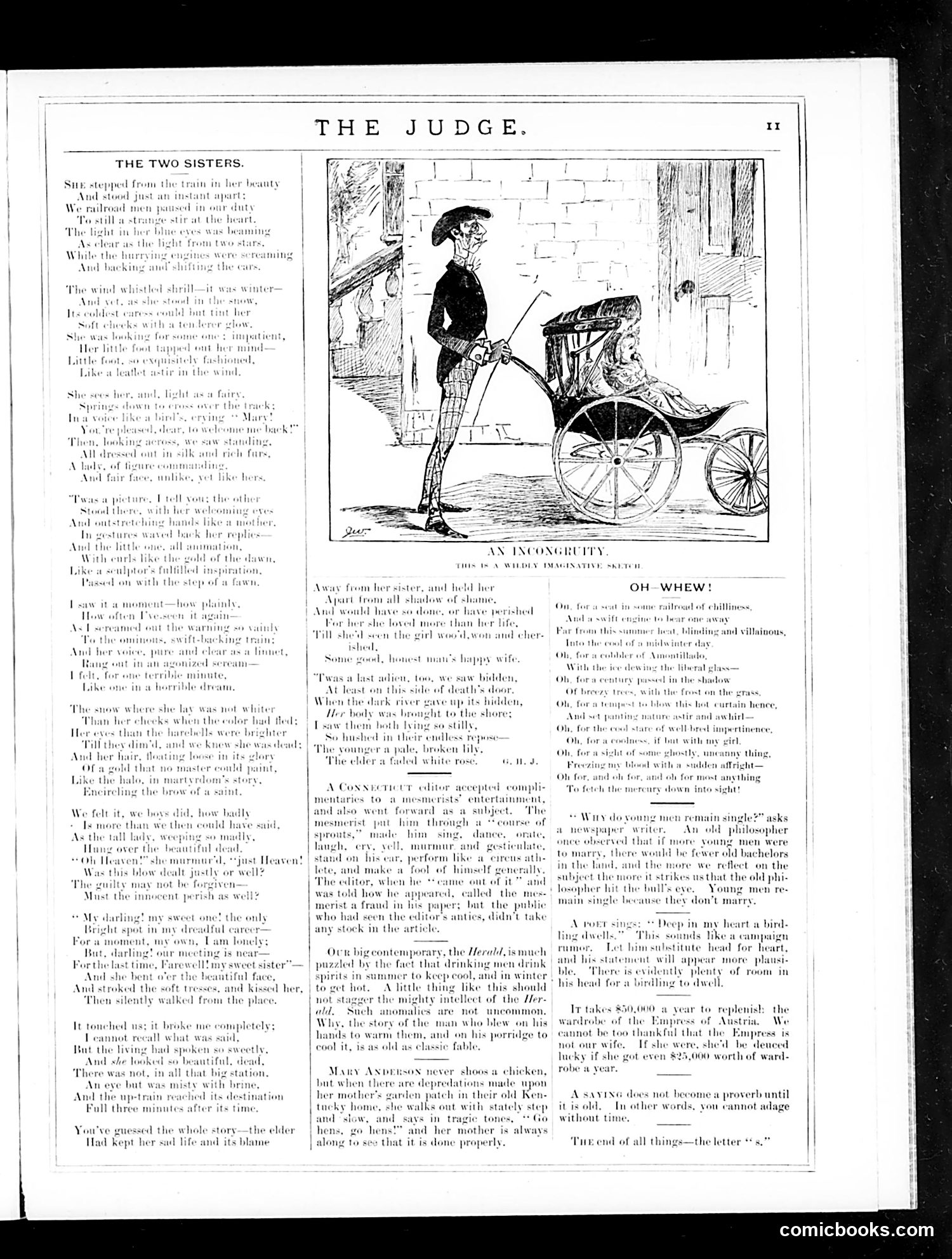
This cartoon satirizes the contrast between a man's shabby appearance and his mode of transportation. The sketch shows a poorly-dressed, thin gentleman in worn clothing standing beside an expensive baby carriage—a striking visual incongruity that serves as the cartoon's joke. The accompanying text "An Incongruity: This is a Wheely Imaginative Sketch" reinforces this theme through wordplay ("Wheely"). The satire targets the pretensions or financial mismanagement of someone who maintains expensive trappings despite obvious poverty or modest circumstances. The page also contains the poem "The Two Sisters" on the left—an unrelated sentimental narrative about sisters separated by circumstance—and various editorial commentary about contemporary issues, including references to the *Herald* newspaper and social observations. This represents typical *Judge* magazine content: mixing visual satire about everyday hypocrisy with lighter literary pieces.
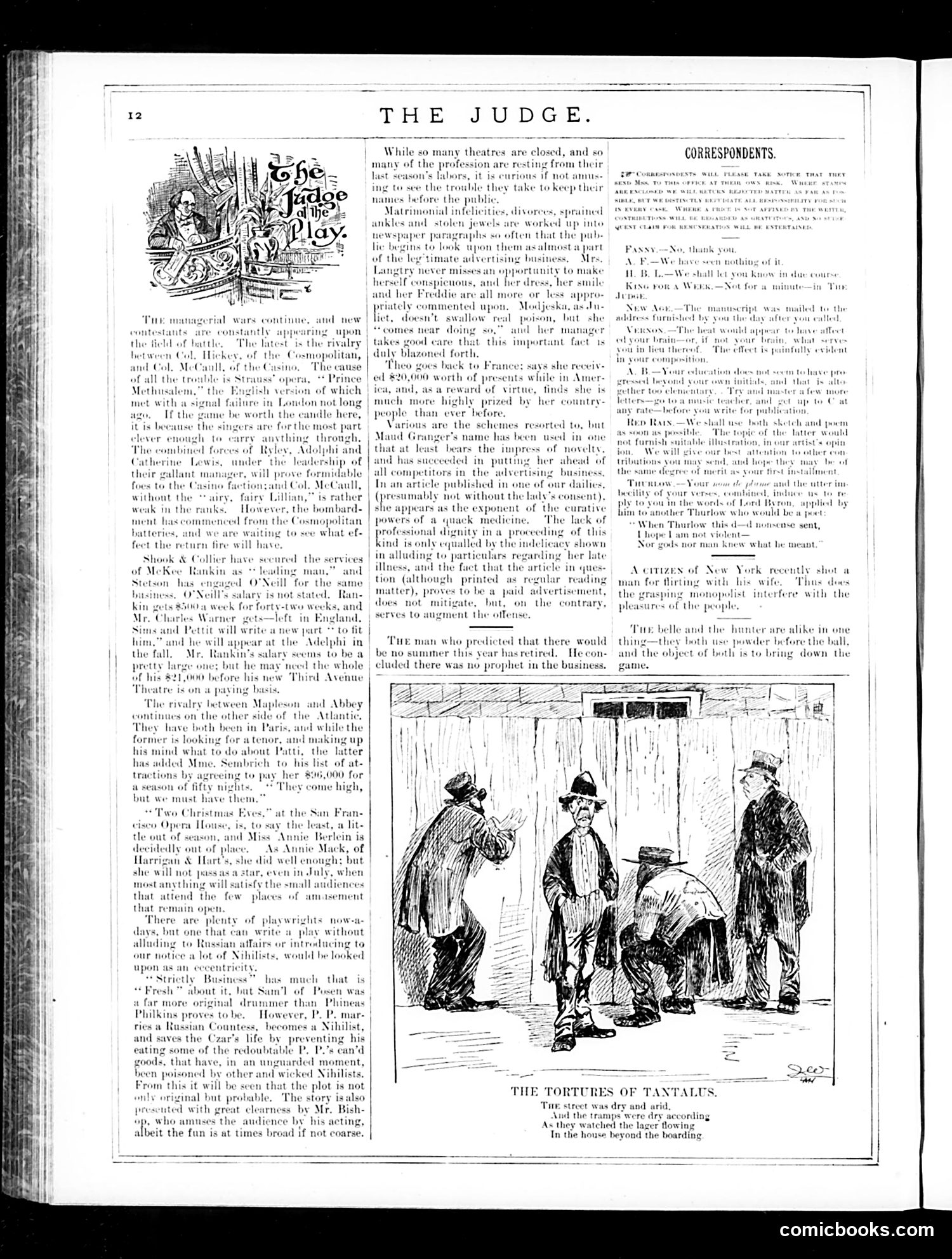
This sketch illustrates a theatrical dispute, likely from the 1880s-90s competitive era of American theater management. The caption references Tantalus (Greek mythology—eternal frustration just beyond reach), suggesting the cartoon depicts theater impresarios or managers in conflict. The accompanying text discusses theatrical rivalries, specifically managerial wars and competition over performers and productions. References to figures like "Abbey" and disputes over theatrical talent suggest this satirizes real competition between theater operators of the period. The three figures appear to be theatrical managers or promoters, drawn in period dress (hats, overcoats), arranged in a tense confrontation. The "tortures" likely refers to the competitive frustrations of theater management—trying to secure performers, fill houses, and outmaneuver rivals, with success perpetually just out of reach. The satire targets the theatrical world's internal conflicts and the obsessive competition that defined the era.
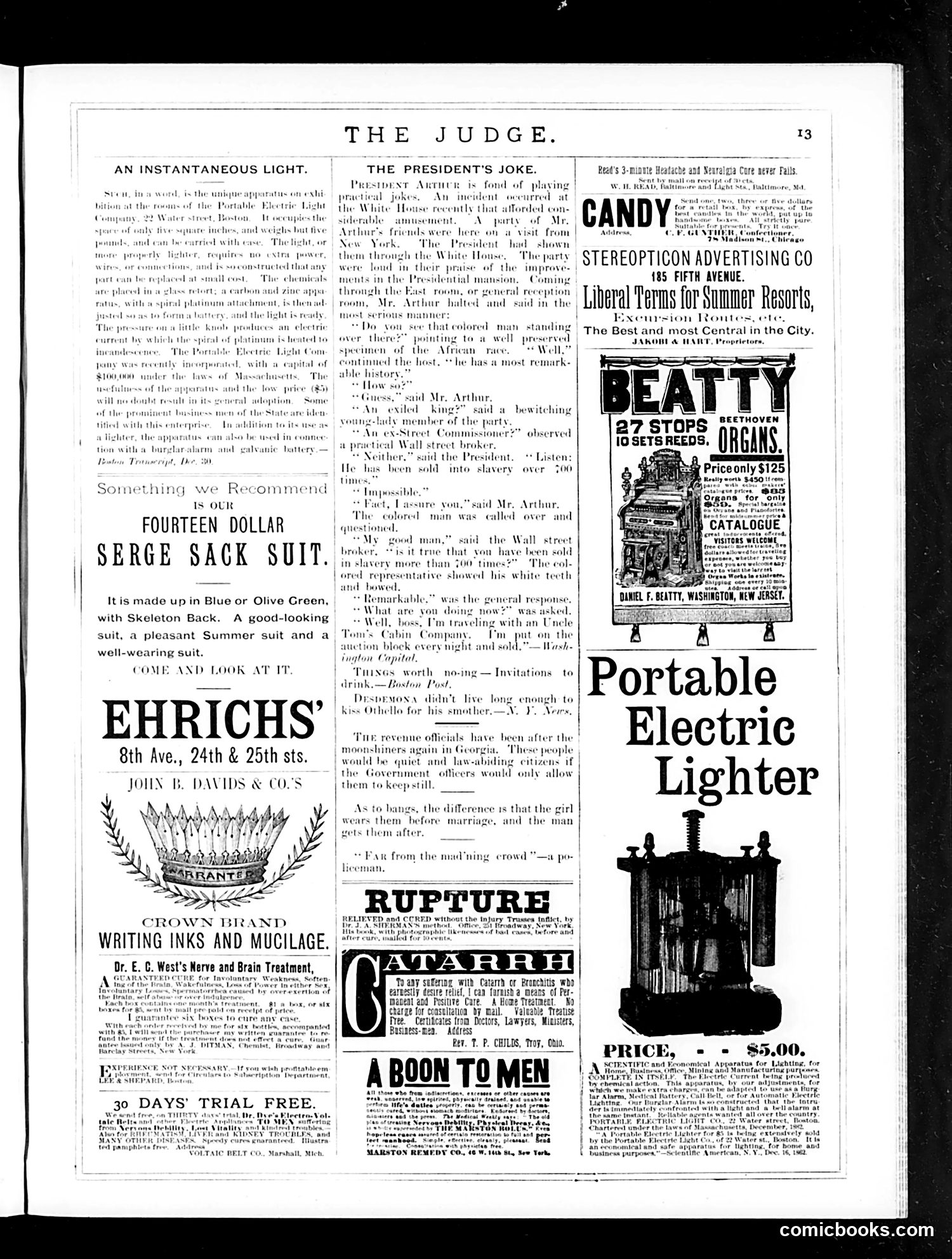
This page features a satirical anecdote about **President Chester Arthur** (indicated by "President" in the title). The joke involves Arthur showing White House visitors a well-preserved African American man, claiming he'd "been sold into slavery over 200 times." A Wall Street broker responds by asking if the man has actually been enslaved 200+ times, to which Arthur replies the man "has been sold into slavery over 200 times." The broker then quips that he himself has "been sold into slavery more than 200 times"—a joke equating his financial/business troubles to slavery. **The satire's point:** This mocks wealthy businessmen's self-pitying complaints about economic hardship by comparing trivial financial losses to actual slavery. It's darkly humorous social commentary—using slavery as a rhetorical device to satirize privileged men's complaints about business setbacks, which is deeply offensive by modern standards. The anecdote reflects 1880s attitudes where slavery could be joked about in "polite" circles as merely dramatic comparison rather than historical atrocity.
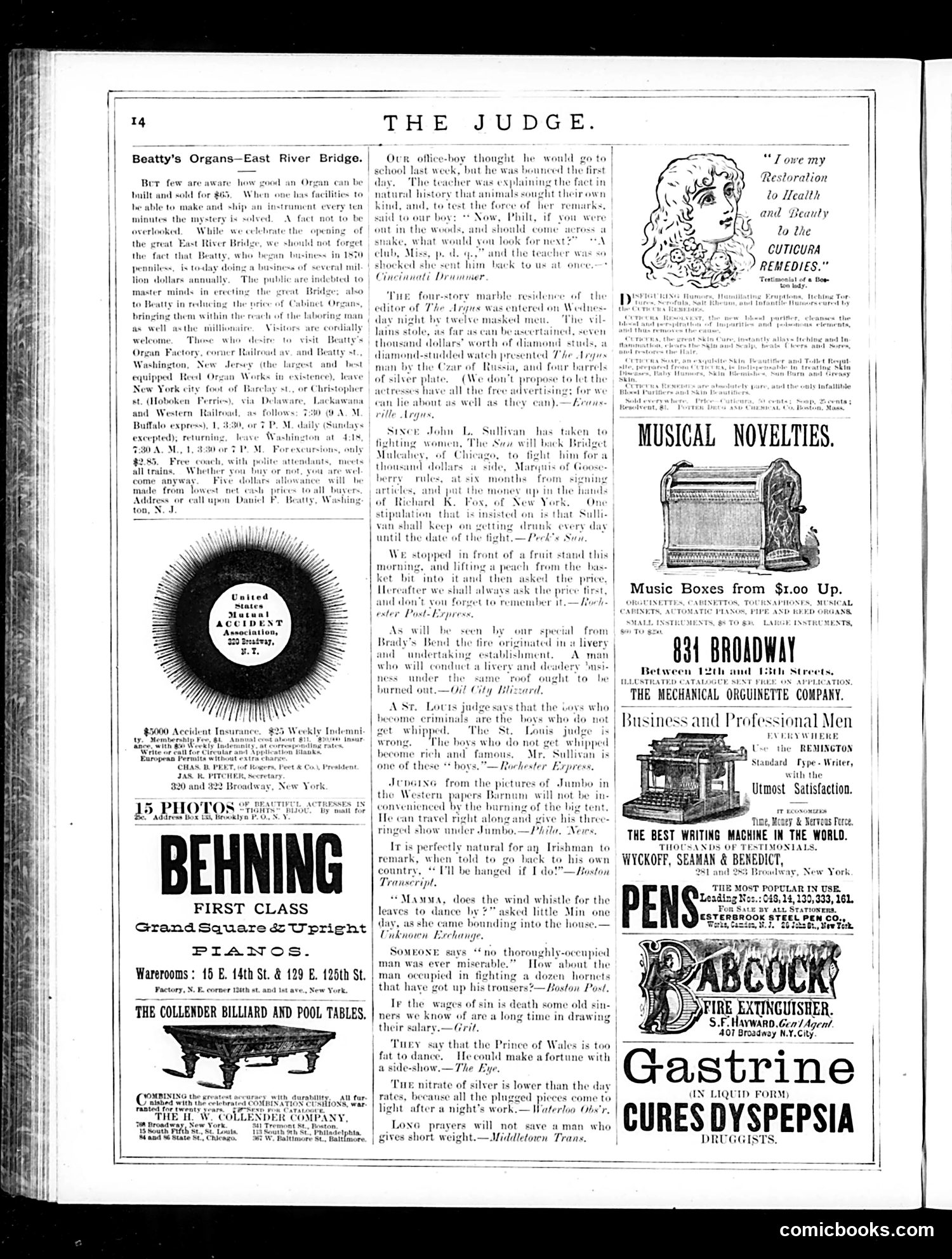
This page is primarily **advertising**, not political cartoons. The main content consists of commercial notices and jokes typical of Judge magazine's humor section. The one identifiable figure is **John L. Sullivan**, the famous heavyweight boxer mentioned in an advertisement or notice stating he has "taken to fighting women" and will visit a widow in Chicago "to fight him for a thousand dollars a side." This is satirical gossip commentary on Sullivan's personal life and reputation. The rest of the page contains generic satirical quips about contemporary life—remarks on Irish immigrants, the Prince of Wales, boys getting whipped, undertakers, and wages. These reference common late-19th-century social anxieties without specific political targets. The advertisements for pianos, typewriters, billiard tables, and patent medicines represent typical Victorian-era commercial content, with "Cuticura Remedies" prominently featured as a cure-all product.
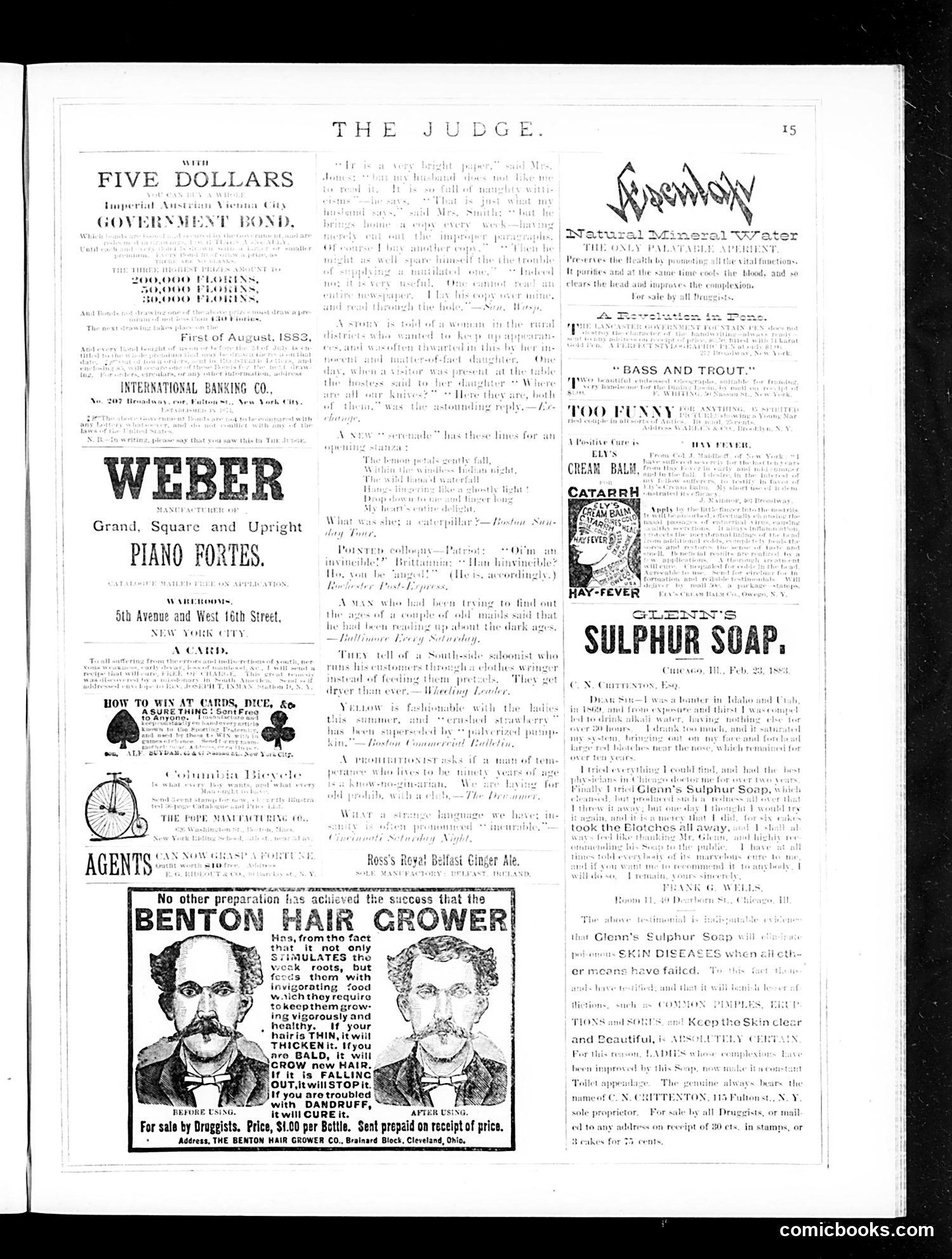
This page is primarily **advertising** rather than editorial content or political satire. It contains numerous commercial advertisements typical of 1880s publications: **Notable ads include:** - **Benton Hair Grower**: A "before and after" testimonial ad claiming to cure baldness and dandruff—common snake-oil style marketing of the era - **Weber Piano Fortes**: Musical instrument manufacturer - **Glenn's Sulphur Soap**: Patent medicine advertisement claiming to cure skin diseases - **Ely's Cream Balm**: Catarrh remedy - Various other period patent medicines and commercial products The page header references a "Judge" article titled "The Judge" (page 15), but the actual editorial content is minimal and largely obscured by advertising. **Historical context**: This reflects the 1880s advertising landscape where patent medicines made extravagant, unregulated health claims. The "before/after" format and testimonial style were standard marketing tactics before modern FDA regulations. There are **no identifiable political cartoons or satire** on this visible page—it's a commercial advertisement section.
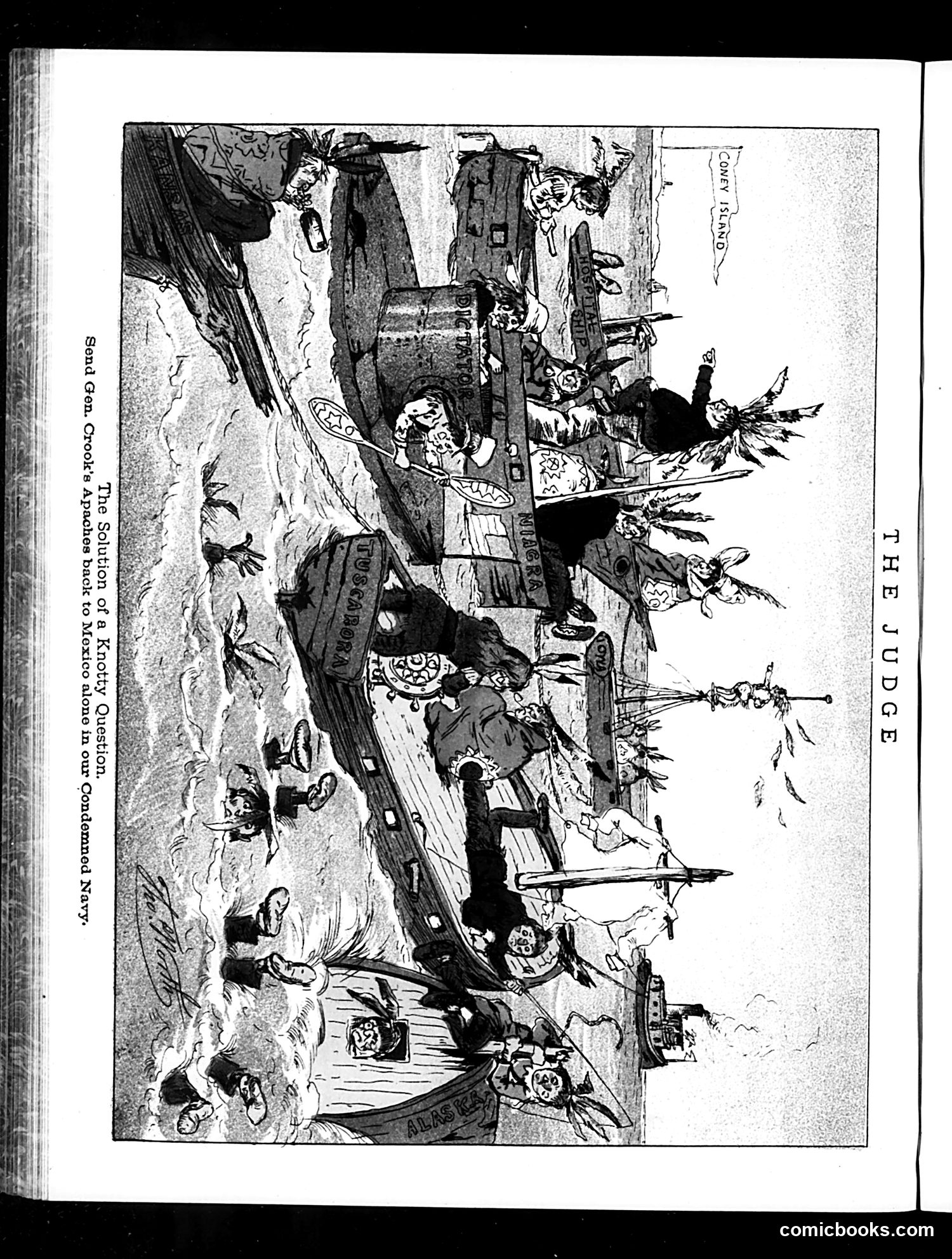
This political cartoon satirizes a proposal regarding Apache prisoners and the U.S. Navy. The caption suggests sending "Gen. Crook's Apaches back to Mexico alone in our Condemned Navy" — apparently a darkly humorous "solution" to the question of what to do with captured Apache warriors. The cartoon depicts Native Americans on what appears to be a deteriorating naval vessel, with the implication being that sending them back via a condemned (unseaworthy) ship is a cruel, absurd idea presented sarcastically. This references the historical tensions of the American Southwest, likely from the 1880s period when General George Crook was actively pursuing Apache groups. The satire mocks either the cruelty of the proposal itself or government officials proposing such impractical, dangerous solutions to the "Apache question."