
A complete issue · 16 pages · 1883
Judge — June 16, 1883
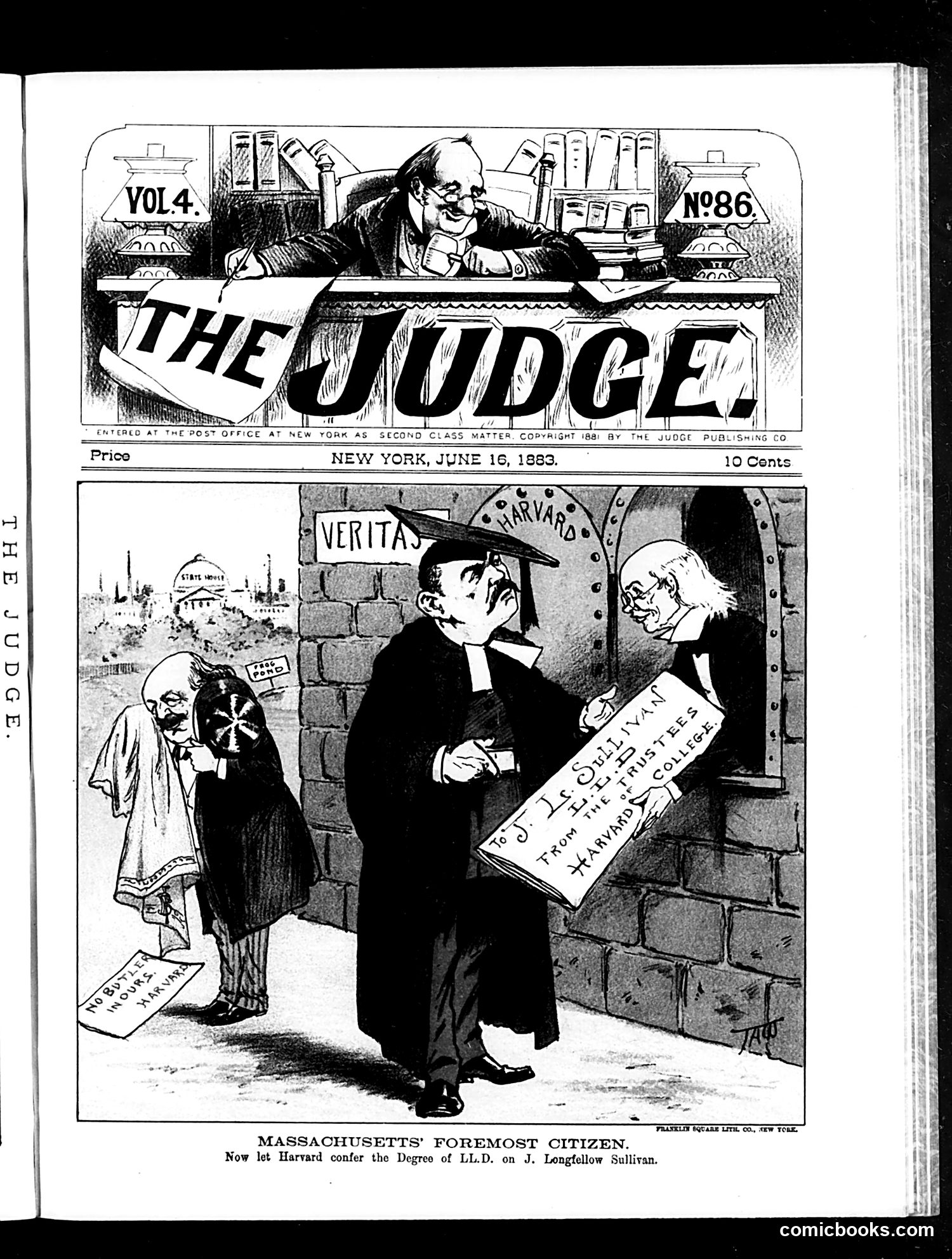
This political cartoon satirizes **J. Longfellow Sullivan**, likely the boxer John L. Sullivan, receiving an honorary degree (LL.D.) from Harvard University. The cartoon mocks this honor as inappropriate: Sullivan is depicted arriving at Harvard's gates alongside figures representing "Veritas" (Harvard's motto) and what appears to be academic or institutional corruption. The satire suggests that awarding a degree to a prizefighter—someone outside traditional academic circles—represented a lowering of Harvard's standards or an absurd capitulation to celebrity culture. The left side shows witnesses to this questionable conferral, emphasizing public skepticism. The cartoon's point: prestigious institutions compromising their integrity by honoring entertainment figures rather than scholars.
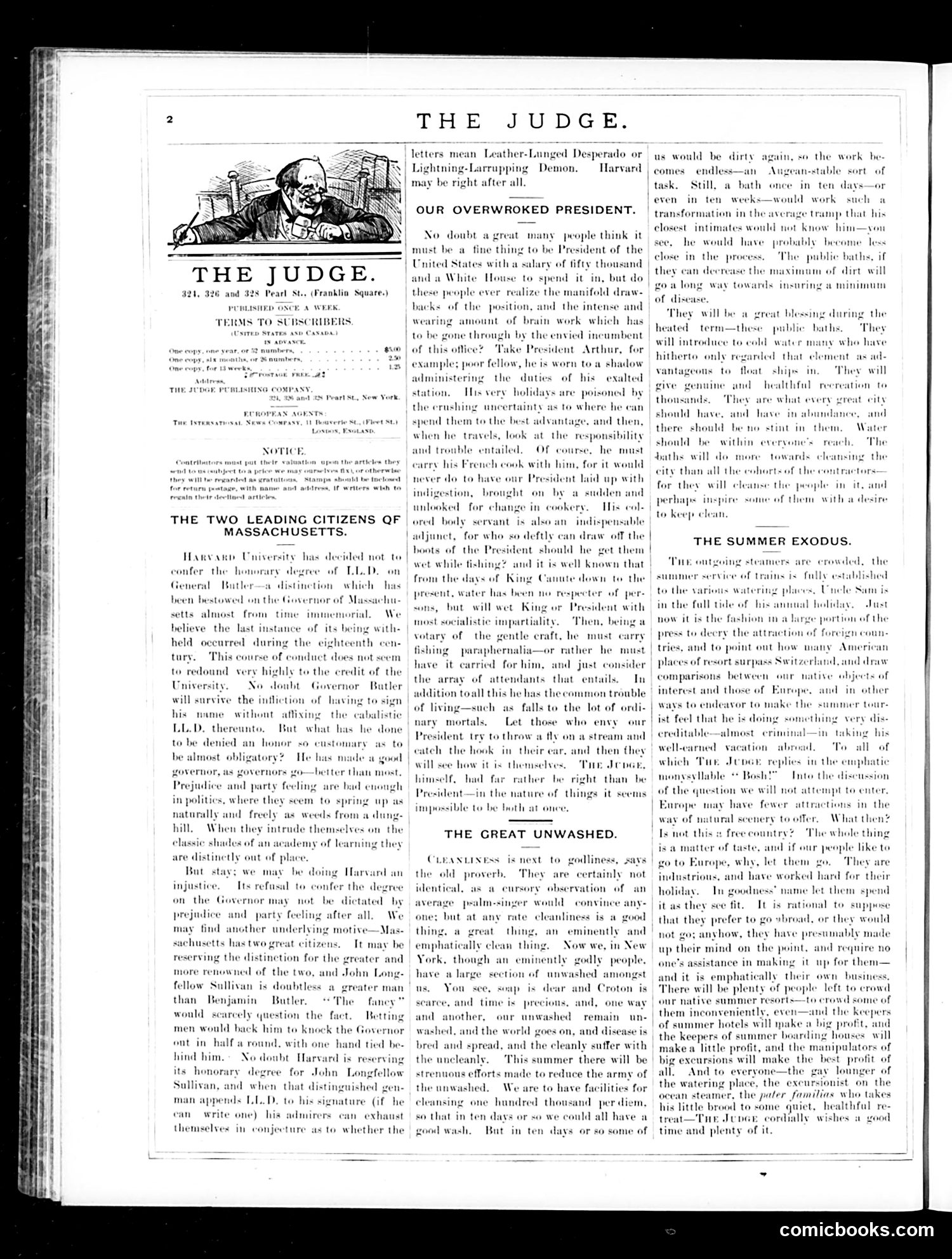
This page contains three satirical pieces targeting prominent American figures and social issues. **"The Two Leading Citizens of Massachusetts"** mocks Harvard University's refusal to grant an honorary degree to Governor Benjamin Butler while conferring one on General John Sullivan. The satire argues Harvard's decision reflects partisan prejudice rather than merit, suggesting Butler—despite his flaws—is the more accomplished figure. The piece criticizes academic institutions for mixing politics with honors. **"Our Overworked President"** lampoons President Chester Arthur's burdensome duties. The satire humorously catalogs his exhausting responsibilities and absurd constraints—including needing to transport his French cook everywhere to avoid digestive upset. It mocks the impossible standards placed on presidents, suggesting he must be both perfectly "right" and simultaneously effective. **"The Great Unwashed"** addresses New York's poor sanitation despite the city's self-proclaimed godliness. The piece ironically notes that while cleanliness is virtuous, the city remains filthy—soap is expensive, cotton is precious, and disease spreads unchecked. It critiques the gap between moral pretense and actual living conditions for working-class New Yorkers.
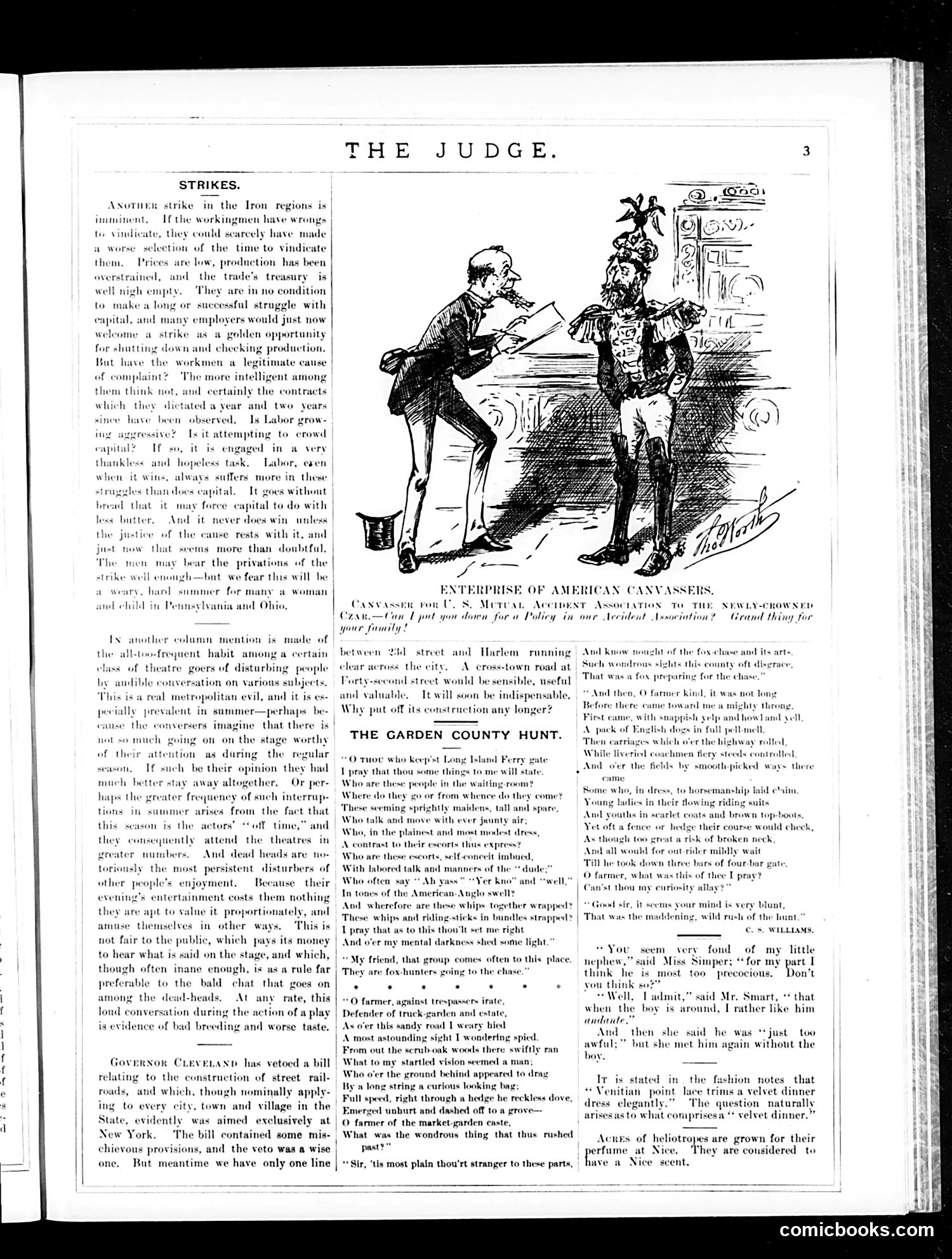
This page contains political and social commentary typical of late 19th-century American satire. **Main Cartoon ("Enterprise of American Canvassers"):** A thin, shabby man approaches a richly-dressed, bearded gentleman (appearing to represent wealth or authority) with a clipboard, asking him to buy an insurance policy. The satire mocks aggressive insurance salesmen pestering the public, and possibly critiques the booming insurance industry's hard-sell tactics. **Text Sections:** Articles discuss labor strikes in Pennsylvania iron regions (workers striking at economically poor timing), theater etiquette (complaining about disruptive audience members), and Governor Cleveland's veto of a street-rail construction bill in New York. **"Garden County Hunt":** A poetic satire mocking wealthy Long Island society—their pretentious escorts, affected speech ("Yer kno," "American-Anglo swell"), and obsession with riding whips and fashionable display during fox hunts. The overall tone criticizes labor conflict, social rudeness, government obstruction, and upper-class affectation.
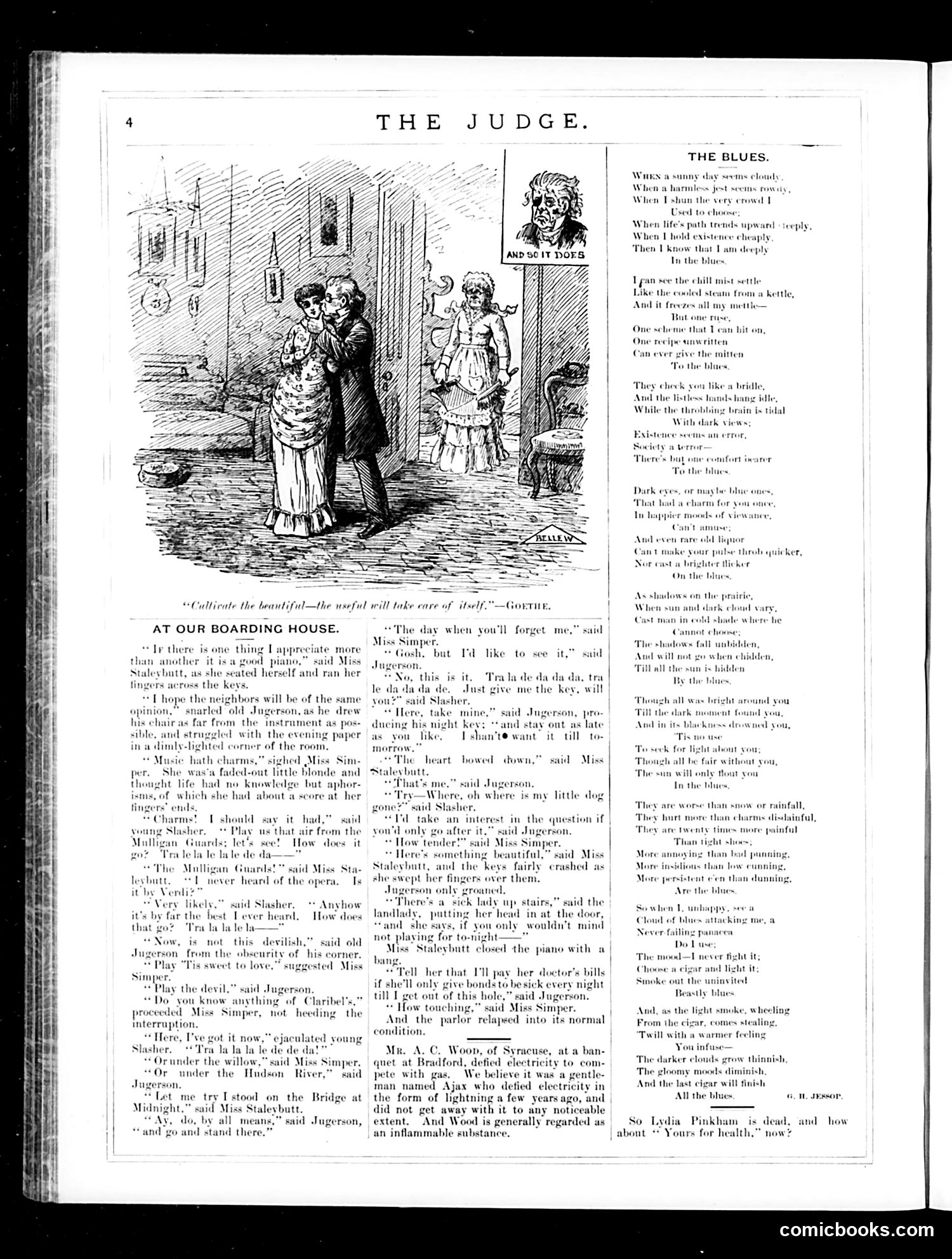
This page contains a domestic comedy sketch satirizing genteel boarding-house life and romantic pretense. The dialogue shows residents engaging in affected cultural performances: Miss Staleybutt plays piano poorly while claiming refined taste, characters debate whether a musical piece is by Verdi, and lodgers conduct flirtations with exaggerated sentimentality. The satire targets the aspirations of middle-class boarding-house residents who mimic upper-class manners and musical knowledge they don't possess. References to "the Bridge at Midnight" and romantic melodrama mock the overwrought emotionalism of Victorian courtship rituals. The accompanying poem "The Blues" treats melancholy as an inescapable condition—no amount of liquor or comfort can cure it—offering mild social commentary on life's disappointments. A brief note about A.C. Wood of Syracuse jokes about electricity competing with gas lighting, apparently referencing a real person or incident now unclear. The humor relies on recognizing pretension and failed sophistication among ordinary people.
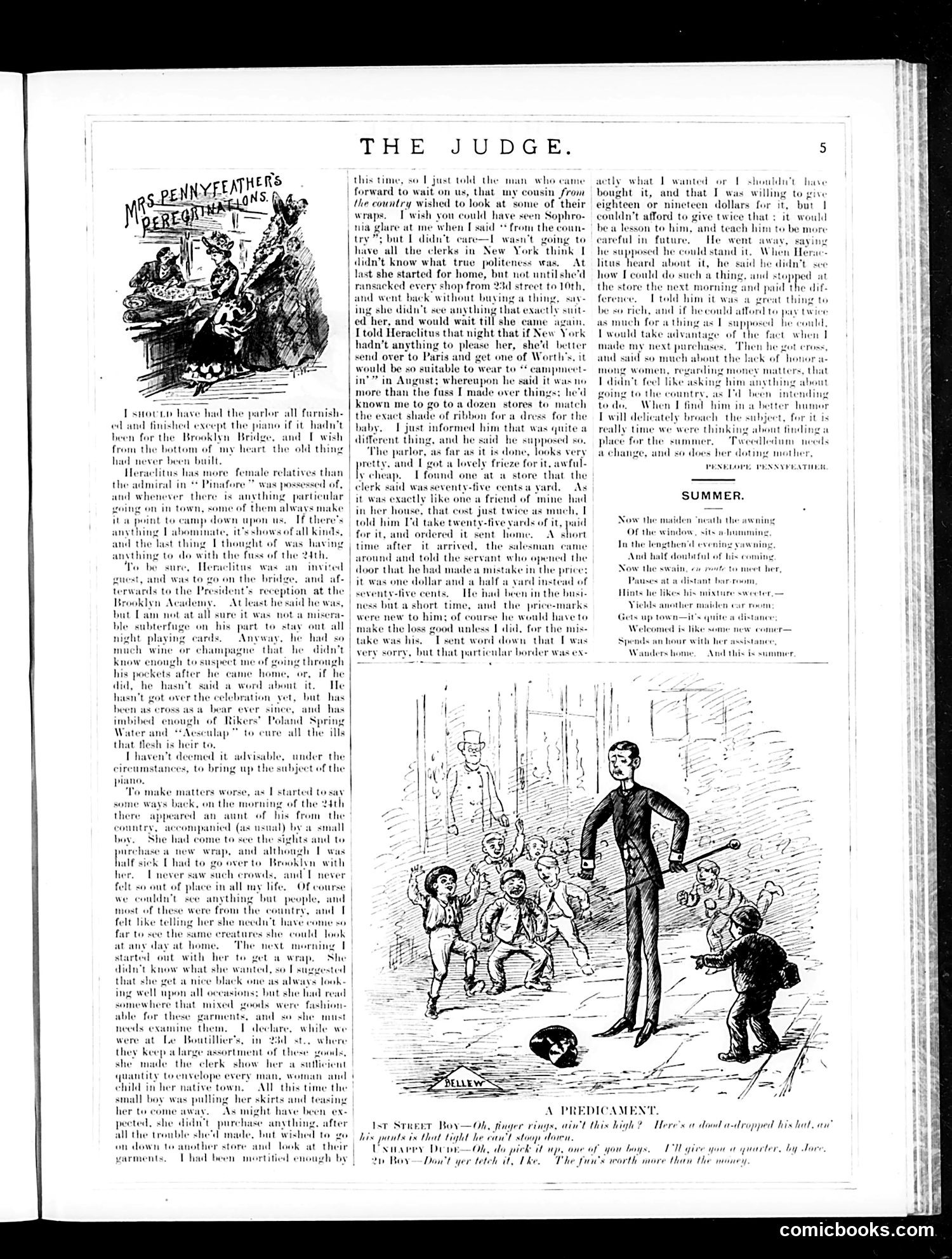
This page satirizes urban class anxieties and pretension in late 19th-century America. The main text is a domestic complaint from a wealthy woman (likely narrated by a character named Herminius or similar) about shopping difficulties and her husband Heraclitus's extravagant behavior. The cartoon at bottom ("A Predicament") depicts street children confronting a well-dressed man about a lost hat. The dialogue mocks both the gentleman's politeness ("I'll give you a quarter") and the boys' street vernacular, satirizing class divisions. The children represent the urban poor; the formal gentleman embodies upper-class propriety. Together, the text and image critique wealthy New Yorkers' obsession with consumption, Paris fashions, and social status—while revealing their simultaneous anxiety about mingling with those beneath their station. The humor targets both the pretentious rich and their condescension toward working-class New Yorkers.
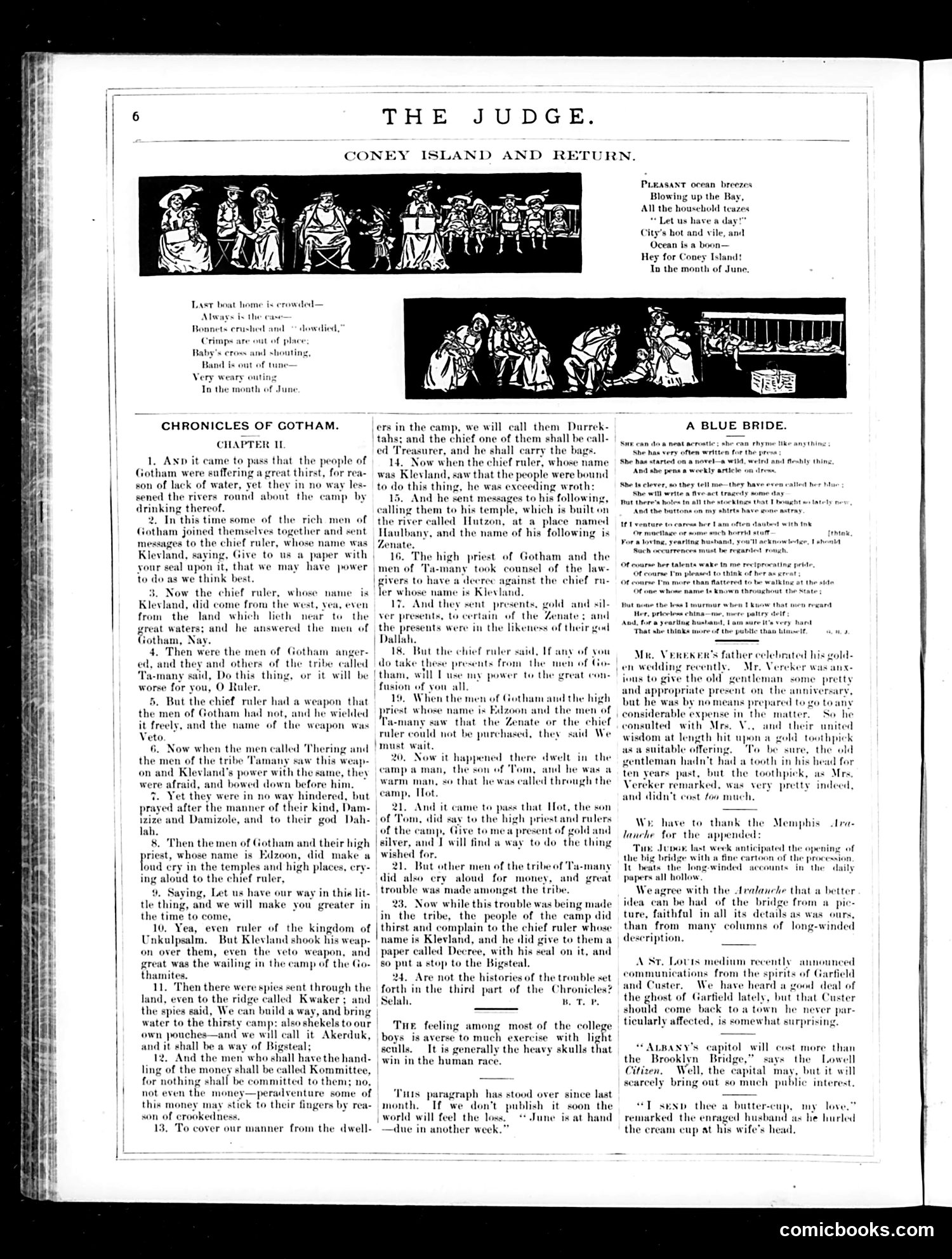
This page satirizes New York City politics, specifically conflicts between Mayor Grover Cleveland (called "Klevland," the "chief ruler") and Tammany Hall (the "tribe Tamany"), the Democratic political machine that controlled city patronage and corruption. The biblical parody mocks a water shortage crisis. Cleveland refuses Tammany's demands for control over relief funds ("Kommittee"), using his veto power as a weapon. Tammany, afraid of Cleveland's strength, attempts bribery through intermediaries ("presents, gold and silver") to the "Zenate" (Senate). When this fails, they resort to complaining publicly about the shortage. The satire criticizes both sides: Cleveland's obstinacy versus Tammany's endemic corruption and vote-buying. The "Chronicles of Gotham" format elevates a mundane municipal dispute to mock-heroic absurdity, a common Judge strategy for ridiculing political incompetence and venality in 1880s New York.
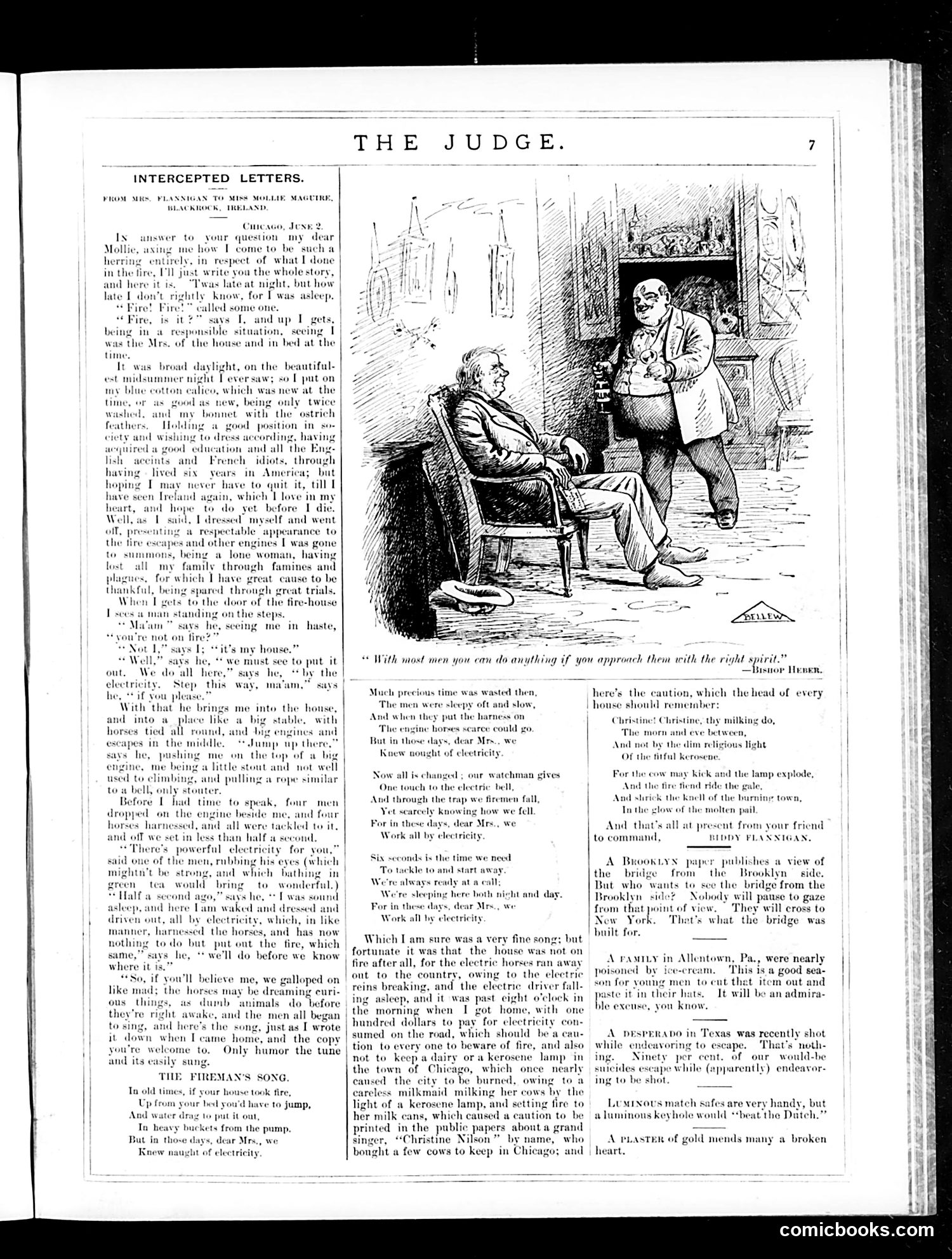
This page satirizes the rapid adoption of **electric-powered fire engines** in Chicago—a recent technological marvel. The humor comes from an Irish immigrant woman ("Mrs. Plansigan") describing her chaotic experience during a fire call. The joke targets both the new technology's unpredictability and the sender's Irish dialect and naïveté. Electric fire engines, though faster than horse-drawn alternatives, are portrayed as dangerously uncontrollable: the electric horses "ran away" into the countryside because their "reins" broke and the driver fell asleep. She's charged $100 for electricity consumption—an absurd outcome. The embedded poem "The Fireman's Song" contrasts the "good old times" of slower but reliable horse-drawn equipment with the chaotic present. The final warning about kerosene lamps and cow-milking references the **Great Chicago Fire of 1871**, which legend blamed on a cow kicking over a lantern. The satire mocks both technological utopianism and working-class anxiety about rapid modernization, while the exaggerated dialect humor was typical of period American satire.
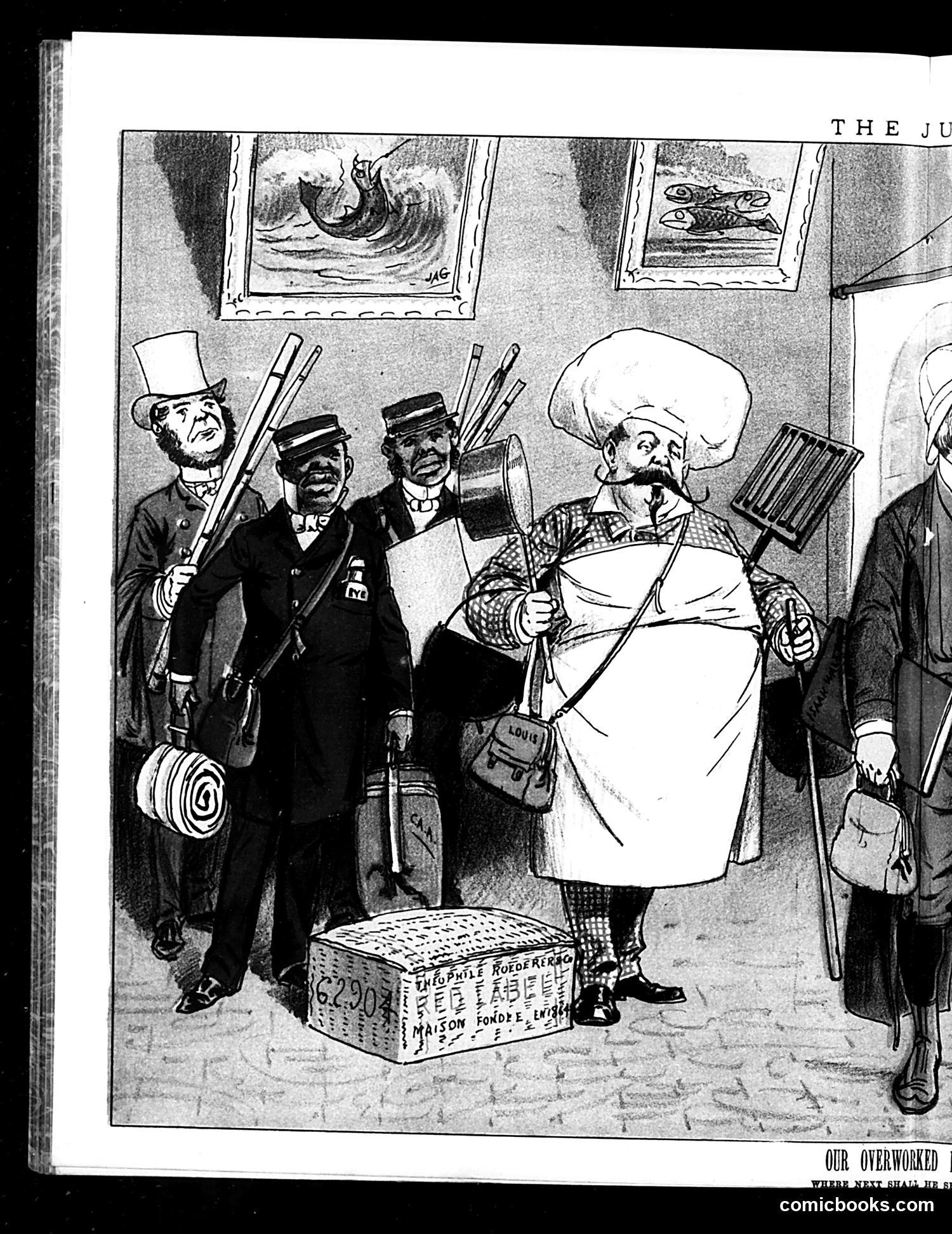
This satirical cartoon depicts a rotund chef or cook (center, wearing chef's hat) surrounded by what appear to be military or government officials carrying tools and supplies. The figures are laden with equipment—axes, rakes, and a box labeled "Roederer" (likely a champagne brand). The title "Our Overworked" suggests commentary on labor or institutional strain. The central figure's exaggerated size contrasts with the busy activity around him, possibly satirizing inefficiency or mismanagement in food service, military provisioning, or government operations during a period of heavy demand. The vintage style and formal attire suggest this dates to the late 19th or early 20th century, but without additional context or visible date, the specific political event referenced remains unclear.
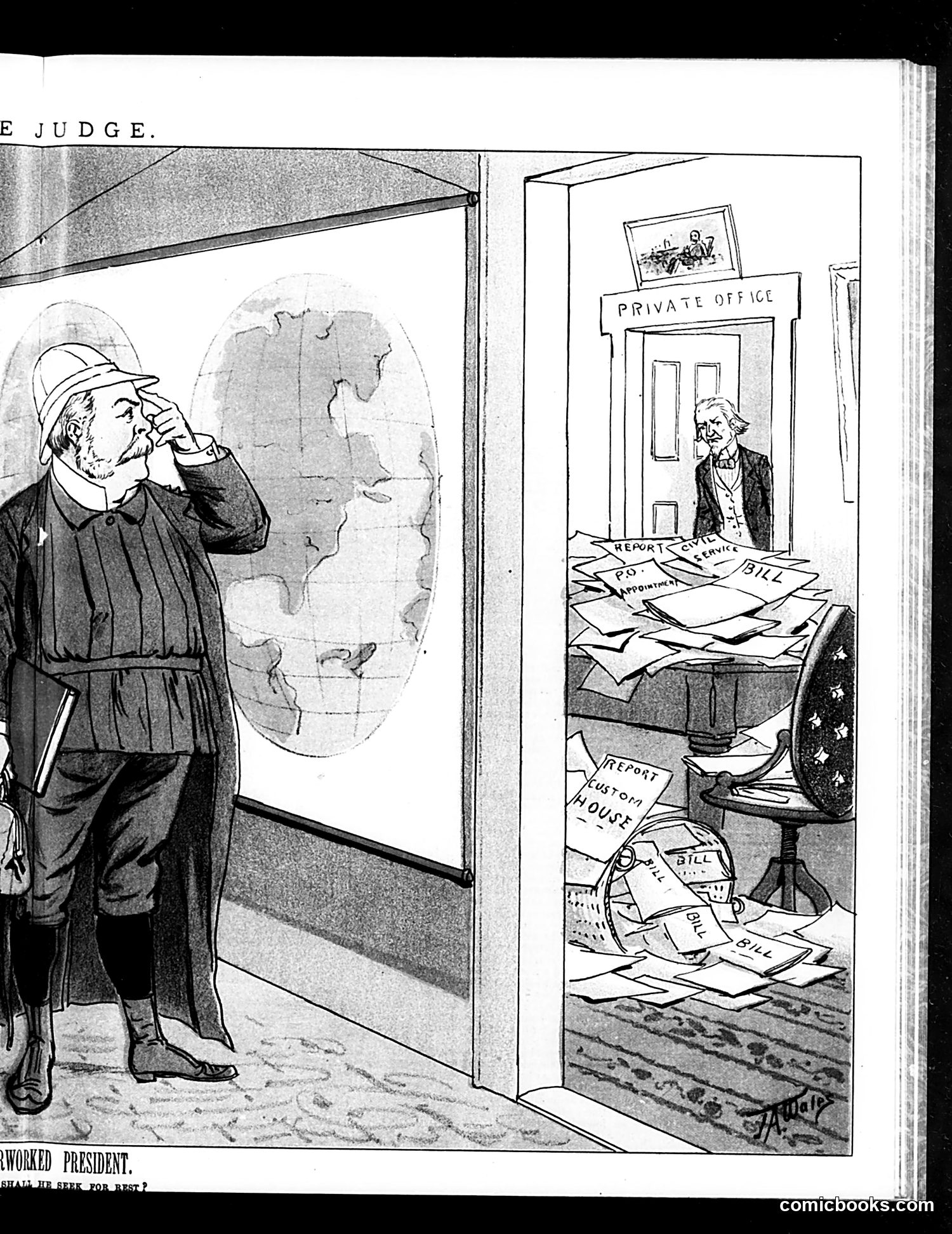
This Judge magazine cartoon depicts a "Overworked President" (text visible at bottom). The left panel shows a exhausted official gazing at a large profile sketch on the wall—likely representing the immense burden of presidential duties and decision-making. The right panel reveals the source of his stress: a private office overwhelmed with paperwork labeled "REPORT," "BILL," "CUSTOM HOUSE," and "APPOINTMENT"—bureaucratic documents piling up on desk and floor. The satire critiques the overwhelming administrative workload facing the president, suggesting the executive is drowning in procedural duties rather than focused governance. The contrast between the weary figure contemplating his own image and the chaos of paperwork behind him emphasizes how the job has consumed him. This appears to comment on late 19th-century presidential administration struggles.
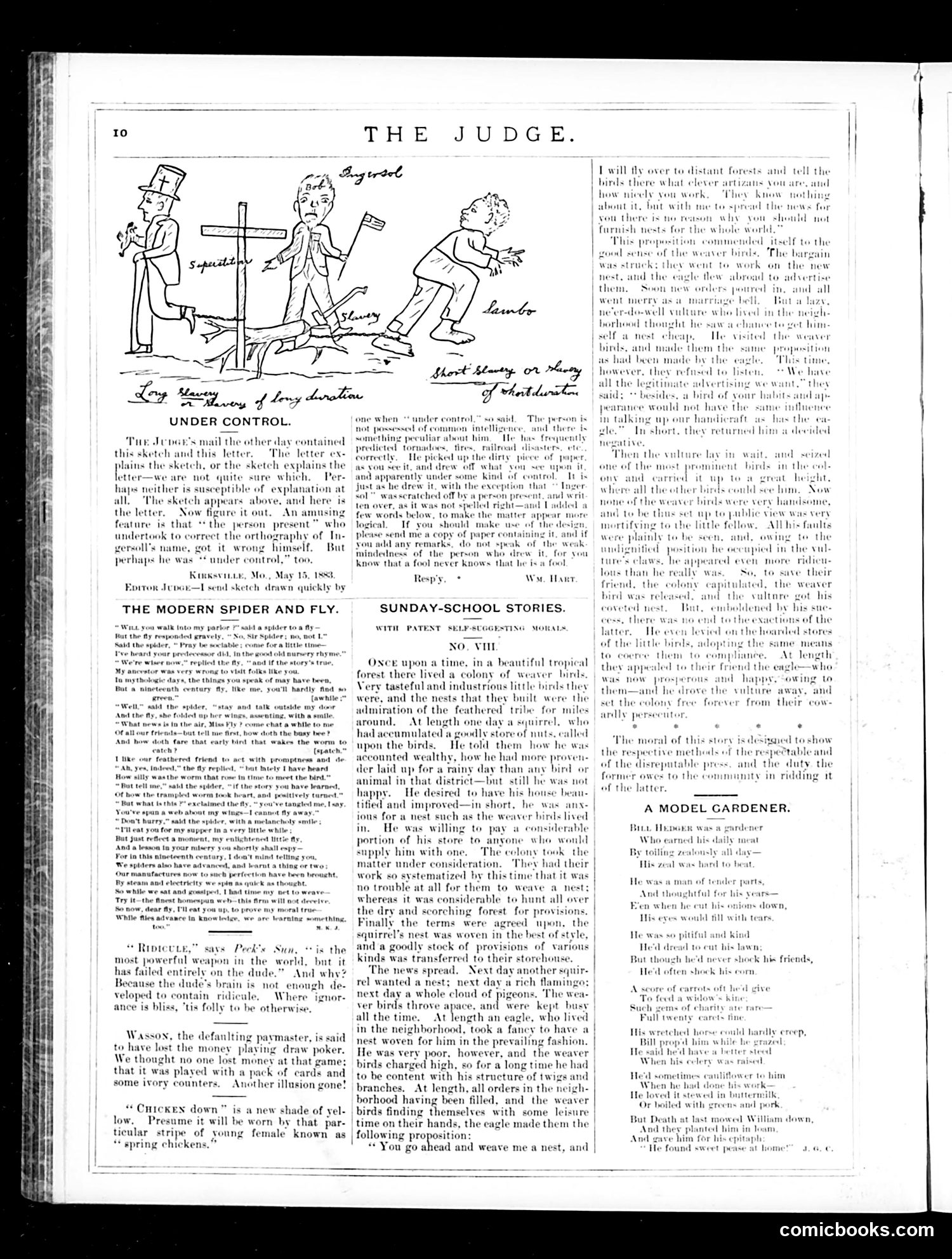
This political cartoon satirizes the handling of a scandal or controversy. The sketch shows three figures labeled "Expedient," "Argument," and "Lying," positioned around a cross marked "Short-Lived or Shoddy" atop what appears to be a body—labeled "Long Memory of Long-Christian [?]." The accompanying letter explains the Judge editor received this sketch with unclear attribution about what it illustrates. The cartoon appears to critique how public figures or institutions manage negative situations through convenient tactics: expedient solutions, persuasive arguments, and outright dishonesty, ultimately producing only short-term results while hoping people forget the underlying truth. The title "Under Control" is ironic—suggesting those in power claim mastery over a situation while actually employing ethically dubious methods. This reflects late-19th-century Judge magazine's typical satirical stance against corruption and political manipulation.
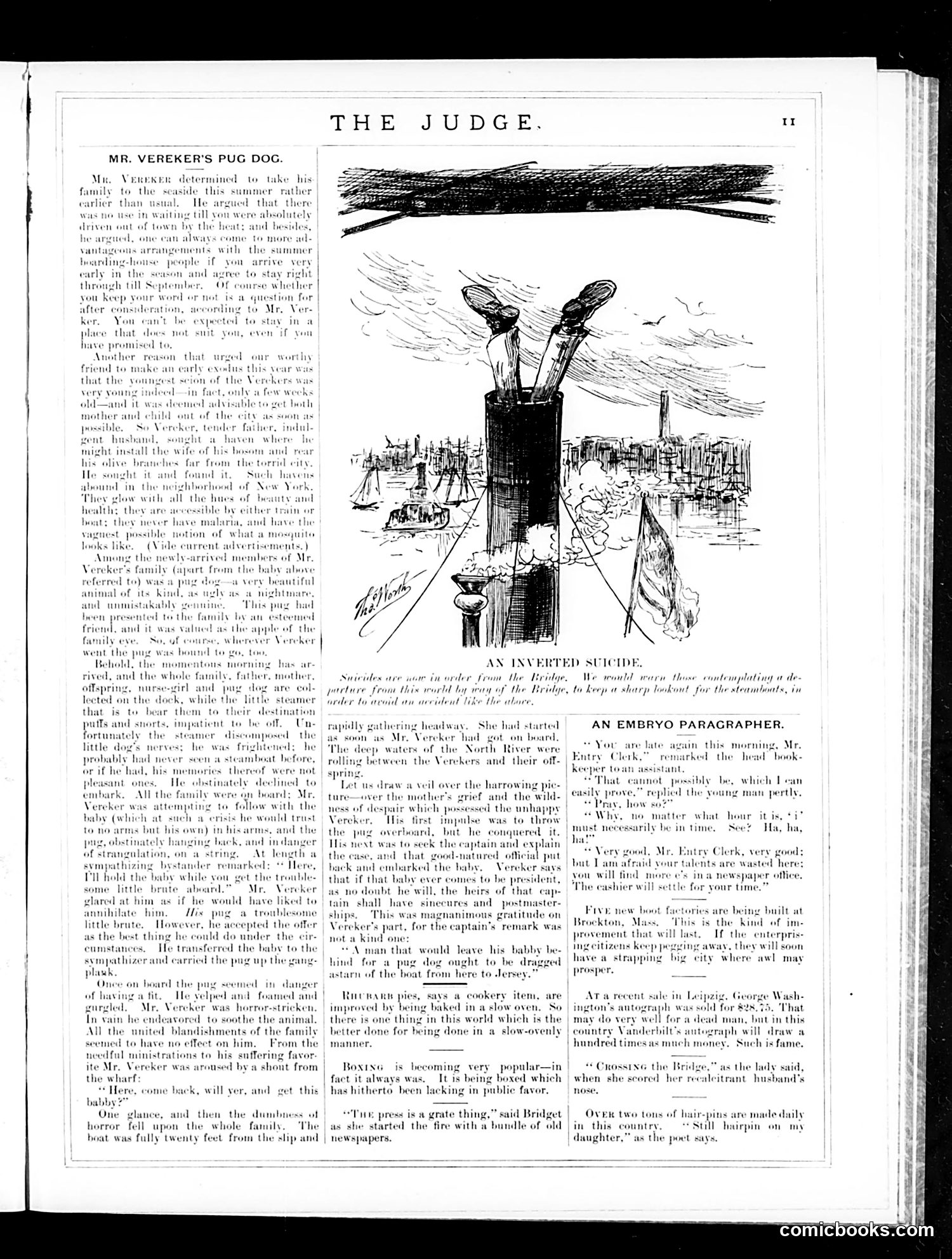
This page contains three separate satirical pieces typical of Judge magazine's humor: **"Mr. Vereker's Pug Dog"** (main story): A lengthy satirical narrative mocking upper-class obsession with pets. Mr. Vereker values his pug so highly that when boarding a steamer to the seaside, he leaves his *baby* behind but brings the dog. The satire ridicules wealthy families' misplaced priorities and sentimental attachment to animals over human children—a pointed critique of Victorian-era affectation among the privileged classes. **"An Inverted Suicide"** (illustration): The accompanying sketch shows a man attempting suicide by jumping from a bridge, only to be saved by his dog. The irony (inversion) is obvious. **"An Embryo Paragrapher"** (brief dialogue): A young man arrives late to work; his supervisor suggests his talents are wasted and suited for newspaper writing instead—a dismissive insult implying mediocrity. These pieces represent Judge's characteristic social satire targeting wealth, pretension, and class foibles of the Gilded Age.
This page features a humorous story about tenement life on New York's East Side. Mrs. Magum, wife of a tailor, creates a makeshift "aeolian harp" (wind harp) by stringing thread across her apartment window, hoping it will produce music from the night breeze. The joke: when her husband is delayed at an art exhibition, an Irish tenant named Darby, unaware of the contraption, becomes tangled in the threads while attempting to use a clothesline. He crashes into a German laundress's tub of wet clothes nearby, soaking her laundry. The resulting chaos—with Darby flailing about and the laundress's angry response—constitutes the punchline. The satire mocks both pretentious attempts at gentility among working-class residents and the chaotic, crowded conditions of tenement living where neighbors' activities constantly interfere with one another.
This page is primarily **advertising**, not political cartooning. It features commercial announcements for organs, musical instruments, office supplies, and patent medicines typical of late 19th-century publications. The small text items scattered throughout are brief humorous anecdotes rather than satirical commentary. These include: - A census-taker joke about a wife correcting her husband's statement - A thief's insistence he's "eccentric, not financially ruined" - A Milwaukee mayor closing saloons (local ordinance humor) - Various editorial quips about editors, birds, and judges The **only identifiable reference** is to "Judge Ritchie of Frederick, Md." and his sixteen unmarried daughters—appearing to mock an actual public figure's domestic situation. The page lacks the pointed political satire Judge magazine was known for. Instead, it's dominated by advertisements for Beatty's organs, musical novelties, typewriters, and "Gastrine" (a digestive cure-all)—reflecting how 19th-century magazines blended content and commerce without clear separation.
This page is **primarily advertisements** with a satirical poem titled "The Shoddy Reception" as the main content piece. ## The Satire "The Shoddy Reception" mocks the nouveau riche—wealthy people of questionable character or origin (implied by the name "Mrs. Shoddy"). The poem describes an ostentatious society gathering filled with showy displays: exotic flowers, silver, diamonds, and fashionably dressed guests. The satire lies in the contrast between material excess and implied moral emptiness. The guests are described with shallow, material focus—their jewelry, fabrics, and European-tour credentials—suggesting that this wealth lacks substance or genuine refinement. "Shoddy" literally means cheap or inferior goods, so the irony is that despite the lavish display, the gathering itself is fundamentally second-rate. This reflects Gilded Age anxieties about newly wealthy industrialists and businesspeople who lacked old-money "breeding" or social pedigree, making them targets for satirical ridicule in publications like *Judge*. The page's advertisements (medical devices, billiard tables, insurance) are typical period commerce, unrelated to the satire.
This page's main content is a children's moral poem titled "A Moral Tale," featuring a dramatic encounter between a large dog, a tiny bee, and a fly. The narrative teaches through consequence: the dog and bee both underestimate the tiny fly, making assumptions based on appearance ("Thinks it is a fly," "Thinks like as not / 'Tis a blooming rose"). When the bee attempts to catch the fly with a snap, it fails—the fly escapes while the bee's prideful overconfidence goes unrewarded. The moral appears to be about not judging by size or appearance, and the dangers of arrogance. The verse rhythm and rhyme scheme suggest this was entertainment for children, though the lesson applies universally. The remainder of the page consists almost entirely of period advertisements for pianos, pens, patent medicines, shirts, and book binding services—typical filler for 19th-century magazines. No political cartoon or satire appears present on this particular page.
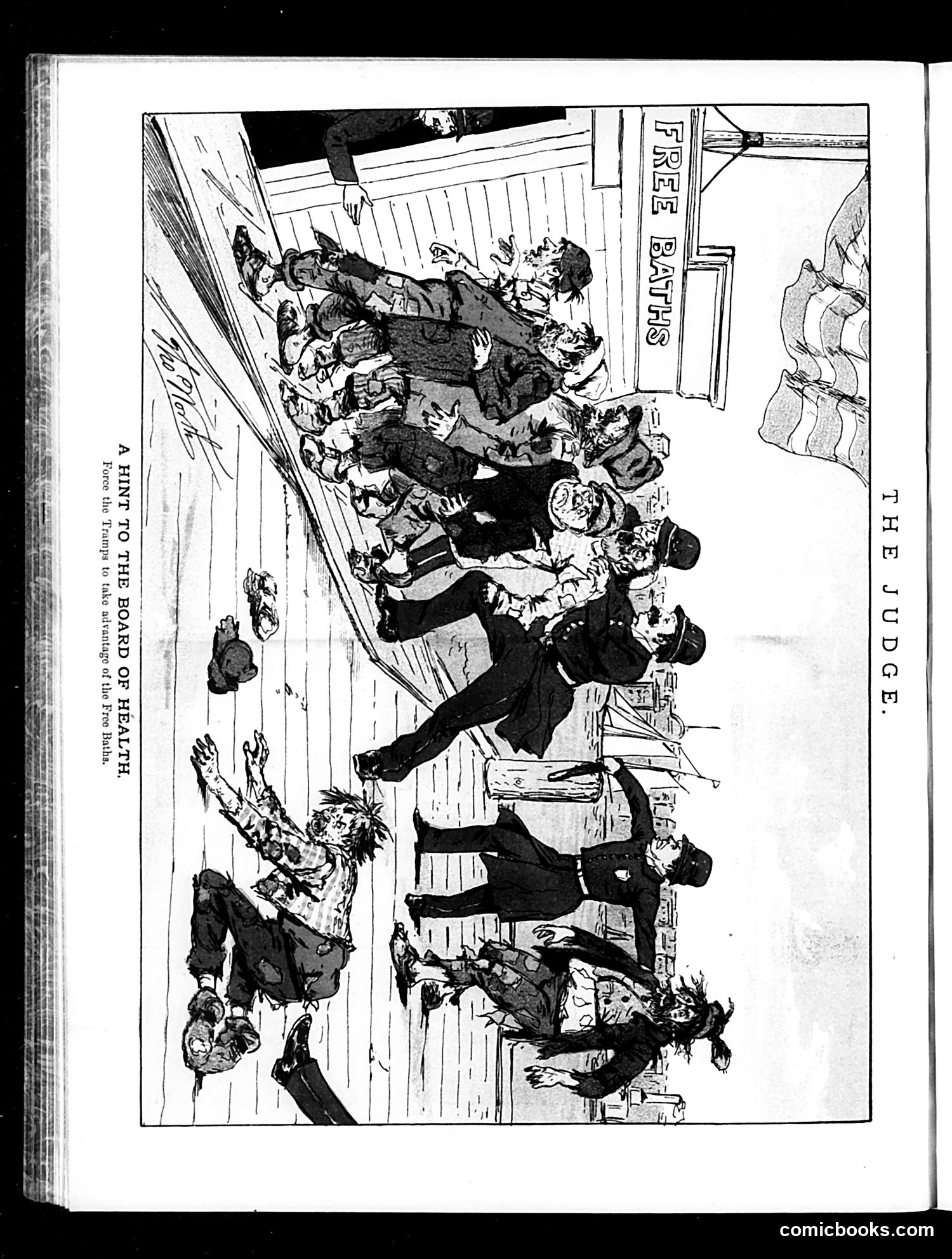
This cartoon satirizes public health and class attitudes in Gilded Age America. It depicts the Board of Health officials (the well-dressed men in the center) observing a crowded public bathhouse ("Free Baths" visible on the sign). The caption suggests forcing homeless "tramps" to use these facilities. The satire operates on multiple levels: it mocks both the board's presumed belief that bathing will solve poverty and homelessness, and the condescending attitude toward the poor. The cramped, chaotic scene of actual bath-users contrasts with the officials' orderly approach to social problems. The cartoon suggests that mandatory hygiene policies, however well-intentioned, cannot address the root causes of urban vagrancy and poverty—a critique of surface-level rather than systemic solutions.