
A complete issue · 16 pages · 1883
Judge — May 12, 1883
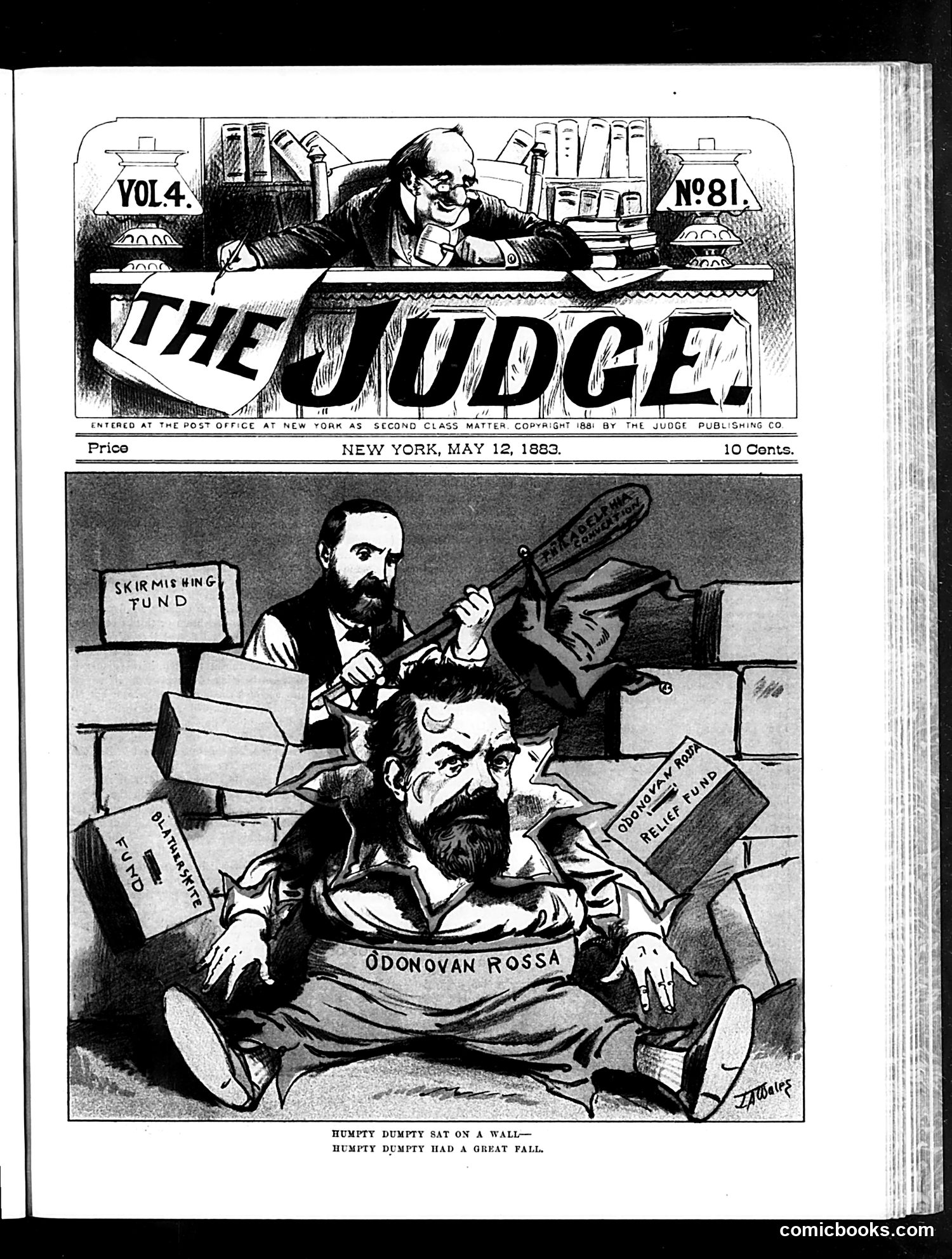
This political cartoon satirizes **Odonovan Rossa** (labeled on his clothing), an Irish-American Fenian activist and publisher. The central figure sits surrounded by collection boxes for various relief funds: "Skirmishing Fund," "Land Fund," and "Odonovan Rossa Relief Fund." A man behind him holds a paddle, referencing the nursery rhyme caption: "Humpty Dumpty sat on a wall—Humpty Dumpty had a great fall." The cartoon suggests Rossa has suffered financial or political collapse and now solicits money from supporters through multiple charitable appeals. The satire mocks Rossa's fundraising practices, implying he repeatedly collects donations from Irish-Americans for various causes, treating them as a means of personal sustenance after his prominence has faded.
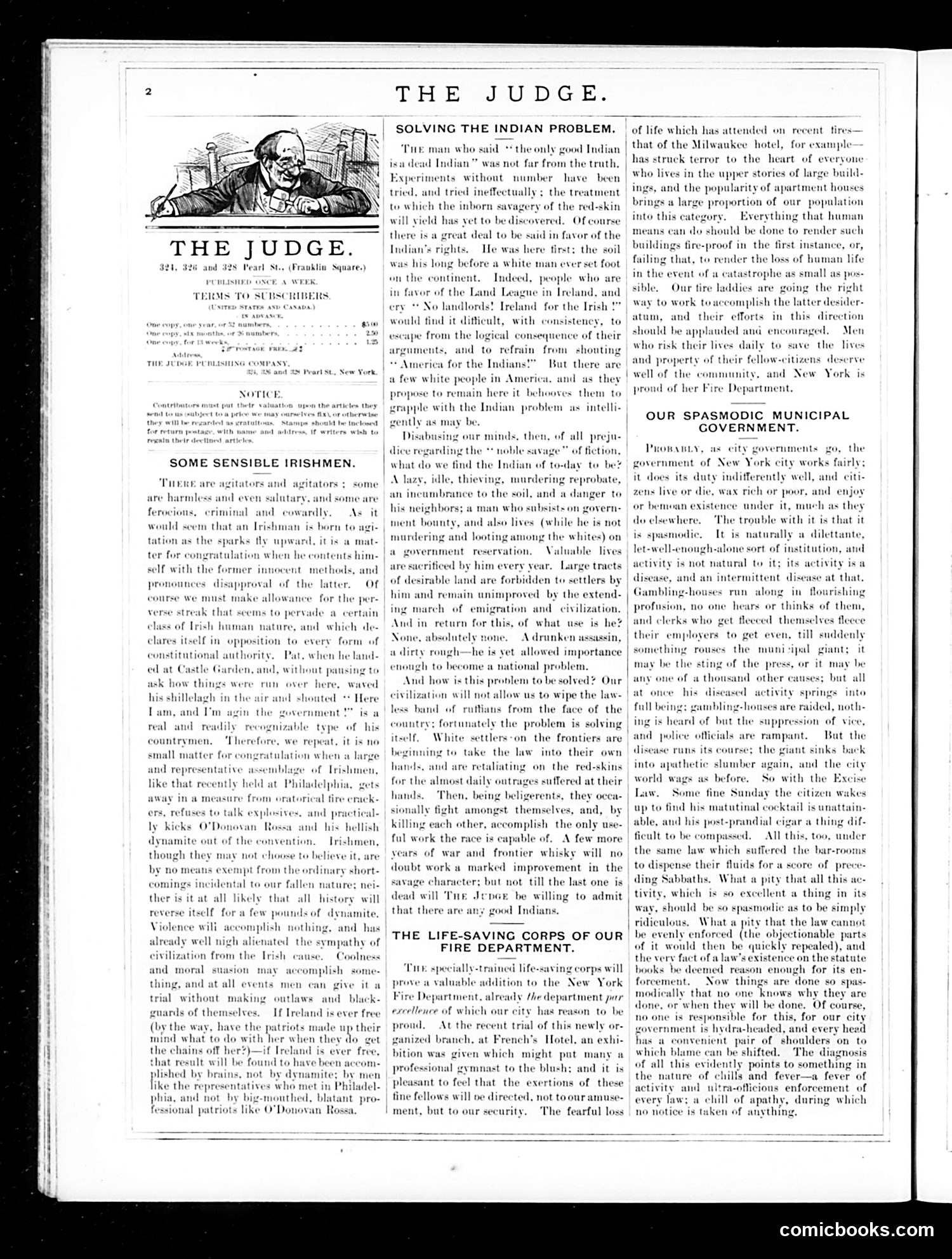
This page from Judge magazine (circa 1880s) contains two satirical columns addressing contemporary political issues: **"Solving the Indian Problem"** critiques American Indian policy through harsh stereotypes. The author argues that Native Americans—depicted as lazy, drunk, and violent—occupy valuable land unproductively. Rather than advocate genocide (which "civilization will not allow"), the piece suggests the "problem" will resolve itself through natural processes, implying displacement or extinction. **"Some Sensible Irishmen"** praises Irish-Americans who reject violent agitation (likely referencing dynamite campaigns by Irish nationalist groups) in favor of constitutional methods. The author distinguishes between reasonable Irish immigrants and destructive "big-mouthed" radicals, suggesting that Irish independence, if achieved, will result from "brains, not dynamite." Both pieces reflect late-19th-century attitudes: paternalistic toward colonized peoples, suspicious of immigrant radicalism, and confident in "civilization's" progress. The cartoons employ ethnic caricature and stereotyping typical of the era's satirical journalism.
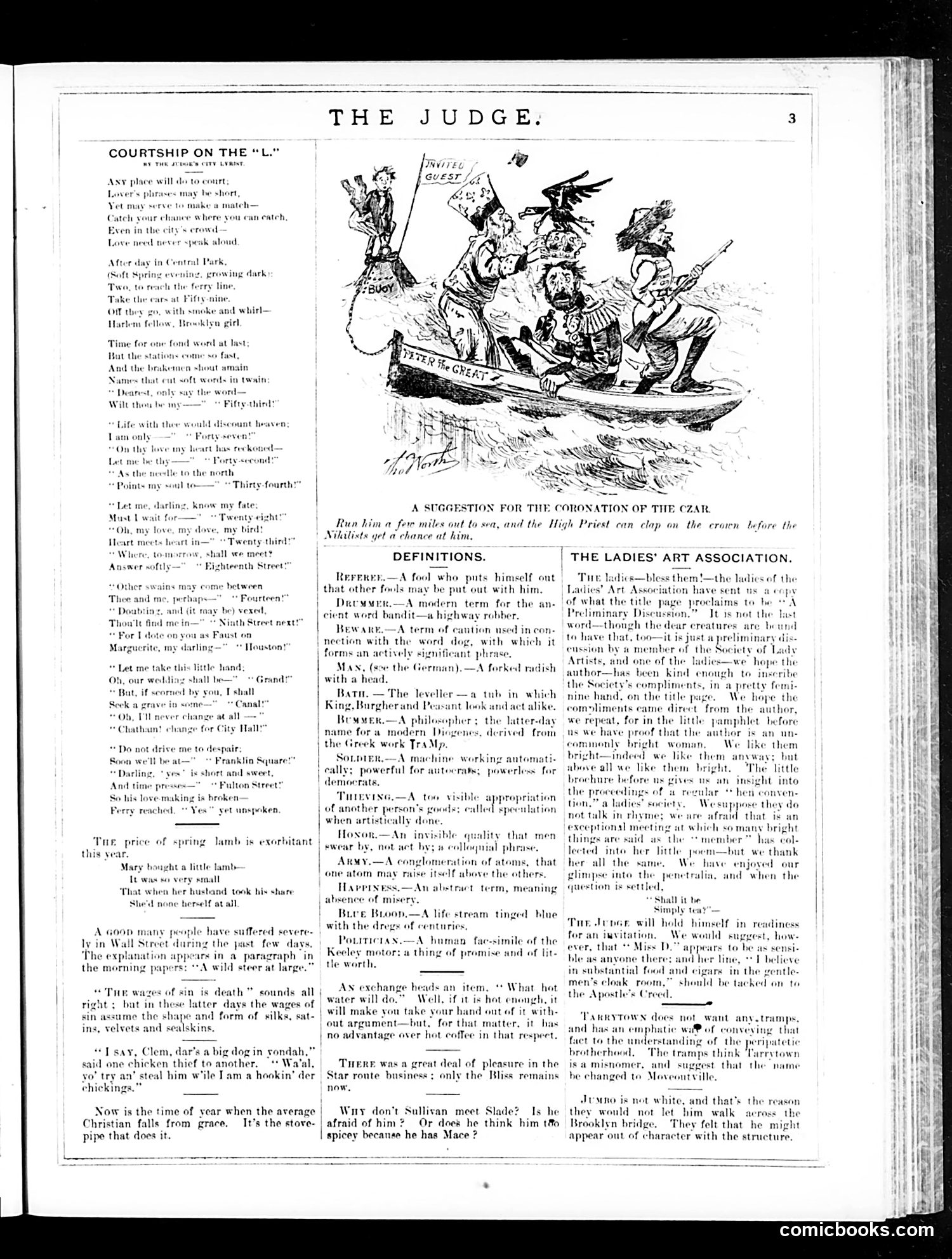
This page satirizes romance conducted on Chicago's elevated railway ("the L"). The poem humorously depicts couples negotiating where to meet for assignations by referencing train stops—"Harlem fellow, Brooklyn girl" arranging trysts at "Fifty-third," "Twenty-third," "Ninth Street," etc. The joke mocks both the cramped, public nature of urban transit romance and working-class courtship customs of the era, where the "L" served as a social space for young lovers. The accompanying cartoon illustrates this absurdity, showing passengers on an overcrowded train car amid comic chaos—the opposite of romantic privacy. The page also includes a satirical "Suggestion for the Coronation of the Czar" (likely referencing Nicholas II's 1894 coronation), proposing sending him miles out to sea so "Nihilists" cannot assassinate him—dark humor about Russian revolutionary threats. Additional content includes dictionary-style joke definitions and gossip about the Ladies' Art Association.
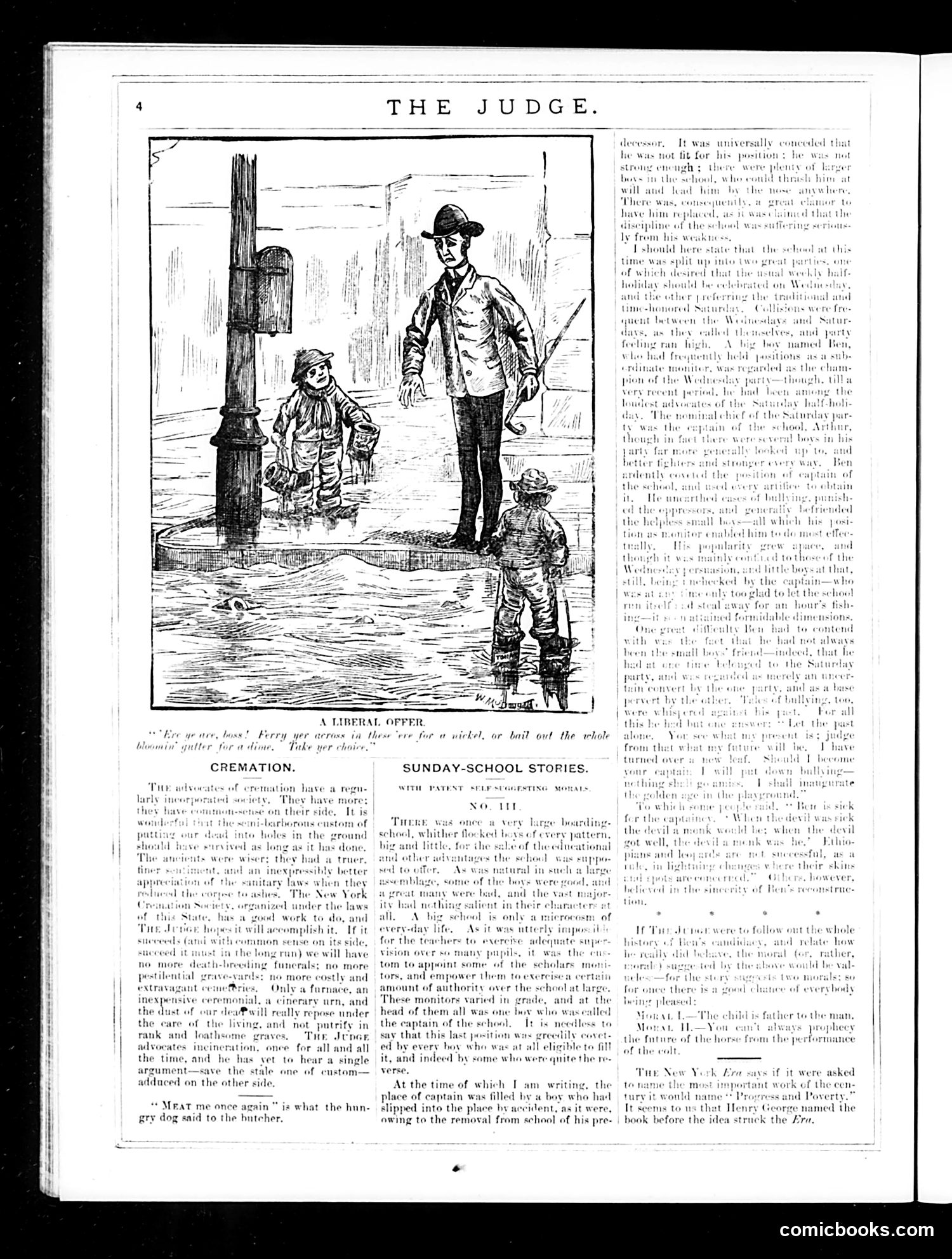
This page contains two satirical pieces typical of late 19th-century American humor journalism: **"A Liberal Offer"** (top cartoon): A street scene showing an adult and children near a lamp post. The caption references a "liberal offer" to transport people "for a nickel, or bail out the whole 'blooming' gutter for a dime"—likely satirizing either corrupt public services or exploitative urban conditions affecting poor families. **"Cremation" and "Sunday-School Stories"** (text pieces): These articles debate cremation as a cost-saving burial alternative and critique Sunday school discipline systems. The cremation piece argues for incineration to reduce expenses and cemetery overcrowding. The school story appears to mock ineffective "monitor" systems where student leaders lack real authority. The overall tone reflects Judge's typical satirical approach to urban social problems, institutional inefficiency, and class disparities in Gilded Age America. The specific individuals referenced in the degraded OCR text remain unclear, but the subjects—poverty, death customs, and education—were common satirical targets.
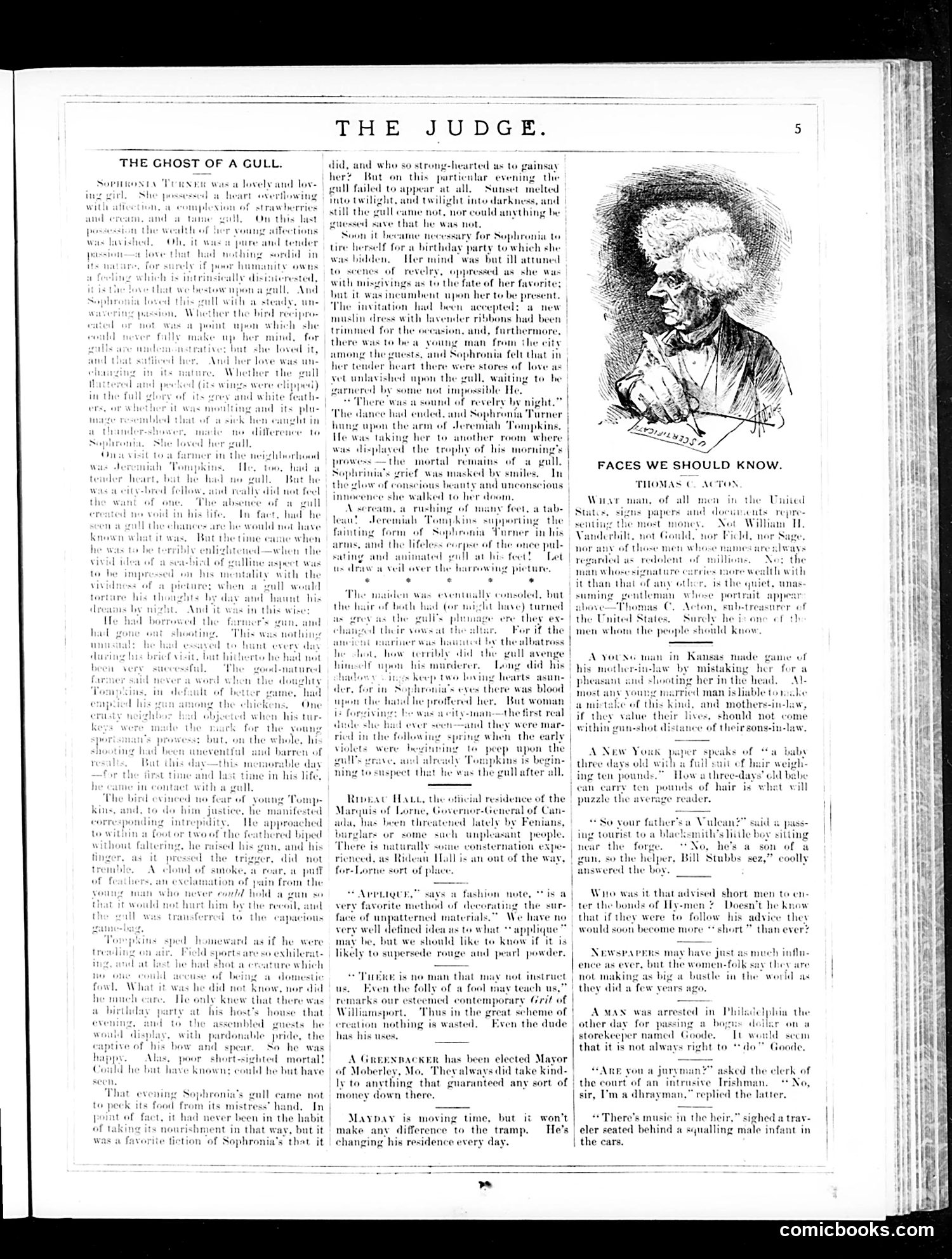
This page presents a sentimental short story rather than a political cartoon. "The Ghost of a Gull" tells of Sophronia Turner, a young woman who adopts a seagull as a pet, believing it returns to her at her host's home. When the bird fails to appear one evening before a birthday party, she grieves deeply. The tragic twist: her suitor Jeremiah Tompkins arrives proudly displaying a dead gull he shot that morning—the very bird Sophronia cherished. The satire targets Victorian sentimentality and romantic melodrama. The story mocks the era's tendency toward overwrought emotion over trivial incidents and the gap between masculine hunting culture and feminine sentimentality. The "Faces We Should Know" section below contains brief biographical sketches of contemporary public figures, typical of Judge's format. This appears to be literary satire rather than political commentary.
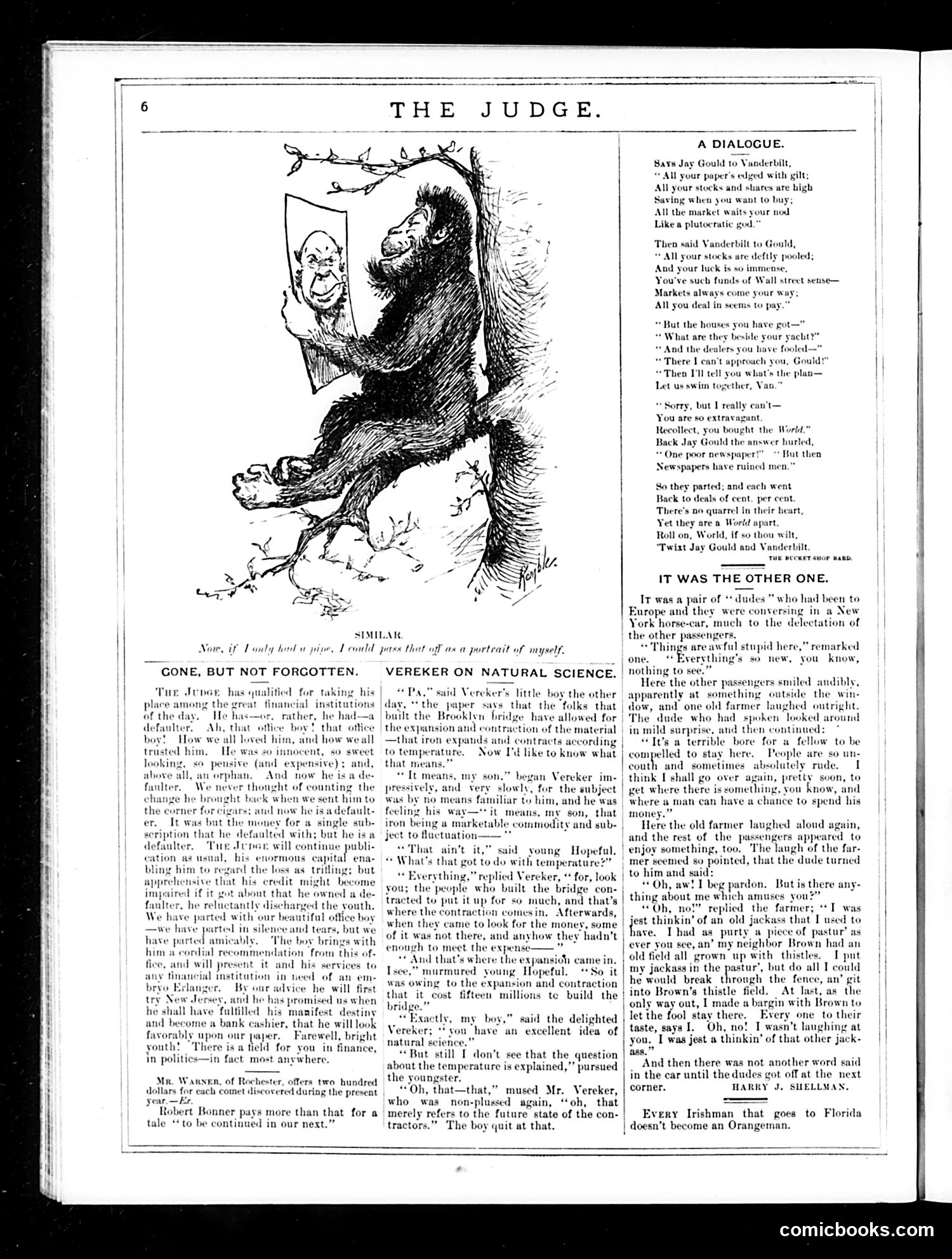
This page contains three satirical pieces about prominent figures and social issues of late 19th-century America. **"Gone, But Not Forgotten"** mocks financial institutions' casual attitude toward embezzlement—an office boy has absconded with funds, yet the publication cheerfully recommends him for future banking positions, implying widespread corruption and institutional negligence. **"Vereker on Natural Science"** ridicules pseudo-intellectual explanations. A father botches explaining thermal expansion of bridge materials, conflating it with financial "contraction" (cost overruns), satirizing both parental pomposity and perhaps the Brooklyn Bridge's own cost controversies. **"A Dialogue"** features Jay Gould and Cornelius Vanderbilt—two of America's wealthiest industrialists—exchanging backhanded compliments about their fortunes. The joke: despite their vast wealth, they can't cooperate because they're too greedy and suspicious, ultimately revealing that newspapers (not their own dealings) have "ruined men"—blaming media while embodying ruthlessness themselves. The satire targets gilded-age plutocrats and financial corruption generally.
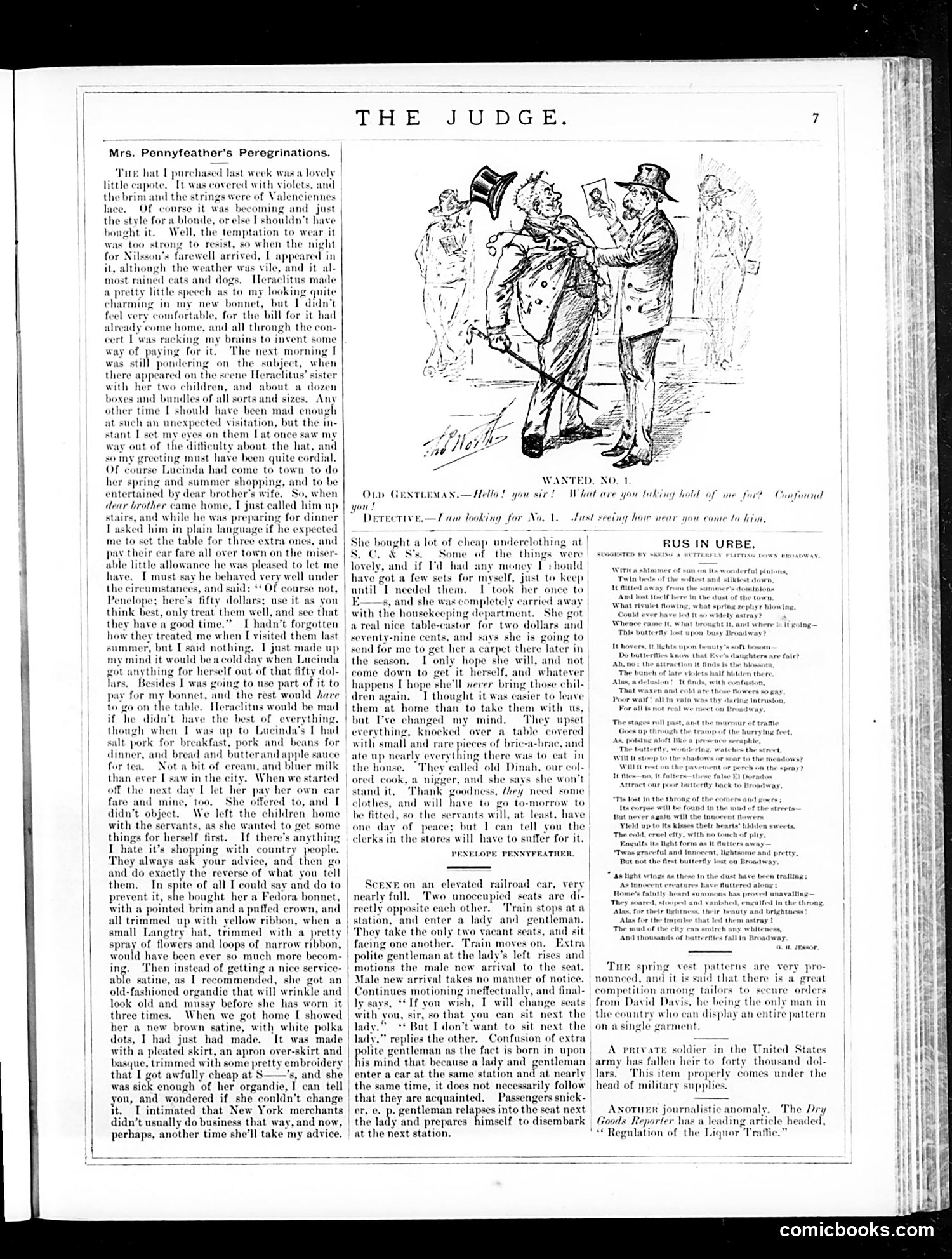
This page contains a serialized domestic humor column centered on Mrs. Pennyfeather's financial anxieties and social frustrations. After purchasing an expensive bonnet she can't afford, she schemes to pay for it by manipulating her visiting sister-in-law Lucinda's shopping trip—pressuring her brother for money while planning to use it for her own hat rather than properly entertaining the guests. The accompanying cartoon labeled "Wanted, No. 1" depicts a street scene where an old gentleman seeks "N. 1"—apparently a sought-after type of person—while another character responds he's "looking for N. 1." The specifics of this reference are unclear without additional context, though it appears social or romantic in nature. The satirical tone mocks middle-class women's shopping obsessions, vanity, and financial dishonesty within households. The humor targets genteel pretense and domestic scheming typical of period satirical magazines.
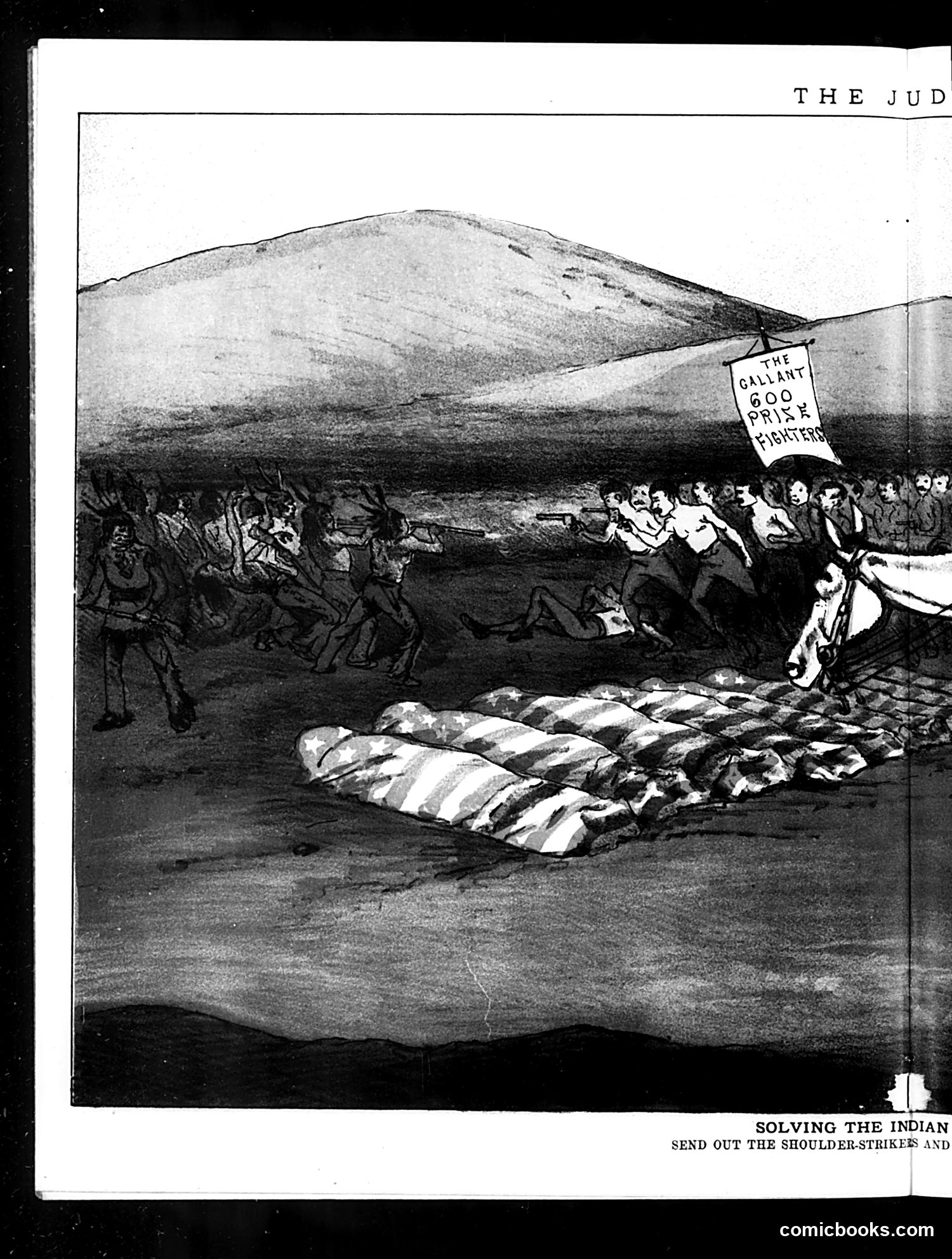
This cartoon satirizes violent approaches to resolving conflicts with Native Americans. The image shows a group of armed fighters or soldiers confronting what appears to be Native Americans, with bodies wrapped in blankets laid out in the foreground—suggesting casualties from conflict. The banner reading "GALLANT 600 FIGHTERS" likely references a specific military engagement. The caption "SOLVING THE INDIAN" combined with "SEND OUT THE SHOULDER-STRIKES" appears to mock the notion that military force constitutes a solution to "the Indian problem"—a phrase used during this era to describe tensions between U.S. authorities and Native American populations. The cartoon criticizes this violent approach as ineffective and inhumane, using dark humor typical of *Judge* magazine's satirical style.
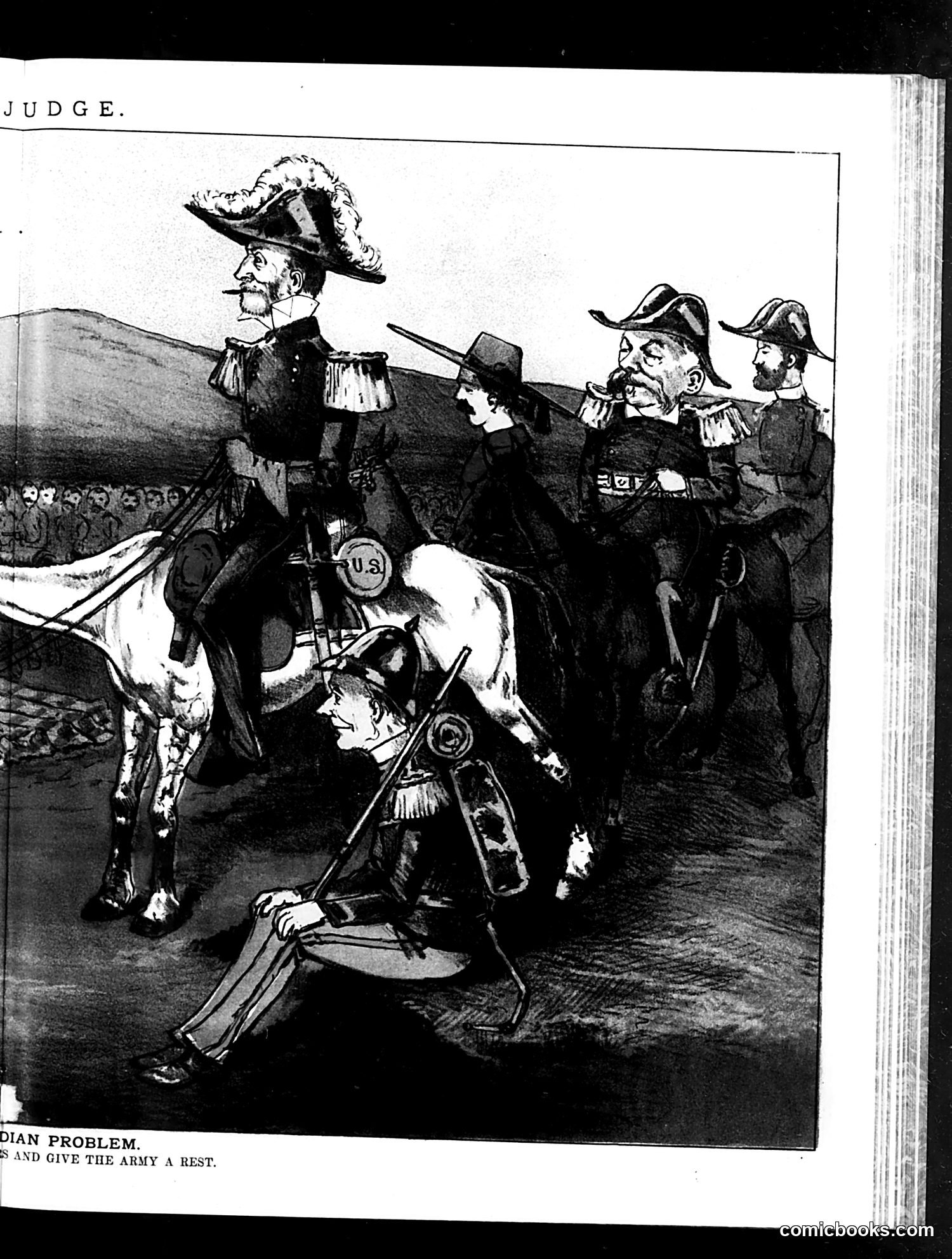
This political cartoon titled "The Indian Problem" depicts a tall military figure on horseback addressing several uniformed officers. The caption reads "...and give the army a rest," suggesting criticism of military involvement in Native American affairs. The satire appears to target U.S. military operations against Native Americans, likely referencing late 19th-century conflicts. The "Indian Problem" was contemporary terminology for the government's struggle controlling tribal populations and western expansion. The cartoon's point seems to be that military campaigns against Native Americans were exhausting the army and should cease—either through different policy approaches or settlement. The exaggerated features of the figures are typical of Judge's satirical style. Without the publication date visible, the specific conflict referenced remains unclear, though such cartoons were common during the Indian Wars era.
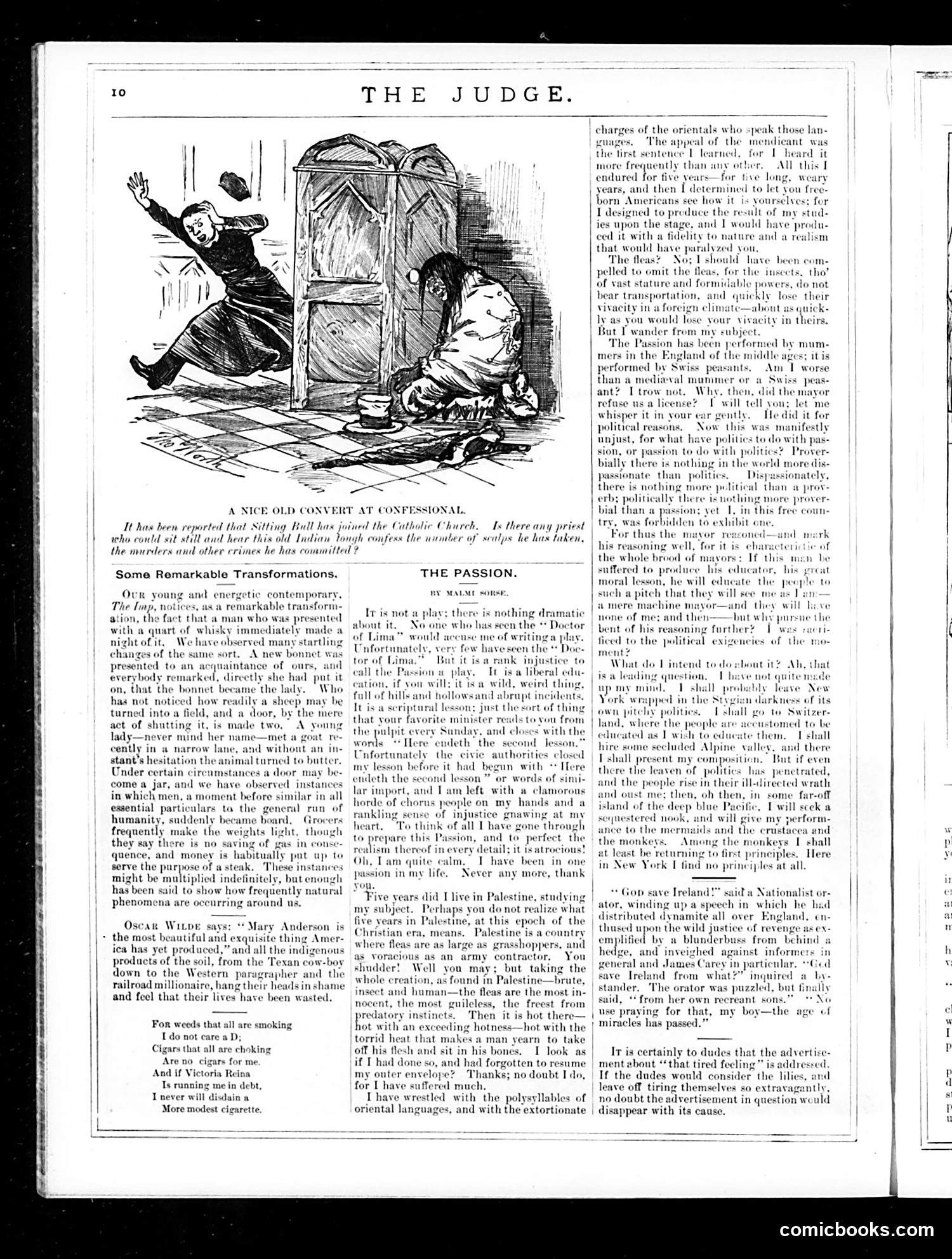
This page contains two main satirical pieces from *Judge* magazine: **"A Nice Old Convert at Confessional"** (top left): A crude joke about Native American leader Sitting Bull allegedly converting to Catholicism. The cartoon ridicules the absurdity of a Catholic priest hearing confession from someone with numerous violent crimes, particularly scalp-taking. The satire mocks both indigenous peoples and religious hypocrisy. **"The Passion" (main article)**: An editor or theater manager complains that a mayor denied him a license to stage a Passion play (depicting Christ's crucifixion), claiming it was "for political reasons." The author argues the mayor feared the play's religious/moral power might educate the public and incite political opposition. This satirizes censorship, municipal corruption, and how authorities suppress art for political advantage rather than legitimate concerns. Both pieces ridicule authority figures (mayors, politicians) abusing power while mocking marginalized groups and religion through crude stereotypes typical of 1880s American satirical magazines.
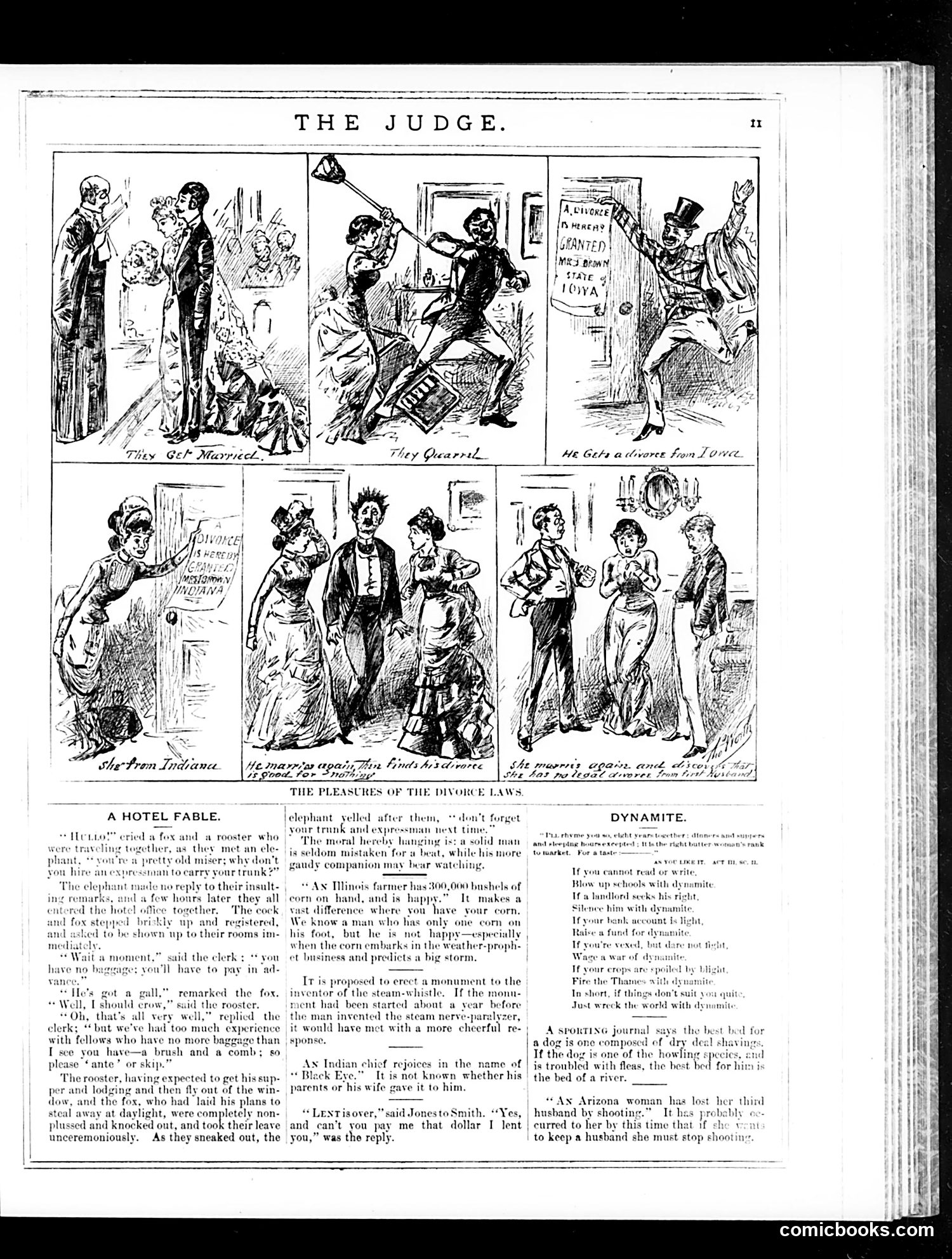
This satirical comic strip mocks late-19th-century American divorce law by depicting its absurd consequences. The six panels show a couple's progression: they marry, quarrel, obtain a divorce, and then remarry—suggesting that loose divorce laws create a cycle of marital instability rather than resolving problems. The accompanying humor pieces reinforce the theme: a "Hotel Fable" about a rooster and fox trying to cheat an innkeeper; jokes about dynamite (appearing to mock anarchist violence of the era); and a final quip about an Arizona woman who has shot three husbands, implying that without strong marriage laws, domestic violence goes unchecked. The satire argues that permissive divorce laws don't protect people—they enable chaos and repeat offenses. The cartoons express conservative anxiety about loosening marital restrictions during this period of legal reform.
This page contains **miscellaneous editorial content** rather than a cohesive political cartoon. The main elements include: **"Correspondents" section**: Humorous responses to reader submissions about poetry, journalism columns, and editorial standards—typical magazine banter. **"What is a Dude?"**: A satirical piece mocking the popular debate about what defines a "dude"—a fashionable, idle young man who was a frequent target of 1880s-90s American humor. **Domestic humor and anecdotes**: Brief jokes about cooking, marriage, and church weddings that reflect period domestic comedy. **"An Address to the Judge"**: A poem praising the magazine's editor for wit and fair judgment. The page appears designed as filler content mixing reader engagement, light satire of contemporary social types (particularly the "dude"), and self-promotional content about Judge magazine itself. There's no single overarching political message—instead, it reflects general period attitudes toward fashion, social pretension, and domestic life.
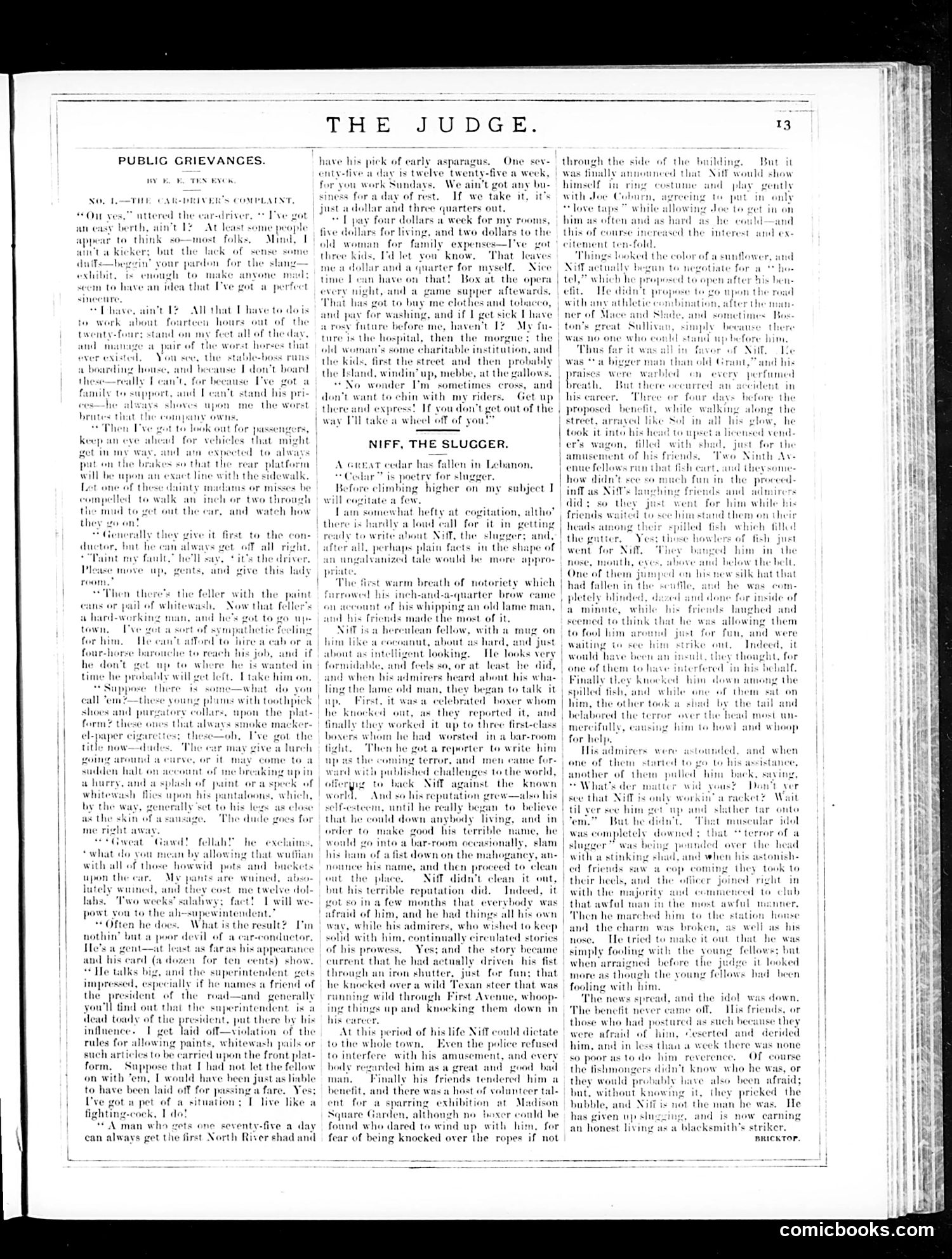
This page presents two working-class complaint monologues satirizing labor conditions in late 19th-century America. **"The Car-Driver's Complaint"** attacks the exploitation of streetcar operators. The driver describes brutal 14-hour shifts for minimal wages ($1.25/day), with expenses consuming his earnings entirely. He faces contradictory rules: blamed for passenger accidents yet punished whether he enforces safety regulations or not. The satire highlights how working-class men, despite dangerous, exhausting work, remain impoverished and vulnerable—a "dead toady" to management. The irony is sharp: a man earning subsistence wages is lectured about spending on luxuries. **"Niff, the Slugger"** describes a violent man who gains notoriety by assaulting an elderly man, then becomes celebrated in newspapers and social circles despite his brutish reputation. The satire critiques how sensationalism and scandal can elevate criminals into minor celebrities among the lower classes. Together, these pieces satirize systemic inequality: workers are exploited and powerless, while violent men gain status through notoriety. The humor is grim—Judge's message is that American society systematically degrades honest labor while rewarding scandal.
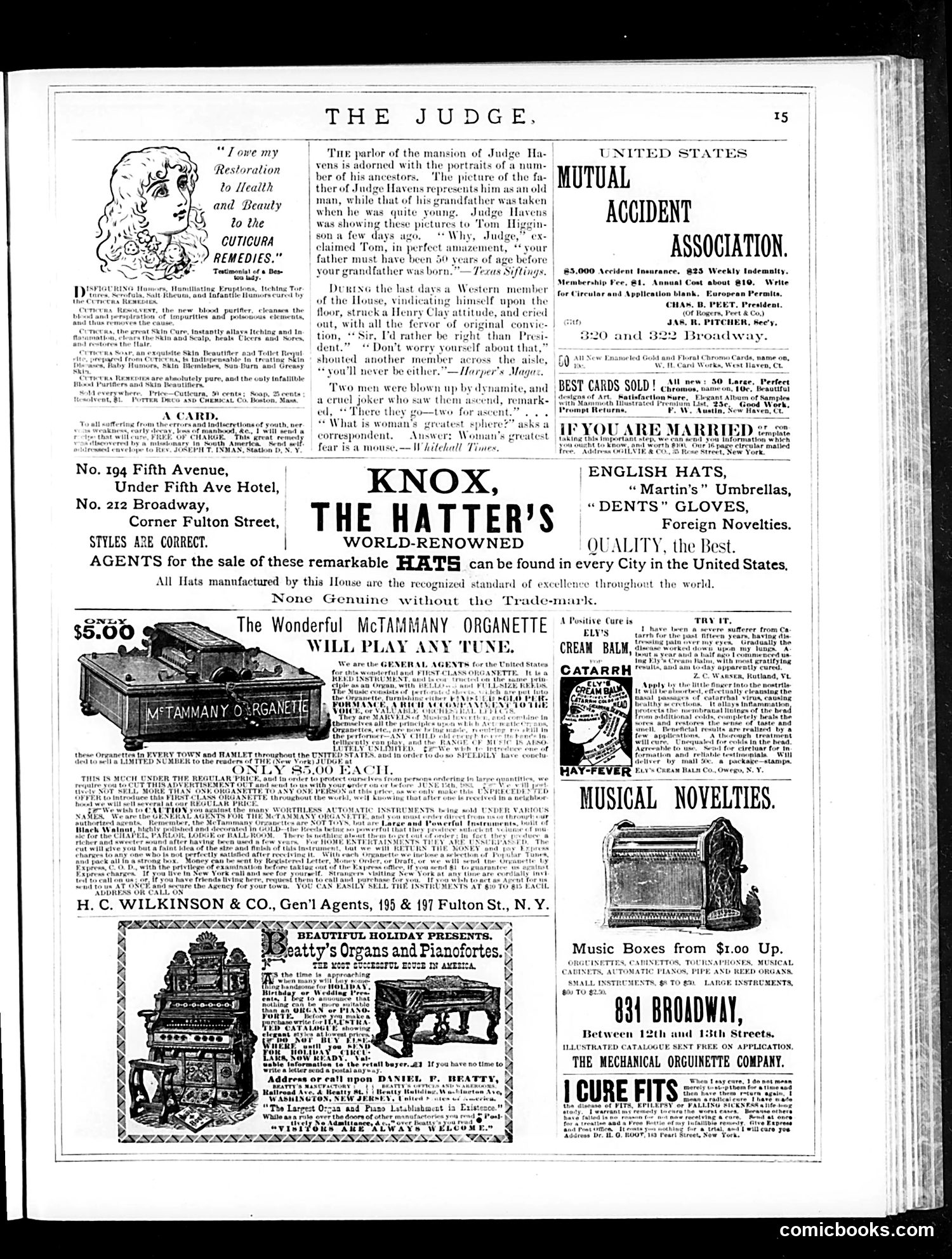
This page is primarily **advertising**, with minimal editorial content. The few brief satirical items visible include: **"Restoration to Health" section**: A column of short anecdotes. One describes Judge Havens showing a visitor portraits of himself at different ages, with a joke about his grandfather's age. Another features a Western congressman striking a dramatic pose while defending himself, with a colleague remarking he'll "never be either" (right or President)—mocking his rhetorical posturing. A third is a brief joke about women's greatest sphere of influence. **Knox the Hatter**: A major advertisement for a well-known hat manufacturer, emphasizing their hats are "the recognized standard of excellence throughout the world." The page otherwise consists of product advertisements (Cuticura Remedies, McTammany Organettes, musical boxes, organs, pianos, and various novelties), reflecting the magazine's mixed editorial-advertising format typical of 19th-century publications. No significant political satire or social commentary appears on this particular page.
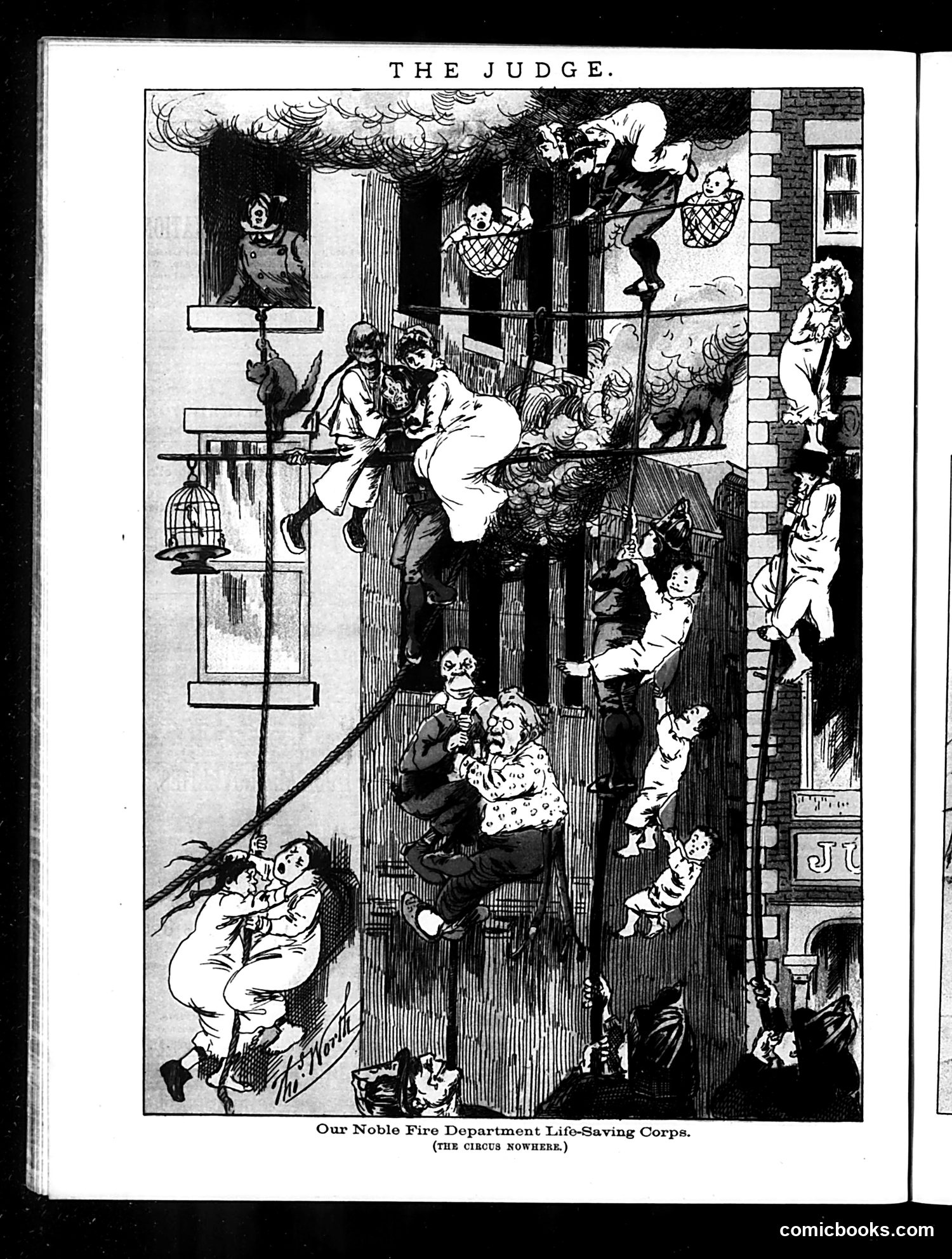
This satirical cartoon depicts firefighters performing an absurdly chaotic rescue operation from a multi-story building. The image mocks the fire department's competence through exaggerated, circus-like pandemonium: figures dangle precariously from ropes and ladders, children are tossed about in baskets, and the overall scene suggests incompetence rather than heroic rescue. The subtitle's parenthetical "(The Circus Nowhere)" emphasizes the satirical comparison—suggesting the fire department operates with carnival-like chaos and improvisation rather than professional organization. The cartoon likely critiques either specific local fire department failures, poor equipment, inadequate training, or general municipal mismanagement during the Gilded Age period when *Judge* magazine operated. Without dating information visible, the precise incident referenced remains unclear.