
Judge, 1883-05-12 · page 6 of 16
Judge — May 12, 1883 — page 6: what you’re looking at
What you’re looking at
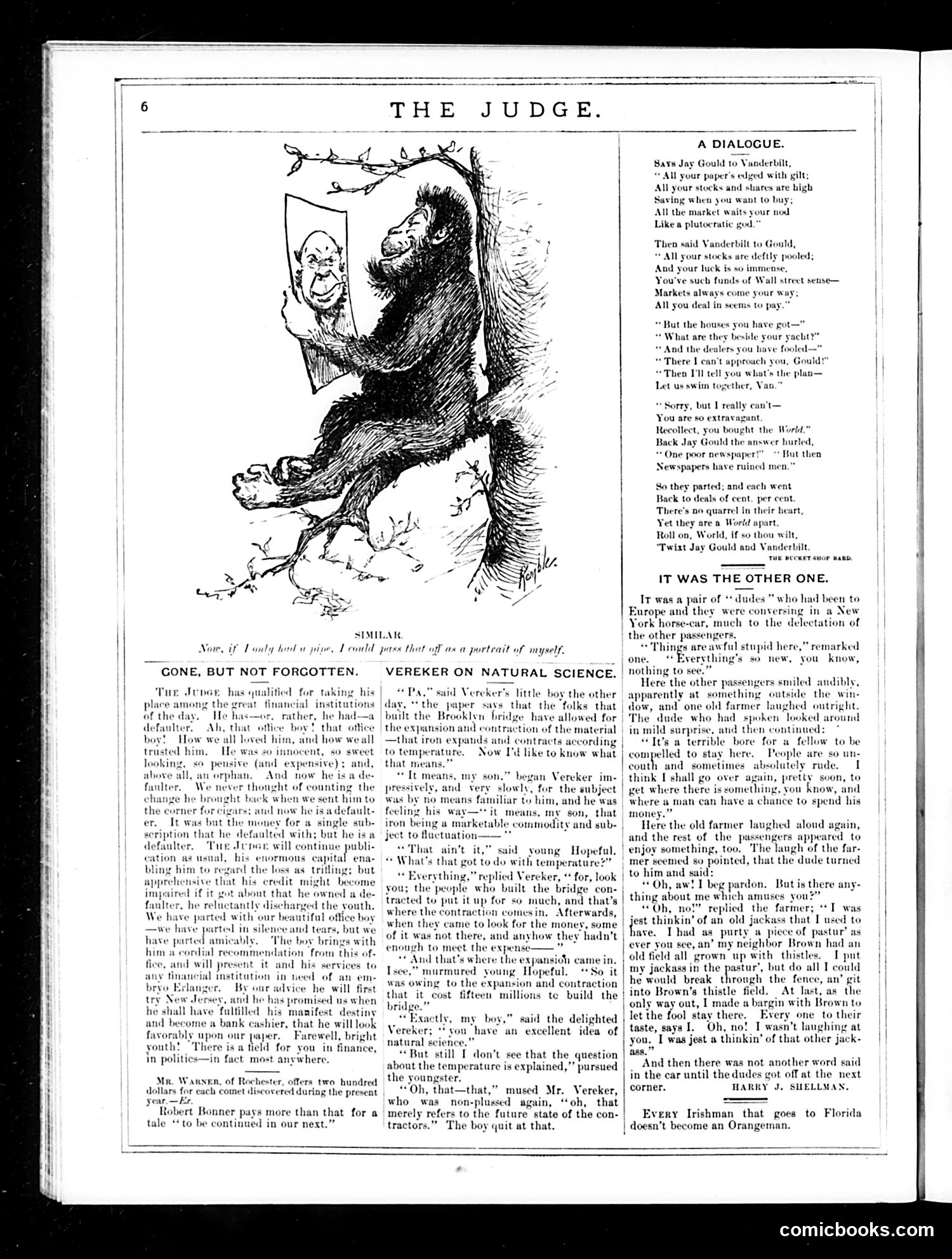
This page contains three satirical pieces about prominent figures and social issues of late 19th-century America. **"Gone, But Not Forgotten"** mocks financial institutions' casual attitude toward embezzlement—an office boy has absconded with funds, yet the publication cheerfully recommends him for future banking positions, implying widespread corruption and institutional negligence. **"Vereker on Natural Science"** ridicules pseudo-intellectual explanations. A father botches explaining thermal expansion of bridge materials, conflating it with financial "contraction" (cost overruns), satirizing both parental pomposity and perhaps the Brooklyn Bridge's own cost controversies. **"A Dialogue"** features Jay Gould and Cornelius Vanderbilt—two of America's wealthiest industrialists—exchanging backhanded compliments about their fortunes. The joke: despite their vast wealth, they can't cooperate because they're too greedy and suspicious, ultimately revealing that newspapers (not their own dealings) have "ruined men"—blaming media while embodying ruthlessness themselves. The satire targets gilded-age plutocrats and financial corruption generally.
📄 Transcribed text from this page (OCR, searchable)
Machine-transcribed from the original scan — historical spelling and the odd misread are preserved.
SIMILAK. Now, if Louly hid a pipe, Leould pass that of asa portrait of myself. ~~ GONE, BUT NOT FORGOTTEN. Tur & has qualitied for taking his place g the great financial institutions of the day. He has—er, rather, he had defaulter, Ah, that office boy! that office boy! How we all loved him, and how weal tristed him. He was so innocent, 30 sweet looki sive (and expensive) above all, an orphan. And now he is ad falter. We never thought of counting the back When we sent him to urs: and now he is adefault- ut the money for a single sub- he defaulted with; but he is a r. THe Jeper will continue publi- sus trifling: but apprehensive that his credit might become Vif it got about that he owned a de- ‘outh. tiful office boy and tears, but we amicably. ‘The boy brings with recommendation from this of- and will present it and his services to ul institution in need of an em- rt. By our advice he will first r Jersey, and he has promised us when he shall have fultilled manifest destiny and become a bank cashier, that he will look favorably upon our paper. ewell, bright youth! “There isa tield for you in finance, in polities—in fact most anywhere. er. It was seription th defaul cation Mr. Wanver dollars for each ¢ two hundred ered during the present »bert Bonner pays more than that for a tale ‘to be continued in our next.” VEREKER ON NATURAL SCIENCE. “Pa,” said Vereker’s little b day, “the paper says that th built the Brooklyn bridge have allowed for the expansion and contraction of the material —that iron expands and contracts according to temperature. Now I'd like to know what that mean the other folks that “It me began Vereker im- pressively, a -y slowly, for the subject | was by no means familiar to him, and he was feeling his way—* itm iron a marketab ject to fluctuation— ns, my son, that ommodity and sub- ‘That ain't it,” said young Hopeful. * What's that got to do with temperature?” * Everything,” replied Vereker, ** for, look you; the people who built the bridge con- tract y put itup for so much, and that’s where the contraction comesin, Afterwards, when they came to look for the money, some of it was not there, and anyhow they hadn't enough to meet the expense—"” ** And that's where the expansioh came in. Isce,” murmured young Hopeful. “So it was owing to the expansion and contraction that it cost fifteen millions te bridge.” * said the delighted n excellent al se But still I don’t see that the question about the temperature is explained,” pursued the youngste: “Oh, that—that,” mused Mr. Vereker, who was non-plussed again, ‘oh, that merely refers to the future state of the con- tractors.” The boy quit at that. A DIALOGUE. Savs Jay Gould to Vanderbilt, * All your paper's edged with gilt; All your stocks and shares are high Saving when you want to buy; All the market waits your nod Like a plutocratic god.” pooled; Then said Vanderbilt to * All your stocks are deft And your luck is so immense, You've such funds of Wall street s Markets always come nse— our w All you deal in seems to pay But the houses you have got—" “What are t ‘de your yacht?” “And th “There 1 can . Gould!” + Then I'll tell you what's the plan— lers you have fooled approach Let us») ther, V: “Sorry, but I really can't— You are so extravagunt Recollect ght the World.” Back Jay Gould the answer hurled, * But then Newspapers have ruined men.” poor newspaper! So they parted; and each went Back to deals of cent. per cent Roll on, World, if so thou wilt, “Twixt Jay Gould and Vanderbilt THE BECKET SWOF BARD. IT WAS THE OTHER ONE. Ir was a pair of “dudes” who en to build the | idea of | Europe and they were conversing in a New York horse-car, much to the deleetation of the other passengers. Things are awful stupid here,” remarked one. thing's so new, you know, nothing to see. Here the other ers smiled audibly, apparently at something outside the win- dow, and one old farmer langhed outright. The dude who } spoken looked arc in mild surprise, and then continued: | ‘Is a terrible bore for a fellow to be compelled to stay here. People are so un- couth and sometimes absolutely rude. I think I shall go over again, pretty soon, to t where there issomething, you know where a man can have a chance to spend his money. Here the old farmer laughed aloud again, and the rest of the passenget ppeared to enjoy something, too. The laugh of the far- mer seemed so pointed, that the dude turned | to him and said: “Oh, aw! I beg pardon. But is there any- thing about me which amuses you?” “Oh, no!” replied the farmer; **T was jest thinkin’ of an old ja s that I used to have. Ihud as purty. a piece of pastur ever you see, an’ my neighbor Brown had an old field all grown up with thistles, [put my ja sin the pastur’, but do all I could he would break through the fence, an’ git into Brown’s thistle field. At last, as the only way out, I made a bargin with Brown to let the fool stay there. Every one to their taste, says I. Oh, no! I wasn’t laughing at | you. I was jest a thinkin’ of that other jack- As | ass. And then there was not another word said in the car until the dudes got off at the next corner. HARRY SHELLMA Every Irishman that goes to Florida | doesn’t become an Orangeman. comicbooks.com