
A complete issue · 16 pages · 1883
Judge — February 10, 1883
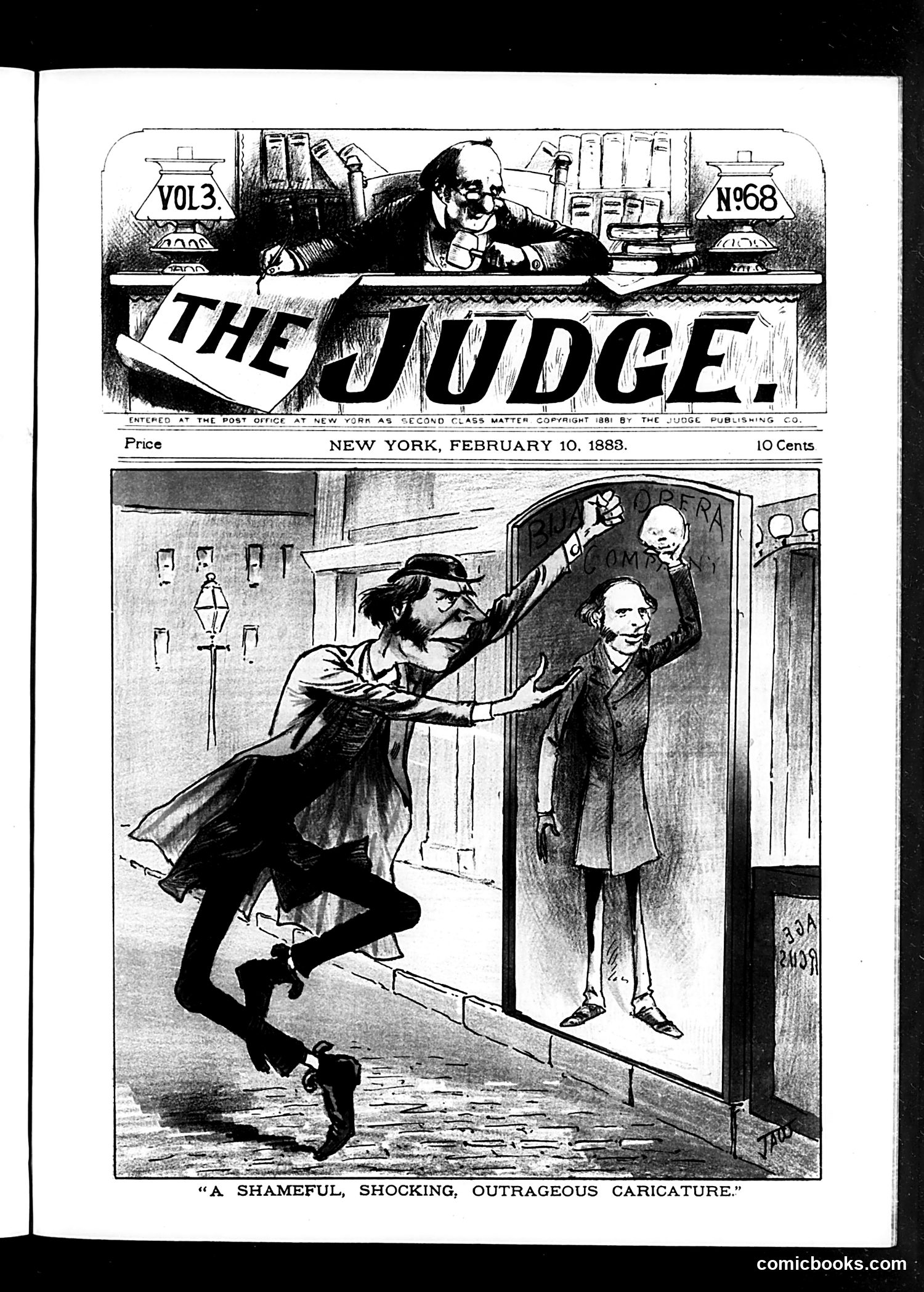
This is the cover of **Judge**, a satirical weekly costing 10 cents. The main cartoon depicts a dramatic nighttime scene captioned "A SHAMEFUL, SHOCKING, OUTRAGEOUS CARICATURE." A figure in a hat and coat lunges toward a thin man holding what appears to be a skull or theatrical prop near a doorway. The exaggerated postures and the caption suggest this is satirizing someone's **theatrical or artistic overreaction**—possibly mocking an actor's performance style or an artist's work as absurdly melodramatic. Without additional context about February 1888 events, the specific identity of the figures remains unclear, though the satire targets excessive artistic pretension or sensationalism of that era.
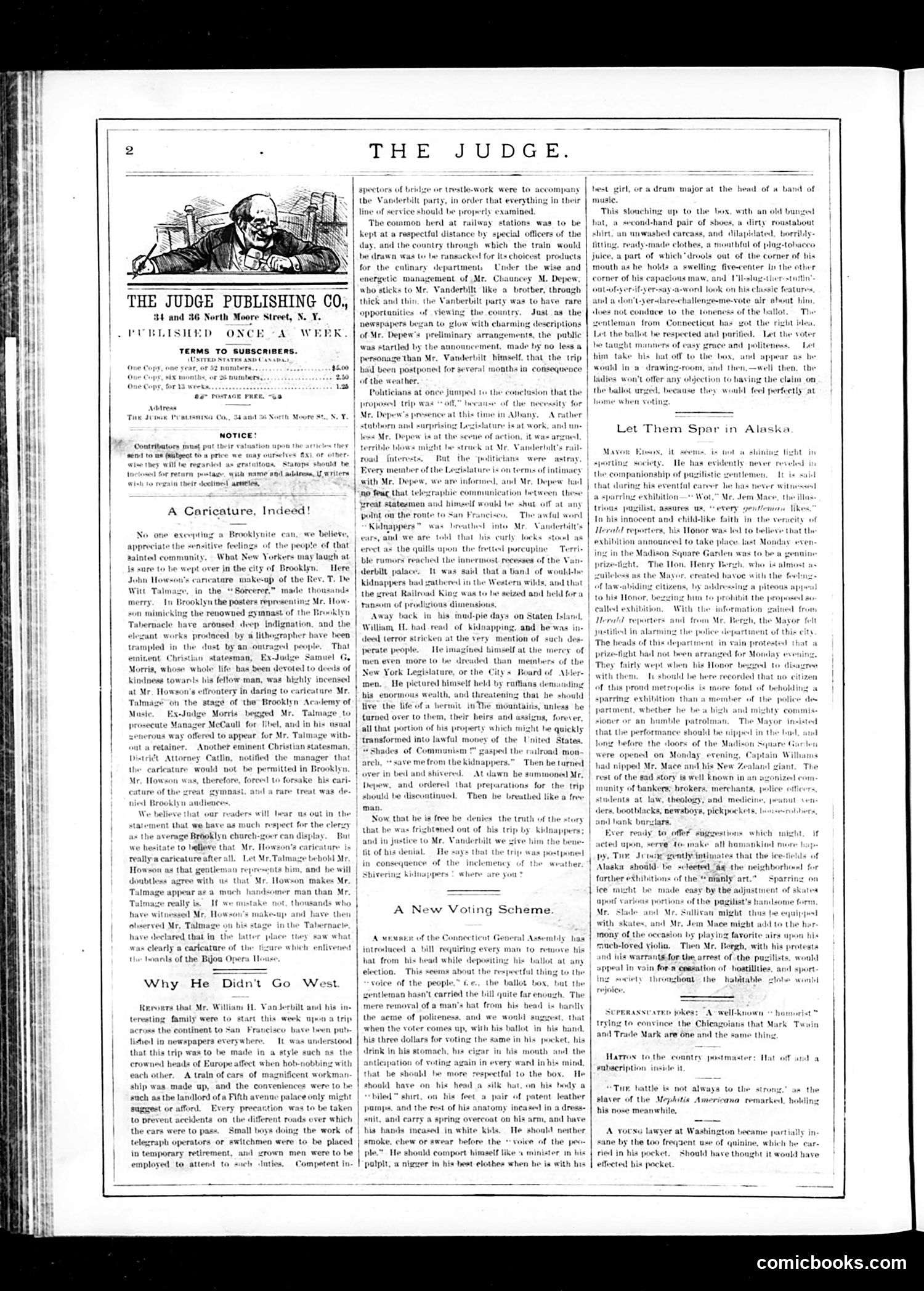
The page centers on **satirizing a cancelled Vanderbilt family trip** west. The main article mocks the elaborate preparations—special train inspections, kept crowds at distance, curated scenery—arranged by railroad executive **Chauncey Depew** for the Vanderbilt party's journey to San Francisco. The satire's point: such ostentatious arrangements expose the absurd gap between wealthy elites and ordinary people. The cancelled trip becomes comedy—all that fussy preparation for nothing. Secondary articles mock **Brooklyn gymnast John Howson's caricature** (likely in theatrical performance) that offended clergy, and a scheme to require voters to deposit ballots in boxes—a jab at election procedures. The **cartoon header** (upper left) depicts a large, grotesque figure, likely representing excess wealth or pretension, though specific identity is unclear from the image alone. This reflects *Judge*'s Gilded Age critique of plutocratic excess and social hypocrisy.
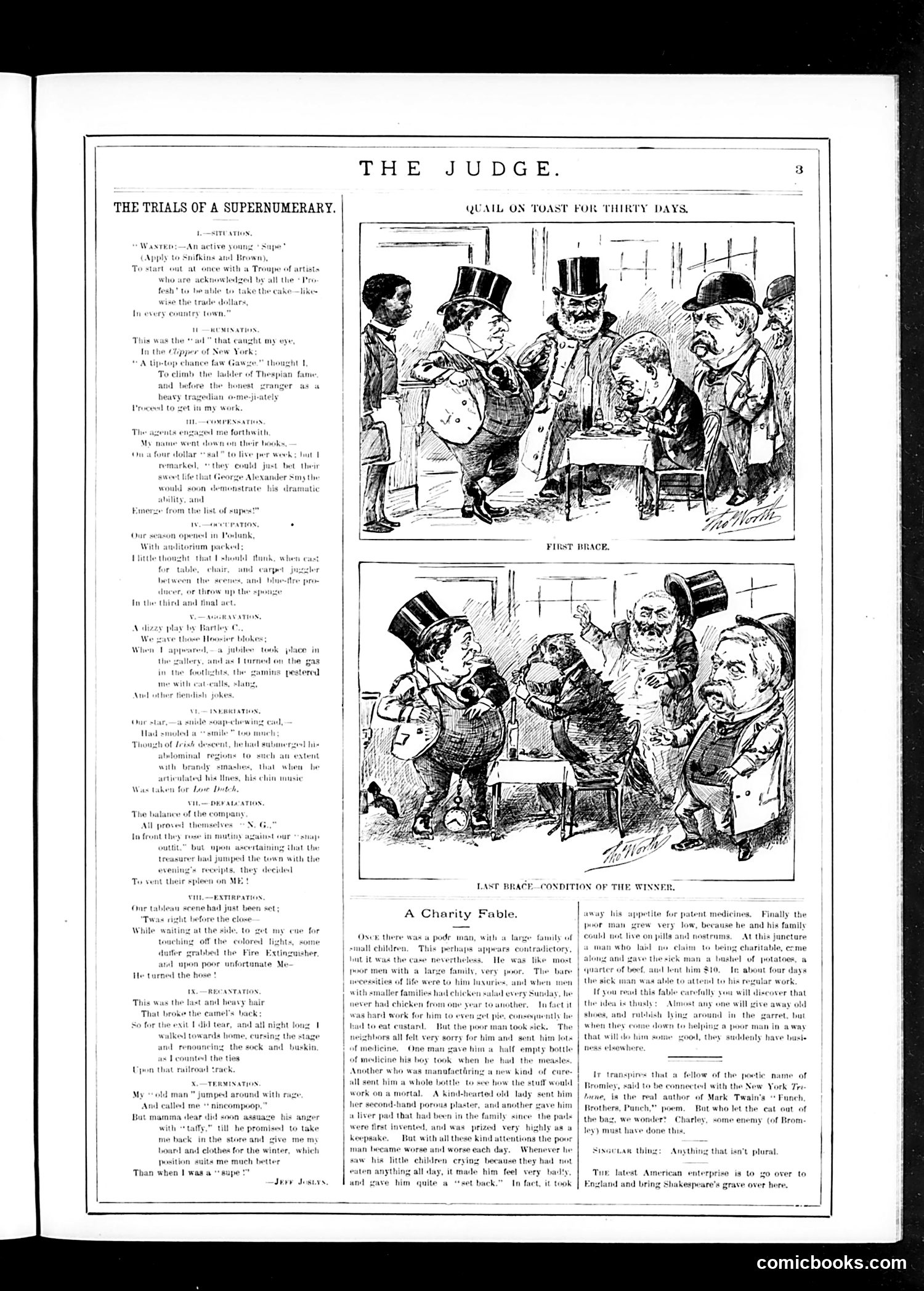
This page contains two distinct pieces: **"The Trials of a Supernumerary"** (left) is a humorous poem about struggling theater bit-players facing exploitation and poor working conditions. The jokes reference low wages ("a dollar a week"), difficult directors, and the indignity of stage work—typical anxieties for minor theatrical performers of the era. **"A Charity Fable"** (right) satirizes well-intentioned but misguided charity. A poor family receives numerous donated remedies and items from sympathetic neighbors, but these accumulate into overwhelming clutter. The final straw—a fire extinguisher—proves too much. The satire critiques how charitable impulses, however kind, can burden recipients with unwanted goods rather than addressing actual needs like food or money. Both pieces use gentle humor to mock social pretensions and the gap between good intentions and practical reality—typical Judge magazine fare mocking middle-class American life circa early 1900s.
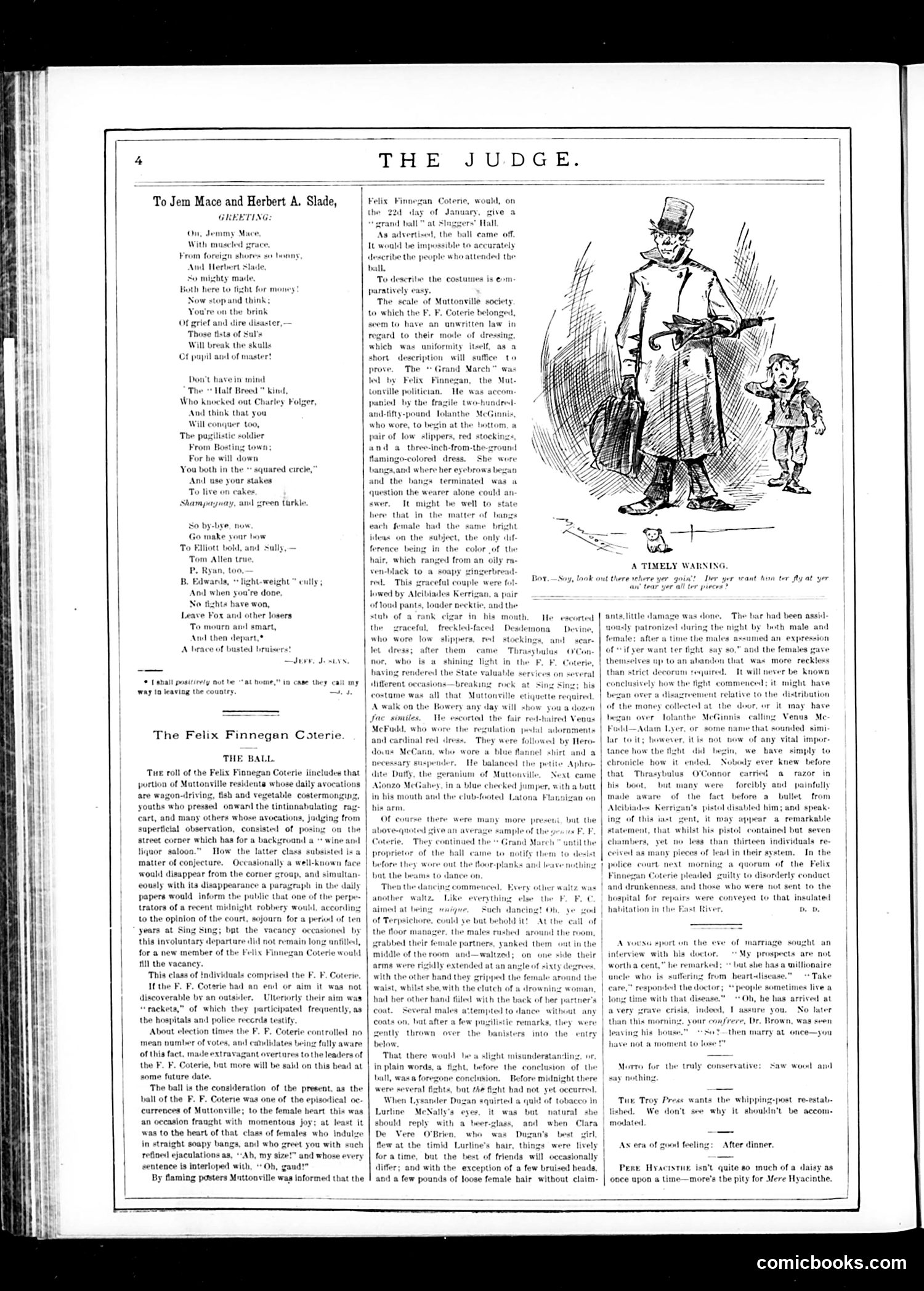
This page from *Judge* magazine satirizes Muttonville's "Felix Finnegan Coterie"—a working-class social group whose members organize a formal ball. The satire targets the pretensions of this lower-class cohort (laborers, cart-drivers, street vendors) attempting to mimic upper-class social conventions. The cartoon illustration (top right) shows an adult and child in tattered clothes, captioned "A TIMELY WARNING," mocking the gap between Muttonville residents' actual circumstances and their social aspirations. The detailed prose section ridicules the ball's attendees: women wearing identical "soapy" bangs and three-inch heels, men in garish formal wear. The satire emphasizes their uniformity and affected mannerisms ("refined ejaculations"), suggesting they're merely aping respectability without understanding it. The poem at top mocks prize fighters Jem Mace and Herbert Slade, contrasting them with allegedly superior boxers. Overall, the page expresses *Judge*'s class-based mockery of working-class social climbing and aspiration.
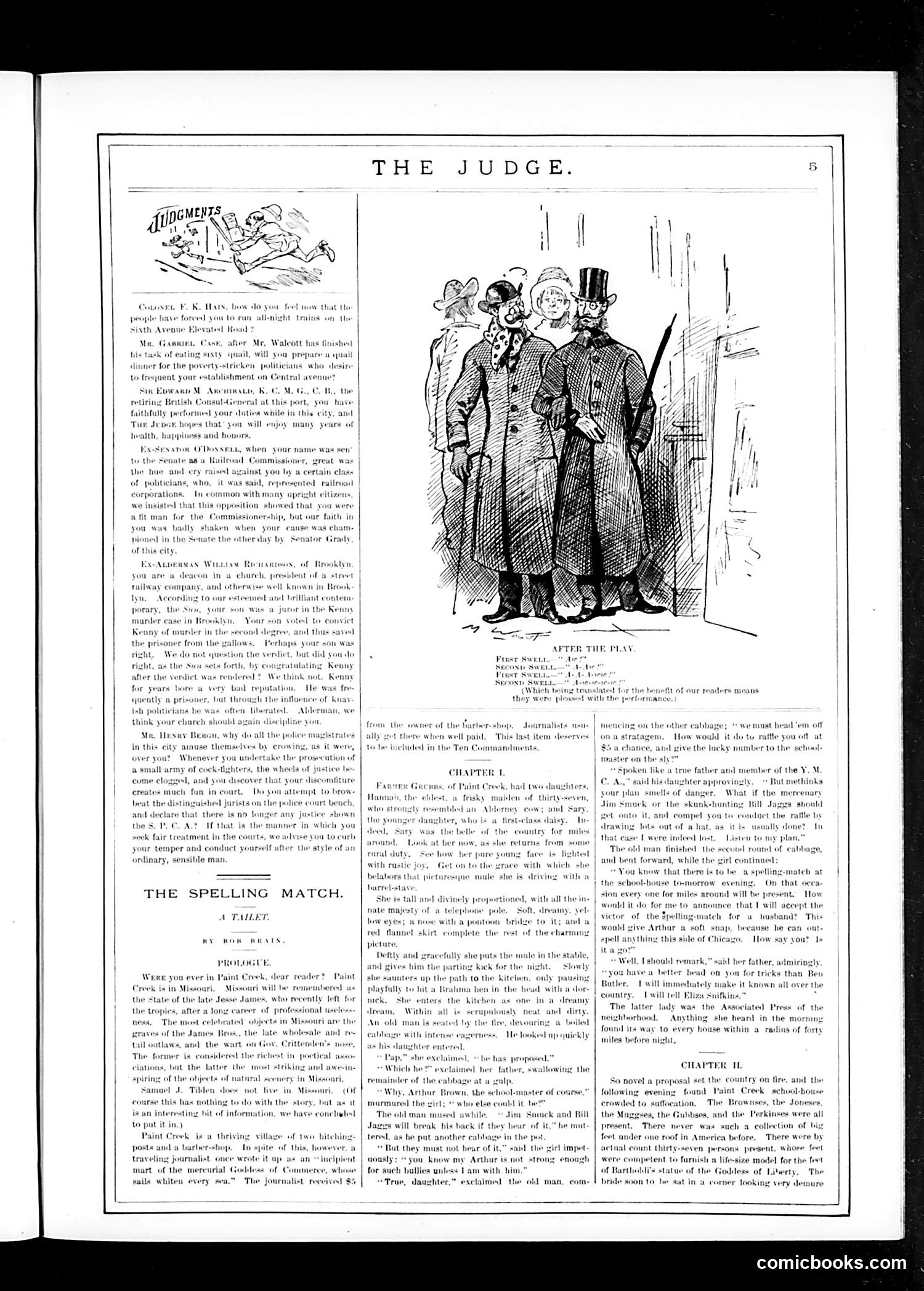
This page from *Judge* magazine contains satirical commentary on New York political corruption circa the 1880s-90s. **"After the Play" cartoon** (top right): Three well-dressed men represent corrupt public officials—likely judges, politicians, or police magistrates—congratulating themselves. The satire targets how these officials celebrate verdicts and decisions allegedly influenced by bribery or political connections rather than justice. **Text sections** mock specific figures: Police magistrates who favor wealthy defendants; a British Consul-General; a church deacon involved in railway corruption; and particularly "Kenny," apparently a notorious prisoner repeatedly freed through political influence despite his "very bad reputation." **Core satire**: The piece exposes how New York's judicial and political system was controlled by corrupt networks—judges, politicians, and railway/corporate interests—who routinely subverted justice through connections. Officials congratulate themselves for releasing guilty parties or convicting innocents based on patronage rather than law. The separate story "The Spelling Match" appears to be fiction using romantic comedy as filler content.
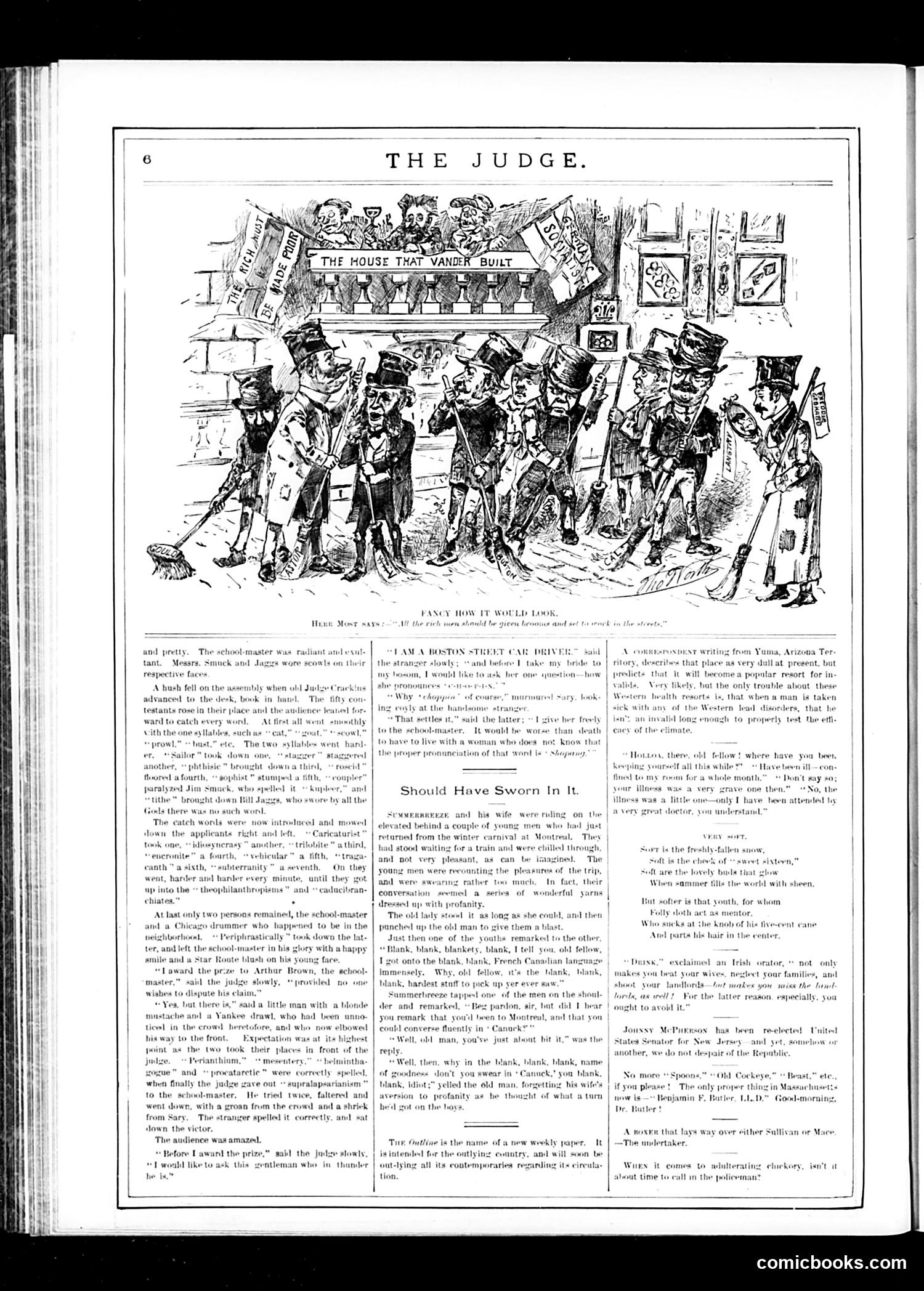
This page satirizes wealthy industrialist **Cornelius Vanderbilt** (referenced by the title "The House That Vander Built," parodying the nursery rhyme). The cartoon depicts various figures—appearing to be lawyers, judges, and politicians—clustered outside an ornate building, suggesting they are parasites feeding on Vanderbilt's wealth and legal disputes. The accompanying stories ("Should Have Sworn In It" and related anecdotes) appear to mock the absurdities of American legal proceedings and social pretension among the wealthy. The dialogue includes crude ethnic stereotyping typical of 1880s-90s Judge magazine. **Key satire:** The cartoon suggests that great fortunes attract hordes of hangers-on and legal entanglements. The "house" built by Vanderbilt becomes a monument to litigation and social chaos rather than achievement. The page reflects late-19th-century American anxieties about monopoly power and corruption surrounding gilded-age industrial fortunes.
This two-part comic presents a romantic melodrama ("Ah, Miserie!") followed by satirical commentary on small-town journalism. The main piece, "A Crushed Editor," mocks an ambitious but delusional job applicant seeking the editor position at the *Caseytown Courier*. The applicant is portrayed as absurdly grandiose—claiming journalism experience and passionate devotion to the craft—while the actual editor is depicted as indifferent and slovenly (described in "seedy black" attire, lounging in a chair). The satire targets both the applicant's overblown self-importance and the shabby state of small-town newspapers. The editor's dismissive responses and the applicant's earnest but hollow claims about circulation growth satirize the gap between ambition and reality in provincial American journalism. The humor relies on class mockery and the contrast between the applicant's grandiose rhetoric and the gritty reality of local newspaper work.
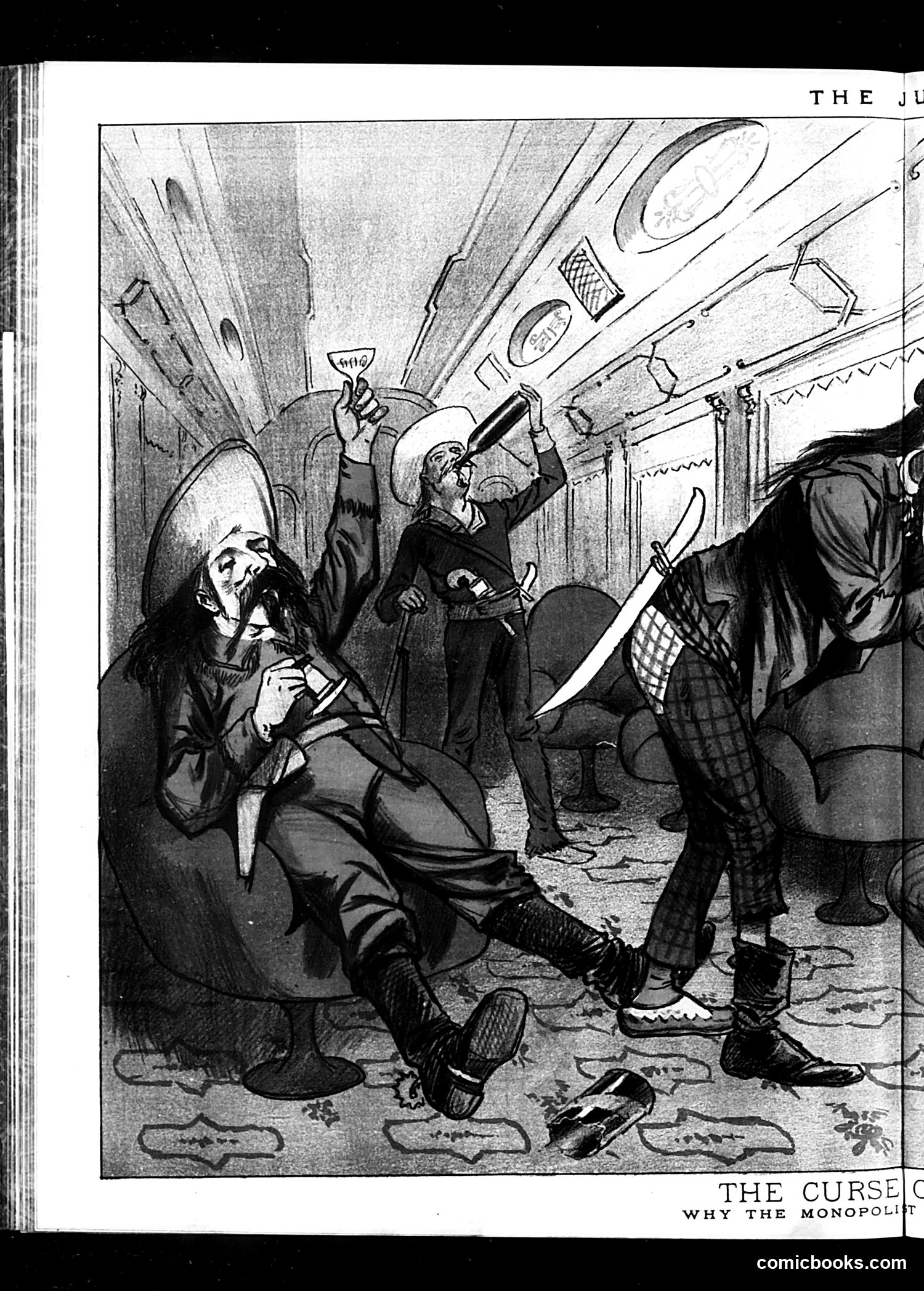
This political cartoon satirizes monopolistic business practices. The image depicts violent chaos in what appears to be a confined space—figures wielding weapons (knives, clubs) attack a cowering victim on the ground. The title "THE CURSE OF THE MONOPOLIST: WHY THE MONOPOLIST" (text cut off) suggests the cartoon critiques how monopolies harm society through predatory or destructive practices. The violent imagery represents economic damage inflicted by monopolistic corporations. The victim's distressed pose emphasizes suffering caused by unchecked corporate power. The cramped, chaotic setting symbolizes a suffocating market controlled by one entity. This reflects early-20th-century *Judge* magazine's progressive stance against monopolies, a major political issue during the Trust-busting era. The exaggerated violence communicates the magazine's view that monopolies posed a serious threat to fair commerce and public welfare.
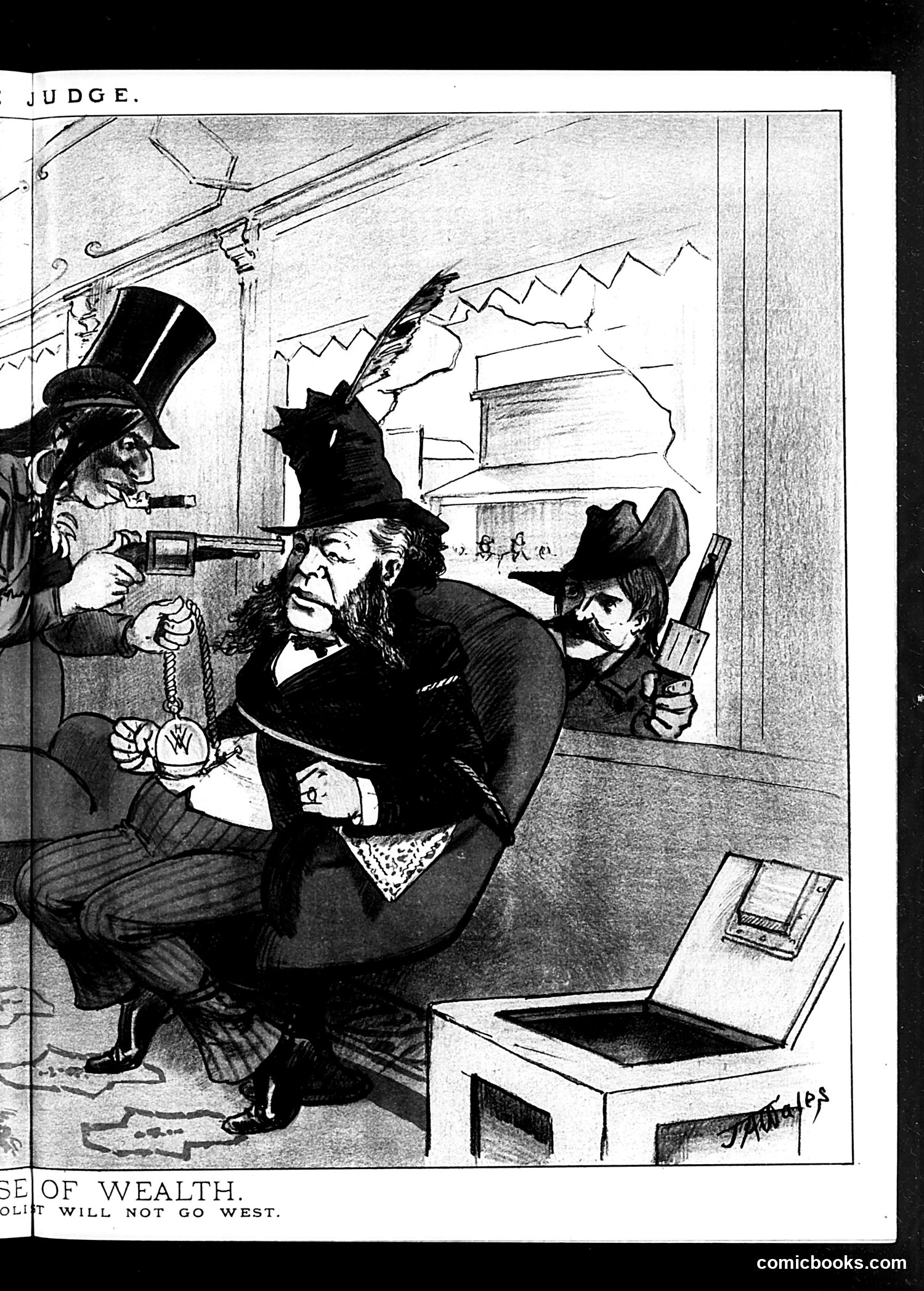
This Judge magazine cartoon satirizes wealth inequality and westward expansion. The central figure—a wealthy man in top hat clutching a money bag—is being forcibly "examined" or "judged" by officials with telescopes and weapons, suggesting scrutiny of the rich. The title fragment "WEALTH" combined with "WILL NOT GO WEST" references the era's debates over whether industrial fortunes would relocate westward or remain concentrated in eastern cities. The cartoon appears to mock wealthy elites' resistance to sharing resources or relocating capital to developing western regions. The exaggerated caricature and armed officials suggest satirical criticism of either the wealthy's power or government attempts to regulate them—the specific critique remains unclear without the complete caption.
This page from *Judge* magazine presents a satirical three-act play criticizing the prison reform system and convict rehabilitation programs of the era. **The Setup:** A detective named Alert investigates a charitable organization run by Manager Jackson that supposedly reforms ex-convicts. The organization places Jackson—an ex-convict with a history of violence—in respectable jobs. **The Satire:** The joke centers on the naive idealism of well-meaning reformers. Despite Jackson's dangerous background, the Manager keeps promoting him based solely on his work performance, dismissing the detective's warnings. The punchline suggests this misplaced faith in rehabilitation is dangerously foolish. **Social Context:** This reflects genuine late-19th-century debates over whether convicts could genuinely reform or whether crime was inherent. *Judge* satirizes both the overly optimistic reformers and the system's failure to prevent recidivism. The play mocks Progressive-era criminal justice initiatives as impractical idealism that endangers the public.
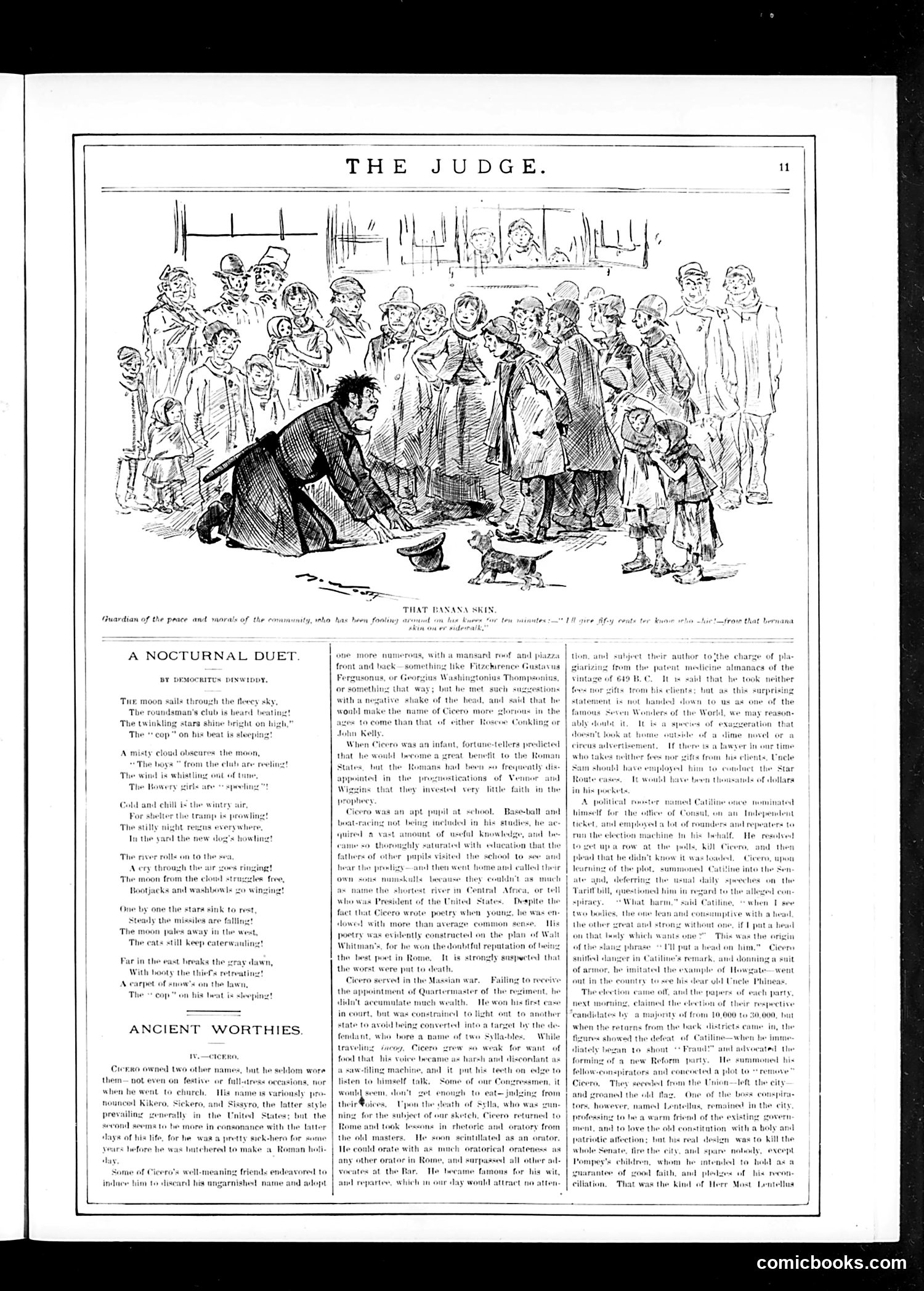
## Main Cartoon: "That Banana Skin" The large central illustration depicts a man (appearing to be a politician or public figure) who has slipped on a banana peel, sprawling before a crowd of onlookers. The caption suggests this is satirizing a political figure's sudden fall from grace or public embarrassment—likely referencing a specific scandal or misstep by someone in power during Judge magazine's era. ## Text Content The page contains two literary pieces: "A Nocturnal Duet" (a poem about cats fighting at night, with a policeman unable to stop them) and "Ancient Worthies" (prose discussing historical Roman and Greek figures and their legacies). ## Overall Meaning The banana-skin cartoon uses slapstick visual humor to mock political vulnerability and public failure. The surrounding literary content appears unrelated—typical of Judge's mixed satirical format combining visual and written humor on single pages.
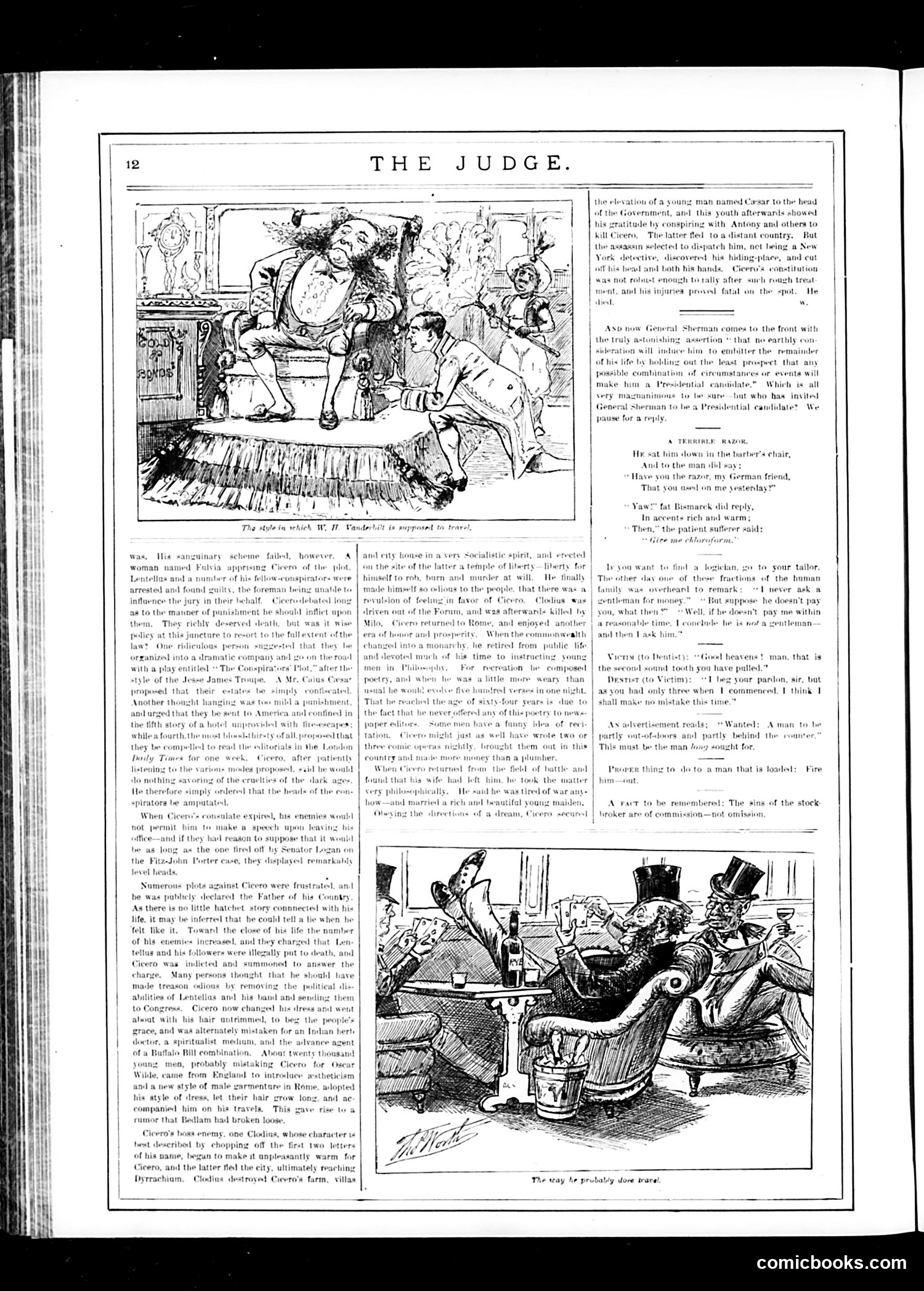
This page satirizes **Caesar Civis**, an obscure political figure, through a historical parallel to Roman dictator Julius Caesar. The text recounts how Civis, a would-be presidential candidate, scheme failed when he was arrested for crimes including murder and extortion. The top cartoon depicts Civis being confronted by authorities or opponents—the caricature shows a rotund, nervous man caught in his machinations. The satire's point: Civis fancied himself a powerful political leader (like Caesar), but was merely a common criminal whose grandiose ambitions collapsed under scrutiny. The bottom cartoon appears to show the aftermath or consequences of his exposed schemes. **The joke for 1880s readers**: Comparing a petty American political schemer to Rome's most famous dictator mocks his pretensions. The piece ridicules both Civis's delusions of grandeur and—implicitly—any candidate harboring similarly dangerous imperial ambitions in American politics. Without clearer OCR text, specific details remain uncertain, but the theme is clear: exposing criminal hypocrisy in political aspirants.
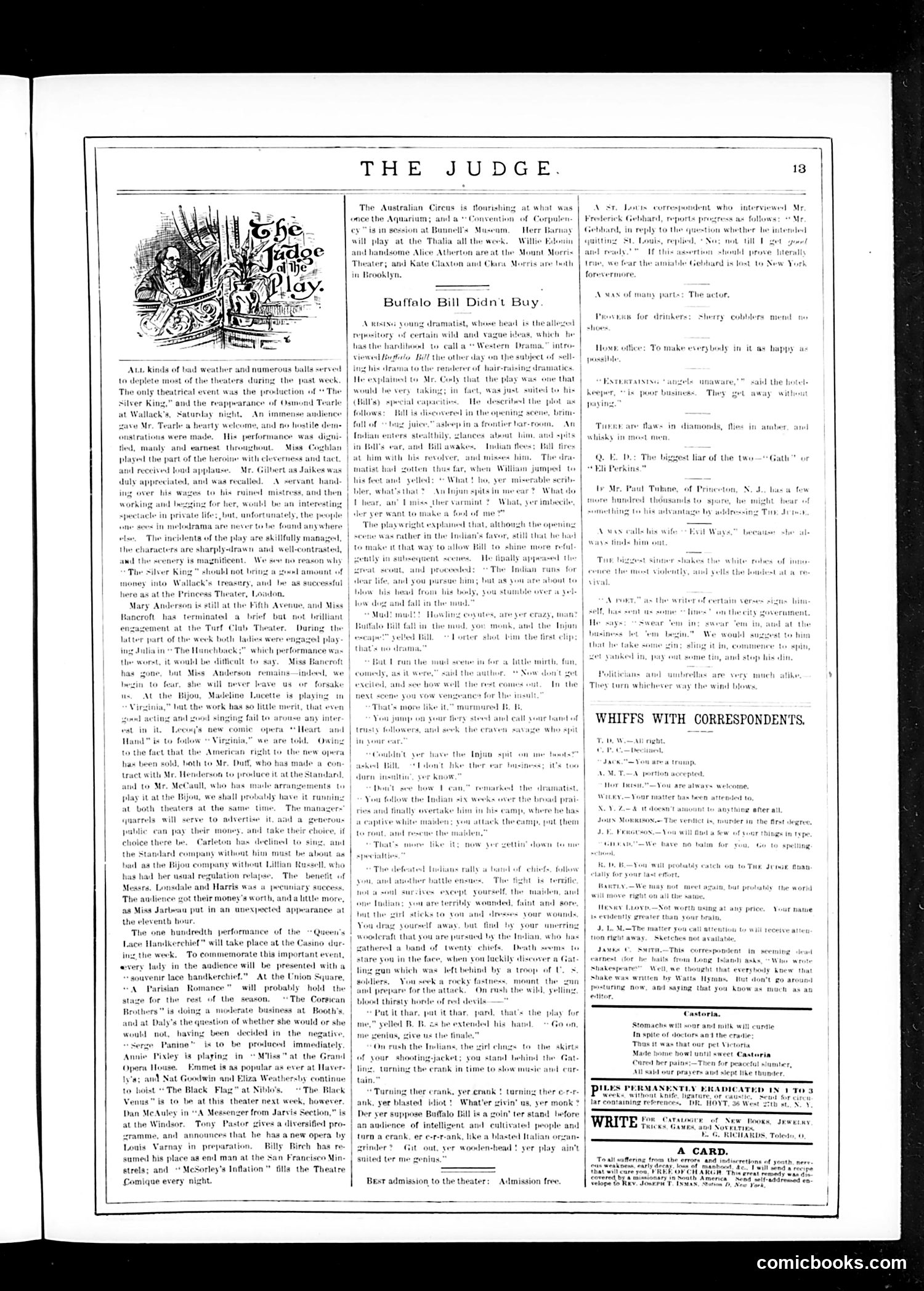
This page from Judge magazine contains theatrical reviews and satirical commentary on New York entertainment circa the 1880s. **Main Content:** The page primarily discusses a young playwright who pitched a "Western Drama" to Buffalo Bill (the famous Wild West showman). The satirical point: the playwright's absurd plot—involving Bill in a frontier bar-room where "an Indian spits in [Bill's] ear"—is so ridiculous that Bill rejects it outright, despite the writer's insistence it suits Bill's "special capacities." **The Satire:** The humor lies in mocking both the playwright's terrible dramatic instincts and the commercialization of Buffalo Bill's frontier image. The implication is that even Buffalo Bill—a man happy to profit from Wild West spectacle—has standards and won't appear in such drivel. **Additional Content:** The page also reviews recent theatrical performances, noting productions at various theaters and critiquing acting quality. A "Whiffs with Correspondents" section provides brief reader responses to earlier pieces. **Context for Modern Readers:** Buffalo Bill was a celebrity impresario; theatrical productions were major entertainment; and Judge used theatrical criticism as a vehicle for social commentary.
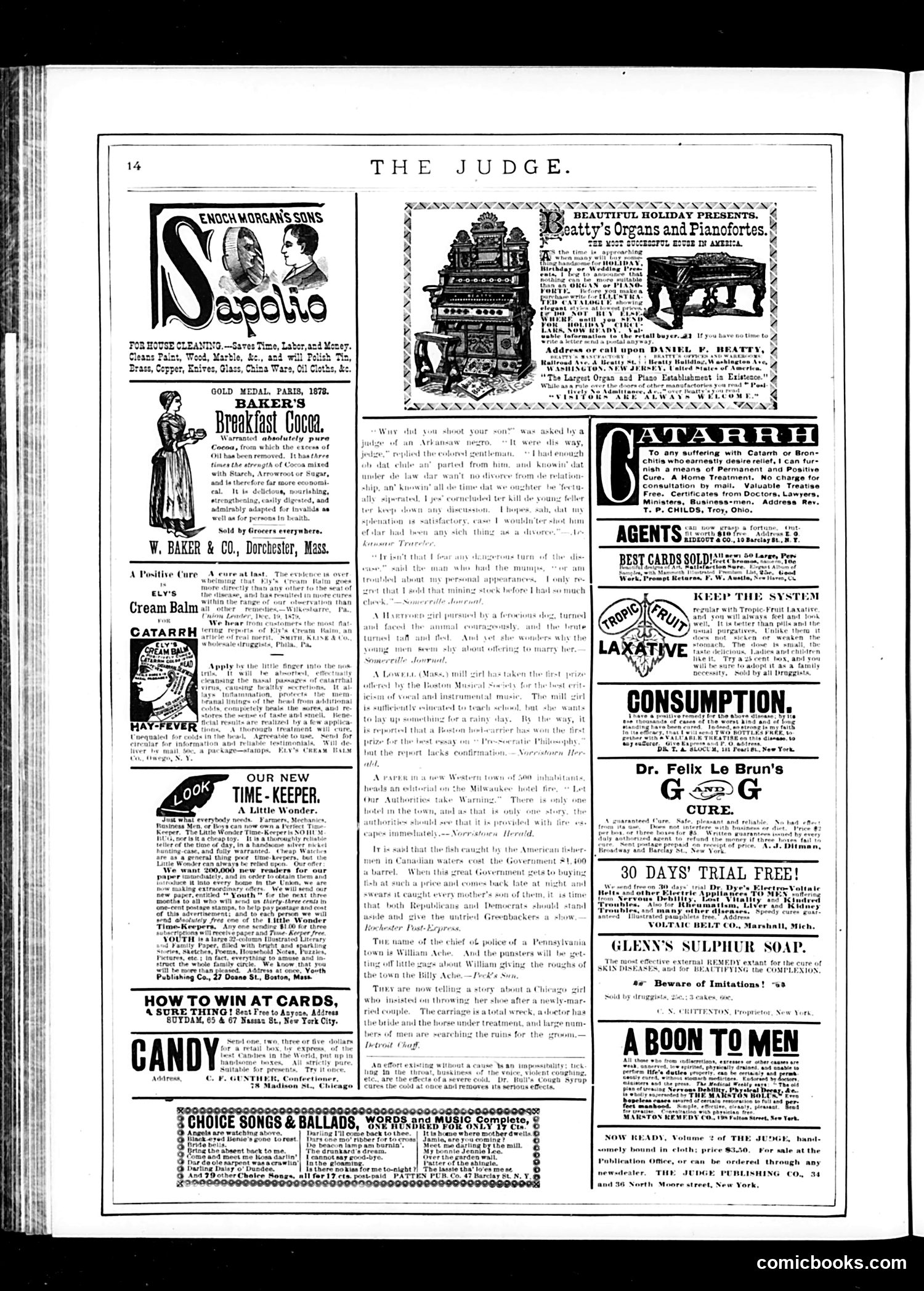
This is primarily an **advertising page** rather than a satirical cartoon page. The layout consists almost entirely of product advertisements typical of late 19th-century magazines. Notable ads include: - **Sapolio soap** (Enoch Morgan's Sons) - a major advertiser of the era - **Baker's Breakfast Cocoa** - featuring an dialect-heavy testimonial from an Arkansas resident, reflecting period advertising conventions - **Beatty's Organs and Pianofortes** - holiday gift marketing - Patent medicines like **Catarrh cure**, **Laxative**, and **Dr. Felix Le Brun's G and G** remedy - A "How to Win at Cards" gambling scheme - Song/ballad collections The small text snippets visible discuss mundane topics: a divorce case anecdote, a fire story, police chief appointments. **What's notable for modern readers:** The casual use of heavy dialect in advertising, the prominence of dubious patent medicines (common before FDA regulation), and the integration of get-rich-quick schemes in respectable publications. This reflects Judge's dual nature as both satire and conventional Victorian-era advertising vehicle.
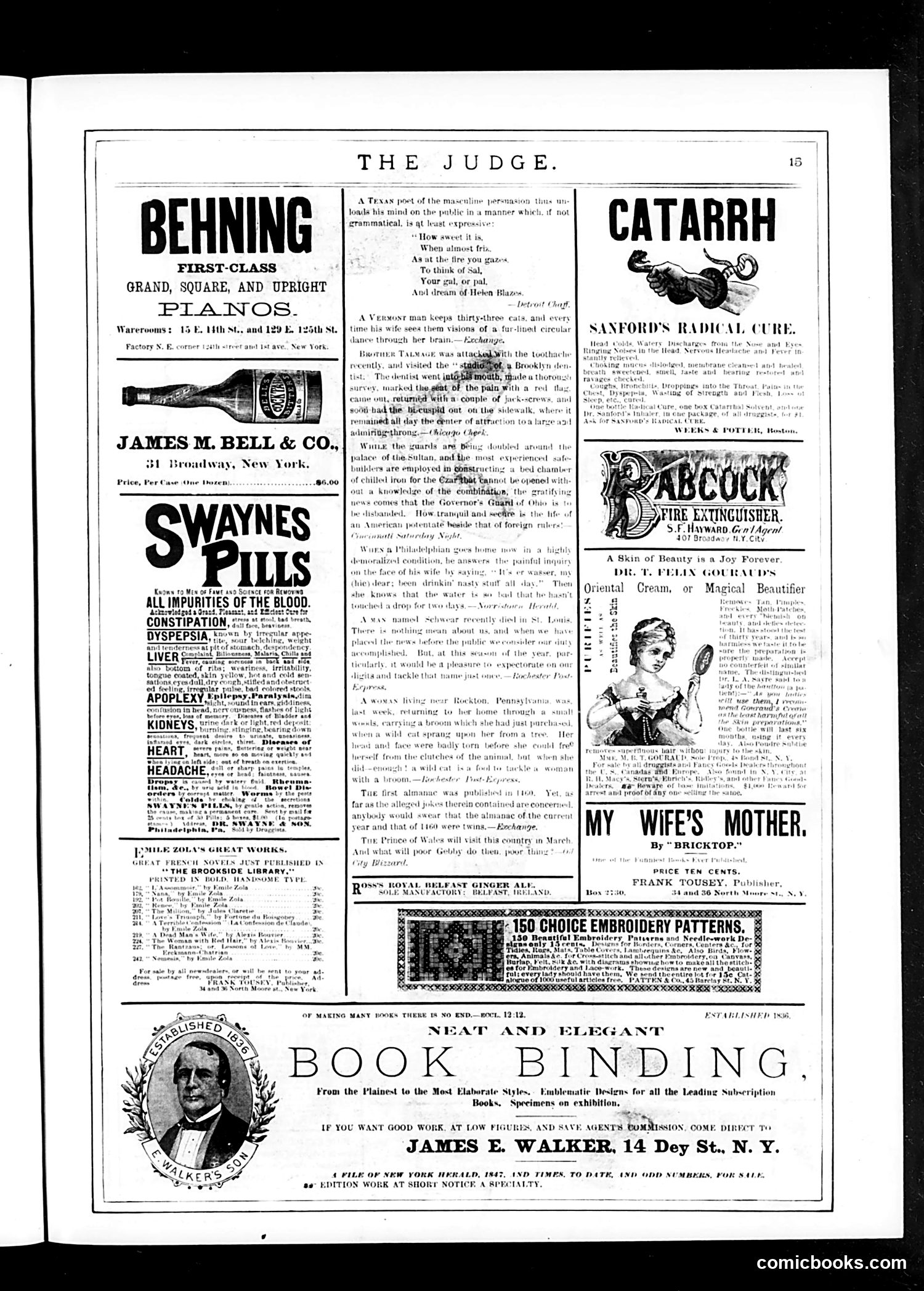
This is primarily an **advertising page** from Judge magazine, with minimal editorial cartoon content. The page features typical late 19th-century patent medicine and consumer goods advertisements (pianos, pills for blood purification, beauty cream), interspersed with brief humorous anecdotes rather than sustained political satire. The few comic items visible include: - A joke about a Texas poet's sentimental musings - A Vermont man tormented by his wife's thirty cats - Anecdotes about accidental injuries and domestic mishaps **Key context for modern readers:** This represents Judge's business model—advertising revenue subsidized satirical content. The "remedies" advertised (Swayne's Pills for constipation, Gouraud's Oriental Cream for skin bleaching) reflect period attitudes toward health and beauty that modern readers would find questionable. The brief jokes rely on domestic and provincial humor typical of the era, lacking the pointed political commentary one might expect from a satirical publication.
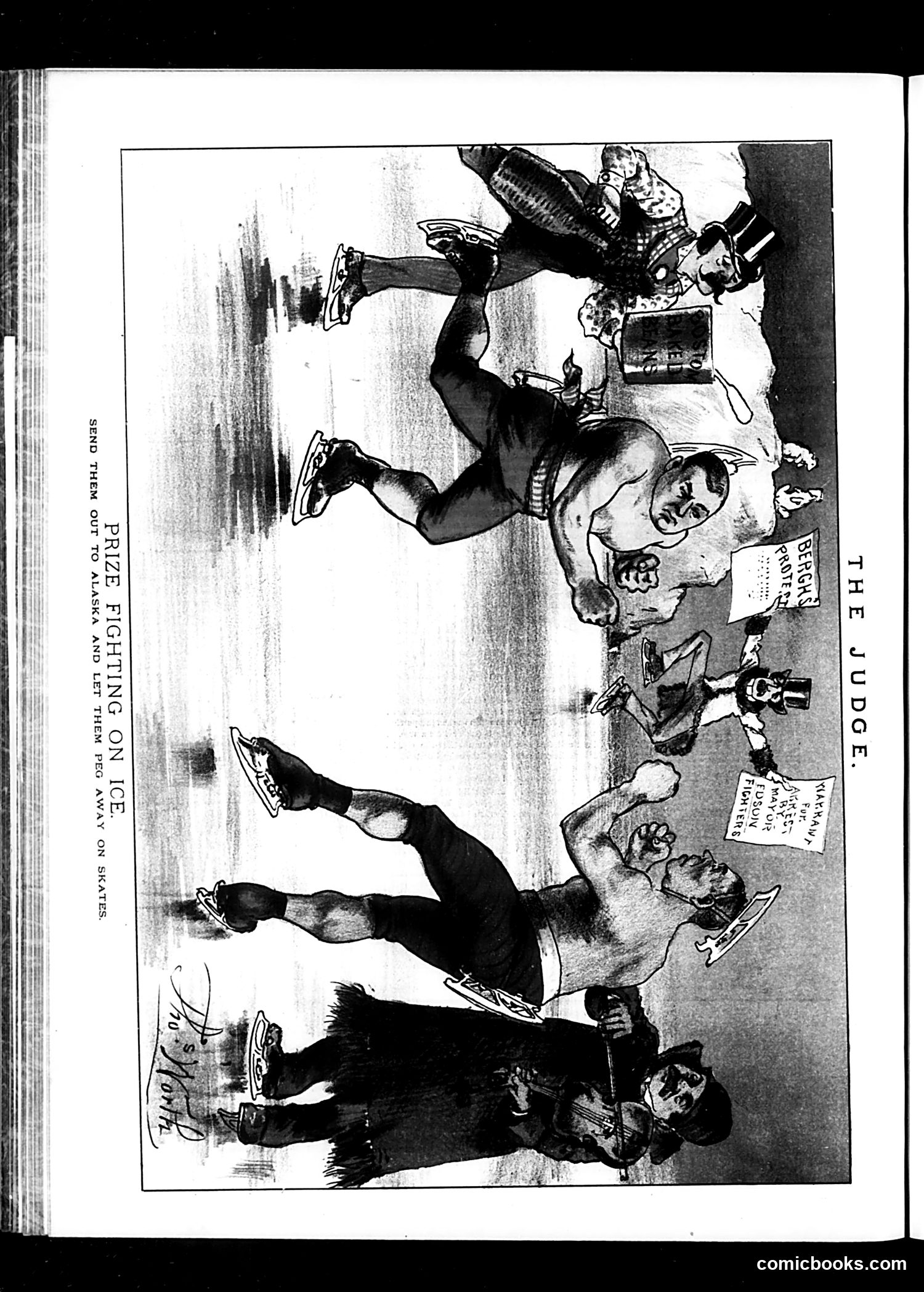
This cartoon satirizes prize fighting by depicting boxers engaged in combat on ice skates. The title "Prize Fighting on Ice" and subtitle suggest a satirical proposal to send boxers "out to Alaska" to fight on skates instead of in traditional rings. The joke appears to mock both the sport of boxing and possibly Alaska's remote, harsh conditions. By placing skilled fighters in an absurd environment requiring skates, the cartoonist ridicules the violence and spectacle of boxing while suggesting exile to an undesirable location. The figures appear to be generic boxers rather than specific historical fighters, making this a broader commentary on the sport itself rather than particular individuals. The humor relies on the incongruity of professional fighters attempting their sport under physically impossible conditions.