
Pulp Fiction, 1913 · page 8 of 36
Cheer Boys Cheer: The Boys' Journal, No. 62 — page 8: what you’re looking at
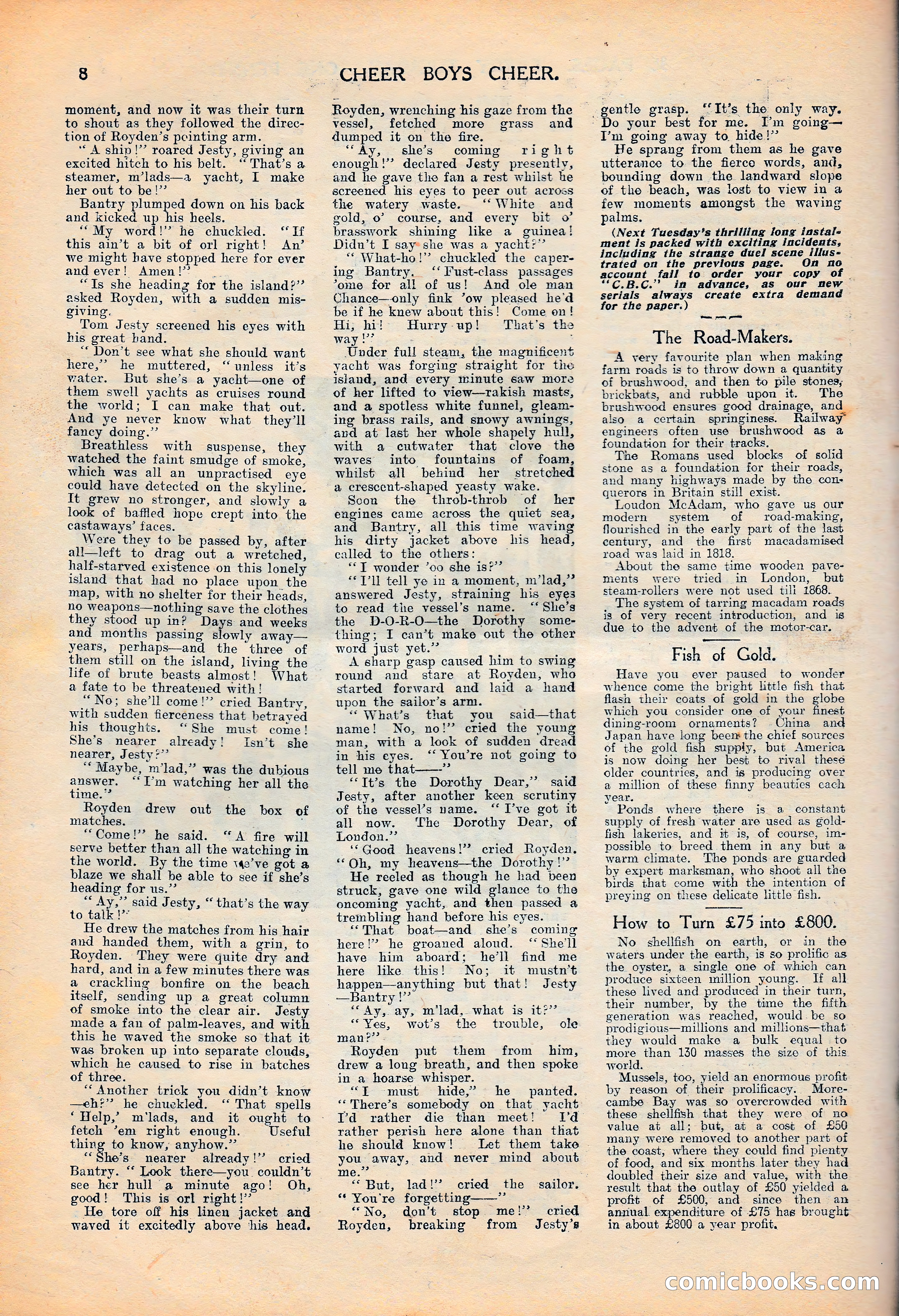
A restored page from Pulp Fiction, 1913. Page through the whole issue in the reader above.
📄 Transcribed text from this page (OCR, searchable)
Machine-transcribed from the original scan — historical spelling and the odd misread are preserved.
8 moment, and now it was their turn to shout as they followed the direc- tion of Royden’s pcinting arm. “A ship |’? roared Jesty, giving an excited hitch to his belt. “ That’s a steamer, m’lads—a yacht, I make her out to be!”’ Bantry plumped down on his back and kicked up his heels. ““My word!” he chuckled. “If this ain’t a bit of orl right! An’ we might have stopped here for ever and ever! Amen!” _ “Ts she heading for the island?’ asked Royden, with a sudden mis- giving. : Tom Jesty screened his eyes with his great band. “Don’t see what she should want here,” he muttered, “unless it’s water. But she’s a yacht—one of them swell yachts as cruises round the world; I can make that out. And ye never know what they’ll fancy doing.”’ Breathless with suspense, they watched the faint smudge of smoke, which was all an unpractised eye could have detected on the skyline. It grew no stronger, and slowly a look of baffled hope crept into the castaways’ faces. Were they to be passed by, after all—left to drag out a wretched, half-starved existence on this lonely island that had no plaee upon the map, with no shelter for their heads, no weapons—nothing save the clothes they stood up in? Days and weeks and months passing slowly away— years, perhaps—and the three of them still on the island, living the life of brute beasts almost! What a fate to be threatened with! “No; she’ll come!” cried Bantry, with sudden fierceness that betraved his thoughts. “She must come! She’s nearer already! Isn’t she nearer, Jesty?”’ “Maybe, m’lad,” was the dubious answer. “I’m watching her all the time.” Royden drew out the box of matches. : “Come!” he said. “A fire will serve better than all the watching in the world. By the time \4s’ve got a blaze we shall be able to see if she’s heading for us.’ “Ay,” said Jesty, “that’s the way to talk |?" He drew the matches from his hair and handed them, with a grin, to Royden. They were quite dry and hard, and in a few minutes there was a crackling bonfire on the beach itself, sending up a great column of smoke into the clear air. Jesty made a fan of palm-leaves, and with this he waved the smoke so that it was broken up into separate clouds, which he caused to rise in batches of three. “Another trick you didn’t know —eh?” he chuekled. “ That spells ‘Help,’ m'lads, and it ought to fetch ’em right enough. Useful thing to know, anyhow.” ““She’s nearer already!” cried Bantry. “ Look there—you couldn’t see her hull a minute ago! Oh, good! This is orl right!” He tore off his linen jacket and — waved it excitedly above this head. _ CHEER BOYS CHEER. Royden, wrenching his gaze from the vessel, fetched more grass and dumped it on the fire. “Ay, she’s coming right enough!’’ declared Jesty presently, and he gave the fan a rest whilst he screened his eyes to peer out across the watery waste. ‘White and gold, o course. and every bit o brasswork shining like a guinea! Didn’t I say she was a yacht?” “ What-ho!” chuckled the caper- ing Bantry. ‘‘TFust-class passages “ome for all of us! And ole man Chance—only fink ’ow pleased he'd be if he knew about this! Come en! Hi, hi! Hurry-up! That’s the way !”? : Under full steam, the magnificent yacht was forging straight for the island, and every minute saw more of her lifted to view—rakish masts, and a spotless white funnel, gleam- ing brass rails, and snowy awnings, and at last her whole shapely hull, with a cutwater that clove the waves into fountains of foam, whilst all behind her stretched a crescent-shaped yeasty wake. Scon the throb-throb of her engines came across the quiet sea, and Bantry, all this time waving his dirty jacket above his head, called to the others: : ““T wonder ’oo she is?’’ “*T’ll tell ye in a moment, m’lad,” answered Jesty, straining his eyes to read the vessel’s name. “‘ She’s the D-O-R-O—the Dorothy some- thing; I can’t make out the other word just yet.” A sharp gasp caused him to swing round and stare at Royden, who started forward and laid a hand upon the sailor’s arm. “What's that you said—that name! No, no!” cried the young man, with a look of sudden dread in his eyes. ‘‘ You're not going to tell me that——-” ‘It’s the Dorothy Dear,’ said Jesty, after another keen scrutiny of the vessel’s name. “I’ve got it all now. ‘The Dorothy Dear, of London.” ‘*Good heavens!’ cried Royden. ‘Oh, my heavens—the Dorothy!” He reeled as though he had been struck, gave one wild glance to the oncoming yacht, and then passed a trembling hand before his eyes. “That boat—and she’s coming here!” he groaned aloud. “She'll have him aboard; he’ll find me here like this! No; it mustn't happen—anything but that! Jesty —Bantry !’’ ““Ay, ay, m’lad, what is it?’’ “Yes, wot’s the trouble, ole man?”’. Royden put them from him, drew a long breath, and then spoke in a hoarse whisper. “JT -must hide,’ he panted. ‘‘There’s somebody on that yacht I'd rather die than meet! Id rather perish here alone than that he should know! Let them take you away, aud never mind about m 39 *© You're forgetting——” “No, don’t stop. me!’ cried Royden, breaking from Jesty’s ‘Do your best for me. e. : “ But, lad!’? cried the sailor. gentle grasp. ‘It’s the only way. I’m going— I’m going away to hide!” He sprang from them as he gave utterance to the fierce words, and, bounding down the. landward slope of the beach, was lost to view in a few moments amongst the waving palms. : : (Next Tuesday's thrilling long inastal= ment is packed with exciting incideats, incliding the strange duel scene illus- trated on the previous page. On no account fail to order your copy of — 5 in advaice, as our new serials always create extra demand for the paper.) — pa The Road-Makers. A yery favourite plan when making farm roads is to throw down a quantity of brushwood, and then to pile stones; brickbats, and rubble upon it. The brushwood ensures good drainage, and also a certain springiness. Railway” engineers often use brushwood as a foundation for their tracks. The Romans used blocks of solid stone as a foundation for their roads, and many highways made by the con- querors in Britain still exist. Loudon McAdam, who gave us our modern system of road-making, flourished in the early part of the last century, and the first macadamised road was laid in 1818. About the same time wooden pave- ments were tried in London, but steam-rollers were not used tili 1868. The system of tarring macadam roads is of very recent introduction, and is due to the advent of the motor-car. Fish of Gold. Have you ever paused to wonder whence come the bright little fish that flash their coats of gold in the globe which you consider one of your finest dining-room ornaments? .China and Japan have long been the chief sources of the gold fish supply, but America is now doing her best to rival these older countries, and is producing over a million of these finny beauties cach year. Ponds where there is a constant supply of fresh water are used as gold- fish lakeries, and it is, of course, im- possible to breed them in any but a warm climate. The ponds are guarded by expert marksman, who shoot all the birds that come with the intention of preying on these delicate little fish. Howto Lua S75 inie £200. No shellfish on earth, or in the waters under the earth, is so prolific as the oyster, a single one of which can produce sixteen million young. If all these lived and produced in their turn, their number, by the time the fifth generation was reached, would. be so prodigious—millions and millions—that they would make a bulk equal to more than 130 masses the size of this world. - z Mussels, too, yield an enormous profit by reason of their prolificacy.. More- cambe Bay was so overcrowded with these shellfish that they were of no value at all; but, at a cost of £50 many were removed to another part of the coast, where they could find plenty of food, and six months later they had doubled their size and value, with the result that the outlay of £50 yielded a profit of £500, and since then an annual. expenditure of £75 has brought in about £800 a year profit, . Taran Za bb Yo) [re 2 Are (GO) IG O0)() S OVS) m