
Pulp Fiction, 1913 · page 7 of 36
Cheer Boys Cheer: The Boys' Journal, No. 62 — page 7: what you’re looking at
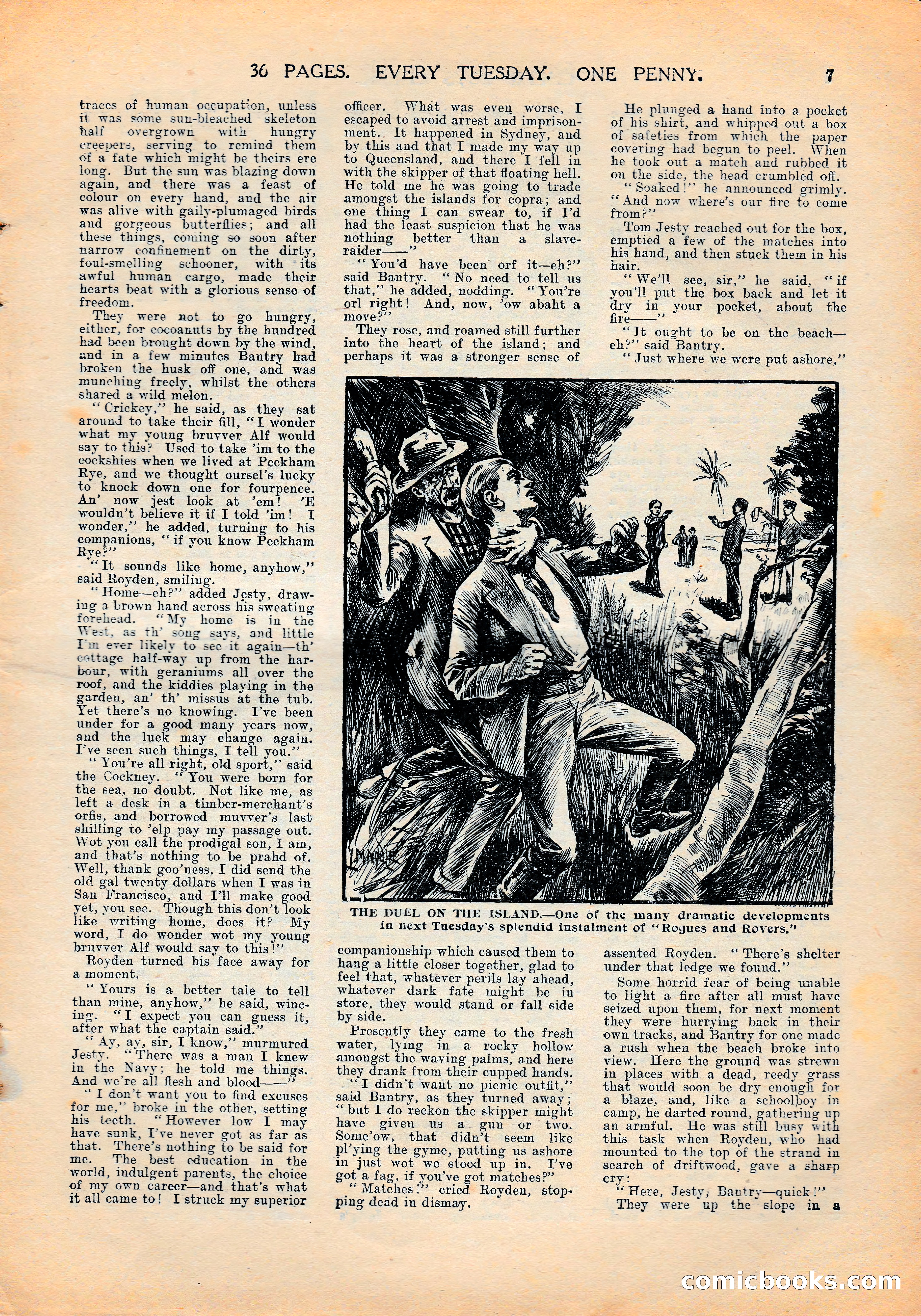
A restored page from Pulp Fiction, 1913. Page through the whole issue in the reader above.
📄 Transcribed text from this page (OCR, searchable)
Machine-transcribed from the original scan — historical spelling and the odd misread are preserved.
36 PAGES. traces of human occupation, unless it was some suu-bleached skeleton half overgrown with hungry creepers, serving to remind them of a fate which might be theirs ere long. But the sun was blazing down again, and there was a feast of colour on every hand, and the air was alive with gaily-plumaged birds and gorgeous butterflies; and all these things, coming so soon after narrow confinement on the dirty, foul-smelling schooner, with — its awful human cargo, made their hearts beat with a glorious sense of freedom. They were not to go hungry, either, for cocoanuts by the hundred had been brought down by the wind, and in a few minutes Bantry had broken the husk off one, and was munching freely, whilst the others shared a wild melon. “Crickey,’’? he said, as they sat around to take their fill, “I wonder what my young bruyver Alf would say to this? Used to take ’im to the cockshies when we lived at Peckham Rye, and we thought oursel’s lucky to knock down one for fourpence. An’ now jest look at ’em! ’H wouldn’t believe it if I told ’im! I wonder,’’ he added, turning to his companions, “if you know Peckham Rye?”’ “It sounds like home, anyhow,” said Royden, smiling. “ Home—eh?” added Jesty, draw- ing a brown hand across his sweating forehead. “My home is in the West, as th’ song says, and little I'm ever likely to see it again—th’ cottage half-way up from the har- bour, with geraniums all over the roof, and the kiddies playing in the garden, an’ th’ missus at the tub. Yet there’s no knowing. I’ve been under for a good many years now, and the luck may change again. I’ve seen such things, I tell you.” “You're all right, old sport,’’ said the Cockney. ‘*‘ You were born for the sea, no doubt. Not like me, as left a desk in a timber-merchant’s orfis, and borrowed muvver’s last shilling to ’elp pay my passage out. Wot you call the prodigal son, I am, and that’s nothing to be prahd of. Well, thank goo’ness, I did send the old gal twenty dollars when I was in San Francisco, and I’ll make good yet, you see. Though this don’t look like writing home, does it? My word, I do wonder wot my young bruvver Alf would say to this!” Royden turned his face away for a moment. “Yours is a better tale to tell than mine, anyhow,” he said, winc- ing. “TI expect you can guess it, after what the captain said.” “ Ay, ay, sir, I know,’”? murmured Jesty. “There was a man I knew in the Navy; he told me things. And we're all flesh and blood——”’ “T don’t want you to find excuses for me,” broke in the other, setting his teeth. “However low I may have sunk, I’ve never got as far as that. There’s nothing to be said for me. The best education in the world, indulgent parents, the choice of my cwn career—and that’s what it all came to! I struck my superior officer. What was even worse, I escaped to avoid arrest and imprison- ment.. It happened in Sydney, and by this and that I made my way up to Queensland, and there I fell in with the skipper of that floating hell. He told me he was going to trade amongst the islands for copra; and one thing I can swear to, if I'd had the least suspicion that he was nothing better than a slave- raider——”’ ““You’d have been orf it—eh?’ said Bantry. ‘No need to tell us that,” he added, nodding. “ You’re orl right! And, now, ’ow abaht a move?” They rose, and roamed still further into the heart of the island; and perhaps it was a stronger sense of . THE DUEL ON THE ISLAND.—One of the many dramatic developments EVERY TUESDAY. ONE PENNY. q He plunged a hand into a pocket of his shirt, and whipped out a box of safeties from which the paper covering had begun to peel. When he took out a match and rubbed it on the side, the head crumbled off, ““Soaked!’’ he announced grimly. “And now where's our fire to come from?” Tom Jesty reached out for the box, emptied a few of the matches into his hand, and then stuck them in his hair. “We'll see, sir,’ he said, ‘if you'll put the box back and let it dry in your pocket, about the fire——” “Tt ought to be on the beach— eh?” said Bantry. “* Just where we were put ashore,” in next Tuesday’s splendid instalment of ‘‘Rogues and Rovers,” companionship which caused them to hang a little closer together, glad to feel that, whatever perils lay ahead, whatever dark fate might be in store, they would stand or fall side by side. Presently they came to the fresh water, lying in a rocky hollow amongst the waving palms, and here they drank from their cupped hands. ““T didn’t want no picnic outfit,” said Bantry, as they turned away; “but I do reckon the skipper might have given us a gun or two. Some’ow, that didn’t seem like pl’ying the gyme, putting us ashore in just wot we stocd up in. I’ve got a fag, if you’ve got matches?” “ Matches!’ cried Royden, stop- ping dead in dismay. assented Royden. ‘“ There’s shelter under that ledge we found.” Some horrid fear of being unable to light a fire after all must have seized upon them, for next moment they were hurrying back in their own tracks, and Bantry for one made a rush when the beach broke into view. Here the ground was strewn in places with a dead, reedy grass that would soon be dry enough for a blaze, and, like a schoolboy in camp, he darted round, gathering up an armful. He was still busy with this task when Royden, who had mounted to the top of the strand in search of driftwood, gave a sharp ery: “Here, Jesty; Bantry—aquick!” They were up the slope in a (A) Ss (A(arlan (el Avaya) <a (CONMIGO! KSn(CO)