
Pulp Fiction, 1920 · page 92 of 132
The Black Mask — page 92: what you’re looking at
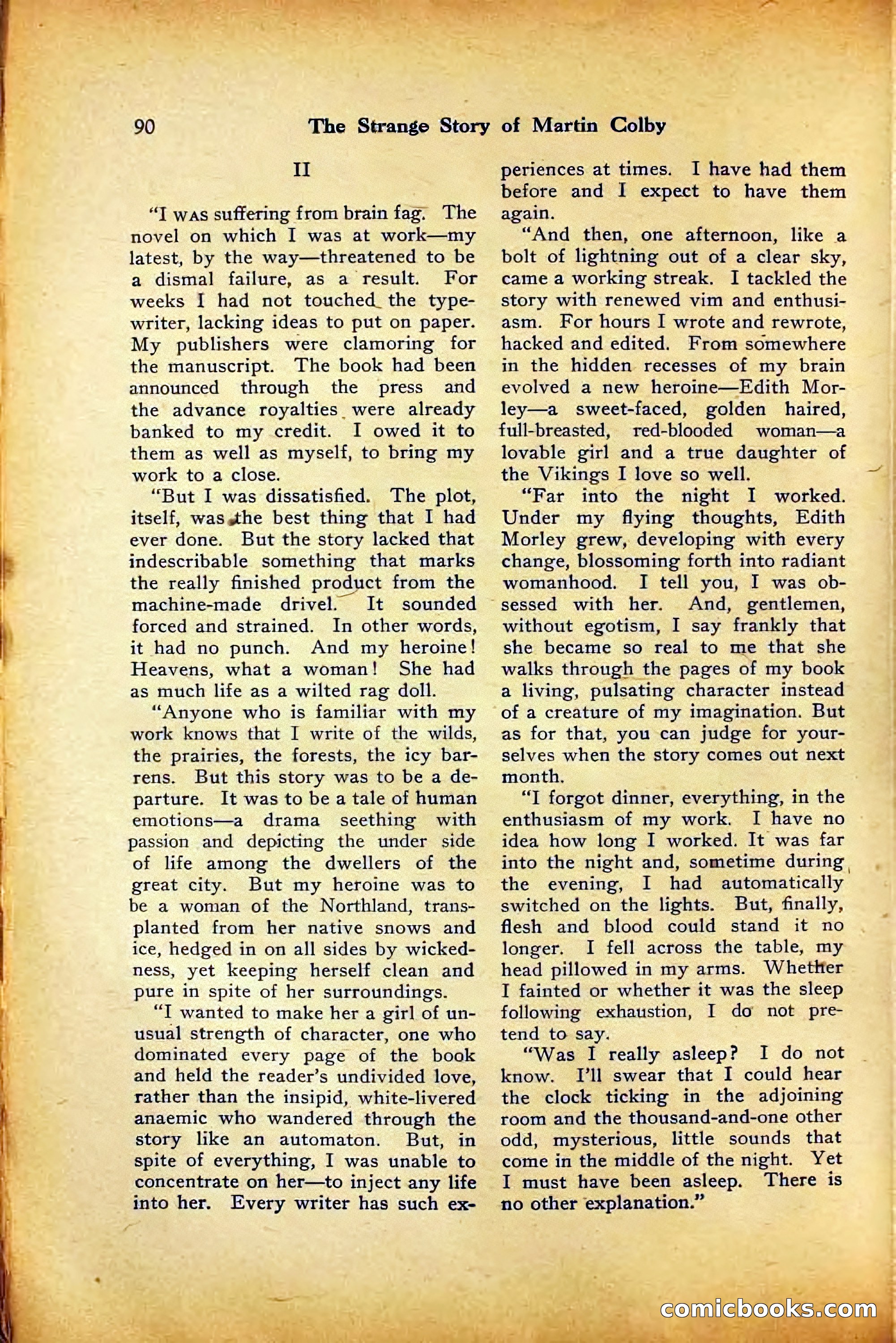
A restored page from Pulp Fiction, 1920. Page through the whole issue in the reader above.
📄 Transcribed text from this page (OCR, searchable)
Machine-transcribed from the original scan — historical spelling and the odd misread are preserved.
Pe 90 The Strange Story of Martin Colby II “T was suffering from brain fag. The novel on which I was at work—my latest, by the way—threatened to be a dismal failure, as a result. For weeks I had not touched the type- writer, lacking ideas to put on paper. My publishers were clamoring for the manuscript. The book had been announced through the press and the advance royalties were already banked to my credit. I owed it to them as well as myself, to bring my work to a close. “But I was dissatisfied. The plot, itself, wassthe best thing that I had ever done. But the story lacked that indescribable something that marks the really finished product from the machine-made drivel. It sounded forced and strained. In other words, it had no punch. And my heroine! Heavens, what a woman! She had as much life as a wilted rag doll. “Anyone who is familiar with my work knows that I write of the wilds, the prairies, the forests, the icy bar- rens. But this story was to be a de- parture. It was to be a tale of human emotions—a drama seething with passion and depicting the under side of life among the dwellers of the great city. But my heroine was to be a woman of the Northland, trans- planted from her native snows and ice, hedged in on all sides by wicked- ness, yet keeping herself clean and pure in spite of her surroundings. “I wanted to make her a girl of un- usual strength of character, one who dominated every page of the book and held the reader’s undivided love, rather than the insipid, white-livered anaemic who wandered through the story like an automaton. But, in spite of everything, I was unable to concentrate on her—to inject any life into her. Every writer has such ex- ~sessed with her. periences at times. I have had them before and I expect to have them again. “And then, one afternoon, like a bolt of lightning out of a clear sky, came a working streak. I tackled the story with renewed vim and enthusi- asm. For hours I wrote and rewrote, hacked and edited. From somewhere in the hidden recesses of my brain evolved a new heroine—Edith Mor- ley—a _ sweet-faced, golden haired, full-breasted, red-blooded woman—a lovable girl and a true daughter of the Vikings I love so well. “Far into the night I worked. Under my flying thoughts, Edith Morley grew, developing with every change, blossoming forth into radiant womanhood. I tell you, I was ob- And, gentlemen, without egotism, I say frankly that she became so real to me that she a living, pulsating character instead of a creature of my imagination. But as for that, you can judge for your- selves when the story comes out next month, : “T forgot dinner, everything, in the enthusiasm of my work. I have no idea how long I worked. It was far into the night and, sometime during, the evening, I had automatically switched on the lights. But, finally, flesh and blood could stand it no longer. I fell across the table, my head pillowed in my arms. Whettter I fainted or whether it was the sleep following exhaustion, I do not pre- tend to say. “Was I really asleep? I do not know. Ill swear that I could hear the clock ticking in the adjoining room and the thousand-and-one other odd, mysterious, little sounds that come in the middle of the night. Yet I must have been asleep. There is no other explanation.” =a a“ .