
Pulp Fiction, 1920 · page 9 of 132
The Black Mask — page 9: what you’re looking at
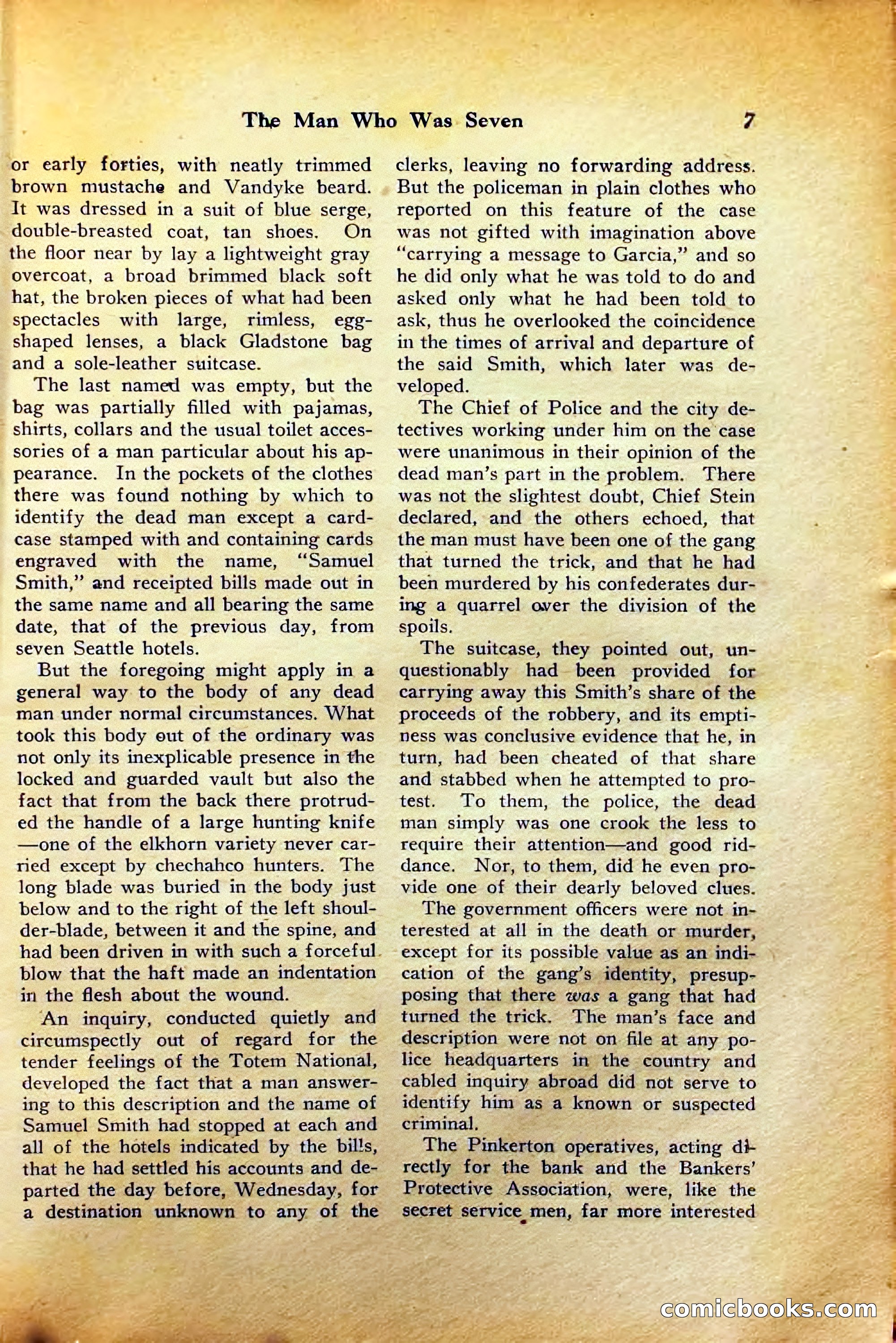
A restored page from Pulp Fiction, 1920. Page through the whole issue in the reader above.
📄 Transcribed text from this page (OCR, searchable)
Machine-transcribed from the original scan — historical spelling and the odd misread are preserved.
The Man Who Was Seven 7 ‘or early forties, with neatly trimmed brown mustache and Vandyke beard. It was dressed in a suit of blue serge, double-breasted coat, tan shoes. On the floor near by lay a lightweight gray overcoat, a broad brimmed black soft hat, the broken pieces of what had been spectacles with large, rimless, egg- shaped lenses, a black Gladstone bag and a sole-leather suitcase. The last named was empty, but the bag was partially filled with pajamas, _ shirts, collars and the usual toilet acces- sories of a man particular about his ap- pearance. In the pockets of the clothes there was found nothing by which to identify the dead man except a card- case stamped with and containing cards engraved with the name, ‘Samuel Smith,” and receipted bills made out in the same name and all bearing the same date, that of the previous day, from seven Seattle hotels. But the foregoing might apply in a general way to the body of any dead man under normal circumstances. What took this body out of the ordinary was not only its inexplicable presence in the locked and guarded vault but also the fact that from the back there protrud- ed the handle of a large hunting knife —one of the elkhorn variety never car- ried except by chechahco hunters. The long blade was buried in the body just below and to the right of the left shoul- der-blade, between it and the spine, and had been driven in with such a forceful. blow that the haft made an indentation in the flesh about the wound. An inquiry, conducted quietly and circumspectly out of regard for the tender feelings of the Totem National, developed the fact that a man answer- ing to this description and the name of Samuel Smith had stopped at each and all of the hote except for its possible value as indicated By the bills, o clerks, leaving no forwarding address. But the policeman in plain clothes who reported on this feature of the case was not gifted with imagination above “carrying a message to Garcia,” and so he did only what he was told to do and asked only what he had been told to ask, thus he overlooked the coincidence in the times of arrival and departure of the said Smith, which later was de- veloped. The Chief of Police and the city de- tectives working under him on the case were unanimous in their opinion of the dead man’s part in the problem. There was not the slightest doubt, Chief Stein declared, and the others echoed, that the man must have been one of the gang that turned the trick, and that he had been murdered by his confederates dur- ing a quarrel over the division of the spoils. The suitcases tiey pointed out, un- carrying away ae Smith’s share of the proceeds of the robbery, and its empti- ness was conclusive evidence that he, in turn, had been cheated of that share and stabbed when he attempted to pro- test. To them, the police, the dead man simply was one crook the less to require their attention—and good rid- dance. Nor, to them, did he even pro- vide one of their dearly beloved clues. The government officers were not in- terested at all in the death or Ee adess cation of the gang’s identity, p posing that there was a gang tt had turned the trick. The man’s face and description were not on file at any po- lice headquarters: in the | country and cabled inquiry Tok did not serve to Gace him : Te. et a, ere a ee \ 4 we PrvTe \