
Pulp Fiction, 1920 · page 20 of 132
The Black Mask — page 20: what you’re looking at
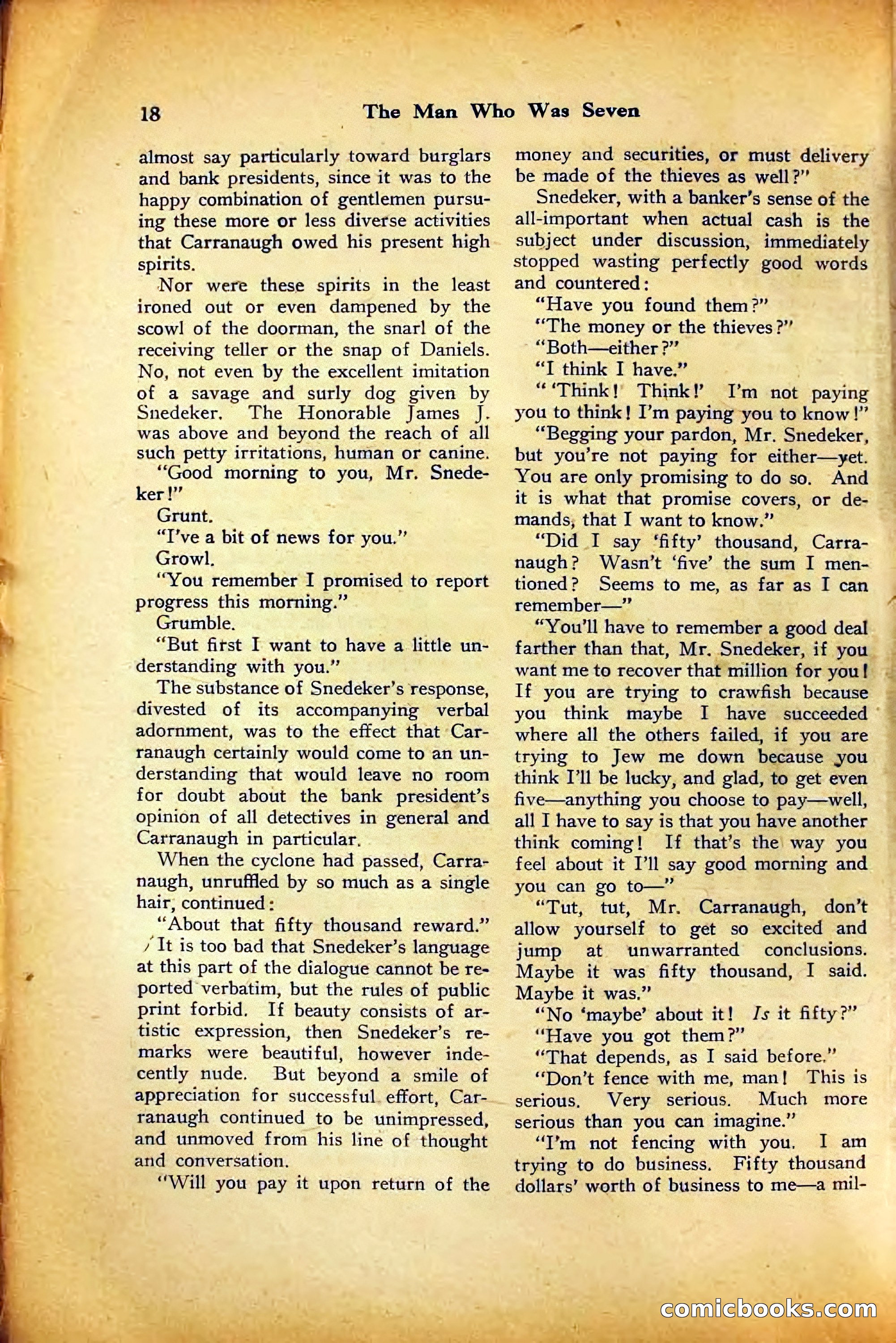
A restored page from Pulp Fiction, 1920. Page through the whole issue in the reader above.
📄 Transcribed text from this page (OCR, searchable)
Machine-transcribed from the original scan — historical spelling and the odd misread are preserved.
> oan —W — 4 ~ 18 The Man Who Was Seven almost say particularly toward burglars and bank presidents, since it was to the happy combination of gentlemen pursu- ing these more or less diverse activities that Carranaugh owed his present high spirits. Nor were these spirits in the least ironed out or even dampened by the scowl of the doorman, the snarl! of the receiving teller or the snap of Daniels. No, not even by the excellent imitation of a savage and surly dog given by Snedeker, The Honorable James J. was above and beyond the reach of all such petty irritations, human or canine. “Good morning to you, Mr. Snede- ker!” : Grunt. “T’ve a bit of news for you.” Growl. “You remember I promised to report progress this morning.” Grumble. “But first I want to have a little un- derstanding with you.” The substance of Snedeker’s response, divested of its accompanying verbal adornment, was to the effect that Car- ranaugh certainly would come to an un- derstanding that would leave no room for doubt about the bank president’s opinion of all detectives in general and Carranaugh in particular, When the cyclone had passed, Carra- naugh, unruffled by so much as a single hair, continued : “About that fifty thousand reward.” / It is too bad that Snedeker’s language at this part of the dialogue cannot be re- ported verbatim, but the rules of public print forbid. If beauty consists of ar- tistic expression, then Snedeker’s re- marks were beautiful, however inde- cently nude. But beyond a smile of appreciation for successful. effort, Car-_ ranaugh continued to be unimpressed, and unmoved from his line of thought and conversation. “Will you pay it upon return of the money and securities, or must delivery be made of the thieves as well?” Snedeker, with a banker’s sense of the all-important when actual cash is the subject under discussion, immediately stopped wasting perfectly good words and countered: aoe “Have you found them?” ‘The money or the thieves?” “Both—either ?” “TI think I have.” ; “Think! Think? I’m not paying you to think! I’m paying you to know!” “Begging your pardon, Mr. Snedeker, but you’re not paying for either—yet. — You are only promising to do so. And it is what that promise covers, or de- mands; that I want to know.” “Did I say ‘fifty’ thousand, Carra- naugh? Wasn’t ‘five’ the sum I men- tioned? Seems to me, as far as I can remember—” “You'll have to remember a good deal farther than that, Mr. Snedeker, if you want me to recover that million for you! If you are trying to crawfish because you think maybe I have succeeded © where all the others failed, if you are trying to Jew me down because you think T’ll be lucky, and glad, to get even five—anything you choose to pay—well, all I have to say is that you have another think coming! If that’s the way you feel about it I’ll say good morning and you can go to—” “Tut, tut, Mr. Carranaugh, don’t allow yourself to get so excited and jump at unwarranted conclusions. Maybe it was fifty thousand, I said. Maybe it was.” “No ‘maybe’ about it! Js it fifty?” “Have you got them?” “That depends, as I said before.” ‘Don’t fence with me, man! This is serious. Very serious. Much more serious than you can imagine.” “T’m not fencing with you. I am trying to do business. Fifty thousand dollars’ worth of business to me—a mil- oo : 5 4