
Pulp Fiction, 1879 · page 29 of 40
Beadle's New York Dime Library, No. 66 — page 29: what you’re looking at
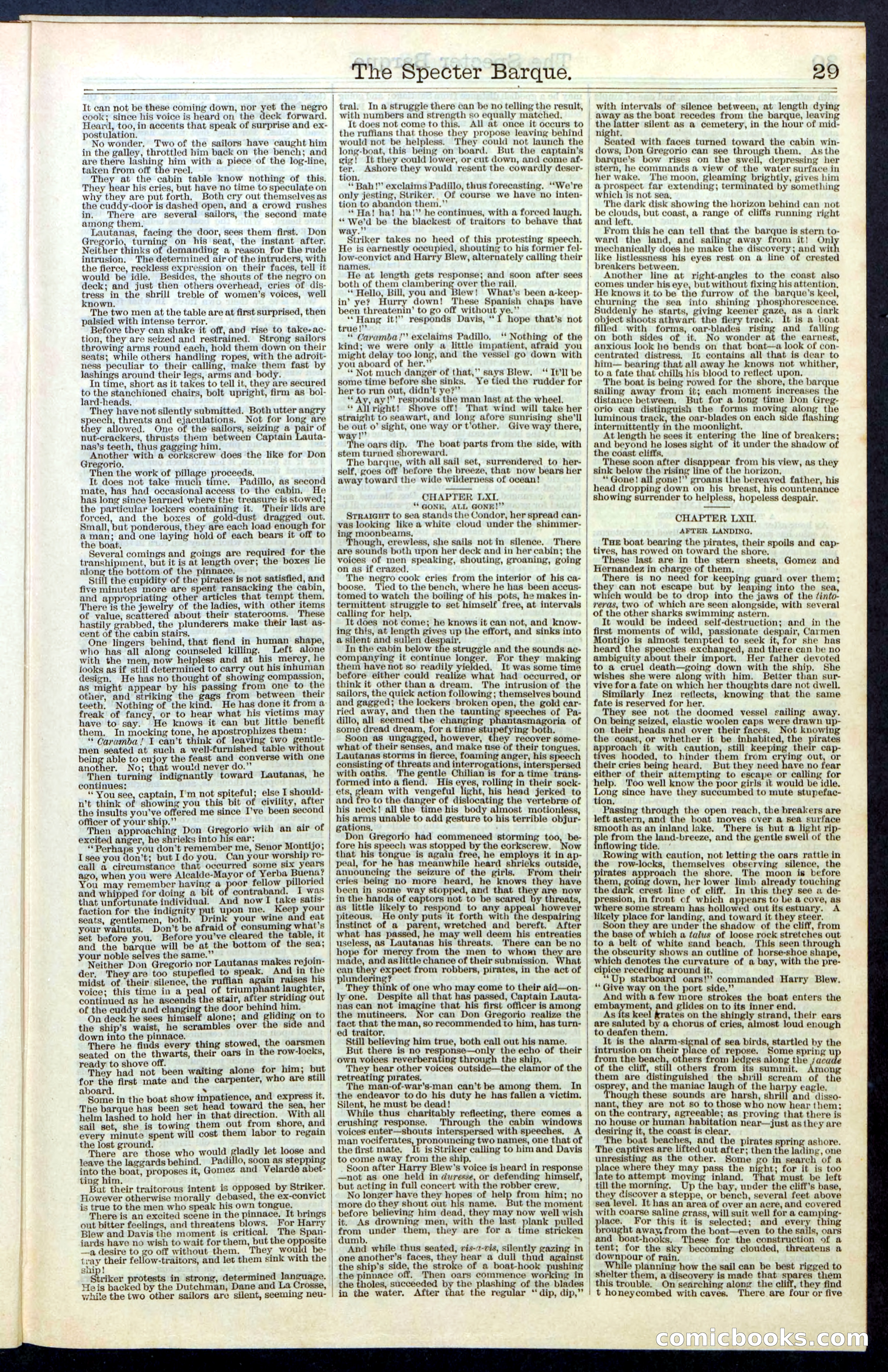
A restored page from Pulp Fiction, 1879. Page through the whole issue in the reader above.
📄 Transcribed text from this page (OCR, searchable)
Machine-transcribed from the original scan — historical spelling and the odd misread are preserved.
—. It can not be these coming down, nor et the negro | tral. The Specter Barque. In a struggle there can be no telling the result, cook; since his voice is heard on the deck forward. | with numbers and strength so equally matched. Heard, too, in accents that speak of surprise and ex- postulation. No wonder. Two of the sailors have caught him in the galley, throttled him back on the bench; and are there lashing him with a piece of the log-line, taken from off the reel. They at the cabin table know nothing of this. They hear his cries, but have no time to speculate on why they are put forth, Both cry out themselves as the cuddy-door is dashed open, and a crowd rushes in. There are several sailors, the second mate among them. Lautanas, facing the door, sees them first. Don Gregorio, turning on his seat, the instant after. Neither thinks of demandivg a reason for the rude intrusion, The determined air of the intruders, with the fierce, reckless expression on their faces, tell it would be idle. Besides, the shouts of the negro on deck; and just then others overhead, cries of dis- tress in the shrill treble of women’s voices, well known. The two men at the table are at first surprised, then palsied with intense terror. Before they can shake it off, and rise to takeeac- tion, they are seized and restrained. Strong sailors throwing arms round each, hold them down on their seats; while others handling ropes, with the adroit- ness peculiar to their calling, make them fast by Jashings around their legs, arms and body. In time, short as it takes to tell it, they are secured to the stanchioned chairs, bolt upright, firm as bol- lard-heads. They have not silently submitted. Both utter angry 9p threats and ejaculations. Not for long are 1ey allowed. One of the sailors, seizing a pair of nut-crackers, thrusts them between Captain Lauta- nas’s teeth, thus gagging him. ; Another with a corkscrew does the like for Don Gregorio. Then the work of pillage psa may It does not take much time. Padillo, as second mate, has had occasional access to the cabin, He has long since learned where the treasure is stowed; the particular lockers containing it. Their lids are forced, and the boxes of gold-dust dragged out. Small, but ponderous, they are each load enough for Geaumee and one laying hold of each bears it off to the boat. Several comings and goings are required for the transhipment, but it is at length over; the boxes lie along the bottom of the pinnace. Still the cupidity of the pirates is not satisfied, and five minutes more are spent ransacking the cabin, and appropriating other articles that tempt them. There is the jewelry of the ladies, with other items of value, scattered about their staterooms. These hastily grabbed, the plunderers make their last as- cent of the cabin stairs. One lingers behind, that fiend in human shape, who has all along counseled killing. Left alone with the men, now helpless and at his mercy, he (ooks as if still determined to carry out his inhuman design. He has no thought of showing compassion, as might ee by his passing from one to the other, and striking the gags from between their teeth. Nothing of the kind. He has done it from a freak of fancy, or to hear what his victims may have to say. He knows it can but little benefit them. In mocking tone, he apostrophizes them: ‘“ Caramba! I can't think of leaving two gentle- men seated at such a well-furnished table without being able to ones, the feast and converse with one another. No; that would never do. Then turning indignantly toward Lautanas, he continues: ‘You see, captain, I'm not spiteful; else I should- n’t think of showing you this bit of civility, after the insults bg ea offered me since I’ve been second officer of your ship.’ . Then aineddchtay? Don Gregorio with an air of excited anger, he shrieks into his ear: ‘Perhaps you don't remember me, Senor Montijo; I see you Fonts but Ido you, Can your worship re- call a circumstance that occurred some six years ayo, when you were Alcalde-Mayor of Yerba Buena? You may remember having a poor fellow pilloried and whipped for doing a bit o contraband. I was that unfortunate individual. And now I take satis- faction for the indignity put upon me. Keep your seats, gentlemen, both. Drink your wine and ea your walnuts, Don't be afraid o consuming what's set before you, Before you've cleared the table, it and the barque will be at the bottom of the sea; our noble selves the same. Neither Don Gregorio nor Lautanas makes rejoin- der. They are too stupefied to speak. And in = midst of ‘their silence, the ruffian in raises h voice; this time in a peal of triump ant laughter, continued as he ascends the stair, after striding out of the cuddy and clanging the door behind him. On deck he sees himself alone; and gliding on to the ship’s waist, he scrambles over the side and down into the pinnace. There he ands every thing stowed, the oarsmen seated on the prvi their oars in the row-locks, to shove off. ret ay had not been waiting alone for him; but for the first mate and the carpenter, who are still aboard, ‘ 4 Some in the boat show impatience, and express it. The barque has been set head toward the sea, her helm lashed to hold her in that direction. With all sail set, she is towing them out from shore, and every minute spent will cost them labor to regain the lost ground. There “are those who would gladly let loose and leave the laggards behind. Padillo, soon as stepping into the boat, proposes it, Gomez and Velardé abet- ting him. But their traitorous intent is opposed by Striker. However otherwise morally debased, the ex-convict is true to the men who speak his own tongue. There is an excited scene in the pinnace. It brings out bitter feelings, and threatens blows. For Harry Blew and Davis the moment is critical. The Span- iards have no wish to wait for them, but the opposite —a desire to go off without them. They would be- tvay their fellow-traitors, and let them sink with the ship! Striker protests in strong, determined language. Heis backed by the Dutchman, Dane and La Crosse, while the two other sailors are silent, seeming neu- Sesser It does not come to this. All at once it occurs to the ruffians that those they propose leaving behind would not be helpless. They could not launch the long-boat, this being on board. But the captain's gig! It they could lower, or cut down, and come af- ter. Ashore they would resent the cowardly deser- tion. ‘** Bah!’ exclaims Padillo, thus forecasting. “We're only jesting, Striker. Of course we have no inten- tion to abandon them.”’ ‘* Ha! ha! ha!’ he continues, with a forced laugh, ‘* We'd be the blackest of traitors to behave that way.” Striker takes no heed of this protesting speech. He is earnestly occupied, shouting to his former fel- low-convict and Harry Blew, alternately calling their names. He at length gets response; and soon after sees both of them clambering over the rail, ** Hello, Bill, you and Blew! in’ ye? Hurry down! been threatenin’ to go off without ye.” ‘*Hang it!’ responds Davis, “1 hope that’s not true!” * Cavramba!” exclaims Padillo. ‘“* Nothing of the kind; we were only a little impatient, afraid you might delay too long, and the vessel go down with you aboard of her.” ‘* Not much danger of that,” says Blew. ‘It'll be some time before she sinks. Ye tied the rudder for her to run out, didn’t ye?” ** Ay, ay!” responds the man last at the wheel. “ All right! Shove off! That wind will take her straight to seawart, and long afore sunrising she'll be out o’ sight, one way or t’other. Give way there, way !’’ The oars dip. The boat parts from the side, with stem turned shoreward., The barque, with all sail set, surrendered to her- self, goes off before the breeze, that now bears her away toward the wide wilderness of ocean! CHAPTER LXI. “GONE, ALL GONE!”’ STRAIGHT to sea stands the Condor, her spread can- vas looking like a white cloud under the shimmer- ing moonbeams, Though, crewless, she sails notin silence, There are sounds both upon her deck and in her cabin; the voices of men speaking, shouting, groaning, going on as if crazed. The negro cook cries from the interior of his ca- boose. Tied to the bench, where he has been accus- tomed to watch the boiling of his pots, he makes in- termittent struggle to set himself free, at intervals calling for help. It does not come; he knows it can not, and know- ing this, at length gives up the effort, and sinks into a silent and sullen despair. In the cabin below the struggle and the sounds ac- companying it continue longer. For they making them have not so readily yielded. It was some time before either could realize what had occurred, or think it other than a dream. The intrusion of the sailors, the quick action following; themselves bound and gagged; the lockers broken open, the gold car- ried away, and then the taunting speeches of Pa- dillo, all seemed the changing phantasmagoria of some dread dream, for a time ng eaten both. Soon as ungagged, however, they recover some- what of their senses, and make use of their tongues. Lautanas storms in flerce, foaming anger, his speech consisting of threats and interrogations, interspersed with oaths. The gentle Chilian is fora time trans- formed into a fiend. His eyes, coat in their sock- ets, gleam with vengeful light, his head jerked to and fro to the danger of dislocating the vertebra of his neck! all the time his body almost motionless, po Rag unable to add gesture to his terrible objur- gations. : Don Gregorio had commenced storming too, be- fore his speech was stopped by the corkscrew. Now that his tongue is again free, he employs it in ap- peal, for he has meanwhile heard shrieks outside, announcing the seizure of the girls. From their cries being no more heard, he knows they have been in some way stopped, and that they are now in the hands of captors not to be scared by threats, as little likely to respond to any Mg ea however jiteous. He only puts it forth with the despairing nstinct of a parent, wretched and bereft. After what has passed, he may well deem his entreaties useless, as Lautanas his threats. There can be no hope for mercy from the men to whom they are made, and as little chance of their submission. What can they expect from robbers, pirates, in the act of plundering? They think of one who may come to their aid—on- ly one. Despite all that has passed, Captain Lauta- nas can not imagine that his first officer is among the mutineers. Nor can Don Gregorio realize the tact that the man, so recommended to him, has turn- ed traitor. Still believing him true, both call out his name. But there is no response—only the echo of their own voices reverberating through the ship, They hear other voices outside—the clamor of the retreating pirates. The man-of-war's-man can’t be among them. In the endeavor todo his duty he has fallen a victim. Silent, he must be dead! While thus charitably reflecting, there comes a crushing response. Through the cabin windows voices enter—shouts interspersed with speeches, A man vociferates, pronouncing two names, one that of the first mate, It is Striker calling to him and Davis to come away from the ship. Soon after Harry Blew's voice is heard in response —not as one held in duresse, or defending himself, but acting in full concert with the robber crew, No longer have they hopes of help from him; no more do they shout out his name. But the moment before believing him dead, they may now well wish it. As drowning men, with the last plank pulled from under them, they are for a time stricke dumb. " And while thus seated, vis-7-vis, silently gene one another’s faces, they hear a dull thud ag t the ship's side, the stroke of a boat-hook pushing the pinnace off. Then oars commence working in the tholes, succeeded by the plashing of the blades in the water. After that the regular “dip, dip,” What's been a-keep- | These Spanish chaps have | sl = a peor gma 1 ee with intervals of silence between, at length dying away as the boat recedes from the barque, meng wae atter silent as a cemetery, in the hour of mid- night. Seated with faces turned toward the cabin win- dows, Don Gregorio can see through them. As the barque’s bow rises on the swell, depressing her stern, he commands a view of the water surface in her wake. The moon, gleaming brightly, gives him a prospect far extending; terminated by something which is not sea, The dark disk showing the horizon behind can not | be clouds, but coast, a range of cliffs running right and left, From this he can tell that the barque is stern to- ward the land, and sailing away from it! Onl mechanically does he make the discovery; and with like listlessness his eyes rest on a line of crested breakers between. Another line at right-angles to the coast also comes under his eye, but without fixing his attention, He knows it to be the furrow of the barque’s keel, churning the sea into shining phosphorescence. he starts, giving keener gaze, as a dark object shoots athwart the fiery track. It is a boat filled with forms, oar-blades rising and falling on both sides of it. No wonder at the earnest, anxious look he bends on that boat—a look of con- centrated distress. It contains all that is dear to him— bearing that all away he knows not whither, to a fate that chills his blood to reflect upon, The boat is being rowed for the shore, the barque sailing away from it; each moment increases the distance between. But for a long time Don Greg- orio can distinguish the forms moving along the luminous track, the oar-blades on each side flashing intermittently in the moonlight. At length he sees it sir | the line of breakers; and beyond he loses sight of it under the shadow of the coast cliffs. These soon after disappear from his view, as they sink below the rising line of the horizon, **Gone! all gone!" groans the bereaved father, his head dropping down on his breast, his countenance showing surrender to helpless, hopeless despair. CHAPTER LXII. AFTER LANDING, THE boat bearing the pirates, their spoils and cap- tives, has rowed on toward the shore. These last are in the stern sheets, Gomez and Hernandez in charge of them. : There is no need for keeping guard over them; they can not escape but by leaping into the sea, which would be to drop into the jaws of the /into- reras, two of which are seen alongside, with several of the other sharks swimming astern. It would be indeed self-destruction; and in the first moments of wild, passionate despair, Carmen Montijo is almost tempted to seek it, for she has heard the peewee exchanged, and there can be no ambiguity about their import. Her father devoted to a cruel death—going down with the ship. She wishes she were along with him. Better than sur- vive for a fate on which her thoughts dare not dwell. rly Inez reflects, knowing that the same fate is reserved for her. They see not the doomed vessel eailing away. On seized, elastic woolen caps were drawn up- on their heads and over their faces. Not knowing the coast, or whether it be inhabited, the pirates approach it with caution, still keeping their cap- tives hooded, to hinder them from ¢ ing out, or their cries being heard. But they need have no fear either of their attempting to escape or calling for help. ‘Too well know the poor girls it would be idle. Lae since have they succumbed to mute stupefac- on, Passing through the open reach, the breakers are left astern, and the boat moves over a sea surface smooth as an inland lake. There is but a light rip- le from the land-breeze, and the gentle swell of the nflowing tide. ° Rowing with caution, not letting the oars rattle in the row-locks, themselves observing silence, the aaa approach the shore. The moon is before em, going down, her lower limb already touching the dark crest line of cliff. In this they see a de- pression, in front of which appears to be a cove, as where some stream has hollowed out its estuary. A likely place for landing, and toward it they steer. Soon they are under the shadow of the cliff, from the base of which a talus of loose rock stretches out to a belt of white sand beach, This seen through the obscurity shows an outline of horse-shoe shape, which denotes the curvature of a bay, with the pre- cipice receding around it. : eine starboard oars!’ commanded Harry Blew. ‘Give w on the port side,” And wit afew more strokes the boat enters the embayment, and glides on to its inner end, As its keel a on the shingly strand, their ears are saluted by a chorus of cries, almost loud enough to deafen them. It is the ere of sea birds, startled by the intrusion on their place of repose. Some spring u from the beach, others from gor along the jacade of the cliff, still others from its summit. Tete them are distinguished the shrill scream of the osprey, and the maniac laugh of the harpy eagle. hough these sounds are harsh, shrill and disso- nant, they are not so to those who now hear them: on = COE Saree, as proving that a is no house or human ha on hear—just as they are — ~ the coast is oot: J 4 e boa es, an é pirates spring ashore. The captives are lifted out after; then the ty one unresisting as the other. Some go in search of a piece where they may pass the night; for it is too ate to attempt moving inland, That must be left till the morning. Up the bay, under the cliff’s base, they ciscover a steppe, or bench, several feet above sea level. It has an area of over an acre, and covered with coarse saline grass, will suit well for a camping- yace. For this it is selected; and every thing Sb away, from the boat—even to the sails, oars and boat-hooks. These for the construction of a tent; for the sky becoming clouded, threatens a downpour of rain. le planning how the sail can be best rigged to shelter them, a discovery is made that spares them this trouble. On searching along the , they find t honeycombed with caves. There are four or five GEomicboo (E Sn(E()