
Pulp Fiction, 1879 · page 28 of 40
Beadle's New York Dime Library, No. 66 — page 28: what you’re looking at
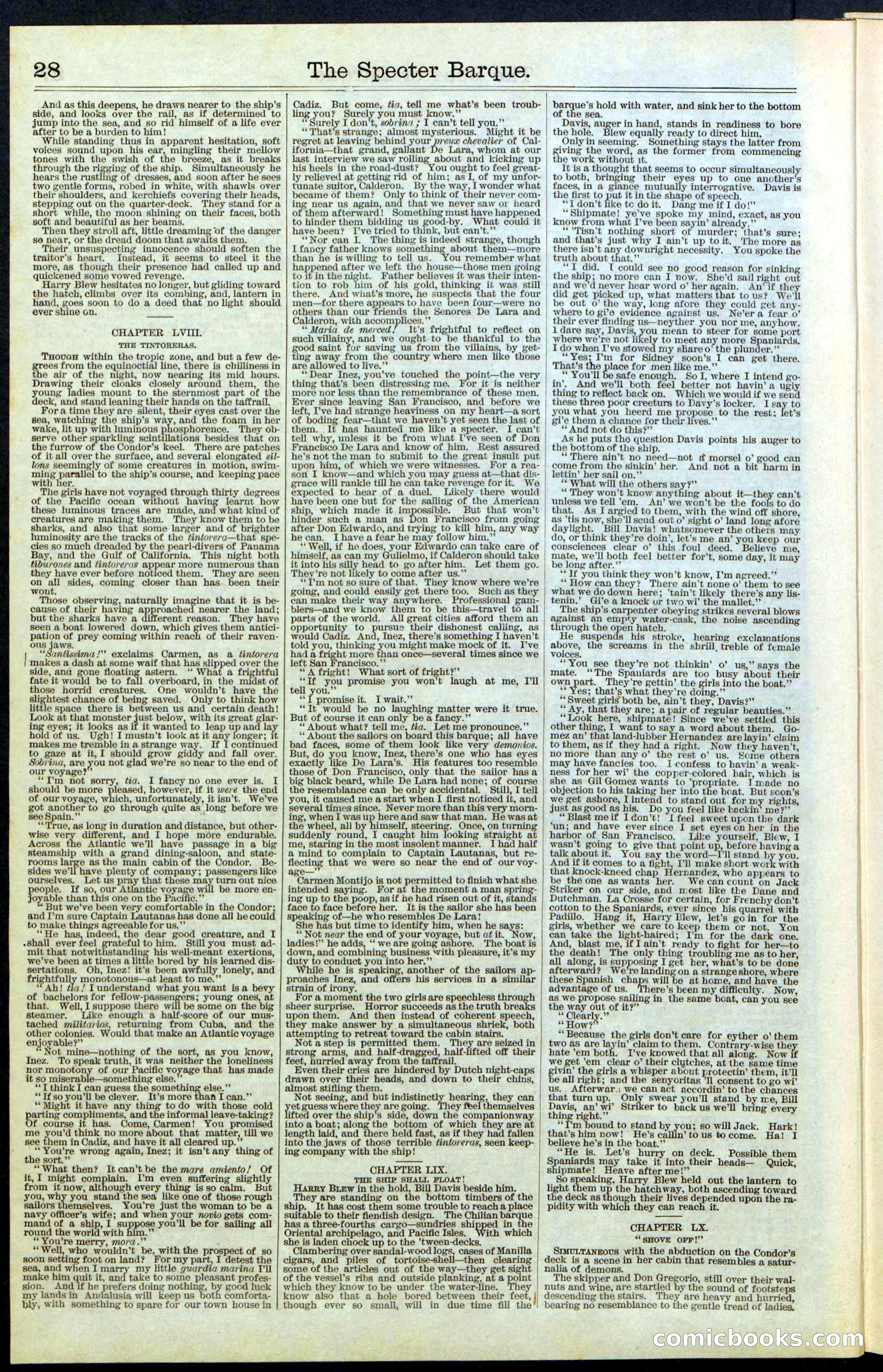
A restored page from Pulp Fiction, 1879. Page through the whole issue in the reader above.
📄 Transcribed text from this page (OCR, searchable)
Machine-transcribed from the original scan — historical spelling and the odd misread are preserved.
28 —_——-- And as this deepens, he draws nearer to the ship’s side, and looks over the rail, as if determined to jump into the sea, and so rid himself of a life ever after to be a burden to him! While standing thus in apparent hesitation, soft voices sound upon his ear, mingling their mellow tones with the swish of the breeze, as it breaks through the rigging of the ship. Simultaneously he hears the rustling of dresses, and soon after he sees two gentle forms, robed in white, with shawls over their shoulders, and kerchiefs covering their heads, stepping out on the quarter-deck. They stand for a short while, the moon shining on their faces, both soft and beautiful as her beams. Then they stroll aft, little dreaming of the danger so near, or the dread doom that awaits them, Their unsuspecting innocence should soften the traitor’s heart, Instead, it seems to steel it the more, as though their presence had called up and quickened some vowed revenge. Harry Blew hesitates no longer, but gliding toward the hatch, climbs over its combing, and, lantern in hand, goes soon to do a deed that no light should ever shine on. CHAPTER LVIII. THE TINTORERAS. THouesH within the tropic zone, and but a few de- ge from the equinoctial line, there is chilliness in e air of the night, now nearing its mid hours. steed their cloaks closely around them, the young la deck, and stand leaning their hands on the taffrail. Fora time they are silent, their eyes cast over the sea, watching the ship’s way, and the foam in her wake, lit up with luminous P osphorence, They ob- serve other sparkling scintillations besides that on the furrow of the Condor’s keel. There are patches of it all over the surface, and several elongated sil- lons seemingly of some creatures in motion, swim- ming parallel to the ship’s course, and keeping pace with her. The girls have not voyaged through thirty degrees of the Pacific ocean without havin these luminous traces are made, an creatures are making them. They know them to be sharks, and also that some larger and of brighter luminosity are the tracks of the tintorera—that spe- cies so much dreaded by the pearl-divers of Panama Bay, and the Gulf of California. This night both tiburones and tintoreras appear more numerous than they have ever before noticed them. They are seen on all sides, coming closer than has. been their ine that it is be- wont. Those observing cause of their having a but the sharks have a seen a boat lowered down, which pation of prey coming within reach of their raven- ous jaws. naturally im roached nearer the land; erent reason. They have “Santissima !"’ exclaims Carmen, as a fintorera makes a dash at some waif that has slipped over the side, ana gone floating astern. ‘“ What a frightful fate it would be to fall overboard, in the hose horrid creatures. One wouldn’t have the t oe chance of being saved. Only to think how espace there is between us and certain death! Look at that monster just below, with its great glar- ing eyes; it looks as hold of us. Ugh! I mustn't look at it any onger; makes me tremble in a strange way. If I continued to gaze at it, I should grow giddy and fall over. Sobrina, are you not glad we're so near to the end of our voyage?” “I’m not sorry, tia. I fancy no one ever is. I should be more pleased, however, if it 2ere the end of our voyage, which, unfortunately, it isn’t. We've got moet to go through quite as long before we see dy : “True, as long in duration and distance, but other- wise iy different, and I hope more endurable. Across the Atlantic we'll have passage in a big steamship with a grand dining-saloon, and state- rooms mg as the main cabin of the Condor. Be- sides we'll have plenty of company; passengers like ourselves, Let us pray that these may turn out nice ople. If so, our Atlantic voyage will be more en- i able than this one on the Pacific.” But we've been very comfortable in the Condor; and I’m sure Captain Lautanas has done all he could to make things agreeable for us." “He indeed, the dear good creature, and I -B8hall ever feel grateful to him. Still you must ad- mit that notwithstanding his well-meant exertions, we've been at times a little bored by his learned dis- sertations. Oh, Inez! it’s been awfully lonely, and Fr ge fe ram least to me.” “Ah! ¢ia/ Lunderstand what you want is a bevy of bachelors for fellow-passengers; young vse that. Well, I suppose there be some on the big steamer, Like enough a half-score of our mus- tached militavios, returning from Cuba, and the other colonies. Would that make an Atlantic voyage enjo able?’ ot mine—nothing of the sort, as you know, Inez. To speak truth, it was neither the loneliness nor monotony of our Pacific voyage that has made it so miserable—something else.”’ m I can guess the something else.”’ “Tfso you'll be clever. It’s more I can.” “Might it have any thing todo with those cold compliments, and the informal leave-taking? f course it has. Come, Carmen! You promised me you’d think no more about that matter, till we see them in Cadiz, and have it all cleared up.*’ “You’re wrong again, Inez; it isn’t any thing of the sort.” com . im even e from it now, atthough every thing is so calm. But you, why you stand the sea like one of those rough sailors t ves. You're just the woman to be a navy Officer’s wife; and when your novio gets com- mand of a ship, I su you'll be for sailing all round the world with Ay * You're merry, mora.” : - who wouldn't be, with the prospect of so soon se foot on land? For my I detest the and when I my little guardia marina Tl e him quit it, and take to some pleasant profes- sion. And if he prefers doing by good luck my landsin Andalusia will keep us both comforta- bly, with something to spare for our town house in The Specter dies mount to the sternmost part of the learnt how what kind of ves them antici- dst of it wanted to leap up an “y Barque. Cadiz. But come, fia, tell me what’s been troub- ling you? Surely you must know.” “Surely I don't, sobrina ; I can’t tell you.” “That's strange; almost mysterious. Might it be regret at leaving behind your preux chevalier of Cal- ifornia—that grand, gallant De last interview we saw rolling about and kicking up his heels in the road-dust? You ought to feel great- ly relieved at getting rid of him; as I, of my unfor- tunate suitor, Calderon. By the way, I wonder what became of them? Only to think of their never com- ing near us again, and that we never saw or heard of them afterward! to hinder them bidding us good-by. have been? I’ve tried to think, but can’t.” ‘‘Nor can I. The thing is indeed strange, though I fancy father knows something about them—more than he is willing to tell us. happened after we left the house—those men going to it in the night. tion to rob him of his gold, thinking it was still there. And what’s more, he suspects that the four men—for there appears to have others than our friends the Senores De Lara and Calderon, with accomplices.” “Maria de merced/ It's frightful to reflect on such sara ah and we ought to be thankful to the good saint for saving us from the villains, by get- ting away from the country where men like ‘those are allowed to live.” “Dear Inez, you've touched the point—the very thing that’s been distressing me. For it is neither more nor less than the remembrance of these men. Ever since leaving San Francisco, and before we left, I’ve had strange heaviness on my heart—a sort Lara, whom at our | Something must have happened | What could it | ou remember what | Father believes it was their inten- | een four—were no | of boding fear—that we haven't yet seen the last of | them. It has haunted me like a specter. I can't tell why, unless it be from what I’ve seen of Don | Francisco De Lara and know of him. Rest assured he’s not the man to submit to the great insult put upon him, of which we were witnesses. For a rea- son I know—and which you may guess at—that dis- grace will rankle till he can take revenge forit. We expected to hear of a duel. have been one but for the sailing of the American ship, which made it impossible. But that won’t hinder such a man as Don Francisco from going after Don Edwardo, and trying to kill him, any way he can. I have a fear he may follow him.’ ‘Well, if he does, your Edwardo can take care of himself, as can my Gulielmo, if Calderon should take it into his silly head They’re not likely to come after us.” ‘**T’'m not so sure of that. They know where we're going, and could easily get there too. Such as they can make their way anywhere. Professional gam- blers—and we know them to be this—travel to all parts of the world. All great cities afford them an opportunity to pursue their dishonest calling, as would Cadiz. And, Inez, there’s something I haven't told you, thinking you might make mock of it. I’ve had a fright more than once—several times since we left San Francisco,”’ “A fright! What sort of fright?” “Tf you promise you won't laugh at me, I'll tell you.” **] promise it. I wait.’ “It would be no laughing matter were it true. But of course it can only be a fancy.” ** About what? tell me, tia. Let me pronounce.” ‘** About the sailors on board this barque; all have bad faces, some of them look like very demonios. But, do you know, Inez, there’s one who has eyes exactly like De Lara’s. His features too resemble those of Don Francisco, only that the sailor hasa big black beard, while De Lara had none; of course the resemblance can be only accidental. Stil), I tell you, it caused me astart when I first noticed it, and several times since. Never more than this very morn- ing, when I was up here and saw that man, He was at the wheel, all b himself ng Once, on tu suddenly round, I caught him looking straight a me, staring in the most insolent manner. I had half a mind to complain to Captain Lautanas, but re- flecting that we were so near the end of our voy- Q—? Carmen Montijo is not permitted to finish what she intended saying. For at the moment a man spring- ing up to the poop, asif he had risen out of it, stands face to face before her. It is the sailor she has been ng of—he who resembles De Lara! She has but time to identify him, when he says: “* Not near the end of your oe bes but atit. Now, ladies!’ he adds, *‘ we are going ashore. ‘The boat is down, and combining business with pleasure, it’s my duty to conduct you into her.” e he is speaking, another of the sailors ap- proaches Inez, and offers his services in a similar strain of irony. For a moment the two girls are speechless through sheer surprise. Horror succeeds as the truth brea upon them. And then instead of coherent speech, they make answer by a simultaneous shriek, both attempting to retreat toward the cabin stairs. Not a step is permitted them. They are seized in strong arms, and half-d ed, half-lifted off their feet, hurried away from the ° Even their cries are hindered by Dutch night-caps drawn over their heads, and down to their chins, almost stifling them. Not seeing, and but indistinctl aa they can et guess where they are going. ey fee themselves over the ship’s side, down the companionway into a boat; along the bottom of which hey are at length laid, and there held fast, as if they had fallen into the jaws of those terrible dintoreras, seen keep- ing company with the ship! CHAPTER LIX. THE SHIP SHALL FLOAT! Harry Buew in the hold, Bill Davis beside him. They are standing on the bottom timbers of the pe It has cost them some trouble to reach a place suitable to their fiendish design. The Chilian barque has a three-fourths cargo—sundries “egy in the Oriental archipelago, and Pacific Isles. ith which she is laden chock up to the 'tween-decks, Clambering over sandal-wood logs, cases of Manilla and piles of tortoise-shelli—then clearin ars, aoe of the articles out of the way—they get sigh of the vessel’s ribs and outside planking, at a t wiser they know to be under the water-line. ow though ever so small, will in due time fill the ey also that a hole bored between their feet, Likely there would | parane's hold with water, and sink her to the bottom of the sea. Davis, auger in hand, stands in readiness to bore the hole. Blew equally ready to direct him, Onlyin seeming. Something stays the latter from giving the word, as the former from commencing the work without 1t. It is a thought that seems to occur simultaneously to both, bringing their eyes up to one another's faces, in a glance mutually interrogative. Davis is the first to pup it in the shape of speech. ‘I don't like to doit. Dang me if I do!” ‘“Shipmate! ye’ve spoke my mind, exact, as you know from what I’ve been sayin’ already.”’ . **'Tisn’t nothing short of murder; that’s sure; and that’s just why I ain’t up to it. The more as there isn’t oid downright necessity. You spoke the truth about that.” “I did. T could see no good reason for sinking the ship; no more can I now. She'd sail right out and we'd never hear word o’ her again, An’ if they did get picked up, what matters that tous? W ol be out o’ the way, long afore they could get any- where to gi’e evidence against us. Ne’era fear o’ their ever finding us—neyther you nor me, anyhow. 1 dare say, Davis, you mean to steer for some port where we're not likely to meet any more Spaniards. I do when I’ve stowed my share o’ the plunder.” “Yes; I’m for Sidney soon’s I can get there. That’s the place for men like me.” *“ You'll be safe enough. So I, where I intend go- in’. And we'll both feel better not havin’ a ugly thing to reflect back on. Which we would if we send these three poor creeturs to Davy’s locker. I say to you what you heerd me propose to the rest; let’s gi’e them a chance for their lives.” ** And not do this?” As he puts the question Davis points his auger to the bottom of the ship. “There ain’t no need—not @ morsel 0’ good can come from the sinkin’ her. And not a bit harm in lettin’ her sail on.” ** What will the others say?” They won't know anything about it—they can’t unless we tell °em. An’ we won’t be the fools to do that. As Il argied to them, with the wind off shore, as ‘tis now, she'll seud out o’ sight o’ land long afore daylight. Bill Davis! whatsomever the others may _ do, or think they’re doin’, let’s me an’ you keep our to go after him. Let them go.. | consciences clear 0’ this foul deed. Believe me, mate, we'll both feel better for’t, some day, it may be long after.”’ ** If you think they won't know, I’m agreed.” ** How can they’ There ain't none o’ them to see what we do down here; ‘tain't likely there’s any lis- tenin.’ Gi’e a knock or two wi’ the mallet.” The ship’s carpenter obeying strikes several blows against an empty water-cask, the noise ascending through the open hatch. He suspends his stroke, hearing exclamations above, the screams in the shrill. treble of female voices. ‘You see they’re not thinkin’ o’ us,” says the mate. “The Spaniards are too busy about their own art. They're gettin’ the girls into the boat.” , 2eS; that’s what they're doing.” ., Sweet girls both be, ain’t they, Davis?” _, Ay, that they are; a pair of regular beauties.” Look here, shipmate! Since we've settled this other thing, I want to say a word about them. Go- mez an’ that land-lubber Hernandez are layin’ claim to them, asif they had a right. Now they haven't, nomore than any 0’ the rest o’ us. Some others may have fancies too. I confess to havin’ a weak- ness for her wi’ the copper-colored hair, which is she as GilGomez wants to ‘propriate. I made no objection to his taking her into the boat. But soon’s we get ashore, [intend to stand out for my rights, just as good as his. Do you feel like backin’ me?” ; Blast meif Idon’t! “I feel sweet upon the dark un; and have ever since I set eyes on her in the harbor of San Francisco. Like yourself, Blew, I wasn’t going to give that point up, before having a talk about it. You say the word—I'll stand by you. And if it comes to a fight, I'll make short work with that knock-kneed chap Hernandez, who appears to be the one as wants her. Wecancount on Jack Striker on our side, and most like the Dane and Dutchman, La Crosse for certain, for Frenchy don’t cotton to the Spaniards, ever since his quarrel with Padillo. Hang it, Harry Blew, let’s goin for the girls, whether we care to keep them or not. You can take the light-haired; I'm for the dark one. And, blast me, ifI ain't ready to fight for her—to the death! The only thing troubling me as to her, all along, is supposing I get her, what's to be done afterward ? We're omperry Pts a strange shore, where these Spanish chaps will be at home, and have the advantage of us. There’s been my difficulty. Now, as we propose sailing in the same boat, can you see the way out of it?” ‘* Clearly.” ‘* How? ‘Because the girls don't care for eyther o' them two as are 5 claim to them. Contrary-wise the hate ’em both. I’ve knowed that all along. Now we get ‘em clear o’ their clutches, at the same time gy the girls a whisper about protectin’ them, it'll e all right; and the senyoritas ‘Il consent to go wi’ us. Afterwar. we can act accordin’ to the chances that turnup. Only swear you'll stand by me, Bill Davis, an’ wi’ Striker to back us we'll bring every thing right.” ‘Pm bound to stand by you; so will Jack. Hark! that’s him now! He’s callin’to us tocome. Ha! I pediexe nee 3 a peak deck “He is. Let’s hurry on deck. Possible them pies apriey may take it into their heads— Quick, So speak ig, tuaxey, Siow Weld ‘ous the lai Sos ng, Harry Blew held out the rm to light them up the hatchway, both ascending toward the deck as though their lives eyvended upon the ra- pidity with which they can reach it. CHAPTER LX. “SHOVE OFF!”’ SIMULTANEOUS with the abduction on the C : deck is a scene in her cabin that resembles ie “Th at Thera Don G rio, still es er and Don Gregorio, still over their wal- nuts and wine, are startled by the sound of footsteps descending the stairs. They are heavy and hurried, bearing no resemblance to the gentle trout of ladies, com S choe CO}