
Pulp Fiction, 1890 · page 24 of 32
Beadle's Dime Library No. 628 — page 24: what you’re looking at
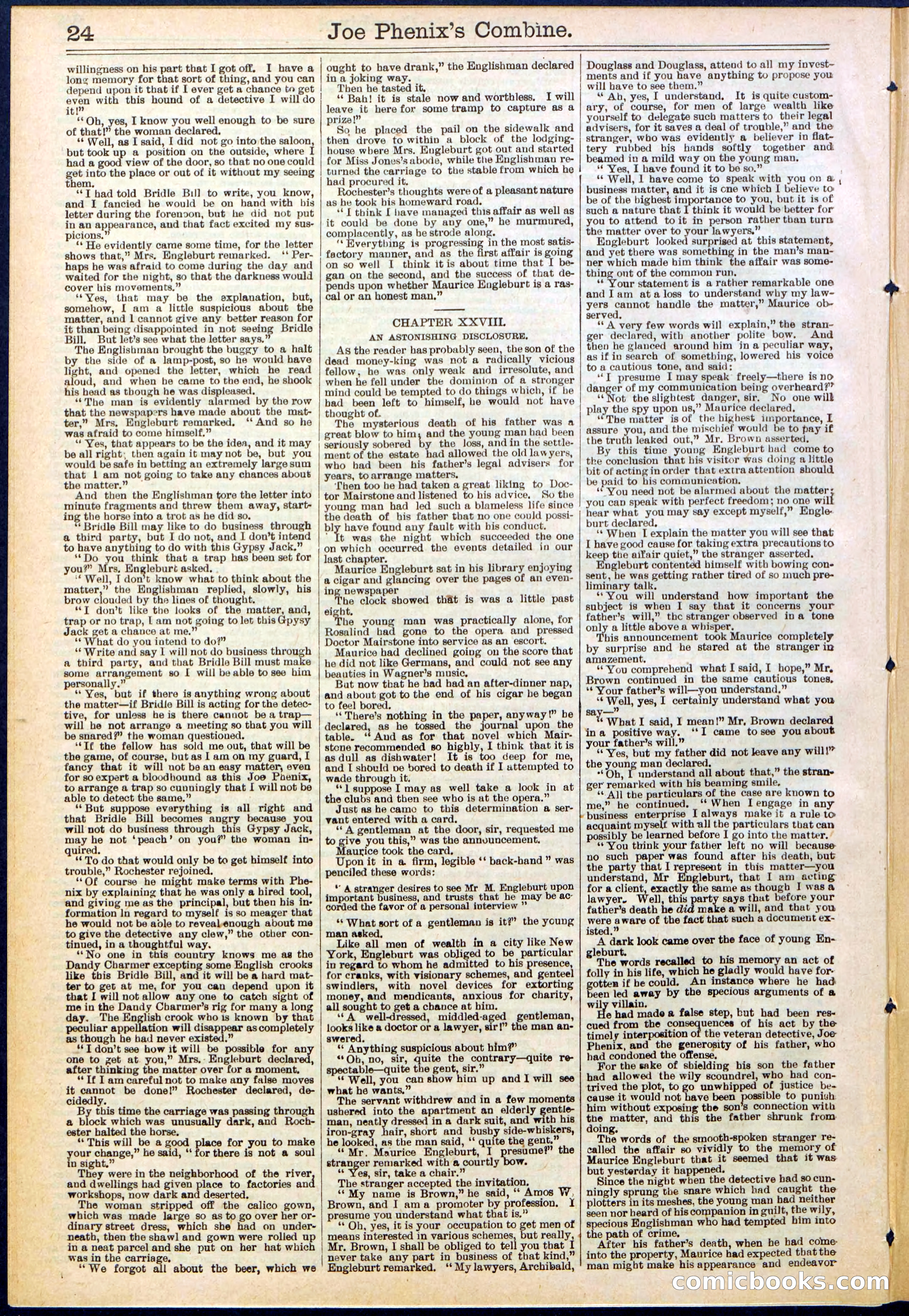
A restored page from Pulp Fiction, 1890. Page through the whole issue in the reader above.
📄 Transcribed text from this page (OCR, searchable)
Machine-transcribed from the original scan — historical spelling and the odd misread are preserved.
= = a oye * alee for star Ce we tele Fn 24 willingness on his part that I got off. I have a long memory for that sort of thing, and you can depend upon it that if | ever get a chance to get even with this hound of a detective I will do it! ‘‘Oh, yes, I know you well enough to be sure of that!” the woman declared. ‘‘ Well, as I said, I did not go into the saloon, but took up a position on the outside, where I had ag view of the door, so that no one could get into the place or out of it without my seeing hem, “‘T had told Bridle Bill to write, you know, and I fancied he would be on hand with bis letter during the forenoon, but he did not put in an appearance, and that fact excited my sus- picions.” ‘‘ He evidently came some time, for the letter shows that,” Mrs. Engleburt remarked. ‘‘ Per- haps he was afraid to come during the day and waited for the night, so that the darkness would cover his movements.” ‘*Yes, that may be the explanation, but, somehow, [I am a little suspicious about the matter, and 1 cannot give any better reason for it than being disappointed in not seeing Bridle Bill. But let’s see what the letter says.’ The Englishman brought the buggy to a halt by the side of a lamp-post, so he would have light, and opened the letter, which he read aloud, and when he came to the end, he shook his bead as though he was displeased, ‘‘The man is evidently alarmed by the row that the newspapers have made about the mat- ter,” Mrs. Engleburt remarked. ‘‘ And so he was afraid to come himself.” ‘* Yes, that appears to be the idea, and it may be all right, then again it may not be, but you would be safe in betting an extremely large sum that | am not going to take any chances about the matter.” And then the Englishman tore the letter into minute fragments and threw them away, start- ing the horse into a trot as he did so, ‘** Bridle Bill may like to do business through a third party, but I do not, and | don’t intend to have anything to do with this Gypsy Jack,” ‘Do you think that a trap has been set for you?” Mrs, Engleburé asked. ‘* Well, I don’t know what to think about the matter,” the Englishman replied, slowly, his brow clouded by the lines of thought. “T don’t like the looks of the matter, and, trap or no trap, | am not going to let this Gpysy Jack get a chance at me.” ‘What do you intend to do?” ‘¢ Write and say | will not do business through a third party, and that Bridle Bill must make some arrangement so [ will beable to see bim personally.” ** Yes, but if there is anything wrong about the matter—if Bridle Bill is acting for the detec- tive, for unless he is there cannot be a trap— will he not arrange a meeting so that you will be snared?’ the woman questioned. ‘‘Tf the fellow has sold me out, that will be the game, of course, but as Il am on my guard, I fancy that it will not be an easy matter, even for so expert a bloodhound as this Joe Phenix, to arrange a trap so cunningly that I will not be able 3 aya the se : ut suppose everything is all right and that Bridle Bill becomes tn Sectaman you will not do business through this Gypsy Jack, may he not ‘peach’ on you?” the woman in- quired. *¢ To do that would only be to get himself into trouble,” Rochester rejoined. ‘Of course he might make terms with Phe- nix by explaining that he was only a bired tool, and giving me as the principal, but then his in- formation In regard to myself is so meager that he would not be aole to revealenough about me to give the detective any clew,” the other con- tinued, in a thoughtful way. ‘*No one in this country knows me as the Dandy Charmer excepting some English crooks like this Bridle Bill, and it will be a hard mat- ter to get at me, for you can depend upon it that I will not allow any one to catch sight of me in the Dandy Charmer’s rig for many a long on he ago i ence we is known by that pecu appellation will disap as completel as though he had never pcs 3 ae 3 “*T don’t see bow it will be possible for an one to zet at you,” Mrs,- Engleburt are after thinking the matter over fur a moment, ‘Tf I am careful not to make any false moves it cannot be done!” Rochester declared, de- cidedly. By this time the carriage was passing through a block which was unusually dark, and Roch- ester halted the horse. ‘** This will be a good place for you to make our change,” he said, ‘‘ for there is not a soul n sight,” They were in the neighborhood of the river and dwellings had given place to factories an workshops, now dark and deserted, The woman stripped off the calico gown, which was made large so as to go over her or- dinary street dress, which she had on under- neath, then the shaw] and gown were rolled up in a neat parcel and she put on her hat which was in the carriage, “We forgot all about the beer, which we ———$—$—$$ lisse ee | Joe Phenix’s Combine. ought to have drank,” the Englishman declared in a joking way. Then he tasted it, ‘ Bah! it is stale now and worthless, I will leave it here for some tramp to capture as a prize!” So he placed the pail on the sidewalk and then drove to within a block of the lodging- house where Mrs. Engleburt got out and started for Miss Jones’s abode, while the Englishman re- turned the carriage to the stable from which he had procured it. Rochester’s thoughts were of a pleasant nature as he took his homeward road. ‘¢ T think [ have managed this affair as well as it could be dove by any one,” he murmured, complacently, as be strode along. ‘Everything is progressing in the most satis- factory manner, and as the first affair is going on so well I think itis about time that I be- gan on the second, and the success of that de- pends upon whether Maurice Engleburt is a ras- cal or an honest man,” CHAPTER XXVIIL AN ASTONISHING DISCLOSURE. As the reader has probably seen, the son of the dead money-king was not a radically vicious fellow, he was only weak and irresolute, and when he fell under the dominion of a stronger mind could be tempted to do things which, if be bad been left to himself, ho would not have thought of. The mysterious death of his father was a great blow to him; and the young man had been seriously sobered by the loss, andin the settle- ment of the estate had allowed the old lawyers, who had been his father’s legal advisers for years, toarrange matters. ‘Then too he had taken a great liking to Doc- tor Mairstone and listened to his advice. So the young man had led such a blameless life since the death of his father that no one could possi- bly have found any fault with bis conduct, ' Tt was the night which succeeded the one on which oceurred the events detailed in our last chapter. Se, Maurice Engleburt sat in his library enjoying a cigar and glancing over the pages of an even- ing newspaper : ‘he clock showed that is was a little past eight. he young man was practically alone, for Rosalind had gone to the opera and pressed Doctor Mairstone into service as an escort. Maurice had declined going on the score that he did not like Germans, and could not see any beauties in Wagner’s music, Bat now that he bad had an after-dinner nap, and about got to the end of his cigar he began to feel bored, ‘“There’s nothing in the paper, anyway!” be declared, as he tossed the journal upon the table. ‘‘ And as for that novel which Mair- stone recommended so highly, I think that it is as dull as dishwater! It is too deep for me, and I should pe bored to death if I attempted to wade through it. ‘*] suppose I may as well take a look in at the clubs and then see who is at the opera.” Just as he came to this determination a ser- vant entered with a card. ‘*A gentleman at the door, sir, requested me to five you this,” was the annuuncement. aurice took the card, Upon it in a firm, legible ‘* back-hand ” was penciled these words: * a stranger desires to see Mr M. Engleburt upon important business, and trusts that he may be ac- corded the favor of a personal interview ” ‘* What sort of a gentleman is it?” the young man asked, ¢ 0 ey Like all men of wealth in a city like New York, Engleburt was obliged to be particular in regard to whom he admitted to his presence, for cranks, with visionary schemes, and genteel swindlers, with novel devices for extorting money, and mendicants, anxious for charity, all sought to get a chance at him. v well-dressed, middled-aged gentleman, looks like a doctor or a lawyer, sir!” the man an- swered. “ Anything suspicious about him?” **Ob, no, sir, quite the contrary—quite re- spectable—quite the gent, sir.” “Well, you can show him up and I will see what he wants,” ; The servant withdrew and in a few moments ushered into the apartment an elderly gentle- man, neatly dressed in a dark suit, and with his iron-gray hair, short and busby side-whiskers, he looked, as the man said, ‘‘ quite the gent.” ‘““Mr, Maurice Engleburt, I presume?” the stranger remarked with a courtly bow. “* Yes, sir, take a chair.” The stranger accepted the invitation, ‘‘My name is Brown,” he said, ‘‘ Amos W, Brown, and I ama promoter by profession, I presume you understand what that is.” ‘** Oh, yes, itis your occupation to get men of means interested in various schemes, but really, Mr. Brown, I shall be obliged to tell you that I never take any part in business of that kind,” Engleburt remarked, ‘‘ My lawyers, Archibald, " ‘ . é | Douglass and Douglass, attend to all my invest~ | ments and if you have anything to propose you will have to see them.” “ Ab, yes, I understand, It is quite custom- ary, of course, for men of large wealth like yourself to delegate such matters to their legal advisers, for it saves a deal of trouble,” and the stranger, who was evidently a believer in flat- tery rubbed his hands softly together and beamed in a mild way on the young man, ‘* Yes, I have found it to be so,” ‘* Well, | have come to speak with you on & business matter, and it is one which I believe to be of the bighest importance to you, but it is of such a nature that I think it would be better for you to attend toit in person rather than turn the matter over to your lawyers.” Engleburt looked surprised at this statement, and yet there was something in the man’s man- ner which made him think the affair was some- thing ont of the common run, ‘* Your statement is a rather remarkable one andl am ataloss to understand why my law- yers cannot handle the matter,” Maurice ob- served, ‘A very few words will explain,” the stran- ger declared, with another polite bow. And then he glanced around him in a peculiar way, as if in search of something, lowered his voice to a cautious tone, and said; “T presume I may speak freely—there is no danger of my communication being overheard?’ ‘‘Not the slightest danger, sir. No one will play the spy upon us,” Maurice declared, “The matter is of the highest importance, L assure you, and the mischief would be to pay if the truth leaked out,” Mr. Brown asserted, By this time young Engleburt bad come to the conclusion that his visitor was doing a little bit of acting in order that extra attention should be paid to his communication. ‘“'You need not be alarmed about the matter; you cap speak with perfect freedom; no one will hear what you may say except myself,” Engle burt declared, ‘‘ When I explain the matter you will see that I have good cause for taking extra precautions to keep the aifair quiet,” the stranger asserted, Engleburt contented bimself with bowing con- sent, he was getting rather tired of so much pre- liminary talk, ** You will understand how important the subject is when I say that it concerns your father’s will,” thc stranger observed ina tone only a little above a whisper. This announcement took Maurice completely by surprise and he stared at the stranger in amazement, ‘You comprehend what I said, I hope,” Mr, Brown continued in the same cautious tones, ‘* Your fatber’s will—you understand,” Ne Well, yes, I certainly understand what you say ‘What I said, I mean!” Mr, Brown declared ina positive way. ‘*I came tosee you about your father’s will.” “Yes, but my father did not leave any will)” the young man declared, ‘Oh, I understand all about that,” the stran- ger remarked eee eee — with his beaming smile, ‘‘ Ajl the particulars of the case are known to me,” he continued, ‘* When [engage in any business enterprise I always make it a rule to acquaint myself with all the particulars that can possibly be learned before I go into the matter,» ‘¢ You think your father left no will because: no such paper was found after his death, but the party that I represent in this matter—you understand, Mr ny that I am acting t for a client, exactly the same as though I wasa lawyer. Well, vert dd says that before your father’s death he did make a will, and that you were aware of the fact that such a document ex- ‘A dark look came over the face of young En- The words recalled to his memory an act of folly in his life, which he gladly would have for- otten if be could, An instance where he had een led away by the specious arguments of a wily villain. He had made a false step, but had been res-~ cued from the consequences of his act by the timely interposition of the veteran detective, Joe Phenix, and the generosity of his father, who had condoned the offense, For the sake of shielding bis son the father had allowed the wily scoundrel, who had con- trived the plot, to go unwhipped of justice be- cause it would not have been possible to punish. him without exposing the son’s connection with pe matter, and this the father shrunk from oing. The words of the smooth-spoken stranger re- called the affair so vividly to the memory of Maurice Engleburt that it seemed that it was but yesterday it happened. Since the nigbt when the detective had so cun- ningly sprung the snare which had caught the plotters in its meshes, the young man had neither seen nor heard of his companion in guilt, the wily, specious Englishman who had tempted him into the path of crime, After his father’s death, when he bad come: into the property, Maurice had expected tbat the man might make his appearance and endeavor - ——F ss * a" < + SES - - aa eo S' 9 gn af a in” ‘> < a s ee * > a - = => rta= Re Eomichbooks i °*2— ae