
Pulp Fiction, 1878 · page 39 of 44
Beadle's Dime Library No. 51: Red Rob, The Boy Road-Agent — page 39: what you’re looking at
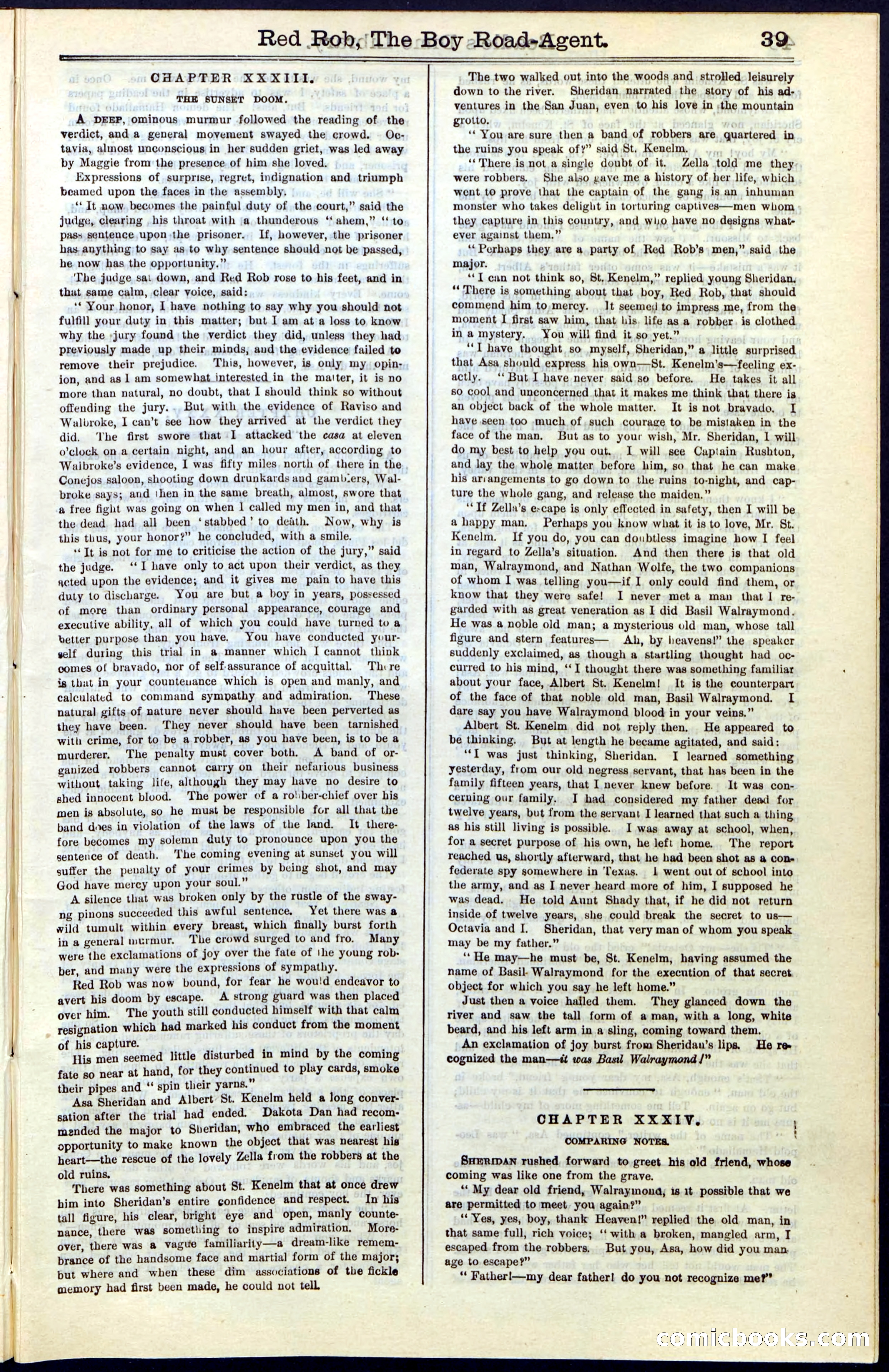
A restored page from Pulp Fiction, 1878. Page through the whole issue in the reader above.
📄 Transcribed text from this page (OCR, searchable)
Machine-transcribed from the original scan — historical spelling and the odd misread are preserved.
> Red Roh; The Boy -Road-Agent. CHAPTER XXXIII. THE SUNSET DOOM. A DEEP, ominous murmur followed the reading of the verdict, and a general movement swayed the crowd. Oc- tavia, almost unconscious in her sudden griet, was led away by Maggie from the presence of him she loved. Expressions of surprise, regret, indignation and triumph beamed upon the faces in the assembly, ‘* It now. becomes the painful duty of the court,” said the judge, clearing his throat with a thunderous ‘‘ ahem,” ‘ to pass sentence upon the prisoner. If, however, the prisoner has. anything to say as to why sentence should not be passed, he now has the opportunity,” The judge sat down, and Red Rob rose to his feet, and in thut same calm, clear voice, said: ‘* Your honor, I have nothing to say why you should not fulfill your duty in this matter; but I am at a loss to know why the »jury found the verdict they did, unless they had previously made up their minds, and the evidence failed to remove their prejudice. This, however, is only my opin- ion, and as 1 am somewhat interested in the mater, it is no more than natural, no doubt, that I should think so without offending the jury.. But with the evidence of Raviso and Walbroke, I can’t see how they arrived at the verdict they did. ‘The first swore that I attacked the casa at eleven o'clock on a certain night, and an hour after, according to Walbroke’s evidence, I was fifty miles. north of there in the Conejos saloon, shooting down drunkards and gamb-ers, Wal- broke says; and then in the same breath, almost, swore that a free fight was going on when | called my men in, and that the dead had all been ‘stabbed’ to death, Now, why is this thus, your honor?” he concluded, with a smile. ‘It is not for me to criticise the action of the jury,” said the judge. ‘‘1 have only to act upon their verdict, as they acted upon the evidence; and it gives me pain to have this duty to discharge. You are but a boy in years, possessed of more than ordinary personal appearance, courage and executive ability, all of which you could have turned to a better purpose than you have. You have conducted your- self during this trial in a manner which I cannot think comes of bravado, nor of self-assurance of acquittal. Thcre ig thut in your countenance which is open and manly, and calculated to command sympathy and admiration. These natural gifts of nature never should have been perverted as they have been. They never should have been tarnished with crime, for to be a robber, as you have been, is to be a murderer. The penalty must cover both. A band of or- ganized robbers cannot carry on their nefarious business without taking life, although they may have no desire to shed innocent blood. The power of a ro!iber-chief over his men is absolute, so he must be responsible for all that the band does in violation of the laws of the land. It there- fore becomes my solemn duty to pronounce upon you the sentence of death. ‘The coming evening at sunset you will suffer the penalty of your crimes by being shot, and may God have merey upon your soul.” A silence that was broken only by the rustle of the sway- ng pinons succeeded this awful sentence, Yet there was a wild tumult within every breast, which finally burst forth in a general murmur. The crowd surged to and fro. Many were the exclamations of joy over the fate of ihe young rob- ber, and many were the expressions of sympathy. Red Rob was now bound, for fear he wou!d endeavor to avert his doom by escape. A strong guard was then placed over him. The youth still conducted himself with that calm resignation which had marked his conduct from the moment i ture. ° a oa seemed little disturbed in mind by the coming fate so near at hand, for they continued to play cards, smoke tr pf nd *‘ spin their yarns. Ber Sheridan He Albert St. Kenelm held a long conver- sation after the trial had ended. Dakota Dan had recom- mended the major to Sheridan, who embraced the earliest opportunity to make known the object that was nearest his heart—the rescue of the lovely Zella from the robbers at the old ruins, There was something about St. Kenelm that at once drew him into Sheridan’s entire confidence and respect. In his tall figure, his clear, bright eye and open, manly counte- nance, there was something to inspire admiration. More- over, there was a vague familiarity—a dream-like remem- prance of the handsome face and martial form of the major; but where and when these dim associations of the fickle memory had first been made, he could not tell. 39. The two walked out into the woods and strolled. leisurely down to the river. Sheridan narrated the story of his ad- ventures in the San Juan, even to his love in :the mountain grotto. ‘‘ You are sure then a band of robbers are quartered in the ruins you speak of?” said St. Kenelm. ) ‘‘There is not a single doubt of it. Zella told me they were robbers. She also gave me a history of her life, which went to prove that the captain of the gang is an inhuman monster who takes delight in torturing captives—men whom they capture in this country, and who have no designs what- ever against them.”’ ‘Perhaps they are a party of Red Rob’s men,” said the major. ‘‘I can not think so, St, Kenelm,” replied young Sheridan, “There is something about that boy, Red Rob, that should commend him to mercy. It seeme;i to impress me, from the moment I first saw him, that his. life as a robber. is clothed in a mystery. You will find it so yet.” ‘I have thought so myself, Sheridan,” a little surprised that Asa should express his own—St. Kenelm’s—feeling ex- actly. ‘‘ But I have never said so before. He takes it all so cool and unconcerned that it makes me think that there is an object back of the whole matter. It is not bravado, I have seen too much of, such courage to be mistaken in the face of the man. But as to your wish, Mr. Sheridan, 1 will do my best to help you out. I will see Captain Rushton, and lay the whole matter before him, so that he can make his ariangements to go down to the ruins to-night, and cap- ture the whole gang, and release the maiden.” ‘Tf Zella’s e-cape is only effected in safety, then I will be a happy man. Perhaps you know what it is to love, Mr. St. Kenelm. If you do, you can doubtless imagine how I feel in regard to Zella’s situation. And then there is that old man, Walraymond, and Nathan Wolfe, the two companions of whom I was telling you—if I only could find them, or know that they were safe! I never meta man that 1 re- garded with as great veneration as I did Basil Walraymond. He was a noble old man; a mysterious old man, whose tall figure and stern features— Ah, by heavens!” the speaker suddenly exclaimed, as though a startling thought had oc- curred to his mind, ‘‘I thought there was something familiar about your face, Albert St. Kenelm! It is the counterpart of the face of that noble old man, Basil Walraymond. I dare say you have Walraymond blood in your veins.” Albert St. Kenelm did not reply then. He appeared to be thinking. But at length he became agitated, and said; ‘I was just thinking, Sheridan. I learned something yesterday, from our old negress servant, that has been in the family fifteen years, that I never knew before. It was con- cerning our family. I had considered my father dead for twelve years, but from the servant I learned that such a thing as his still living is possible. I was away at school, when, for a secret purpose of his own, he left home. The report reached us, shortly afterward, that he had been shot as @ con- federate spy somewhere in Texas. 1 went out of school into the army, and as I never heard more of him, I supposed he was dead. He told Aunt Shady that, if he did not return inside of twelve years, she could break the secret to us— Octavia and I. Sheridan, that very man of whom you speak may be my father.” ‘‘He may—he must be, St. Kenelm, having assumed the name of Basil. Walraymond for the execution of that secret object for which you say he left home.” Just then a voice hailed them. They glanced down the river and saw the tall form of aman, with a long, white beard, and his left arm in a sling, coming toward them. An exclamation of joy burst from Sheridan’s lips. He re cognized the man—#t was Basil Walraymond /” CHAPTER XXXIV, COMPARING NOTES SHERMAN rushed forward to greet his old friend, whose coming was like one from the grave. “‘ My dear old friend, Walraymona; is it possible that we are permitted to meet. you again?” ** Yes, yes, boy, thank Heaven!” replied the old man, in that same full, rich voice; ‘‘ with a broken, mangled arm, I escaped from the robbers, But you, Asa, how did you man. age to escape?” “* Father!—my dear father! do you not recognize me?” ren CORNICOOOKS (C(O)