
Pulp Fiction, 1878 · page 38 of 44
Beadle's Dime Library No. 51: Red Rob, The Boy Road-Agent — page 38: what you’re looking at
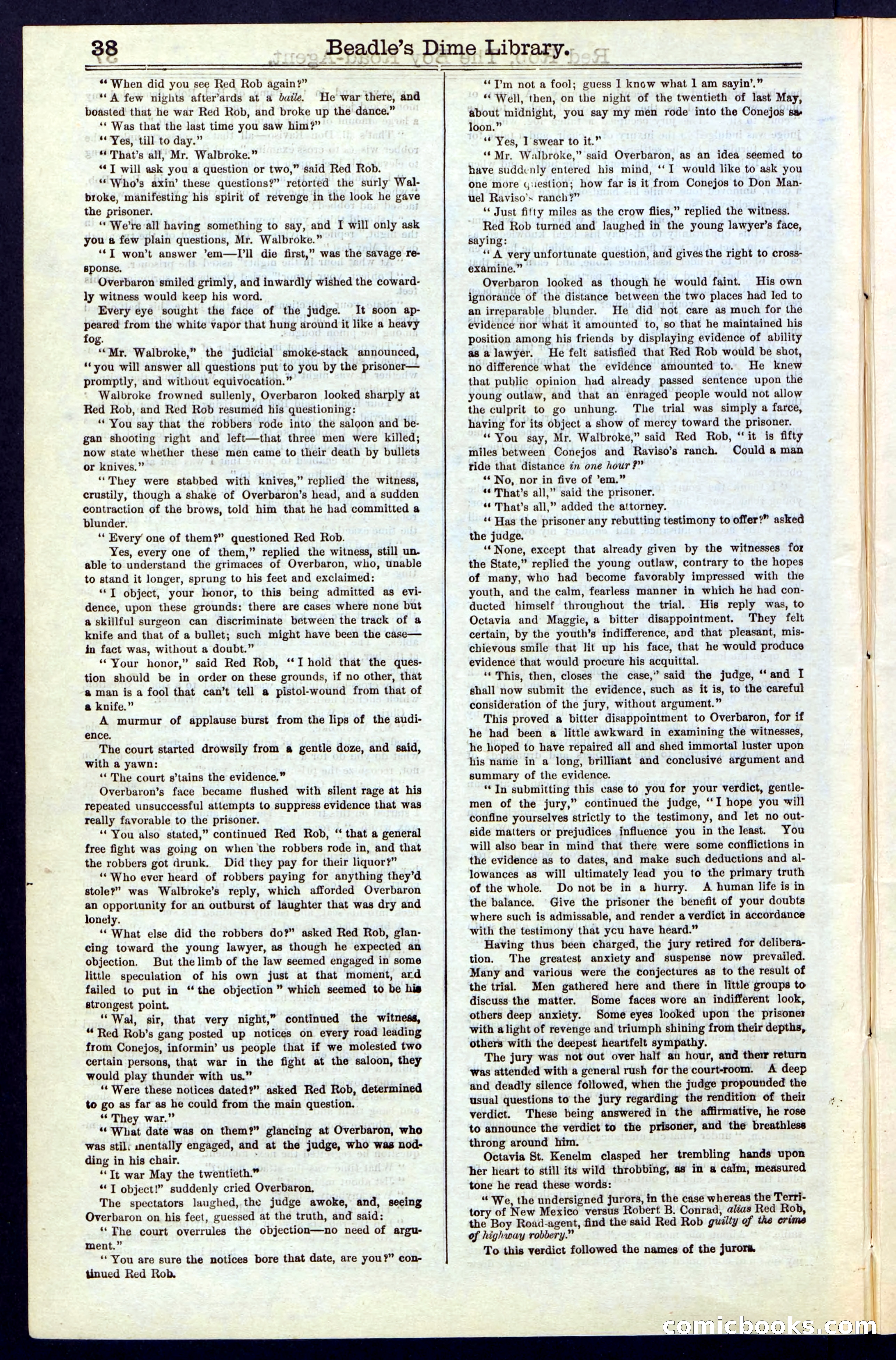
A restored page from Pulp Fiction, 1878. Page through the whole issue in the reader above.
📄 Transcribed text from this page (OCR, searchable)
Machine-transcribed from the original scan — historical spelling and the odd misread are preserved.
38 ——— ** When did you see Red Rob again?” ‘‘A few nights after’ards at a baile. He war there, and boasted that he war Red Rob, and broke up the dance.” ‘* Was that the last time you saw him?” ** Yes, till to day.” **That’s all, Mr. Walbroke.” ‘*] will ask you a question or two,” said Red Rob. ‘““Who’s axin’ these questions?” retorted the surly Wal- broke, manifesting his spirit of revenge in the look he gave the prisoner. ‘We're all having something to say, and I will only ask you a few plain questions, Mr. Walbroke.” ‘I won’t answer ’em—lI’ll die first,” was the savage re- sponse, Overbaron smiled grimly, and inwardly wished the coward- ly witness would keep his word. Every eye sought the face of the judge. It soon ap- peared from the white vapor that hung around it like a heavy fog. ‘“Mr. Walbroke,” the judicial smoke-stack announced, ‘*you will answer all questions put to you by the prisoner— promptly, and without equivocation.” Walbroke frowned sullenly, Overbaron looked sharply at Red Rob, and Red Rob resumed his questioning: ‘* You say that the robbers rode into the saloon and be- gan shooting right and left—that three men were killed; now state whether these men came to their death by bullets or knives.” “5; ‘They were stabbed with knives,” replied the witness, crustily, though a shake of Overbaron’s head, and a sudden contraction of the brows, told him that he had committed a blunder. ‘* Every one of them?” questioned Red Rob. Yes, every one of them,” replied the witness, still un. able to understand the grimaces of Overbaron, who, unable to stand it longer, sprung to his feet and exclaimed: ‘‘T object, your honor, to this being admitted as evi- dence, upon these grounds: there are cases where none but a skillful surgeon can discriminate between the track of a knife and that of a bullet; such might have been the case— in fact was, without a doubt.” “Your honor,” said Red Rob, ‘“‘I hold that the ques- tion should be in order on these grounds, if no other, that & man is a fool that can’t tell a pistol-wound from that of a knife.” A murmur of applause burst from the lips of the audi- ence. The court started drowsily from a gentle doze, and said, with a yawn: ‘The court s’tains the evidence,” Overbaron’s face became flushed with silent rage at his repeated unsuccessful attempts to suppress evidence that was really favorable to the prisoner. ‘‘ You also stated,” continued Red Rob, ‘‘ that a general free fight was going on when the robbers rode in, and that the robbers got drunk. Did they pay for their liquor?” ‘“Who ever heard of robbers paying for anything they’d stole?” was Walbroke’s reply, which afforded Overbaron an opportunity for an outburst of laughter that was dry and lonely. ‘‘ What else did the robbers do?” asked Red Rob, glan- cing toward the young lawyer, as though he expected an objection. But the limb of the law seemed engaged in some little speculation of his own just at that moment, ard failed to put in “the objection” which seemed to be his strongest point. “Wal, sir, that very night,” continued the witness, “Red Rob’s gang posted up notices on every road leading from Conejos, informin’ us people that if we molested two certain persons, that war in the fight at the saloon, they would play thunder with us.” ‘‘ Were these notices dated?” asked Red Rob, determined to go as far as he could from the main question. “They war.” ‘‘ What date was on them?” glancing at Overbaron, who was stil: unentally engaged, and at the judge, who was nod- ding in his chair. ‘Tt war May the twentieth.” “T object!” suddenly cried Overbaron. The spectators laughed, the judge awoke, and, seeing Overbaron on his feet, guessed at the truth, and said: ‘‘The court overrules the objection—no need of argu- ment.” ‘‘ You are sure the notices bore that date, are you?” con- tinued Red Rob. 1p /Beadie’s Dame BinTAR« - 53 ‘“‘T’m not a fool; guess 1 know what 1 am sayin’.” ‘“Well, then, on the night of the twentieth of last May, about midnight, you say my men rode into the Conejos sw» loon.” ‘Yes, I swear to it.” ‘‘Mr. Walbroke,” said Overbaron, as an idea seemed to have suddenly entered his mind, ‘‘I would like to ask you one more «q:estion; how far is it from Conejos to Don Man- uel Raviso’s ranch?” ‘« Just fifty miles as the crow flies,” replied the witness. Red Rob turned and laughed in the young lawyer’s face, saying: ‘‘ A very unfortunate question, and gives the right to cross- examine.” Overbaron looked as though he would faint. His own ignorance of the distance between the two places had led to an irreparable blunder. He did not care as much for the evidence nor what it amounted to, so that he maintained his position among his friends by displaying evidence of ability asalawyer. He felt satisfied that Red Rob would be shot, no difference what the evidence amounted to. He knew that public opinion had already passed sentence upon the young outlaw, and that an enraged people would not allow the culprit to go unhung. The trial was simply a farce, having for its object a show of mercy toward the prisoner. ‘‘You say, Mr. Walbroke,” said Red Rob, ‘it is fifty miles between Conejos and Raviso’s ranch. Could a man ride that distance in one hour?” ‘‘ No, nor in five of ’em.” ‘‘ That’s all,” said the prisoner. ‘‘ That’s all,” added the attorney. «‘ Has the prisoner any rebutting testimony to offer?” asked the judge. ‘None, except that already given by the witnesses for the State,” replied the young outlaw, contrary to the hopes of many, who had become favorably impressed with the youth, and the calm, fearless manner in which he had con- ducted himself throughout the trial. His reply was, to Octavia and Maggie, a bitter disappointment. They felt certain, by the youth’s indifference, and that pleasant, mis- chievous smile that lit up his face, that he would produce evidence that would procure his acquittal. ‘‘ This, then, closes the case,” said the judge, ‘and I shall now submit the evidence, such as it is, to the careful consideration of the jury, without argument.” This proved a bitter disappointment to Overbaron, for if he had been a little awkward in examining the witnesses, he hoped to have repaired all and shed immortal luster upon his name in a long, brilliant and conclusive argument and summary of the evidence. ‘‘In submitting this ease to you for your verdict, gentle- men of the jury,” continued the judge, ‘“‘I hope you will confine yourselves strictly to the testimony, and let no out- side matters or prejudices influence you in the least. You will also bear in mind that there were some conflictions in the evidence as to dates, and make such deductions and al- lowances as will ultimately lead you to the primary truth of the whole. Do not be in a hurry. A human life is in the balance. Give the prisoner the benefit of your doubts where such is admissable, and render a verdict in accordance with the testimony that ycu have heard.” Having thus been charged, the jury retired for delibera- tion. The greatest anxiety and suspense now prevailed. Many and various were the conjectures as to the result of the trial. Men gathered here and there in little groups to discuss the matter. Some faces wore an indifferent look, others deep anxiety. Some eyes looked upon the prisoner with alight of revenge and triumph shining from their depths, others with the deepest heartfelt sympathy. The jury was not out over half an hour, and therr return was attended with a general rush for the court-room. A deep and deadly silence followed, when the judge propounded the usual questions to the jury regarding the rendition of their verdict. These being answered in the affirmative, he rose to announce the verdict to the prisoner, and the breathless throng around him. Octavia St. Kenelm clasped her trembling hands upon her heart to still its wild throbbing, as in a calm, measured tone he read these words: “ We, the undersigned jurors, in the case whereas the Terri- tory of New Mexico versus Robert B. Conrad, alias Red Rob, the Boy Road-agent, find the said Red Rob guilty of the crime of highway robbery.” To this verdict followed the names of the jurors. com EVOOKS (C (0)