
Pulp Fiction, 1888 · page 5 of 32
Beadle's New York Dime Library, No. 500 — page 5: what you’re looking at
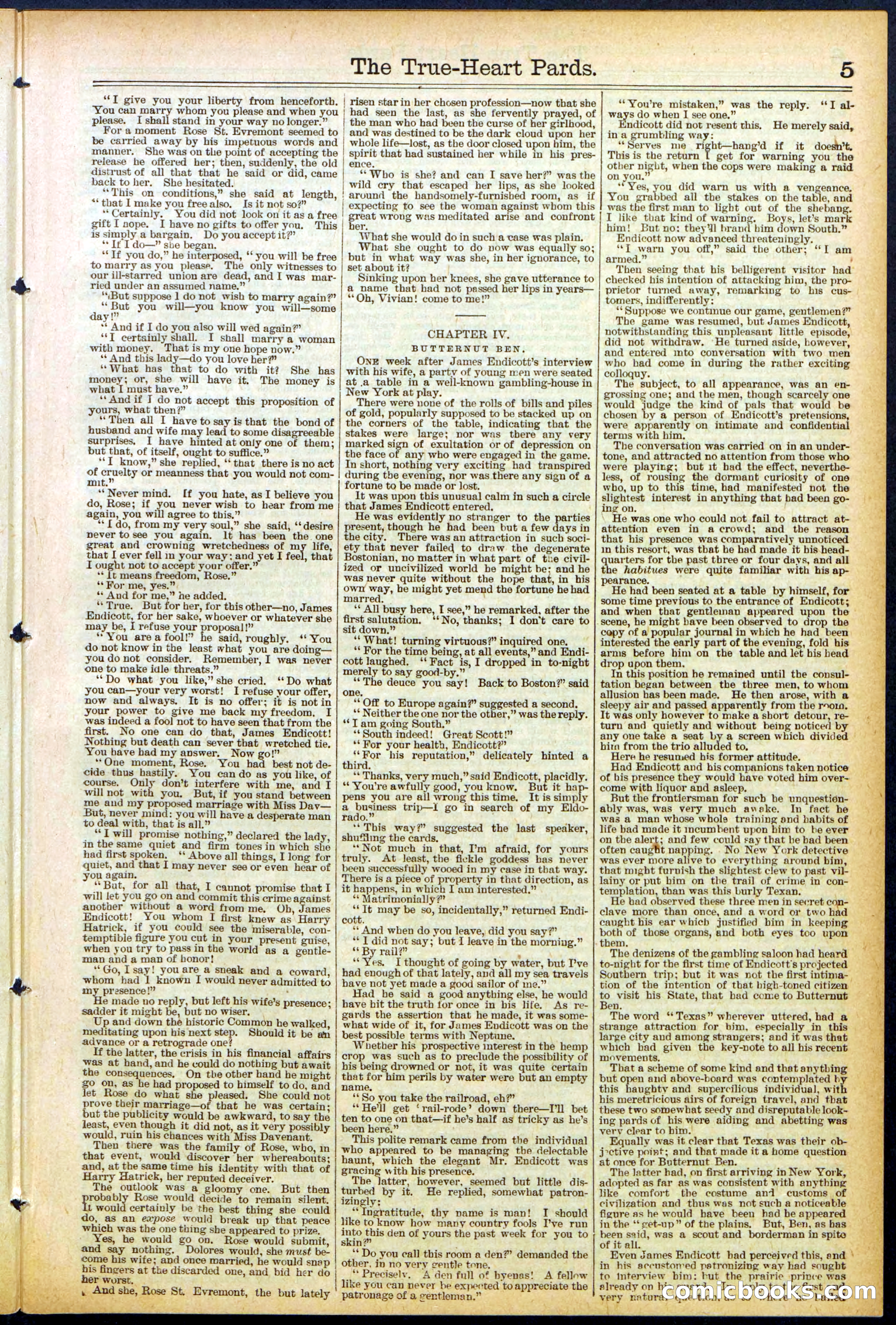
A restored page from Pulp Fiction, 1888. Page through the whole issue in the reader above.
📄 Transcribed text from this page (OCR, searchable)
Machine-transcribed from the original scan — historical spelling and the odd misread are preserved.
The True-Heart Pards. risen star in her chosen profession—now that she had seen the last, as she fervently prayed, of | the man who had been the curse of her girlhood, and was destined to be the dark cloud upon her whole life—lost, as the door closed upon him, the spirit that had sustained her while in his pres- ‘I give you your liberty from henceforth. | ‘You can marry whom you please and when you | please. I shall stand in your way no longer.” Fora moment Rose St. Evremont seemed to | be carried away by his impetuous words and She was on the point of accepting the release he offered her; then, suddenly, the old distrust of all that that he said or did, came She hesitated. ‘This on conditions,” she said at length, *“that I make you freealso. Is it not so?” You did not look on it as a free I have no gifts to offer you. Do you accept it?” ** Who is she? and can I save her?” was the | wild cry that escaped her lips, as she looked : around the handsomely-furnished room, as if expecting to see the woman against whom this great wrong was meditated arise and confront is simply a bargain. ** [tf I do—” she began. “Tf you do,” he interposed, ‘‘ you will be free The only witnesses to What she would do in such a vase was plain. What she ought to do now was equally so; but in what way was she, in her ignorance, to to marry as you please. our ill-starred union are dead, and I was mar- ried under an assumed name,” ‘But suppose ] do not wish to marry again?” “ But you will—you know you will—some Sinking upon her knees, she gave utterance to a name that had not passed her lips in years— **Oh, Vivian! come to me!” ** And if I do you also will wed again?” ‘*T certainly shall. I shall marry a woman with money. That is my one hope now.” ** And this lady—do you love her?” ‘*What has that to do with it? money; or, she will have it, what I must have.” ‘*And if I do not accept this proposition of yours, what then?” “Then all I have to say is that the bond of husband and wife may lead to some disagreeable I have hinted at on! but that, of itself, ought to suffic “TI know,” she replied, ‘‘ that there is no act of cruelty or meanness that you would not com- CHAPTER IV. BUTTERNUT BEN, ONE week after James Endicott’s interview with his wife, a party of young men were seated at .a table in a well-known gambling-house in New York at play. There were none of the rolls of bills and piles of gold, popularly supposed to be stacked up on the corners of the table, indicating that the stakes were large; nor was tbere any very of exultation or of depression on ny who were engaged in the game. Tn short, nothing very exciting had transpired during tbe evening, nor was there any sign of a fortune to be made or lost. It was upon this unusual calm in such a circle that James Endicott entered, He was evidently no stranger to the present, though he had been but a few days in the city. There was an attraction in such soci- ety that never failed to draw the degenerate Bostonian, no matter in what part of tie civil- ized or uncivilized world be might be; and he was never quite without the hope that, in his own wey he might yet mend the fortune he had ** All busy here, I see,” he remarked, after the ‘**No, thanks; I don't care to ** What! turning virtuous?” inquired one. _ ‘* For the time being, at all events,” and Endi- ‘*Fact is, I dropped in to-night to say good-by.” e deuce you say! Back to Boston?” said The money is y one of them; ‘* Never mind. {f you hate, as I believe you do, Rose; if you never wish to hear from me again, you will agree to this,” ‘* { do, from my very soul,” she said, ‘‘ desire never to see you again. great and crowning wretchedness of m that I ever fell im your way; and yet I feel, that ht not to accept your offer.” ‘** it means freedom, R yes ** And for me “True. But for her, for this other—no, James Endicott, for her sake, whoever or whatever she may be, I refuse your proposa!!” ** You are a fool!” do not know in the least what you are doing— Remember, I was never first salutation. e said, roughly. you do not consider. one to make idle threats.” ‘*Do what you like,” she cried. you can—your very worst! I refuse your offer, It is no offer: it is not in your power to give me back my freedom, I was indeed a foo! not to have seen that from the first. No one can do that, James Endicott! Nothing but death can sever that wretched tie, You bave bad my answer, **One moment, Rose. You had best not de- - You can do as you like, of don’t interfere with me, and I ,if you stand between lage with Miss Day— have a desperate man declared the lady, tones in which she ** Above all things, quiet, and that I may never see or ev now and always, ‘“* Off to Europe again?” suggested a second. ‘* Neither the one nor the other,” was the reply. **T am going South.” ** South indeed! ‘**For your health, Endicott?” ‘ Fe Se his reputation,” delicately hinted a Great Scott!” cide thus hastily ‘* Thanks, very much,” said Endicott, placidly. “You're awfully good, you know, pens you are all wrong this time, It is simp a business trip—I go in search of my Eldo- ‘* This way?’ suggested the last speaker, shufiling the cards, **Not much in that, I’m afraid, for yours truly. At least, the fickle goddess has never been successfully wooed in my case in that way. There is a piece of property in that direction, as it happens, in which I am interested.” ** Matrimonially?” ‘**It may be so, incidentally,” returned Endi- me and my propos But, never mind: you will to deal with, that is all.” “I will promise nothing,” in the same quiet and firm had first spoken, “Bat, for all that, I caunot promise that I will let you go on and commit this crime against another without a word from me, You whom I first Hatrick, if you could see the temptible figure you cut in your p when you try to pass in the world man and a man of honor! “Go, Isay! you are a sneak and a coward, known I would never admitted to knew as Harry | cott. miserable, con- ** And when do you leave, did you say?” ** I did not say; but I leave in the morning.” es. I thought of going by water, but Pve had enough of that lately, and all my sea travels have not yet made a good sailor of me.” Had be said a good anything else, he would have bit the truth for once in bis life. gards the assertion that he made, it was some- what wide of it, for James Endicott was on the best possible terms with Neptune. Whether his prospective interest in the hemp was such as to preclude the possibility of ing drowned or not, it was quite certain that for him perils by water were but an empty ou take the railroad, eh?” get ‘rail-rode’ down there—I’ll bet e on that—if he’s half as tricky as he’s e made no reply, but left his wife’s presence; sadder it might be, but no wiser. | Up and down the historic Common he w meditating upon his next —_ Should it be an advance or a retro If the latter, the crisis in his financial affairs was at hand, and he could do nothing but await ences, On the otber hand he might leased. She could not that he was certain; @ awkward, to say the gh it did not, as it very possibly chances with Miss Davenant. mily of Rose, who, in ver her whereabouts: let Rose do what prove their marriage—o but the publicity would b least, even thou would, ruin his Then there was the fa that event, would disco and, at the same time his identity with that of Hatrick, her reputed deceiver. The outlook was a gloomy one. But then Rose would decide ‘to remain silent. certainly be the best thing she could n expose would break up that peace ch was the one thing she appeared to prize. Y t e would submit, othing. Dolores would, she must be- and once married, he would snap be discarded one, and bid her do This polite remark came from the individual who appeared to be managing the delectable haunt, which the elegant Mr. Endicott was with his presence. atter, however, seemed but little dis- turbed by it. He replied, somewhat patron- Ingratitude, thy name is man! like to know how many country fools I’ve run into this den of yours the past week for you to n?” demanded the would go on. ; ‘* Do you call this room a de other, in no very centile tone, ., Precisely, Aden full of byenas! <A fellow never be expected to appreciate the his fingers at t lik e but lately patrona *' oP oon fi we a oe peer a ae: aud! “4 My Sot sik be *“You’re mistaken,” was the reply. ‘I al- ways do when I see one.” ndicott did not resent this. He merely said, ina grumbling way: “Serves me Wi, Loa tpl So if it doesn’t, This is the return | get for warning you the other night, when the cops were making a raid on you.’ ‘** Yes, you did warn us with a vengeance. You grabbed all the stakes on the table, and was the first man to light out of the shebang. I like that kind of warning. Boys, let’s mar him! But no: they brand bim down South.” Endicott now advanced threateningly. ‘“*T warn you off,” said the other; “I am armed.” Then seeing that his belligerent visitor had’ checked his intention of attacking him, the pro- prietor turned away, remarking to his cus- | tomers, indifferently: ‘* Suppose we continue our game, gentlemen?” The game was resumed, but James Endicott, notwithstanding this unpleasant little episode, did not withdraw. He turned aside, however, and entered mto conversation with two men who had come in during the rather exciting colloquy. The subject, to all appearance, was an en- grossing one; and the men, though scarcely one would judge the kind of pals that would be chosen by a person of Endicott’s pretensions, were apparently on intimate and confidential terms with him. The conversation was carried on in an under- tone, and attracted no attention from those who were playing; but it bad the effect, neverthe- less, of rousing the dormant curiosity of one who, up to this time, had manifested not the slightest interest in anything that bad been go- ing on. \ He was one who could not fail to attract at- — attention even in a crowd; and the reason that his presence was comparatively unnoticed in this resort, was tbat he had made it bis head- uarters for the past three or four days, and all a the habitues were quite familiar with hisap- rance. (i He had been seated at a table by himself, for — some time previous to the entrance of Endicott; and when that gentleman appeared upon the scene, he might bave been observed to drop the copy of a popular journal in which he had been interested the early part of the evening, fold his arms before him on the table and let his head drop upon them, In this position he remained until the consul- tation began between the three men, to whom eam allusion has been made, He then arose, with a sleepy air and passed apparently from the roo, It was only however to make a short ert re- Bi turn and quietly and without being noticed b any one take a seat by a screen which divided ip hirn from the trio alluded to, Here he resumed his former attitude. Had Endicott and his companions taken notice of bis presence they would have voted him over- ES ‘ & YY Ae * come with liquor and asleep, But the frontiersman for such he unquestion- __ ably was, was very much aweke. In fact he was a man whose whole training and habitsof __ life bad made it incumbent upon him to be ever on the alert; and few could say that he bad been _ hS often caught napping. No New York detective was ever more alive to everything around bim, _ that might furnish the slightest clew to past vil- lainy or put bim on the trail of crime in con-— templation, than was this burly Texan. ; He bad observed these three men in secret con- , Fe clave more than once, and a word or twohad | caught his ear which justified bim in keeping _ both of those organs, and both eyes too upon — them. . a) The denizens of the gambling saloon had heard to-night for the first time of Endicott's projected ie Southern trip; but it was not the first in tion of the intention of that high-toned citizen to visit his State, that bad come to Butternut en. igo The word ‘* Texas” wherever uttered, had a strange attraction for bim, especially in this 2 large city and among strangers; and it wasthat which had given the key-note toallhisrecent — movements. Tole That a scheme of some kind and that anything but 5 and above-board was contemplated by this his meretricious airs of foreign travel, and that aughty and supercilious individual, with these two somewhat seedy and disreputablelook~ ing pards of his were aiding and abetting was very clear to him.’ | Catal Equally was it clear that Texas was their ob-_ jrctive point; and that made it a home question at once for Butternut Ben. > The latter had, on first arriving in New York, adopted as far as was consistent with anything like comfort the costume ani customs of | civilization and thus was not such a noticeable _ figure as he would have been had he appeared in the “set-up” of the plains. But, Ben, as has been bade was a scout and borderman in spite of it a 5 ; * > Even James Endicott had perceived this, and ‘ | in his accustomed pstronizing way had sought — he prairie prince was =" to interview bim: but t already on Woon) So ae J * [Eee > he ‘Po a” : —— ea, —_ wee