
Pulp Fiction, 1888 · page 25 of 32
Beadle's New York Dime Library, No. 500 — page 25: what you’re looking at
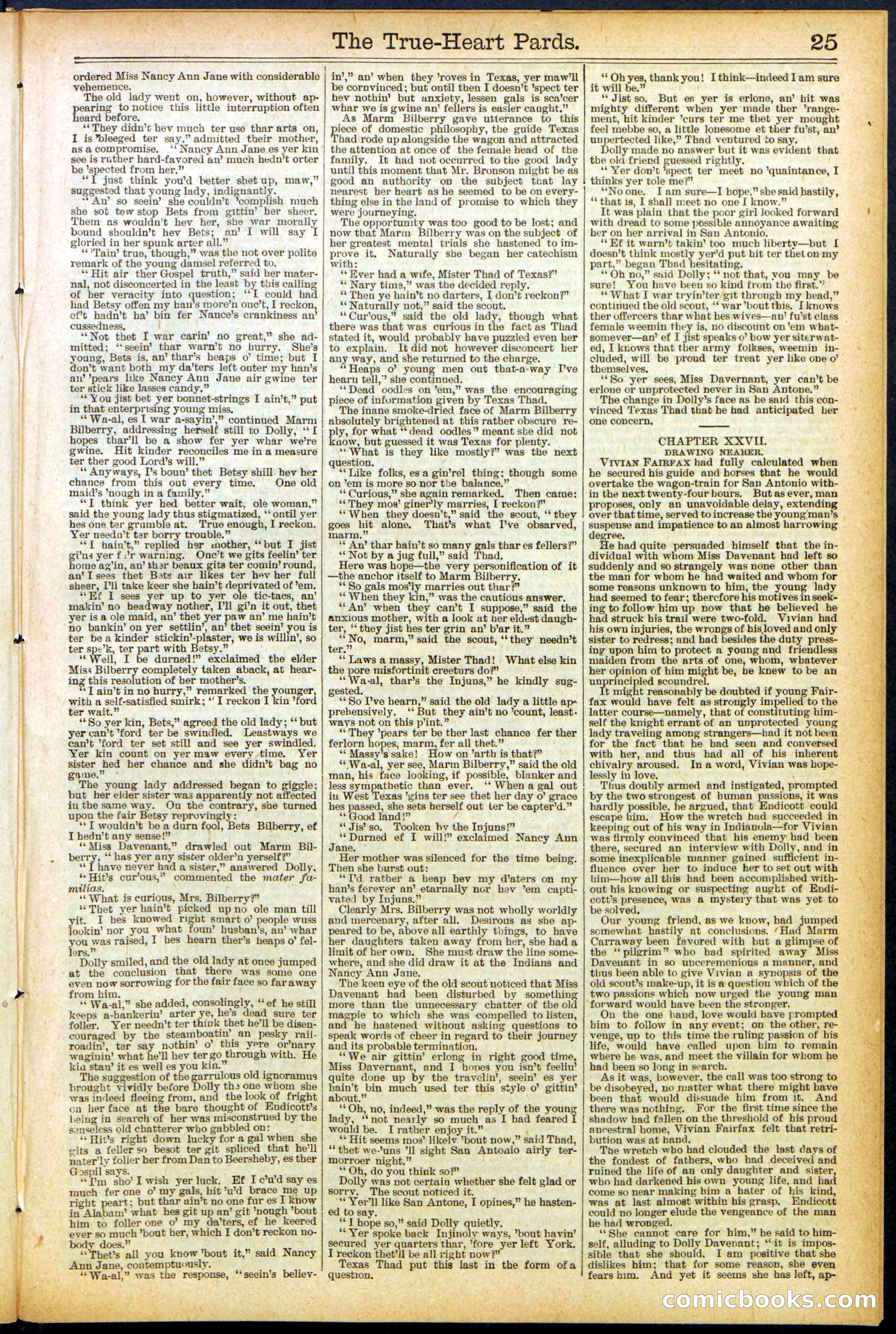
A restored page from Pulp Fiction, 1888. Page through the whole issue in the reader above.
📄 Transcribed text from this page (OCR, searchable)
Machine-transcribed from the original scan — historical spelling and the odd misread are preserved.
dy * The True-Heart Pards. 25 ordered Miss Nancy Ann Jane with considerable vehemence, The old lady went on, however, without ap- earing to notice this little interruption often feard before. ‘*They didn’t hev much ter use thar arts on, I is bleeged ter say,” admitted their mother, as acompromise, ‘' Nancy Ann Jane es yer kin see is ruther hard-favored an’ much hedn’t orter be ’spected from her.” “| just think you'd better shet up, maw,” suggested that young lady, indignantly. | in’,” an’ when they ’rovesin Texas, yer maw’ll be cornvinced; but ontil then I doesn’t ’spect ter hey nothin’ but unxiety, lessen gals is sca’cer whar we is gwine an’ fellers is easier caught.” As Marm Bilberry gave utterance to this eee of domestic philosophy, the guide Texas had rode up alongside the wagon and attracted the attention at once of the female head of the family. It had not occurred to the good lady until this moment that Mr. Bronson might be as good an authority on the subject that lay nearest her heart as he seemed to be on every- ‘** An’ so seein’ she couldn’t ’complish much | thing else in the land of promise to which they she sot tew stop Bets from gittin’ her sheer. | Them as wouldn’t hev her, she war morally bound shouldn’t hey Bets; an’ I will say I gloried in ber spunk arter all.” “°Tain’ true, though,” was the not over polite remark of the young damsel referred to, “‘ Hit air ther Gospel truth,” said her mater- nal, not disconcerted in the least by this calling of her veracity into question; “I could had had Betsy offen my kan’s more’n onc’t, I reckon, ef’t hadn’t ha’ bin fer Nance’s crankiness an’ cussedness, ‘‘Not thet I war carin’ no great,” she ad- mitted; ‘‘seein’ thar warn’t no hurry. She’s young, Bets is, an’ thar’s heaps o’ time; but I don’t want both my da’ters left onter my han’s an’ pears like Nancy Ann Jane air gwine ter ter stick like lasses candy.” ** You jist bet yer bonnet-strings I ain’t,” put in that enterprising young miss, ‘“Wa-al, es | war a-sayin’,” continued Marm Bilberry, addressing herself still to Dolly, ‘I hopes thar’ll be a show fer yer whar we're gwine. Hit kinder reconciles me in a measure ter ther good Lord’s will.” ‘** Anyways, I’s boun’ thet Betsy shill hev her chance from this out every time. One old maid’s *nough in a family.” ‘‘I] think yer hed better wait, ole woman,” said the young lady thus stigmatized, ‘‘ ontil yer hes one ter grumble at. True enough, I reckon. Yer needu’t ter borry trouble.” ‘*T hain’t,” replied her mother, *‘ but I jist ns yerfv’r warning. Onc’t we gits feelin’ ter tel ag’in, an’ thar beaux gits ter comin’ round, an’I sees thet Bets air likes ter hev her full sheer, [’li take keer she hain’t deprivated of ’em, “Efe I sees yer up to yer ole tic-tacs, an’ makin’ no headway nother, [ll gi’n it out, thet yer is a ole maid, an’ thet yer paw an’ me hain’t no bankin’ on yer settlin’, an’ thet seein’ you is ter bea kinder stickin’-plaster, we is willin’, so ter spe’k, ter part with Betsy.” ‘* Weil, I be durned!” exclaimed the elder Mis; Bilberry completely taken aback, at hear- ing this resolution of ber mother’s. ‘I ain’t in no hurry,” remarked the younger, with a self-satisfied smirk; ‘‘ I reckon I kin ’ford ter wait.” ‘*So yer kin, Bets,” agreed the old lady; ‘* but yer can’t ford ter be swindled. Leastways we can’t "ford ter set still and see yer swindled. Yer kin count on yer maw every time. Yer sister shed her chance and she didn’t bag no game, The young lady addressed began to giggle; but_ her elder sister was apparently not affected in the same way. On the contrary, she turned upon the fair Betsy reprovingly: ‘*T wouldn’t be a durn fool, Bets Bilberry, ef T hedn’t any sense!” ‘* Miss Davenant.” drawled out Marm Bil- berry, ‘‘ has yer any sister older’n yerself?” ‘*] have never had a sister,” answered Dolly. ‘ Hit’s cur’ous,” commented the mater fa- milias. ‘‘ What is curious, Mrs, Bilberry?” “Thet yer hain’t picked upno ole man till it. I bes knowed right smart o’ people wuss ookin’ nor you what foun’ husban’s, an’ whar you was raised, I bes hearn ther’s heaps o’ fel- lers.” Dolly smiled, and the old lady at once jumped at the conclusion that there was some one even now sorrowing for the fair face so faraway from bim. ; ‘‘ Wa-al,” she added, consolingly, “ef he still keeps a-hankerin’ arter ye, he’s dead sure ter foller. Yer needn’t ter think thet he'll be disen- couraged by the steamboatin’ an pesky rail- roadin’, ter say nothin’ o’ this yere or’nary waginin’ what he'll hev ter go through with. He kia stau’ it es well es you kia.” 5 The suggestion of the garrulous old ignoramus brought vividly before Dolly the one whom she was in‘leed fleeing from, and the look of fright on her face at the bare thought of Endicott’s being in search of her was misconstrued by the senseless old chatterer who gabbled on: ‘it’s right down lucky for a gal when she cits a feller so besot ter git spliced that he’ll nater'ly folier her from Dan to Beersheby, es ther Gospil says. Pm phat I wish yer luck. Ef I c’u’d say es much fer one o’ my gals, hit’u’d brace me up right peart; but thar ain’t no one fur es I know in Alabam’ what hes git up an’ git ’nough ’bout him to foller one o’ my da’ters, ef he keered ever so much ’bout her, which I don’t reckon no- body does.” “Thet’s all you know ’bout it,” said Nancy Ann Jane, contemptuvusly. : “‘ Wa-al,” was the response, “‘seein’s believ- ee were journeying. The opportunity was too good to be lost; and now that Marm Bilberry was on the subject of her greatest mental trials she hastened to im- prove it. Naturally she began her catechism with: ‘* Ever had a wife, Mister Thad of Texas?’ ‘* Nary time,” was the decided reply. ** Then ye hain’t no darters, I don’t reckon?” ** Naturally not,” said the scout. “Cur’ous,” said the old lady, though what there was that was curious in the fact as Thad stated it, would probably have puzzled even her to explain. It did not however disconcert her any way, and she returned to the cbarge. “Heaps o’ young men out that-a-way I’ve hearn tell,” she continued, ‘*Dead oodles on ’em,” was the encouraging piece of information given by Texas Thad. The inane smoke-dried face of Marm Bilberry absolutely brightened at this rather obscure re- ply, for what ‘‘dead oodles” meant ske did not aow, but guessed it was Texas for plenty. ‘What is they like mostly?” was the next question, ‘** Like folks, esa gin’rel thing; though some on ’em is more so nor the balance,” ‘* Curious,” she again remarked, Then came: ‘¢ They mos’ giner’ly marries, [ reckon?” ‘* When they doesn’t,” said the scout, ‘* the goes hit alone. That’s what I’ve obsarved, marm.” ** An’ thar hain’t so many gals thar es fellers?” *‘ Not by a jug full,” said Thad. Here was hope—the very personification of it —the anchor itself to Marm Bilberry. ** So gals mos’ly marries out thar?” ** When they kin,” was the cautious answer. **An’ when they can’t I suppose,” said the anxious mother, with a look at her eldest daugh- ter, ‘‘they jist hes ter grin an’ b’ar it.” ‘*No, marm,” said the scout, ‘‘they needn’t ter.” ‘* Laws a massy, Mister Thad! What else kin the pore misfortinit creeturs do?” ‘*Wa-al, thar’s the Injuns,” he kindly sug- gested. ‘**So [ve hearn,” said the old lady a little ap- prehensively, ‘* But they ain’t no ’count, least- ways not on this p’int.” ‘They pears ter be ther last chance fer ther ferlorn hopes, marm, fer all thet.” ‘* Massy’s sake! How on’arth is that?” ** Wa-al, yer see, Marm Bilberry,” said the old man, his face looking, if possible, blanker and less sympathetic than ever. ‘* Whena gal out iu West Texas ’yins ter see thet her day o’ grace hes passed, she sets herself out ter be capter’d.” ** Good land!” ** Jis’so, Tooken by the Injuns!” ‘*Durned ef I will!” exclaimed Nancy Ann ane, Her mother was silenced for the time being. Then she burst out: ‘““['d rather a heap hev my d’aters on my han’s ferever an’ etarnally nor hev ’em capti- vated by Injuns.” Clearly Mrs. Bilberry was not wholly worldly and mercenary, after all. Desirous as she ap- peared to be, above all earthly things, to have her daughters taken away from her, she hada limit of her own. She must draw the line some- where, and she did draw it at the Indians and Nancy Ann Jane. The keen eye of the old scout noticed that Miss Davenant had been disturbed by something more than the unnecessary chatter of the old magpie to which she was compelled to listen, and he hastened without asking questions to speak words of cheer in regard to their journey and its probable termination. ‘We air gittin’ erlong in right good time, Miss Davernant, and I hopes you isn’t feelin quite done up by the travelin’, seein’ es yer hain’t bin much used ter this style o’ gittin’ about.” ‘*Oh, no, indeed,” was the reply of the young lady, ‘‘not nearly so much as I had feared I would be. I rather enjoy it.” ** Hit seems mos’ likelv "bout now,” said Thad, “thet we’uns ‘Il sight San Antoaio airly ter- morroer night,” ** Oh, do you think so?” Dolly was not certain whether she felt glad or sorrv. The scout noticed it. ‘** Yer'll like San Antone, I opines,” he hasten- ed to say. ‘**T hope so,” said Dolly quietly. ‘** Yer spoke back Injinoly ways, bout havin’ secured yer a er thar, ’fore yer left York. I reckon thet’ll be all right now?” Texas Thad put this last in the form ofa question, sss esses ‘* Oh yes, thank you! I think—indeed I am sure it will be.” ** Jist so. But es yer is erlone, an’ hit was mighty different when yer made ther ’range- ment, hit kinder ’curs ter me thet yer mought feel mebbe so, a little lonesome et ther fu’st, an’ uupertected like,” Thad ventured to say. olly made no answer but it was evident that the old friend guessed rightly. ‘** Yer don’t ’spect ter meet no ’quaintance, I thinks yer tole me?” ‘*‘Noone. Iam sure—I hope,” she said hastily, ** that is, I shall meet no one I know.” It was plain that the poor girl looked forward with dread to some possible annoyance awaiting ber on her arrival in San Antonio. ‘* Ef it warn’t takin’ too much liberty—but [ doesn’t think at yer’d put bit ter theton my part,” began Thad hesitating. **Oh no,” suid Dolly; ** not that, vou may be sure! You have been so kind from the first.” “What I war tryin’ter git through my head,” continued the old scout, ‘‘ war’bout this, I knows ther offercers thar what hes wives—an’ fu’st class female weemin they is, no discount on’em what- somever—an’ ef I jist speaks 0’ bow yer siterwat- ed, I knows that ther army folkses, weemin in- cluded, will be proud ter treat yer like one o’ themselves, ‘*So yer sees, Miss Davernant, yer can’t be erlone or unprotected never in San Antone.” The change in Dolly’s face as he said this con- vinced Texas Thad that he had anticipated her one concern, CHAPTER XXVILI. DRAWING NEAHER. VIVIAN Farrrax had fully calculated when he secured his guide and horses that he would overtake the wagon-train for San Antonio with- in the next twenty-four hours. Butas ever, man proposes, only an unavoidable delay, extending over that time, served to increase the young man’s ae and impatience to an almost harrowing egree, e had quite persuaded himself that the in- dividual with whom Miss Davenant had left so suddenly and so strangely was none other than the man for whom he had waited and whom for some reasons unknown to him, the young lady had seemed to fear; therefore his motives in seek- ing to follow him up now that he believed he had struck his trail were two-fold. Vivian had his own injuries, the wrongs of his,loved and only sister to redress; and had besides the duty press- ing upon him to protect a young and friendless maiden from the arts of one, whom, whatever her opinion of him might be, be knew to be an unprincipled scoundrel. t might reasonably be doubted if young Fair- fax would have felt as strongly impelled to the latter course—namely, that of constituting him- self the knight errant of an unprotected young lady traveling among strangers—bad it not been for the fact that he had seen and conversed with her, and thus had all of his inherent chivalry aroused. Ina word, Vivian was hope- lessly in love. Thus doubly armed and instigated, prompted by the two strongest of human passions, it was hardly possible, he argued, that Endicott could escape him, How the wretch bad succeeded in keeping out of his way in Indianula—for Vivian was firmly convinced that his enemy had been there, secured an interview with Dolly, and in some inexplicable manner gained sufficient in- fluence over her to induce her to set out with him—how all this had been accomplished with- out his knowing or suspecting augbt of Endi- cott’s presence, was a mystery that was yet to be solved, Our young friend, as we know, had jumped somewhat hastily at conclusions. ‘Had Marm Carraway been favored with but a glimpse of the ‘“‘ pilgrim” who bad spirited away Miss Davenant in so unceremonious a manner, and thus been able to give Vivian a synopsis of the old scout’s make-up, it is a question which of the two passions which now urged the young man forward would have been the stronger. On the one hand, love would bave prompted him to follow in any event; on the other, re- venge, up to this time the ruling passion of his life, would have called upon bim to remain where he was, and meet the villain for whom he had been so long in search. As it was, however, the call was too strong to be disobeyed, no matter what there might have been that would dissuade him from it. And there was nothing. For the first time since the shadow had fallen on the threshold of his proud ancestral home, Vivian Fairfax felt that retri- bution was at band. The wretch who had clouded the last days of the fondest of fathers, who had deceived and ruined the life of an only daughter and sister, who had darkened his own young life, and had come so near making bim a hater of his kind, was at last almost within his grasp. Endicott could no longer elude the vengeance of the man he had wronged. “She eannot care for him,” he said to him- self, alluding to Dolly Davenant; “it is impos- sible that she should, I am positive that she dislikes him; that for some reason, she even fears him. And yet it seems she has left, ap- comicbooks: col