
Pulp Fiction, 1888 · page 15 of 32
Beadle's New York Dime Library, No. 500 — page 15: what you’re looking at
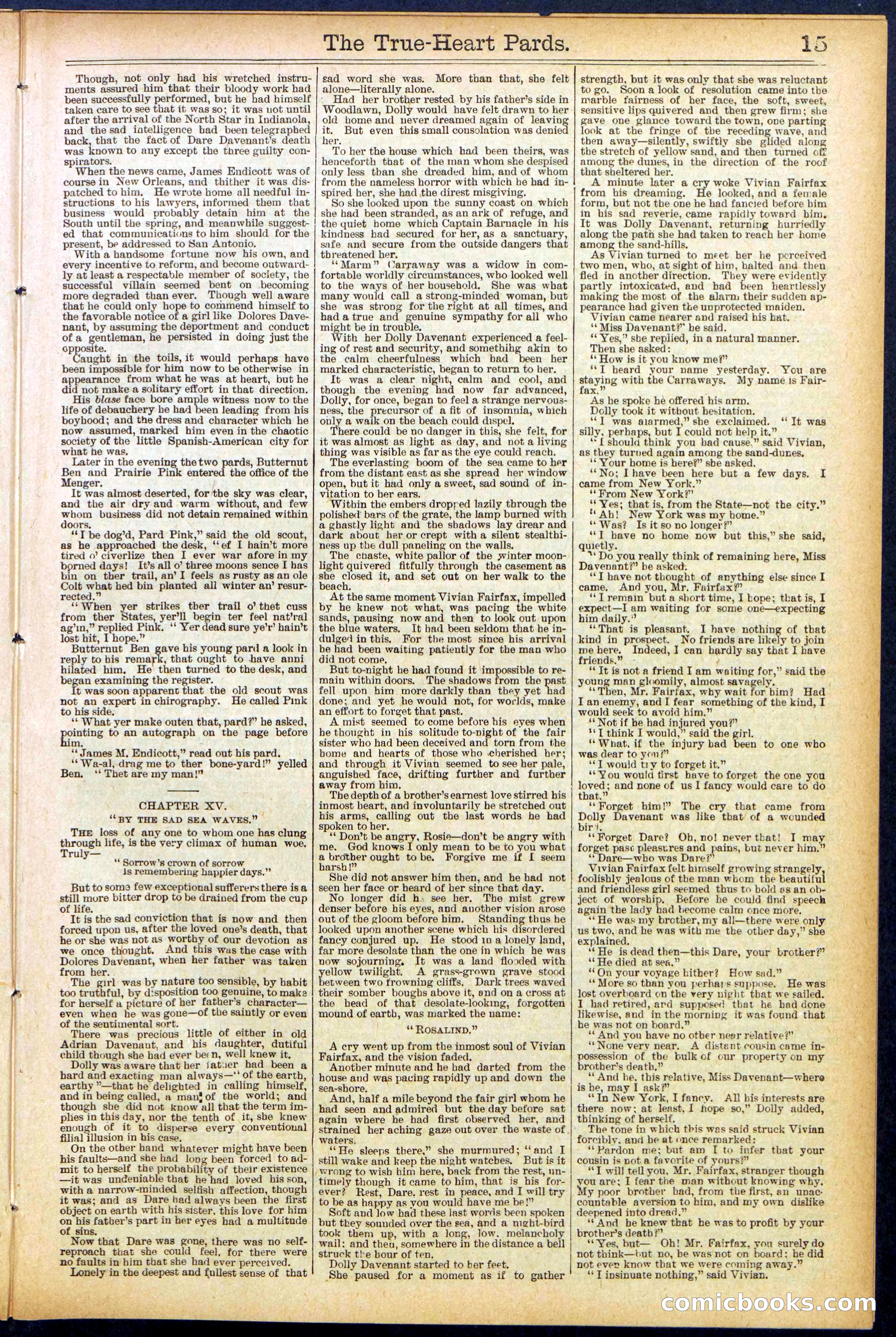
A restored page from Pulp Fiction, 1888. Page through the whole issue in the reader above.
📄 Transcribed text from this page (OCR, searchable)
Machine-transcribed from the original scan — historical spelling and the odd misread are preserved.
—_———— — ee = rer oy ee =ry _———« sine o——— i« — a ee aD lla a OU « ee = i 8 ‘ : 7 Z + » r na a "he . en te Nyt oe * rae AX | . ~ iy se a 7 ‘ The True-Heart Pards. Though, not only had his wretched instru- ments assured him that their bloody work had been successfully performed, but he had himself taken care to see that it} was so; it was uot until after the arrival of the North Star in Indianola, and the sad iatelligence bad been telegraphed back, that the fact of Dare Davenant’s death was known to any except the three guilty con- spirators, When the news came, James Endicott was of course in New Orleans, and thither it was dis- patched to him. He wrote home all needful in- structions to his lawyers, informed them that business would probably detain him at the South until the spring, and meanwhile suggest- ed that communications to him should for the present, be addressed to San Antonio. With a handsome fortune now his own, and every incentive to reform, and become outward- ly at least a respectable member of society, the successful villain seemed bent on becoming more degraded than ever. Though well aware that he could only hope to commend himself to the favorable notice of a girl like Dolores Dave- nant, by assuming the deportment and conduct ofa gentleman, he persisted in doing just the Kime eY.. aught in the toils, it would perhaps have been impossible for him now to be otherwise in appearance from what he was at heart, but he did not make a solitary effort in that direction. His blase face bore gs agg now to the life of debauchery he had n leading from his boyhood; and the dress and character which he now assumed, marked him even in the chaotic society of the little Spanish-American city for what he was, Later in the evening thetwo pards, Butternut Ben and Prairie Pink entered the office of the Menger. It was almost deserted, for the sky was clear, and the air dry and warm without, and few pie business did not detain remained within oors, ‘*T be dog’d, Pard’ Pink,” said the old scout, as he approached the desk, ‘‘ef I hain’t more tired 0’ civerlize then I ever war afore in my borned days! It’s all o’ three moons sence I has bin on ther trail, an’ I feels as rusty as an ole Colt what hed bin planted all winter an’ resur- rected.” ‘“When yer strikes ther trail o’ thet cuss from ther States, yer’ll begin ter feel nat’ral ag’in,” replied Pink. ‘‘ Yer dead sure ye’r’ hain’t lost hit, I hope.” Butternut Ben eh his young pard a look in reply to bis remark, that ought to have anni hilated him, He then turned to the desk, and began examining the register. t was soon apparent that the old scout was not an expert in chirography. He called Pink to his side. ‘‘ What yer make outen that, pard?” he asked, ointing to an autograph on the page before m. ‘** James M, Endicott,” read out his pard. ‘*Wa-al, drag me to ther bone-yard!” yelled Ben. ‘‘ Thet are my man!” CHAPTER XV. ‘“BY THE SAD SEA WAVES.” THE loss of any one to whom one has clung through life, is the very climax of human woe, Truly— ** Sorrow’s crown of sorrow is remembering happier days.” But to some few exceptional sufferers there is a still mvre bitter drop to be drained from the cup of life. It is the sad conviction that is now and then forced upon us, after the loved one’s death, that he or she was not as worthy of our devotion as we once thought. And this was the case with Dolores Davenant, when her father was taken from her. : The girl was by nature too sensible, by habit too truthful, by d:sposition too genuine, to make for herself a picture of her father’s character— even when he was goue—of the saintly or even of the sentimental sort. _ , There was precious little of either in old Adrian Davenant, and his daughter, dutiful child though she had ever bern, well knew it, Dolly was aware that her jatuer had been a hard and exacting man always—*' of the earth, earthy ”—that he delighted in calling himself, and in being called, a mantof the world; and though she did not know all that the term im- plies in this day, nor the tenth of it, she knew enough of it to disperse every conventional filial illusion in his case, On the other hand whatever might have been his faults—and she had long been forced to ad- mit to herself the probability of their existence —it was undeniable that he had loved his son, with a narrow-minded selfish affection, though it was; and as Dare had always been the first object on earth with his sister, this love for him on his father’s part in her eyes had a multitude of sins. Now that Dare was gone, there was no self- reproach that she could feel, for there were sad word she was. More than that, she felt alone—literally alone. Had her brother rested by his father’s side in Woodlawn, Dolly would have felt drawn to her old home and never dreamed again of leaving a But even this small consolation was denied er. To her the house which had been theirs, was henceforth that of the man whom she despised only less than she dreaded him, and of whom from the nameless horror with which he had in- spired her, she had the direst misgiving. So she looked upon the sunny coast on which she had been stranded, as an ark of refuge, and the quiet home which Captain Barnacle in his kindness had secured for her, as a sanctuary, safe and secure from the outside dangers that threatened her. ‘*Marm” Carraway was a widow in com- fortable worldly circumstances, who looked well to the ways of her household. She was what many would call a strong-minded woman, but she was strong for the right at all times, and had atrue and genuine sympathy for all who might be in trouble. With her Dolly Davenant experienced a feel- ing of rest and security, and somethihg akin to the calm cheerfulness which had been her marked characteristic, began to return to her. It was a clear night, calm and cool, and though the evening had now far advanced, Dolly, for once, began to feel a strange nervous- ness, the precursor of a fit of insomnia, which a a waik on the beach could dispel. here could be no danger in this, she felt, for it was almost as light as day, and nota living thing was visible as far as the eye could reach. The everlasting boom of the sea came to her from the distant east as she spread her window open, but it had only a sweet, sad sound of in- vitation to her ears. Within the embers dropred lazily through the polished bars of the grate, the lamp burned with a ghastly light and the shadows lay drear and dark about her or crept with a silent stealthi- ness up the dull paneling on the walls. The chaste, white pallor of the winter moon- light quivered fitfully throngh the casement as she closed it, and set out on her walk to the beach. At the same moment Vivian Fairfax, impelled by he knew not what, was pacing the white sands, pausing now and then to look out upon the blue waters, It had been seldom that he in- dulged in this. For the most since his arrival he had been waiting patiently for the man who did not come, But to-night he had found it impossible to re- main within doors. The shadows from the past fell upon him more darkly than they yet had done; and yet he would not, for worlds, make an effort to forget that past. A mist seemed to come before his eyes when he thought in his solitude to-night of the fair sister who had been deceived and torn from the bome and hearts of those who cherished her; and through it Vivian seemed to see her pale, anguished face, drifting further and further away from him. The depth of a brother’s earnest love stirred his inmost heart, and involuntarily he stretched out his arms, calling out the last words he had spoken to her. ‘** Don’t be augry. Rosie—don’t be angry with me. God knows I only mean to be to you what a brother ought to be. harsh!” She did not answer him then, and he had not seen her face or heard of ber since that day. No longer did h- see her. The mist grew denser before his eyes, and another vision arose out of the gloom before him. Standing thus he looked upon another scene which his disordered fancy conjured up. He stood ina lonely land, far more desolate than the one in which he was now sojourning, It was a land flooded with alee twilight. A grass-grown grave stood etween two trowning cliffs, Dark trees waved their somber boughs above it, and on a cross at the head of that desolate-lookmg, forgotten mound of eartb, was marked the name: **¢ ROSALIND,” A ery went up from the inmost soul of Vivian Fairfax, and the vision faded. Another minute and he had darted from the house and was pacing rapidly up and down the sea-shore, And, half a mile beyond the fair girl whom he had seen and admired but the day before sat again where he had first observed her, and strained her aching gaze out over the waste of waters, ‘‘He sleeps there,” she murmured; ‘‘and I still wake and keep the night watcbes. But is it / wrong to wish him here, back from the rest, un- timely though it came to him, that is his for- ever? Rest, Dare, rest in peace, and I will try to be as happy as you would have me be!” Soft and low had these last words been spoken but they sounded over the sea, and a night-bird took them up, with a long, low. melanchol wail: and then, somewhere in the distance a be struck the hour of ten, Forgive me if I seem ——— ee — ees ite ee er l= strength, but it was only that she was reluctant to go. Soon a look of resolution came into the marble fairness of her face, the soft, sweet, sensitive lips quivered and then grew firm; she gave one glance toward the town, ove parting look at the fringe of the receding wave, and then away—silently, swiftly she glided along the stretch of yellow sand, and then turned off among the dunes, in the direction of the roof that sheltered her. A minute later a cry woke Vivian Fairfax from his dreaming. e looked, and a female form, but not the one he had fancied before him in his sad reverie, came rapidly toward bim, It was Dolly Davenant, returning hurriedly along the path she had taken to reach her home among the sand-hills, As Vivian turned to meet ber he perceived two men, who, at sight of him, halted and then fled in ancther direction. They were evidently partly intoxicated, and had been heartlessly making the most of the alarm their sudden ap- pearance had given the unprotected maiden. Vivian came nearer and raised his hat. ‘* Miss Davenant?” he said. * Yes,” she replied, in a natura] manner. Then she asked: ** How is it you know me?” ‘*T heard your name yesterday. You are staying with the Carraways. My name is Fair- ax, As he spoke he offered his arm. Dolly took it without hesitation. ‘“*] was alarmed,” she exclaimed. silly, perbaps, but I could not help it.” ‘**{ should think you bad cause.” said Vivian, as they turved again among the sand-dunes, ‘* Your home is here?” she asked. ‘‘ No; Ihave been here but a few days. I came from New York.” ‘*From New York?’ ‘*'Yes; that is, from the State—not the city.” *“ Ah! New York was my home.” ‘* Was? Is it so no longer?” ‘*T have no home now but this,” she said, quietly. **Do you really think of remaining here, Miss Davenant?” he asked. **T have not thought of anything else since I came, And you, Mr. Fairfax?’ ‘‘T remain but a short time, I hope; that is, I expect—I am waiting for some one—expecting him daily.” ‘That is pleasant. I have nothing of that kind in prospect. No friends are likely to join me here. Indeed, I can hardly say that I have friends.” r *« It is not a friend I am waiting for,” said the young man gloomily, almost savagely, ‘Then, Mr, Fairfax, why wait for bim? Had I an enemy, and I fear something of the kind, I would seek to avoid him,” ‘* Not if be had injured you?” **T think I would,” said the girl. ‘What, if the injury bad been to one who was dear to yon?” ‘*T would try to forget it.” ‘You would tirst have to forget the one you loved; and none of us I fancy would care to do that.” The cry “Tt was ‘* Forget him!” that came from ole Davenant was like that of a wounded gi fe ’ ‘‘Forget Dare? Ob, no! never that! I may forget pasc pleasures and pains, but never him,” ‘* Dare—who was Dare? Vivian Fairfax felt himself growing strangely, foolishly jealous of the man whom the beautiful and friendless girl seemed thus to bold ss an ob- ject of eS Before he could find speech again the lady had become calm once more, __ ‘He was my brother, my all—there were only us two, and he was with me the other day,” she | explained, ee ‘*He is dead then—this Dare, your brother?’ “* He died at sea,” *‘On your voyage hither? How sad.” ‘‘ More so than you perhars suppose. Hewas lost overboard on the very night that we sailed. I had retired, ard supposed that he had done likewise, and in the morning it was found that he was not on board,” “‘ And you have no other negr relative?” “None very near. A distant cousin came in- possession of the bulk of cur property on my brother’s death,” ** And he, this relative, Miss Davenant—where is he, may I ask? ““In New York, I fancy. All bis interests are there now; at least, 1 hope so,” Dolly added, thinking of herself. The tone in which this was said struck Vivian forcibly. and be at once remarked: ‘Pardon me; but am [ to infer that your cousin is not a favorite of yours?” } *“T will tell you, Mr. Fairfax, stranger though vou are; I fear the man without knowing why. y poor brother had, from the first, an unac- countable aversion to him, and my own dislike deepened into dread.” ‘* And he knew that he was to profit by your brother’s death?” ‘*Yes, but— Oh! Mr. Fairfax, you surely do not think—tut no, be was not on board; he did a . FP vw, * s, * ¢ s = OOS. ee oe ?, ‘ * “ ~~ ey Cae cet wi >» - et Pena ia ‘ aa r : aus me v5 oe Rie ; vs no faults in him that she had ever perceived. Dolly Davenant started to ber feet. not ever know that we were coming away.” Te. a Lonely in the deepest and fullest seuse of that' She paused for a moment as if to gather’ “ : insinuate nothing,” said Vivian. ty: fe Ge se. Foe en, ‘ a , pw) 0S ae ‘ 4 Wye eee os ait ai ) ; ; é - ahd ~ te be Fi it a =. - el “ : ; . ns ah 2 4 og , . ‘i Ls a / FD ee ae ee | NNT Sen OY See ee (nie Pa NE eee) Seen ye: piiie he edge aS SS ee bac Sls EID ea eR ; os