
Pulp Fiction, 1888 · page 13 of 32
Beadle's New York Dime Library, No. 500 — page 13: what you’re looking at
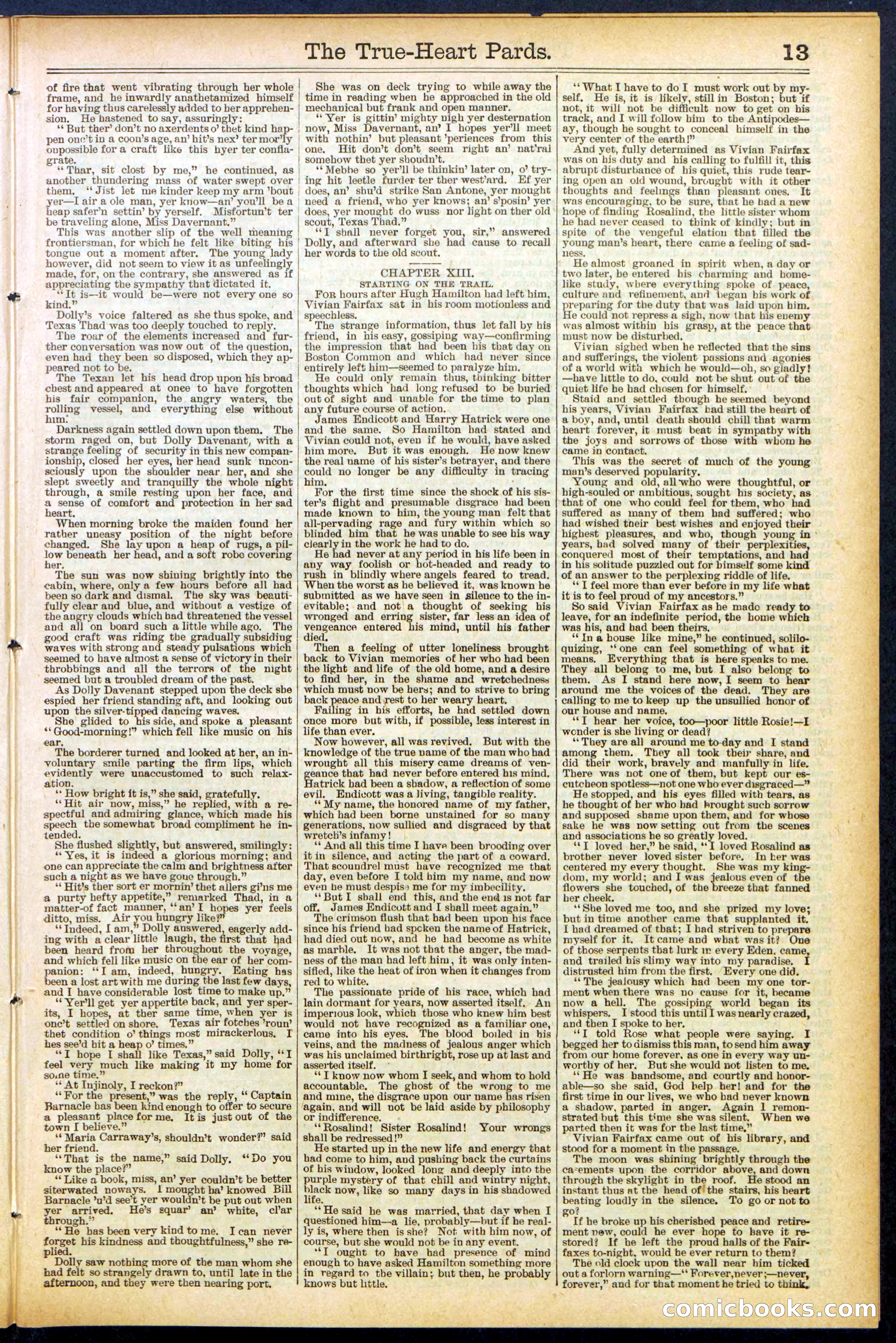
A restored page from Pulp Fiction, 1888. Page through the whole issue in the reader above.
📄 Transcribed text from this page (OCR, searchable)
Machine-transcribed from the original scan — historical spelling and the odd misread are preserved.
——— - - * mm - a - . er -- = eng a * 7 a at ua Se oe — } es Pas = aa ad Re ees ee ee ee, te . % . ‘ f 4 . =" ‘ ‘ . ; rT a vi | The True-Heart Pards. of fire that went vibrating through her whole frame, and he inwardly anathetamized himself for having thus carelessly added to ber apprehen- sion. He hastened to say, assuringly: ‘* But ther’ don’t no axerdents o’ thet kind P, pen onc’t in a coon’s age, an’ hit’s nex’ ter mor’ly oupossible for a craft like this hyer ter confla- grate. ‘Thar, sit clost by me,” he continued, as | another thundering mass of water swept over | them. ‘‘Jist let me kinder keep my arm ’bout yer—I air a ole man, yer know—an’ you'll bea heap safer’n settin’ by yerself. Misfortun’t ter be traveling alone, Miss Davernant.” This was another slip of the well meaning frontiersman, for which he felt like biting his tongue out a moment after. The young lady however, did not seem to view it as unfeelingly made, for, on the contrary, she answered as if appreciating the sympathy that dictated it, ‘It is—-it would be—were not every one so kind.” Dolly’s voice faltered as she thus spoke, and Texas Thad was too deeply touched to reply. The roar of the elements increased and fur- ther conversation was now out of the question, even had they been so disposed, which they ap- peared not to be. The Texan let his head drop upon his broad chest and appeared at onee to have forgotten his fair companion, the angry waters, the rolling vessel, and everything else without him. Darkness again settled down upon them, The storm raged on, but Dolly Davenant, with a strange feeling of security in this new compan- ionship, closed her eyes, her head sunk nncon- sciously upon the shoulder near her, and she slept sweetly and tranquilly the whole night through, a smile resting upon her face, and a sense of comfort and protection in her sad heart. When morning broke the maiden found her rather uneasy position of the night before changed. She lay upon a heap of rugs, a pil- ae beneath her head, and a soft robe covering er. The sun was now sbining brightly into the cabin, where, only a few hours before all had been so dark and dismal. The sky was beauti- fully clear and blue, and without a vestige of the angry clouds which had threatened the vessel and all on board such a little while ago. The good craft was riding the gradually subsiding waves With strong and steady pulsations which seemed to have almost a sense of victory in their throbbings and all the terrors of the night seemed but a troubled dream of the past. As Dolly Davenant stepped upon the deck sbe espied her friend standing aft, and looking out upon the silver-tipped dancing waves, She glided to his side, and spoke a pleasant **Good-morning!” which fell like music on his ear. The borderer turned and looked at her, an in- voluntary smile parting the firm lips, which evidently were unaccustomed to such relax- ation. ‘* How bright it is,” she said, gratefully. ‘*Hit air now, miss,” he replied, with a re- spectful and admiring glance, which made his — the somewhat broad compliment he in- tended. She flushed slightly, but answered, smilingly: “Yes, it is indeed a glorious morning; and one can appreciate the calm and brightness after such a night as we have gone through.” ‘* Hit’s ther sort er mornin’ thet allers gi’ns me a purty hefty appetite,” remarked Thad, in a matter-of fact manner, ‘‘an’I hopes yer feels ditto, miss. Air you hungry like?” ‘* Indeed, [ am, ’ Dolly auswered, eagerly add- ing with a clear little laugh, the first that had been heard from her throughout the voyage, and which fell like music on the ear of her com- panion: “I am, indeed, hungry. Eating has been a lost art with me during the last few days, and I have considerable lost time to make up,” ‘*Yer'll get yer appertite back, and yer sper- its, I hopes, at ther same time, when yer is once’t settled on shore. Texas air fotches ’roun’ thet condition o’ things most mirackerlous, I hes see’d bit a heap o’ times.” “I hope I shall like Texas,” said Dolly, ‘TI feel very much like making it my home for so.ne time.” ‘** At Injinoly, I reckon?” ‘‘For the present,” was the reply, “‘ Captain Barnacle bas been kind enough to offer to secure a pleasant placeforme, Itis just out of the town I believe.” ‘* Maria Carraway’s, shouldn’t wonder?” said her friend. “‘That is the name,” said Dolly. **‘Do you know the place?” ‘Like a book, miss, an’ yer couldn’t be better siterwated noways. 1 mought ha’ knowed Bill Barnacle ’u’d see’t yer wouldn’t be put out when yer arrived. He’s squar’ an’ white, cl’ar through.” . _ “He bas been very kindtome. Ican never forget his kindness and thoughtfulness,” she re- . aay, saw nothing more of the man whom she had felt so strangely drawn to, until late in the on, and they were then nearing port. 1 a, ~~ ee She was on deck trying to while away the | time in reading when he approached in the old | mechanical but frank and open manner. “Yer is gittin’ mighty pigh yer desternation | now, Miss Davernant, an’? I hopes yer’ll meet | with nothin’ but pleasant ’periences from this one. Hit don’t don’t seem right an’ nat’ral somehow thet yer shoudn’t. ‘*Mebbe so yer’ll be thinkin’ later on, 0’ try- ing hit leetle furder ter ther west’ard. Ef yer does, an’ shu’d strike San Antone, yer mought need a friend, who yer knows; an’ s’posin’ yer does, yer mought do wuss nor light on ther old scout, Texas Thad,” **T shall never forget you, sir,” answered Dolly, and afterward she had cause to recall her words to the old scout. CHAPTER XIII, STARTING ON THE TRAIL. For hours after Hugh Hamilton had left him, Vivian Fairfax sat in his room motionless and speechless, The strange information, thus let fall by his friend, in his easy, gossiping way—confirming | the impression that had been his that day on | Boston Common and which had never since entirely left him—seemed to paralyze him. ' He could only remain thus, thinking bitter | thoughts which had long refused to be buried out of sight and unable for the time to plan any future course of action. James Endicott and Harry Hatrick were one and the same. So Hamilton had stated and Vivian could not, even if he would, bave asked him more. But it was enough. He now knew the real name of his sister’s betrayer, and there could no longer be any difficulty in tracing him, For the first time since the shock of his sis- ter’s flight and presumable disgrace had beeu made known to him, the young man felt that all-pervading rage and fury within which so blinded him that he was unable to see bis way clearly in the work he had to do. He had never at any period in his life been in any way foolish or hot-headed and ready to rush in blindly where angels feared to tread. When the worst as he believed it, was known he submitted as we have seen in silence to the in- evitable; and not a thought of seeking his wronged and py sister, far less an idea of ope entered his mind, until his father ied, Then a feeling of utter loneliness brought back to Vivian memories of her who had been the light and life of the old home, and a desire to find her, in the shame and wretchedness which must now be hers; and to strive to bring back ates and rest to her weary heart. Failing in bis efforts, he had settled down once more but with, if possible, less interest in life than ever. Now however, all was revived. But with the knowledge of the true name of the man who had wrought all this misery came dreams of ven- eance that had never before entered his mind, atrick had been a sbadow, a reflection of some evil. Endivott was a living, tangible reality. ** My name, the honored name of my father, which had been borne unstained for so many generations, now sullied and disgraced by that wretch’s infamy! ‘** And all this time I have been brooding over itin silence, and acting the part of a coward. That scoundrel must have recognized me that day, even before I told bim my name, and now even he must despiss me for my imbecility, ‘*But I sball end this, and the end 1s not far off, James Endicott and I shall meet again.” The crimson flush that bad been upon his face since his friend bad spcken the name of Hatrick, had died out now, and he had become as white as marble. It was not that the anger, the mad- ness of the man had left him, it was only inten- sified, like the heat of iron when it changes from red to white. The passionate pride of his race, which had lain dormant for years, now asserted itself. An imperious look, which those who knew him best would not have recognized as a familiar one, came into his eyes. The blood boiled in his veins, and the madness of jealous anger which was his unclaimed birthright, rose up at last and asserted itself. ~ ‘‘T know now whom I seek, and whom to hold accountable. The ghost of the wrong to me and mine, the disgrace upon our name bas risen ‘again, and will not be laid aside by philosophy or indifference. ‘** Rosalind! Sister Rosalind! shall be redressed!” He started up in the new life and energy that bad come to him, and pushing back the curtains of his window, looked long and deeply into the purple mystery of that chill and wintry night, eee now, like so many days in his shadowed e. ‘*He said he was married, that day when I questioned him—a lie, probably—but if he real- ly is, where then isshe? Not with him now, of course, but she would not be in any event. “*T ought to bave had presence of mind enough to have asked Hamilton something more in regard to the villain; but then, he probably knows but little. Your wrongs eS res ee 2 ERE a Pe Ee Re re Sa a es eS ee ee a a ee ee eh ee ; weet Lanes eS 39 13 ‘* What I have to do I must work out by my- self. He is, it is likely, stillin Boston; but if not, it will not be difficult now to get on his track, and I will follow bim to the Antipodes— ay, though he sought to conceal himself in the very center of the earth!” And yet, fully determined as Vivian Fairfax was on his duty and his calling to fulfill it, this abrupt disturbance of his quiet, this rude tear- ing open an old wound, brought with it other thoughts and feelings than pleasant ones, It was encouraging, to be sure, that he bad a new hope of finding Rosalind, the little sister whom he had never ceased to think of kindly; but in spite of the vengeful elation that filled the young man’s heart, there came a feeling of sad- ness, He almost groaned in spirit when, a day or two later, be entered his charming and home- like study, where everything spoke of peace, culture and refinement, and began bis work of preparing for the duty that was laid upon him. He could not repress a sigh, now that his enemy was almost within bis grasp, at the peace that must now be disturbed, Vivian sighed when he reflected that the sins and sufferings, the violent passions and agonies of a world wita which be would—oh, so giadly! —have little to do, could not be shut out of the quiet life he bad chosen for himself, Staid and settled though he seemed beyond his years, Vivian Fairfax bad still the heart of a boy, and, until death should chill that warm heart forever, it must beat in sympathy with the joys and sorrows of those with whom he came in contact. This was the secret of much of the young man’s deserved popularity. Young and old, all'‘who were thoughtful, or high-souled or ambitious, sought his society, as that of one who could feel for them, who had suffered as many of them had suffered; who had wished their best wishes and enjoyed their highest pleasures, and who, though young in > years, bad solved many of their perplexities conquered most of their temptations, and had in his solitude puzzled out for bimself some kind of an answer to the perplexing riddle of life. ‘* I feel more than ever before in my life what it is to feel a of my ancestors.” So said Vivian Fairfax as he mado ready to leave, for an indefinite period, the home which was his, and had been theirs, ‘* In a house like mine,” he continued, solilo- quizing, ‘‘one can feel something of what it means, Everything that is here speaks to me. They all belong to me, but I also belong to them. As I stand here now, I seem to hear around me the voices of the dead. They are calling to me to keep up the unsuilied honor of our house and name, ‘*T hear her voice, too—poor little Rosie!—I wonder is she living or dead? ‘“They are all around me to-day and I stand among them. They all took theiy share, and did their work, bravely and manfully in life. There was not oneof them, but kept our es- cutcheon spotless—not one who ever disgraced—” He stopped, and his eyes filled with tears, as he thought of her who had brought sucb sorrow and supposed shame upon them, and for whose sake he was now setting out from the scenes and associations he so greatly loved. **T loved her,” he said, ‘I loved Rosalind as brotber never loved sister before. In her was centered my every thought. She was my king- dom, my world; and I was jealous even of the flowers she touched, of the breeze that fanned ber cheek, ‘She loved me too, and she prized my love; but in time another came that supplanted it. I had dreamed of that; I had striven to prepare myself for it. Itcame and what wasit? One of those serpents that lurk im every Eden, came and trailed his slimy way into my paradise. I distrusted him from the first. Every one did. ‘*'The jealousy which had been my one tor- ment when there was no cause for it, became now a hell. The ago world began its whispers. I stood this until I was nearly crazed, and then I spoke to her. ‘*T told Rose what people were saying. I begged her to dismiss this man, tosend him away from our home forever, as one in every way un- worthy of her. But she would not listen to me, ‘He was handsome, and courtly and honor- able—so she said, God help her! and for the first time in our lives, we who bad never known a shadow, parted in anger. Again 1 remon- strated but this time she was silent. When we parted then it was for the last time,” Vivian Fairfax came out of his library, and stood for a moment in the passage. The moon was shining brightly through the ca-ements upon the corridor above, and down through the skylight in roof. He stood an instant thus at the head of the stairs, his heart beating loudly in the silence, To go or not to 2 0? If he broke up his cherished peace and retire- ment new, could he ever hope to have it re- stored? If he left the proud halls of the Fair- faxes to-night, would be ever return to them? The old clock upon the wall near him ticked out a forlorn warning—* Forever,never ;—never, forever,” and for that moment he tried to t €: a 2 Te. * 3a p co ar —% ——_———— tab Th 6 Es ee eee A 48 vs, er sgl PPPs O oo