
Pulp Fiction, 1888 · page 9 of 32
Beadle's New York Dime Library, No. 484 — page 9: what you’re looking at
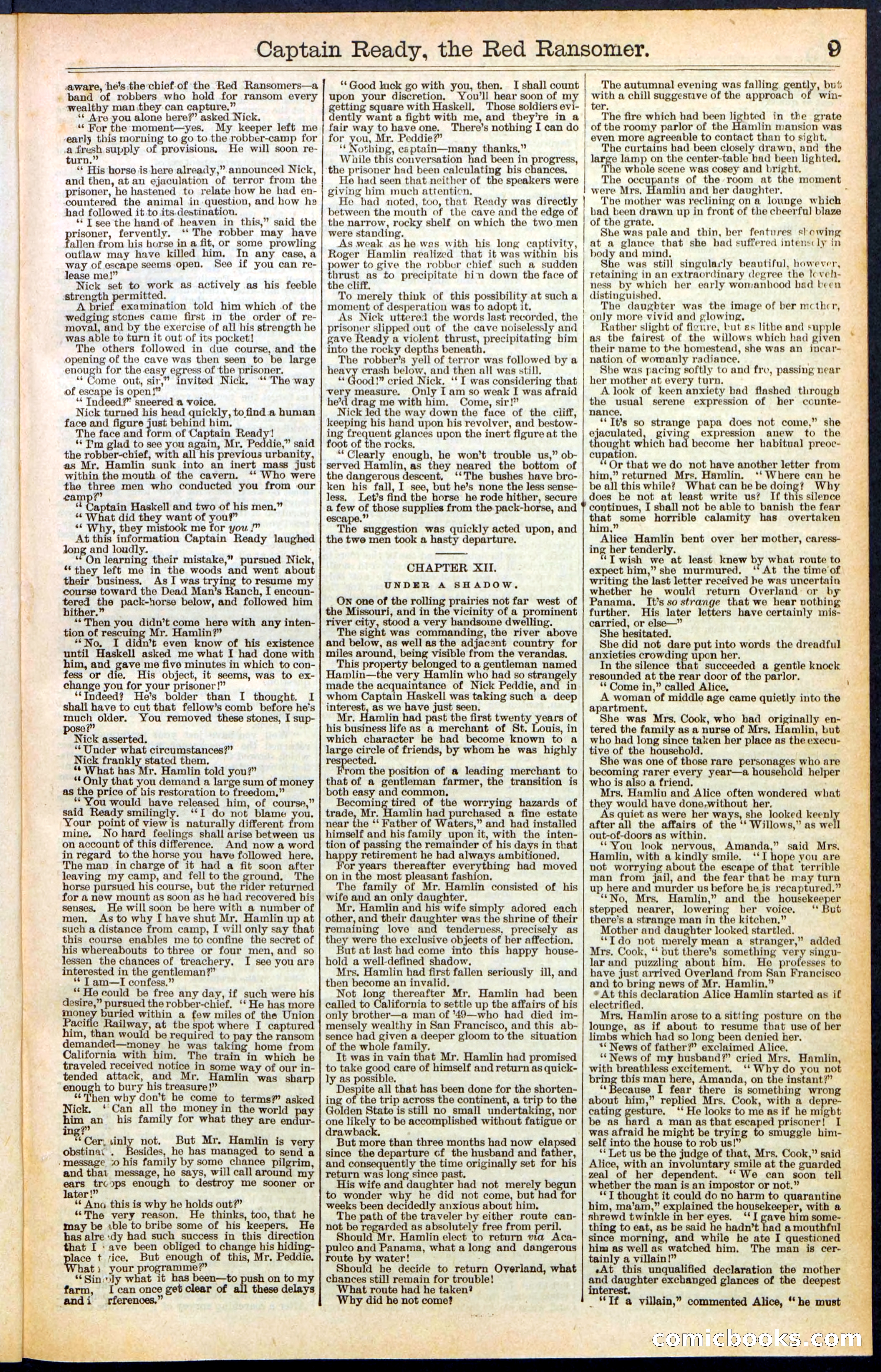
A restored page from Pulp Fiction, 1888. Page through the whole issue in the reader above.
📄 Transcribed text from this page (OCR, searchable)
Machine-transcribed from the original scan — historical spelling and the odd misread are preserved.
’ « . .m Captain Ready, | ne the Red Ransomer. 6 at » 9 aw. wealthy man they can capture.” ‘* Are you alone here?” asked Nick. ‘‘ For the moment—yes. My keeper left me { fair way to have one. | for you, Mr. Peddie?” early this morning to go to the robber-camp for a fresh supply of provisions, He will soon re- turn.” ‘* His horse is here already,” announced Nick, and then, at an ejaculation of terror from the prisoner, he hastened to relate how he had en- countered the animal in question, and how ha had followed it to its.destination. ‘‘ T see the hand of heaven in this,” said the risoner, fervently. ‘*‘ The robber may have allen from his horse in a fit, or some prowling outlaw may have killed him. Tn any case, a way of escape seems open. See if you can re- lease me!” Nick set to work as actively as his feeble strength permitted. A brief examination told him which of the wedging stones came first mm the order of re- moval, and by the exercise of all his strength he was able to turn it out of its pocket! The others followed in due course, and the opening of the cave was then seen to be large enough for the easy egress of ‘the prisoner. “Come out, sir,” invited Nick, “‘ The way of escape is open!” ‘* Indeed?” sneered a voice. Nick turned his head quickly, to find a human face and figure just behind him. The face and form of Captain Ready! ** ’m glad to see you again, Mr. Peddie,” said the robber-chief, with all his previous urbanity, as Mr. Hamlin sunk into an inert mass just within the mouth of the cavern. ‘‘ Who were the three men who conducted you from our oper “* Captain Haskell and two of his men.” “ What did they want of you?” *““ Why, they mistook me for you /” At this information Captain Ready laughed Jong and loudly. ‘On learning their mistake,” pursued Nick, “they left me in the woods and went about their business. As I was trying to resume my course toward the Dead Man’s Ranch, I encoun- tered the pack-horse below, and followed him hither.” ‘“*Then you didn’t come here with any inten- tion of rescuing Mr. Hamlin?” “No. I didn’t even know of his existence until Haskell asked me what I had done with him, and gave me five minutes in which to con- fess or die. His object, it seems, was to ex- change you for your prisoner!” ‘*Indeed? He’s bolder than I thought. I shall have to cut that fellow’s comb before he’s much older. You removed these stones, I sup- pose Nick asserted. ** Under what circumstances?” Nick frankly stated them. ** What has Mr. Hamlin told you?” ** Only that you demand a large sum of money as the price of his restoration to freedom.” ** You would have released him, of course,” said Ready smilingly. ‘‘I do not blame you. Your point of view is naturally different from mine. Nohard feelings shall arise between us on account of this difference. And now a word in regard to the horse you have followed here. The man incharge of it had a fit soon after leaving my camp, and fell to the ground. The horse pursued his course, but the rider returned for a new mount as soon as he had recovered bis senses. He will soon be here with a number of men. As to why [ have shut Mr. Hamlin up at such a distance from camp, I will only say that this course enables me to confine the secret of his whereabouts to three or four men, and so lessen the chances of treachery. I see you are interested in the gentleman?” ** T am—I confess.” “‘ He could be free any day, if such were his desire,” pursued the robber-chief. ‘‘ He has more money buried within a few miles of the Union ‘acific ey at the spot where I captured him, than would be required to pay the ransom demanded—money he was taking home from California with him. The train in which he traveled received notice in some way of our in- tended attack, and Mr. Hamlin was sharp enough to bury his treasure!” “Then why don’t he come to terms?” asked Nick. ‘ Can all the money in the world pay him an his family for what they are endur- ? on Cer, vinly not. But Mr. Hamlin is very obstinar . sides, he has managed to send a e # his family by some chance pilgrim, and that message, he says, will call around my ears troops enough to destroy me sooner or later!” “* Ano this is why he holds out?” “The very reason. He thinks, too, that he may be ible to bribe some of his keepers. He has alre ‘dy had such success in this direction that I : ave been obliged to change his hiding- lace t vice. But enough of this, Mr. Peddie, What: your programme?” “Sin. oly what it has been—to push on to my I can once get clear of these delays rferences,” andi re, he’s the chief.of the Red Ransomers—a . band of robbers who hold for ransom every | upon your discretion, ** Good luck go with you, then. I shall count You'll hear soon of my getting square with Haskell. Those soldiers evi- dently want a fight with me, and they’re in a There’s nothing I can do ‘* Nothing, captain—many thanks.” While this conversation had been in progress, the prisoner had been calculating bis chances, He had seen that neither of the speakers were giving him much attention. He had noted, too, that Ready was directly between the mouth of the cave and the edge of the narrow, rocky shelf on which the two men were standing. As weak as he was with his long captivity, Roger Hamlin realized that it was within bis power to give the robber chief such a sudden thrust as to precipitate hin down the face of the cliff. To merely think of this possibility at such a moment of desperation was to adopt it. As Nick uttered the words last recorded, the prisoner slipped out of the cave noiselessly and gave Ready a violent thrust, precipitating him into the rocky depths beneath. The robber’s yell of terror was followed by a heavy crash below, and then all was still. “Good!” cried Nick. ‘‘ I was considering that very measure. Only I am so weak I was afraid he’d drag me with him. Come, sir!” Nick led the way down the face of the cliff, keeping his hand upon his revolver, and bestow- ing frequent glances upon the inert figure at the foot of the rocks. “Clearly enough, he won’t trouble us,” ob- served Hamlin, as they neared the bottom of the dangerous descent, ‘*‘The bushes have bro- ken his fall, I see, but he’s none the less sense- less. Let’s find the horse he rode hither, secure a few of those supplies from the pack-horse, and escape.” The suggestion was quickly acted upon, and the twe men took a hasty departure. CHAPTER XII. UNDER A SHADOW, On one of the rolling prairies not far west of the Missouri, and in the vicinity of a prominent river city, stood a very handsome dwelling. The sight was commanding, the river above and below, as well as the adjacsnt country for miles around, being visible from the verandas. This property belonged to a gentleman named Hamlin—the very Hamlin who had so strangely made the acquaintance of Nick Peddie, and in whom Captain Haskell was taking such a deep interest, as we have just seen. Mr. Hamlin had past the first twenty years of his business life as a merchant of St. Louis, in which character he had become known to a large circle of friends, by whom he was highly ted. roe the position of a leading merchant to that of a gentleman farmer, the transition is both easy and common, Becoming tired of the worrying hazards of trade, Mr. Hamlin had purchased a fine estate near the “‘ Father of Waters,” and had installed himself and his family upon it, with the inten- tion of passing the remainder of his days in that happy retirement he had always ambitioned. or years thereafter everything had moved on in the most pleasant fashion. The family of Mr. Hamlin consisted of his wife and an only daughter. Mr. Hamlin and his wife simply adored each other, and their daughter was the shrine of their remaining love and tenderness, precisely as they were the exclusive objects of ber affection, But at last had come into this happy house- hold a well-defined shadow. Mrs, Hamlin had first fallen seriously ill, and then become an invalid. Not long thereafter Mr. Hamlin had been called to California to settle up the affairs of his only brother—a man of *49—who had died im- mensely wealthy in San Francisco, and this ab- sence had given a deeper gloom to the situation of the whole family. It was in vain that Mr. Hamlin had promised to take good care of himself and return as quick- ly as possible. Despite all that has been done for the shorten- ing of the trip across the continent, a trip to the Golden State is still no small undertaking, nor one So be accomplished without fatigue or drawbac But more than three months had now elapsed since the departure cf the husband and father, and consequently the time originally set for his return was long since past. His wife and daughter had not merely begun to wonder why he did not come, but had for weeks been decidedly anxious about him, The path of the traveler by either route can- not be regarded as absolutely free from peril. Should Mr. Hamlin elect to return via Aca- pulco and Panama, what along and dangerous route by water! Should he decide to return Overland, what chances still remain for trouble! What route had he taken? Why did he not come? | | ! were Mrs. SN eee erased team a The autumnal evening was falling gently, bu% with a chill suggestive of the approach of win- ter. The fire which had been lighted in the grate of the roomy parlor of the Hamlin mansion was even more agreeable to contact than to sight. The curtains had been closely drawn, and the large lamp on the center-table bad been lighted. 1e whole scene was cosey and bright. The occupants of the room at the moment amlin and her daughter. The mother was reclining on a lounge which bad been drawn up in front of the cheerful blaze of the grate. She was pale and thin, ber features showing at a glance that she bad suffered intens«ly in hody and mind, She was still singularly beautiful, however, retaining in an extraordinary degree the lcveh- ness by which her early womanhood bad been distinguished. The daughter was the imuge of ber mcthcr, only more vivid and glowing, Rather slight of figure, but es lithe and supple as the fairest of the willows which had given their name to the homestead, she was an incar- nation of womanly radiance. . She was pacing softly to and fro, passing near her mother at every turn. A look of keen anxiety bad flashed through the usual serene expression of her counte- nance. ‘*Tt’s so strange papa does not come,” she ejaculated, giving expression anew to the thought which bad become her habitual preoc- cupation. ‘Or that we do not have another letter from him,” returned Mrs. Hamlin. ‘‘ Where can he be all this while? What can he be doing! Why does ke not at least write us? If this silence continues, I shall not be able to banish the fear ee some horrible calamity has overtaken im, Alice Hamlin bent over her mother, caress- ing her tenderly. “T wish we at least knew by what route to expect him,” she murmured. ‘ At the time of writing the last letter received he was uncertain whether he would return Overland or by Panama, It’s so strange that we hear nothing further. His later letters have certainly mis- carried, or else—” She hesitated. She did not dare put into words the dreadful anxieties crowding upon her. In the silence that succeeded a gentle knock resounded at the rear door of the parlor. ** Come in,” called Alice, A woman of middle age came quietly into the apartment, She was Mrs. Cook, who had originally en- tered the family as a nurse of Mrs, Hamlin, but who had long since taken her place as the execu- tive of the household. She was one of those rare personages who are becoming rarer every year—a household helper who is also a friend. 7 Mrs, Hamlin and Alice often wondered what they would have done,without her, As quiet as were her ways, she looked keenl after all the affairs of the ‘‘ Willows,” as well out-of-doors as within. “You look nervous, Amanda,” said Mrs, Hamlin, with a kindly smile. ‘‘I hope you are not worrying about the escape of that terrible man from jail, and the fear that he may turn up here and murder us before he is recaptured.” ‘*No, Mrs. Hamlin,” and the housekeeper stepped nearer, lowering her voice, ‘ But there’s a strange man in the kitchen,” Mother and daughter looked startled. **Tdo not merely mean a stranger,” added Mrs. Cook, “* but there’s something very singu- lar and puzzling about him. He professes to have just arrived Overland from San Francisco and to bring news of Mr. Hamlin.” * At this declaration Alice Hamlin started as if — electrified. Mrs. Hamlin arose to a sitting posture on the - lounge, as if about to resume that use of her limbs which had so long been denied her. ** News of father?” exclaimed Alice. ** News of my husband?” cried Mrs. Hamlin, with breathless excitement. ‘‘ Why do you not bring this man here, Amanda, on the instant?” ‘*Because I fear there is something wrong about him,” replied Mrs. Cook, with a depre- cating pene ‘“* He looks to me as if he might be as hard a man as that escaped prisoner! I was afraid he might be trying to smuggle him- self into the house to rob us!” ‘** Let us be the judge of that, Mrs, Cook,” said Alice, with an involuntary smile at the guarded zeal of her dependent. ‘‘We can soon tell whether the man is an impostor or not.” # —+% > “ied ‘ - j i é 4 i ay nee | ‘wg * ‘‘T thought it could do no harm to quarantine a him, ma’am,” explained the housekeeper, with a shrewd twinkle in her eyes. ‘I thing to eat, as he said he hadn’t had a mouthful since morning, and while he ate I questioned him as well as watched him. tainly a villa ae hter exchanged glances of the d an ug exchan ces of the deepest interest. - wi in!” _ “If a villain,” commented Alice, “he must ave him some- . The man is cer- MIGDOOKS.GO (EC) Cc t rs, ne « . ro a this unqualified declaration the mother ~. * im © 3 . we . » y ‘alee