
Pulp Fiction, 1888 · page 2 of 32
Beadle's New York Dime Library, No. 484 — page 2: what you’re looking at
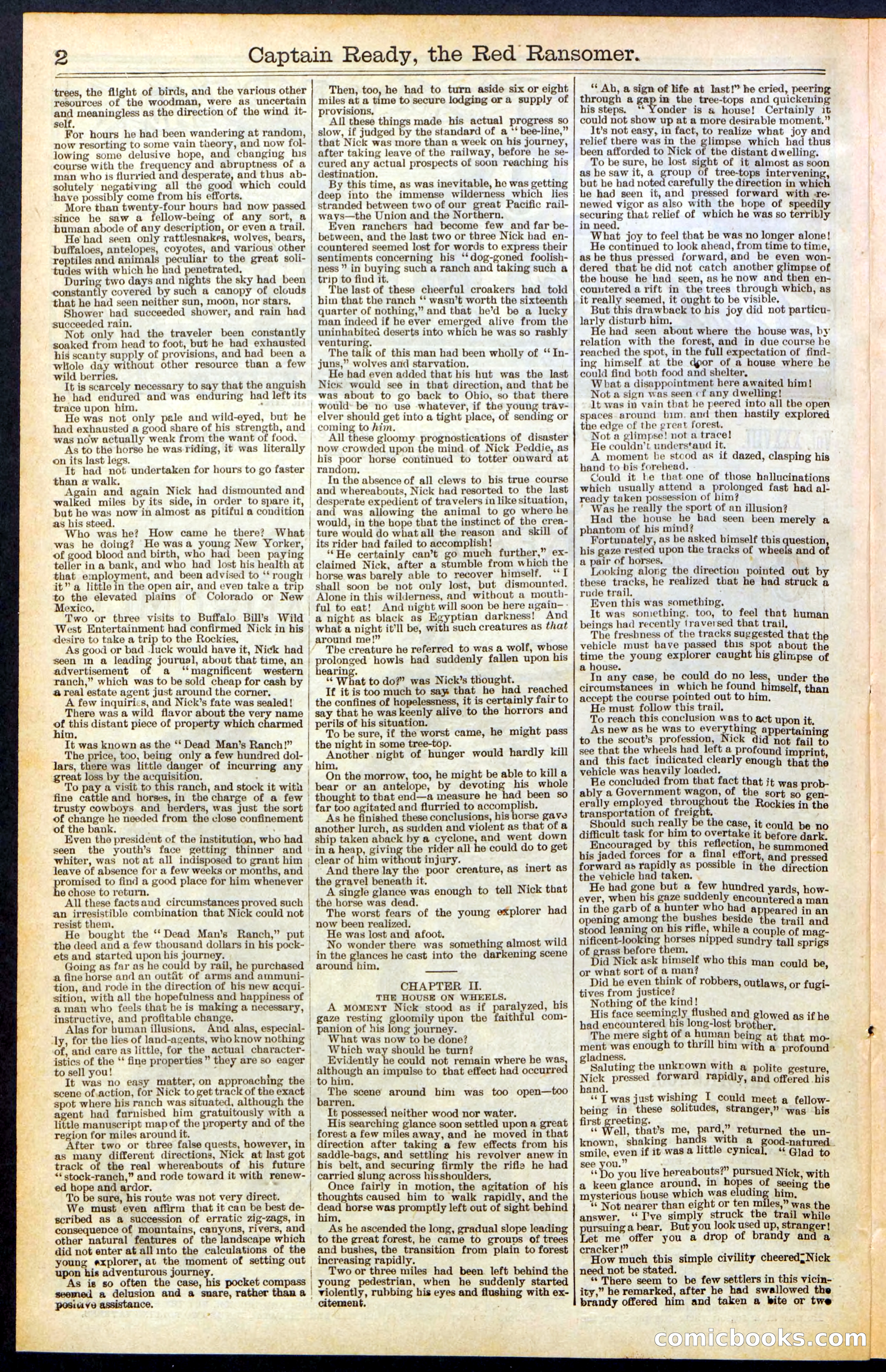
A restored page from Pulp Fiction, 1888. Page through the whole issue in the reader above.
📄 Transcribed text from this page (OCR, searchable)
Machine-transcribed from the original scan — historical spelling and the odd misread are preserved.
great loss by the acquisition. 2 —_ trees, the flight of birds, and the various other resources of the woodman, were as uncertain and meaningless as the direction of the wind it- self, For hours he had been wandering at random, now resorting to some vain theory, and now fol- lowing some delusive hope, and changing his course with the frequency and abruptness of a man who is flurried and desperate, and thus ab- solutely negativing all the good which could have possibly come from his efforts. More than twenty-four hours had now passed since he saw a fellow-being of any sort, a buman abode of any description, or even a trail. He had seen only rattlesnakes, wolves, bears, buffaloes, antelopes, coyotes, and various other reptiles and animals peculiar to the great soli- tudes with which he had penetrated, During two days and nights the sky had been constantly covered by suc that he had seen neither sun, moon, nor stars, Shower had succeeded shower, and rain had succeeded rain. Not only had the traveler been constantly soaked from head to foot, but he had exhausted his scanty supply of provisions, and had been a wiiole day without other resource than a few wild berries. It is scarcely necessary to say that the anguish he had endured and was enduring had left its trace upon him. ‘ He was not only pale and wild-eyed, but he had exhausted a good share of his strength, and was now actually weak from the want of food. As to the horse he was riding, it was literally on its last legs. It had not undertaken for hours to go faster than a walk. Again and again Nick had dismounted and walked miles by its side, in order to spare it, but be was now in almost as pitiful a condition as his steed. Who was he? How came he there? was he doing? He wasa young New Yorker, of good blood and birth, who had been paying teller in a bank, and who had lost his health at that employment, and been advised to ** rough it” a little in the open air, and even take a trip to the elevated plains of Colorado or New Mexico. Two or three visits to Buffalo Bill’s Wild West Entertainment had confirmed Nick in his | desire to take a oe to the Rockies, As good or bad .luck would have it, Nick had seen in a leading jourusl, about that time, an advertisement of a ‘‘magnificent western ranch,” which was to be sold cheap for cash by a real estate agent just around the corner, A few inquirics, and Nick’s fate was sealed! There was a wild flavor about the very name aH this distant piece of property which c ed | m, It was known as the ‘‘ Dead Man’s Ranch!” _ The price, too, being only a few hundred dol- lars, there was little danger of incurring any | To pay a visit to this ranch, and stock it with fine cattle and horses, in the charge of a few | trusty cowboys and herders, was just the sort of change he needed from the close confinement of the bank. | Even the president of the institution, who had seen the youth’s face getting thinner and whiter, was not at all indisposed to grant him | leave of absence for a few weeks or months, and | romised to find a good place for him whenever | e chose to return. All these factsand circumstances proved such | an irresistible combination that Nick could not > resist them. the deed and a few thousand dollars in his pock- ets and started upon his journey. Going as far as he could by rail, he purchased a fine horse and an outfit of arms and ammuni- tion, and rode in the direction of his new acqui- | sition, with all the hopefulness and happiness of | aman who feels that he is making a necessary, instructive, and profitable change. Alas for buman illusions. And alas, especial- ‘ly, for the lies of land-agents, who know nothing of, and care as little, for the actual character- istics of the ‘‘ fine properties” they are so eager to sell you! ‘ f It was no easy matter, on approaching the scene of.action, for Nick to get track of the exact spot where his ranch was situated, although the agent had furnished him gratuitously with a little manuscript mapof the property and of the region for miles around it, ‘After two or three false quests, however, in as many different directions, Nick at last got track of the real whereabouts of his future **stock-ranch,” and rode toward it with renew- ed hope and ardor. To be sure, his route was not very direct. We must even affirm that it can be best de- scribed as a succession of erratic zig-zags, in co other natural features of the landscape which did not enter at all into the calculations of the young explorer, at the moment of setting out upon bis adventurous journey. As is so often the case, his pocket compass seemed a delusion and a snare, rather than a posiwve assi ce. 7 a canopy of clouds | horse was barely able to recover himself. ' bear or an antelope, by devotin uence of mountains, canyons, rivers, and | + 7 ¥" Then, too, he had to turn aside six or eight miles at a time to secure lodging ora supply of provisions, All these things made his actual progress so slow, if judged by the standard of a *‘ bee-line,” that Nick was more than a week on his journey, after taking leave of the railway, before he se- cured any actual prospects of soon reaching his destination. By this time, as was inevitable, he was getting deep into the immense wilderness which lies stranded between two of our great Pacific rail- ways—the Union and the Northern, Even ranchers had become few and far be- between, and the last two or three Nick had en- _ countered seemed lost for words to express their sentiments concerning his ‘*‘dog-goned foolish- ness ” in buying such a ranch and taking such a trip to find it. he last of these cheerful croakers had told | him that the ranch “ wasn’t worth the sixteenth | quarter of nothing,” and that be’d be a lucky man indeed if he ever emerged alive from the uninhabitea deserts into which he was so rashly venturing. The talk of this man had been wholly of ‘ In- juns,” wolves and starvation. | He had even added that his hut was the last Nick would see in that direction, and that be was about to go back to Obio, so that there would be no use whatever, if the young trav- elver should get into a tight place, of sending or coming to him. All these gloomy prognostications of disaster now crowded upon the mind of Nick Peddie, as his poor horse continued to totter onward at random, In the absence of all clews to bis true course and whereabouts, Nick bad resorted to the last desperate expedient of travelers in like situation, and was allowing the animal to go where he | would, in the hope that the instinct of the crea- What | ture would do what all the reason and skill of its rider had failed to accomplish! ‘‘He certainly can’t go much further,” ex- claimed Nick, after a stumble from which ie shall soon be not only lost, but dismounted. Alone in this wilderness, and without a mouth- ful to eat! And night will soon be here ugain-- a night as black as Egyptian darkness! And what a night it'll be, with such creatures as that around me!” Tbe creature he referred to was a wolf, whose prolonged howls had suddenly fallen upon his hearing. . What to do?” was Nick’s thought. If it is too much to say that he had reached the confines of hopelessness, it is certainly fair to say that he was keenly alive to the horrors and perils of his situation. . To be sure, if the worst came, he might pass the night in some tree-top. Another night of hunger would hardly kill him, On the morrow, too, he might be able to kill a his whole thought to that end—a measure he d been so far too agitated and flurried to accom lish, As he finished these conclusions, his horse gave another lurch, as sudden and violent as that ofa ship taken aback by a cyclone, and went down in a heap, giving the rider all he could do to get clear of Sh without injury. ; And there lay the poor creature, as inert as the gravel beneath it. : A single glance was enough to tell Nick that the horse was dead. The worst fears of the young explorer had _ now been realized. He bought the ‘‘Dead Man’s Ranch,” put | He was lost and afoot. : No wonder there was something almost wild in the glances he cast into the darkening scene around him. CHAPTER II. THE HOUSE ON WHEELS. F A moMENT Nick stood as if paralyzed, bis gaze resting gloomily upon the faithful com- panion of his long journey. What was now to be done? Which way should he turn? | Evidently he could not remain where he was | Sey ay an impulse to that effect had occurred 1m, The scene around him was too open—too barren. It possessed neither wood nor water. His searching glance soon settled upon a great forest a few miles away, and he moved in that direction after taking a few effects from his saddle-bags, and settling his revolver anew in his belt, and securing firmly the rifls he had carried slung across hisshoulders, | Once fairly in motion, the agitation of his | thoughts caused him to walk rapidly, and the dead horse was promptly left out of sight behind m, As he ascended the long, gradual slope leading to the great forest, he came to grounvs of trees and bushes, the transition from plain to forest _ increasing rapidly. | Twoor three miles had been left behind the | young pedestrian, when he suddenly started a rubbing his eyes and flushing with ex- citement, ‘ H p | Captain Ready, the Red Ransomer. ** Ab, a sign of life at last!” he cried, peering through a gapin the tree-tops and quickening his steps. ‘“* Yonder is a house! Certainly it could not show up at a more desirable moment.” It’s not easy, in fact, to realize what joy and relief there was in the glimpse which had thus been afforded to Nick of the distant dwelling. To be sure, be lost sight of it almost as soon as he saw it, a group of tree-tops intervening, but he had noted carefully the direction in which he had seen it, and pressed forward with -re- newed vigor as also with the hope of speedily securing that relief of which he was so terribly in need. What joy to feel that he was no longer alone! He continued to look ahead, from time to time, as he thus pressed forward, and he even won- dered that he did not catch another piprabrcs of the house he had seen, as he now and then en- countered a rift in the trees through which, as it really seemed, it ought to be visible, But this drawback to his joy did not particu- larly disturb him. e had seen about where the house was, by relation with the forest, and in due course he reached the spot, in the full expectation of find- ing himself at the dpor of a house where he could find both food and shelter, W bat a disappointment bere awaited him! Not a sign was seen cf any dwelling! lt was in vain that he peered into all the open spaces around him. and then hastily explored the edge of the great forest. Not a glimpse! not a trace! He couldn't understand it. A moment be stood as if dazed, clasping his hand to bis forehead. Could it be that one of those hallucinations which usually attend a prolonged fast had al- ready taken possession of him? Was he really the sport of an illusion? Had the house be bad seen been merely a hantom of his mind? Fortunately, as he asked bimself this question his gaze rested upon the tracks of wheels and of a pair of horses, . . Looking along the direction pointed out by these tracks, he realized that he had struck a rude trail. Even this was something. It was something, too, to feel that human beings had recently traversed that trail, The freshness of the tracks suggested that the vehicle must bave passed this 3m about the time the young explorer caught his glimpse of a aor: : a \ n any case, he cou o no less, und circumstances in which he found himself, than accept the course pointed out to him, He must follow this trail. To reach this conclusion was to act upon it As new as he was to everything appertaining to the scout’s profession, Nick did not fail to see that the wheels had left a profound imprint and this fact indicated clearly enough that the e conclu om that fact that jt ably a Government wagon, of the ia eta erally employed tbrocgaaue the Rockies in the transportation of freight. Should such really be the case, it could be no difficult task for him to overtake it before dark. Encouraged by this reflection, he summoned ies ait ia ee octet ty and pressed orward as rapidly as possible in ¢ ; the, vehicle had taken.» aja e had gone but a few hundred ya f ever, when his gaze suddenly PR ln Rok in the garb of a hunter who had appeared in an opening among the bushes beside the trail and eye eae Seg rifle, ae a couple of mag- nificent-looking horses nipped sundr of an before them. nin fae y tall sprigs id Nick ask himself who this m or what sort ie ° rae RS an could be, Did he even think of robbers, ou he tives from justice? Haws, or fugi Nothing of the eon at His face seemingly flus and glow i had encountered aa song “lost brother, segs phe: 5 The mere sight of a human being a ment was enough to thrill him with 4 per N= . luting the unk ith Saluting the unknown with a polite gesture, pie pressed forward rapidly, aha ottered fe hand. . , “ T was just wishing I could meet a fellow- being in these solitudes, stranger,” was his first Erecting: ‘“ Well, that’s me, pard,” returned the un- known, shaking bands with a good-natured. smnile, even if it was a little cynical, “ Glad to see you.” : 3 ‘*Do you live hereabouts?” pursued Nick, with a keen glance around, in hopes of seeing the mysterious house which was eluding him, . ‘‘ Not nearer than eight or ten miles,” was the answer, “I’ve simply struck the trail while ursuing a bear, But you look used up, stranger! Let me offer you a drop of brandy and a cracker!” ; How much this simple civility cheered; Nick need not be stated. er, “There seem to be few settlers in this vicin- ity,” he remarked, after he had swallowed the © brandy offered him and taken a bite or twe JOO G Geom ‘S. t ae . nr ae