
Pulp Fiction, 1888 · page 17 of 32
Beadle's New York Dime Library, No. 484 — page 17: what you’re looking at
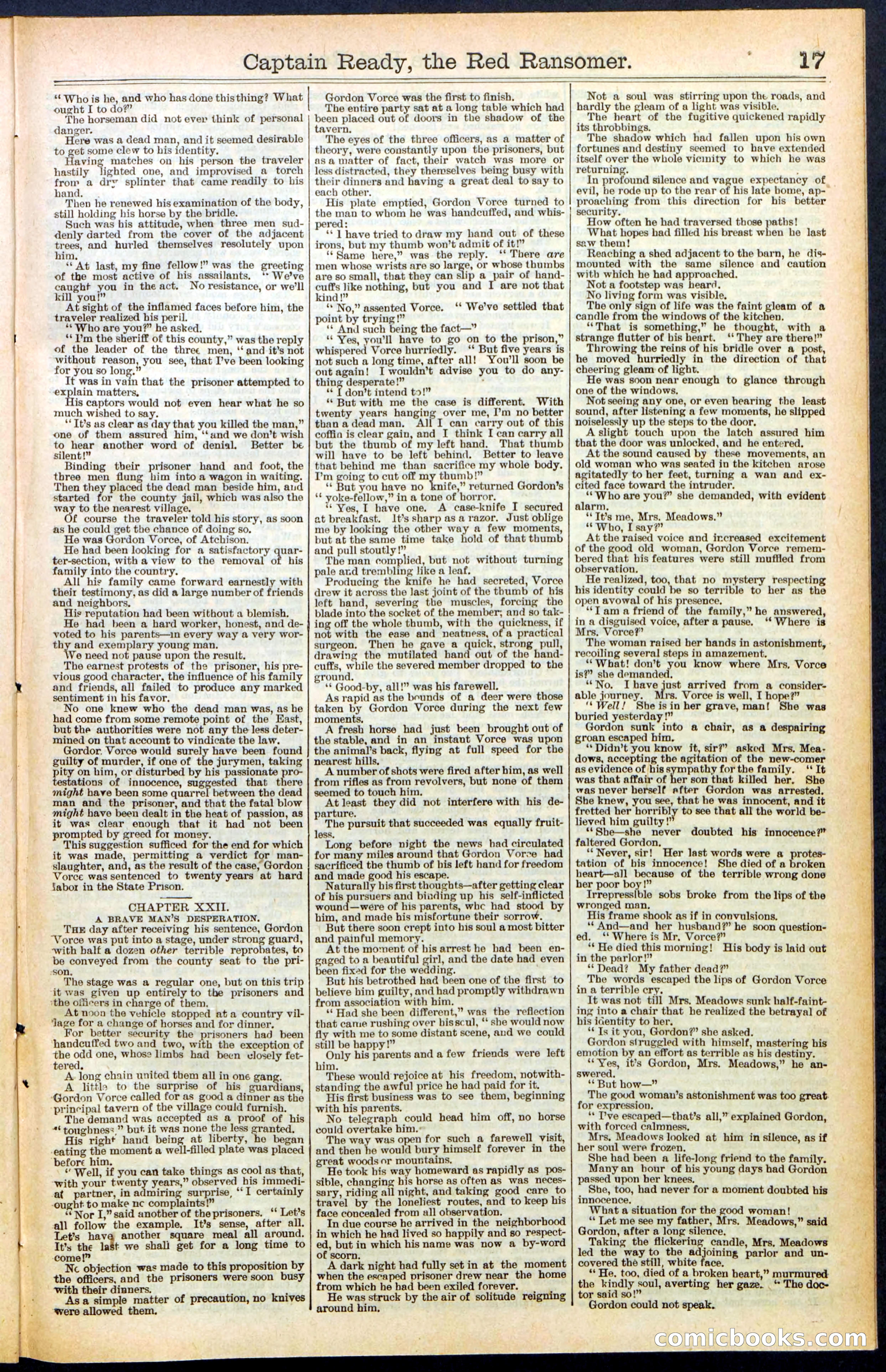
A restored page from Pulp Fiction, 1888. Page through the whole issue in the reader above.
📄 Transcribed text from this page (OCR, searchable)
Machine-transcribed from the original scan — historical spelling and the odd misread are preserved.
Captain Ready, the Red Ransomer. _———— *‘ Who is he, and who has done thisthing? What ought I to do?’ The horseman did not ever think of personal danger. Here was a dead man, and it seemed desirable to get some clew to his identity. Having matches on his person the traveler hastily lighted one, and improvised a torch from a drv splinter that came readily to his hand. Then he renewed his examination of the body, still holding his horse by the bridle. Such was his attitude, when three men sud- denly darted from the cover of the adjacent trees, and hurled themselves resolutely upon him, ‘‘ At last, my fine fellow!” was the greeting of the most active of his assailants. ‘* We’ve caught you in the act. No resistance, or we'll kill you!” At sight of the inflamed faces before him, the traveler realized his peril. ‘* Who are you?” he asked. ** ’m the sheriff of this county,” was the reply of the leader of the three men, “ and it’s not without reason, you see, that I’ve been looking for you so long.” It was in vain that the prisoner attempted to explain matters, is captors would not even hear what he so much wished to say. ‘* It’s as clear as day that you killed the man,” one of them assured him, ‘‘ and we don’t wish to hear another word of denial. Better be silent!” Binding tbeir prisoner hand and foot, the three men flung him into a wagon in waiting. Then they placed the dead man beside him, aud started for the county jail, which was also the ey to the nearest village. f course the traveler told his story, as soon as he could get the chance of doing so. He was Gordon Vorce, of Atchison. He had been looking for a satisfactory quar- ter-section, with a view to the removal of his family into the country. All his family came forward earnestly with their testimony, as did a large number of friends and neighbors, His reputation had been without a blemish. He had been a hard worker, honest, and de- voted to his parents—in every way a very wor- thy and exemplary young man. Ve need not pause upon the result. The earnest protests of the prisoner, his pre- vious good character, the influence of his family and friends, all failed to produce any marked sentiment in his favor. No one knew who the dead man was, as he had come from some remote point of the East, but the authorities were not any the less deter- mined on that account to vindicate the law. Gordor. Vorce would surely have been found guilty of murder, if one of the jurymen, taking ps ey him, or disturbed by his passionate pro- tions of innocence, suggested that there might have been some tthe between the dead man and the prisoner, and that the fatal blow might have been dealt in the heat of passion, as it was clear enough that it had not been prompted by greed for money. This suggestion sufficed for the end for which it was made, permitting a verdict for man- slaughter, and, as the result of the case, Gordon Vorce was sentenced to twenty years at hard {abor in the State Prison. CHAPTER XXII. A BRAVE MAN’S DESPERATION. Tuer day after receiving his sentence, Gordon ‘Vorce was put into a stage, under strong guard, ‘with half a dozen other terrible reprobates, to be conveyed from the county seat to the pri- “son. The stage was a regular one, but on this trip it was given up entirely to the prisoners and ‘the officers in charge of them. At noon the vehicle stopped ata country vil- ‘lage for a change of horses and for dinner. For better security the prisoners had been handcuffed two and two, with the exception of the any one, Whose limbs had been vlosely fet- tered. A. long chain united them all in one gang. A little to the surprise of his guardians, Gordon Vorce called for as good a dinner as the ‘principal tavern of the village could furnish. The demand was accepted as a proof of his “¢ toughness,” but it was none the less granted. His right hand being at liberty, he began eating the moment a well-filled plate was placed before him. “ Well, if you can take things as cool as that, with your twenty years,” observed his immedi- at partner, in admiring surprise, “I certainly ought to make nc complaints!” _ be A ‘Nor I,” said another of the prisoners. ‘ Let’s all follow the example. It’s sense, after all. Let’s hava another square meal all around. It’s the la8t we shali get for a long time to come!” : Nc objection was made to this proposition by the officers, and the prisoners were soon busy - With their dinners. Asa simple matter of precaution, no knives ‘were allowed them. Gordon Vorce was the first to finish. The entire party sat at a long table which had been placed out of doors in the shadow of the tavern. The eyes of the three officers, as a matter of theory, were constantly upon the prisoners, but asa matter of fact, their watch was more or less distracted, they themselves being busy with their dinners and having a great deal to say to each other. ‘ His plate emptied, Gordon Voree turned to the man to whom he was handcuffed, and whis- pered: ‘* ] have tried to draw my hand out of these irons, but my thumb won’t admit of it!” ‘‘Same here,” was the reply. ‘* There are men whose wrists are so large, or whose thumbs are so small, that they can slip a pair of hand- cuffs like nothing, but you and I are not that kind!” ‘* No,” assented Vorce. ‘‘ We've settled that point by trying!” ‘* And such being the fact—” ‘“ Yes, you'll have to go on to the prison,” whispered Vorce hurriedly. ‘‘ But five years is not such a long time, after all! You'll soon be out again! I wouldn’t advise you to do any- thing desperate!” ' ‘* [ don’t intend to!” ‘‘ But with me the case is different. With twenty years nang ite over me, I’m no better than adead man. All I can carry out of this coffin is clear gain, and I think I can carry all but the thumb of my left hand. That thumb will have to be left behind. Better to leave that behind me than sacrifice my whole body. I’m going to cut off my’ thumb!” ‘* But you have no knife,” returned Gordon’s ** voke-fellow,” in a tone of horror. ‘Yes, I have one. A case-knife I secured at breakfast. It’s sharp asarazor. Just oblige me by looking the other way a few moments, but at the same time take hold of that thumb and pull stoutly!” The man complied, but not without turning pale ard trembling like a leaf, Producing the knife he had secreted, Vorce drew it across the Jast joint of the thumb of his left hand, severing the muscles, forcing the blade into the socket of the member; and so tak- ing off the whole thumb, with the quickness, if not with the ease and neatness, of a practical surgeon. Then he gave a quick, strong pull, drawing the mutilated hand out of the hand- cuffs, while the severed member dropped to the ground, : ‘* Good-by, all!” was his farewell. As rapid as the bounds of a deer were those taken by Gordon Vorce during the next few moments, A fresh horse had just been brought out of the stable, and in an instant Vorce was upon the animal’s back, flying at full speed for the nearest hills, : A number of shots were fired after him, as well from rifles as from revolvers, but none of them seemed to touch him, ; At least they did not interfere with his de- parture. . The pursuit that succeeded was equally fruit- less. Long before night the news had circulated for many miles around that Gordon Vorve had sacrificed the thumb of bis left hand for freedom and made good his escape. Naturally his first thoughts—after getting clear of his pursuers and binding up his self-inflicted wound—were of his parents, whc had stood by him, and made his misfortune their sorrow. But there soon crept into his soul a most bitter and painful memory. At the moment of his arrest he had been en- gaged to a beautiful girl, and the date had even been fixed for the wedding. But his betrothed had been one of the first to believe bim guilty, and had promptly withdrawn from association with him. ‘¢ Had she been different,” was the reflection that came rushing over bisscul, “ she would now fly with me to some distant scene, and we could still be happy!” / Only his parents and a few friends were left im, These would rejoice at his freedom, notwith- standing the awful price he had paid for it. | His first business was to see them, beginning with his parents. No telegraph could head him off, no horse could overtake him.’ ie The way was open for such a farewell visit, and then he would bury himself forever in the great woods or mountains, He took his way homeward as rapidly as pos- sible, changing his horse as often as was neces- sary, riding all night, and taking good care to travel by the loneliest routes, and to keep his face concealed from all observation. In due course he arrived in the neighborhood in which he had lived so happily and so respect- ed, but in which his name was now a by-word of scorn. A dark night had fully set in at the moment when the escaped prisoner drew near the home from which he had been exiled forever. He was struck by the air of solitude reigning around him, Oe rit eee EE EE EE EE ee | Not a soul was stirring upon the roads, and hardly the gleam of a light was visible. The heart of the fugitive quickened rapidly its throbbings. The shadow which had fallen upon his own fortunes and destiny seemed to have extended itself over the whole vicinity to which he was returning. - In profound silence and vague expectancy of evil, he rode up to the rear of his late home, ap- proaching from this direction for his better security. How often he had traversed those paths! What hopes had filled his breast when he last saw them! Reaching a shed adjacent to the barn, he dis- mounted with the same silence and caution with which he had approached. Not a footstep was heard. No living form was visible, The only sign of life was the faint gleam of a candle from the windows of the kitchen. “That is something,” he thought, with a strange flutter of bis heart. ‘‘ They are there!” Throwing the reins of his bridle over a post, he moved hurriedly in the direction of that cheering gleam of light. He was soon near enough to glance through one of the windows, Not seeing any one, or even hearing the least sound, after listening a few moments, he slipped noiselessly up the steps to the door, A slight touch upon the latch assured him that the door was unlocked, and he entered, At the sound caused by these movements, an old woman who was seated in the kitchen arose agitatedly to her feet, turning a wan and ex- cited face toward the intruder. ‘Who are you?” she demanded, with evident alarm. ‘** It’s me, Mrs. Meadows.” ‘*' Who, I say?” At the raised voice and increased excitement of the good old woman, Gordon Vorce remem- bered that bis features were still muffled from observation. He realized, too, that no mystery respecting his identity could be so terrible to her as the open avowal of his presence. ‘‘Tam a friend of the family,” he answered, in a disguised voice, after a pause. “‘ Where is Mrs. Vorce?” The woman raised her hands in astonishment, recoiling several steps in amazement. “What! don’ a know where Mrs, Vorce is?” she demanded, ‘“*No. Ihave just arrived from a consider- able journey. rs. Vorce is well, I hope?” ‘*Well! Sheisin her grave,man! She was buried yesterday!” Gordon sunk into a chair, as a despairing groan escaped him. ‘*Didn’t you know it, sir?” asked Mrs, Mea- dows, accepting the agitation of the new-comer as evidence of his sympathy for the family. ‘ It was that affair of her son that killed her, She was never herself after Gordon was arrested. She knew, you see, that he was innocent, and it fretted her horribly to see that all the world be- lieved him guilty!’ ‘*She—she never doubted his innocence?” faltered Gordon, ** Never, sir! Her last words were a protes- tation of bis innocence! She died of a broken heart—all because of the terrible wrong done her poor boy!” Irrepressible sobs broke from the lips of the wronged man. His frame shook as if in convulsions. ‘** And—and her husband?” he soon question- ed. ‘‘ Where is Mr, Vorce?” ‘** He died this morning! His body is laid out in the parlor!” ** Dead? My father dead?” The words escaped the lips of Gordon Vorce in a terrible cry. It was not till Mrs. Meadows sunk half-faint- ing into a chair that he realized the betrayal of his identity to her. ** Ts it you, Gordon?” she asked. Gordon struggled with himself, mastering his emotion by an effort as terrible as his destiny. ‘Yes, it’s Gordon, Mrs. Meadows,” he an- swered., ‘** But how—” The good woman’s astonishment was too great. for expression. ** Pve escaped—that’s all,” explained Gordon, with forced calmness, Mrs, Meadows looked at him in silence, as if her soul were frozen, She had been a life-long friend to the family. Many an bour of his young days had Gordon passed upon her knees, _ She, too, had never for a moment doubted his innocence. What a situation for the good woman! ‘“‘ Let me see my father, Mrs. Meadows,” said Gordon, after a long silence, Taking the flickering candle, Mrs, Meadows led the way to the adjoining parlor and un- covered thé still, white face. “‘ He, too, died of a broken heart,” murmured the kindly soul, averting her gaze. “ The doc- tor said so!” Gordon could not speak. S JOO com (C \ (EO}Lf