
Pulp Fiction, 1888 · page 3 of 32
Beadle's New York Dime Library No. 483 — page 3: what you’re looking at
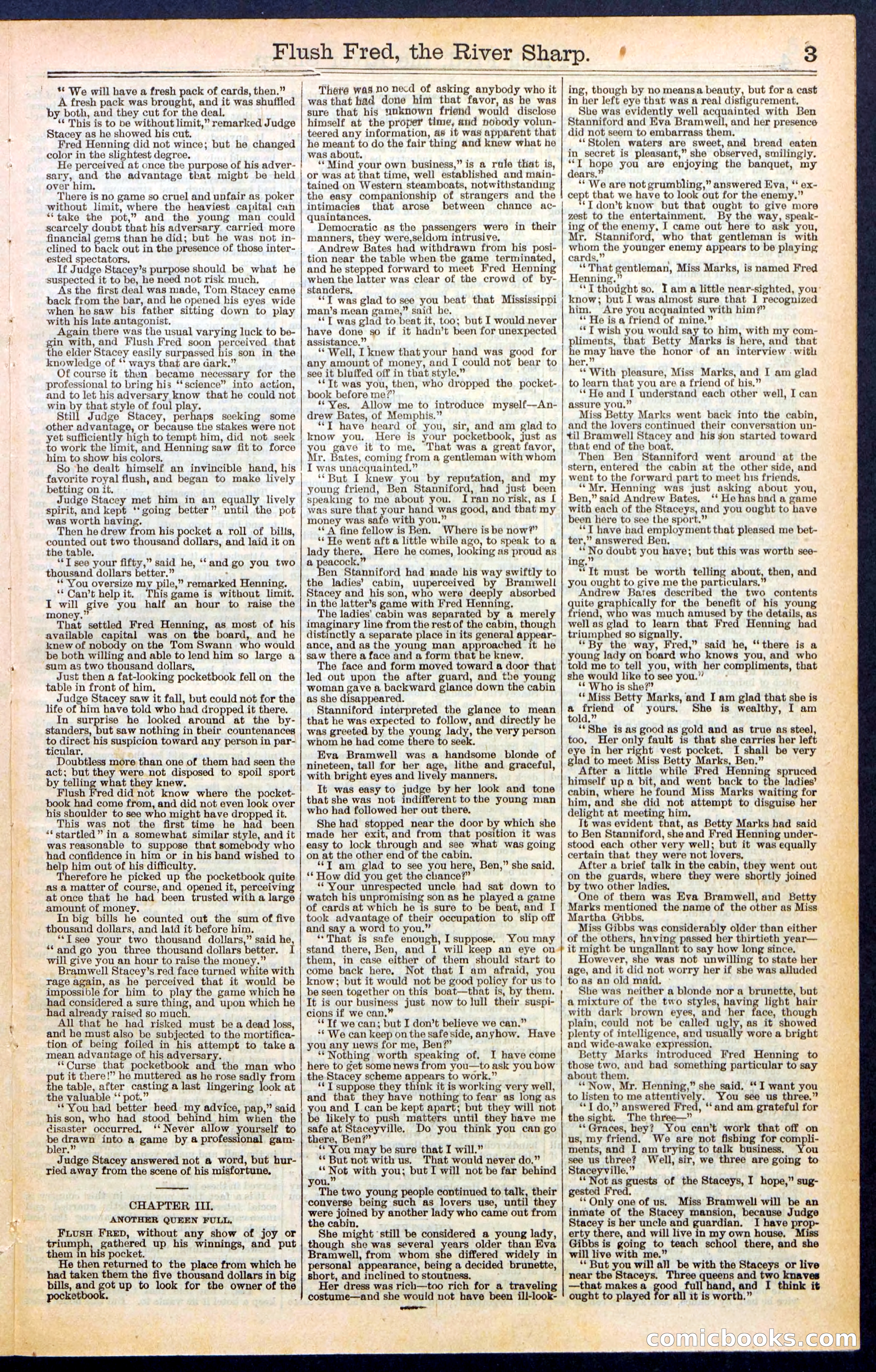
A restored page from Pulp Fiction, 1888. Page through the whole issue in the reader above.
📄 Transcribed text from this page (OCR, searchable)
Machine-transcribed from the original scan — historical spelling and the odd misread are preserved.
Eo ** We will have a fresh pack of cards, then.” A fresh pack was brought, and it was shuffled by both, and they cut for the deal. ‘* This is to be without limit,” remarked Judge Stacey as he showed his cut. Fred Henning did not wince; but he changed color in the slightest degree, He perceived at once the purpose of his adver- sary, and the advantage that migbt be held over him. There is no game so cruel and unfair as poker without limit, where the heaviest capital can “take the pot,” and the young man could scarcely doubt that his adversary carried more financial gems than he did; but he was not in- clined to back out in the presence of those inter- ested spectators. If Judge Stacey’s purpose should be what he suspected it to be, he need not risk much, As the first deal was made, Tom Stacey came back from the bar, and he opened his eyes wide when he saw his father sitting down to play with his late antagonist. Again there was the usual varying luck to be- gin with, and Flush Fred soon perceived that the elder Stacey easily surpassed his son in the knowledge of ** ways that are dark.” Of course it them became necessary for the professional to bring his “science” into action, and to let his adversary know that he could not win by that style of foul play. Still Judge Stacey, perhaps seeking some other advantage, or because the stakes were not yet sufficiently high to tempt him, did not seek to work the limit, and Henning saw fit to force him to show his colors, So he dealt himself an invincible hand, his favorite royal flush, and began to make lively betting on tt, Judge Stacey met him in an equally lively spirit, and kept ‘‘ going better” until the pot was worth having. Then he drew from his pocket a roll of bills, counted out two thousand dollars, and laid it on the table. ‘“*T see your fifty,” said he, ‘‘and go you two thousand dollars better.” : ‘** You oversize my pile,” remarked Henning. ‘** Can’t help it. This game is without limit. I will give you half an hour to raise the money.” That settled Fred Henning, as most of his available capital was on the board, and he knew of nobody on the Tom Swann who would be both willing and able to lend him so large a sum as two thousand dollars, Just then a fat-looking pocketbook fell on the table in front of him, Judge Stacey saw it fall, but could not for the life of him have told who had dropped it there. In surprise he looked around at the by- standers, but saw nothing in their countenances to direct his suspicion toward any person in par- ticular, Doubtless more than one of them had seen the act; but they were not disposed to spoil sport by telling what they knew. Flush Fred did not know where the pocket- book had come from, and did not even look over his shoulder to see who might have dropped it. This was not the first time he had been ** startled” in a somewhat similar style, and it was reasonable to suppose that somebody who had confidence in him or in his band wished to help him out of his difficulty. Thefetbre he picked up the pocketbook quite asa matter of course, and opened it, perceiving at once that he had been trusted with a large amount of money. In big bills he counted out the sum of five thousand dollars, and laid it before him. **ITsee your two thousand dollars,” said he, ““and go you three thousand dollars better. I will give you an hour to raise the money.” Bramwell Stacey’s red face turned white with rage again, as he perceived that it would be impossible for him to play the game which he had considered a sure thing, and upon which he had already raised so much. All that he had risked must be a dead loss, and he must also be subjected to the mortifica- tion of being foiled in his attempt to takea mean advantage of his adversary. ‘Curse that pocketbook and the man who put it there!” he muttered _as he rose sadly from the table, after casting a last lingering look at the valuable ‘‘ pot.” ‘** You had better heed my advice, pap,” said his son, who had stood behind him when the Cisaster occurred, ‘‘ Never allow yourself to a drawn into a game by a professional gam- er. ) Judge Stacey answered not a word, but hur- ried away from the scene of his misfortune, CHAPTER III. ANOTHER QUEEN FULL. FuiusH FRED, without any show of joy or triumph, gathered up his winnings, and put them in his pocket. He then returned to the place from which he had taken them the five thousand dollars in big bills, and got up to look for the owner of the pocketbook. | ———— —_—————————————————— “a ~~ Flush Fred, the Rive eee There was no necd of asking anybody who it was that had done him that favor, as he was sure that his unknown friend would disclose himself at the proper time, atid nobody volun- teered any information, as it was apparent that he meant to do the fair thing and knew what he was about. ‘‘Mind your own business,” is a rule that is, or was at that time, well established and main- tained on Western steamboats, notwithstanding the easy companionship of strangers and the intimacies that arose between chance ac- quaintances. Democratic as the passengers were in their manners, they were,seldom intrusive, Andrew Bates had withdrawn from his posi- tion near the table when the game terminated, and he stepped forward to meet Fred Henning when the latter was clear of the crowd of by- standers, ‘*‘T was glad to see you beat that Mississippi man’s mean game,” said he, ‘‘T was glad to beat it, too; but I would never have done so if it hadn’t been for unexpected assistance.” ** Well, I knew that your hand was good for any amount of money, and I could not bear to see it bluffed off in that style.” ‘*Tt was you, then, who dropped the pocket- book before me?” ‘Yes. Allow me to introduce myself—An- drew Bates, of Memphis.” “Tt have heard of you, sir, and am glad to know you. Here is your pocketbook, just as you gave it to me, That was a great favor, Mr. Bates, coming from a gentleman with whom I was unacqnainted.” ‘But I knew you by reputation, and my young friend, Ben Stanniford, had just been speaking to me about you. Iran no risk, as [ was sure that Pies’ hand was good, and that my money was safe with you.” ‘‘ A fine fellow is Ben. Where is be now?” ** He went aft a little while ago, to speak to a lady there. Here he comes, looking as proud as a peacock,” en Stanniford had made his way swiftly to the ladies’ cabin, uuperceived by Bramwell Stacey and his son, who were deeply absorbed in the latter’s game with Fred Henning. The ladies' cabin was separated by a merel imaginary line from the rest of the cabin, thoug distinctly a separate place in its general appear- ance, and as the young man approached it he saw there a face and a form that he knew. The face and form moved toward a door that led out upon the after guard, and the young woman gave a backward glance down the cabin as she disappeared. Stanniford interpreted the glance to mean that he was expected to follow, and directly he was greeted by the young lady, the very person whom he had come there to seek. Eva Bramwell was a handsome blonde of nineteen, tall for her age, lithe and graceful, with bright eyes and lively manners, It was easy to judge by her look and tone that she was not indifferent to the young man who had followed her out there. She had stopped near the door by which she made her exit, and from that position it was easy to look through and see what was going on at the other end of the cabin. ‘‘T am glad to see you here, Ben,” she said, ‘* How did you get the chance?” ‘Your unrespected uncle had sat down to watch his unpromising son as he played a gaine of cards at which he is sure to be beat, and I took advantage of their occupation to slip off and say a word to you.” ‘That is safe enough, I suppose, You may stand there, Ben, and | will keep an eye on them, in case either of them should start to come back here, Not that I am afraid, you know; but it would not be good policy for us to be seen together on this boat—that is, by them. It is our business just now to lull their suspi- cions if we can.” ‘¢ Tf we can; but I don’t believe we can.” ** We can keep on the safe side, anyhow. Have you any news for me, Ben?” ‘* Nothing worth speaking of. I have come here to get some news from you—to ask you how the Stacey scheme appears to work.” **T suppose they think it is working very well, and that they have nothing to fear as long as ou and I can be kept apart; but they will not a likely to push matters until they have me safe at Staceyville. Do you think you can go there, Ben?” **’‘You may be sure that I will.” ** But not with us. That would never do,” oe Not with you; but I will not be far behind you. The two young people continued to talk, their converse being such as lovers use, until they were joined by another lady who came out from the cabin. She might ‘still be considered a young lady, though she was several years older than Eva Bramwell, from whom she differed widely in personal appearance, being a decided brunette, short, and inclined to stoutness. Her dress was rich—too rich for a traveling costume—and she would not have been ill-look- ewe or Sharp. al 3 ing, though by no meansa beauty, but for a cast in ber left eye that was a real disfigurement, She was evidently well acquainted with Ben Stanniford and Eva Bramwell, and her presence did not seem to embarrass them. ‘*Stolen waters are sweet,and bread eaten in secret is pleasant,” she observed, smilingly. **[ hope you are enjoying the banquet, my dears,” ‘* We are not grumbling,” answered Eva, “ ex- cept that we have to look out for the enemy.” ‘IT don’t know but that ought to give more zest to the entertainment. By the way, speak- ing of the enemy, I came out here to ask you, Mr. Stanniford, who that gentleman is with pei Pa younger enemy appears to be playing cards, ‘That gentleman, Miss Marks, is named Fred Henning.” ‘‘T thought so. I am a little near-sighted, you’ know; but I was almost sure that I recognized him. Are you acquainted with him?” ‘* He is a friend of mine.” **T wish you would say to him, with my com- pliments, that Betty Marks is here, and that a may have the honor of an interview . with er, ‘* With pleasure, Miss Marks, and I am glad to learn that you are a friend of his.” ‘* He and | understand each other well, I can assure you,” Miss Betty Marks went back into the cabin, and the lovers continued their conversation un- til Bramwell Stacey and his gon started toward that end of the boat, Then Ben Stanniford went around at the stern, entered the cabin at the other side, and went to the forward part to meet his friends. ‘“*Mr. Henning was just asking about you, Ben,” said Andrew Bates. ‘‘ He has had a game with each of the Staceys, and you ought to have been here to see the sport.” ‘*T have had employment that pleased me bet- ter,” answered Ben, a. No doubt you have; but this was worth see- ing. 5 It must be worth telling about, then, and you ought to give me the particulars,” Andrew Bates described the two contents quite graphically for the benefit of his young riend, who was much amused by the details, as well as glad to learn that Fred Henning had triumphed so signally. “ By the way, Fred,” said he, “there is a young lady on board who knows you, and who told me to tell you, with her compliments, that she would like to see you.” ** Who is she?” ‘* Miss Betty Marks, and I am glad that she is a eee of yours. She is wealthy, I am told, **She is as good as gold and as true as steel, too, Her only fault is that she carries her left eye in her right vest pocket. I shall be very glad to meet Miss Betty Marks, Ben.” After a little while Fred Henning spruced himself up a bit, and went back to the ladies’ cabin, where he found Miss Marks waiting for him, and she did not attempt to disguise her delight at meeting him. It was evident that, as Betty Marks had said to Ben Stanniford, she and Fred Henning under- stood each other very well; but it was equally certain that they were not lovers, After a brief talk in the cabin, they went out on the guards, where they were shortly joined by two other ladies, One of them was Eva Bramwell, and Betty Marks mentioned the name of the other as Miss Martha Gibbs. , Miss Gibbs was considerably older than either of the others, having passed her thirtieth year— it might be ungallant to say how long since. However, she was not unwilling to state her age, and it did not worry her if she was alluded to as an old maid. She was neither a blonde nor a brunette, but a mixture of the two styles, having light hair with dark brown eyes, and ‘her ace, though plain, could not be called ugly, as it showed plenty of intelligence, and usually wore a bright and wide-awake expression, Betty Marks introduced Fred Henning to those two, and bad something particular to say about them. ** Now, Mr. Henning,” she said, “I want you to listen to me attentively. "You see us three.” **T do,” answered Fred, ‘and am grateful for the sigbt. The three—” ‘*Graces, hey? You can’t work that off on us, my friend. We are not fisbing for compli- ments, and I am trying to talk business, ou see us three? Well, sir, we three are going to Staceyville,” ‘* Not as guests of the Staceys, I hope,” sug- | gested Fred. ‘* Only one of us. Miss Bramwell will be an inmate of the Stacey mansion, because Judge Stacey is her uncle and guardian. I have ioe erty there, and will live in my own house, Gibbs is going to teach school there, and she will live with me.” ‘* But you will all be with the Staceys or live near the Staceys. ueens and two knaves —that makesa good full hand, and I think it ought to played for all it is worth.” JOO Goim (C Ss (E(0)