
Pulp Fiction, 1888 · page 2 of 32
Beadle's New York Dime Library No. 483 — page 2: what you’re looking at
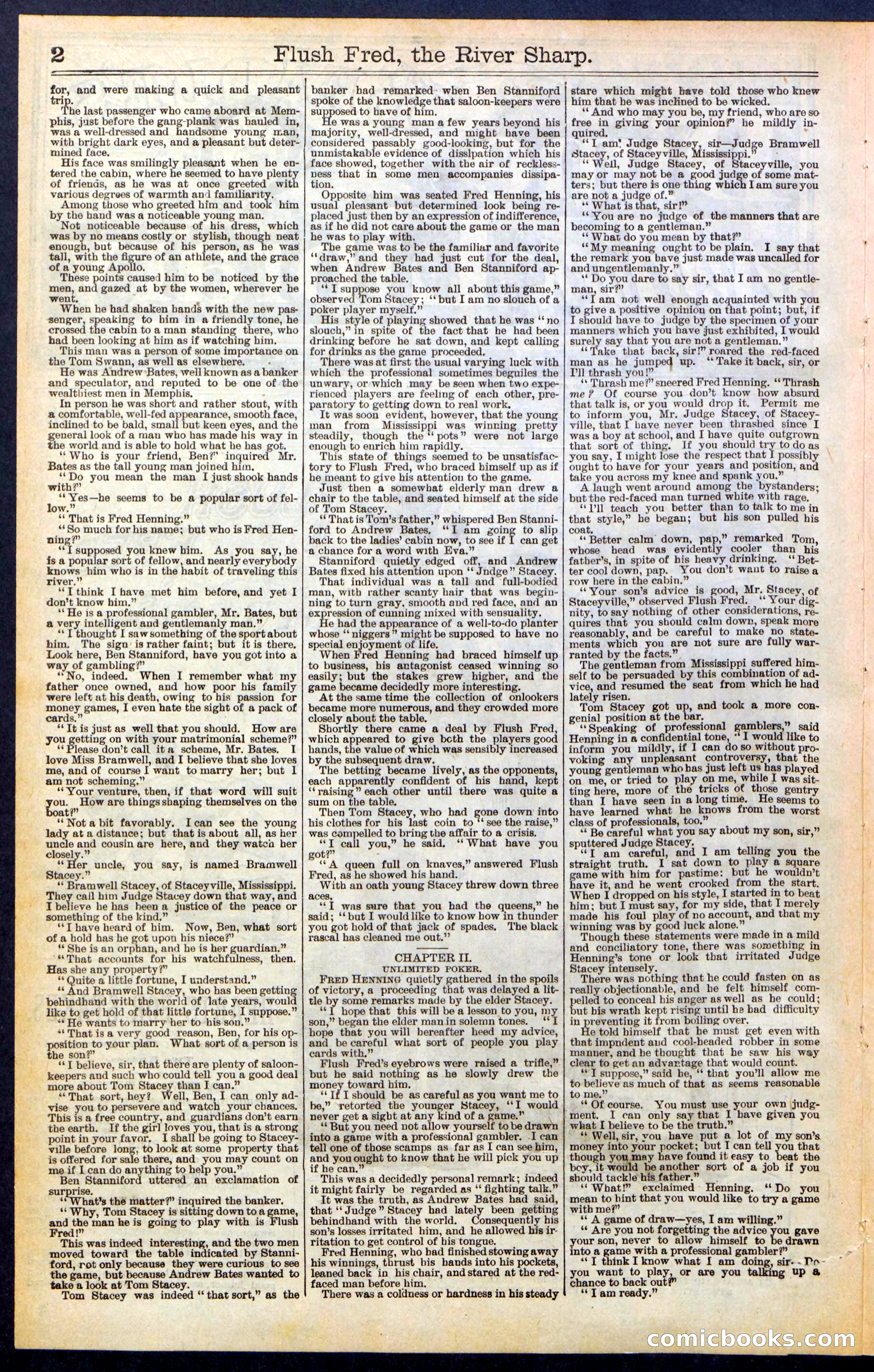
A restored page from Pulp Fiction, 1888. Page through the whole issue in the reader above.
📄 Transcribed text from this page (OCR, searchable)
Machine-transcribed from the original scan — historical spelling and the odd misread are preserved.
~ more about Tom Stace 2 Flush Fred, the River Sharp. for, and were making a quick and pleasant trip. The last passenger who came aboard at Mem- phis, just before the gang-plank was hauled in, was a well-dressed and handsome young man, with bright dark eyes, and a pleasant but deter- mined face. His face was smilingly pleasant when he en- tered the cabin, where he seemed to have plent of friends, as he was at once greeted wit various degrees of warmth and familiarity. Among those who greeted him and too by the band was a noticeable young man. Not noticeable because of his dress, which was by no means costly or stylish, though neat enough, but because of his person, as he was tall, with the figure of an athlete, and the grace of a young Apollo. These points caused him to be noticed by the men, and gazed at by the women, wherever he went. When he had shaken bands with the new pas- senger ae to bim in a friendly tone, he crossed the cabin to a man standing there, who had been looking at him as if watching him. This man was a person of some importance on the Tom Swann, as well as elsewhere. . He was Andrew ‘Bates, well known as a banker and speculator, and reputed to be one of the wealthiest men in Memphis. In person he was short and rather stout, with a comfortable, well-fed i aloe smooth face, inclined to be bald, small but keen eyes, and the general look of a man who has made his way in the world and is able to hold what he has got. * Who is your friend, Ben?” inquired Mr. Bates as the tall young man joined him. **Do you mean the man I just shook hands with?” **'Yes—he seems to be a popular sort of fel- low.” ‘** That is Fred Henning.” **So much for his name; but who is Fred Hen- ning?” ry poss 4 pe you knew him. As you say, he is a popular sort of fellow, and nearly everybody knows him who is in the habit of traveling this river.” ““T think I have met him before, and yet I don’t know him.” ‘* He is a professional gambler, Mr. Bates, but a very intelligent and gentlemanly man.” “TI thought I saw something of the sport about him, The sign is rather faint; but it is there, Look here, Ben Stanniford, have you got into a way of gambling?” ‘No, indeed. When I remember what my father once owned, and how poor his family him were left at his death, owing to bis passion for money games, I even hate the sight of a pack of cards.” “Tt is just as well that you should. How are you getting on with your matrimonial scheme?” ‘* Please don’t call ita scheme, Mr. Bates. I love Miss Bramwell, and I believe that she loves me, and of course | want to marry her; but | am not scheming.” ‘* Your venture, then, if that word will suit “Ee Pi are things shaping themselves on the t ‘Nota bit favorably. Ican see the young lady at a distance; but that is about all, as her uncle and cousin are here, and they watcao her re ‘‘Her uncle, you say, is named Bramwell Stacey.” ‘‘ Bramwell Stacey, of Staceyville, Mississippi. They call him Judge Stacey down that way, and I believe he has heen a justice of the peace or something of the kind.” **T have heard of him. Now, Ben, what sort of a hold has he got upon his niece?” ** She is an orphan, and he is her guardian.” ‘*“That accounts for his watchfulness, then. Has she any property?” ‘Quite a little fortune, I understand.” ** And Bramwell Stacey, who has been gettin behindhand with the world of late years, woul like to get hold of that little fortune, I suppose.” ** He wants to marry her to his son.” ** That is avery good reason, Ben, for his op- position to your plan. What sort of a person is the son?” ‘*T believe, sir, that there are plenty of saloon- keepers and such who could tell you a good deal than J can.” “That sort, hey? ell, Ben, I can only ad- vise you to persevere and watch your chances. This is a free country, and guardians don’t earn the earth. If the gir) loves you, that is a strong point in your favor, I shall be going to Stacey- ville before long, to look at some property that is offered for sale there, and you may count on me if I can do anything to help you.” Ben Stanniford uttered an exclamation of au} aes ; ‘What's thé matter?” inquired the banker. ‘* Why, Tom Stacey is sitting down toa game, and the man he is going to play with is Flush ! This was indeed interesting, and the two men - moved toward the table indicated by Stanni- ford, rot only because they were curious to see the game, but because Andrew Bates wanted to take a look at Tom Stacey. Tom Stacey was indeed “ that sort,” as the banker had remarked- when Ben Stanniford | stare which might have told those who knew spoke of the knowledge that saloon-keepers were | him that he was inclined to be wicked. sed to have of him. @ was a young man afew years beyond his majority, well-dressed, and might have been considered passably good-looking, but for the unmistakable evidence of disslpation which his face showed, together with the air of reckless- ps that in some men accompanies dissipa- ion. Opposite him was seated Fred Henning, his usual pleasant but determined look being re- placed just then by an expression of indifference, as if he did not care about the game or the man he was to play with. The game was to be the familiar and favorite ‘‘draw,” and they had just cut for the deal, when Andrew Bates and Ben Stanniford ap- proached the table. pst sun ou know all about this game,” observed Tom Stacey; ‘‘ but I am no slouch of a poker player myself.” His style of playing showed that he was ‘‘no slouch,” in spite of the fact that he had been drinking before he sat down, and kept calling for drinks as the game proceeded, There was at first the usual varying luck with which the professional sometimes beguiles the unwary, or which may be seen when two expe- rienced players are feeling of each other, pre- paratory to getting down to real work, It was soon evident, however, that the young man from Mississippi was winning pretty steadily, though the ‘‘ pots” were not large enough to enrich him rapidly. This state of things seemed to be unsatisfac- tory to Flush Fred, who braced himself up as if he meant to give his attention to the game. Just then a somewhat elderly man drew a chair to the table, and seated himself at the side of Tom Stacey. ‘* That is Tom’s father,” whispered Ben Stanni- ford to Andrew Bates. “‘I am going to slip back to the ladies’ cabin now, to see if I can get a chance for a word with Eva,” Stanniford quietly edged off, and Andrew Bates fixed his attention upon ‘‘ Jndge” Stacey. That individual was a tall and full-bodied man, with rather scanty hair that was begin- ning to turn gray, smooth and red face, and an expression of cunning nixed with sensuality. e had the appearance of a well-to-do planter whose “ niggers” might be supposed to have no special enjoyment of life, When Fred Henning had braced himself up to business, bis antagonist ceased winning so easily; but the stakes grew higher, and the game became decidedly more interesting. At the same time the collection of onlookers became more numerous, and they crowded more closely about the table, Shortly there came a deal by Flush Fred, which appeared to give beth the players good hands, the value of which was sensibly increased by the subsequent draw. The betting became lively, as the opponents, each apparently confident of his hand, kept ‘‘raising” each other until there was quite a sum on the table, Then Tom Stacey, who had gone down into his clothes for his last coin to ‘‘ see the raise,” was cenpeed to bring the affair to a crisis. 1 you,” he said. ‘‘What have you sup ‘*A queen full on knaves,” answered Flush Fred, as he showed his hand. With an oath young Stacey threw down three aces, ‘‘T was sure that you had the queens,” he said; ‘‘ but I would like to know how in thunder you got hold of that jack of spades, The black rascal has cleaned me out.” CHAPTER IL UNLIMITED POKER. FRED HENNING quietly gathered in the spoils of victory, a proceeding that was delayed a lit- tle by some remarks made by the elder Stacey. ‘*] hope that this will be a lesson to you, my son,” began the elder manin solemn tones. ‘“‘T hope that you will bereafter heed my advice, and be careful what sort of people you play cards with.” Flush Fred’s apewro ws were raised a trifle,” but he said nothing as he slowly drew the money toward him, ‘‘ Tf IT should be as careful as you want me to be,” retorted the yom Stacey, ‘‘I would never get a sigbt at any kind of a fares “ But you need not allow yourself to be drawn into a game with a professional gambler. .I can tell one of those scamps as far as I can see him, and you ought to know that he will pick you up if he can,” , This was a decidedly personal remark; indeed it might fairly be regarded as “‘ fighting talk.” It was the truth, as Andrew Bates had said, that ‘‘ Judge” Stacey had my. been getting behindhand with the world. nsequently his son’s losses irritated him, and he allowed his ir- ritation to get control of his tongue. Fred Henning, who bad finished stowing away his winnings, thrust bis bauds into his pockets, leaned back in his chair, andstared at the red- faced man before him, There was a coldness or hardness in his steady ** And who may you be, my friend, who are so free a giving your opinion?’ he mildly in- quired, ; “T am' Judge ng sir—J udge Bramwell Stacey, of Staceyville, Mississippi.’ ‘“ Well, Judge Stacey, of Staceyville, you may or may not be a good judge of some mat- ters; but there is one thing which Iam sure you are not a judge of.” ‘* What is that, sir!” ‘*'You are no judge of the manners that are becoming to a gentleman.” ** What do you mean by that?” “My meaning ought to be plain. I say that the remark you bave just made was uncalled for and ungentlemanly.” ‘* Do you dare to say sir, that I am no gentle- man, sir?” “Tam not well enough acquainted with you to give a positive opinion on that point; but, if I should have to judge by the specimen of your manners which you have just exhibited, I would surely say that you are not a gentleman,” ‘“‘Take that back, sir!” roared the red-faced man as he jumped up. “Take it back, sir, or T}l thrash you!” ‘+ Thrash me?” sneered Fred Henning, ‘* Thrash me ? Of course you don’t know how absurd that talk is, or you would drop it. Permit me to inform you, Mr. Judge Stacey, of Stacey- ville, that I bave never been thrashed since I was a boy at school, and I have quite outgrown that sort of thing. If you should try to do as you say, I might lose the respect that I } ought to have for your years and position, and take you across my knee and spank you.” A laugh went around among the bystanders; but the red-faced man turned white with rage, “1ll teach you better than to talk to me in that style,” be began; but his son pulled his oat, ‘Better calm down, pap,” remarked Tom, whose head was evidently cooler than his father’s, in spite of his heavy drinking. ‘ Bet- ter cool down, pap. You don’t want to raise a row here in the cabin.” ‘Your son’s advice is good, Mr. Stacey, of Staceyville,” observed Flush Fred. wa Your dig- nity, to say nothing of other considerations, re- quires that you should calm down, speak more reasonably, and be careful to make no state- ments which you are not sure are fully war- ranted by the facts.” ‘ A The gentleman from Mississippi suffered him- self to be persuaded by this combination of ad- vice, and resumed the seat from which he had lately risen. Tom Stacey got up, and took a more con- genial position at the bar, ‘Speaking of professional gamblers, > said Henning in a confidential tone, * I would like to inform you mildly, if I can do so without pro- voking any unpleasant controversy, that the young gentleman who bas just left us has played on me, or tried to play on me, while I was sit- ting here, more of the tricks of those gentry than I have seen in alongtime. He seems to have learned what he knows from the worst class of professionals, too.” ‘“* Be careful bk you say about my son, sir,” sputtered Jud tacey. Pa I am carenan and I am telling you the straight truth. I sat down to play a square me with him for pastime: but he wouldn’t ave it, and he went crooked from the start, When I dropped on his style, I started in to beat him: but I must say, for my side, that I merely made his foul play of no account, and that my winning was by good luck alone.” Though these statements were made in a mild and conciliatory tone, there was something in Henning’s tone or look that irritated Judge Stacey intensely, There was nothing that he could fasten on as really objectionable, and he felt himself com- elled to conceal his anger as well as he could; but bis wrath kept rising until he bad difficulty in preventing it from boiling over. He told himself that he must get even with that impndent aud cool-headed robber in some manner, and he thought that he saw his way clear to get an advantage that would count. ‘*T suppose,” said he, *‘ that you'll allow me to believe as much of that as seems reasonable to me,” | ** Of course, You must use your own jjudg- ment. I can only say that I bave given you what I believe to be the truth.” _ * Well, sir, vou have put a lot of my son’s money into your pocket; but I can tell you that though y y have found it easy to t the boy, it would be another sort of a job if you should tackle his father.” ‘‘ What!” exclaimed Henning. “Do you mean to hint that you would like to try a game game oO w—yes, | am ** Are you not forgetting the advice a gave our son, never to allow himself to be drawn into a game with a professional gambler?” o1:4 ne Soe what [ am doin sir. - Pr- ou wan play, or are you taliing p a Shance to back out?” ‘*T am ready.” possibly — 200! < eh