
Pulp Fiction, 1887 · page 22 of 32
Beadle's New York Dime Library No. 476 — page 22: what you’re looking at
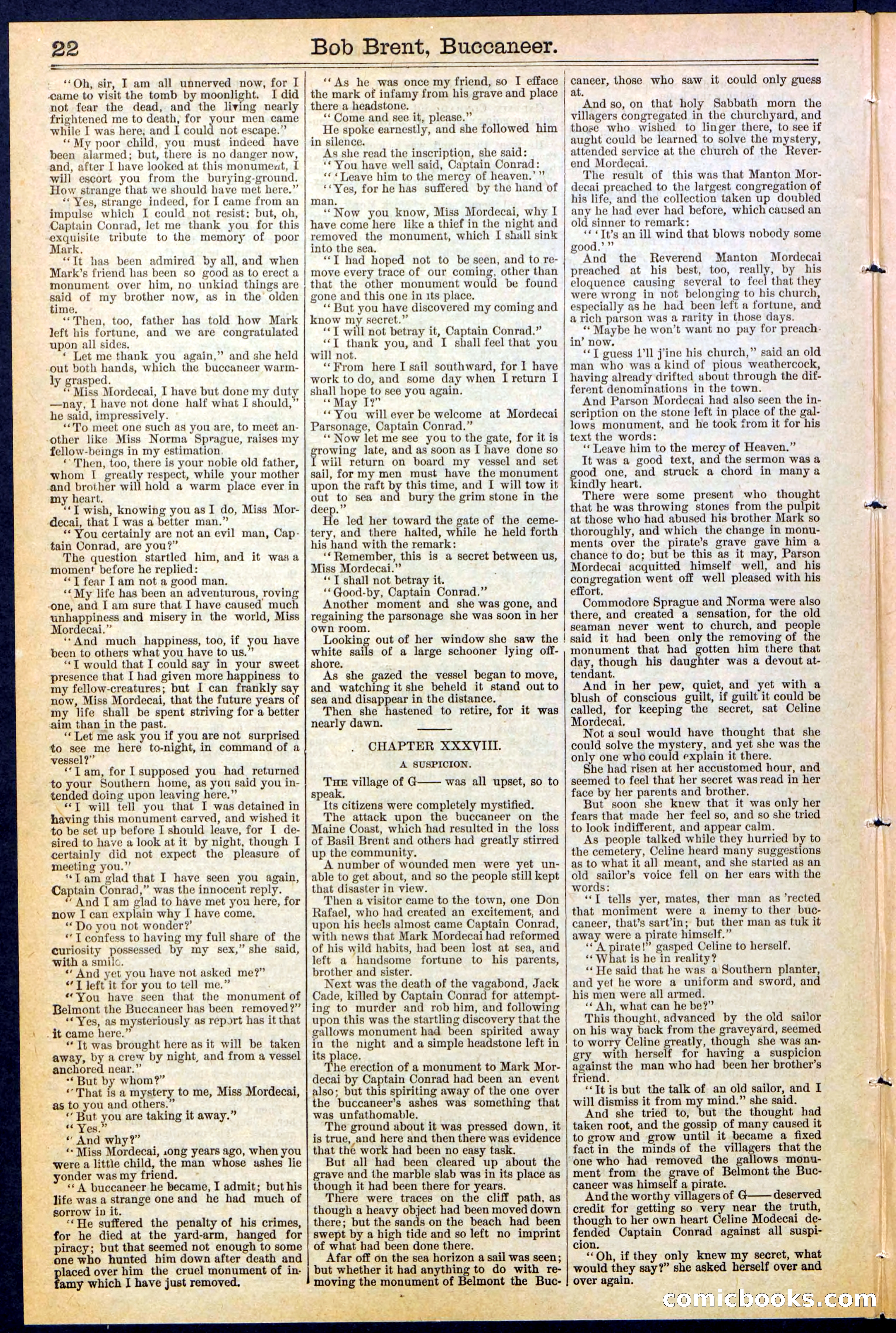
A restored page from Pulp Fiction, 1887. Page through the whole issue in the reader above.
📄 Transcribed text from this page (OCR, searchable)
Machine-transcribed from the original scan — historical spelling and the odd misread are preserved.
22 i ee eee ee ee eee Bob Brent, Buccaneer. ‘‘Oh, sir, I am all unnerved now, for I came to visit the tomb by moonlight. I did not fear the dead, and the living nearly frightened me to death, for your men came while I was here, and I could not escape.”’ ‘‘My poor child, you must indeed have been alarmed; but, there is no danger now, and, after I have looked at this monumeut, I will escort you from the burying-ground. How strange that we should have met here.”’ ‘* Yes, strange indeed, for I came from an impulse which I could not resist; but, oh, Captain Conrad, let me thank you for this exquisite tribute to the memory of poor Mark. ‘Tt has been admired by all, and when Mark’s friend has been so good as to erect a monument over him, no unkind things are said of my brother now, as in the olden time. ‘‘Then, too, father has told how Mark left his fortune, and we are congratulated upon all sides. * Let me thank you again,” and she held out both hands, which the buccaneer warm- ly grasped. ‘Miss Mordecai, I have but done my duty —nay, I have not done half what I should,” he said, impressively. ‘*To meet one such as you are, to meet an- other like Miss Norma Sprague, raises my fellow-beings in my estimation ‘Then, too, there is your noble old father, whom I greatly respect, while your mother and brother will hold a warm place ever in my heart. ‘*T wish, knowing you as I do, Miss Mor- decai, that I was a better man.” “* You certainly are not an evil man, Cap- tain Conrad, are you?” The question startled him, and it wasa moment before he replied: ie, “T fear Iam not a good man. f ** My life has been an adventurous, roving one, and I am sure that I have caused much unhappiness and misery in the world, Miss Mordecai.” ‘‘And much happiness, too, if you have been to others what you have to us.” *‘T would that I could say in your sweet presence that I had given more happiness to my fellow-creatures; but I can frankly say now, Miss Mordecai, that the future years of my life shall be spent striving for a better aim than in the past. «Let me ask you if you are not surprised to see me here to-night, in command of a vessel?” ‘Lam, for I supposed you had returned to your Southern home, as you said you in- tended doing upon leaving here.” «*T will tell you that I was detained in having this monument carved, and wished it to be set up before I should leave, for I de- sired to have a look at it by night, though I certainly did not expect the pleasure of meeting you.”’ fm ‘Tam glad that I have seen you again, | Captain Conrad,” was the innocent reply. ‘ . “ And I am glad to have met you here, for now I can explain why I have come, r “Do you not wonder?’ : x ‘‘T confess to having my full share of the 4 curiosity possessed by my sex,” she said, with a smilc. 4 «‘ And yet you have not asked me?” ‘‘T left it for you to tell me.” Ss “You have seen that the monument of Belmont the Buccaneer has been removed?” ‘«Yes, as mysteriously as report has it that it came here.” “Tt was brought here as it will be taken away, by a crew by night, and from a vessel anchored near.” | == ** But by whom?” “That is a mystery to me, Miss Mordecai, as to you and others.” eh ‘‘ But you are taking it away.” 7" OV os. nc. AG My __._ ** Miss Mordecai, .ong years ago, when you ‘were a little child, the man whose ashes lie | yonder wasmy friend. ~ _ * + A buccaneer he became, I admit; but his -_ Jife was a strange one and he had much of sorrow in it. | --—s **‘ He suffered the penalty of his crimes, for he died at the yard-arm, hanged for _ piracy; but that seemed not enough to some fs one who hunted him down after death and placed over him the cruel monument of in- - famy which I have just removed. i= + * % a2 AZ My - ° 2% * Eee a ‘*As he was once my friend, so I efface the mark of infamy from his grave and place there a headstone. ** Come and see it, please.” He spoke earnestly, and she followed him in silence. As she read the inscription, she said: ‘You have well said, Captain Conrad: ‘¢*Teave him to the mercy of heaven.’ ” ‘*YVes, for he has suffered by the hand of man. ‘‘Now you know, Miss Mordecai, why I have come here like a thief in the night and removed the monument, which I shall sink into the sea. ‘‘T had hoped not to be seen, and to re- move every trace of our coming, other than that the other monument would be found gone and this one in its place. ‘‘ But you have discovered my coming and know my secret.” ‘*T will not betray it, Captain Conrad.” ‘‘T thank you, and I shall feel that you will not. ‘“‘From here I sail southward, for 1 have work to do, and some day when I return I shall hope to see you again. ‘*May I?” “You will ever be welcome at Mordecai Parsonage, Captain Conrad.” ‘* Now let me see you to the gate, for it is rowing late, and as soon as I have done so will return on board my vessel and set sail, for my men must have the monument upon the raft by this time, and I will tow it ao to sea an bury the grim stone in the eep. He led her toward the gate of the ceme- tery, and there halted, while he held forth his hand with the remark: ‘Remember, this is a secret between us, Miss Mordecai.” ‘*T shall not betray it. ‘*Good-by, Captain Conrad.” Another moment and she was gone, and regaining the parsonage she was soon in her own room. Looking out of her window she saw the white sails of a large schooner lying off- shore. As she gazed the vessel began to move, and watching it she beheld it stand out to sea and disappear in the distance. Then she hastened to retire, for it was nearly dawn. CHAPTER XXXYVIII. A SUSPICION. THe village of G—— was all upset, so to speak, Its citizens were completely mystified. The attack upon the buccaneer on the Maine Coast, which had resulted in the loss of Basil Brent and others had greatly stirred up the community. A number of wounded men were yet un- able to get about, and so the people still kept that disaster in view. Then a visitor came to the town, one Don Rafael, who had created an excitement, and upon his heels almost came Captain Conrad, with news that Mark Mordecai had reformed of his wild habits, had been lost at sea, and left a handsome fortune to his parents, brother and sister. Next was the death of the vagabond, Jack Cade, killed by Captain Conrad for attempt- ing to murder and rob him, and following upon this was the startling discovery that the gallows monument had been spirited away in the night and a simple headstone left in its Boel he erection of a monument to Mark Mor- decai by Captain Conrad had been an event Iso; but this spiriting away of the one over he buccaneer’s ashes was something that was unfathomable. The ground about it was pressed down, it is true, and here and then there was evidence that thé work had been no easy task. But all had been cleared up about the grave and the marble slab was in its place as though it had been there for years. There were traces on the cliff path, as though a heavy object had been moved down there; but the sands on the beach had been swept by a high tide and so left no imprint of what had been done there. Afar off on the sea horizon a sail was seen; but whether it had anything to do with re- moving the monument of Belmont the Buc- —- - . . ' ot, y - & > .* ‘ a 7 ee S54 Sar, ae, Se 33 ~~): OS a> FL ee ee lg SS. SSP Oe eee caneer, those who saw it could only guess at. And so, on that holy Sabbath morn the villagers congregated in the churchyard, and thoze who wished to linger there, to see if aught could be learned to solve the mystery, attended service at the church of the Rever- end Mordecai. The result of this was that Manton Mor- decai preached to the largest congregation of his life, and the collection taken up doubled any he had ever had before, which caused an old sinner to remark: ‘**Tt’s an ill wind that blows nobody some good.’ ” And the Reverend Manton Mordecai preached at his best, too, really, by his eloquence causing several to feel that they were wrong in not belonging to his church, especially as he had been left a fortune, and a rich parson was a rarity in those days. “Maybe he won’t want no pay for preach- in’ now. ‘“‘T guess Ll j'ine his church,” said an old man who was a kind of pious weathercock, having already drifted about through the dif- ferent denominations in the town. And Parson Mordecai had also seen the in- scription on the stone left in place of the gal- lows monument, and he took from it for his text the words: ‘Leave him to the mercy of Heaven.” It was a good text, and the sermon was a ood one, and struck a chord in many a indly heart. There were some present who thought that he was throwing stones from the pulpit at those who had abused his brother Mark so thoroughly, and which the change in monu- ments over the pirate’s grave gave him a chance to do; but be this as it may, Parson Mordecai acquitted himself well, and his congregation went off well pleased with his effort. Commodore Sprague and Norma were also there, and created a sensation, for the old seaman never went to church, and people said it had been only the removing of the monument that had gotten him there that day, though his daughter was a devout at- tendant. And in her pew, quiet, and yet with a blush of conscious guilt, if guilt it could be called, for keeping the secret, sat Celine Mordecai. Not a soul would have thought that she could solve the mystery, and yet she was the only one who could explain it there. he had risen at her accustomed hour, and seemed to feel that her secret was read in her face by her parents and brother, But soon she knew that it was only her fears that made her feel so, and so she tried to look indifferent, and appear calm. As people talked while they hurried by to the cemetery, Celine heard many suggestions as to what it all meant, and she started as an old sailor’s voice fell on her ears with the words: ‘‘T tells yer, mates, ther man as ’rected that moniment were a inemy to ther buc- caneer, that’s sart’in; but ther man as tuk it away were a pirate himself.” ‘“A pirate!” gasped Celine to herself. ‘* What is he in reality? ‘‘ He said that he was a Southern planter, and yet he wore a uniform and sword, and his men were all armed. ‘¢ Ah, what can he be?” This thought, advanced by the old sailor on his way back from the graveyard, seemed to worry Celine greatly, though she was an- gry with herself for having a suspicion against the man who had been her brother's friend. ‘‘Tt is but the talk of an old sailor, and I will dismiss it from my mind.” she said. And she tried to, but the thought had taken root, and the gossip of many caused it to grow and grow until it became a fixed fact in the minds of the villagers that the one who had removed the ows monu- ment from the pe of Belmont the Buc- caneer was himself a pirate. And the worthy villagers of G—— deserved credit for getting so ay near the truth, though to her own heart Celine Modecai de fended Captain Conrad against all suspi- cion. ‘“‘Oh, if they only knew my secret, what would they over again. (E(0) mrecboo: = n° ¢ _% say?” she asked herself over and — : x f