
Pulp Fiction, 1887 · page 21 of 32
Beadle's New York Dime Library No. 476 — page 21: what you’re looking at
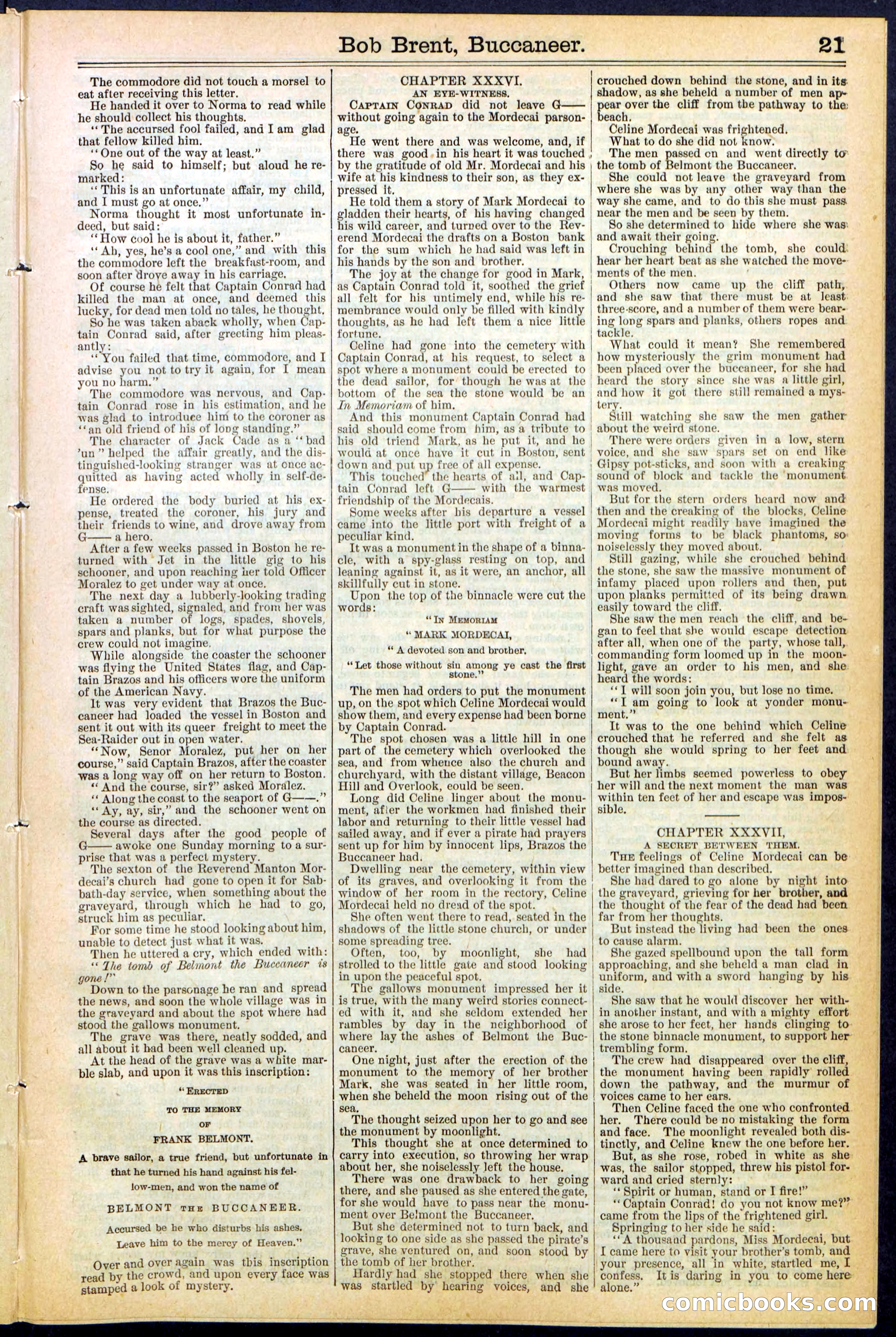
A restored page from Pulp Fiction, 1887. Page through the whole issue in the reader above.
📄 Transcribed text from this page (OCR, searchable)
Machine-transcribed from the original scan — historical spelling and the odd misread are preserved.
The commodore did not touch a morsel to eat after receiving this letter. He handed it over to Norma to read while he should collect his thoughts. ‘The accursed fool failed, and Iam glad that fellow killed him. ‘*One out of the way at least.” So he said to himself; but aloud he re- marked: ‘‘This is an unfortunate affair, my child, and I must go at once,” Norma thought it most unfortunate in- deed, but said: ‘* How cool he is about it, father.” ‘Ah, yes, he’s a cool one,” and with this the commodore left the breakfast-room, and soon after Uroye away in his carriage. Of course he felt that Captain Conrad had killed the man at once, and deemed this lucky, for dead men told no tales, he thought, So he was taken aback wholly, when Cap- tain Conrad said, after grecting him pleas- antly: ‘You failed that time, commodore, and I advise you not to try it again, for I mean you no harm,” The commodore was nervous, and Cap- tain Conrad rose in his estimation, and he was glad to introduee him to the coroner as ‘‘an old friend of his of long standing.” The character of Jack Cade as a ‘‘ bad ’un” helped the affair greatly, and the dis- tinguished-looking stranger was at once ac- quitted as having acted wholly in self-de- fense. He ordered the body buried at his ex- pense, treated the coroner, his jury and their friends to wine, and drove away from G a hero. After a few weeks passed in Boston he re- turned with Jet in the little gig to his schooner, and upon reaching ier told Officer Moralez to get under way at once. The next day a lubberly-looking trading craft was sighted, signaled, and from her was taken a number of logs, spades, shovels, spars and planks, but for what purpose the crew could not imagine, While alongside the coaster the schooner was flying the United States flag, and Cap- tain Brazos and his officers wore the uniform of the American Navy. It was very evident that Brazos the Buc- caneer had loaded the vessel in Boston and sent it out with its queer freight to meet the Sea-Raider out in open water. ‘“Now, Senor Moralez, put her on her course,” said Captain Brazos, after the coaster was a long way off on her return to Boston. «‘ And the course, sir?” asked Moralez. ‘* Along the coast to the seaport of G——.’ ‘* Ay, ay, sir,” and the schooner went on the course as directed. Several days after the good people of G—— awoke one Sunday morning to a sur- prise that was a perfect mystery. The sexton of the Reverend Manton Mor- decai’s church had gone to open it for Sab- bath-day service, when something about the graveyard, through which he had to go, struck him as peculiar. For some time he stood looking about him, unable to detect just what it was. ‘ Then he uttered a cry, which ended with: “The tomb of Belmont the Buccaneer is one |” Down to the parsonage he ran and spread the news, and soon the whole village was in the graveyard and about the spot where had stood the gallows monument. The grave was there, neatly sodded, and all about it had been well cleaned up. At the head of the grave was a white mar- ble slab, and upon it was this inscription: ’ * ERECTED TO THE MEMORY oF FRANK BELMONT. A brave sailor, a true friend, but unfortunate in that he turned his hand against his fel- low-men, and won the name of BELMONT toe BUCCANEER. Accursed be he who disturbs his ashes, Leave him to the mercy of Heaven.” Over and over again was tbis inscription - yead by the crowd, and upon every face was ook of mystery. mped al ee ay > ~~ at eee nT = 4 t * a Van? -, n A. i Ti. * ES) aif Bob Brent, Buccaneer. CHAPTER XXXVI. AN EYE-WITNESS. CapraIn ConrapD did not leave G—— without going again to the Mordecai parson- age. He went there and was welcome, and, if there was good.in his heart it was touched by the gratitude of old Mr. Mordecai and his wife at his kindness to their son, as they ex- pressed it, He told them a story of Mark Mordecai to eladden their hearts, of his having changed his wild career, and turned over to the Revy- erend Mordecai the drafts on a Boston bank for the sum which he had said was left in his hands by the son and brother. The joy at the change for good in Mark, as Captain Conrad told it, soothed the grief all felt for his untimely end, while his re- membrance would only be filled with kindly thoughts, as he had left them a nice little— fortune. Celine had gone into the cemetery with Captain Conrad, at his request, to select a spot where a monument could be erected to the dead sailor, for though he was at the bottom of the sea the stone would be an In Memorian of him. And this monument Captain Conrad had said should come from him, as a tribute to his old triend Mark, as he put it, and he would at once have it cut in Boston, sent down and put up free of all expense. This touched’ the hearts of ail, and Cap- tain Conrad left G with the warmest friendship of the Mordecais. Some weeks after his departure a vessel came into the little port with freight of a peculiar kind. It was a monument in the shape of a binna- cle, with a spy-glass resting on top, and leaning against it, as it were, an anchor, all skillfully cut in stone. Upon the top of the binnacle were cut the words: “In MEMORIAM “ MARK MORDECAI, ** A devoted son and brother, **Let those without sin among ye cast the first stone.” The men had orders to put the monument up, on the spot which Celine Mordecai would show them, and every expense had been borne by Captain Conrad. The spot chosen was a little hill in one part of the cemetery which overlooked the sea, and from whence also the church and churchyard, with the distant village, Beacon Hill and Overlook, eould be seen. Long did Celine linger about the monu- ment, afler the workmen had finished their labor and returning to their little vessel had sailed away, and if ever a pirate had prayers sent up for him by innocent lips, Brazos the Buccaneer had. Dwelling near the cemetery, within view of its graves, and overlooking it from the window of her room in the rectory, Celine Mordecai held no dread of the spot. She often went there to read, seated in the shadows of the little stone church, or under some spreading tree. Often, too, by moonlight, she had strolled to the little gate and stood looking in upon the peaceful spot. The gallows monument impressed her it is true, with the many weird stories connect- ed with it, and she seldom extended her rumbles by day in the neighborhood of where lay the ashes of Belmont the Buc- caneer. One night, just after the erection of the monument to the memory of her brother Mark, she was seated in her little room, when she beheld the moon rising out of the sea, The thought seized upon her to go and see the monument by moonlight. This thought she at once determined to carry into execution, so throwing her wrap about her, she noiselessly left the house. There was one drawback to her going there, and she paused as she entered the gate, for she would have to pass near the monu- ment over Belmont the Buccaneer, But she determined not to turn back, and looking to one side as she passed the pirate’s grave, she ventured on, and soon stood by the tomb of her brother. Hardly had she stopped there when she was startled by” Keatlug voices, and she Soi oe tent LP See ie © OP i . wt ? , , at wk Fd 4.¥\ EB» % « a, EF; J a ee 4 (E(0) MoE OB. oe ihe - 21 crouched down behind the stone, and in its. shadow, as she beheld a number of men ap» oe over the cliff from tbe pathway to the: each, Celine Mordecai was frightened, What to do she did not know. The men passed cn and went directly to the tomb of Belmont the Buccaneer. She could not leave the graveyard from where she was by any other way than the way she came, and to do this she must pass near the men and be seen by them. » So she determined to hide where she was: and await their going. Crouching behind the tomb, she could hear her heart beat as she watched the move- ments of the men. | Others now came up the cliff path,. and she saw that there must be at least. three-score, and a number of them were bear- ing long spars and planks, others ropes and. tackle. What could it mean? She remembered ) how mysteriously the grim monument had | been placed over the buccaneer, for she had ; heard the story since she was a little girl, ‘ and how it got there still remained a mys- tery. Still watching she saw the men gather ¢ about the weird stone. There were orders given in a low, stern voice, and she saw spars set on end like Gipsy pot-sticks, and soon with a creaking sound of block and tackle the monument was moved. But for the stern orders heard now and then and the creaking of the blocks, Celine Mordecai might readily bave imagined the 4 moving forms to be black phantoms, so a noiselessly they moved about. all Still gazing, while she crouched behind | the stone, she saw the massive monument of infamy placed upon rollers and then, put — upon planks permitted of its being drawn easily toward the cliff, She saw the men reach the cliff, and be- gan to feel that she would escape detection — after all, when one of the party, whose tall, = commanding form loomed up in the moon~ light, gave an order to his men, and she heard the words: ‘*T will soon join you, but lose no time. —__ ‘‘T am going to look at yonder monu~ ment,” .. It was to the one behind which Celine crouched that he referred and she felt as 2 #, « a Se ee ee : NN aa though she would spring to her feet and ~ bound away. But her limbs seemed powerless to obey her will and the next moment the man was wins ten feet of her and escape was impos~ | sible. oe CHAPTER XXXVII, et A SECRET BETWEEN THEM, a, Tre feelings of Celine Mordecai can be better imagined than described. 12 She had dared to go alone by night into | the graveyard, grieving for her brother, and Bit the thought of the fear of the dead had been far from her thoughts. | ‘ But instead the living had been the ones to cause alarm. ae , She gazed spellbound upon the tall form approaching, and she beheld a man clad in: ee aon and with a sword hanging by his | side. eh | She saw that he would discover her with- in another instant, and with a mighty effort she arose to her feet, her hands clinging to Fs | the stone binnacle monument, to support her — trembling form. ¥y, The crew had disappeared over the cliff, — the monument having been rapidly rolled down the pathway, and the murmur of ~~ voices came to her ears. 1 ae Then Celine faced the one who confronted. her. There could be no mistaking the form and face. The moonlight revealed both dis- tinctly, and Celine knew the one before her. | But, as she rose, robed in white as she was, the sailor stopped, threw his pistol for- | ward and cried sternly: eae ‘* Spirit or human, stand or I fire!” mie. | ‘“‘Oaptain Conrad! do you not know me?? came from the lips of the frightened gir == Springing to her side he said: pane ae ‘*A thousand pardons, Miss Mordecai, but | I came here to visit your brother’s tomb, and yous presence, all in white, startled me,IL | confess, Itis daring in you to ed ae alone.” ie Lf < oyoye) i<S , (elolig 4 (as 7% <x. os ea ar) ~ ’ oat yhn mr t Pe. ve se) : .