
Pulp Fiction, 1878 · page 30 of 32
Beadle's Dime Library No. 42 — page 30: what you’re looking at
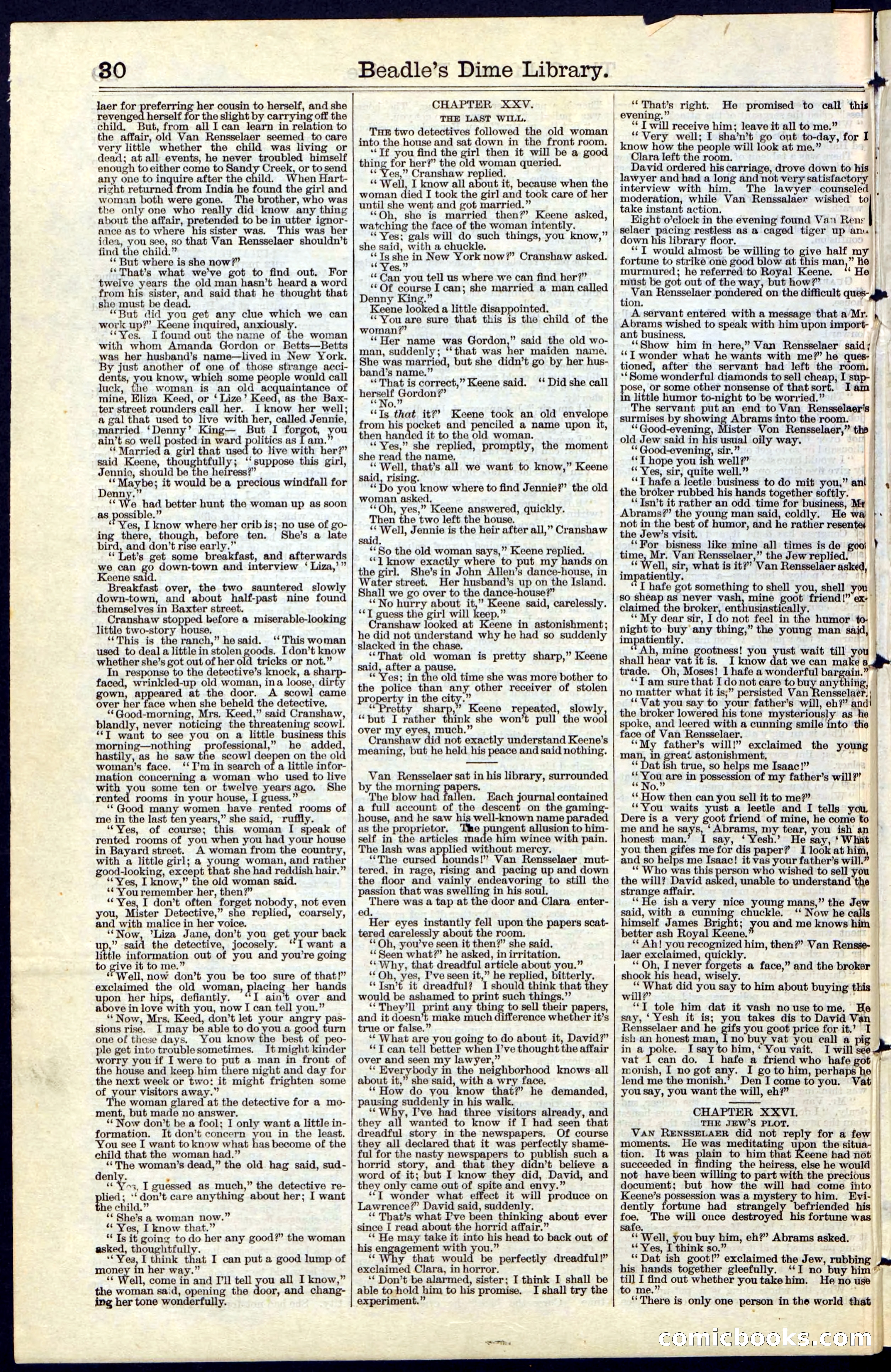
A restored page from Pulp Fiction, 1878. Page through the whole issue in the reader above.
📄 Transcribed text from this page (OCR, searchable)
Machine-transcribed from the original scan — historical spelling and the odd misread are preserved.
30 Beadle’s Dime Library. laer for peoternn her cousin to herself, and she revenged herself for the slight by carrying off the child. But, from all I can learn in relation to the affair, old Van Rensselaer seemed to care very little whether the child was living or dead; at all events, he never troubled himself enough to either come to Sandy Creek, or to send any one to inquire after the child. When Hart- right returned from India he found the girl and woman both were gone. The brother, who was the only one who really did know any thing about the affair, pretended to be in utter ignor- ance as to where his sister was. This was ber idea, you see, so that Van Rensselaer shouldn’t find the child.” ‘* But where is she now?” **That’s what we've got to find out. For twelve years the old man hasn’t heard a word from his sister, and said that he thought that she must be dead. “But did you get any clue which we can work up?’ Keene inquired, anxiously. “Yes. I found out the name of the woman with whom Amanda Gordon or Betts—Betits was her husband’s name—lived in New York. By just another of one of those strange acci- dents, you know, which some people would call luck, the woman is an old acquaintance of mine, Eliza Keed, or ‘ Lize’ Keed, as the Bax- ter street rounders call her. I know her well; a gal that used to live with her, called Jennie, married ‘Denny’ King— But I Forgot you ain’t so well posted in ward politics as [ am.” “* Married a girl that to live with her?” said Keene, thoughtfully; ‘‘suppose this girl, Jennio, should be the heiress?” ‘‘Maybe; it would be a precious windfall for were ‘* We had better hunt the woman up as soon ossible.” “Yes, I know where her crib is; no use of go- ing there, though, before ten. She’s a late bird, and don’t rise early.” “ Let's get some breakfast, and afterwards we can go down-town and interview ‘ Liza,’” Keene said. Breakfast over, the two sauntered slowly down-town, and about half-past nine found themselves in Baxter street. Cranshaw a before a miserable-looking little two-story house. ‘*This is the ranch,” hesaid. ‘‘ This woman used to deal a little in stolen goods. I don’t know whether she’s got out of her old tricks or not.” In response to the detective’s knock, a sharp- faced, wrinkled-up old woman, ina loose, dirty gown, ap ed at the door. A scowl came over her face when she beheld the detective. ‘‘Good-morning, Mrs. Keed,” said Cranshaw, blandly, never noticing the threatening scowl. ‘*T want to see you on a little business this morning—nothing professional,” he added hastily, as he saw the scowl deepen on the old woman’s face. ‘I’m in search of a little infor- mation concerning a woman who used to live with you some ten or twelve years ago. She ee rooms in your house, I guess.” ‘Good many women have rented rooms of me in the last ten years,” she said, ruffly. ‘“Yes, of course; this woman I speak of rented rooms of you when you had your house in Bayard street. A woman from the country, with a little girl; a young woman, and rather good-looking, except that she had reddish hair.” ‘*Yes, I know,” the old woman said. ‘You remember her, then?” “Yes, I don’t often forget nobody, not even you, Mister Detective,” she replied, coarsely, and with malice in her voice. ‘Now, Liza Jane, don’t you get your back up,” said the detective, jocosely. “I want a little information out of you and you're going to give it to me.” “Well, now don’t you be too sure of that!” exclaimed the old woman, placing her hands Spon her hips, defiantly. “I ain’t over and above in love with you, now I can tell you.” ** Now, Mrs. Keed, don’t let your angry pas- sions rise. I may be able to do you a good turn one of these days. You know the best of peo- ple get into troublesometimes. It might kinder worry you if I were to put a man in front of the house and keep him there night and day for the next week or two: it might frighten some of your visitors away.” e woman glared at the detective for a mo- ment, but made no answer. “Now don’t be a fool: I only want a little in- formation. It don’t concern you in the least. You see I want to know what has become of the child that the woman had.” ‘‘The woman’s dead,” the old hag said, sud- denly. . ‘«'‘Yo3, I guessed as much,” the detective re- lied; ‘‘ don’t care anything about her; I want he child.” ‘* She’s a woman now.” “* Yes, I know that.” “Is it going todo her any good?” the woman asked, thoughtfully. “Yes, I think that I can put a good lump of money in her way.” ‘¢ Well, come in and I'l] tell you all I know,” the woman said, opening the door, and chang- ing her tone wonderfully. as CHAPTER XXV. THE LAST WILL. THE two detectives followed the old woman into the house and sat down in the front room. ‘Tf you find the girl then it will be a good thing for her?’ the old woman queried. ‘* Yes,” Cranshaw replied. ‘* Well, I know all about it, because when the woman died I took the girl and took care of her until she went and got married.” “Oh, she is married then?’ Keene asked, watching the face of the woman intently. “Yes; gals will do such things, you know,” she said, with a chuckle. ‘**Ts she in New York now?’ Cranshaw asked. ac Yes. ” “Can you tell us where we can find her?” ‘“Of course I can; she married a man called Denny m3 Keene looked a little disappointed. ‘You are sure that this is the child of the woman?” ‘“‘Her name was Gordon,” said the old wo- man, suddenly; ‘‘ that was her maiden name. She was married, but she didn’t go by her hus- band’s name.” ‘**That is correct,” Keene said. ‘‘ Did she call herself Gordon ? ‘No “Ts that it?’ Keene took an old envelope from his pocket and penciled a name upon it, then handed it to the old woman. ‘“ Yes,” she replied, promptly, the moment she read the name, ‘Well, that’s all we want to know,” Keene said, rising. “Do you know where to find Jennie?” the old woman asked, “*Oh, yes,” Keene answered, quickly. Then the two left the house. ** Well, Jennie is the heir after all,” Cranshaw d. “So the old woman says,” Keene replied. ‘*] know exactly where to put my hands on the girl. She’sin John Allen’s dance-house, in Water street. Her husband’s up on the Island. Shall we go over to the dance-house?” ‘*No hurry about it,” Keene said, carelessly. **T guess the girl will keep.” Cranshaw looked at Keene in astonishment; he did not understand why he had so suddenly slacked in the chase. ‘‘That old woman is pretty sharp,” Keene said, after a pause. “Yes: in the old time she was more bother to the police than any other receiver of stolen Prgnerty in the city.” “Pretty sharp,” Keene repeated, slowly “but I rather think she won’t pull the wool over my eyes, much,” Cranshaw did not exactly understand Keene’s meaning, but he held his peace and said nothing. Van Rensselaer sat in his library, surrounded by the moming a, Sona The blow had fallen. Each journal contained a full account of the descent on the gaming- house, and he saw his well-known name paraded as the proprietor, The pungent allusion to him- self in the articles made him wince with pain. The lash was ge without mercy. ‘“The cursed hounds!” Van Rensselaer mut- tered, in rage, rising and pacing up and down the floor and vainly endeavoring to still the passion that was swelling in his soul. BO pi was a tap at the door and Clara enter- Her eyes instantly fell upon the papers scat- tered carelessly about the room. **Oh, you’ve seen it then?” she said. ** Seen what?’ he asked, in irritation. ‘“‘ Why, that dreadful article about you.” ‘*Oh, yes, I’ve seen it,” he neulion®, meer “Tsn’t it dreadful? I should think that they would be ashamed to print such things.”’ “They'll print any asp to sell their papers, and it doesn’t make much difference whether it’s true or false.” ‘* What are you going to do about it, David?” **T can tell better when I’ve thought the affair over and seen my lawyer,” ** Everybody in the neighborhood knows all about it,” she said, with a wry face. ‘* How do you know that?’ he demanded, pausing suddenly in his walk. oan ''f Ys I’ve had three visitors already, and they all wanted to know if I had seen that dreadful story in the newspapers. Of course they all declared that it was perfectly sbhame- ful for the nasty newspapers to publish such a horrid story, and that they didn’t believe a word of it; but I know they did, David, and they only came out of spite and envy.” **T wonder what effect it will produce on Lawrence?” David said, suddenly. “‘ That’s what Pve been thinking about ever since I read about the horrid affair.” ‘* He may take it into his head to back out of his engagement with you.” i y that would be perfectly dreadful!” exclaimed Clara, in horror. ‘** Don’t be alarmed, sister; I think I shall be able to hold him to his promise. I shall try the experiment.” ‘*That’s right. He promised to call this ; evening.” “* I will receive him; leave it all to me.” “Very well; I sha’n’t go out to-day, for I know how the people will look at me.” . Clara left the room. David ordered his carriage, drove down to his |. lawyer and had a long and not very satisfactory interview with him. The lawyer counseled |, moderation, while Van Renssalaer wished to take instant action. Kight o’clock in the evening found Va Rens selaer pacing restless as a caged tiger up anu down his library floor. ** I would almost be willing to are half my fortune to strike one good blow at this man,” he murmured; he referred to Royal Keene. ‘‘ He must be got out of the way, but how?” Van Rensselaer pondered on the difficult ques- tion. A servant entered with a message that a Mr. Abrams wished to speak with him upon import- — ant business. **Show him in here,” Van Rensselaer said; “IT wonder what he wants with me?’ he ques- | tioned, after the servant had left the room, ‘Some wonderful diamonds to sell cheap, I sup- pose, or some other nonsense of that sort. Iam in little humor to-night to be worried.” The servant put an end to Van Rensselaer's surmises by showing Abrams into the room. ‘“‘Good-evening, Mister Von Rensselaer,” ths old Jew said in his usual oily way. ** Good-evening, sir.” ‘**T hope you ish well?” | “Yes, sir, quite well.” “T hafe a leetle business to do mit you,” anl ” the broker rubbed his hands together softly. _ ‘“‘Isn’t it rather an odd time for business, Mt Abrams?’ the young man said, coldly. He wa not in the best of humor, and he rather resentet the Jew’s visit. _“For bisness like mine all times is de goo} time, Mr. Van Rensselaer,” the Jew replied. © "* Well, sir, what is it?’ Van Rensselaer asked, impatiently. ; ‘I hafe got something to shell you, shell you so sheap as never v mine goot friend!” ex-’ claimed the broker enthusiastically. ah _“* My dear sir, I do not feel in the humor to- night to buy any thing,” the young man said, impatiently. , ‘Ah, mine gootness! you Fe wait till you shall hear vat itis. I know dat we can make a trade. Oh, Moses! I hafe a wonderful bargain.” ‘“‘T am sure that I do not care to buy anythin no matter what it is;” persisted Van Rensselaer.) ‘** Vat you say to your father’s will, eh?’ and the broker lowered his tone mysteriously as he spoke, and leered with a cunning smile into thie face of Van Rensselaer. ‘‘My father’s will!” exclaimed the young man, in great astonishment, - “Dat ish true, so helps me Isaac!” f St ie in possession of my father’s will?’ ‘No. ‘** How then can you sell it to me?” ‘You waits yust a leetle and I tells you, Dere is a very goot friend of mine, he come to me and he says, ‘Abrams, my tear, you ish an honest man.’ I say, ‘ Yesh.’ He say, ‘What you then gifes me for dis paper? I look at him and so helps me Isaac! it vas your father’s will.” ** ‘Who was ipl era who wished to sell you | the will? David asked, unable to understand the — strange affair. - @ ‘He ish avery nice young mans,” the Jew said, with a ee chuckle. ‘‘ Now hee himself James Bright; you and me knows him — better ash Royal Keene. ** Ah! you recognized him, then?” Van Rensse- laer exclaimed, quickly. i ‘Oh, I never forgets a face,” and the broker shook his head, wisely. a eae did you say to him about buying this will? : “T tole him dat it vash nousetome. He say, ‘ Yesh it is; you takes dis to David Van Rensselaer and he eats you goot price for it.’ T ish an honest man, Ino buy vat you call a pig — in a poke. I say to him,‘ You vait. I will see. vat I can do. hafe a friend who hafe got _ monish, I no got any. I go to him, perhaps he lend me the monish.’ Den I come to you. Vat you say, you want the will, eh?” | CHAPTER XXVI. THE JEW’S PLOT. VAN RENSSELAER did not reply for a few — moments. He was meditating upon the situa- tion. It was ar to him that Keene had not succeeded in ding the heiress, else he would | not have been willing to part with the precious document; but how the will had come into > Keene’s ' recang § was a mystery tohim. Evi- | dently fortune had strangely befriended his foe. The will once destroyed his fortune was safe. ‘* Well, you buy him, eh?’ Abrams asked. | “Dat aia laimed the J | ‘Dat ish goot!” exclaim e Jew, rubbing | his hands together gleefully. ‘I no’ buy ie 4 cil I find out whether youtakehim. He no use me. - ‘There is only one person in the world that ' MICO) KS,(€O) (E(@) ( ‘SGOm)