
Pulp Fiction, 1878 · page 29 of 32
Beadle's Dime Library No. 42 — page 29: what you’re looking at
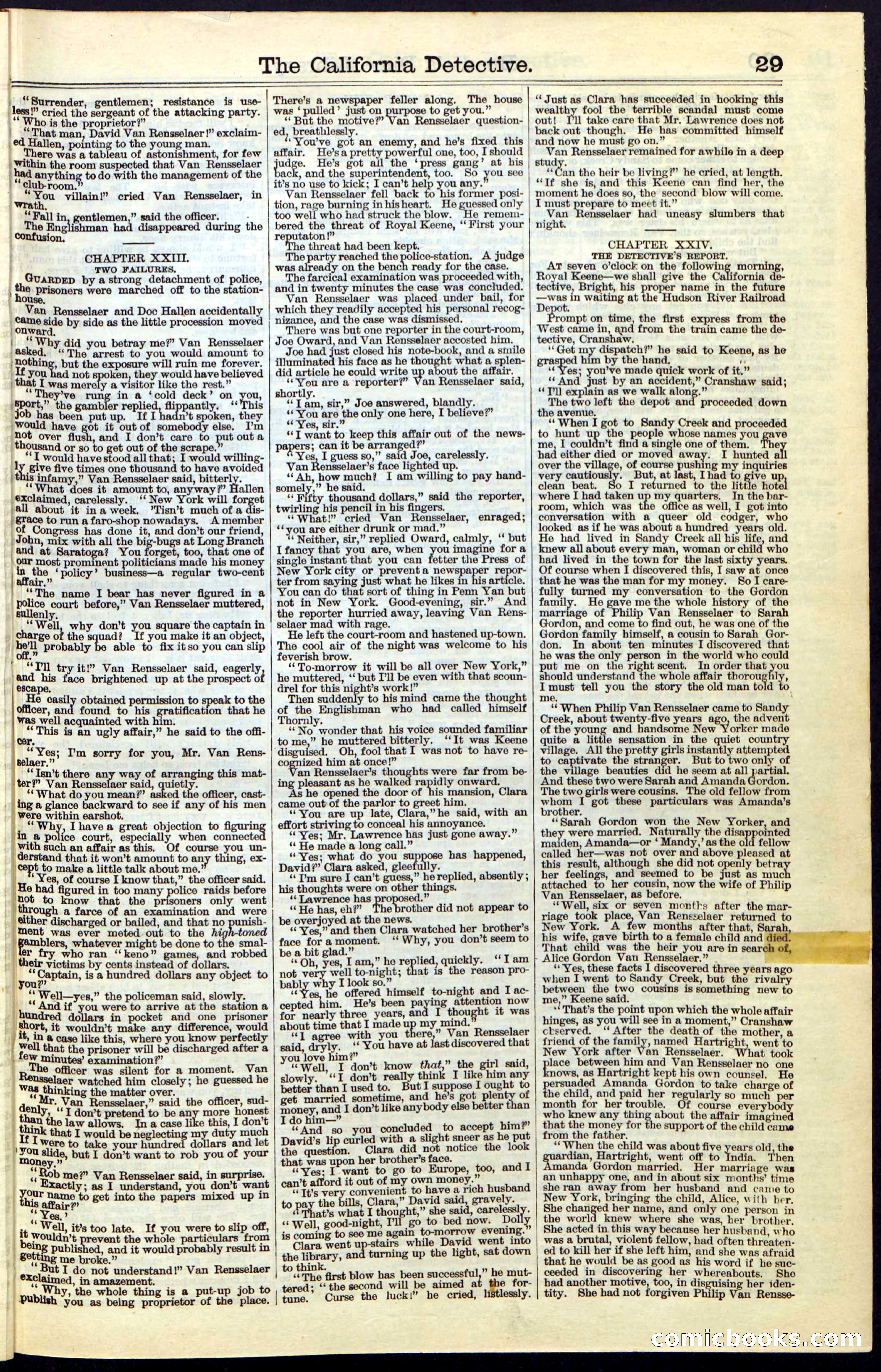
A restored page from Pulp Fiction, 1878. Page through the whole issue in the reader above.
📄 Transcribed text from this page (OCR, searchable)
Machine-transcribed from the original scan — historical spelling and the odd misread are preserved.
The California Detective. 29 “Surrender, gentlemen; resistance is use- | There’s a newspaper feller along. The house less !” cried the sergeant of the attacking party. | was ‘pulled’ just on eee to get you.” iy ho is the proprietor?” That man, David Van Rensselaer!” exclaim- ed Hallen, pointing to the young man. | ere was a tableau of astonishment, for few within the room suspected that Van Rensselaer a anything todo with the management of the club-room.” : you villain!” cried Van Rensselaer, in “Fall in, gentlemen,” said the officer. ; The Englishman had disappeared during the confusion, oneal ; CHAPTER XXIII. TWO FAILURES, GuarRpEp by a strong detachment of police, ne prisoners were marched off to the station- Se. Van Rensselaer and Doc Hallen accidentally Came side by side as the little procession moved onward, | “Why did you betray me?” Van Rensselaer asked. ““The arrest to you would amount to othing, but the exposure will ruin me forever. If you had not > agi they would have believed that I was merely a visitor like the rest.” Be. he Cg eon in . ‘ sper — gh ben. ' ) e gambler replied, flippantly. is job has been put up. If I hadwt os they would have got it out of somebody else. I’m ‘not over flush, and I don’t care to put out a thousand or so to get out of the scrape.” I would have stood all that; I would willing- give five times one thousand to have avoided infamy,” Van Rensselaer said, bitterly. ) t does it amount to, anyway?’ Hallen exclaimed, carelessly. ‘‘ New York will forget about it ina week. ’Tisn’t much of a dis- grace to run a faro-shop nowadays. A member of Congress has done it, and don’t our friend, John, mix with all the ce ten at Long Branch and at Saratoga? You forget, too, that one of our most prominent politicians made his money | ad Saag ‘policy’ business—a regular two-cent r. 1 it “The name I bear has never figured in a police court before,” Van Rensselaer muttered, Wall, why don't h ini ell, why don’t you square the captain in _ charge of the squad? ‘If you make it an object, nel probably be able to fix itso you can slip apy try it!’ Van Rensselaer said, eagerly | jos so face brightened up at the prospect of He casily obtained permission to to the officer, and found to his tification that he was well acquainted with him. This is an ugly affair,” he said to the offi- cer. Yes; I’m sorry for you, Mr. Van Rens- r “‘Isn’t there any way of arranging this mat- ter?’ Van Rensselaer said, ss ‘What do you mean?” asked the officer, cast- ing a glance backward to see if any of his men were enn seep ee a ve a great objection gurin in a police court, especially when connec _ with such an affair as this. course you un- derstand that it won’t amount to any thing, ex- _ cept to make a little talk about me.’ Yes, of course I know that,” the officer said. | ye A figured in too many police raids before | through a farce of an examination and were _ either discharged or bailed, and that no punish- ment was ever meted out to the high-toned Famblers, whatever might be done to the smal- der fry who ran “keno” games, and robbed their victims by cents instead of dollars. ong is a hundred dollars any object to ., Well—yes,” the policeman said, slowly. ,. And if you were to arrive at the station a hundred dollars in pocket and one prisoner _ Short, it wouldn’t make any difference, would in a case like this, where you know perfectly | Well that the prisoner will be discharged after a few minutes’ examination?” The officer was silent for a moment. Van Rensselaer watched him closely; he guessed he 48 thinking the matter over. d - Van Rensselaer,” said the officer, sud- enly, ‘I don’t pretend to be any more honest than the law allows. Ina case like this, I don’t Itt that I would be neglecting 4 duty much ; Were to take your hundred dollars and let money but I don’t want to rob you of your oney, (, Rob me?” Van Rensselaer said, in surprise. 7 tly; as I understand, you don’t want A name to get into the papers mixed up in a ‘Well, it’s too late. If you were to slip off ’ . p ’ pwouldn’t revent the eh particulars from ing published, and it would probably result in _ Betting me broke.” But I do not understand!” Van Rensselaer _ ©Xclaimed, in amazement. | Why, the whole thing is a put-up job to Publish you as belng proprietor of the place. ** But the motive?’ ed, breathlessly. ‘You’ve got an enemy, and he’s fixed this affair. He’sa pretty powerful one, too, I should judge. He’s got all the ‘press gang’ at his ck, and the superintendent, too. So you see it’s no use to kick; I can’t help you any.” Van Rensselaer fell back to his former posi- tion, rage burning inhisheart. He guessed only too well who had struck the blow. He remem- bered the threat of Royal Keene, ‘‘ First your reputaton!” e threat had been kept. The party reached the police-station, A judge was already on the bench ready for the case. The farcical examination was proceeded with, and in twenty minutes the case was concluded. Van Rensselaer was placed under bail, for which they readily accepted his personal recog- nizance, and the case was dismissed. There was but one reporter in the court-room, Joe Oward, and Van Rensselaer accosted him. an Rensselaer question- Joe had just closed his note-book, and a smile his face as he thought what a splen- illumina did article he could write u ‘‘You are a reporter?” shortly. ‘‘T am, sir,” Joe answered, blandly. ‘‘-You are the only one here, I believe?” ‘Yes, sir.” ‘‘T want to keep this affair out of the news- papers; can it be arran ‘ Yes, I guess so,” said Joe, carelessly. Van Rensselaer’s face lighted up. ‘Ah, how much? I am willing to pay band- somely,” he said. ‘‘ Fifty thousand dollars,” said the reporter, twirling his pencil in his fingers. ‘‘ What!” cried Van Rensselaer, enraged; ‘vou are either drunk or mad.” ‘* Neither, sir,” replied Oward, calmly, ‘‘ but I fancy that you are, when you imagine for a single instant that you can fetter the Press of New York city or preventa howe r repor- ter from saying just what he likes in his article. You can do that sort of thing in Penn Yan but not in New York. Good-evening, sir.” And the reporter hurried away, leaving Van Rens- selaer mad with rage. He left the court-room and hastened up-town. The cool air of the night was welcome to his feverish brow. ‘To-morrow it will be all over New York,” he muttered, ‘‘ but I’ll be even with that scoun- drel for this night’s work!” Then suddenly to his mind came the thought of the Englishman who had called himself Thornly. ‘‘No wonder that his voice sounded familiar to me,” he muttered bitterly. ‘‘It was Keene disguised Oh, fool that I was not to have re- about the affair. an Rensselaer said, ized him at once!” an Rensselaer’s thoughts were far from be- ing pleasant as he walk oy le onward. he opened the door of his mansion, Clara came out of the parlor to t him. ; ‘‘You are up late, Clara,” he said, with an effort striving to conceal his annoyance. “Yes: Mr. Lawrence has just gone away.” ‘He made a long call.” “Yes; what do you ra Ae has happened, David?” Clara asked, gleefully. _ “I’m sure I can’t guess,” he replied, absently ; his thoughts were on other things. ‘‘ Lawrence has i oc ? ‘“‘ He has, eh?” e brother did not appear to be overjoyed at the news. “Yes,” and then Clara watched her brother's face fora moment. ‘‘Why, you don’t seem to be a bit glad.” ** Oh, ans I am,” he replied, quickly. “Tam not very well to-night; that is the reason pro- bably why I look so.” “Yes he offered himself to-night and I ac- cepted him. He’s been pa attention now for nearly three years, and I thought it was about time that I made up my mind. ela with you there,” Van Rensselaer said, dryly. ‘‘ You have at last discovered that you love him?” - : J “Well, I don’t know that, the girl said, slowly. ‘I don’t really think I like him any better than I used ll a pint ants = et married sometime, and hes money, and I don’t like anybody else better than I do him—” “And so you concluded to accept him? David's lip curled with a slight sneer as he put the question. Clara did not notice the look that was upon her brother’s face. “Yes; tage Dp go to oe too, and I % afford it out of my own f ee It's very convenient to have a rich husband to pa the bills, Clara,” David said, gravely. , That's what I thought,” she said, ong or ‘Well, good-night, I'll go to bed now. Dol y is coming to see me again to-morrow evening. Clara went up-stairs while David went into the library, and turning up the light, sat down to ae first blow has been successful,” he mut- tered; ‘‘ the second will be aimed at 8 for- tune. Curse the luck!” he cried, listlessly. co ‘Just as Clara has succeeded in hooking this wealthy fool the terrible scandal must come out! Tl take care that Mr. Lawrence does not back out though. He has committed himself and now he must go on.” Van Rensselaer remained for awhile in a deep i: ‘*Can the heir be living?’ he cried, at length. “If she is, and this Keene can find her, the moment he does so, the second blow will come. I must prepare to meet it.” Van Rensselaer had uneasy slumbers that night. CHAPTER XXIV. THE DETECTIVE’S REPORT. AT seven o’clock on the following morning, rath Keene—we shall give the California de- tective, Bright, his proper name in the future ide in waiting at the Hudson River Railroad epot. rompt on time, the first express from the West came in, and from the train came the de- tective, Cranshaw. ** Get TT he said to Keene, as he gra him by the hand, V6 ‘‘-Yes; you’ve made quick work of it.” ‘‘ And just by an accident,” Cranshaw said; “Tl explain as we walk along.” The two left the depot and proceeded down the avenue. ‘When I got to Sandy Creek and proceeded to hunt up the people whose names you gave me, I couldn’t find a single one of them. e had either died or moved away. I hunted all over the village, of course pushing my inquiries very cautio ry. But, at last, I had ve up clean beat. I returned to the little hotel where I had taken 7 my quarters. In the bar- room, which was the office as well, I got into conversation with a queer old codger, who looked as if he was about a hundred years old. He had lived in Sandy Creek all his life, and knew all about every man, woman or child who had lived in the town for the last sixty years. Of course when I discovered this, I saw at once that he was the man formy money. So I care- fully turned my conversation to the Gordon family. He gave me the whole history of the marriage of Philip Van Rensselaer to Sarah Gordon, and come to find out, he was one of the Gordon family himself, a cousin to Sarah Gor- don. In abont ten minutes I discovered that he was the only person in the world who could put me on the right scent. In order that you should understand the whole affair thorou ity, I must tell you the story the old man told to. m e. ‘‘ When Philip Van Rensselaer came to Sandy Creek, about twenty-five years ago, the advent of the young and handsome New Yorker made quite a little sensation in the quiet country village. All the pretty girls instantly attempted to captivate the ‘sabes a But to two only of the village beauties did he seem at all partial. And these two were Sarah and Amanda Gordon. The two girls were cousins. The old fellow from whom I got these particulars was Amanda’s brother. “Sarah Gordon won the New Yorker, and they were married. Naturally the disa pointed maiden, Amanda—or ‘ Mandy,’ as the old fellow called her—was not over and above pleased at this result, although she did not openly betra her feelings, and seemed to be fast as muc attached her cousin, now the wife of Philip Van Rensselaer, as before. ‘Well, six or seven months after the mar- riage took place, Van Rensselaer returned to New York. A few months after that, Sarak his wife, gave birth to a female child and diet That child was the heir you are in seare Alice Gordon Van Rensselaer.” ‘Yes, these facts I discovered three years ago when I went to Sandy Creek, but the rivalry between the two cousins is something new to me,” Keene said. ‘‘ That’s the point upon which the whole affair hinges, as you will see in a moment,” Cranshaw chserved. ‘After the death of the mother, a friend of the family, named Hartright, went to New York after Van Rensselaer. What took lace between him and Van Rensselaer no one ows, as Hartright kept his own counsel. He porsuets Amanda Gordon to take charge of e child, and paid her regularly so much per month for her trouble. Of course everybody who knew any thing about the affair imagined that the money for the support of the child came from the father. ** When the child was about five years old, the aloe Hartright, went off to India. Then anda Gordon married. Her marriage was an unhappy one, and in about six months’ time she ran away from her husband and came to New York, bringing the child, Alice, with her. She lee her name, and only one person in the world knew where she was, her brother. She acted in this way because her husband, who was a brutal, violent fellow, had often threaten- ed to kill her if she left him, and she was afraid that he would be as good as his word if he suc- ceeded in discovering her whereabouts. Sho had another motive, too, in disguising her iden- tity. She had not forgiven Philip Van Rensse- Gomicbhoo Cc Ss (E(©)