
Pulp Fiction, 1878 · page 3 of 32
Beadle's Dime Library No. 42 — page 3: what you’re looking at
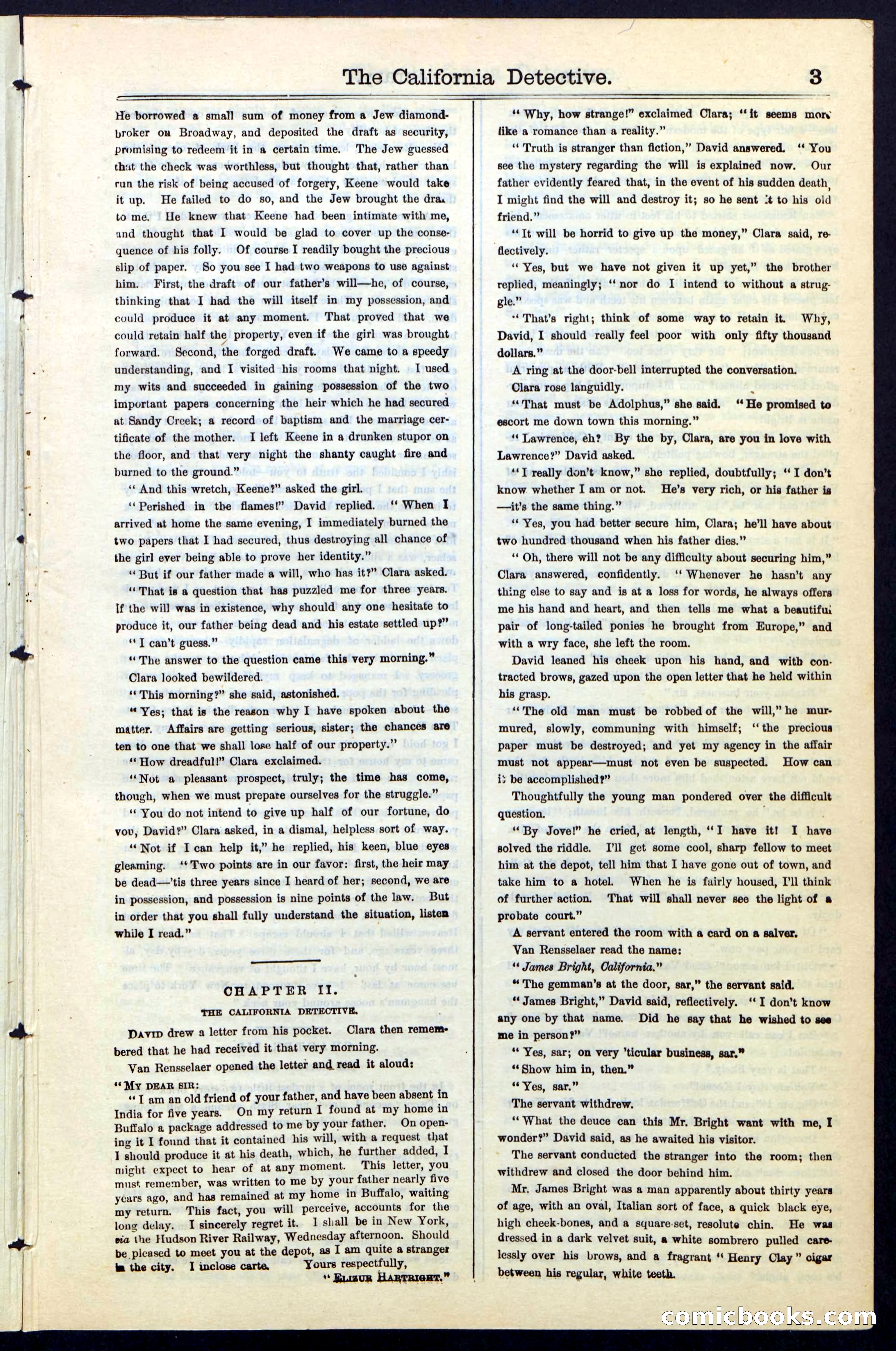
A restored page from Pulp Fiction, 1878. Page through the whole issue in the reader above.
📄 Transcribed text from this page (OCR, searchable)
Machine-transcribed from the original scan — historical spelling and the odd misread are preserved.
He borrowed a small sum of money from a Jew diamond- proker ou Broadway, and deposited the draft as security, promising to redeem it in a certain time. The Jew guessed that the check was worthless, but thought that, rather than run the risk of being accused of forgery, Keene would take it up. He failed to do so, and the Jew brought the dra. tome. He knew that Keene had been intimate with me, and thought that I would be glad to cover up the conse- quence of his folly. Of course I readily bought the precious slip of paper. So you see I had two weapons to use against him. First, the draft of our father’s will—he, of course, thinking that I had the will itself in my possession, and could produce it at any moment. That proved that we could retain half the property, even if the girl was brought forward. Second, the forged draft. We came to a speedy understanding, and I visited his rooms that night. 1 used my wits and succeeded in gaining possession of the two important papers concerning the heir which he had secured at Sandy Creek; a record of baptism and the marriage cer- tificate of the mother. I left Keene in a drunken stupor on the floor, and that very night the shanty caught fire and burned to the ground.” ‘‘ And this wretch, Keene?” asked the girl. ‘‘Perished in the flames!” David replied. ‘‘ When I arrived at home the same evening, I immediately burned the two papers that I had secured, thus destroying all chance of the girl ever being able to prove her identity.” “But if our father made a will, who has it?” Clara asked. ‘That is a question that has puzzled me for three years. If the will was in existence, why should any one hesitate to produce it, our father being dead and his estate settled up?” **T can’t guess.” “The answer to the question came this very morning.” Clara looked bewildered. ‘‘This morning?” she said, astonished. “Yes; that is the reason why I have spoken about the matter. Affairs are getting serious, sister; the chances are ten to one that we shall lose half of our property.” ‘‘ How dreadful!” Clara exclaimed. ‘‘Not a pleasant prospect, truly; the time has come, though, when we must prepare ourselves for the struggle.” ‘You do not intend to give up half of our fortune, do vov, David?” Clara asked, in a dismal, helpless sort of way. “Not if I can help it,” he replied, his keen, blue eyes gleaming. ‘*Two points are in our favor: first, the heir may be dead—’tis three years since I heard of her; second, we are in possession, and possession is nine points of the law. But in order that you shall fully understand the situation, listen while I read.” ————_—_— CHAPTER II. THE CALIFORNIA DETECTIVE. Davip drew a letter from his pocket. Clara then remem- bered that he had received it that very morning. Van Rensselaer opened the letter and read it aloud: “(My DEAR SIR: ‘T am an old friend of your father, and have been absent in India for five years. On my return I found at my home in Buffalo a package addressed to me by your father. On open- ing it I found that it contained his will, with a request that I should produce it at his death, which, he further added, I might expect to hear of at any moment. This letter, you must remember, was written to me by your father nearly five years ago, and has remained at my home in Buffalo, waiting my return. This fact, you will perceive, accounts for the long delay. I sincerely regret it. 1 shall be in New York, via the Hudson River Railway, Wednesday afternoon. Should be pleased to meet you at the depot, as I am quite a stranger im the city. I inclose carte. Yours respectfully, * Buimun HARTRIGET.” The California Detective. | 3 ‘* Why, how strange!” exclaimed Clara; ‘‘it seems mor like a romance than a reality.” ‘Truth is stranger than fiction,” David answered. ‘* You see the mystery regarding the will is explained now. Our father evidently feared that, in the event of his sudden death, I might find the will and destroy it; so he sent :t to his old friend.” ‘‘It will be horrid to give up the money,” Clara said, re- flectively. ‘‘ Yes, but we have not given it up yet,” the brother replied, meaningly; ‘‘nor do I intend to without a strug- gle.” That's right; think of some way to retain it. Why, David, I should really feel poor with only fifty thousand dollars.” A ring at the door-bell interrupted the conversation. Clara rose languidly. , ““That must be Adolphus,” she said. ‘*He promised to escort me down town this morning.” ‘‘ Lawrence, eh? By the by, Clara, are you in love with Lawrence?” David asked. ‘*T really don’t know,” she replied, doubtfully; ‘I don’t know. whether I am or not. He’s very rich, or his father is — it’s the same thing.” ‘* Yes, you had better secure him, Clara; he’ll have about two hundred thousand when his father dies.” ‘‘ Oh, there will not be any difficulty about securing him,” Clara answered, confidently. ‘‘ Whenever he hasn’t any thing else to say and is at a loss for words, he always offers me his hand and heart, and then tells me what a beautifui pair of long-tailed ponies he brought from Europe,” and with a wry face, she left the room. David leaned his cheek upon his hand, and witb con- tracted brows, gazed upon the open letter that he held within his grasp. ‘“‘The old man must be robbed of the will,” he mur- mured, slowly, communing with himself; ‘‘the precious paper must be destroyed; and yet my agency in the affair must not appear—must not even be suspected. How can it be accomplished?” Thoughtfully the young man pondered over the difficult question. . ; “ By Jovel” he cried, at length, ‘‘I have it! I have solved the riddle. I'll get some cool, sharp fellow to meet him at the depot, tell him that I have gone out of town, and take him to a hotel. When he is fairly housed, I'll think of further action. That will shall never see the light of a probate court.” A servant entered the room with a card on a salver, Van Rensselaer read the name: ** James Bright, Oalifornia.” “The gemman’s at the door, sar,” the servant said. ** James Bright,” David said, reflectively. ‘‘ I don’t know any one by that name. Did he say that he wished to see me in person?” “Yes, sar; On very ’ticular business, sar.” ** Show him in, then.” **'Yes, sar.” The servant withdrew. ‘What the deuce can this Mr, Bright want with me, I wonder?” David said, as he awaited his visitor. The servant conducted the stranger into the room; then withdrew and closed the door behind him. Mr. James Bright was a man apparently about thirty years of age, with an oval, Italian sort of face, a quick black eye, high cheek-bones, and a square-set, resolute chin. He was dressed in a dark velvet suit, a white sombrero pulled care- lessly over his brows, and a fragrant ‘‘ Henry Clay” cigar between his regular, white teeth. Gomicbooks.co