
Pulp Fiction, 1878 · page 2 of 32
Beadle's Dime Library No. 42 — page 2: what you’re looking at
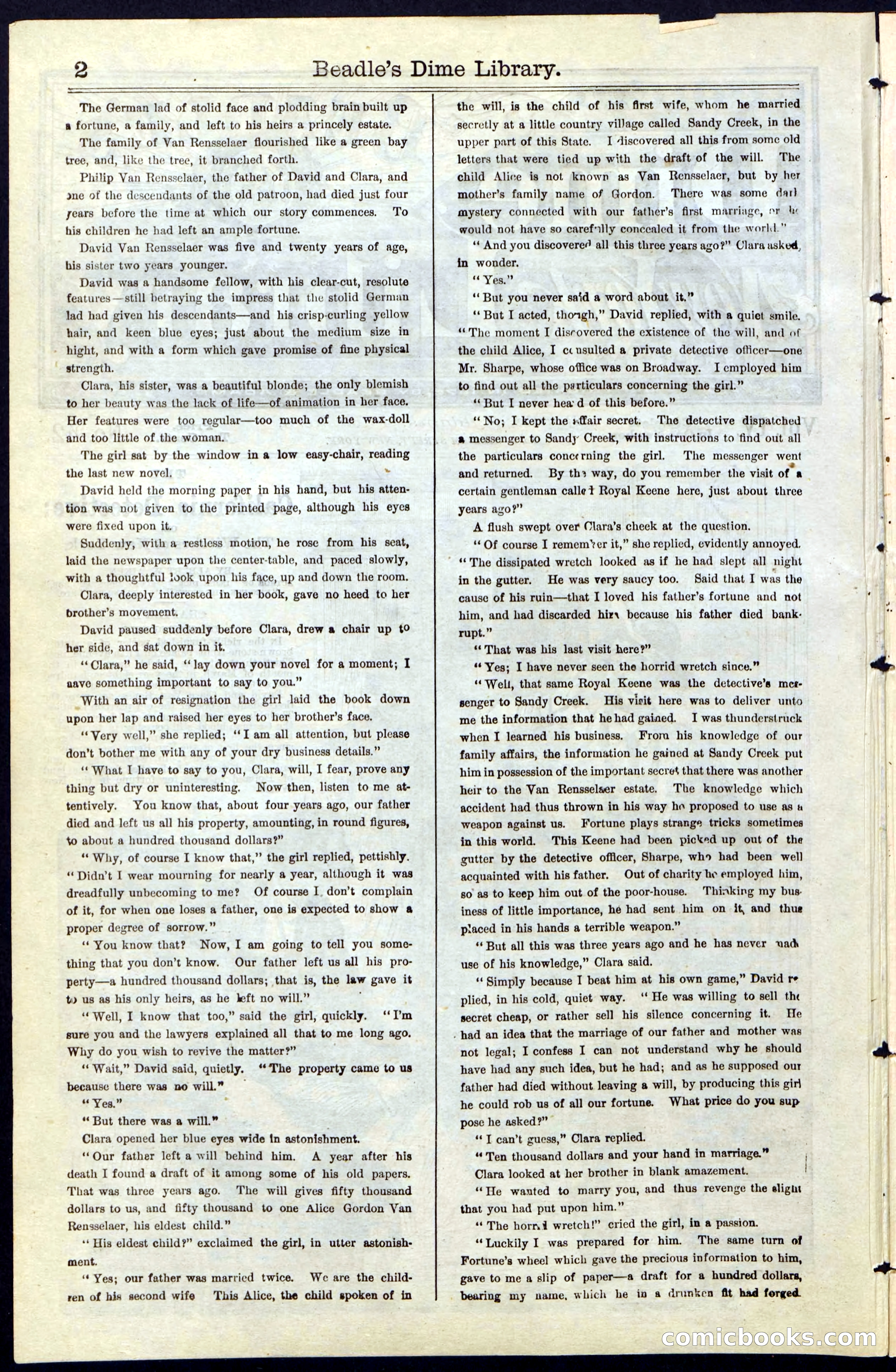
A restored page from Pulp Fiction, 1878. Page through the whole issue in the reader above.
📄 Transcribed text from this page (OCR, searchable)
Machine-transcribed from the original scan — historical spelling and the odd misread are preserved.
2 Beadle’s Dime Library. The German lad of stolid face and plodding brain built up a fortune, a family, and left to his heirs a princely estate. The family of Van Rensselaer flourished like a green bay tree, and, like the tree, it branched forth. Philip Van Rensselaer, the father of David and Clara, and one of the descendants of the old patroon, had died just four years before the time at which our story commences. To his children he had left an ample fortune. David Van Rensselaer was five and twenty years of age, his sister two years younger. David was a handsome fellow, with his clear-cut, resolute features —still betraying the impress that the stolid German lad had given his descendants—and his crisp-curling yellow hair, and keen blue eyes; just about the medium size in hight, and with a form which gave promise of fine physical strength. Clara, his sister, was a beautiful blonde; the only blemish to her beauty was the lack of life—of animation in her face. Her features were too regular—too much of the wax-doll and too little of the woman. The girl sat by the window in a low easy-chair, reading the last new novel. » David held the morning paper in his hand, but his atten- tion was not given to the printed page, although his eyes were fixed upon it. Suddenly, with a restless motion, he rose from his seat, laid the newspaper upon the center-table, and paced slowly, with a thoughtful took upon his face, up and down the room, Clara, deeply interested in her book, gave no heed to her brother’s movement. David paused suddenly before Clara, drew a chair up t° her side, and sat down in it. “Clara,” he said, “lay down your novel for a moment; I aave something important to say to you.” With an air of resignation the girl laid the book down upon her lap and raised her eyes to her brother’s face. ‘Very well,” she replied; ‘‘I am all attention, but please don’t bother me with any of your dry business details.” ‘‘ What I have to say to you, Clara, will, I fear, prove any thing but dry or uninteresting. Now then, listen to me at- tentively. You know that, about four years ago, our father died and left us all his property, amounting, in round figures, to about a hundred thousand dollars?” ‘“ Why, of course I know that,” the girl replied, pettishly. ‘‘Didn’t I wear mourning for nearly a year, although it was dreadfully unbecoming to me? Of course I. don’t complain of it, for when one loses a father, one is expected to show 4 proper degree of sorrow.” ‘‘ You know that? Now, I am going to tell you some- thing that you don’t know. Our father left us all his pro- perty—a hundred thousand dollars; that is, the law gave it t») us as his only heirs, as he kft no will.” ‘“Well, I know that too,” said the girl, quickly. ‘I’m sure you and the lawyers explained all that to me long ago. Why do you wish to revive the matter?” ‘‘ Wait,” David said, quietly. ‘*The property came to us because there was no will.” “Yes.” . ‘But there was a will.” | Clara opened her blue eyes wide in astonishment. ‘‘Our father left a will behind him. A year after his death I found a draft of it among some of his old papers. That was three years ago. The will gives fifty thousand dollars to us, and fifty thousand to one Alice Gordon Van Rensselaer, his eldest child.” ‘‘ His eldest child?” exclaimed the girl, in utter astonish- ment. ‘‘ Yes; our father was married twice. We are the child- ren of his second wife This Alice, the child spoken of in <ceettt LLL LL the will, is the child of his first wife, whom he married secretly at a little country village called Sandy Creek, in the upper part of this State. I discovered all this from some old letters that were tied up with the draft of the will. The child Alice is not known as Van Rensselaer, but by her mother’s family name of Gordon. There was some dar} mystery connected with our father’s first marriage, or he would not have so carefnily concealed it from the workl.” ‘‘ And you discovere? all this three years ago?” Clara asked, in wonder. “You ‘‘But you never said a word about it,” ‘But I acted, though,” David replied, with a quiet smile. “The moment I disrovered the existence of the will, and of the child Alice, I cc usulted a private detective ofticer—one Mr. Sharpe, whose office was on Broadway. I cmployed him to find out all the particulars concerning the girl.” ‘But I never hea d of this before.” ‘No; I kept the «fair secret. The detective dispatched a messenger to Sandy Creek, with instructions to find out all the particulars concerning the girl. The messenger went and returned. By th: way, do you remember the visit of a certain gentleman calle t Royal Keene here, just about three years ago?” A flush swept over Clara’s cheek at the question. ‘¢Of course I remem’er it,” she replied, evidently annoyed. - The dissipated wretch looked as if he had slept all night in the gutter. He was very saucy too. Said that I was the cause of his ruin—that I loved his father’s fortune and not him, and had discarded hir.x because his father died bank- rupt.” ‘“‘That was his last visit here?” ‘¢-Yes; I have never seen the horrid wretch since.” “Well, that same Royal Keene was the detective’s mes- senger to Sandy Creek. His visit here was to deliver unto me the information that hehad gained. I was thunderstruck when I learned his business. From his knowledge of our family affairs, the information he gained at Sandy Creek put him in possession of the important secret that there was another heir to the Van Rensselaer estate. The knowledge which accident had thus thrown in his way hea proposed to use as & weapon against us. Fortune plays strange tricks sometimes in this world. This Keene had been picked up out of the gutter by the detective officer, Sharpe, who had been well acquainted with his father. Out of charity he employed him, so as to keep him out of the poor-house. Thinking my bus: iness of little importance, he had sent him on it, and thue placed in his hands a terrible weapon.” ‘‘ But all this was three years ago and he has never ath use of his knowledge,” Clara said. “Simply because I beat him at his own game,” David re plied, in his cold, quiet way. ‘He was willing to sell the secret cheap, or rather sell his silence concerning it. He had an idea that the marriage of our father and mother was not legal; I confess I can not understand why he should have had any such idea, but he had; and as he supposed our father had died without leaving a will, by producing this gir| he could rob us of all our fortune. What price do you sup pose he asked?” “‘T can’t guess,” Clara replied. “Ten thousand dollars and your hand in marriage.” : Clara looked at her brother in blank amazement. “Tle wanted to marry you, and thus revenge the eligi that you had put upon him.” ‘‘'The hornid wretch!” cried the girl, im a passion. “Luckily I was prepared for him. The same turn of Fortune’s wheel which gave the precious information to him, gave to me a slip of paper—a draft for a hundred dollars, bearing my name, which he in a drunken fit had forged Eomicbooks (E (o)