
Pulp Fiction, 1886 · page 3 of 32
Beadle's Dime Library No. 407 — page 3: what you’re looking at
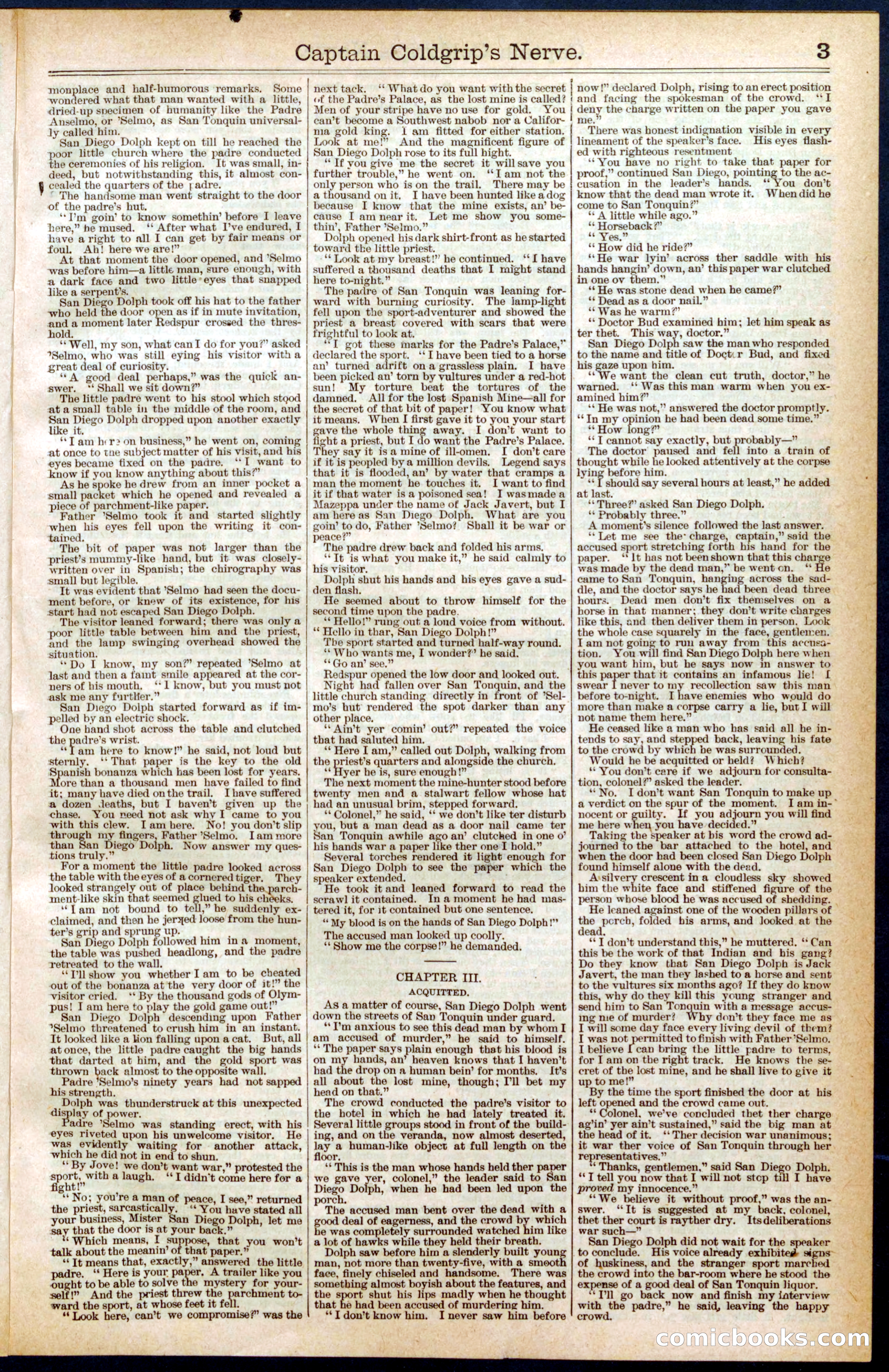
A restored page from Pulp Fiction, 1886. Page through the whole issue in the reader above.
📄 Transcribed text from this page (OCR, searchable)
Machine-transcribed from the original scan — historical spelling and the odd misread are preserved.
<= ; . *. * * monplace and half-humorous remarks. Some | next tack. ‘‘ Whatdo you want with the secret | now!” declared Dolph, rising to an erect position of the Padre’s Palace, as the lost mine is called? ' and facing the spokesman of the crowd. wondered what that man wanted with a little, dried-up specimen of humanity like the Padre Anselmo, or *Selmo, as San Tonquin universal- ly called him. San Diego Dolph kept on till he reached the poor little church where the padre conducted the ceremonies of his religion. It was small, in- deed, but notwithstanding this, it almost con- cealed the quarters of the ;adre. ' The handsome man went straight to the door of the padre’s hut. ‘‘I’m goin’ to know somethin’ before I leave here,” he mused. ‘‘ After what I’ve endured, I have aright to all I can get by fair means or foul. Ah! here we are!” At that moment the door opened, and ’Selmo was before him—a little man, sure enough, with a dark face and two little*eyes that snapped like a serpent’s. San Diego Dolph took off his hat to the father who held the door open as if in mute invitation, and a moment later Redspur crossed the thres- hold. ‘* Well, my son, what canI do for you?” asked %Selmo, who was still eying his visitor witha great deal of curiosity. : ‘*A good deal perhaps,” was the quick an- swer. ‘Shall we sit down?” The little padre went to his stool which stood ata small table in the middle of the room, and San Diego Dolph dropped upon another exactly like it. ‘*T am hr r2 on business,” he went on, coming at once to tne subject matter of his visit, and his eyes became fixed on the padre. ‘‘I want to know if you know anything about this?” As he spoke he drew from an inner pocket a small tr which he opened and revealed a piece of parchment-like paper. Father ‘Selmo took it and started slightly when his eyes fell upon the writing it con- tained. The bit of paper was not larger than the priest’s mummy-like hand, but it was closely- written over in Spanish; the chirography was small but legible. It was evident that ’Selmo had seen the docu- ment before, or knew of its existence, for his start had not escaped San Diego Dolph. The visitor leaned forward; there was only a poor little table between him and the priest, and the lamp swinging overhead showed the situation. ‘Do I know, my son?” repeated ’Selmo at last and then a faint smile appeared at the cor- ners of his mouth, ‘*1 know, but you must not ask me any furtler.” San Diego Dolph started forward as if im- pelled by an electric shock. One hand shot across the table and clutched the padre’s wrist. ‘‘Tam here to know!” he said, not loud but sternly. ‘‘ That paper is the key to the old Spanish bonanza which has been lost for years. ore than a thousand men have failed to find it; many have died onthe trail. Ihave suffered a dozen Jeaths, but I baven’t given up the chase. You reed not ask why I came to you with this clew. Iam here. No! you don’t slip vote my fingers, Father ’Selmo. Iam more than San Diego Dolph. Now answer my ques- tions truly.” For a moment the little padre looked across the table with the eyes of a cornered tiger. They looked strangely out of place behind t rch- ment-like skin that seemed glued to his chéeks. ‘Tam not bound to tell,” he suddenly ex- claimed, and then he jeryed loose from the hun- ter’s grip and sprung up. Ae de San Diego Dolph followed him ina moment, the table was pushed headlong, and the padre retreated to the wall. ‘Tl show you whether I am to be cheated out of the bonanza at the very door of it!” the visitor cried. ‘‘ By the thousand gods of Olym- pus! I am here to play the goid game out!” San Diego Dolph descending upon Father *Selmo threatened to crush him in an instant. It looked like a lion falling uponacat. But, all at once, the little padre caught the big hands that darted at him, and the gold sport was thrown back almost to the opposite wall. Padre ’Selmo’s ninety years had not sapped his strength. Dolph was thunderstruck at this unexpected aepley of Pot adre ’Selmo was standing erect, with his eyes riveted upon his unwelcome visitor. He was evidently waiting for another attack, which he did not in end to shun. ‘* By Jove! we don’t want war,” protested the pA alaugh, ‘I didn’t come here for a ot ‘‘ No; you’re a man of peace, I see,” returned the iat er ora ; 4 ou mars stated all aay that the door is at your back.” ph, * Which means, I suppose, that you won't talk about the meanin’ of that paper.” ‘‘ It means that, exactly,” answered the little . “Here is your paper, A trailer like you ought to be able to solve the mystery for your- self!” And the priest threw the parchment to- ward the sport, at whose feet it fell. “Look here, can’t we compromise?” was the ce ee : —* & =m = a 3 _—_ F Captain Coldgrip’s Nerve. 3 a . ae | Men of your stripe have no use for gold. You | deny the charge written on the paper you gave can’t become a Southwest nabob nor a Califor- nia gold king. 1 am fitted for either station. Look at me!” And the magnificent figure of San Diego Dolph rose to its full hight. ‘If vou give me the secret it willsave you further trouble,” he went on. ‘‘I am not the only person who is on the trail. There may be a thousand on it, I have been hunted like a dog because I know that the mine exists, an’ be- cause [ am nearit, Let me show you some- thin’, Father ’Selmo.” Dolph opened his dark shirt-front as he started toward tke little priest. ‘* Look at my breast!” he continued. ‘‘ I have suffered a thousand deaths that I might stand here to-night.” The padre of San Tonquin was leaning for- ward with burning curiosity. The lamp-light fell upon the sport-adventurer and showed the priest a breast covered with scars that were frightful to look at. ‘*T got these marks for the Padre’s Palace,” declared the sport. ‘‘ I have been tied to a horse an’ turned adrift on a grassless plain. I have been picked an’ torn by vultures under a red-hot sun! My torture beat the tortures of the damned, All for the lost Spanish Mine—all for the secret of that bit of paper! You know what it means. When I first gave it to you your start ave the whole thing away. I don’t wunt to fight a priest, but I do want the Padre’s Palace. They say it isa mine of ill-omen. I don’t care if it is peopled bya million devils. Legend says that it is flooded, an’ by water that cramps a man the moment he touches it. I want to find it if that water is a poisoned sea! I wasmadea Mazeppa under the name of Jack Javert, but I am here as San Diego Dolph. What are you goin’ to do, Father ’Selmo? Sball it be war or peace?” The padre drew back and folded his arms. ‘*It is what you make it,” he said calmly to his visitor. Dolph shut his hands and his eyes gave a sud- den flash. He seemed about to throw himself for the second time upon the padre. ‘** Hello!” rung out a lond voice from without. ‘** Hello in thar, San Diego Dolph!” The sport started and turned half-way round. ‘* Who wants me, I wonder?” he said. **Go an’ see.” . Redspur opened the low door and looked out. Night had fallen over San Tonquin, and the little church standing directly in front of ’Sel- mo’s hut rendered the spot darker than any other place. ‘* Ain’t yer comin’ out?” repeated the voice that had saluted him. ‘* Here I am,” called out Dolph, walking from the priest’s quarters and alongside the church. ‘* Hyer he is, sure enough!” The next moment the mine-hunter stood before twenty men and a stalwart fellow whose hat had an unusual brim, stepped forward. ** Colonel,” he said, ‘*‘ we don’t like ter disturb you, but a man dead as a door nail came ter San Tonquin awhile ago an’ clutched in one 0’ his hands war a paper like ther one I hold.” Several torches rendered it light enough for San Diego Dolph to see the paper which the speaker extended. He took it and leaned forward to read the scrawl it contained. Ina moment he had mas- tered it, for it contained but one sentence. “My blood is on the hands of San Diego Dolph!” The accused man looked up coolly. ‘* Show me the corpse!” he demanded. CHAPTER III. ACQUITTED. As a matter of course, San Diego Dolph went down the streets of San Tonquin under guard. ‘I’m anxious to see this dead man by whom I am accused of murder,” he said to himself. ‘* The paper says plain enough that his blood is on my hands, an’ heaven knows that I haven't had the drop on a human bein’ for months, It’s all about the lost mine, though; [ll bet my head on that.” The crowd conducted the padre’s visitor to the hotel in which he had lately treated it. Several little groups stood in front of the build- ing, and on the veranda, now almost deserted, id a human-like object at full length on the oor. ‘* This is the man whose hands held ther paper we gave yer, colonel,” the leader said to San bm Doiph, when he had been led upon the porch, The accused man bent over the dead with a ood deal of eagerness, and the crowd by which was sore pee surrounded watched him like a lot of hawks while they held their breath. Dolph saw before him a slenderly built youn man, not more than twenty-five, with a smoeo face, finely chiseled and handsome. There was something almost boyish about the features, and the sport shut his lips madly when he thought that he had been of murdering him. **T don’t know him. I never saw him before : - = . LL LL LLL LLL LDL XL LLL LLL LL LLL LLL LBLLBLRB LBW LL LLL LLDLLLLLBXLLL_ LLL LLL OLX LLL me.” There was honest indignation visible in every lineament of the speaker’s face. His eyes flash- ed with righteous resentment ‘You have no right to take that paper for proof,” continued San Diego, pointing to the ac- cusation in the leader’s hands. ‘*‘ You don’t know that the dead man wrote it. Whendid he come to San Tonquin?” ** A little while ago.” : ‘** Horseback?” sé Yes.” ‘** How did he ride?” ‘*He war lyin’ across ther saddle with his in hands hangin’ down, an’ this paper war clutched in one ov them.” ‘* He was stone dead when he came?” ** Dead as a door nail.” ‘**'Was he warm?” ‘** Doctor Bud examined him; let him speak as ter thet. This way, doctor.” Ri. San Diego Dolph saw the man who responded to the name and title of Doct: r Bud, and fixed his gaze upon him. ‘We want the clean cut truth, doctor,” he warned. ‘* Was thisman warm when you ex- a amined him?” ‘* He was not,” answered the doctor promptly. ‘*Tn my opinion he had been dead some time.” ** How long?” “ ‘*T cannot say exactly, but probably—” The doctor paused and fell into a train of thought while he looked attentively at the corpse lying before him. ‘*T should say several hours at least,” he added at last. op ‘* Three?” asked San Diego Dolph. sah fos) ‘* Probably three.” a A moment's silence followed the last answer. — ‘Let me see the* charge, captain,” said the | accused sport stretching forth his hand for the | paper. ‘It has not beenshown that this ch St was made by the dead man,” he wenton. “‘“He ce came to San Tonquin, hanging across the sad- 7 dle, and the doctor says he had been dead three hours. Dead men don’t fix themselves on a yes horse in that manner; they don’t write charges like this, and then deliver them in person. Look the whole case squarely in the face, gentlemen. I am not going to run away from this accnea- tion. You will find San Diego Dolph here when you want him, but he says now in answer to L this ag oe that it contains an infamous lie! [ swear I never to ts recollection saw this man before to-night. I have enemies who would do ey more than make a corpse carry a lie, butI will not name them here.” He ceased like a man who has said all he in- os tends to say, and ec sig back, leaving his fate aN to the crowd by which be was surrounded. W ould he be acquitted or held? Which? ae ** You don’t care if we adjourn for consulta- = tion, colonel?” asked the leader. rh. “No. Idon’t want San Tonquintomakeup a verdict on the spur of the moment. ITamin-" nocent or guilty. If you prs et hg you will find ~le me here when you have decided.” “een Taking the speaker at bis word the crowd ad- journed to the bar attached to the hotel,and when the door had been closed San Diego Dolph hes found himself alone with the dead. _, A:silvery crescent ina cloudless sky showed him the white face and stiffened figure of the = person whose blood he was accused of shedding. = He leaned against one of the wooden pillarsof == [et ibe folded bis arms, and looked at the ead, ihe ‘‘T don’t understand this,” he muttered. “Can = this be the work of that Indian and his gang? = A Do they know that San Diego Dolph isJack Javert, the man they lashed toa horse and sent e to the vultures six months ago? If they doknow = this, why do they kill this young stranger and — send him to San Tonquin with a message accus- ss ing me of murder? Why don’t they face me as. I will some day face every living devil of them? I was not permitted tofinish with Father’Selmo, I believe [ can bring the little padre to terms, | for Iam on the right track. He knows the se- cret of the lost mine, and he shall live to give it up to me!” or By the time the sport finished the door at his left ome and the crowd came out. a, “Colonel, we’ve concluded thet ther charge = ag’in’ yer ain’t sustained,” said the big man at ~~ / My ~ a he iw: | the head of it. ‘‘Ther decision war unanimous; — it war ther voice of San Tonquin through her representatives.” ae ‘Thanks, gentlemen,” said San Diego Dolph. **T tell you now that I will not stop Ihave . | ved my innocence.” fae **We believe it without proof,” wasthean- © swer. “It is at my back, colonel, thet ther court is rayther dry. Itsdeliberations war such—” Vas San Diego Dolph did not wait for t eaker iy F e. » a | a ’ * Muse i CATES to conclude. His voice alread of huskiness, and the stranger sport ma a the tated into oy earch waite he = the expense 0 a good n Tonquin liquor, — ‘Tl go back now and finish my Lode vine yt with the padre,” he said, leaving the happy crowd. GOMIG “Ss i" a cal JOO