
Pulp Fiction, 1886 · page 2 of 32
Beadle's Dime Library No. 407 — page 2: what you’re looking at
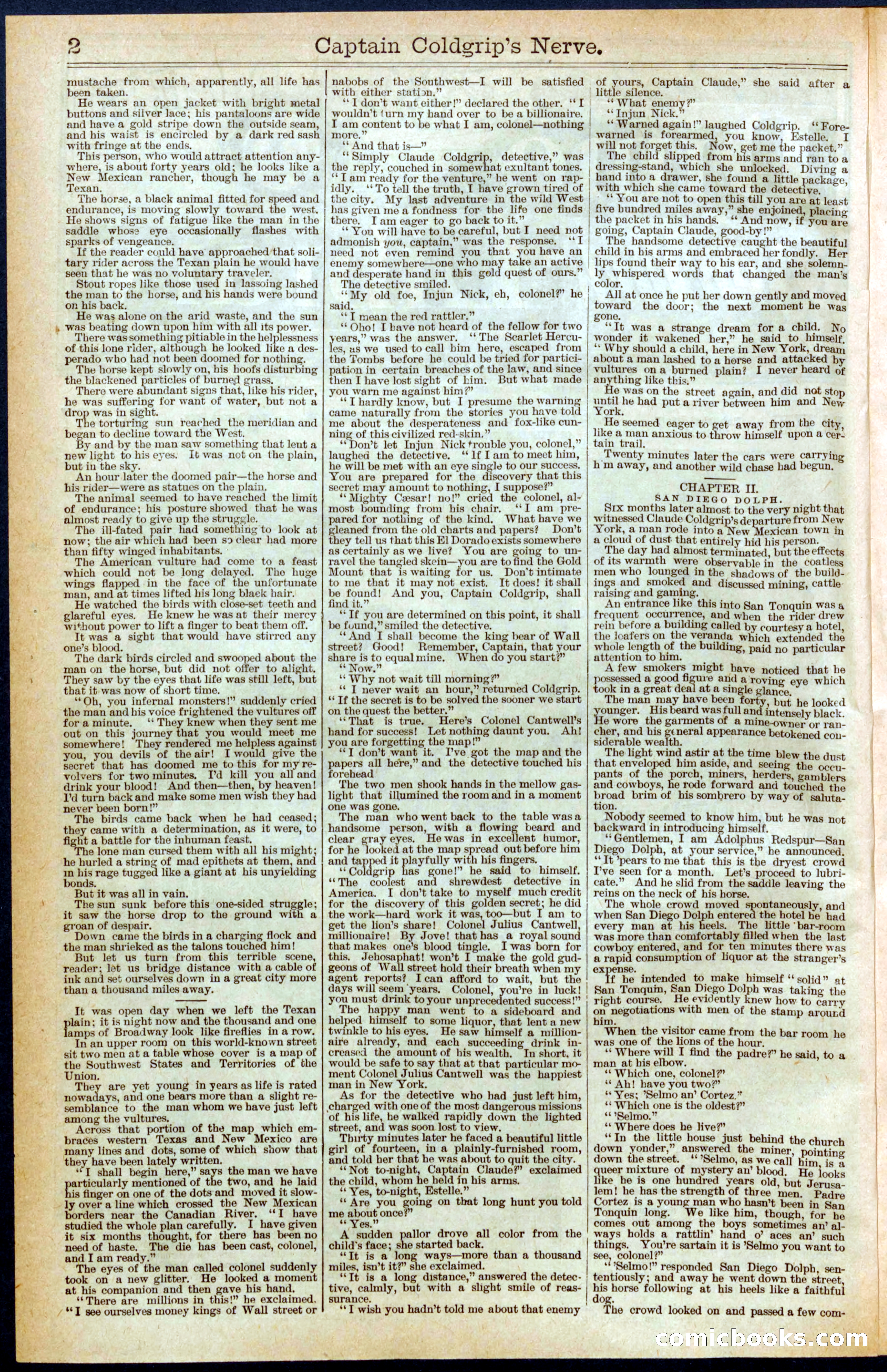
A restored page from Pulp Fiction, 1886. Page through the whole issue in the reader above.
📄 Transcribed text from this page (OCR, searchable)
Machine-transcribed from the original scan — historical spelling and the odd misread are preserved.
- ~~? v¥ a . ~ 7 — ‘ - : = m~: i ar "~ fav ¢ % ‘ ’ eh “—% — . out on this journey that _ drink your blood! nowa semblance to the man whom we have just left Ze mustache from which, apparently, all life has been taken. He wears an open jacket with bright metal buttons and silver lace; his pantaloons are wide and have a gold stripe down the outside seam, and his waist is encircled by a dark red sash with fringe at the ends. This person, who would attract attention any- where, is about forty years old; he looks like a New Mexican rancher, though he may be a Texan. The horse, a black animal fitted for speed and endurance, is moving slowly toward the west. He shows signs of fatigue like the man in the saddle whose eye occasionally flashes with sparks of vengeance. If the reader could have approached that soli- tary rider across the Texan plain he would have seen that he was no voluntary traveler. Stout ropes like those used in lassoing lashed the man to the horse, and his hands were bound on his back. He was alone on the arid waste, and the sun was beating down upon him with all its power. There was something pitiable in the helplessness of this lone rider, although he looked like a des- perado who had not been doomed for nothing. The horse kept slowly on, his hoofs disturbing the blackened particles of burned grass, There were abundant signs that, like his rider, he was suffering for want of water, but not a drop was in sight. The torturing sun reached the meridian and began to decline toward the West. By and by the man saw something that lent a new light to his eyes. It was noton the plain, but in the sky. An hour later the doomed pair—the horse and his rider—were as statues on the plain. The animal seemed to have reached the limit of endurance; his posture showed that he was almost ready to give up the struggle. The ill-fated pair had something to look at now; the air which had been s9 clear had more than fifty winged inhabitants. | The American vulture had come to a feast which could not be long delayed. The huge wings flapped in the face of the unfortunate man, and at times lifted his long blaek hair. He watched the birds with close-set teeth and glareful eyes. He knew he was at their mercy without power to lift a finger to beat them off. It was a sight that would have stirred any one’s blood. The dark birds circled and swooped about the man on the horse, but did not offer to alight. They saw by the eyes that life was still left, but that it was now of short time. **Oh, you infernal monsters!” suddenly cried the man and bis voice frightened the vultures off fora minute. ‘* They knew when they sent me ou would meet me somewhere! They rende me helpless against you, you devils of the air! I would give the secret that has doomed me to this for my re- volvers for two minutes. Id kill you all and And then—then, by heaven! l’d turn back and make some men wish they had never been born!” The birds came back when he had ceased; they came with a determination, as it were, to — a battle for the inhuman feast. e lone man cursed them with all his might; he hurled a string of mad epithets at them, and in his rage tugged like a giant at his unyielding bonds But it was all in vain. sun sunk before this one-sided struggle; _ it saw the horse drop to the ground with a - groan of despair. Down came the birds in a charging flock and the man shrieked as the talons touched him! But let us turn from this terrible scene, reader; let us bridge distance with a cable of ink and set ourselves down in a great city more than a thousand miles away. It was open day when we left the Texan aera it is night now and the thousand and one ps of Broadway look like fireflies in a row, In an upper room on this world-known street - git two men at a table whose cover is a map of the Southwest States and Territories of the Union. They are yet young in years as life is rated ys, and one bears more than a slight re- among the vultures, Across that portion of the map_ which em- braces western Texas and New Mexico are many lines and dots, some of which show that ‘} neg have been lately written. shall begin here,” yn oe the man we have icularly mentioned of the two, and he laid finger on one of the dots and moved it slow- fe tol a line which the New Mexican orders near the Canadian River. “‘I have studied the whole plan carefully. I have given it six months thought, for there has been no ~ need of haste. The die has been cast, colonel, wg: ogo. ready.” .- eyes of the man called colonel suddenly took on a new glitter. He looked a moment at his companion and then gave his hand, ‘‘There are millions in this!” he exclaimed. +] gee ourselves money kings of Wall street or ° port ” Captain Coldgrip’s Nerve, ; -———_--——— nabobs of the Southwest—I will be satisfied witb either station.” ‘* 1 don’t want either!” declared the other. ‘‘I wouldn’t {urn m more.” ** And that is—” ‘Simply Claude Coldgrip, detective,” was the reply, couched in scent exultant tones. ‘* [am ready for the venture,” he went on rap- idly. ‘‘ To tell the truth, I have grown tired of the city. My last adventure in the wild West has given me a fondness for the life one finds there. I am eager to go back to it.” ‘* You will have to be careful, but I need not admonish you, captain,” was the response. ‘I need not even remind you that you have an enem and desperate hand in this gold quest of ours.” The detective smiled. ‘“My old foe, Injun Nick, eh, colonel?’ he said, ‘*T mean the red rattler.” ‘“Oho! I bave not heard of the fellow for two ears,” was the answer. ‘‘ The Scarlet Hercu- es, us we used to call bim here, escaped from the Tombs before he could be tried for partici- pation in certain breaches of the law, and since then I have lost sight of him. But what made you warn me against him?” ‘‘T hardly know, but I presume the warning came naturally from the stories you have told | me about the desperateness and fox-like cun- ning of this civilized red-skin.” ‘*Don’t let Injun Nick trouble you, colonel,” laughed the detective. ‘‘1f Iam to meet him, he will be met with an eye single to our success. You are prepared for the discovery that this secret may amount to nothing, I suppose?” ‘* Mighty Cesar! no!” cried the colonel, al- most bounding from his chair. ‘‘I am pre- pared for nothing of the kind. What have we Speen from the old charts and papers? Don’t they tell us that this El Dorado exists somewhere as certainly as we live? You are going to un- ravel the tangled skein—you are to find the Gold Mount that is waiting for us. Don’t intimate to me that it may not exist. It does! it shall be found! And you, Captain Coldgrip, shall find it.” ** If you are determined on this point, it shall be fuund,” smiled the detective. ‘*And I shall become the king bear of Wall street? Good! Remember, Captain, that your = is to equal mine, When do you start?” ow.’ ‘Why not wait till morning?” ‘* T never wait an hour,” returned Coldgrip. ‘‘ Tf the secret is to be solved the sooner we start on the quest the better.” ‘‘That is true. Here’s Colonel Cantwell’s hand for success! Let nothing daunt you. Ah! you are forgetting the map!” ‘*T don’t want it. I’ve got the map and the papers all here,” and the detective touched his forehead The two men shook hands in the mellow gas- ligbt that illumined the room and in a moment one was gone. The man who went back to the table wasa handsome person, with a flowing beard and clear gray eyes. Hewas in excellent humor, for he Nocked at the map spread out before him and tapped it playfully with his fingers. - Cok grip has gone!” he said to himself. ‘‘The coolest and shrewdest detective in America. I don’t take to myself much credit for the discovery of this golden secret; he did the work—bard work it was, too—but I am to get the lion’s share! Colonel Julius Cantwell, millionaire! By Jove! that has a royal sound that makes one’s blood tingle. Iwas born for this. Jehosaphat! won’t I make the gold gud- geons of Wall street hold their breath when my agent reports? Ican afford to wait, but the days will seem years. Colonel, you’re in luck! you must drink to your unpr ented success!” The happy man went to a sideboard and epee himself to some liquor, that lent a new twinkle to his eyes. He saw himself a million- aire already, and each succeeding drink in- creased the amount of his wealth. In short, it would be safe to say that at that particular mo- ment Colonel Julius Cantwell was the happiest man in New York. As for the detective who had just left him, charged with one of the most dangerous missions ‘of his life, he walked rapidly down the lighted street, and was soon lost to view. Thirty minutes later he faced a beautiful little girl of fourteen, in a plainly-furnished room, and told her that he was about to quit the city. ‘‘Not to-night, Captain Claude?’ exclaimed the child, whom he held in his arms. ‘Yes, to-night, Estelle.” ** Are you going on that long hunt you told me about once?” A sudden llor drove all color from the child's face; started back. “Tt is a long ways—more than a thousand miles, isn’t it?” she exclaimed. ‘It is a long distance,” answered the detec- tive, calmly, but with a slight smile of reas- surance. ‘*T wish you hadn’t told me about that enemy ¢ ‘ | . ' , hand over to be a billionaire. | I am content to be what I am, colonel—nothing somewhere—one who may take an active | of yours, Captain Claude,” she said after a little silence. | What enemy ?” ‘*TInjun Nick,” ‘* Warned again!” laughed Coldgrip. warned is forearmed, you know, Estelle. I ! will not forget this. ow, get me the packet.” The child slipped from his arms and ran to a | dressing-stand, which she unlocked. Diving a : band into a drawer, she found a little package | with which she came toward the detective. ‘* You are not to open this till you are at least | _ five bundred miles away,” she enjoined, placing | the packet in his hands, ‘* And now, if you are | ' going, Captain Claude, good-by!” | | The handsome detective caught the beautify] | child in his arms and embraced her fondly. Her lips found their way to his ear, and she solemn- ly whispered words that changed the man’s _ color, | All at once he put her down gently and moved | toward the door; the next moment he was | ** Fore- gone, ‘It was a strange dream for a child. No wonder it wakened her,” he said to himself, ‘* Why should a child, here in New York, dream about a man lashed to a horse and attacked by | vultures ona burned plain? I never heard of | anything like this,” | © was on the street again, and did not stop | _ until he had put a river between him and New | York. _He seemed eager to get away from the ci ; like a man anxious to throw himself upon a cer- | tain trail, Twenty minutes later the cars were Carry ing | hm away, and another wild chase had begun, CHAPTER II. SAN DIEGO DOLPH. Srx months later almost to the very night that witnessed Claude Coldgrip’s departure from New York, a man rode into a New Naxioatt town in a cloud of dust that entirely hid his person. The day had almost terminated, but the effects of its warmth were Observable in the coatless men who lounged in the shadows of the build- ings and smoked and discussed mining, cattle raising and gaming. An entrance like this into San Tonquin was a frequent occurrence, and when the rider drew rein before a building called by courtesy a hotel, te i tare Se apse ia which extended the whole length of the building, paj particular attention to him. ee eer | ew smokers might have noticed that he possessed a good figure and a roving eye which | took in a great deal at a single | The man may have been fo ounger. His beard was full an e wore the garments of a mine-owner or ran- cher, and his eneral appearance E siderable Waele. betokened con The light wind astir at the time bl | that envelo him aside, and seeing the hy pants of the porch, miners, herders, gamblers and cowboys, he rode forward and touched the er brim of his sombrero by way of saluta- on. Nobody seemed to know him, but he was not backward in introducing himself. “Gentlemen, I am Adolphus Redspur—San Diego Dolph, at your service,” he announced, ‘It ‘pears to me that this is the dryest crowd I’ve seen fora month. Let’s proceed to lubri- cate.” And he slid from the saddle leaving the i on Hoe: neck of his horse. e whole crowd moved spontaneously, and when San Diego Dolph entered the hotel a had every man at his heels. The little “bar-room was more than comfortably filled when the last cowboy entered, and for ten minutes there was a rapid consumption of liquor at the stranger’s glance, , but he looked intensely black. expense. | Te he intended to make himself ‘ solid” at San Tonquin, San Diego Do] h was taki right course. He evidently k Ing the ew how to carr | on negotiations with men of the stamp arcane m. . When the visitor came from the | was one of the lions of the hour. re a ‘* Where will I find the padre?” he said, to a man at his elbow. eth ‘* Which one, colonel?” ** Ah! have you two?” ** Yes; Selmo an’ Cortez.” ** Which one is the oldest?” ** *Selmo.” eae tie nae n the little house just behind t down yonder,” answered the miner Arse. down the street. ‘*’Selmo, as we call him. is ; queer mixture of mystery an’ blood. He looks | like he is one hundred years old, but Jerusa. lem! he has the strength of three men. Padre Cortez is a young man who hasn’t been in San | Tonquin long. We like him, though, for he comes out among the boys sometimes an’ al- ways holds a rattlin’ hand o’ aces an’ such things. You're sartain it is Selmo you want to See, colonel?” ‘“"Selmo!” responded San Diego Dolph, sen- | tentiously; and away he went down the street | his horse following at his heels like a faithful O | dog. The crowd looked on and passed a few com- | EOMiE ‘S-cOm — pees. +> eee IOO