
Pulp Fiction, 1878 · page 28 of 32
Beadle's New York Dime Library, No. 40 — page 28: what you’re looking at
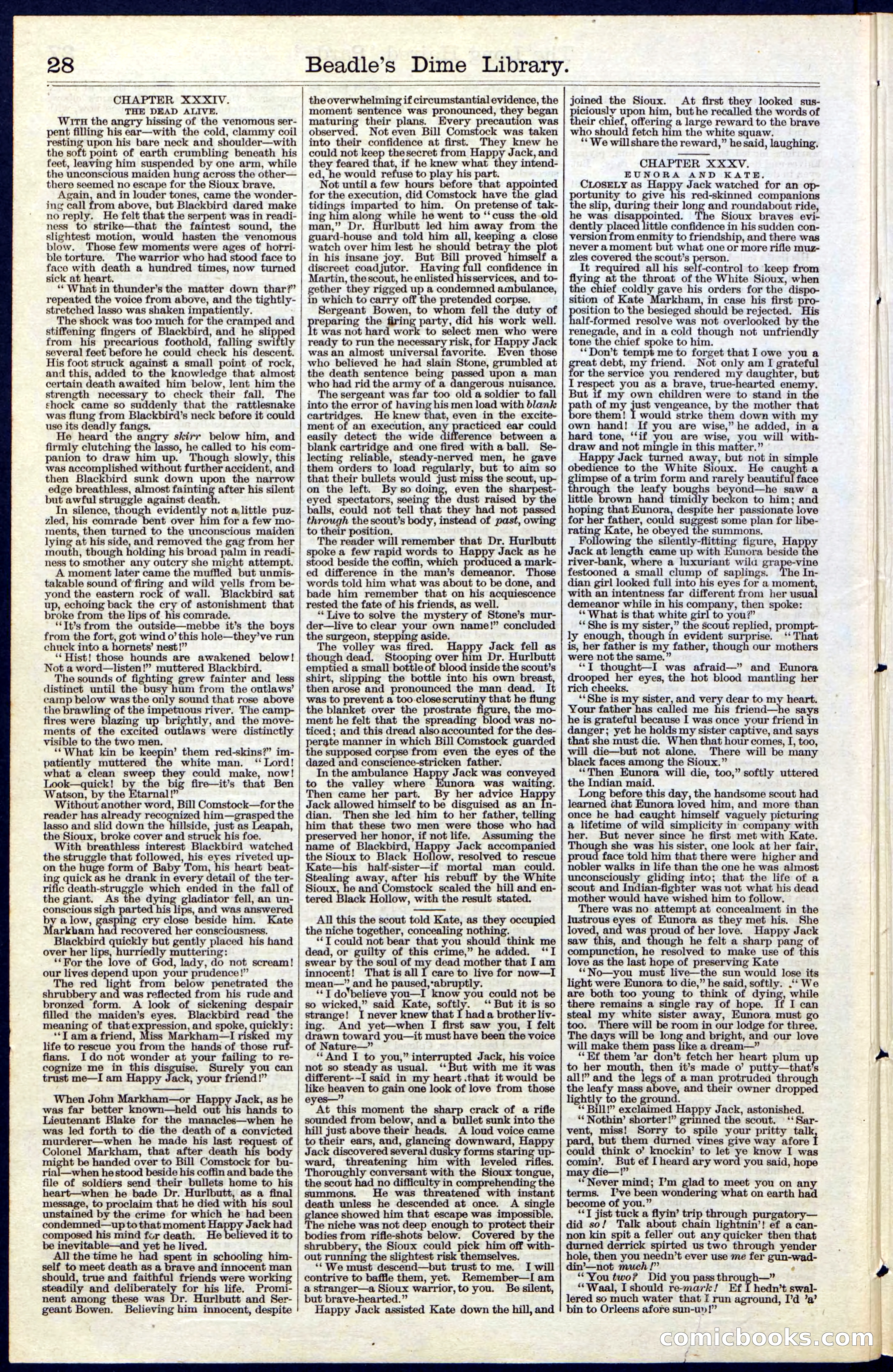
A restored page from Pulp Fiction, 1878. Page through the whole issue in the reader above.
📄 Transcribed text from this page (OCR, searchable)
Machine-transcribed from the original scan — historical spelling and the odd misread are preserved.
28 ee — CHAPTER XXXIV. THE DEAD ALIVE. Wirth the hissing of the venomous ser- pent filling his ear—with the cold, clammy coil resting upon his bare neck and shoulder—with the soft point of earth crumbling beneath his feet, leaving him suspended by one arm, while the unconscious maiden hung across the other— there seemed no escape for the Sioux brave, Again, and in louder tones, came the wonder- ing call from above, but Blackbird dared make no reply. He felt that the serpent was in readi- ness to strike—that the faintest sound, the slightest motion, would hasten the venomous blow. Those few moments were ages of hofri- ble torture. The warrior who had stood face to face with death a hundred times, now turned sick at heart. ‘* What in thunder’s the matter down thar?” repeated the voice from above, and the tightly- stretched lasso was shaken impatiently. . The shock was too much for the cramped and stiffening fingers of Blackbird, and he sli from his precarious foothold, falling swiftly several feet before he could check his descent. His foot struck i a small point of rock, and this, added to the knowledge that almost certain death awaited him below, lent him the strength necessary to check their fall. The shock came so suddenly that the rattlesnake was flung from Blackbird’s neck before it could use its deadly fangs. He heard the an skirr below him, and firmly clutching the lasso, he called to his com- panion to draw him up. Though slowly, this was accomplished without further accident, and then Blackbird sunk down upon the narrow edge breathless, almost fainting after his silent but awful struggle against death. In silence, though evidently not alittle puz- zled, his comrade bent over him for a few mo- ments, then turned to the unconscious maiden lying at his side, and removed the gag from her mouth, though holding his broad palm in readi- ness to smother any outcry she might attempt. A moment later came the muffled but unmis- takable sound of firing and wild yells from be- yond the eastern rock of wall. Blackbird sat up, echoing back the cry of astonishment that broke from the lips of his comrade. ‘It’s from the outside—mebbe it’s the boys from the fort, got wind o’ this hole—they’ve run chuck into a hornets’ nest!” ‘* Hist! those hounds are awakened below! Not a word—listen!”’ muttered Blackbird. The sounds of fighting grew fainter and less distinct until the busy hum from the outlaws’ camp below was the only sound that rose above the brawling of the impetuous river. The camp- fires were Hiagin zg te brightly, and the move- ments of the exci outlaws were distinctly visible to the two men. ‘*What kin be keepin’ them red-skins?” im- patiently muttered the white man. ‘Lord! what a clean sweep they could make, now! Look—quick! by the big fire—it’s that Ben Watson, by the Etarnal!” Without another word, Bill Comstock—for the reader has already recognized him—grasped the lasso and slid down the hillside, just as Leapah, the Sioux, broke cover and struck his foe. With breathless interest Blackbird watched the struggle that followed, his eyes riveted up- on the huge form of Baby Tom, his heart beat- ing quick as he drank in every detail of the ter- rific death-struggle which ended in the fall of the giant. As the dying gladiator fell, an un- conscious sigh his lips, and was answered by a low, gasping cry close beside him. Kate rkham recovered her consciousness. Blackbird quickly but gently placed his hand over her lips, hurriedly muttering: “For the love of God, lady, do not scream! our lives depend upon your prudence!” The red light from below penetrated the shrubbery and was reflected from his rude and bronzed form. A look of sickening despair filled the maiden’s eyes. Blackbird read th meaning of that expression, and oe a ‘*Tama friend, Miss Markham—I ed on 3 life to rescue you from the hands of those - fians. Ido not wonder at your failing to re- co me in this disguise. Surely you can trust me—I am Happy Jack, your friend!” When John Markham—or peer seek as he was far better known—held out his hands to Lieutenant Blake for the manacles—when he was led forth to die the death of a convicted murderer—when he made his last uest of Colonel Mar that after death body might be handed over to Bill Comstock for bu- rial—when he stood beside his coffin and bade the file of soldiers send their bullets home to his heart—when he bade Dr. Hurlbutt, as a final message, to proclaim that he died with his soul unstained by the crime for which he had been condemned—up to that moment Ha Jack had composed his mind for death. He believed it to be inevitable—and yet he lived. All the time he had spent in schooling him- self to meet death as a brave and innocent man should, true and faithful friends were working steadily and a for his life. Promi- nent among these was Dr. Hurlbutt and Ser- geant Bowen. Believing him innocent, despite = Beadle’s the overwhelming if circumstantial evidence, the moment sentence was pronounced, they began maturing their plans. Every precaution was observ Not even Bill Comstock was taken into their confidence at first. They knew he could not keep thesecret from Happy Jack, and they feared that, if he knew what they intend- ed, he would refuse to play his part. Not until a few hours before that odes for the execution, did Comstock have the glad tidings imparted to him. On pretense of tak- ing him reds while he went to ‘‘cuss the old man,” Dr. Hurlbutt led him away from the guard-house and told him all, keeping a close watch over him lest he should betray the plot in his insane joy. But Bill proved himself a discreet coadjutor. Having full confidence in Martin, the scout, he enlisted his services, and to- ether they rigged up a condemned ambulance, in which to carry off the pretended corpse. Sergeant Bowen, to whom fell the duty of reparing the firing party, did his work well. t was not hard work to select men who were ready to run the necessary risk, for Happy Jack was an almost universal favorite. Even those who believed he had slain Stone, grumbled at the death sentence being upon a man who had rid the army of a dangerous nuisance. The sergeant was far too old a soldier to fall into the error of having his men load with blank cartrid He knew that, even in the excite- ment of an execution, any practiced ear could easily detect the wide difference between a blank cartridge and one fired with a ball. Se- lecting reliable, steady-nerved men, he gave them orders to load regularly, but to aim so that their bullets would just miss the scout, up- on the left. By so doing, even the sharpest- eyed spectators, seeing the dust raised by the balls, could not tell that they had not passed th h the scout’s body, instead of past, owing to their position, The reader will remember that Dr. Hurlbutt spoke a few rapid words to Happy Jack as he stood beside the coffin, which uced a mark- ed difference in the man’s demeanor. Those words told him what was about to be done, and bade him remember that on his acquiescence rested the fate of his friends, as well. “Live to solve the mystery of Stone’s mur- der—live to clear your own name!” concluded the surgeon, stepping aside. The volley was fired. Happy Jack fell as though dead. Stooping over him Dr. Hurlbutt emptied a small bottle of blood inside the scout’s shirt, slipping the bottle into his own breast, then arose and pronounced the man dead. It was to prevent a too closescrutiny that he flung the blanket over the prostrate figure, the mo- ment he felt that the spreading blood was no- ticed; and this dread accounted for the des- perate manner in which Bill Comstock guarded the supposed corpse from even the eyes of the dazed and conscience-stricken father. In the ambulance noes ack was conveyed to the valley where ora was waiting. Then came her part. By her advice Happy Jack allowed himself to be disguised as an In- dian. Then she led him to her father, a him that these two men were those who preserved her honor, if not life. Assuming the name of Blackbird, Happy Jack accompanied the Sioux to Black Hollow, resolved to rescue Kate—his half-sister—if mortal man could. re heioer away, after his rebuff by the White Sioux, he and Comstock scaled the hill and en- tered Black Hollow, with the result stated. All this the scout told Kate, as they occupied the niche together, concealing nothing. “‘T could not bear that you should think me dead, or guilty of this crime,” he added. “I swear by the soul of my dead mother that I am innocent! That is all 1 care to live for now—I mean—” and he paused,*abruptly. ‘*T do'believe yo know you could not be so wicked,” said Kate, softly. ‘ But it is so strange! I never knew that I hada brother liv- ing. And yet—when I first saw you, I felt drawn toward you—it must have been the voice of Nature—” ‘*And I to you,” interrupted Jack, his voice not so steady as usual. ‘But with me it was different--I said in my heart .that it would be like heaven to gain one look of love from those eyes— At this moment the sharp crack of a rifle sounded from below, and a bullet sunk into the hill just above their heads. A loud voice came to their ears, and, glancing downward, Happy Jack discovered several dusky forms staring up- threatening him with leveled rifles. Thoroughly conversant with the Sioux tongue, the scout had no difficulty in pas wor the summons. He was threatened with instant death unless he descended at once. A single lance showed him that escape was impossible. e niche was not deep enough to protect their bodies from rifle-shots below. Covered by the shrubbery, the Sioux could pick him off with- out running the slightest risk themselves. ‘* We must descend—but trust to me. I will contrive to baffle them, yet. Remember—I am a stranger—a Sioux warrior,to you. Be silent, but brave-hearted.” Happy Jack assisted Kate down the hill, and Dime" Library. — a ES joined the Sioux. At first they looked sus- erie upon him, buthe recalled the words of heir chief, offering a large reward to the brave who should fetch him the white squaw. ‘* We willshare the reward,” he said, laughing. CHAPTER XXXV. EUNORA AND KATE. CLOSELY as Happy Jack watched for an op- portunity to give his red-skinned companions the slip, during their long and roundabout ride, he was disappointed. e Sioux braves evi- dently pl ittle confidence in his sudden con- version from enmity to friendship, and there was never amoment but what one or more rifle muz- zles covered the scout’s person. It required all his self-control to keep from flying at the throat of the White Sioux, when the chief coldly gave his orders for the dispo- sition of Kate Markham, in case his first pro- ition to the besieged should be rejected. His alf-formed resolve was not overlooked by the renegade, and in a cold though not unfriendly tone the chief spoke to him. ‘*Don’t tempt me to forget that lowe you a ons debt, my friend. Not only am I grateful or the service you rendered my daughter, but I respect you as a brave, true-hearted enemy. But if my own children were to stand in the _ of my just vengeance, by the mother that re them! I would strke them down with my own hand! If you are wise,” he added, in a hard tone, ‘‘if you are wise, you will with- draw and not mingle in this matter.” Happy Jack turned away, but not in simple obedience to the White Sioux. He cau ae es of a trim form and rarely beautiful face ay a the an boughs beyond—he saw a little brown hand timi beckon to him; and hoping that Eunora, despite her passionate love for her father, coul ms oa some plan for libe- rating Kate, he obeyed the summons. Following the silently-flitting figure, Happy Jack at length came up with Eunora beside the river-bank, where a luxuriant wild grape-vine festooned a small clump of saplings. The In- dian girl looked full into his eyes for a momen with an intentness far different from her u demeanor while in his come then spoke: ‘** What is that white girl to you?” ‘She is my sister,” the scout replied, prompt- ly enough, though in evident rise. ‘* That is, her father is my father, though our mothers were not the same.” “I thought—I was afraid—” and Eunora drooped her eyes, the hot blood mantling her rich cheeks. ‘She is my sister, and very dear to my heart. Your father has called me his friend—he sa he is grateful because I was once your friend in danger; yet he holds my sister captive, and says that she must die. When that hour comes, I, too, will die—but not alone. There will be many black faces among the Sioux.” “Then Eunora will die, too,” softly uttered the Indian maid. ae before this day, the handsome scout had learned chat Eunora loved him, and more than once he had caught himself vaguely picturing a lifetime of wild simplicity in company with her. But never since he first met with Kate. Though she was his sister, one look at her fair proud face told him that there were higher an nobler walks in life than the one he was almost unconsciously gliding into; that the life of a scout and Indian-fighter was not what his dead mother would have wished him to follow. There was no attempt at concealment in the lustrous Spa of Eunora as they met his. She loved, and was proud of her love. Happy Jack saw this, and though he felt a sharp pang of compunction, he resolved to make use of this love as the last hope of preserving Kate ‘*No—you must live—the sun would lose its light were Eunora to die,” he said, softly. .“‘ We are both too young to think o dying, while there remains a single ray of hope. If I can steal my white sister away, Eunora must go too. There will be room in our lodge for three. The days will be long and bright, and our love will make them pass like a dream—” “Ef them ’ar don’t fetch her heart plum up to her mouth, then it’s made o’ putty—that’s all!” and the legs of a man protruded through the leafy mass above, and their owner dropped lightly to the ground. ‘* Bill” exclaimed Happy Jack, astonished. ‘Nothin’ shorter!” grinned the scout. ‘‘Sar- vent, miss! Sorry to spile your pritty talk Vern” but them durned vines give way afore I could think o’ knockin’ to let a know I was comin’. But ef [heard ary word you said, hope may die—!” ‘“*Never mind; I’m glad to meet you on any terms. I’ve been wondering what on earth had Dey ist tack a flyin’ trip thro h q ck a flyin’ trip ul atory— did so/ Talk about chain lightnin’! ef na ta non kin spit a feller out any quicker then that durned derrick spirted us two through yender hole, then you needn’t ever use me fer gun-wad- din’—not much !” ¢ “You two? Did you pass through—” “‘Waal, Ishould re-mark! Ef I hedn’t swal- lered so much water that I run aground, I’d ’a’ bin to Orleens afore sun-u»!” (COMME NO KS E(o) / an Ty a eee eee a = ee Ey Spake : LEY et See NET ep ET BE YET CDE a pr "s ‘mea og a