
Pulp Fiction, 1878 · page 27 of 32
Beadle's New York Dime Library, No. 40 — page 27: what you’re looking at
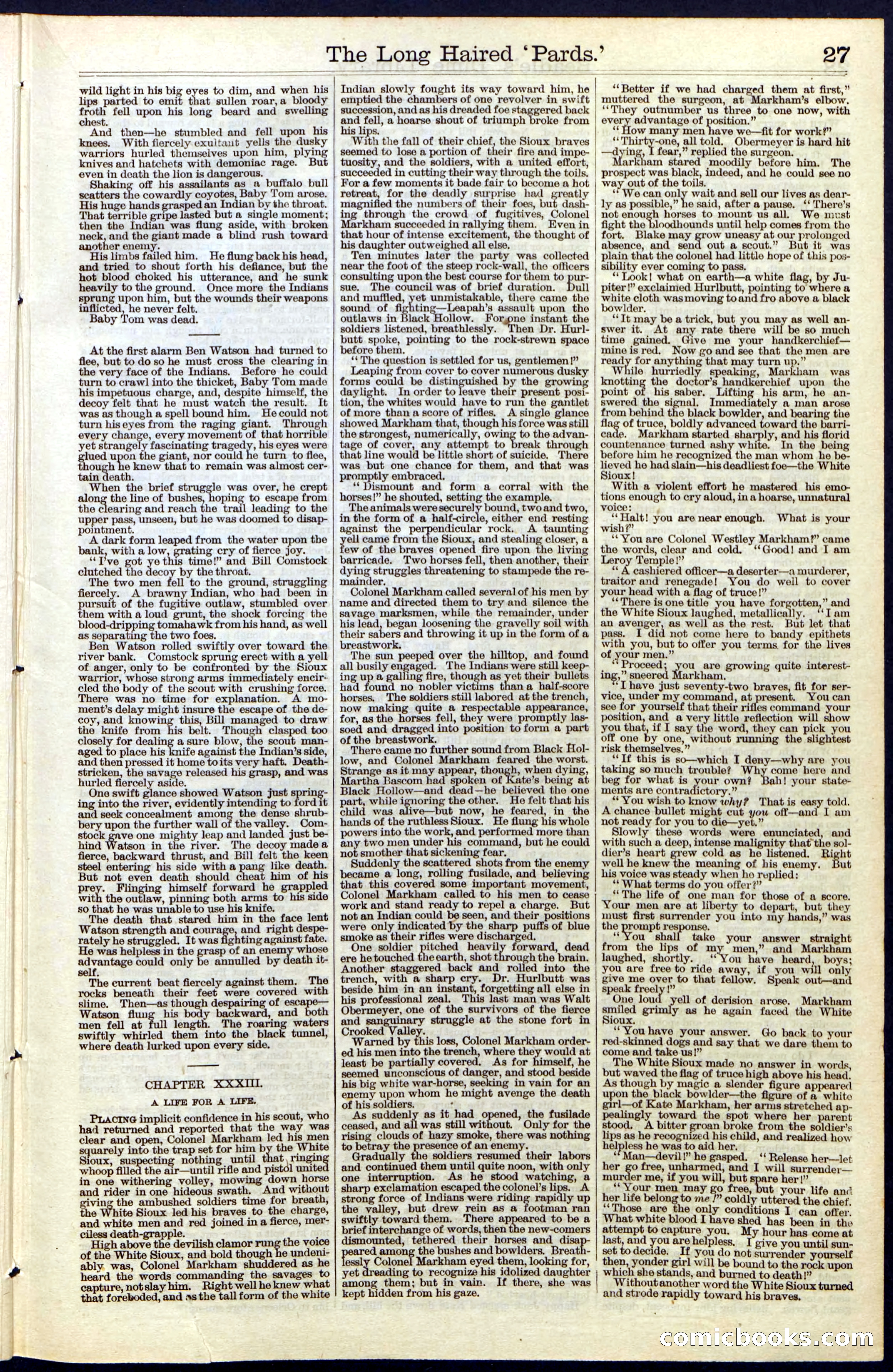
A restored page from Pulp Fiction, 1878. Page through the whole issue in the reader above.
📄 Transcribed text from this page (OCR, searchable)
Machine-transcribed from the original scan — historical spelling and the odd misread are preserved.
wild light in his big eyes to dim, and when his lips parted to emit that sullen roar,a bloody ao fell upon his long beard and swelling chest. And then—he stumbled and fell upon his knees. With fiercely exuitaut yells the dusky warriors hurled themselves upon him, plying knives and hatchets with demoniac rage. But even in death the lion is dangerous. Shaking off his assailants as a buffalo bull scatters the cowardly coyotes, Baby Tom arose. His huge hands an Indian by the throat. That terrible gripe lasted but a single moment; then the Indian was flung aside, with broken neck, and the giant made a blind rush toward another enemy. His limbs failed him. He flung back his head, and tried to shout forth his defiance, but the hot blood choked his utterance, and he sunk heavily to the ground. Once more the Indians sprung upon him, but the wounds their weapons inflicted, he never felt. Baby Tom was dead. At the first alarm Ben Watson had turned to flee, but to do so he must cross the clearing in the very face of the Indians. Before he could turn to craw] into the thicket, Baby Tom made his impetuous charge, and, despite himself, the decoy felt that he must watch the result. It was as though a spell bound him. Hecould not turn hiseyes from the raging giant. Through every change, every movement of that horrible yet strangely fascinating yee 4 his eyes were lued upon the giant, nor could he turn to flee, toa h he knew that to remain was almost cer- tain death. When the brief struggle was over, he crept along the line of bushes, hoping to escape from the clearing and reach the trail leading to the upper pass, unseen, but he was doomed to disap- pointment. A dark form leaped from the water upon the bank, with a low, grating cry of fierce joy. “ve got ye this time!” and Bill Comstock clutched the decoy by the throat. The two men fell to the ground, struggling fiercely. A parser ¢ Indian, who had been in pursuit of the fugitive outlaw, stumbled over them with a loud grunt, the shock forcing the blood-dripping tomahawk from his hand, as well as separating the two foes. Ben Watson rolled swiftly over toward the river bank. Comstock sprung erect with a yell of anger, only to be confronted bef the Sioux warrior, whose strong arms immediately encir- cled the body of the scout with crushing force. There was no time for explanation. A mo- ment’s delay might insure the escape of the de- coy, and knowing this, Bill managed to draw the knife from his belt. Though clasped too closely for oe ee blow, the scout man- aged to place his knife against the Indian’s side, and then pressed it home toits very haft. Death- stricken, the savage released his grasp, and was hurled fiercely aside. : One swift glance showed Watson just spring- ing into the river, evidently intending to ford it and seek concealment among the dense shrub- bery upon the further wall of the valley. Com- stock gave one mighty leap and landed just be- hind Tinteon in the river. The decoy made a fierce, backward thrust, and Bill felt the keen steel entering his side witha pang like death. But not even death should cheat him of his oney- she himself forward he grappled with the outlaw, pinning both arms to his side so that he was unable to use his knife. The death that stared him in the face lent Watson strength and courage, and right despe- rately he struggled. It was fichting against fate. He was helpless in the grasp of an enemy whose po or could only be annulled by death it- The current beat fiercely against them. The rocks a bec i were sc es with slime. en—as though despai of esca Watson flung his body fearon and both men fell at Full length. The roaring waters swiftly whirled them into the black tunnel, where death lurked upon every side. CHAPTER XXXIIL A LIFE FOR A LIFE. PLACING implicit confidence in his scout, who had returned and reported that the way was clear and open, Colonel Markham led his men sananery. into the gees for sats b = ge hite loux maneen nothing un ‘ whoop filled the air—tontll rifle and pistol cuted in one withering volley, mowing down horse and rider in one hideous swath. And without iving the ambushed soldiers time for breath, fh ite Sioux led his braves to the charge, and white men and red joined in a fierce, mer- ciless death-grapple. High above the devilish clamor rung the voice of the White Sioux, and bold though he undeni- ably. was, Colonel Markham shuddered as he heard the words commanding the savages to capture, notslay hi Right well he knew what that foreboded, and as the tall form of the white Indian slowly fought its way toward him, he emptied the chambers of one revolver in swift succession, and as his dreaded foe staggered back oe fell, a hoarse shout of triumph broke from ips. With the fall of their chief, the Sioux braves seemed to lose a portion of their fire and impe- tuosity, and the soldiers, with a united effort, succeeded in cutting their way through the toils. For a few moments it bade fair to become a hot retreat, for the deadly surprise had greatly magnified the numbers of their foes, but dash- ing through the crowd of fugitives, Colonel Markham succeeded in rallying them. Even in that hour of intense excitement, the thought of his daughter outweighed all else, Ten minutes later the party was collected near the foot of the steep rock-wall, the officers consulting upon the best course for them to pur- sue. The council was of brief duration. Dull and muffled, yet unmistakable, there came the sound of fighting—Leapah’s assault upon the outlaws in Black Hollow. Forgne oe Seer the soldiers listened, breathlessly. Then Dr. Hurl- butt spoke, pointing to the rock-strewn space before them. ‘* The question is settled for us, gentlemen!” Leaping from cover to cover numerous dusky forms could be a a moa by the growing daylight. In order to leave their present posi- tion, the whites would have to run the gantlet of more than a score of rifles. A single glance showed Markham that, though his force was still the strongest, numerically, owing to the advan- ge of cover, any attempt to break through that line would be little short of suicide. There was but one chance for them, and that was promptly embraced. **Dismount and form a corral with the horses!” he shouted, setting the example, The animals were securely bound, two and two, in the form of a half-circle, either end resting against the e-em rock, A taunting ell came from the Sioux, and stealing closer, a ew of the braves opened fire upon the living barricade. Two horses fell, then another, their dying struggles threatening to stampede the re- mainder, Colonel Markham called several of his men by name and directed them to try and silence the savage marksmen, while the remainder, under his lead, began loosening the gravelly soil with their sabers and throwing it up in the form of a breastwork. The sun peeped over the hilltop, and found all busily engaged. The Indians were still kee ing up a galling fire, though as yet their bulle had found no nobler victims than a half-score horses. The soldiers still labored at the trench, now making quite a respectable appearance, for, as the horses fell, they were promptly las- soed and into position to form a part of the breastwork. There came no further sound from Black Hol- low, and Colonel Markben ered ae Hig Strange as it may appear, though, when dying, Mastin Bascom had spoken of Kate’s being at Black Hollow—and dead—he believed the one part, while ienorng the other. He felt that his child was alive—but now, he feared, in the hands of the ruthless Sioux. He flung his whole powers into the work, and performed more than any two men under his command, but he could not smother that sickening fear. Suddenly the scattered shots from the enemy became a long, rolling fusilade, and believing that this covered some important movement, Colonel Markham called to his men to cease work and stand ready to repel a charge. But not an Indian could be seen, and their positions were only indicated by the sharp puffs of blue smoke as their rifles were d One soldier pitched heavil orward, dead ere he touched the earth, shot through the brain. Another back and rolled into the trench, with a sharp cry. Dr. Hurlbutt was beside him in an instant, forgetting all else in his professional zeal. This last man was Walt Obermeyer, one of the survivors of the fierce and san struggle at the stone fort in Crooked -aint Warned by loss, Colonel Markham order- ed his men into the trench, where they would at least be partially covered. As for himself, he seemed unconscious of r, and stood beside his big white war-horse, seeking in vain for an epemny upon whom he might avenge the death f) his soldiers. ‘ As ecienly as it had opened, the fusilade ceased, and all was still without. Only for the rising clouds of hazy smoke, there was no to betray the )aheiccr of an enemy. Gradually the soldiers resumed their labors and continued them until quite noon, with only one interruption. As he stood watching, a sharp exclamation escaped the colonel’s ence A strong force of Indians were riding rapidly up the valley, but drew rein as a footman ran swiftly toward them. There a to be a brief interchange of words, then the new-comers dismounted, tethered their horses and disa among the bushes and bowlders, Breath- essl Colonel Markham eyed them, looking for, yet g to recognize his idolized daughter among them; but in vain. there, she was kept hidden from his gaze. The Long Haired “Pards.’ 27 ——— “Better if we had charged them at first,” muttered the surgeon, at kham’s elbow, ‘*They outnumber us three to one now, with ort advantage of position.” ‘* How many men have we—fit for work?” Om -one, all told, Obermeyer is hard hit — ng» fear,” replied the surgeon. Rar am stared moodily before him. The prospect was black, indeed, and he could see no way out of the toils. ‘** We can only wait and sell our lives as dear- ly as possible,” he said, after a pause, ‘‘ There’s not enough horses to mount us all. We must fight the bloodhounds until help comes from tho fort. Blake may or uneasy at our prolonged absence, and send out a scout.” But it was plain that the colonel had little hope of this pos- sibility ever coming to pass. ** Look! what on earth—a white flag, by Ju- piter!” exclaimed Hurlbutt, pointing to where a white cloth wasmoving toand fro above a black bowlder. ‘It may be a trick, but you may as well an- swer it. At any rate there will be so much time gained. Give me your handkerchief— mine is red. Now go and see that the men are ready for anything that may turn DP cham was While hurriedly speaking, Mar knotting the doctor’s handkerchief upon the point of his saber. Lifting his arm, he an- swered the signal, Immediately a man arose from behind the black bowlder, and bearing the so Ag truce, boldly advanced toward the barri- . Markham started sharply, and his florid countenance turned ashy white. In the being before him he recognized the man whom he be- pe ihe had slain—his deadliest foe—the White ioux With a violent effort he mastered his emo- tions enough to cry aloud, in a hoarse, unnatural voice: F ‘*Halt! you are near enough. What is your wish?” ‘* You are Colonel Westley Markham?” came the words, clear and cold. ‘‘Good! and I am Leroy Temple!” “‘ A cashiered officer—a deserter—a murderer, traitor and renegade! You do well to cover your head with a flag of truce!” ‘** There is one title you have for otten, ” and the White Sioux laughed, metallically. ‘‘I am an avenger, as well as the rest. But let that pass. I did not come here to bandy epithets with you, but to offer you terms. for the lives otypar men.” roceed; you are wing quite interest- ing,” sneered cohen. “te “Thave just seventy-two braves, fit for ser- vice, under my command, at present. You can see for yourself that their rifles command your position, and a very little reflection will show you that, if I say the word, they can pick you off one by one, without running the slightest risk themselves.” ‘If this is so—which I deny—why are you taking so much trouble? aby come here and beg for what is your own? ! your state- ments are contradictory.” “You wish to know why? That is easy told. A chance bullet might cut you off—and I am not ready for you to die—yet,” Slowly these words were enunciated, and with such a deep, intense malignity that the sol- dier’s heart grew cold as he listened. ht well he knew the meaning of his enemy. But his voice was steady when ho replied: ‘* What terms do you offer?” “The life of one man for those of a score. Your men are at liberty to depart, but they must first surrender you into my hands,” was the Rrompe nse, Moor "the- lire tetten rom the lips of my men,” and laughed, shortly. ‘You have heard, boys; you are free to ride away, if you will only give me over to that fellow. Speak out—and speak poe ” One loud yell of derision arose. Markham oe pat as he again faced the White ‘You have your answer. Go back to your red-skinned dogs and say that we dare ae to “othe White Sioux © oux made no answer in words, but waved the flag of truce high above his head. As though by magic a slender figure appeared upon the black bowlder—the figure of a white girl—of Kate Markham, her arms stretched ap- gly toward the spot where her nt stood. A bitter broke from the soldier’s shi i your answer straight kham lips as he r his child, and realized how © e ease h let be oe free, unharmed, and I will Sesame AS oO free, but your li 1 her life belong to me /” coldly uttered the ebiet, ‘*Those are the only conditions ; What white blood I Lave shed hes bene in the attempt to capture you. My hour has come at rr a — are helpless, I give you until sun- set todecide. If you do not surrender yourself then, yonder girl will be bound to the rock upon ra ane ep and burned to death!” ithout another word the White Sioux turned and strode rapidly toward his braves. “oh books GOm!G (E(0)