
Pulp Fiction, 1886 · page 19 of 32
Beadle's New York Dime Library, No. 390 — page 19: what you’re looking at
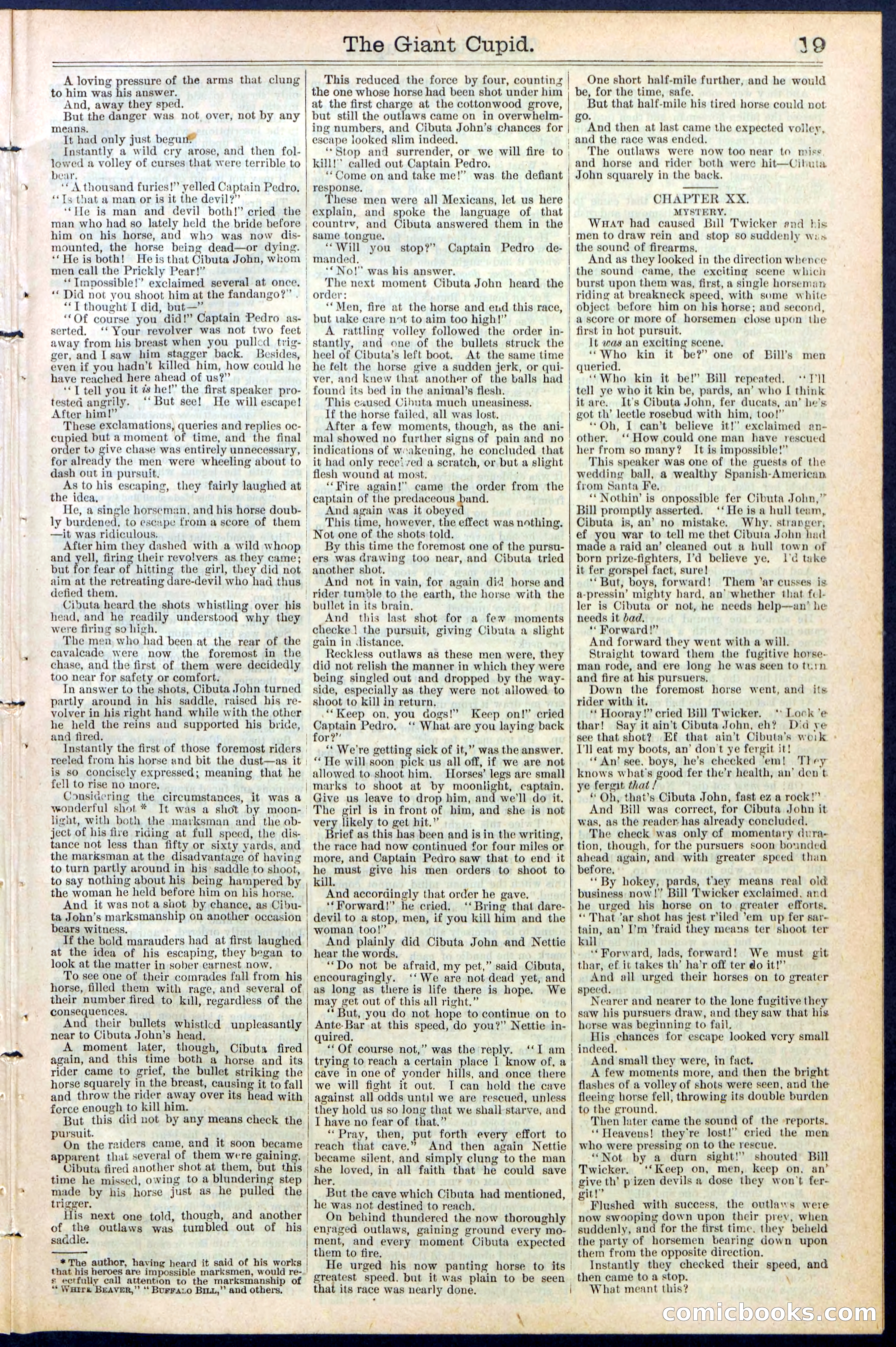
A restored page from Pulp Fiction, 1886. Page through the whole issue in the reader above.
📄 Transcribed text from this page (OCR, searchable)
Machine-transcribed from the original scan — historical spelling and the odd misread are preserved.
A loving pressure of the arms that clung to him was his answer. And, away they sped. But the danger was not over, not by any means. It had only just begun! Instantly a wild cry arose, and then fol- lowed a volley of curses that were terrible to bear. ‘* A thousand furies!”’ yelled Captain Pedro, ‘Ts that a man or is it the devil?” ‘‘Ile is man and devil both!” eried the | man who had so lately held the bride before him on his horse, and who was now dis- mounted, the horse being dead—or dying. ‘* He is both! men call the Prickly Pear!” ‘‘ Impossible!” exclaimed several at once, ‘Did not you shoot him at the fandango?” . “‘T thought I did, but—”. ‘“‘Of course you did!” Captain Pedro as- serted. He is that Cibuta John, whom | ‘‘ Your revolver was not two feet | away from his breast when you pulled trig- | ger, and |saw him stagger back. Besides, even if you hadn’t killed him, how could he have reached here ahead of us?” ‘«T tell you it 7 he!” the first speaker pro- tested angrily. ‘‘ But see! He will escape! After him!” | These exclamations, queries and replies oc- | cupied but amoment of time, and the final order to give chase was entirely unnecessary, for already the men were wheeling about to dash out in pursuit. As to his escaping, they fairly laughed at the idea, He, a single horseman, and his horse doub- ly burdened, to escape from a score of them —it was ridiculous. After him they dashed with a wild whoop and yell, firing their revo!vers as they came; but for fear of hitting the girl, they did not aim at the retreating dare-devil who had thus defied them. Cibuta heard the shots whistling over his head, and he readily understood why they were firing so high. The men who had been at the rear of the cavalcade were now the foremost in the chase, and the first of them were decidedly too near for safety or comfort. In answer to the shots, Cibuta John turned partly around in his saddle, raised his re- volver in his right hand while with the other he held the reins aud supported his bride, and fired. | Instantly the first of those foremost riders | reeled from his horse and bit the dust—as it | is sO concisely expressed; meaning that he fell to rise no more, Consicering the circumstances, it was a wonderful shot * It was a shot by moon- | light, with both the marksman and the ob- ject of his fire riding at full speed, the dis- tance not less than fifty or sixty yards, and the marksman at the disadvantage of having to turn partly around in his saddle to shoot, to say nothing about his being hampered by the woman he held before him on his horse. And it was not a shot by chance, as Cibu- ta John’s marksmanship on another occasion bears witness. If the bold marauders had at first laughed at the idea of his escaping, they began to look at the matter in sober earnest now, The Giant Cupid. This reduced the force by four, counting | the one whose horse had been shot under him at the first charge at the cottonwood grove, but still the outlaws came on in overwhelm- ing numbers, and Cibuta John’s chances for escape looked slim indeed. ‘Stop and surrender, or we will fire to | kill!” called out Captain Pedro. “Come on and take me!” was the defiant response, These men were all Mexicans, let us here explain, and spoke the language of that country, and Cibuta answered them in the same tongue. “Will you stop?” manded. ‘* No!” was his answer. The next moment Cibuta John heard the order: ‘*Men, fire at the horse and end this race, but take care not to aim too high!” Captain Pedro de- stantly, and one of the bullets struck the heel of Cibuta’s left boot. At the same time he felt the horse give a sudden jerk, or qui- ver, and knew that another of the balls had found its bed in the animal’s flesh. This caused Cibuta much uneasiness. If the horse failed, all was lost. After afew moments, though, as the ani- mal showed no further signs of pain and no indications of weakening, he concluded that To see one of their comrades fall from his _ horse, filled them with rage, and several of their number fired to kill, regardless of the consequences, And their bullets whistled unpleasantly A moment later, though, Cibuta fired again, and this time both a horse and its rider came to grief, the bullet striking the horse squarely in the breast, causing it to fall and throw the rider away over its head with force enough to kill him. But this did not by any means check the pursuit. On the raiders came, and it soon became apparent that several of them were gaining, Vibuta fired another shot at them, but this time he missed, owing to a blundering step made by his horse just as he pulled the trigger, His next one told, though, and another of the outlaws was tumbled out of his saddle. | *The author, having heard it said of his works | that his heroes are impossible marksmen, would re-.| s ectfully call attention to the marksmanship of “ Watra Braver,” ‘‘ Burraro Bru,” and others, near to Cibuta John’s head, it had only received a scratch, or but a slight flesh wound at most. ‘Fire again!’ came the order from the captain of the predaceous ae And again was it obeyec This time, however, the effect was nothing. | Not one of the shots told. By this time the foremost one of the pursu- ers was drawing too near, and Cibuta tried another shot. And not in vain, for again dia horse and rider tumble to the earth, the horse with the bullet in its brain. And this last shot for a few moments checke | the pursuit, giving Cibuta a slight gain in distance, Reckless outlaws as these men were, they did not relish the manner in which they were being singled out and dropped by the way- side, especially as they were not allowed to shoot to kill in return, “Keep on, you dogs!” Keep on!” cried Captain Pedro, ‘* What are you laying back | for?” ‘We're getting sick of it,”” was the answer. “He will soon pick us all off, if we are not allowed to shoot him. Horses’ legs are small marks to shoot at by moonlight, captain. Give us leave to drop him, and we'll do it. The girl is in front of him, and she is not veEy likely to get hit.” rief as this has been and is in the writing, the race had now continued for four miles or more, and Captain Pedro saw that to end it be asm give his men orders to shoot to And accordingly that order he gave. ‘* Forward!” he cried. ‘‘ Bring that dare- | devil to a stop, men, if you kill him and the woman too!” And plain hear the words, ‘*Do not be afraid, my pet,” said Cibuta, encouragingly. ‘‘ We are not dead yet, and as long as there is life there is hope. We may get out of this all right.” ‘But, you do not hope to continue on to Ante-Bar at this speed, do you?” Nettie in- quired. ‘**Of course not,” was the reply. ‘<I am trying to reach a certain place | know of, a cave in one of yonder hills, and once there we will fight it out. I can hold the cave did Cibuta John and Nettie against all odds until we are rescued, unless | 19 ey One short half-mile further, and he would be, for the time, safe. But that half-mile his tired horse could not Oo. And then at last came the expected volley, , and the race was ended. they hold us so long that we shall starve, and | I have no fear of that.” ‘Pray, then, put forth every effort to reach that cave.” And then again Nettie became silent, and simply clung to the man She loved, in all faith that he could save | her. But the cave which Cibuta had mentioned, he was not destined to reach, On behind thundered the now thoroughly enraged outlaws, gaining ground every mo- ment, and every moment Cibuta expected them to fire. He urged his now panting horse to its greatest speed. but it was plain to be seen that its race was nearly done. f \ | ' ! The outlaws were now too near to miss and horse and rider both were hit—Cibuta John squarely in the back. CHAPTER XX. MYSTERY. Wnuat had caused Bill Twicker end his men to draw rein and stop so suddenly wis the sound of firearms. And as they looked in the direction whence the sound came, the exciting scene which burst upon them was, first, a single horseman riding at breakneck speed, with some white object before him on his horse; and second, | a score or more of horsemen close upon the A rattling volley followed the order in- | first in hot pursuit. It was an exciting scene, ‘Who kin it be?” one of Bill’s men queried. ‘‘Who kin it be!” Bill repeated. ‘Tl tell ye who it kin be, pards, an’ who [ think it are. It’s Cibuta John, fer ducats, an’ he’s got th’ leetle rosebud with him, too!” “Oh, I can’t believe it!’ exclaimed an- other. ‘‘ How could one man have rescued her from so many? It is impossible!” This speaker was one of the guests of the wedding ball, a wealthy Spanish-American. from Santa Fe. ‘‘ Nothin’ is onpossible fer Cibuta John,” Bill promptly asserted. ‘‘ He is a hull team, Cibuta is, an’ no mistake. Why. stranger, ef you war to tell me thet Cibuia John had made a raid an’ cleaned out a bull town of born prize-fighters, I'd believe ye, I'd take it fer gorspel fact, sure! ‘But, boys, forward! Them ‘ar cusses is a-pressin’ mighty hard, an’ whether that fcl- ler is Cibuta or not, he needs help—an’ he needs it bad. ‘* Forward!” And forward they went with a will. Straight toward them the fugitive horse- man rode, and ere long he was seen to turn and fire at his pursuers, Down the foremost horse went, and its rider with it. ‘* Hooray!” cried Bill Twicker. * Look ’e thar! Say it ain't Cibuta John, eh? Did ve see that shot? Ef that ain’t Cibuta’s woik - I'll eat my boots, an’ don't ye fergit it! ‘* An’ see, boys, he’s checked ‘em! They knows what's good fer the’r health, an’ den t. ye fergit that / * Oh, that’s Cibuta John, fast ez a rock!” And Bill was correct, for Cibuta John it was, as the reader has already concluded. The check was only cf momentary dura- tion, though, for the pursuers soon bounded ahead again, and with greater speed than before, ‘‘ By hokey, pards, taey means real old business now!” Bill Twicker exclaimed, and he urged his horse on to greater efforts, “That ’ar shot has jest riled ’em up fer sar- tain, an’ I’m ’fraid they means ter shoot ter kall ‘*Forward, lads, forward! We must git thar, ef it takes th’ ha’r off ter do it!” And all urged their horses on to greater speed. Nearer and nearer to the lone fugitive they saw his pursuers draw, and they saw that his horse was beginning to fail. His chances for escape looked very small indeed, » And small they were, in fact. A few moments more, and then the bright flashes of a volley of shots were seen, and the fleeing horse fell, throwing its double burden to the ground. Then later came the sound of the reports. ‘* Heavens! they're lost!” cried the men who were pressing on to the rescue. “Not by a durn sight!” shouted Bill Twicker. ‘‘Keep on, men, keep on, an’ give th’ pizen devils a dose they won't fer- rit!” 5 Flushed with success, the outlaws were now swooping down upon their prev, when suddenly, and for the first time, they beheld the party of horsemen bearing down upon them from the opposite direction. Instantly they checked their speed, and then came to a stop. \ What meant this? Eomichoo (C <SiEO