
Pulp Fiction, 1886 · page 18 of 32
Beadle's New York Dime Library, No. 390 — page 18: what you’re looking at
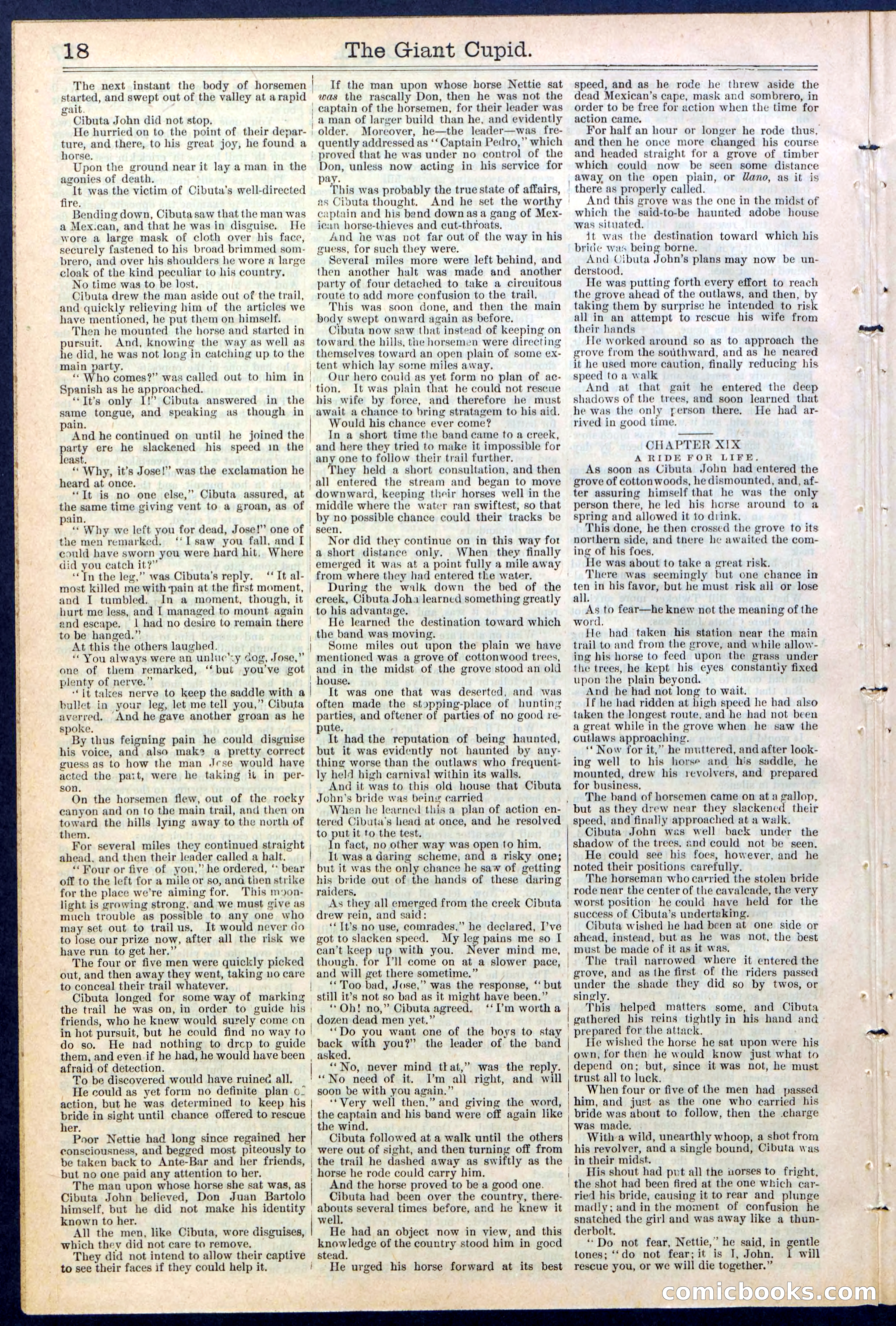
A restored page from Pulp Fiction, 1886. Page through the whole issue in the reader above.
📄 Transcribed text from this page (OCR, searchable)
Machine-transcribed from the original scan — historical spelling and the odd misread are preserved.
-_< 5S oe eee le -— “= - —— SS — he BS a 53 Os ke Jo. Dees Pp ——* - Ta ee is reas ee 18 The Giant Cupid. The next instant the body of horsemen | started, and swept out of the valley at arapid grit. ~ Gibuta John did not stop. He hurried on to the point of their depar- | ture, and there, to his great joy, he found a horse. Upon the ground near it lay a man in the agonies of death. It was the victim of Cibuta’s well-directed fire. Bending down, Cibutasaw that the man was a Mex.can, and that he was in disguise. He wore a large mask of cloth over his face, securely fastened to his broad brimmed som- brero, and over his shoulders he wore a large cloak of the kind peculiar to his country, No time was to be lost, Cibuta drew the man aside out of the trail, and quickly relieving him of the articles we have mentioned, he put them on himself. Then he mounted the horse and started in pursuit. And, knowing the way as well as he did, he was not long in catching up to the main party. ‘“ Who comes?” was called out to him in | Spanish as he approached. ‘Tt’s only I!” Cibuta answered in the same tongue, and speaking as though in pain. And he continued on until he joined the party ere he slackened his speed 1n the least. ‘ Why, it’s Jose!” was the exclamation he heard at once. ‘‘Tt is no one else,’ Cibuta assured, at the same time giving vent to a groan, as of ain. a Why we left you for dead, Jose!” one of | the men remarked, ‘‘I saw you fall, and [ | could have sworn you were hard hit, Where | did you catch it?” | ‘Tn the leg,” was Cibuta’s reply. ‘‘ It al- most killed me with-pain at the first moment, and I tumbled. In a moment, though, it hurt me less, and I managed to mount again and escape. 1 had no desire to remain there to be hanged.” : At this the others laughed. | ‘You always were an unluc’:y dog, Jose,” one of them remarked, ‘‘ but you've got plenty of nerve.” ! ‘‘It takes nerve to keep the saddle with a | bullet in your leg, let me tell you,” Cibuta averred. And he gave another groan as he spoke. By thus feigning pain he could disguise his voice, and also make a pretty correct guess as to how the man Jcse would have acted the pait, were he taking it in per- son. On the horsemen flew, out of the rocky canyon and on to the main trail, and then on toward the hills lying away to the north of them. For several miles they continued straight ahead, and then their leader called a halt. — | ‘‘ Four or five of you,” he ordered, ‘* bear off to the left for a mile or so, ana then strike for the place we're aiming for. This m9on- light is growing strong, and we must give as much trouble as possible to any one who may set out to trailus. It would never do to lose our prize now, after all the risk we have run to get her.” The four or five men were quickly picked out, and then away they went, taking no care to conceal their trail whatever. | Cibuta longed for some way of marking the trail he was on, in order to guide his | friends, who he knew would surely come on in hot pursuit, but he could find no way to | do so. He had nothing to drcp to guide them, and even. if he had, he would have been , afraid of detection. | To be discovered would have ruined all, - He could as yet form no definite plan o- action, but he was determined to keep his | bride in sight until chance offered to rescue | her. Poor Nettie had long since regained her consciousness, and begged most piteously to be taken back to Ante-Bar and her friends, | but no one paid any attention to her. The man upon whose horse she sat was, as Cibuta John believed, Don Juan Bartolo himself, but he did not make his identity | known to her. All the men, like Cibuta, wore disguises, which they did not care to remove, They did not intend to allow their captive to see their faces if they could help it. If the man upon whose horse Nettie sat was the rascally Don, then he was not the | captain of the horsemen, for their leader was 'aman of larger build than he, and evidently older. Moreover, he—the leader—was fre- quently addressed as ‘‘ Captain Pedro,” which proved that he was under no control of the Don, unless now acting in his service for pay. This was probably the true state of affairs, as Cibuta thought. And he set the worthy captain and his bend down asa gang of Mex- icun horse-thieves and cut-throats. And he was not far out of the way in his guess, for such they were. Several miles more were left behind, and then another halt was made and another party of four detached to take a circuitous route to add more confusion to the trail. This was soon done, and then the main body swept onward again as before. Cibuta now saw tbat instead of keeping on toward the hills, the horsemen were directing themselves toward an open plain of some ex- tent which lay some miles away. Our hero could as yet form no plan of ac- tion. It was plain that he could not rescue his wife by force, and therefore he must await a chance to bring stratagem to his aid. W ould his chance ever come? In a short time the band came to a creek, and here they tried to make it impossible for any one to follow their trail further. hey held a short consultation, and then all entered the stream and began to move downward, keeping their horses well in the middle where the water ran swiftest, so that by no possible chance could their tracks be seen, Nor did they continue on in this way fot a short distance only. When they finally emerged it was at a point fully a mile away from where they had entered the water. During the walk down the bed of the creek, Cibuta Joha learned something greatly to his advantage. He learned the destination toward which the band was moving. Some miles out upon the plain we have mentioned was a grove of cottonwood trees, and in the midst of the grove stood an old house. It was one that was deserted, and was often made the stopping-place of hunting parties, and oftener of parties of no good re- pute, It had the reputation of being haunted, but it was evidently not haunted by any- thing worse than the outlaws who frequent- ly held high carnival within its walls. And it was to this old house that Cibuta John’s bride was being carried When he learned this a plan of action en- tered Cibuta’s head at once, and he resolved to put it to the test. In fact, no other way was open to him. It was a daring scheme, and a risky one; but it was the only chance he saw of getting his bride out of the hands of these daring raiders, As they all emerged from the creek Cibuta drew rein, and said: ‘¢ It’s no use, comrades,” he declared, I’ve got to slacken speed. My leg pains me so I can’t keep up with you. ever mind me, though, for I’ll come on at a slower pace, and will get there sometime.” ‘“Too bad, Jose,” was the response, ‘‘ but still it’s not so bad as it might have been.” ‘Oh! no,” Cibuta agreed. ‘‘?m worth a dozen dead men yet.” ‘“Do you want one of the boys to stay back with you?” the leader of the band asked. ‘“‘ No, never mind that,” was the reply. ‘“No need of it. I’m all right, and will soon be with you again.” ‘Very well then,” and giving the word, the captain and his band were off again like the wind. Cibuta followed at a walk until the others were out of sight, and then turning off from the trail he dashed away as swiftly as the horse he rode could carry him. And the horse proved to be a good one. Cibuta had been over the country, there- one several times before, and he knew it well, He had an object now in view, and this knowledge of the country stood him in gocd stead. He urged his horse forward at its best a a speed, and as he rode he threw aside the dead Mexican’s cape, mask and sombrero, in order to be free for action when the time for action came. For half an hour or longer he rode thus, and then he once more changed his course and headed straight for a grove of timber which could now be seen some distance away on the open plain, or Wano, as it is there as properly called. And this grove was the one in the midst of which the said-to-be haunted adobe house was situated. it was the destination toward which his bride was being borne. And Cibuta John’s plans may now be un- derstood. He was putting forth every effort to reach the grove ahead of the outlaws, and then, by taking them by surprise he intended to risk all in an attempt to rescue his wife from their hands Ile worked around so as to approach the grove from the southward, and as he neared it he used more caution, finally reducing his speed to a walk And at that gait he entered the deep shadows of the trees, and soon learned that he was the only person there. He had ar- rived in good time. CHAPTER XIX A RIDE FOR LIFE. As soon as Cibuta John had entered the grove of cottonwoods, he dismounted, and, af- ter assuring himself that he was the only person there, he led his horse around to a spring and allowed it to drink. This done, he then crossed the grove to its northern side, and there he awaited the com- ing of his foes, He was about to take a creat risk. There was seemingly but one chance in oe in his favor, but he must risk all or lose all. As to fear—he knew not the meaning of the word. He had taken his station near the main trail to and from the grove, and while allow- ing his horse to feed upon the grass under the trees, he kept his eyes constantiy fixed upon the plain beyond. And he had not long to wait. If he had ridden at high speed he had also taken the longest route, and he had not been a great while in the grove when he saw the outlaws approaching. ‘* Now for it,’ he muttered, and after look- ing well to his horse and his saddle, he mounted, drew his revolvers, and prepared for business. The band of horsemen came on ata gallop, but as they drew near they slackencd their | speed, and finally approached at a walk. Cibuta John was well back under the shadow of the trees, and could not be seen. He could see his foes, however, and he noted their positions carefully. The horseman who carried the stolen bride rode near the center of the cavalcade, the very worst position he could have held for the success of Cibuta’s undertaking. Cibuta wished he had been at one side or ahead, instead, but as he was not, the best must be made of it as it was. The trail narrowed where it entered the grove, and as the first of the riders passed under the shade they did so by twos, or singly. This helped matters some, and Cibuta gathered his reins tightly in his hand and prepared for the attack. He wished the horse he sat upon were his own, for then he would know just what to depend on; but, since it was not, he must trust all to luck. When four or five of the men had passed him, and just as the one who carried his bride was about to follow, then the charge was made. With a wild, unearthly whoop, a shot frorn his revolver, and a single bound, Cibuta was in their midst. His shout had put all the uorses to fright, the shot had been fired at the one which car- ried his bride, causing it to rear and plunge madly; and in the moment of confusion he snatched the girl and was away like a thun- derbolt. ‘‘Do not fear, Nettie,” he said, in gentle tones; ‘‘do not fear; it is I, John, will rescue you, or we will die together.” ated oKefe) EOmiic S) (¢ (@) “