
Pulp Fiction, 1886 · page 8 of 32
Beadle's New York Dime Library No. 389 — page 8: what you’re looking at
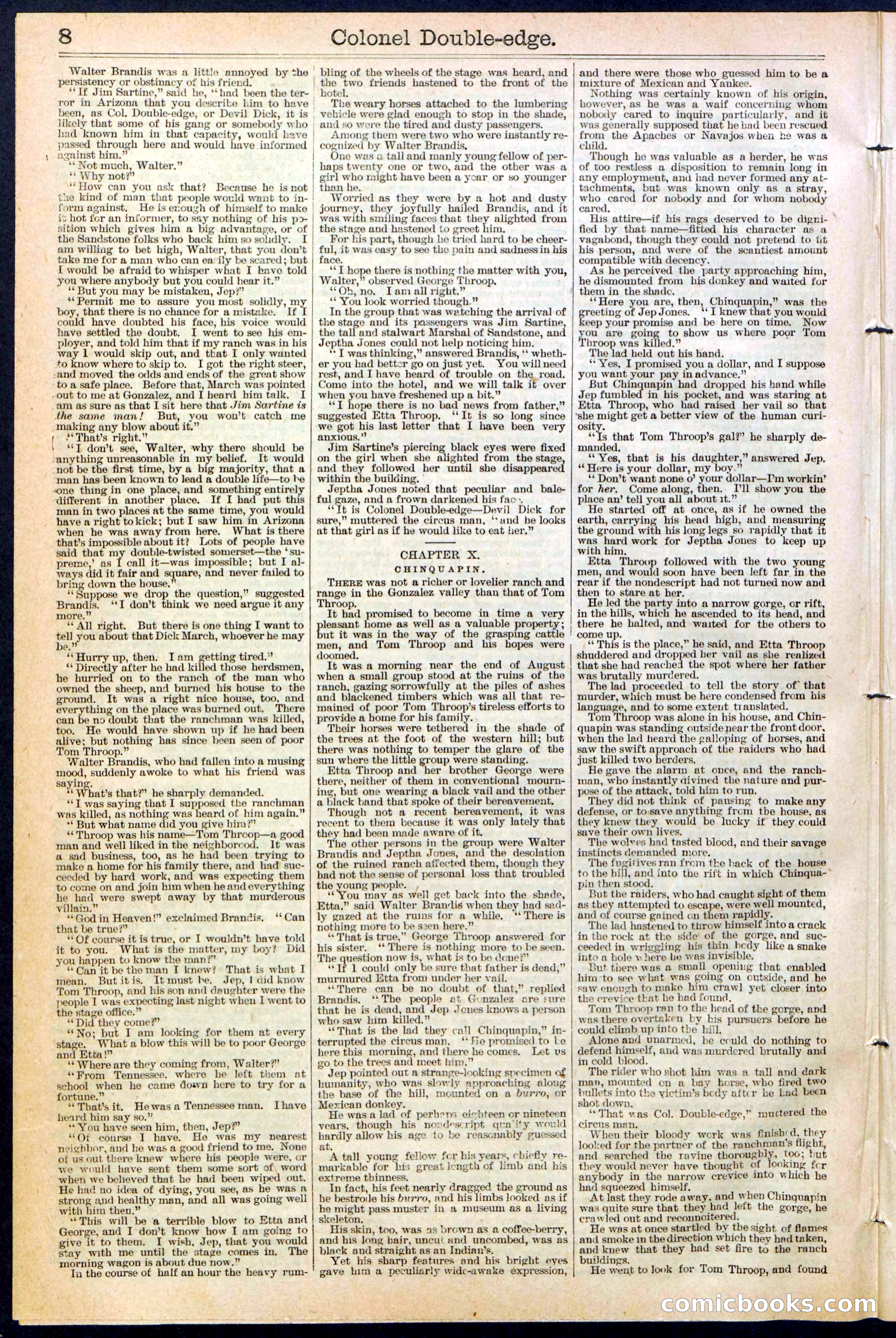
A restored page from Pulp Fiction, 1886. Page through the whole issue in the reader above.
📄 Transcribed text from this page (OCR, searchable)
Machine-transcribed from the original scan — historical spelling and the odd misread are preserved.
* ‘ . _> a 8 Colonel Double-edge -_——- Suene aoa =r * See 7 Walter Brandis was a little annoyed by the | persistency or obstinacy of his friend. **If Jim Sartine,” said he, *‘had been the ter- ror in Arizona that you describe him to have been, as Col, Double-edge, or Devil Dick, it is likely that some of his gang or somebody who had known him in that capacity, would heve | passed through here and would have informed avainst him.” ‘* Not much, Walter.” ‘* Why not?” ‘How can you ask that? form against, He is enouch of himself to make is hot for an informer, to say nothing of his p>- | sition which gives him a big advantage, or of | the Sandstone folks who back him so solidly. I | am willing to bet high, Walter, that you don’t take me for a man who can eavily be scared; but { would be afraid to whisper what I have told you where anybody but you could hear it.” ‘** But you may be mistaken, Jep?”’ **Permit me to assure you most solidly, my boy, that there is no chance for a mistake. If I could have doubted his face, his voice would have settled the doubt. I went to see his em- ployer, and told him that if my ranch was in his way 1 would skip out, and that I only wanted to know where to skip to. I got the right steer, -and moved the odds and ends of the great show toa safe place. Before that, March was pointed out to me at Gonzalez, and I heard him talk, I am as sure as that I sit here that Jim Sartine is | -anything unreasonable in my belief. the same man! But, you won’t catch me making any blow about it.” *That’s right.” ‘‘T don’t see, Walter, why there should be It would not be the first time, by a big majority, that a man has been known to lead a double life—to be -one thing in one place, and something entirely ‘different in another place. If I bad put this man in two places at the same time, you would have a right tokick; but I saw him in Arizona when he was away from here. What is there that’s impossible about it? Lots of people have said that my double-twisted somerset—the ‘su- preme,’ as I call it—was impossible; but I al- ways did it fair and square, and never failed to bring down the house, “Suppose we drop the question,” suggested Brandis. ‘I don’t think we need argue it any e,” ‘All right. But there is one thing I want to oe about that Dick March, whoever he may e@, ‘‘ Hurry up, then. Iam getting tired.” ** Directly after he had killed those herdsmen, he hurried on to the ranch of the man who owned the sheep, and burned his house to the ground. It was a right nice house, too, and everything on the place was burned out. There can be no doubt that the ranchman was killed, too. He would have shown up if he had been alive: but nothing has since been seen of poor Tom Throop.” Walter Brandis, who had fallen into a musing mood, suddenly awoke to what his friend was saying. “ What's that?” he sharply demanded. ‘*T was saying that I supposed the ranchman was killed, as nothing was heard of him again.” ‘ But what name did you give hima?” “Throop was his name—Tom Throop—a good man and well liked in the neighborcod. It was a sad business, too, as he had been trying to make a home for his family there, and had suc- ceeded by hard work, and was expecting them to come on and join him when he and everything he had were swept away by that murderous villain.” **(iod in Heaven!” exclaimed Brandis. ‘‘ Can that be true?” ‘“‘ Of course it is true, or I wouldn’t have told it to you. What is the matter, my boy? Did you happen to know the man?” ** Can it be the man I knew? That is what I mean. Butitis. It must be. Jep, | did know Tom Threop, and his son and daughter were the people I was expecting last night when I went to the stage office.” “Did they come?” “No; but I am looking for them at every stage. What a blow this will be to poor George and Etta!” , ‘¢ Where are they coming from, Walter?” “From Tennessee. where he left them at school when he came doan here to try for a fortune.” “* That’s it. Hewas a Tennessee man. Ihave heard him say so.” “You have seen him, then, Jep?”’ “Of course I have. He was my nearest neighber, and he was a good friend to me. None of us out there knew where his people were, or we would have sent them some sort of word when we beheved that he had been wiped out. He had no idea of dying, you see, as he was a strong and healthy man, and all was going well with him then.” “This will be a terrible blow to Etta and George, and I don’t know how I am going to give it to them. I wish, Jep, that you would stay with me until the stage comes in, The morning wagon is about due now.” Tn the course of half an hour the heavy rum- ' Because he is not | the kind of man that people would want to in- | ser two friends hastened to the front of the otel. The weary horses attached to the lumbering | vebicle were glad enough to stop in the shade, and so were the tired and dusty passengers. Among them were two who were instantly re- cognized by Walter Brandis, | One was a talland manly young fellow of per- haps twenty one or two, and the other was a girl who might have been a ycar or so younger than he. Worvied as they were by a hot and dusty journey, they joyfully hailed Brandis, and it was with smiling faces that they alighted from the stage and hastened to greet him. For his part, though he tried hard to be cheer- | ful, it was easy to see the pain and sadness in his face, ———— a a a a a a ee ee ~ ~ é as ‘ a4 - e ‘ aboth, a —+ Din le ee ee tis et ude TA o- ‘*T hope there is nothing the matter with you, Walter,” observed George Throop. ‘Ob, no. Iam all right.” ** You look worried though.” In the group that was wetching the arrival of the stage and its passengers was Jim Sartine, the tall and stalwart Marshal of Sandstone, and Jeptha Jones could not help noticing him. ‘** | was thinking,” answered Brandis, ‘* wheth- er you had better go on just yet. You willneed rest, and I have heard of trouble on the road. Come into the hotel, and we will talk it over when you have freshened up a bit.” ‘‘T hope there is no bad news from father,” suggested Etta Throop. ‘‘It is so long since we got his last letter that I have been very anxious,” Jim Sartine’s piercing black eyes were fixed on the girl when she alighted from the stage and they followed her until she disappeared within the building. © Jeptha Jones noted that peculiar and _ bale- ful gaze, and a frown darkened his fac. ‘**Tt is Colonel Double-edge—Devil Dick for sure,” muttered the circus man, ‘*und he looks at that girl as if he would like to eat her.” CHAPTER X. CHINQUAPIN. THERE was not a richer or lovelier ranch and range in the Gonzalez valley than that of Tom Throop. It had promised to become in time a very leasant home as well as a valuable property; se" it was in the way of the grasping cattle men, and Tom Throop and his hopes were doomed. It was a morning near the end of August when a small group stood at the ruins of the ranch, gazing sorrowfully at the piles of ashes and blackened timbers which was all that re- mained of poor Tom Throop’s tireless efforts to provide a home for his family. Their horses were tethered in the shade of the trees at the foot of the western hill; but there was nothing to temper the glare of the sun where the little group were standing. Etta Throop and her brother George were there, neither of them in conventional mourn- ing, but one wearing a black vail and the other a black band that spoke of their bereavement. Though not a recent bereavement, it was recent to them because it was only lately that they had been made aware of it. The other persons in the group were Walter Brandis and Jeptha Jones, and the desolation of the ruined ranch affected them, though they bad not the sense of personal loss that troubled the young people. _, ‘You may as well get back into the shade, Etta,” said Walter Brandis when they had sad- ly gazed at the ruins for a while, ‘ There is nothing more to be s2en here.” “That is true,” George Throop answered for his sister. ‘* There is nothing more to be seen. The question now is, what is to be dene?” ‘Tf 1 could only be sure that father is dead,” murmured Etta from under her vail. ‘There can be no doubt of that,” replied Brandis. ‘**The people at Gonzalez are sure that he is dead, and Jep Jcnes knows a person who saw him killed.” ‘That is the lad they call Chinquapin,” in- terrupted the circus man. ‘Sie promised to be here this morning, and there he comes, Let vs go to the trees and meet him.” Jep pointed out a strange-looking specimen af humanity, who was slowly approaching along the base of the hill, mounted on a burro, or Mexican donkey. He was a lad of perhens eichteen or nineteen vears, though his nondescript qua’ity would hardly allow his age to be reasonably guessed at. A tall young fellow for his years, cbiefly re- markable for his great length of mb and his extreme thinness, ) In fact, his feet nearly dragged the ground as he bestroile his burre, and his limbs looked as if he might pass muster in a museum as a living skeleton, His skin, too, was as brown as a coffee-berry, and his Jong bair, uncué and uncombed, was as black and straight as an Indian’s. Yet his sharp features and his bright eyes gave him a peculiarly wide-awake expression, bling of the wheels of the stage was heard, and a — at eenennnnnneeendineenneeeennennnemmee ooo and there were those who guessed him to be a mixture of Mexican and Yankee. Nothing was certainly known of his origin, however, as he was a waif concerning whom nobody cared to inquire particularly, and it was generally supposed that he bad been rescued from the Apaches or Navajos when he was a child. Though he was valuable as a herder, he was of too restless a disposition to remain long in any employment, and had never formed any at- tachments, but was known only as a stray, who cared for nobody and for whom nobody cared, His attire—if his rags deserved to be digni- fled by that name—fitted his character as a vagabond, though they could not pretend to fit his person, and were of the scantiest amount compatible with decency. As he perceived the party approaching him, he dismounted from his donkey and waited for them in the shade. ‘*Here you are, then, Chinquapin,” was the grretng of JepJones. ‘I knew that you would eep your promise and be here on time. Now you are going to show us where poor Tom Throop was killed.” The lad held out his hand. ** Yes, I promised you a dollar, and I suppose you want your pay in advance.” But Cea had dropped his hand while Jep fumbled in his pocket, and was staring at Etta Throop, who had raised her vail so that ‘she might get a better view of the human curi- osity. “Ts that Tom Throop’s gal?” he sharply de- manded, ‘Yes, that is his daughter,” answered Jep. “Here is your dollar, my boy.” ** Don’t want none o’ your dollar—I’m workin’ for her. Come along, then. Vl show you the place an’ tell you all about 1t.” He started off at once, as if he owned the earth, carrying his head high, and measuring the ground with his long legs so rapidly that it was hard work for Jeptha Jones to keep up with him, Etta Throop followed with the two young men, and would soon have been left far in the rear if the nondescript had not turned now and then to stare at her. He led the party into a narrow gorge, or rift, in the hills, which he ascended to its head, and there he halted, and waited for the others to ' come up. it ett TTT Tw ‘* This is the place,” he said, and Etta Throop shuddered and dropped ber vail as she realized that she had reached the spot where her father was brutally murdered. The lad proceeded to tell the story of that murder, which must be here condensed from his language, and to some exteut translated. om Throop was alone in his house, and Chin- quapin was standing outside near the front door, when the lad heard the galloping of horses, and saw the swift approach of the raiders who had just killed two herders, He gave the alarm at once, and the ranch- man, who instantly divined the nature and pur- pose of the attack, told him to run, They did not think of pausing to make any defense, or tosave anything from the house, as they knew they would be lucky if they could save their own lives. The wolves had tasted blocd, and their savage instincts demanded more, , The fugitives ran from the hack of the house to the bill, and into the rift in which Chinqua-" pin then stood, But the raiders, who had caught sight of them as they attempted to escape, were well mounted, and of course gained on them rapidly, The lad hastened to throw himself into a crack in the rock at the side’ of the gorge, and suc- ceeded in wriggling his thin hedy ‘like a snake into a hole where be was invisible. But there was a small opening that enabled him to see what was going On outside, and he saw enough to make him craw] yet closer into the crevice that be had found, Tom Throop ren to the head of the gorge, and was there overtaken by bis pursuers before he could climb up into the hill, Alone and unarmed, he eculd do nothing to defend himself, and was murdered brutally and in cold blood. The rider who shot him was a tall and dark man, mounted on a bay horse, who fired two bullets into the victim’s bedy aftcr he bad been shot down, ‘“That was Col. Double-edge,” muctered the cireus man. é When their bloody work was finishrd, they looked for the partner of the ranchman’s flight, and searched the ravine thoroughly, too; hut they would never have thought of ooking fer anybody in the narrow crevice into which he had squeezed himself. 4 | At last they rode away, and when Chingnapin was quite sure that they bad left the gorge, he crawled out and reeonnoitered. He was at once startled by the sight of flames and smoke in the direction which they had taken, and knew that they had set fire to the ranch buildings. He went to look for Tom Throop, and found com (E