
Pulp Fiction, 1886 · page 6 of 32
Beadle's New York Dime Library No. 389 — page 6: what you’re looking at
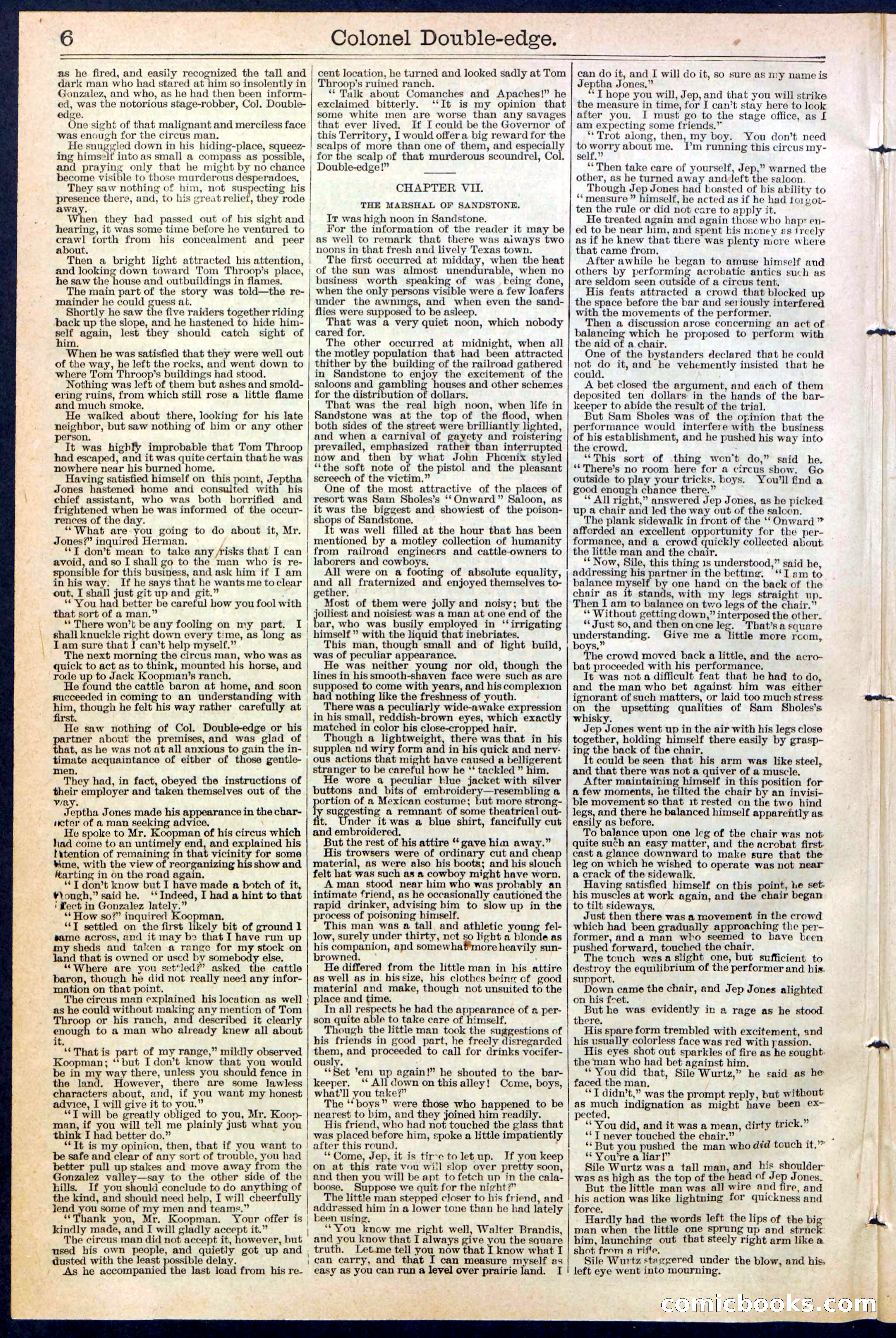
A restored page from Pulp Fiction, 1886. Page through the whole issue in the reader above.
📄 Transcribed text from this page (OCR, searchable)
Machine-transcribed from the original scan — historical spelling and the odd misread are preserved.
6 as he fired, and easily recognized the tall and dark man who had stared at him so insolently in Gonzalez, and who, as he had then been inform- ed, was the notorious stage-robber, Co]. Double- edge. One sight of that malignant and merciless face was enough for the circus man. He snuggied down in his hiding-place, squeez- ing himself into as small a compass as possible, and praying only that he might by no chance become visible to those murderous desperadoes, They saw nothing of him, not suspecting his presence there, and, to his greatrelief, they rode orev. When they had passed out of his sight and hearing, it was some time before he ventured to crawl torth from his concealment and peer about. Then a bright light attracted his attention, and looking down toward Tom Throop’s place, he saw the house and outbuildings in flames. The main part of the story was told—the re- mainder he could guess at. Shortly he saw the five raiders together riding back up the slope, and he hastened to hide him- ope again, lest they should catch sight of im. When he was satisfied that they were well out of the way, he left the rocks, and went down to where Tom Throop’s buildings had stood. Nothing was left of them but ashes and smold- ering ruins, from which still rose a little flame and much smoke, He walked about there, looking for his late neighbor, but saw nothing of him or any other person. It was highfy improbable that Tom Throop had escaped, and it was quite certain that he was nowhere near his burned home, Having satisfied himself on this point, Jeptha Jones hastened home and consulted with his chief assistant, who was both horrified and frightened when he was informed of the occur- rences of the day. “What are you going to do about it, Mr. Jones?” inquired Herman. “T don’t mean to take any risks that I can avoid, and so I shall go to the man who is re- sponsible for this business, and ask him if I am in his way. If he says that he wants me toclear out, I shall just git up and git.” ** You had better be careful how you fool with that sort of a man.” “There won’t be any fooling on my part. I shall knuckle right down every time, as long as Iam sure that ! can’t help myself.” The next morning the circus man, who was as quick to act as to think, mounted his horse, and rode up to Jack Koopman’s ranch, He found the cattle baron at home, and soon succeeded in coming to an understanding with him, though he felt his way rather carefully at He saw nothing of Col. Double-edge or his rtner about the premises, and was glad of hat, as he was not at all anxious to gain the in- timate acquaintance of either of those gentle- men. They had, in fact, obeyed the instructions of their employer and taken themselves out of the vay. eritlin Jones made his appearance in the char- meteor of a man seeking advice, He spoke to Mr. Koopman of his circus which had come to an untimely end, and explained his tatention of decane in that vicinity for some bime, with the view o po pis his show and farting in on the road again, **T don’t know but I have made a botch of it, ¥VYough,” said he. ‘‘ Indeed, I had a hint to that ‘fect in Gonzalez lately.” “‘ How so?” inquired Koopman. “T settled on the first hkely bit of ground 1 same across, and it may be that I have run up my sheds and taken a rango for my stock on land that is owned or used by somebody else. ‘““Where are you set'led?’ asked the cattle baron, though he did not really need any infor- mation on that point. The circus man explained his location as well as he could without making any mention of Tom Throop or his ranch, and described it clearly enough to a man who already knew all about it. ‘*Thatis part of my range,” mildly observed Koopman; ‘‘ but I don’t know that you would be in m way there, unless you should fence in the land. However, there are some lawless characters about, and, if you want my honest advice, I will give it to you.” “T will be greatly obliged to you, Mr. Koop- man, if you will tell me plainly just what you think I had better do.” “It is my opinion, then, that if you want to be safe and clear of any sort of trouble, you had better pull up stakes and move away from the Gonzalez valley—say to the other side of the hills. If you should conclude to do anything of the kind, and should need help, I will cheerfully Jend you some of my men and teams.” 4 “Thank you, Mr. Koopman. Your offer is kindly made, and I will gladly accept it.” The circus man did not accept it, however, but used his own people, and quietly got up and dusted with the een pom delay. As he accompanied the last load from his re- a 2 a wins Se Men | — SS Spec ssn deer Colonel Double-edge. cent location, he turned and looked sadly at Tom Throop’s ruined ranch. ** Talk about Comanches and Apaches!” he exclaimed bitterly. ‘It is my opinion that some white men are worse than any savages that ever lived. If I could be the Governor of this Territory, I would offer a big reward for the scalps of more than one of them, and especially | for the scalp of that murderous scoundrel, Col. | Double-edge!” CHAPTER VII. THE MARSHAL OF SANDSTONE, It was high noon in Sandstone. For the information of the reader it may be as well to remark that there was aiways two noons in that fresh and lively Texas town. The first occurred at midday, when the heat of the sun was almost unendurable, when no business worth speaking of was being Cone, when the only persons visible were a few loafers under the awnings, and when even the sand- flies were supposed to be asleep. That was a very quiet noon, which nobody cared for. The other occurred at midnight, when all the motley population that had been attracted thither by the building of the railroad gathered in Sandstone to enjoy the excitement of the saloons and gambling houses and other schemes for the distribution of dollars. That was the real high noon, when life in Sandstone was at the top of the flood, when both sides of the street were brilliantly lighted, and when a carnival of gayety and roistering prevailed, emphasized rather than interrupted now and then by what John Phoenix styled ‘*the soft note of the pistol and the pleasant sereech of the victim.” One of the most attractive of the places of resort was Sam Sholes’s ‘‘ Onward” Saloon, as it was the biggest and showiest of the poison- shops of Sandstone. It was well filled at the hour that has been mentioned by a motley collection of humanity from railroad engineers and cattle-owners to laborers and cowboys, All were on a footing of absolute equality, and, all fraternized and enjoyed themselves to- gether. Most of them were jolly and noisy; but the jolliest and noisiest was a man at one end of the ar, who was busily employed in ‘‘irrigating himself ” with the liquid that inebriates. This man, though small and of light build, was of peculiar appearance. He was neither young nor old, though the lines in his smooth-shaven face were such as are supposed to come with years, and his complexion had nothing like the freshness of youth. There was a peculiarly wide-awake expression in his small, reddish-brown eyes, which exactly matched in color his close-cropped hair. Though a lightweight, there was that in his supplea nd wiry form and in his quick and nerv- ous actions that might have caused a belligerent stranger to be careful how he ‘‘ tackled ” him. He wore a peculiar blue jacket with silver buttons and bits of embroidery—resembling a peri of a Mexican costume; but more strong- *, suggesting a remnant of some theatrical out- t. Under it was a blue shirt, fancifully cut and embroidered. But the rest of his attire “‘ gave him away.” His trowsers were of ordinary cut and chea material, as were also his boots; and his slouc felt hat was such as a cowboy might have worn. Aman stood near him who was probably an intimate friend, as he occasionally cautioned the rapid drinker, advising him to slow up in the process of poisoning himself, This man was a tall and athletic young fel- low, surely under thirty, nct so light a blonde as his companion, and somewhaf*more heavily sun- browned. — He differed from the little man in his attire as well as in hissize, his clothes being of good material and make, though not unsuited to the | place and time. In all respects he had the appearance of a per- son quite able to take care of himself, Though the little man took the suggestions of his friends in good part, he freely disregarded them, and proceeded to call for drinks vocifer- ously. “Set ’em up again!” he shouted to the bar- keeper. ‘* All down on this alley! Come, boys, what'll you take?” The ‘‘ boys” were those who happened to be nearest to him, and they joined him readily. His friend, who had not touched the glass that was placed before him, spoke a little impatiently ) after this round. ‘* Come, Jep, it is tire toletup. If you keep on at this rate vou will slop over pretty soon, and then you will be apt to fetch up in the cala- boose. Suppose we quit for the night?” The little man stepped closer to his friend, and addressed him in a lower tone than he had lately | been using, ‘You know me right well, Walter Brandis, and you know that I always give you the square _ truth. Letme tell you now that I know what I | can carry, and that I can measure myself as easy as you can run a level over prairie land. I peat! > Det es leas ee ia Ee sree SE RN ka a aa SR ae pr crn a a a SD cnc tS oil a aa _————————— can do it, and I will doit, so sure as my name is J eptha Jones,” ‘IT hope you will, Jep, and that you will strike the measure in time, for I can’t stay here to look after you. I must go to the stage office, as [ am expecting some friends.” ** Trot along, then, my boy. You don’t need ed about me. I’m running this circus my- self. ‘‘Then take care of yourself, Jep,” warned the other, as he turned away andleft the saloon. Though Jep Jones had boasted of his ability to ‘measure ” himself, he acted as if he had 101 got- ten the rule or did not care to apply it. He treated again and again those who hapr en- ed to be near him, and spent bis money as ireely as if he knew that there was plenty more where that came from. After awhile he began to amuse himself and others by performing acrobatic antics such as are seldom seen outside of a circus tent, His feats attracted a crowd that blocked u the space before the bar and seriously interfered with the movements of the performer. Then a discussion arose concerning an act of balancing which he proposed to perform with the aid of a chair. One of the bystanders declared that he could not do it, and he vehemently insisted that he could. A bet closed the argument, and each of them deposited ten dollars in the hands of the bar- keeper to abide the result of the trial, But Sam Sholes was of the opinion that the performance would interfere with the business of his establishment, and he pushed his way into the crowd. “This sort of thing wen't do,” said he. ‘*There’s no room here for a circus show. Go outside to play your tricks, boys. You'll find a good enough chance there.” ** All right,” answered Jep Jones, as he picked up a chair and led the way out of the saloon. The plank sidewalk in front of the ‘‘ Onward ” afforded an excellent opportunity for the per- formance, and a crowd quickly collected about. the little man and the chair. ‘* Now, Sile, this thing 1s understood,” said he, addressing his partner in the betting. ‘I am to balance myself by one hand on the back of the chair as it stands, with my legs straight up. Then I am to balance on two legs of the chair.” ** Without getting down,” interposed the other. ** Just so, and then onone leg. That’sa square understanding. Give me a Tittle more rcom, boys, The crowd moved back a little, and the acro- bat proceeded with his performance. It was not a difficult feat that he had to do, and the man who bet against him was either ignorant of such matters, or laid too much stress on the upsetting qualities of Sam Sholes’s whisky. Jep Jones went up in the air with his legs close together, holding himself there easily by grasp- ing the back of the chair. t could be seen that his arm was like steel, and that there was not a quiver of a muscle, After maintaining himself in this position for a few moments, ue tilted the chair by an invisi- ble movement so that 1t rested on the two hind legs, and there he balanced himself apparently as easily as before. To balance upon one leg of the chair was not quite such an easy matter, and the acrobat first cast a glance downward to make sure that the leg on which he wished to operate was not near a crack of the sidewalk. Having satisfied himself on this point, he set: his muscles at work again, and the chair began to tilt sideways, Just then there was a movement in the crowd which had been gradually approaching the per- former, anda man who seemed to have been pushed forward, touched the chair. The tcuch was a slight one, but sufficient to destroy the equilibrium of the performer and his. support. . Down came the chair, and Jep Jones alighted on his fret. : But he was evidently in a rage as he stood there. His spare form trembled with excitement, and his usually colorless face was red with passion. His eyes shot out sparkles of fire as he sought: the man who had bet against him. “You did that, Sile Wurtz,” he said as he faced the man, “*T didn’t,” was the prompt reply, but without as aoe indignation as might have been ex- pected, , ‘You did, and it was a mean, dirty trick.” ‘*T never touched the chair.” ‘But you pushed the man who dtd touch it,” © * You're a liar!” ; Sile Wurtz was a tall man, and his shoulder was as high as the top of the head of Jep Jones. But the little man was all wire and fire, and his action was like lightning for quickness and force. Hardly had the words left the lips of the big man when the little one sprung up and strnck him, launching out that steely right arm likea shot from a rifte. Sile Wurtz stnggered under the blow, and his, left eye went into mourning. — Gomilchboo cS)