
Pulp Fiction, 1886 · page 4 of 32
Beadle's New York Dime Library No. 389 — page 4: what you’re looking at
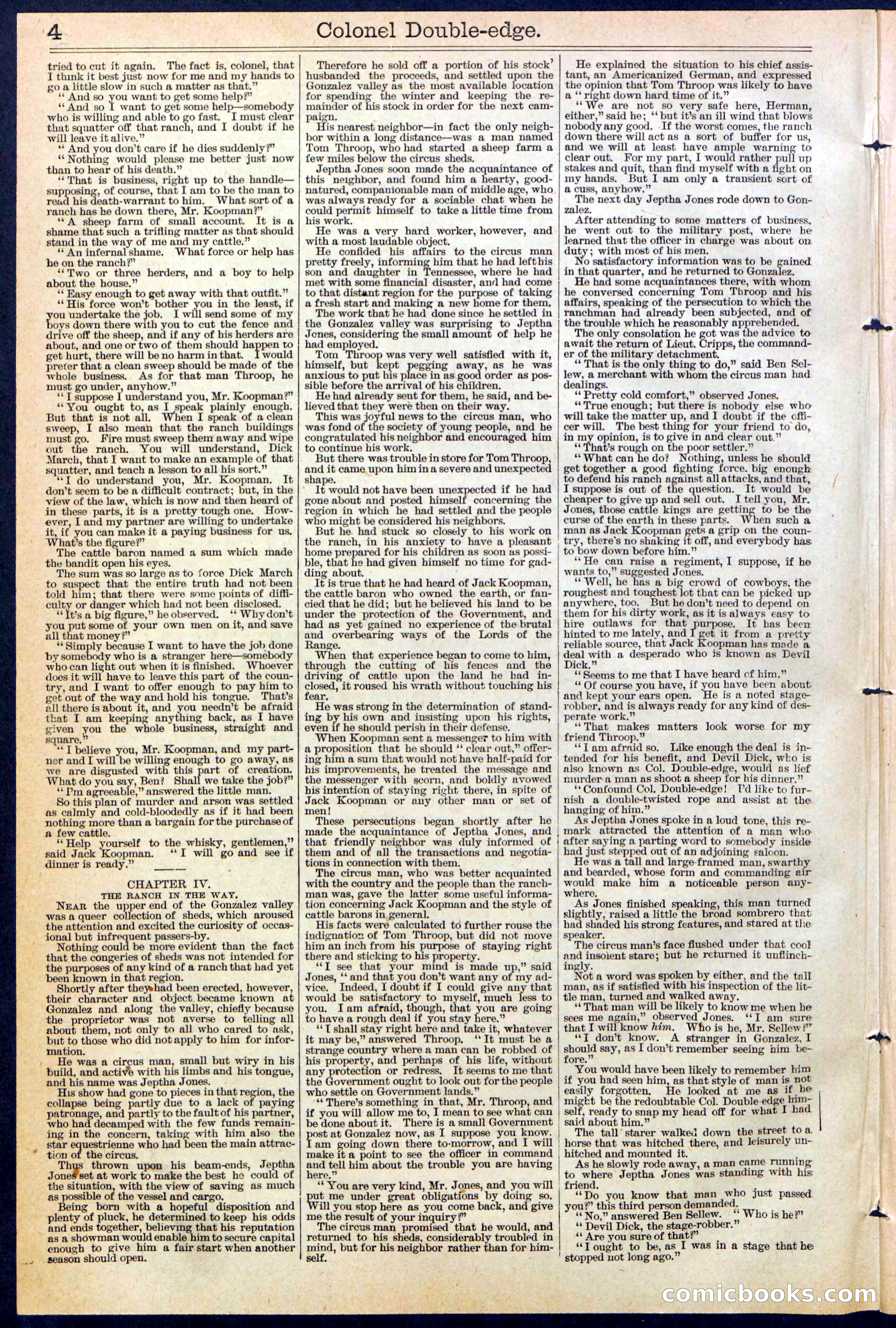
A restored page from Pulp Fiction, 1886. Page through the whole issue in the reader above.
📄 Transcribed text from this page (OCR, searchable)
Machine-transcribed from the original scan — historical spelling and the odd misread are preserved.
tried to cut it again. The fact is, colonel, that I think it best just now for me and my hands to go a little slow in such a matter as that.” ‘* And so you want to get some help?” ‘‘ And so [ want to get some help—somebody who is willing and able to go fast. I must clear that squatter off that ranch, and I doubt if he will leave it alive.” ‘“ And you don’t care if he dies suddenly?” ‘* Nothing would please me better just now than to hear of his death.” ‘‘That is business, right up to the handle— supposing, of course, that I am to be the man to read his death-warrant to him. What sort of a ranch has he down there, Mr. Koopman?” **A sheep farm of small account. It is a shame that such a trifling matter as that should stand in the way of me and my cattle.” “An infernal shame. What force or help has he on the ranch?” ‘‘Two or three herders, and a boy to help about the house.” ‘* Rasy enough to get away with that outfit.” ‘His force won’t bother you in the least, if ou undertake the job. I will send some of my oys down there with you to cut the fence and drive off the sheep, and if any of his herders are about, and one or two of them should ig oe to get hurt, there will be no harm inthat. I would prefer that a clean sweep should be made of the whole business. As for that man Throop, he must go under, anyhow.” ‘**T suppose I understand you, Mr. Koopman?” “You ought to, as I speak plainly enough. But that is not all. hen I speak of a clean sweep, I also mean that the ranch buildings must go. Fire must sweep them away and wipe out the ranch. You will understand, Dick March, that I want to make an example of that squatter, and teach a lesson to all his sort.” ‘“‘T do understand you, Mr. Koopman. It don’t seem to be a difficult contract; but, in the view of the law, which is now and then heard of in these parts, it is a pretty tough one. How- ever, I and my partner are willing to undertake it, if you can make it a paying business for us. What’s the figure?” The cattle baron named a sum which made the bandit open his eyes. The sum was so large as to force Dick March to suspect that the entire truth had not been told him; that there were some points of diffi- culty or danger which had not been disclosed. “Ts a big figure,” he observed. ‘* Why don’t you a some of your own men on it, and save all that money?” ‘¢ Simply because I want to have the joh done by somebody who is a stranger here—some | who can light out when it is finished. Whoever does it will have to leave this part of the coun- try, and I want to offer enough to pay him to get out of the way and hold his tongue, That’s all there is about it, and you needn’t be afraid that I am keeping anything back, as I have given you the whole business, straight and re,” ‘*T believe you, Mr. Koopman, and my part- . ner and I will be willing enough to go away, as . we are disgusted with this part of creation. What do you say, Ben? Shall we take the job?” Pn iieeskie” answered the little man. So this plan of murder and arson was settled as calmly and cold-bloodedly as if it had been nothing more than a bargain for the purchase of a few cattle. “Help yourself to the whisky, gentlemen,” said Jack Koopman. ‘“I will go and see if _dinneris ready.” —_ i? CHAPTER IV. THE RANCH IN THE WAY. Near the al end of the Gonzalez valley was a queer collection of sheds, which aroused the attention and excited the curiosity of occas- ional but infrequent passers-by. ’ Nothing could be more evident than the fact that the congeries of sheds was not intended for _ the p of any kind of a ranch that had yet been known in that region. Shortly after theyehad been erected, however, their character and object became known at 4 Gonzalez and along the valley, chiefly because | the proprietor was not averse to telling all about them, not only to all who cared to ask, but to those who did notapply to him for infor- mation. He was a circus man, small but wiry in his build, and active with his limbs and his tongue, and his name was Jeptha Jones. - His show had gone to pieces in that region, the : collapse being partly due to a lack of paying r patronage, and partly to the fault of his partner, who had decamped with the few funds remain- ing in the concern, taking with him also the ' tion € ‘ yee ee who had been the main attrac- of the circus. Thus thrown upon his beam-ends, Jeptha | Jones'set at work to make the best he could of the situation, with the view of saving as much ve ble of the vessel and cargo ing born with a hopeful disposition and __ plenty of pluck, he determined to keep his odds _ and ends together, belie that his reputation as a showman would enable to secure capital enough to give him a fair start when another /.. season should open. is * “< nt rh shape. ' It would not have been unexpected if he had Colonel Double-edge. He explained the situation to his chief assis- tant, an Americanized German, and expressed the opinion that Tom Throop was likely to have a ‘‘ right down hard time of it.” ‘We are not so very safe here, Herman, either,” said he; ‘‘ but it’s an ill wind that blows nobody any good. -If the worst comes, the ranch down there will act as a sort of buffer for us, and we will at least have ample warning to clear out. For my part, I woilt rather pull up stakes and quit, than find myself with a fight on my hands. But I am only a transient sort of a cuss, anyhow.” — next day Jeptha Jones rode down to Gon- zalez. After attending to some matters of business, he went out to the military post, where he learned that the officer in charge was about om ony with most of his men, o satisfactory information was to be gained in that quarter, and he returned to Gonzalez. He had some acquaintances there, with whom he conversed concerning Tom Throop and his affairs, speaking of the persecution to which the ranchman had already been subjected, and of the trouble which he reasonably apprehended, The only consolation he got was the advice to await the return of Lieut. Cripps, the command- er of the military detachment. ‘** That is the only thing to do,” said Ben Sel- lew, a merchant with whom the circus man had dealings. ‘* Pretty cold comfort,” observed Jones. “True enough; but there is nobody else who will take the matter up, and I doubt if the offi- cer will. The best thing for your friend to do, in my opinion, is to give in and clear out.” ‘* That’s rough on the poor settler.” ‘What can he do? Nothing, unless he should get together a good fighting force. big enough to defend his ranch against all attacks, and that, I suppose is out of the question. It would be cheaper to give up and sell out. I tell you, Mr. Jones, those cattle kings are getting to be the curse of the earth in these parts. When such a man as Jack Koopman gets a grip on the coun- _ try, there’s no shaking it off, and everybody has | to bow down before him.” ‘‘He can raise a regiment, I suppose, if he wants to,” suggested Jones. “Well, he has a big crowd of cowboys, the roughest and toughest lot that can be picked up anywhere, too, But he don’t need to depend on _ them for his dirty work, as it is always easy to | hire outlaws for that purpose. It has been | hinted to me lately, and get it from a pretty reliable source, that Jack Koopman has made a deal with a desperado who is known as Devil Dick.” ‘‘Seems to me that I have heard of him.” ‘* Of course you have, if you have been about and kept your ears open. e is a noted stage- robber, and is always ready for any kind of des- perate work.” ‘‘That makes matters look worse for my friend Throop.” ‘*Tam afraid so. Like enough the deal is in- tended for his benefit, and Devil Dick, who is _also known as Col. Double-edge, would as lief murder a man as shoot a sheep for his dinner,” ‘*Confound Col, Double-edge! Td like to fur- nish a double-twisted rope and assist at the hanging of him.” As Jeptha Jones spoke in a loud tone, this re- mark attracted the attention of a man who after saying a parting word to somebody inside had just stepped out of an adjoining saloon. He was a tall and large framed man, swarth and bearded, whose form and commanding air would make him a noticeable person any- where, As Jones finished speaking, this man turned slightly, raised a little the broad sombrero that had shaded his strong features, and stared at the speaker. The circus man’s face flushed under that cool em insolent stare; but he returned it unflinch- ingly. Not a word was spoken by either, and the tall man, as if satisfied with his inspection of the lit- Therefore he sold off a portion of his stock’ husbanded the proceeds, and settled upon the Gonzalez valley as the most available location for spending the winter and keeping the re- mainder of his stock in order for the next cam- paign. His nearest: neighbor—in fact the only neigh- bor within a long distance—was a man named Tom Throop, who had started a sheep farm a few miles below the circus sheds. Jeptha Jones soon made the acquaintance of this neighbor, and found him a hearty, good- natured, companionable man of middle age, who was always ready for a sociable chat when he could permit himself to take a little time from his work. He was a very hard worker, however, and with a most laudable object. He confided his affairs to the circus man pretty freely, informing him that he had left his son and daughter in Tennessee, where he had met with some financial disaster, and had come to that distant region for the purpose of taking a fresh start and making a new home for them, The work that he had done since he settled in the Gonzalez valley was surprising to Jeptha Jones, considering the small amount of help he had employed. Tom Throop was very well satisfied with it, himself, but kept pegging away, as he was anxious to put his place in as g order as pos- sible before the arrival of his children. He had already sent for them, he said, and be- lieved that they were then on their way. This was joyful news to the circus man, who was fond of the society of young people, and he congratulated his neighbor and encouraged him to continue his work. But there was trouble in store for Tom Throop and it came upon him ina severe and unexpected gone about and pos himself concerning the region in which he had settled and the people who might be considered his neighbors. But he had stuck so closely to his work on the ranch, in his anxiety to have a pleasant home Le for his children as soon as possi- ble, that he had given himself no time for gad- ding about. It is true that he had heard of Jack Koopman, the cattle baron who owned the earth, or fan- cied that he did; but he believed his land to be under the protection of the Government, and had as yet gained no experience of the brutal and overbearing ways of the Lords of the nge. When that experience began to come to him, through the cutting of his fences and the driving of cattle upon the land he kad in- closed, it roused his wrath without touching his ear, He was strong in the determination of stand- | ing by his own and insisting upon his rights, even if he should perish in their defense. When Koopman sent a messenger to him with a proposition that he should * clear out,” offer- ing him a sum that would not have half-paid for his improvements, he treated the message and the messenger with scorn, and boldly avowed his intention of staying right there, in spite of Jack Koopman or any other man or set of men! These persecutions began shortly after he made the acquaintance of Jeptha Jones, and that friendly neighbor was duly informed of them and of all the transactions and negotia- tions in connection with them. The circus man, who was better acquainted with the country and the people than the ranch- man was, gave the latter some useful informa- tion concerning Jack Koopman and the style of cattle barons in general. His facts were calculated to further rouse the indignation of Tom Throop, but did not move him an inch from his purpose of staying right there and sticking to his property. ‘*T see that your mind is made up,” said Jones, ‘‘ and that you don’t want any of my ad- vice. Indeed, I doubt if I could give any that would be satisfactory to aye much less to | tle man, turned and walked away, you. Iam afraid, though, that you are going ‘‘That man will be likely to know me when he sees me again,” observed Jones, ‘‘I am sure that I will know him. Who is he, Mr. Sellew?’” ‘“T don’t know. A stranger in Gonzalez, I aap say, as I don’t remember seeing him ore. You would have been likely to remember him if you had seen him, as that style of man is not easily forgotten, e looked at me as if he migkt be the redoubtable Col. Double-edge bim~ self, ready to snap my head off for what I had said about him.” The tall starer walked down the street toa, horse that was hitched there, and leisurely un- hitched and mounted it. é As he slowly rode away, a man came running to have a rough deal if you stay here.” ‘*T shall stay right here and take it, whatever it may be,” answered Throop, ‘It must be a strange country where a man can be robbed of his property, and perhaps of his life, without any protection or redress. It seems to me that the Government ought to look out for the people who settle on Government lands.” ‘‘ There’s something in that, Mr. Throop, and if you will allow me to, I mean to see what can be done about it. There is a small Government 0st at Gonzalez now, as I suppose you know. am going down there to-morrow, and I will make it a point to see the officer in command | (2 na ~ and tell him about the trouble you are having here.” /to where Jeptha Jones was standing with his ** You are very kind, Mr. Ys and you will | friend. . ons by doing so. | ‘Do you know that man who just passed oy me under great obliga ill you stop here as you come back, and give | you?” this third person demanded, me the result of your inquiry?” ‘‘No,” answered Ben Sellew. 39 Who is he?” The circus man promised that he would, and ‘ Devil Dick, the stage-robber. returned to his sheds, considerably troubled in ‘‘ Are you sure of that?” mind, but for his neighbor rather than for him- “T ought to be, as I was in a stage that he if. . stopped not long ago.” m (G Baht ene leet eo 200 | i | | '