
Pulp Fiction, 1886 · page 16 of 32
Beadle's New York Dime Library No. 389 — page 16: what you’re looking at
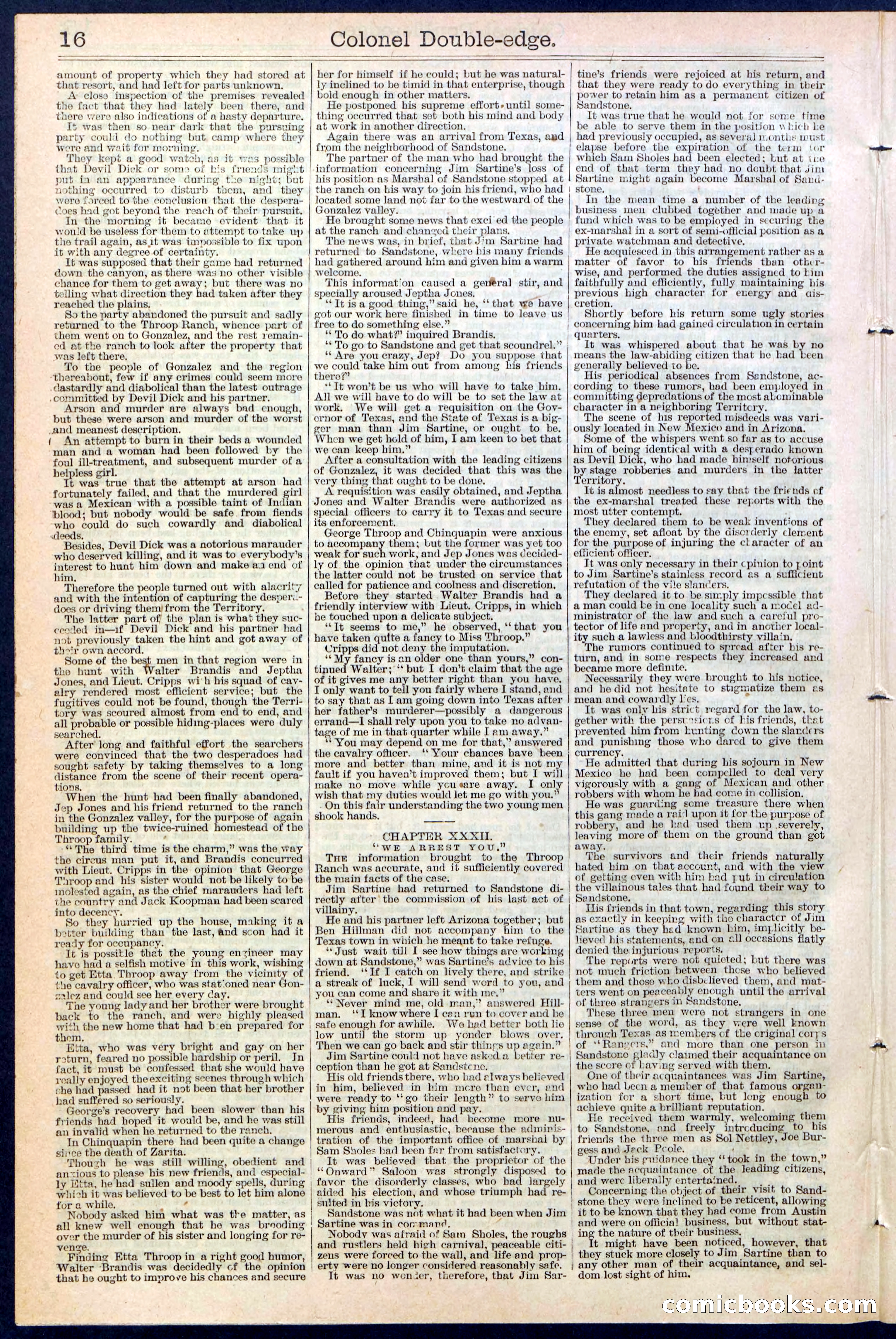
A restored page from Pulp Fiction, 1886. Page through the whole issue in the reader above.
📄 Transcribed text from this page (OCR, searchable)
Machine-transcribed from the original scan — historical spelling and the odd misread are preserved.
16 amount of property which they had stored at that resort, and had left for parts unknown. A close inspection of the premises revealed the fact that they had lately been there, and there were also indications of a hasty departure, f was then so near dark that the pursuing party could do nothing but. camp where they were and weit for morning. They kept a good watch, as it wes possible that Devil Dick or some of bis frends might put in an appearance during the night; but nothing occurred to disturb tboem, and they were forced to the conclusion that the Cespera- Coes had got beyond the reach of their pursuit, In the morning it became evident that it would be useless for them to ettempt to take up the trail again, asit was impossible to fix upon it with any degree of certainty. It was supposed that their gnme had returned down the canyon, as there was no other visible chance for them to get away; but there was no telling what direction they had taken after they reached the plains. So the party abandoned the pursuit and sadly returned to the Throop Ranch, whence part of them went on to Gonzalez, and the rest 1emain- ed at the ranch to look after the property that was left there. To the people of Gonzalez and the region ‘thereabout, few if any crimes could seem more dastardly and diabolical than the latest outrage .committed by Devil Dick and his partner. Arson and murder are always bad cnough, but these were arson and murder of the worst and meanest description. ( An attempt to burnin their beds a wounded man and a woman had been followed by the foul ill-treatment, and subsequent murder of a helpless girl. It was true that the attempt at arson had fortunately failed, and that the murdered girl was a Mexican with a possible taint of Indian blood; but nobody would be safe from fiends who could do such cowardly and diabolical «leeds. : Besides, Devil Dick was a notorious marauder who deserved killing, and it was to everybody’s interest to hunt him down and make aa end of him. Therefore the people turned out with alacrity and with the intention of ot 8 ioe 3 the desperi.- does or driving them/from the Territory. The latter part of the plan is what they suc- ceoted in—if Devil Dick and his partner had not previously taken the hint and got away of ther own accord. Some of the peg men in that region were in the hunt with alter Brandis and Jeptha Jones, and Lieut. Cripps wi'h his squad of cay- alry rendered most efficient service; but the fugitives could not be found, though the Terri- tory was scoured almost from end to end, and all probable or possible hiding-places were duly searched. After long and faithful effort the searchers were convinced that the two desperadoes had sought safety by taking themselves to a long distance from the scene of their recent opera- tions. When the hunt had been finally abandoned, Jep Jones and his friend returned to the ranch in the Gonzalez valley, for the purpose of again building up the twice-ruined homestead of the Throop family. a **The third time is the charm,” was the way the cireus man put it, and Brandis concurred with Lieut. Cripps in the opinion that George Throop and his sister would not be likely to be molested again, as the chief niarauders had left the country and Jack Koopman had been scared into decency. So they hurried up the house, rete | it a better building than the last, and scon had it ready for occupancy. It is possitle that the young enzineer may have had a selfish motive in this work, wishing to get Etta Throop away from the vicinity of the cavalry officer, who was stat‘oned near Gon- s2lez and could see her every Cay. The young lady and her brother were brought back to the ranch, and wero highly pleased with the new home that had b-en prepared for them, Etta, who was very bright and gay on her roturn, feared no possible hardship or peril. In fact, it must be confessed that she would have really enjoyed theexciting scenes through which che had passed had it not been that her brother had suffered so seriously. George’s recovery had been slower than his friends had hoped it would be, and he was still an invalid when he returned to the ranch. In Chinquapin there had been quite a change since the death of Zarita. Thouzh he was_ still willing, obedient and an-ious to please his new friends, and especial- ly Etta, he had sullen and moody spells, during which it was believed to be best to let him alone for a while, gllirbe.. Nobody asked him what was tre matter, as all knew well enough that he was _ brooding over the murder of his sister and longing for re- venze. Finding Etta Throop in a right good humor, Walter ‘Brandis was decidedly cf the opinion that he ought to improve his chances and secure a a tng Sat | Colonel Double-edge. her for himself if he could; but he was natural- ly inclined to be timid in that enterprise, though bold enough in other matters. He postponed his supreme efforts until some- thing occurred that set both his mind and body at work in another direction. Again there was an arrival from Texas, and from the neighborhood of Sandstone. The partner of the man who had brought the information concerning Jim Sartine’s loss of his position as Marshal of Sandstone stopped at the ranch on kis way to join his friend, who had located some land not far to the westward of the Gonzalez valley. He brought some news that exci ed the people at the ranch and chanzed their plans. The news was, in bricf, that J'm Sartine had returned to Sandstone, where his many friends had gathered around him and given him a warm welcome. This informat'on caused a geré@ral stir, and specially aroused Jeptha Jones. ‘It isa good thing,” said he, ‘‘ that we bave got our work here finished in time to leave us free to do something else.” ** To do what?” inquired Brandis. ‘* To go to Sandstone and get that scoundrel.” ** Are you crazy, Jep? Do you suppose that we could take him out from among his friends there?” **Tt won’t be us who will have to take him. All we will have to do will be to set the law at work. We will get a requisition on the Goy- ornor of Texas, and the State of Texas is a big- ger man than Jim Sartine, or ought to be. When we get hold of him, I am keen to bet that we can keep bim.” After a consultation with the leading citizens of Gonzalez, it was decided that this was the very thing that ought to be done. A requisition was easily obtained, and Jeptha Jones and Walter Brandis were authorized as special officers to carry it to Texas and secure its enforcement. George Throop and Chinquapin were anxious to accompany them; but the former was yet too weak for such work, and Jep Jones was Cecided- ly of the opinion that under the circumstances the latter could not be trusted on service that called for patience and coolness and discretion, Before they started Walter Brandis had a friendly interview with Lieut. Cripps, in which he touched upon a delicate subject. ‘‘Tt seems to me,” he observed, ‘‘ that you have taken quite a nett to Miss Throop.” Cripps did not deny the imputation, “ fancy is an older one than yours,” con- dininelt Walter; ‘‘ but I don’t claim that the age of it gives me any better right than you have, I only want to tell you fairly where I stand, and to say that as I am going down into Texas after her father’s murderer—possibly a dangerous errand—lI shall rely upon you to take no advan- tage of me in that quarter while I am away.” ‘* You may depend on me for that,’ answered the cavalry ofticer. ‘‘ Your chances have been more and better than mine, and it is not my fault if you haven’t improved them; but I will make no move while youeare away. I only wish that my duties would let me go with you.’ .On this fair understanding the two young men shook hands. iets © CHAPTER XXXII, “WE ARREST YOU.” Tue information brought to the Throop Ranch was accurate, and it sufficiently covered the main facts of the case, Jim Sartine had returned to Sandstone di- rectly after the commission of his last act of villainy. He and his partner left Arizona together; but Ben Hillman did not accompany him to the Texas town in which he meant to take refuge. * Just wait till I see how things are working down at Sandstone,” was Sartine’s acvice to his friend. ‘If I catch on lively there, and strike a streak of luck, I will send word to you, and you can come and share it with me,” ‘‘ Never mind me, old man,’ answered Hill- man. ‘I know where [ can run to cover and be safe enough for awhile. We had better both lie low unti] the storm up yonder blows over. Then we can go back and stir things up agein.” Jim Sartine could not have asked. a better re- ception than he got at Sandstcne. His old friends there, who had elways believed in him, believed in him mere than ever, and were ready to ‘*‘go their length” to serve him by giving him position and pay. His friends, indeed, had hecome more nu- merous and enthusiastic, hecause the adminris- tration of the important office of marshal by Sam Sholes had been far from satisfactory. It was believed that the proprietor of the ‘“‘Onward” Saloon was strongly disposed to favor the disorderly classes, who had largely aided his election, and whose triumph had re- snited in kis victory. Sandstone was not what it had been when Jim Sartine was in command, f Nobody was afraid of Sam Sholes, the roughs and rustlers held high carnival, peaceable citi- zeus were forced to the wall, and life and prop- erty were no longer considered reasonably safe. It was no wonder, therefore, that Jim Sar- URE OE a ae ee ee ee ee ee ee a cnt a LACIE A EL —— _ a ee tine’s friends were rejoiced at his return, and that they were ready to do everything in their power to retain him as a permanent citizen of Sandstone. It was true that he would not for some time be able to serve them in the position which he had previously occupied, as several months wust elapse before the expiration of the term tor which Sam Sholes bad been elected; but at ive end of that term they had no doubt that Jim Sartine might again become Marshal of Sand- stone, In the mean time a number of the leading business men clubbed together and made up a fund which was to be employed in securing the ex-marshal in a sort of semi-official position as a private watchman and detective, He acquiesced in this arrangement rather as a matter of favor to his friends than othcr- wise, and performed the duties assigned to him faithfully and efficiently, fully maintaining his previous high character for energy and ais- cretion, Shortly before his return some ugly stories concerning him had gained circulation in certain quarters, It was whispered about that he was b means the law-abiding citizen that he bad generally believed to be. His periodical absences from Sandstone, ac- cording to these rumors, had been employed in committing depredations of the most abominable character in a neighboring Territcry. The scene of his reported misdeeds was vari- ously located in New Mexico and in Arizona. Some of the whispers went so far as to accuse him of being identical with a desperado known as Devil Dick, who had made himself notorious by stage robberies and murders in the latter Territory. It is A Soa needless to say that the friends of the ex-marshal treated these reports with the most utter contempt. They declared them to be weak inventions of the enemy, set afloat by the disorderly clement for the purpose of injuring the claracter of an efficient officer. It was only necessary in their cpinion to , oint to Jim Sartine’s stainless record as a sufficient refutation of the vile slancers. They declared it to be simply impcssible that a man could be in one locality such a mocel ad- ministrator of the law and such a careful pro- tector of life and property, and in another local- ity such a lawless and bloodthirsty villain. The rumors continued to spread after his re- turn, and in some respects they increased and became more definite. Necessarily they were brought to his notice, and he did not hesitate to stigmatize them es mean and cowardly les. , It was onlv his strict regard for the law, to- gether with the perst:sicrs of his friends, that prevented him from kunting down the slanders and punishing those who dared to give them currency. He admitted that during his sojourn in New Mexico he had been compelled to deal very vigorously with a gang of Mexican and other robbers with whom he had come in collision, He was guarding some treasure there when this gang made a rail upon it for the purpose of robbery, and he ked used them up severely, leaving more of them on the ground than got away. The survivors and their friends naturally hated him on that account, and with the view of getting even with him had put in circulation the villainous tales that had found tkeir way to Sendstone, Ilis friends in that town, regarding this story as exactly in keepirg with tho charactcr of Jim Sartine as they hed known kim, implicitly be- lieved his statements, end on cll occasions flatly denied the injurious reports. The reports were not quicted; but there was not much friction between these who believed them and those who disbelieved them, and mat- ters went on peaceably enough until the arrival of three strangers in Sandstone. These three men were not strangers in one sense of the word, as they were well known through Texas as members of the original corys of ‘‘Ranvers,” and more than one person in Sandstono gladly claimed their acquaintance on the score of having served with them. One of their acquaintances was Jim Sartine, who had becn a member of that famous orgen- ization for a short time, but long enough to achieve quite a brilliant reputation. He received them warmly, welcoming them to Sandstone. and freely intreducing to_ his friends the three men as Sol Nettley, Joe Bur- gess and Jeck Pcole. ‘ Under his puidance they “took in the town,” made the acquaintance of the leading citizens, and werc liberally entertained. ¥ Concerning the object of their visit to Sand- stone they were inclined to be reticent, allowing it to be known that they had come from Austin and were on official business, but without stat- ing the nature of their business, It might have been noticed, however, that they stuck more closely to Jim Sartine than to any other man of their acquaintance, and sel- dom lost sight of him, ho cen tr Aa eom (E ,OO cS (e (0)