
Pulp Fiction, 1886 · page 14 of 32
Beadle's New York Dime Library No. 389 — page 14: what you’re looking at
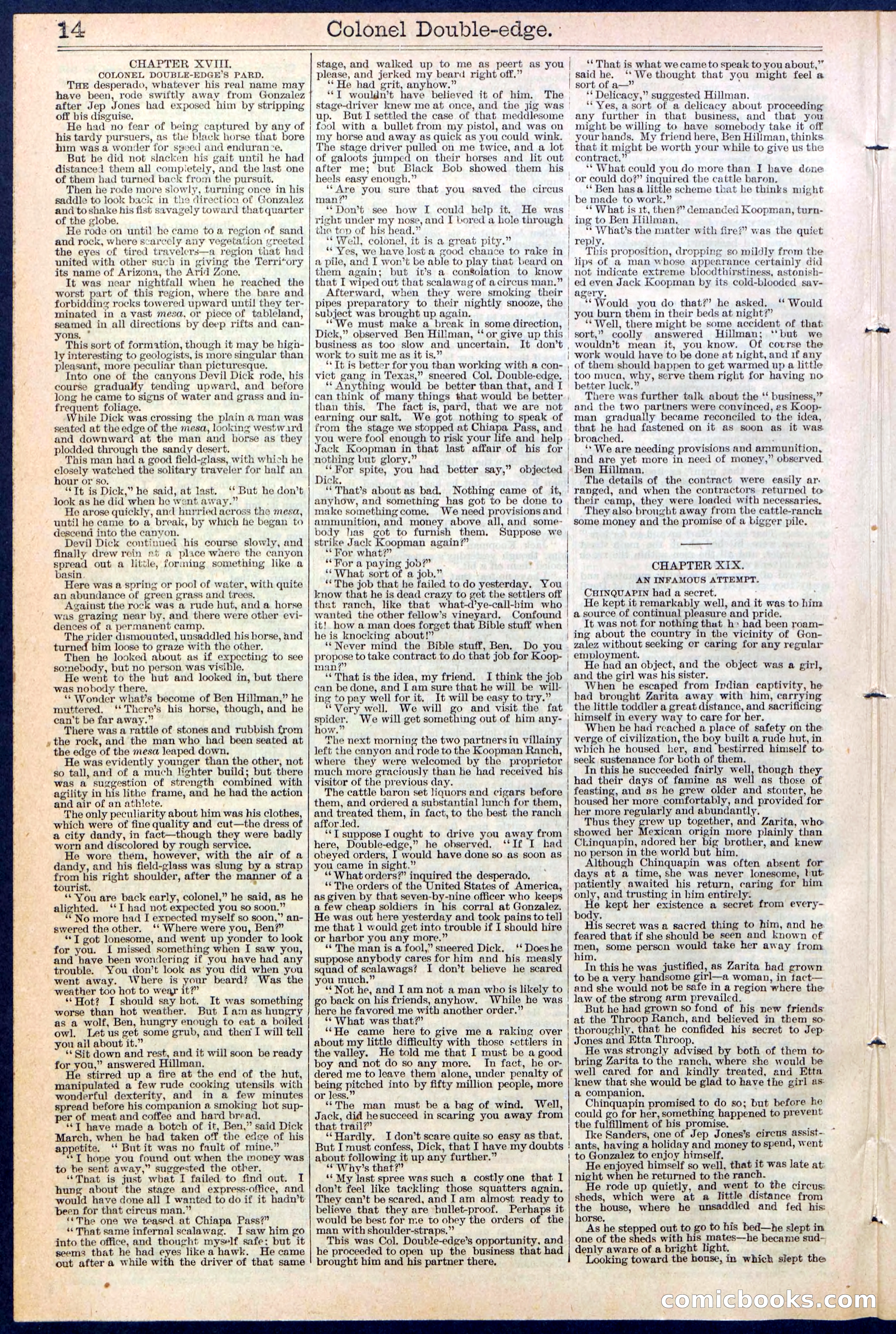
A restored page from Pulp Fiction, 1886. Page through the whole issue in the reader above.
📄 Transcribed text from this page (OCR, searchable)
Machine-transcribed from the original scan — historical spelling and the odd misread are preserved.
14 CHAPTER XVIII, COLONEL DOUBLE-EDGE’S PARD. Tue desperado, whatever his real name may have been, rode swiftly away from Gonzalez after Jep Jones had exposed him by stripping off his disguise. He had no fear of being captured by any of his tardy pursuers, as the black horse that bore him was a wonder for speed and enduran:e. But he did not slacken his gait until he had distanced them all compietely, and the last one of them had turned back from the pursuit. Then he rode more slowly, turning once in his saddle to look bacix in the direction of Gonzalez and to shake his fist savagely toward that quarter of the globe. He rode on until he came toa region of sand and rock, where scarcely any vegetation greeted the eyes of tired travelcrs—a region that had united with other such in giving the Terri*ory its name of Arizona, the Arid Zone. It was near nightfall when he reached the worst part of this region, where the bare and forbidding rocks towered upward until they ter- minated in a vast mesa, or piece of tableland, seamed in all directions by deep rifts and can- ons. This sort of formation, though it may be high- ly interesting to geologists, is more singular than pleasant, more peculiar than picturesque. Into one of the canyons Devil Dick rode, his course graduaMy tending upward, and before long he came to signs of water and grass and in- frequent foliage. hile Dick was crossing the plain a man was seated at the edge of the mesa, looking westward and downward at the man and horse as they plodded through the sandy desert, This man had a good field-glass, with which he closely watched the solitary traveler for half an hour or so. “Tt is Dick,” he said, at last. ‘‘ But he don’t look as he did when he went away.” He arose quickly, and hurried across the mesa, until he came to a break, by which he began to descend into the canyon. Devil Dick continued his course slowly, and finally drew rein »t a place waere the canyon spread out a little, forming something like a basin. Here was a spring or pool of water, with quite an abundance of green grass and trees. Agaiust the rock was a rude hut, and a horse was grazing near by, and there were other evi- dences of a permanent camp. The rider dismounted, unsaddled his horse, and turned him loose to graze with the other. Then he looked about as if expecting to see somebody, but no person was visible. He went to the hut and looked in, but there was nobody there. ‘‘ Wonder what’s become of Ben Hillman,” he muttered. ‘*There’s his horse, though, and he can't be far away.” There was a rattle of stones and rubbish from » the rock, and the man who had been seated at the edge of the mesa leaped down, He was evidently younger than the other, not so tall, and of a much lighter build; but there was a suggestion of strength combined with agility in his lithe frame, and he had the action and air of an athlete. The only peculiarity about him was his clothes, which were of fine quality and cut—the dress of a city dandy, in fact—though they were badly worn and discolored by rough service. He wore them, however, with the air of a dandy, and his field-glass was slung by a strap from his right shoulder, after the manner of a tourist. ‘“You are back early, colonel,” he said, as he alighted. ‘‘I had not expected you so soon.” “No more had I expected myself so soon,” an- swered the other. ‘‘ Where were you, Ben?” **T got lonesome, and went up yonder to look for you. I missed something when I saw you, and have been wondering if you have had any trouble. You don’t look as you did when you went away. Where is your beard? Was the weather too hot to wear it?” ‘‘ Hot? I should say hot. It was something worse than hot weather. But I am as hungry as a wolf, Ben, hungry enough to eat a boiled owl. Let us get some grub, and then I will tell you ail about it.” ; ‘¢ Sit down and rest, and it will soon be ready for you,” answered Hillman, He stirred up a fire at the end of the hut, manipulated a few rude cooking utensils with wonderful dexterity, and in a few minutes spread before his companion a smoking hot sup- per of meat and coffee and hard bread. ‘‘T have made a botch of it, Ben,” said Dick March, when he had taken off the edge of his appetite. ‘ But it was no fault of mine.” “‘T hope you found out when the money was to he sent away,” suggested the other. “That is just what I failed to find out. I hung about the stage and express-office, and would have done all I wanted to do if it hadn’t been for that circus man.” , “The one we teased at Chiapa Pass?” “That same infernal scalawag. I saw him go into the office, and thought myself safe: but it seems that he had eyes likea hawk. He came out after a while with the driver of that same stage, and walked up to me as peert as you | please, and jerked my beard right off.” ‘He had grit, anyhow.” ‘*T wouldn’t have believed it of him. The stage-driver knew me at once, and the jig was | up. But I settled the case of that meddlesome fool with a bullet from my pistol, and was on my horse and away as quick as you could wink. The stage driver pulled on me twice, and a lot of galoots jumped on their horses and lit out after me; but Black Bob showed them his heels easy enough.” ‘‘Are you sure that you saved the circus man?” ‘*Don’t see how I could help it. He was right under my nose, and I bored a hole through the top of his head,” | | ‘* Weil, colonel, it is a great pity.” ** Yes, we have lost a good chance to rake in | a pile, and I won’t be able to play that beard on them again; but it’s a con8olation to know that I wiped out that scalawag of a circus man.” Afterward, when they were smoking their | pipes preparatory to their nightly snooze, the | subject was brought up again. | ‘*We must make a break in some direction, | Dick,” observed Ben Hillman, ‘‘ or give up this business as too slow and uncertain, It don’t work to suit me as it is,” ‘‘ Tt is better for you than working with a con- vict gang in Texas,” sneered Col. Double-edge. ‘* Anything would be better than that, and I can think of many things that would be better, than this. The fact is, pard, that we are not earning our salt. We got nothing to speak of from the stage we stopped at Chiapa Pass, and you were fool enough to risk your life and help Jack Koopman in that last affair of his for nothing but glory.” wee ee spite, you had better say,” objected | ick, “That’s about as bad, Nothing came of it, anyhow, and something has got to be done to make something come. We need provisions and ammunition, and money above all, and some- body has got to furnish them, Suppose we strike Jack Koopman again?” ‘* For what?” ‘Wor a paying job?” ’ ‘“ What sort of a job.” ‘*The job that he failed to do yesterday. You know that he is dead crazy to get the settlers off that ranch, like that what-d’ye-call-bim who wanted the other fellow’s vineyard. Confound it! how a man does forget that Bible stuff when he is knocking about!” ‘‘ Never mind the Bible stuff, Ben. Do you propose to take contract to do that job for Koop- man?’ ‘‘ That is the idea, my friend. I think the job can be done, and I am sure that he will be will- ing to pay well for it, It will be easy to try.” “Very well. We will go and visit the fat spider. We will get something out of him any- how.” The next morning the two partnersin villainy left the canyon and rode to the Koopman Ranch, where they were welcomed by the proprietor much more graciously than he had received his visitor of the previous day. | The cattle baron set liquors and cigars before them, and ordered a substantial Junch for them, and treated them, in fact, to the best the ranch affor led. ‘*T suppose I ought to drive you away from here, Double-edge,” he observed, ‘‘If I had obeyed orders, I would have done so as soon as you came in sight.” ‘* What orders?” inquired the desperado. ‘* The orders of the United States of America, | as given by that seven-by-nine officer who keeps a few cheap soldiers in his corral at Gonzalez. He was out here yesterday and took pains to tell | me that 1 would get into trouble if I should hire or harbor you any more.” ‘¢ The man is a fool,” sneered Dick. ‘‘ Doeshe suppose anybody cares for him and his measly squad of scalawags? I don’t believe he scared you much,” : ‘Not he, and Iam not a man who is likely to 0 back on his friends, anyhow. While he was bere he favored me with another order.” ‘What was that?” ‘“‘He came here to give me a raking over about my little difficulty with those settlers in the valley. He told me that I must be a good boy and not do so any more. In fact, he or- dered me to leave them alone, under penalty of being pitched into by fifty million people, more or less.” ‘“The man must be a bag of wind, Well, Jack, did hesucceed in scaring you away from that trail?” ‘“Hardly. I don’t scare quite so easy as that. | But I must confess, Dick, that I have my doubts ' about following it up any further.” | “'Why’s that?” ‘‘ My last spree was such a costly one that I don’t feel like tackling those A anor again, They can’t be scared, and I am almost ready to believe that they are bullet-proof. Perhaps it would be best for me to obey the orders of the man with shoulder-straps.” This was Col. Double-edge’s opportunity, and he proceeded to open up the business that had brought him and his partner there, ‘*That is what we came to speak to you about,” said he. ‘* We thought that you might feel a sort of a—” : ‘* Delicacy,” suggested Hillman. ‘**Yes, a sort of a delicacy about proceeding any further in that business, and that you might be willing to have somebody take it off your hands, My friend here, Ben Hillman, thinks that it might be worth your while to give us the contract.” ‘* What could you do more than I have done or could do?” inquired the cattle baron. ‘* Ben has a little scheme that he thinks might be made to work.” ‘* What is 1t, then?” demanded Koopman, turn- ing to Ben Eillman, ‘* What's the matter with fire?’ was the quict reply. This proposition, dropping so mildly from the lips of a man whose appearance certainly did not indicate extreme bloodthirstiness, astonish- _ed even Jack Koopman by its cold-blooded sav- agery, ‘‘Would you do that?’ he asked. ‘ Would you burn them in their beds at night?” ‘* Well, there might be some accident of that sort,” coolly answered Hillman; ‘'but we wouldn’t mean it, you know. Of course the work would have to be done at night, and if any of them should bappen to get warmed up a little too muca, why, serve them right for having no better luck.” here was further talk about the ‘‘ business,” and the two partners were convinced, es Koop- man gradually became reconciled to the idea, that he had fastened on it as soon as it was broached. ‘* We are needing provisions and ammunition, and are yet more in need of money,” observed. Ben Hillman. The details of the contract were easily ar. ' ranged, and when the contractors returned to their camp, they were loaded with necessaries. They also brought away from the cattle-ranck some money and the promise of a bigger pile. CHAPTER XIX. AN INFAMOUS ATTEMPT. CHINQUAPIN had a secret. He kept it remarkably well, and it was to him a source of continual pleasure and pride. It was not for nothing that h» had been roam- ing about the country in the vicinity of Gon- zalez without seeking or caring for any regular employment. He had an object, and the object was a girl, and the girl was his sister. When he escaped from Indian captivity, he had brought Zarita away with him, carrying the little toddler a great distance, and sacrificing himself in every way to care for her. When he had reached a place of safety on the verge of civilization, the boy built a rude hut, in which he housed her, and bestirred himself to. seek sustenance for both of them. In this he succeeded fairly well, though they had their days of famine as well as those of feasting, and as he grew older and stouter, he housed her more comfortably, and provided for her more regularly and abundantly. Thus they grew up together, and Zarita, who showed her Mexican origin more plainly than ChLinquapin, adored her big brother, and knew no person in the world but him. Although Chinquapin was often absent for days at a time, she was never lonesome, but patiently awaited his return, caring for him only, and trusting in him entirely. i ae kept her existence a secret from every- ody, ; His secret was a sacred thing to him, and he feared that if she should be seen and known of a Ee some person would take her away from im. In this he was justified, as Zarita bad grown to be a very handsome girl—a woman, in tact— and she would not be safe in a region where the law of the strong arm prevailed. | But he had grown so fond of his new friends at the earaep Ranch, and believed in them so. thoroughly, that he confided his secret to Jep: Jones and Etta Throop. He was strongly advised by both of them to bring Zarita to the ranch, where she would be well cared for and kindly treated, and Etta knew that she would be glad to have the girl as: a companion, Chinquapin promised to do so; but before he could go for her, something happened to prevent the fulfillment of his promise. ; Ike Sanders, one of Jep Jones’s circus assist- ants, having a holiday and money to spend, went to Gonzalez to enjoy himself, : He enjoyed himself so well, that it was late at: night when he returned to the ranch. He rode up quietly, and_went to the circus: sheds, which were at a little distance from the house, where he unsaddled and fed his: orse, As he sapped out to go to his bed—he slept im one of the sheds with his mates—he became sud- denly aware of a bright light. Looking toward the house, in which slept the Gomilecboo (C <S) - im 7, Oo eae <e€om a =