
Pulp Fiction, 1886 · page 10 of 32
Beadle's New York Dime Library No. 389 — page 10: what you’re looking at
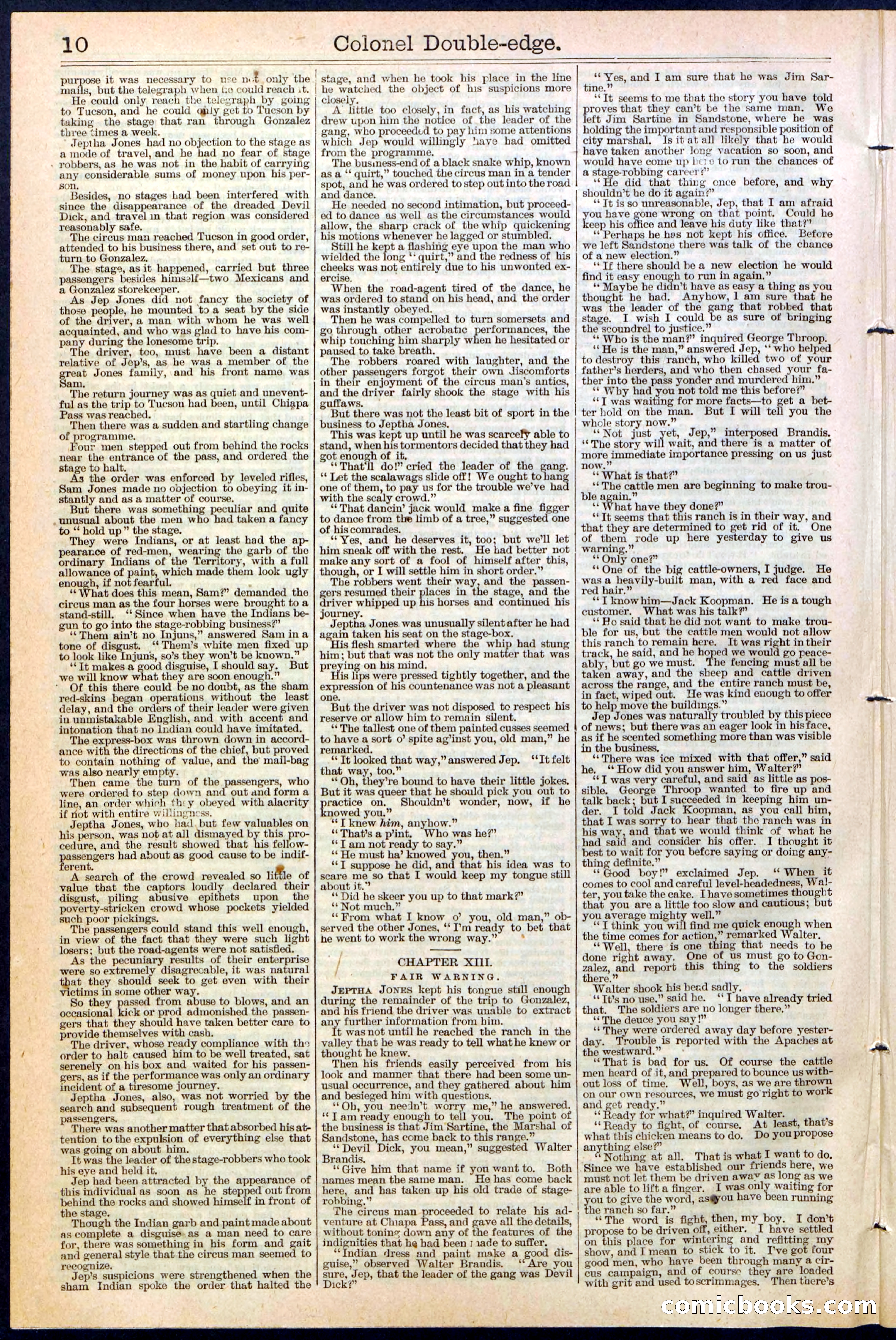
A restored page from Pulp Fiction, 1886. Page through the whole issue in the reader above.
📄 Transcribed text from this page (OCR, searchable)
Machine-transcribed from the original scan — historical spelling and the odd misread are preserved.
> 10 purpose it was necessary to use net only the mails, but the telegraph when lc could reach :t. He could only reach the telegraph by going to Tucson, and he could aply get to Tucson by tuking the stage that ran through Gonzalez three times a week. Jeptha Jones had no objection to the stage as a mode of travel, and he had no fear of stage . robbers, as he was not in the habit of carrying any considerable sums of money upon his per- son, Besides, no stages had been interfered with since the disappearance of the dreaded Devil Dick, and travel in that region was considered reasonably safe. The circus man reached Tucson in good order, attended to his business there, and set out to re- turn to Gonzalez. The stage, as it happened, carried but three passengers besides himself—two Mexicans and a Gonzalez storekeeper. As Jep Jones did not fancy the society of those people, he mounted to a seat by the side of the driver, a man with whom he was well acquainted, and who was glad to have his com- pany during the lonesome trip. The driver, teo, must have been a distant relative of Jep’s, as he was a member of the at Jones family, and his front name was m. The return journey was as quiet and unevent- ful as the trip to Tucson had been, until Chiapa Pass was reached, Then there was a sudden and startling change of programme. Four men stepped out from behind the rocks near the entrance of the pass, and ordered the stage to halt. As the order was enforced by leveled rifles, Sam Jones made no objection to obeying it in- stantly and as a matter of course, But there was something peculiar and quite unusual about the men who had taken a fancy to “hold up” the stage. They were Indians, or at least had the ap- pearance of red-men, wearing the garb of the ordinary Indians of the Territory, with a full allowance of paint, which made them look ugly enough, if not fearful. : ‘¢ What does this mean, Sam?’ demanded the circus man as the four horses were brought to a stand-still. ‘‘ Since when have the Indians be- gun to go into the stage-robbing business?” ‘‘Them ain’t no Injuns,” answered Sam ina tone of dis “‘Them’s white men fixed up to look like Injuns, so’s they won’t be known.” ‘Tt makes a good disguise, I should say. But we will know what they are soon enough.” Of this there could be no doubt, as the sham red-skins began operations without the least delay, and the orders of their leader were given in unmistakable English, and with accent and intonation that no Indian could have imitated. The express-box was thrown down in accord- ance with the directions of the chief, but proved to contain nothing of value, and the mail-bag was also nearly empty. Then came the turn of the passengers, who were ordered to step down and out and form a line, an order which th: y obeyed with alacrity if not with entire willingness. Jeptha Jones, who hal, but few valuables on his person, was not at all dismayed by this pro- cedure, and the result showed that his fellow- ssengers had about as good cause to be indif- erent. A search of the crowd revealed so 1iffle of value that the captors loudly declared their disgust, piling abusive epithets upon the poverty-stricken crowd whose pockets yielded such poor pickings. The passengers could stand this well enough, in view of the fact that they were such light losers; but the road-agents were not satisfied. As the pecuniary results of their enterprise were so extremely disagrecable, it was natural that they should seek to get even with their ctims in some other way. So they passed from abuse to blows, and an ional kick or prod admonished the passen- gers that they should have taken better care to provide themselves with cash. The driver, whose ready compliance with tho order to halt caused him to be well treated, sat serenely on his box and waited for his passen- gers, as if the performance was only an ordinary incident of a tiresome journey. Jeptha Jones, also, was not worried by the search and subsequent rough treatment of the passengers, There was another matter that absorbed his at- tention to the expulsion of everything else that was going on about him. It was the leader of the stage-robbers who took his eye and held it, Jep had been attracted by the appearance of this individual as soon as he anEes out from behind the rocks and showed himself in front of the stage. Though the Indian garb and paint made about as complete a disguise-as a man need to care for, there was something in his form and gait and general style that the circus man seemed to recognize. Jep’s suspicions were strengthened when the sham Indian spoke the order that halted the Double-edge. Colonel | stage, and when he took his place in the line he watched the object of his suspicions more closely. A little too closely, in fact, as his watching drew upon him the notice of the leader of the gang, who proceeded to pay him some attentions which Jep would willingly Nave had omitted from the programme. The business-end of a black snake whip, known as a *‘ quirt,” touched the circus man in a tender spot, and he was ordered to step out into the road and dance. He needed no second intimation, but proceed- ed to dance as well as the circumstances would allow, the sharp crack of the whip quickening his motions whenever he lagged or stumbled. Still he kept a flashing eye upon the man who wielded the long ‘* quirt,” and the redness of his cheeks was not entirely due to his unwonted ex- ercise. When the road-agent tired of the dance, he was ordered to stand on his head, and the order was instantly obeyed. Then he was compelled to turn somersets and go through other acrobatic performances, the whip touching him sharply when he hesitated or paused to take breath. The robbers roared with laughter, and the other passengers forgot their own Jiscomforts in their enjoyment of the circus man’s antics, and the driver fairly shook the stage with his guffaws. — But there was not the least bit of sport in the business to Jeptha Jones. This was kept up until he was scarcef¥ able to stand, when his tormentors decided that they had got enough of it, ‘‘That'll do!” cried the leader of the gang. ** Let the scalawags slide off! We ought to han one of them, to pay us for the trouble we’ve ha with the scaly crowd.” ‘That dancin’ jack would make a fine figger to dance from the limb of a tree,” suggested one of his comrades. ‘* Yes, and he deserves it, too; but we’ll let him sneak off with the rest. He had better not make any sort of a fool of himself after this, though, or I will settle him in short order.” The robbers went their way, and the passen- gers resumed their places in the stage, and the driver whipped up his horses and continued his journey. Jeptha Jones was unusually silent after he had ste taken his seat on the stage-box. is flesh smarted where the whip had stung him; but that was not the only matter that was preying on his mind. is lips were pressed tightly together, and the expression of his countenance was not a pleasant one. But the driver was not disposed toe respect his reserve or allow him to remain silent. ‘The tallest one of them painted cusses seemed to have a sort 0’ spite ag’inst you, old man,” he remarked. *‘ Tt looked that way,” answered Jep. ‘‘It felt that way, too.” ** Oh, they’re bound to have their little jokes. But it was queer that he should pick you out to scat on. Shouldn’t wonder, now, if he owed you,” “‘T knew him, anyhow.” ‘“‘That’s a p’int. Who was he?” ‘**T am not ready to say.” ‘** He must ha’ knowed you, then.” ‘**T suppose he did, and that his idea was to scare me so that I would keep my tongue still about it.” ‘* Did he skeer you up to that mark?’ ** Not much.” ‘‘From what I know o’ you, old man,” ob- served the other Jones, ‘“‘ I’m ready to bet that he went to work the wrong way.” A / CHAPTER XIII. FAIR WARNING. JEPTHA JONES kept his tongue still enough during the remainder of the trip to Gonzalez, and his friend the driver was unable to extract any further information from him. t was not until he reached the ranch in the valley that he was ready to tell what he knew or thought he knew. Then his friends easily perceived from his look and manner that there had been some un- usual occurrence, and they gathered about him and besieged him with questions. ‘“Oh, you needn’t worry me,” he answered. ‘¢T am ready enough to tell you. The point of the business is that Jim Sartine, the Marshal of Sandstone, has come back to this range.” ‘“Devil Dick, you mean,” suggested Walter Brandis. ““Give him that name if you want to. Both names mean the same man. He has come back here, and has taken up his old trade of stage- robbing.” The circus man proceeded to relate his ad- venture at Chiapa Pass, and gave all the details, without tonine down any of the features of the indignities that he had been | 1ade to suffer, “Indian dress and paint make a good dis- guise,” observed Walter Brandis. Are you ures 3 ep, that the leader of the gang was Devil 1c nee ne ee S , °7 Yes, and I am sure that he was Jim Sar- ine. ‘“Tt seems to me that the story you have told roves that they can’t be the same man. We eft Jim Sartine in Sandstone, where he was holding the important and responsible position of city marshal. Is it at all likely that he would have taken another long vacation so soon, and would have come up h«:s to run the chances of a stage-robbing career?’ ‘‘He did that thing once before, and why shouldn’t be do it again?” ‘‘ Tt is so unreasonable, Jep, that I am afraid you have gone wrong on that point. Could he eep his office and leave his duty like that?” ‘* Perhaps he hes not kept his office. Before we left Sandstone there was talk of the chance of a new election.” ‘Tf there should be a new election he would find it easy enough to run in again.” ‘* Maybe he didn’t have as easy a thing as you thought he bad. Anyhow, 1 am sure that he was the leader of the gang that robbed that stage. I wish I could be as sure of bringing the scoundrel to justice.” ‘* Who is the man?’ inquired George Throop, ‘He is the man,” answered Jep, ** who helped to destroy this ranch, who killed two of your father’s herders, and who then chased your fa- ther into the pass yonder and murdered him,” ‘‘ Why had you not told me this before?” ‘‘T was waiting for more facts—to get a bet- ter hold on the man. But I will tell you the whole story now.” ‘““Not just yet, Jep,” interposed Brandis. ‘“The story will wait, and there is a matter of more immediate importance pressing on us just w. ‘* What is that?” ‘‘The cattle men are beginning to make trou- ble again,” ‘* What have they done?” ‘Tt seems that this ranch is in their way, and that they are determined to get rid of it. One of them rode up here yesterday to give us warning.” ** Only one?” “One of the big cattle-owners, I judge. He was a heavily-built man, with a red face and red hair.” ‘*T know him—Jack Koopman. He is a tough customer. What was his talk?” ‘* Ho said that he did not want to make trou- ble for us, but the cattle men would not allow this ranch to remain here. It was right in their track, he said, and he hoped we would go peace- ably, but go we must. ‘The fencing must all be taken away, and the sheep and cattle driven across the range, and the entire ranch must be, in fact, wiped out. Ue was kind enough to offer to help move the buildings.” Jep Jones was naturally troubled by this piece of news; but there was an eager look in hisface, as if he scented something more than was visible in the business, ‘‘There was ice mixed with that offer,” said he. ‘* How did you answer him, Walter?” ““T was very careful, and said as little as pos- sible. George Throop wanted to fire up and talk back; but I succeeded in keeping him un- der, I told Jack Koopman, as you call him, that I was sorry to hear that the ranch was in his way, and that we would think of what he had said and consider his offer. I thought it best to wait for you before saying or doing any- thing definite.” “Good boy!” exclaimed Jep. ‘* When it comes to cool and careful level-headedness, Wal- ter, you take the cake. [have sometimes thought that you are a little too slow and cautious; but you average mighty well.” “T think you will find me quick enough when the time comes for action,” remarked Walter, ‘“ Well, there is one thing that needs to be done right away. One of us must go to Gon- zalez, and report this thing to the soldiers there.” Walter shook his head sadly. ‘* Tt’s no use.” said he. ‘‘T have already tried that. The soldiers are no longer there.” ‘The deuce you say!” ey a were ordered away day before yester- day. Trouble is reported with the Apaches at the westward.” “That is bad for us. Of course the cattle men heard of it, and prepared to bounce us with- out loss of time. Well, boys, as we are thrown on our own resources, We must go right to work and get ready.” ‘Ready for what?” inquired Walter. A ‘Ready to fight, of course. At least, that’s what this chicken means to do, Do you propose anything else?” ‘Nothing at all. That is what I want to do. Since we have established our friends here, we must not let them be driven away as long as we are able to lift a finger. I was cca waiting for you to give the word, as@you have been running the ranch so far.” ‘The word is fight, then, my boy. I don’t propose to be driven off, either. I have settled on this place for wintering and refitting my show, and I mean to stick to it. I’ve got four good men, who haye been through many @ cir- cus campaign, and of course they are loaded with grit and used toscrimmages, Then tiere’s Gomilcbooks € “ ms -- a —— | ad + —