
Pulp Fiction, 1886 · page 8 of 32
Beadle's Dime Library No. 384 — page 8: what you’re looking at
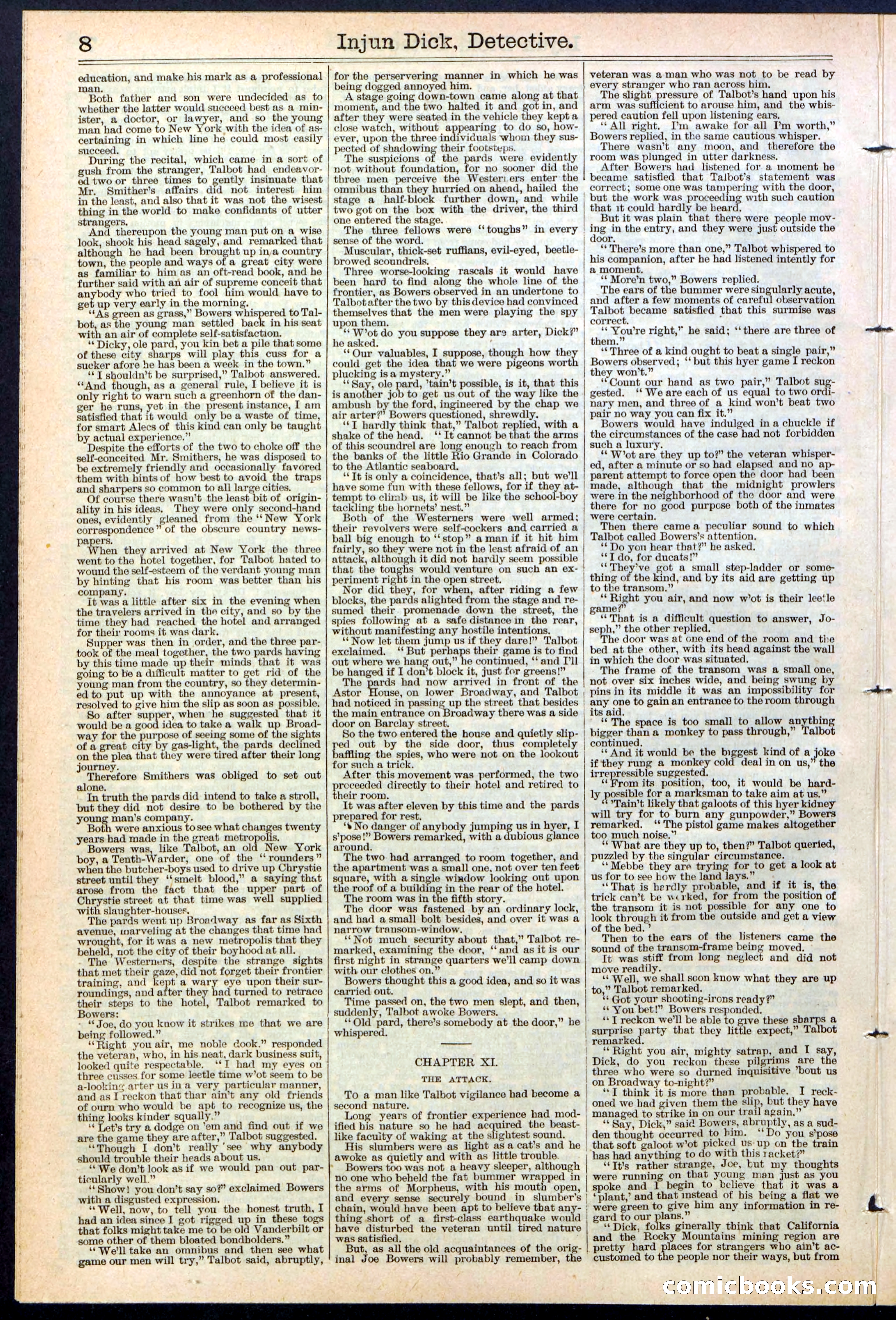
A restored page from Pulp Fiction, 1886. Page through the whole issue in the reader above.
📄 Transcribed text from this page (OCR, searchable)
Machine-transcribed from the original scan — historical spelling and the odd misread are preserved.
8 Injun Dick, Detective. education, and make his mark as a professional man. Both father and son were undecided as to whether the latter would succeed best as a min- ister, a doctor, or lawyer, and so the young man had come to New York with the idea of as- certaining in which line he could most easily succeed. During the recital, which came in a sort of gush from the stranger, Talbot had endeavor- ed two or three times to gently insinuate that Mr. Smither’s affairs did not interest him in the least, and also that it was not the wisest thing in the world to make confidants of utter strangers, And thereupon the young man put on a wise look, shook his head sagely, and remarked that although he had been brought up ina country town, the people and ways of a great city were as familiar to him as an oft-read book, and he further said with an air of supreme conceit that anybody who tried to fool him would have to get up very early in the morning, ‘“‘As green as grass,” Bowers whispered to Tal- bot, as the young man settled back in his seat with an air of complete self-satisfaction. “ Dicky, ole pard, you kin bet a pile that some of these city sharps will play this cuss for a sucker afore he has been a week in the town.” ‘¢T shouldn’t be surprised,” Talbot answered. ‘And though, as a general rule, I believe it is only right to warn such a greenhorn of the dan- ger he runs, yet in the adi instance, I am satisfied that if would only be a waste of time, for smart Alecs of this kind can only be taught by actual experience.” Despite the efforts of the two to choke off the self-conceited Mr. Smithers, he was disposed to be extremely friendly and occasionally favored them with hints of how best to avoid the traps and sharpers so common to all large cities. Of course there wasn’t the least bit of origin- ality in his ideas, They were only second-hand ones, evidently gleaned from the ‘‘New York correspondence” of the obscure country news- pares’ hen they arrived at New York the three went to the hotel together, for Talbot bated to wouud the self-esteem of the verdant young man by hinting that his room was better than his company. it was a little after six in the evening when the travelers arrived in the city, and so by the time they had reached the hotel and arranged for their rooms it was dark. Supper was then in order, and the three par- took of the meal together, the two pards having by this time made up their minds that it was going to be a difficult matter to get rid of the young man from the country, 80 they determin- ed to put up with the annoyance at present, resolved to give him the slip as soon as possible, So after supper, when he suggested that it would be a good idea to take a walk up Broad- way for the purpose of seeing some of the sights of a great city by gas-light, the pards declined on the plea that they were tired after their long journey. Therefore Smithers was obliged to set out alone. In truth the pards did intend to take a stroll, but they did not desire to be bothered by the young man’s company. Both were anxious tosee what changes twenty years had made in the great metropolis, Bowers was, like Talbot, an old New York boy, a Tenth-Warder, one of the ‘ rounders” when the butcher-boys used to drive up Chrystie street until they ‘‘smelt blood,” a saying that arose from the fact that the upper part of Chrystie street at that time was well supplied with slaughter-houses. The pards went up Broadway as far as Sixth avenue, warveling at the changes that time had wrought, for it was a new metropolis that they beheld, not the city of their boyhood at all. . The Westerners, despite the strange sights that met their gaze, did not forget their frontier training, and kept a are eye upon their sur- roundings, and after they bad turned to retrace their steps to the hotel, Talbot remarked to Bowers: - “Joe, do you know it strikes me that we are being followed.” “Right you air, me noble cook,” responded the veteran, who, in his neat, dark business suit, ‘for the perservering manner in which he was being dogged annoyed him. A stage going down-town came along at that moment, and the two halted it and got in, and after they were seated in the vehicle they kept a close watch, without appearing to do so, how- ever, upon the three individuals whom they sus- pected of shadowing their footsteps. The suspicions of the pards were evidently not without foundation, for no sooner did the three men perceive the Wester:ers enter the omnibus than they hurried on ahead, hailed the stage a half-block further down, and while two got on the box with the driver, the third one entered the stage. veteran was a man who was not to be read by every stranger who ran across him, The slight pressure of Talbot’s hand upon his arm was sufficient to arouse him, and the whis- pered caution fell upon listening ears. ‘*All right. Dm awake for all ’'m worth,” Bowers replied, in the same cautious whisper. There wasn’t any moon, and therefore the room was plunged in utter darkness. After Bowers had listened for a moment he became satisfied that Talbot’s statement was correct; some one was tampering with the door, but the work was proceeding with such caution that 1t could hardly be heard. But it was plain that there were people mov- The three fellows were ‘‘toughs” in every | ing in the entry, and they were just outside the sense of the word. Muscular, thick-set ruffians, evil-eyed, beetle- browed scoundrels, Three worse-looking rascals it would have been hard to find along the whole line of the frontier, as Bowers observed in an undertone to Talbotafter the two by this device had convinced themselves that the men were playing the spy upon them. ‘* W’ot do you suppose they ars arter, Dick?” he asked. : ‘‘Our valuables, I suppose, though how the could get the idea that we were pigeons wort plucking is a mystery.” ‘Say, ole pard, ’tain’t possible, is it, that this is another job to get us out of the way like the ambush by the ford, ingineered by the chap we air arter?’ Bowers questioned, shrewdly. ‘‘T hardly think that,” Talbot replied, with a shake of the head. ‘‘ It cannot be that the arms of this scoundrel are long enough to reach from the banks of the little Rio Grande in Colorado to the Atlantic seaboard. ‘Tt is only a coincidence, that’s all; but we'll have some fun with these fellows, for if they at- tempt to climb us, it will be like the school-boy tackling tbe hornets’ nest.” Both of the Westerners were well armed; their revolvers were self-cockers and carried a ball big enough to ‘‘stop” aman if it hit him fairly, so they were not in the least afraid of an attack, although it did not hardly seem possible that the toughs would venture on such an ex- periment right in the open street. Nor did they, for when, after riding a few blocks, the pards alighted from the stage and re- sumed their promenade down the street, the spies following at a safe distance in the rear, without manifesting any hostile intentions. ‘‘ Now let them jump us if they dare!” Talbot exclaimed. ‘‘ But perbaps their game is to find out where we hang out,” he continued, ‘*‘ and [ll be hanged if I don’t block it, just for greens!” The pards had now arrived in front of the Astor House, on lower Broadway, and Talbot had noticed in passing up the street that besides the main entrance on Broadway there was a side door on Barclay street. So the two entered the house and quietly slip- es out by the side door, thus completely affling the spies, who were not on the lookout for such a trick. After this movement was performed, the two peoseorse directly to their hotel and retired to heir room. It was after eleven by this time and the pards prepared for rest, ‘t No danger of anybody jumping us in hyer, I spose!” Bowers os Be j with a dubious glance around. The two had arranged to room together, and the apartment was a small one, not over ten feet square, with a single wiadow looking out upon the roof of a building in the rear of the hotel. The room was in the fifth story. The door was fastened by an ordinary lock, and had asmall bolt besides, and over it was a narrow transom-window. ‘‘Not much security about that,” Talbot re- marked, examining the door, ‘‘ and as it is our first night in strange quarters we'll camp down with our clothes on.” Bowers thought this a good idea, and so it was carried out, Time passed on, the two men slept, and then, suddenly, Talbot awoke Bowers. ‘**Old pard, there’s somebody at the door,” he whispered. A >, SS Sit door. ‘*There’s more than one,” Talbot whispered to his companion, after he had listened intently for a moment. ‘** More’n two,” Bowers replied. The ears of the bummer were singularly acute, and after a few moments of careful observation Talbot became satisfied that this surmise was correct. ; ‘* You're right,” he said; ‘‘ there are three of them.” ‘* Three of a kind ought to beat a single pair,” Bowers observed; ‘‘ but this hyer game I reckon they won't.” ‘Count our hand as two pair,” Talbot sug- gested. ‘* We are each of us equal to two ordi- nary men, and three of a kind won’t beat two pair no way you can fix it.” Bowers would have indulged in a chuckle if the circumstances of the case had not forbidden such a luxury. ‘Wot are they up to?” the veteran whisper- ed, after a minute or so had elapsed and no ap- parent attempt to force open the door had been made, although that the midnight prowlers were in the neighborhood of the door and were there for no good purpose both of the inmates were certain. Then there camea peculiar sound to which Talbot called Bowers’s attention. ‘* Do you hear that?” he asked. **T do, for ducats!” ““They’ve got a small step-ladder or some- thing of the kind, and by its aid are getting up to the transom.” fs Right you air, and now w’ot is their leetle ‘*That is a difficult question to answer, Jo- seph,” the other replied. The door was at one end of the room and the bed at the other, with its head against the wall in which the door was situated. The frame of the transom was a small one, not over six inches wide, and being swung by pins in its middle it was an impossibility for any one to gain an entrance to the room through its aid. ‘The space is too small to allow cag nite bigger than a monkey to pass through,” Talbot continued. ‘¢ And it would be the biggest kind of a joke if they rung a monkey cold deal in on us,” the irrepressible suggested. «Brom its position, too, it would be hard- ly possible for a marksman to take aim at us.” “*Tain’t likely that galoots of this hyer kidney will try for to burn any gunpowder,” Bowers remarked. ‘‘ The pistol game makes altogether too much noise.” ‘* What are they up to, then?” Talbot queried, puzzled by the singular circumstance. ‘*Mebbe they are trying for to get a look at us for to see how the land lays.” . “That is herdly probable, and if it is, the trick can’t be werked, for from the position of the transom it is not possible for any one to look through it from the outside and get a view of the bed. ’ . Then to the ears of the listeners came the sound of the transom-frame being moved. It was stiff from long neglect and did not move readily. ‘¢ Well, we shall soon know what they are up to,” Talbot remarked. ‘** Got your shooting-irons ready?” ‘“‘ You bet!” Bowers responded. ‘*T reckon we'll be able to give these ar a surprise sporty that they little expect,” Talbot remarked. ‘Right you air, mighty satrap, and I say, ener, pet LL LLL LLL LLL LLL LLL LDL LLL LLL sss Dick, do you reckon these pilgrims are the three who were so durned inquisitive "bout us on Broadway to-night?” “I think it is more than probable. I reck- oned we had given them the slip, but they have managed to strike in on our trail again,” ‘“‘ Say, Dick,” said Bowers, abruptly, as a sud- den thought occurred to him. ‘Do you s’pose that soft galoot w’ot } ger us up on the train has had anvthing to do with this racket?” “Tts rather strange, Joe, but my thoughts CHAPTER XI. THE ATTACK. To a man like Talbot vigilance had become a second nature. Long years of frontier experience had mod- ified his nature so he had acquired the beast- like facuity of waking at the slightest sound. His slumbers were as light as a cat’s and he awoke as quietly and with as little trouble. Bowers too was not a heavy sleeper, although | ! looked quite respectable, ‘‘I had my eyes on is three cusses for some leetle time w’ot seem to be Me a-looking arter us ina very particular manner, ie and as I reckon that thar ain’t any old friends i of onrn who would be apt to recognize us, the i thing looks kinder squally.” " ¥ ‘¢ Let’s try a dodge on ’em and find out if we hi. are the game they are after,” Talbot suggested. ! ‘“Though I don’t really ‘see why anybody f should trouble their heads about us. F ‘* We don’t look as if we would pan out par- ‘ ticularly well.” no one who beheld the fat bummer wrapped in | were running on that young man just as you : ‘Show! you don’t say so?’ exclaimed Bowers | the arms of Morpheus, with his mouth open, | spoke and 1 begin to believe that it was a i with a disgusted expression. and every sense securely bound in slumber’s | ‘plant,’ and that mstead of his being a flat we ft gard to our plans.” | ‘‘ Dick, folks ginerally think that California HA!) Mountains mining region are pretty hard places for strangers who ain’t ac- customed to the people nor their ways, but from chain, would have been apt to believe that any- | were green to give him any information in re- thing short of a first-class earthquake would have disturbed the veteran until tired nature was satisfied. ie ‘Well, now, to tell you the honest truth, I . had an idea since I got rigged up in these togs ¢ that folks might take me to be old Vanderbilt or hi. some other of them bloated bondholders.” ; “Well take an omnibus and then see what b game our men will try,” Talbot said, abruptly, | i 3 | | Gomichbooks.co | f an r ¢ ” = a * and the Rocky But, as all the old acquaintances of the orig- inal Joe Bowers will probably remember, the wz)